Business
Steal clearer thinking on money, markets, startups, and the decisions that separate hype from durable advantage.
Kanalen verkennen
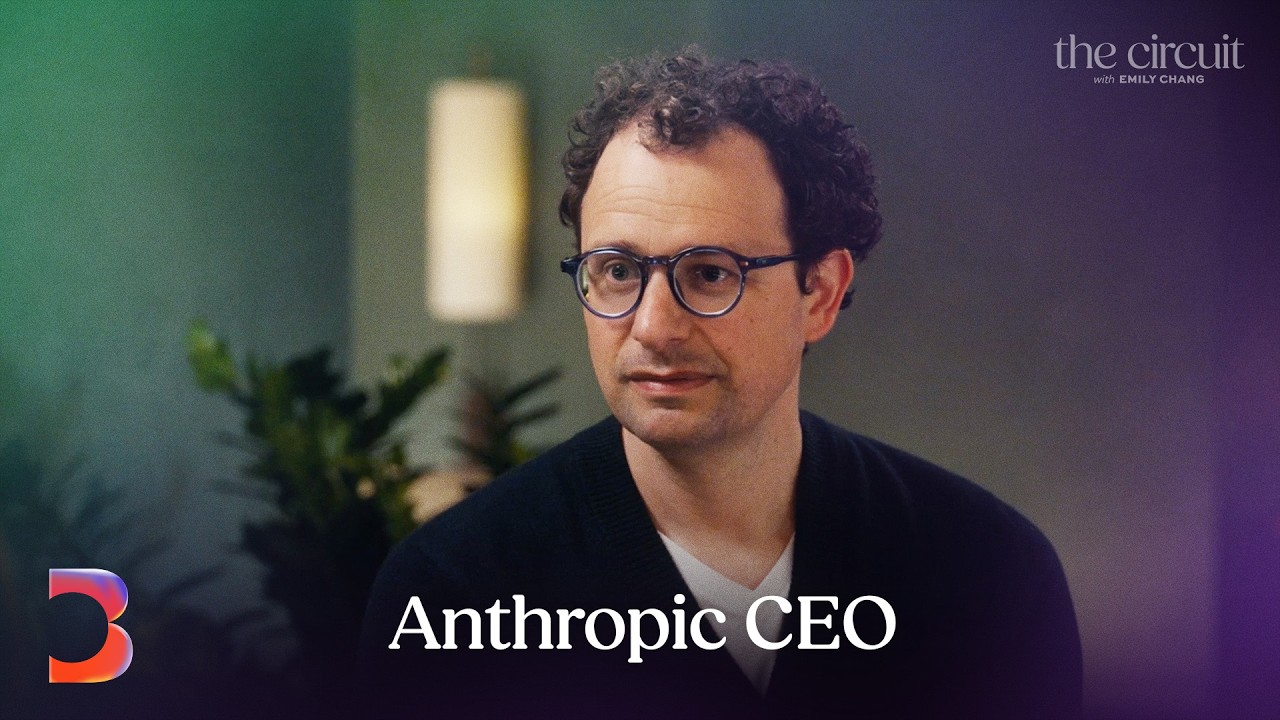
Inside the Mind of Anthropic CEO Dario Amodei | The Circuit | Extended Interview
Emily Chang sits down with Anthropic CEO Dario Amodei for a wide-ranging hour that swings from how he sleeps under "relativistic" pressure to why he signed a Pentagon contract despite a lifelong anti-war stance. Along the way he explains the bet on coding and enterprise that vaulted Anthropic past OpenAI, walks through a compute crunch driven by revenue tripling in a single quarter, and defends releasing — and withholding — a cyber-capable model called Mythos. He closes on the stakes he keeps returning to: AI job loss, the case against nationalizing AI, and his own 10-25% estimate of civilizational collapse. ## [00:00] Inside Anthropic Amodei opens on the personal cost of running a frontier lab, describing the pace with a special-relativity analogy: each day he "wakes up" to find more days have passed on the outside. He admits the pressure is unusual and that he is still learning to manage it. > *"Well, let's just say I'm, you know, I'm, I'm learning the art of, of, you know, finding ways to relax and sleep through, through moments of unusual pressure."* ## [03:34] Dario background He traces his San Francisco childhood — a leather-craftsman father, a librarian mother — and a kid who ignored the dot-com boom around him in favor of math, physics and science fiction. He credits the city with a culture of nonconformism that shaped how he thinks. > *"Yeah, I mean, I think the general, you know, the general spirit of kind of, you know, nonconformism and individualism and it's okay to be crazy."* ## [05:51] Leaving OpenAI Pressed on what really drove the split from OpenAI, Amodei says disagreements over safety alone never would have been enough — every lab has those. The break came down to trust and values, not any single policy fight. > *"And look, at the end of the day, why argue with someone when you don't have the same vision and you don't trust them."* ## [07:42] India AI summit On the viral moment where he and Sam Altman appeared to refuse to hold hands on stage, Amodei blames a chaotic, last-minute summit setup rather than personal animus. He reframes the OpenAI relationship less as a feud than as rivals who quietly borrow each other's good ideas. > *"It's not even competition, it's just, it's just, you know, each company does something cool and the other company's like, that's cool."* ## [10:45] Enterprise bet He explains why Anthropic leaned into coding and enterprise with Claude Code and Claude Cowork: a business model that funds expensive model training without betraying the company's values. The flip side, he warns, is that incumbents who refuse to adapt will struggle. > *"I think those who don't adapt, who put their heads in the sand, who don't kind of see what's coming, who don't identify the moats they have, they're gonna have a really hard time."* ## [19:29] Compute crunch Amodei pushes back on the idea that Anthropic under-bought compute. The team planned for 10x annual growth; instead revenue grew more than 3x in a single quarter — a pace that would annualize to roughly 80x, which he says no one could rationally have provisioned for in advance. > *"It would not have been rational to plan for 80x annualized growth, because that means if you only get 10x, you know that you, you have eight times less."* ## [21:15] Surpassing OpenAI Asked whether passing his arch-rival feels good, Amodei downplays the scoreboard and returns to his "race to the top" framing: the point of being preeminent is the ability to pull the rest of the ecosystem toward better behavior, not to beat rivals for its own sake. > *"And so I think the value of being the preeminent company, both commercially and in terms of models, you know, it's, it's not about beating rivals for the sake of beating rivals."* ## [24:07] Product velocity He attributes Anthropic's shipping speed to two things: a culturally unified, efficient organization, and Claude itself, now used internally to help build and accelerate the next models. > *"That we're now using Claude to help, you know, develop our models and, you know, make them more efficient and quickly develop products."* ## [24:52] AI discoveries The most striking results he's seen are in biology and medicine — including a case where Claude caught a diagnosis human specialists had missed — and early strength in drug design and computational chemistry. This, he argues, is where AI's enormous upside lives. > *"I've seen a number of cases, including Daniela actually, where Claude diagnosed a medical problem that, you know, a bunch of fancy doctors had missed."* ## [26:13] Dario’s writing style A committed essayist, Amodei says he still won't let Claude write his prose directly — he's too particular about style — but uses it to brainstorm, pressure-test themes and hunt references. He worries aloud about what we lose if we stop struggling through our own ideas. > *"There's some way, as the models get better, I think probably to, to use them directly much more directly in the writing and yet still preserve those benefits."* ## [28:10] AI and the workforce Revisiting his warning that AI could wipe out half of entry-level white-collar jobs, Amodei says the original point was about the magnitude of possible disruption, not a precise forecast — and that he's always paired it with proposed responses, from a token tax to macro policy. He points to emerging hybrid roles as one way work adapts. > *"You know, there's something we call a forward deployed engineer or in like applied AI solutions architect where their job is a mix of technical work and talking to customers."* ## [36:41] Pentagon standoff He defends signing one of the first DoD contracts to run on classified networks despite a longstanding anti-war stance, citing a resurgent authoritarian bloc — Russia in Ukraine, the risk of China and Taiwan. His line: Anthropic won't deny the technology over individual operations it might privately disagree with. > *"Now, I might privately believe that this military operation makes sense and that military operation is a bad idea, but we're not gonna deny the technology."* ## [43:29] AI warfare Confronted with a reported strike that killed children, Amodei says the company can't know exactly how its models are used, calls such outcomes terrible, and stresses the red lines Anthropic enforces. The core principle he defends: a human, not the model, makes the final call. > *"But you know, the principle that, that we have established, and I think the principle that was obeyed here is a human makes the human makes the final decision."* ## [48:18] Mythos On the model deemed too powerful to release, Amodei describes a sharp, unprompted jump in the ability to find vulnerabilities and turn them into working exploits — to the point that early testers called it a weapon. > *"It was a particularly large jump and without us really prompting them at all, some of the early companies that we gave this to said things like, this is a super weapon."* ## [55:15] Nationalizing AI Amodei takes the "why not let the government take you over" question seriously but argues against it, noting AI is the first powerful technology built in the private sector rather than government labs. He's wary of those who opposed all regulation until the first scare, then pivoted to seizure. > *"And then as soon as they see the first real danger, which I've been expecting all along, there's all this talk of like nationalization and the government should just seize it."* ## [58:57] Visit to the White House He describes Anthropic's approach to government as principle-driven and cooperative where possible, citing serious engagement on Mythos with Treasury Secretary Bessent and Chief of Staff Susie Wiles, while accepting that every administration has parts easier and harder to work with. > *"You know, I, I I said we have this simple approach, like we have a set of principles, we like follow those principles and we hope that folks on the other side are reasonable."* ## [59:47] China Drawing on his time at Baidu, Amodei frames Chinese open-source models through the lens of an intelligence premium — users rarely prefer weaker models — and warns of the authoritarian risk if the CCP can reach into US networks. He'd rather AI become a pro-democracy technology. > *"The fact that the CCP could reach into the US business network and, you know, and suppress criticism, that's an authoritarian state and, and a high tech authoritarian state."* ## [63:24] Recursive self-improvement He rejects the idea of a single moment when AI starts improving itself, describing instead a continuous, accelerating process already visible in AI suggesting architectures for the next AI. Sudden reversals on policy, he says, signal people who were caught off guard. > *"If you see someone having this kind of crazy yo-yo reaction, that's a sign that they were caught by surprise and that they're not serious."* ## [65:07] Dario’s favorite book Amodei identifies less with Oppenheimer than with Leo Szilard, who first grasped the chain-reaction idea, and casts Oppenheimer as a cautionary tale. His takeaway: no larger-than-life figure should be at the center — what's needed is checks and balances among many powerful actors. > *"There's a lot of powerful actors who have interests here, and the only way it's gonna end well for everyone is if there is some, there's basically checks and balances everywhere."* ## [65:49] Civilization collapse Asked whether Anthropic's own technology could trigger the 10-25% collapse risk he cites, Amodei says he hopes not and argues the company's actions lower that probability more than they raise it — while conceding the risk can never reach zero given the technology's inherent unpredictability. > *"You know, half of what we do within the company is try and, you know, reduce the risk as much as we can, but, you know, it's, it's never gonna be zero."* ## [67:32] Trust Closing on "why should we trust you," Amodei accepts that starting from distrust is rational given Silicon Valley's recent record, and argues trust has to be earned through actions — pointing to the commercial cost Anthropic ate by holding back Mythos and cutting model access over China. > *"And there were a bunch of smaller things before it, you know, we, we, we put our money where our mouth is on, you know, China, we cut off access to, to models."* ## Entities - **Dario Amodei** (Person): Co-founder and CEO of Anthropic; former biologist and OpenAI VP of research. - **Emily Chang** (Person): Bloomberg anchor and host of *The Circuit*, conducting the interview. - **Daniela Amodei** (Person): Anthropic co-founder and president; cited in a Claude medical-diagnosis anecdote. - **Sam Altman** (Person): OpenAI CEO, referenced over the India summit and the labs' rivalry. - **Leo Szilard** (Person): Physicist who conceived the nuclear chain reaction; the figure Amodei most identifies with. - **Anthropic** (Organization): Frontier AI lab behind Claude, maker of the withheld Mythos model. - **OpenAI** (Organization): Rival lab Amodei left and which Anthropic claims to have surpassed. - **Claude** (Software): Anthropic's model family, including Claude Code and Claude Cowork, used internally to accelerate development. - **Mythos** (Software): Anthropic model judged too powerful to release publicly due to autonomous cyber-exploit capability. - **Pentagon / Department of Defense** (Organization): US defense agency at the center of the classified-networks contract standoff.
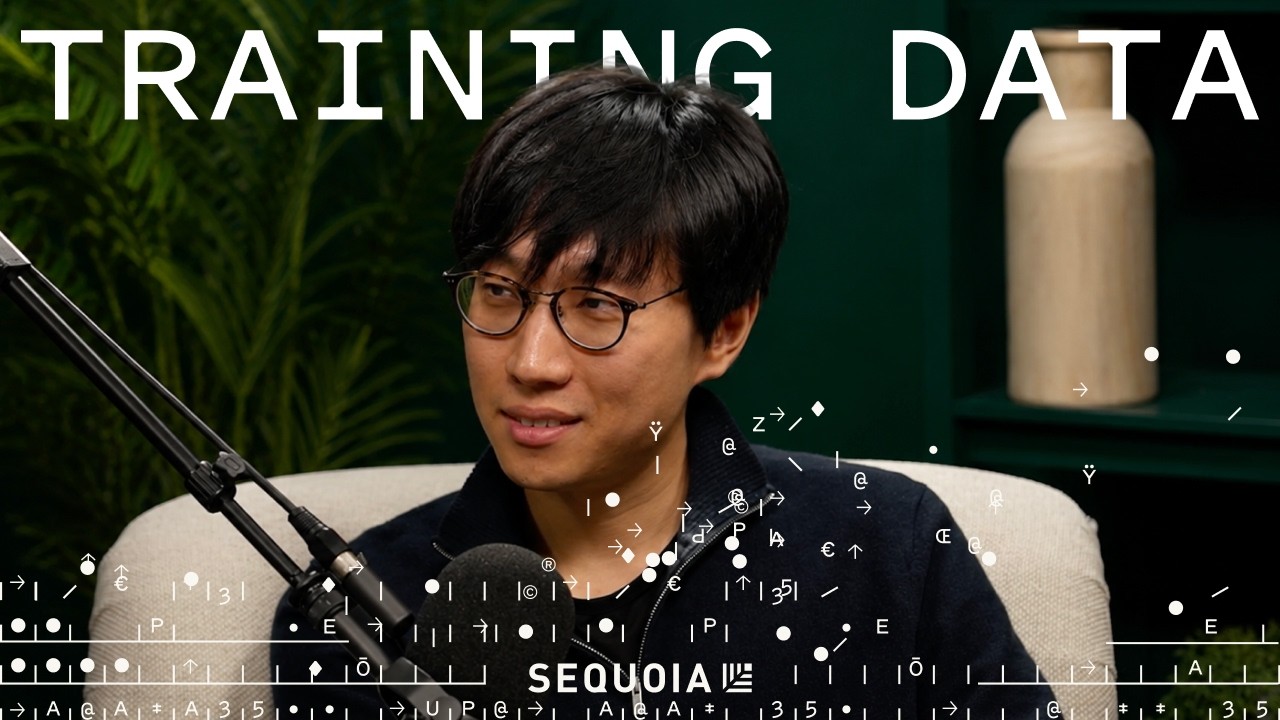
Simulating Humans at Scale: Simile's Joon Sung Park
Joon Sung Park, founder and CEO of Simile and creator of Stanford's Smallville generative-agents study, walks Sonya Huang through the arc from a 25-agent game town that spontaneously threw a Valentine's party to a company that simulated 1,000 Americans and predicted their answers 85% as accurately as the people reproduced their own. His core argument: today's frontier labs are building the "CPU of intelligence" — rational machines superhuman at problems with right answers — while simulating real human society needs the opposite, a model that encodes people's irrational values, preferences, and taste. CVS uses it for concept testing; some customers simulate their own earnings calls; and Joon's longer bet is a "CERN of human society" that could one day model bank runs, climate cooperation, or the early signals of a collapsing democracy. ## [00:00] Inside Smallville: 25 agents throw a Valentine's party The conversation opens on Joon's conviction — that science fiction's advanced societies always rest on two pillars, "some version of AGI and some version of simulations that really help guide the society" — before Sonya takes him back to Smallville, the April 2023 Stanford project that made his name. The setup was 25 generative agents, each given a persona and equipped with memory, planning, and reflection, then left to live in a small game town: wake up, do routines, go to work, form relationships. What surprised the team was emergent coordination. Isabella, a café owner, decided to throw a Valentine's Day party, spent the day before gathering materials and inviting customers, and on the day itself the party actually formed. > *some of the agents did not explicitly get invited, but we had one agent who got the invite, Claus, who decided to ask his crush out on a date* ## [03:34] From a foundation-models paper to simulating a subreddit Joon traces the origin back to 2020, the year GPT-3 was about to land. As a Stanford researcher he co-wrote the "Opportunities and Risks of Foundation Models" paper, and the part that gripped him was not that the models could classify or generate — interaction researchers had done that for years — but that they could encode human behavior. Coming out of the social-computing tradition, he saw a long-standing hole: there was no way to test how millions of people would behave on a platform short of shipping it and watching what happens, sometimes at real cost. That led to the 2022 Social Simulacra paper, the precursor to generative agents, which populated a simulated subreddit with thousands of personas to let a designer see community dynamics before launch. > *The only way we test it today is you basically field test it. You release your prototype, see what happens.* ## [07:57] The CPU of intelligence can't model irrational humans Asked when models got good enough for a faithful representation of society, Joon marks the path from GPT-3 — janky, no instruction tuning, needing prompt tricks just to follow orders — to today's foundation level where these applications become imaginable. But he draws a sharp limit. The frontier labs' north star is a rational, superhuman machine optimized for objective problems, and that is the wrong target for simulating people. As accuracy on objective benchmarks climbs, the ability to predict and simulate human behavior diverges, because people are not rational. > *We have a lot of subjective values, preferences, and taste.* ## [10:04] Why this became a company, not another paper Joon distinguishes the two vehicles bluntly: research is built for breadth, where each researcher owns a slice of thesis and is "not necessarily known for finishing our job," while a company is built for depth on a single conviction. The pull toward a company came roughly half a year after the generative-agents paper, first from social scientists wanting to run RCTs on the platform, then from Fortune 500 boards and CEOs who saw the demo at Stanford and asked whether the surveys and market questions they could never answer might run in simulation. Before committing, the team validated accuracy: simulations of 1,000 people across the US population. > *we can actually predict people's behaviors 85% as accurately as people replicate their own* ## [12:43] How a Simile engagement works — and the say-do gap Simile's first major customer is CVS, brought in by a senior VP of human insights who had read the validation paper and felt bottlenecked by how few questions he could field-test. The workflow mirrors how firms already use polling and panel companies: a customer names a population they want to understand, and Simile — through a strategic partnership with Gallup — reaches real humans, asks the magical 15-minute questions, and turns that data into agents that answer far beyond the original survey. Sonya pushes on why an LLM alone can't just role-play a 34-year-old woman from a coastal metro. Joon's answer is the say-do gap: models are trained on what people said online, not what they actually do, and closing that gap requires behavioral data — RCTs, pricing studies, and life-story interviews that surface the long-tail of a person. > *There are things that people say and then there are people there are things that people actually do and the gap there is real* ## [20:27] The GPU of intelligence: from concept tests to earnings calls Here Joon gives the framing that anchors the company. Today's models are the CPU of intelligence — one model trained on rational data, superb at objective questions. Simile is building something closer to the GPU: not superhuman, but as human as possible, where individual subunits represent the real viewpoints of different populations. Customers usually enter through a concrete door — concept testing, where instead of testing 5 to 10 ideas they imagine testing a thousand ideas across a thousand sub-populations — then move toward product testing with a temporal dimension and multi-agent simulation. One recurring and initially surprising ask: simulate the company's own earnings call to see how the audience reacts. > *imagine the current today's model are akin to the CPU of intelligence unit* ## [26:32] How accurate is it? Convergence versus divergence On evaluation, Joon starts from the theoretical limit — humans answer the same question slightly differently each time, so perfect prediction is impossible — then describes the metric: total variation distance between the ground-truth and simulated response distributions, with a TVD under 0.15 treated as strong enough for decisions. The deeper idea is two categories of simulation. Convergent ones tolerate compounding error because the pull toward an outcome is strong — like a network always forming a hub, the scale-free structure that powered PageRank. Divergent ones — was World War I inevitable, who wins an election — can't be expected to repeat, so the evaluation shifts to confidence: run it 100 times, see how often outcome X appears, and show the diversity of possible futures. He likens the work to the early days of inferential statistics setting the p < 0.05 threshold. > *was World War I inevitable or was it not?* ## [31:56] A CERN for human society Sonya raises the grander possibility — that fields like macroeconomics, which she sees as human behavior at scale, might one day be partly solved by simulation, including the venture question of where value accrues across the AI stack. Joon agrees there is "a Nobel Prize to be won there," recalling how Thomas Schelling's deliberately crude agent-based segregation models revealed something deep about macro behavior. The augmented version replaces red-dot/blue-dot agents with agents that replicate the full richness of individuals, opening questions economists actually asked him: when does a bank run happen, can nations be modeled solving climate's collective-action problem, what are the early signals of a democracy about to collapse. He imagines a simulation that costs $100 million and months to run once but answers a fundamental question — a Hubble telescope for human society. > *building simulator that's akin to the CERN of human society* ## Entities - **Joon Sung Park** (Person): Founder and CEO of Simile; created Stanford's Smallville generative-agents study and co-authored Social Simulacra. - **Sonya Huang** (Person): Partner at Sequoia Capital, AI investing; host of the conversation. - **Simile** (Organization): Applied AI lab building models that simulate human behavior and societies for concept testing, product testing, and multi-agent scenarios. - **Smallville** (Concept): 2023 Stanford experiment with 25 generative agents living in a game town, known for emergent behavior like a self-organized Valentine's party. - **Social Simulacra** (Concept): 2022 paper simulating a subreddit with thousands of personas; precursor to generative agents. - **Say-do gap** (Concept): The difference between what people say (the basis of LLM training data) and what they actually do, which behavioral data is collected to close. - **CPU vs GPU of intelligence** (Concept): Joon's framing — frontier labs build a rational "CPU" superhuman at objective problems; Simile builds a "GPU" encoding the diversity of human values and taste. - **Total variation distance** (Concept): Simile's accuracy metric comparing ground-truth and simulated response distributions; TVD < 0.15 treated as decision-grade. - **CVS** (Organization): Simile's first major customer, using it for concept testing via its human-insights team. - **Gallup** (Organization): Polling and panel partner Simile uses to reach real humans and ground simulations in real data.
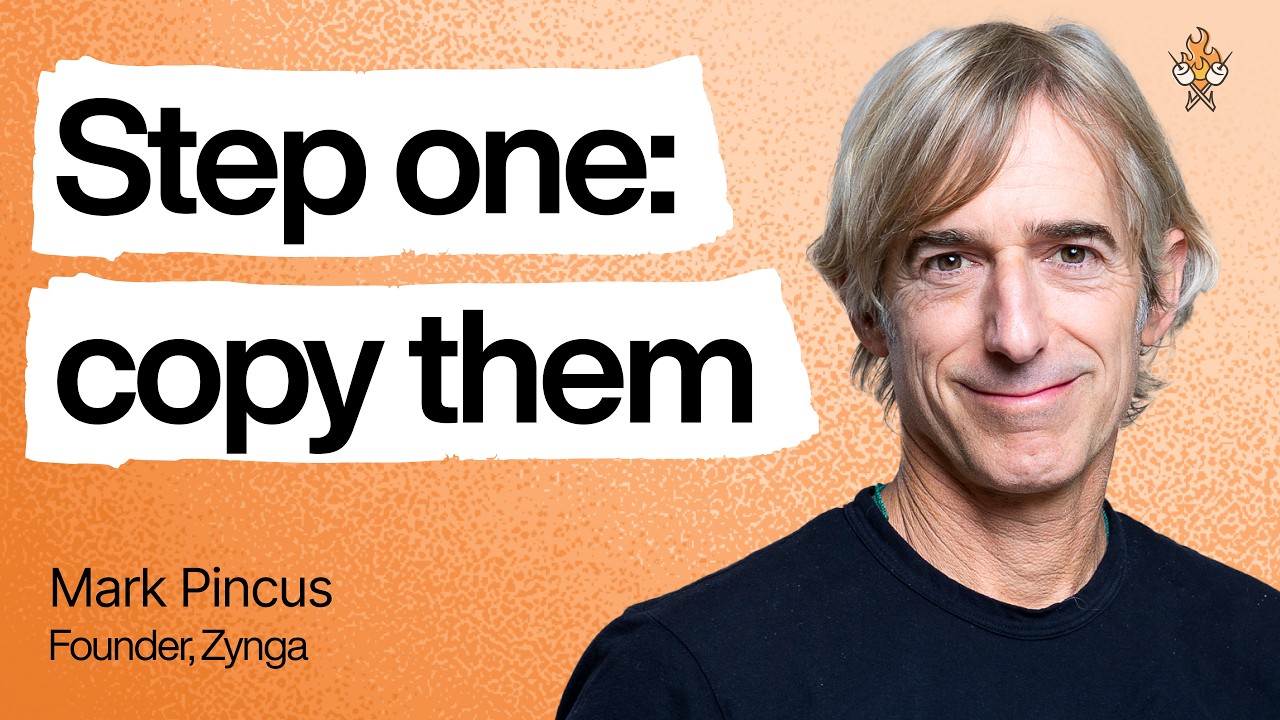
The hidden pattern behind successful products | Mark Pincus (FarmVille, Words with Friends, & more)
Mark Pincus built eight massive hit games out of ten launches at Zynga — FarmVille, Words with Friends, Zynga Poker among them — and spent five years distilling the pattern behind that record into a book, *Life at the Speed of Play*. The core idea: your instincts are right 95% of the time but your ideas are wrong 75% of the time, so a good framework doesn't generate ideas — it filters them. That framework is Proven Better New: nail what's already working on your platform, make one thing 10-out-of-10 users would say "f*** yes" to, then add exactly one unproven bet. The conversation also covers why radical ambition demands embarrassingly small starting points, how to use AI as a failure machine rather than a speed-to-market tool, and what makes consumer social the biggest untapped opportunity on the internet right now. ## [00:00] Introduction to Mark Pincus Lenny opens with a rapid-fire preview of Mark's most quotable lines — burn your resume if you're truly ambitious, your instincts are right but your ideas are wrong, kill hope before hope kills you — before introducing him as the founder of Zynga and author of *Life at the Speed of Play*, out June 23. Sam Altman's blurb for the book frames the stakes: in the AI era, the only bottleneck to great products is knowing what to build, and Mark has thought about that longer and harder than almost anyone. > *"If you're truly ambitious, burn your resume."* ## [02:46] The Proven Better New framework overview Mark traces the framework back to Zynga's early culture, where it became a "religion" for product management. The engine: isolate your innovation zone (the gut instinct), separate it from the ideas you layer on top, and use Proven Better New to test many ideas around that instinct rather than betting everything on one. He illustrates with Sid Meier's failed Facebook social strategy — even the godfather of game design sank because his first-time user experience didn't copy what Zynga's most junior PMs already knew was best-of-breed. His innovation never got seen because he skipped the Proven step. > *"Your instincts are right 95% of the time. Your ideas are wrong 75% or at best right 25% of the time."* ## [07:29] Earning the right to innovate You can't skip Proven and go straight to New. Mark's framing: if you're building an AI camera, you haven't earned the right to innovate on the camera until you are the world's leading PhD on the best mobile cameras that already exist. Get that PhD first — copy legally and with taste — then and only then does your actual innovation have a chance to be seen. > *"We haven't earned the right to innovate on the camera until we are the world's leading PhD on the best mobile cameras that already exist."* ## [08:30] What "better" really means Better is not what you think is better — that's actually New. Better is an increment that every existing user of the product would confirm as an improvement: it's free, it loads faster, the polish is there. Words with Friends was Scrabble as the Proven base; the Better was mobile polish so clean that 14 million people played daily when Scrabble itself never reached that; the New was the Facebook social graph already populated with your real friends. Mark's test: 10 out of 10 users say "f*** yes." Anything short of that is a New, not a Better — and New probably fails. > *"Better is something that 10 out of 10 of the existing users of that product would say f*** yeah."* ## [12:03] Quick summary of the framework Lenny synthesizes: Proven = list what's already working and loved on your platform; Better = one improvement so obvious that every existing user would switch immediately; New = one unproven bet nobody's tried. He runs the iPhone and iPod through the lens — music player → better hardware and interface → social distribution — and notes that most successful products follow this pattern whether their makers called it that or not. > *"Most products are better versions of things that existed before."* ## [12:40] Examples of the framework in action Mark was at the TED conference when an MIT team demoed their touchscreen on a giant whiteboard. Steve Jobs spent the whole time there, obsessing over the touch interaction. The observation: Jobs' only true New idea in the iPhone was the touchscreen — everything else was Proven Better applied to an existing phone. > *"Like, okay, there's his new idea — it's a touch screen. It's his only new idea."* ## [13:30] How to use proven correctly on your platform Founders misuse Proven by pointing at something popular from a different era or platform and calling it "proven." Proven only counts on this platform, for this audience, for this experience. Slack is Mark's favorite example of Proven Better with almost no New at all — it took workplace chat that people already did over email and IRC, made it radically more accessible, and that was enough. Sometimes no New is even better: people don't like change, so if you can make a behavior they already love more fun or accessible, they'll love you for it. > *"I don't want to sound anti-innovation, but people don't like change."* ## [15:13] The moral arbitrage of copying There's a moral resistance to copying baked into how founders think — school taught them copying is cheating, and becoming a founder meant becoming an innovator. Mark calls this "moral arbitrage" in Peter Thiel's sense: that resistance makes the copying opportunity more available to founders willing to put ego aside and define their ambition through their consumer's eyes, not their peers'. His line to Zynga product teams: you're trying to win the hearts and minds of nurses in Indiana for Farmville, not win awards from your Silicon Valley cohort. If you take something she loves and make it one inch better, she'll love your version more than a blank-whiteboard innovation she didn't know she wanted. He also draws the contrast between Nikita Bier (found a buried feature in an Arabic-only app, built TBH around it — that's gold) versus Angry Birds (45 completely different games, no learning across iterations, 44 failures before the one hit — that's wildcat drilling). OMGPop made Draw Something by ruthlessly copying Zynga's turn-based system from Words with Friends after their own innovative game flopped. The hit came from the copy, not the original idea. > *"If you're truly ambitious, burn your resume. Define your ambition in the eyes of your consumer, not your peers."* ## [23:55] Be less ambitious The paradox: the more ambitious you are, the humbler your starting point should be. Facebook started as a tool to check out classmates at Harvard. Zynga started as a poker game on Facebook — Mark was 41, a multi-time successful founder, and people thought he had lost his dignity. But that embarrassingly small starting point was the key. After his Tribe social network failed because he tried to do everything at once, he needed to get to any product-market fit and dropped his altitude from 100,000 feet to 1,000. First-time founders have an advantage here: they can't raise money on a big vision yet, so they're forced to stay humble. Multi-time successful founders have too much rope to hang themselves. > *"The paradox is the more ambitious you are, the more humble you should be and the smaller place you should be willing to start."* ## [28:25] The Bolt.new story and staying humble Bolt.new as the modern version of this: the team toiled in obscurity building a web-stack virtual machine, barely kept commercial development going, open-sourced it, then realized that adding their VM to an AI coding co-pilot created something genuinely better than any alternative. They were passionate about one thing, stuck with it, and the breakout came from that focused humility. Slack is the same arc: Stewart Butterfield kept trying to build mass-market MMOs, got humbled by that difficulty, noticed that the internal tool his engineers used was actually the product, and pivoted. Mark's point: it takes a really attuned, curious, humble founder to call that ball when investors and team are all pointed in the other direction. > *"It really takes a really attuned, curious, humble founder to call the ball on that."* ## [33:15] Kill hope before hope kills you Hope is confidence without basis — not founded in lived experience with the product, not in data, just a prayer that the next release does something magical. Belief is different. The best product makers are collecting winnings, not making bets — they already know they have a hit before they launch. Mark draws the distinction between an MVP (minimum viable product, where "viable" is where hope lives) and an MLP (maximum launchable product, where you believe, not hope, that it's a hit). AI makes this more dangerous, not less: it lets teams get to a viable product in three months instead of three years, which accelerates the speed at which founders can fool themselves into thinking viable equals ready. > *"Kill hope before hope kills you. There's a difference between belief and hope. Hope is confidence without basis."* ## [37:00] Using AI as a failure machine What Mark expected AI to produce: testing machines that run a hundred ideas a week instead of one idea per quarter. What he actually sees: teams using AI to build one idea in three months, only faster. The right mental shift — build it completely wrong before you know it's the right product. If you believe it's wrong, you won't waste three months perfecting the wrong thing; you'll build the cheapest version that gives you signal. He illustrates with a Zynga FarmVille expansion pack story: instead of spending a $10 million ad budget on "coming soon" banners, they put locked art variants on the game board for existing players, measured which got most clicks, and ended up selling $19 million worth of early-access keys — turning what would have been afterthought advertising into product direction plus revenue. > *"The way we should be using AI is as a testing machine, a failure machine."* ## [40:08] Why Zynga's games succeeded (it wasn't virality) Farmville and CityVille became associated with spam in users' Facebook feeds, so many founders assume Zynga's secret was aggressive virality. Mark pushes back: the real engine was retention, not virality. Zynga tracked Day 365 retention — something Mark believes no other consumer company does today — and built toward it. The metric that actually predicted retention was ASN (Active Social Network): how many round-trips did a player complete with another player? Going from zero to one ASN meant an 80% chance of seeing that player the next month; reaching four ASN meant an 80% chance of seeing them 22 out of the next 30 days. The second engine was social dimensionality — the games let people invest, express, and connect. Middle-aged women didn't just play Farmville alone; they co-op-farmed with real friends, gifted each other in-game items, and felt creative in a way their lives outside the game didn't offer. Virality was a byproduct, not a strategy. > *"It wasn't that we were good at virality. We were focused on two things we did better than anybody else."* ## [48:36] The future of consumer social apps Nothing is working in consumer social right now, and founders have largely given up on it. Mark's read: there is still massive latent demand — we want to be social — but existing platforms have lost the adrenaline. When people quit Instagram their NPS goes from +35 to -35; they feel like they just quit smoking. The platforms shifted from social productivity (Facebook let you stay in the loop with 300 friends in minutes) to time-wasting engagement optimization (Instagram got TikTok envy). The opportunity: whoever finds the new step function of social productivity for the agentic AI era will find gold. Mark frames it as the "cocktail party" instinct — you know when you're at a great cocktail party because you feel "I'm so glad I'm here" and you're leaving with great leads. Facebook, LinkedIn, and even Zynga's games were cocktail-party experiences at different scales. Today everyone's hanging out with their Claude or GPT, but there's no cocktail party. The Easter egg: figure out how to make that cocktail party rowdy and socially productive. > *"Today, we're all hanging out on our Claude, on our GPT, but there's no cocktail party."* ## [57:05] How to know if your product is a B The dating analogy: when you're with the right person, you know — you're not asking, "Could this be the one?" If you're asking whether your product is an A, it's not an A. When you have lightning in a bottle, everything works: you're addicted to it, friends love it, metrics confirm it. Nobody asked whether GPT was it. The hard part is what to do once you've named it a B+: can you be intellectually honest enough to call it, and then use it to learn rather than just killing it? Mark pulled the plug on his "Earth" metaverse project after four years and $25 million — and in the two weeks since has felt more inspired than at any point in those four years. > *"If you're asking whether or not your product is an A, it's not an A."* ## [61:25] Distribution in the age of AI Mark's first move is to ask whether AI is a new platform — and his current answer is no, not yet. It's an important technology and a new kind of portal (the chat interface), but it's not a hardware platform and it's not yet a platform that opens distribution the way mobile or social did. We're still in the mobile and web era. App install rates are near zero. Forty thousand new games launched in the App Store last year and zero became top-ten hits. Distribution has to be baked into product strategy from day one, not treated as something you figure out after build. His more forward-looking bets: build for pro-sumers and whales first (people who care enough to find you and pay early). Watch the token cost curve — if tokens trend toward free in two years, there are consumer services that only make economic sense at free-token prices, and building toward that now is an interesting innovation zone. His favorite Easter egg: an AI-native travel agent that's always on, knows your context, and actively manages your trip when things go wrong. That service has always had latent demand but never had a viable economic model — free tokens could change that. > *"Distribution has to be part of your product and part of baked into the strategy deeply and proven from the beginning."* ## [75:39] Make everyone a CEO Mark hates managing people. Every day spent managing is a day away from product. His escape: give people a hill to take and make them a real CEO of it — operating control, degrees of freedom, their own plan and budget, then get out of the way. He found two things: he didn't have to manage them anymore, and a certain kind of person (the frustrated expert witness who's a bit of a know-it-all and has pent-up demand to prove they were right) becomes incredibly motivated. Brian Armstrong's "everyone is an individual contributor" push at Coinbase is the Silicon Valley version of the same idea — the best CEO is the best player at the position, doing the thing they're great at rather than wasting time on management hierarchy. > *"All of management is just how do we get people to do the right thing when we're not in the room."* ## [78:18] Stay close to the metal Early in a career you're in the trenches, closest to the data and probably to the right answer, but furthest from the decision — that's the expert witness syndrome. When you become a CEO, the trap is drifting away from the metal: delegating the most important UX and product decisions to the least experienced people while you do investor relations. Discord's founders realized they were doing exactly that and inverted the pyramid, making the founders the first and last mile for product decisions. Steve Jobs picked out carpet in conference rooms. Bezos and Zuck spent two days a week deep with specific teams on the things that mattered most. If you're the best product maker in the company, the team needs you on the field, not in the stands. > *"I believe the best product CEOs are in the minutia of the details."* ## [81:35] Why Mark says micromanagement is beautiful At Zynga up to 50 employees, Mark ran a daily standup that went two hours, tracking every name in a spreadsheet with what they were supposed to do yesterday and what they'd do today. Brutal, but effective. The framing: be in the room as much as you can for as long as you can. Only delegate when you physically can't be in all the rooms simultaneously. All management principles are just strategies for getting people to do the right thing when you're not there — so minimize how often you're not there. He notes it was more controversial twenty years ago; today, with founder-led product culture being normalized, "micromanagement is beautiful" lands closer to conventional wisdom. > *"If you can be in the room, be in the room — assuming that you are the best player."* ## [83:35] The expert witness How do you transfer the vampire blood — your passion and approach to the product — to other people? Two mechanisms. First, the teaching hospital: put as many people as possible in the room while you do product management, let your methodology spread through proximity. Second, the tech assistant: pull one person from the ranks to shadow you for six to twelve months, give them projects to test them, then place them in a much bigger role. Andy Jassy ran the program at Amazon — everyone on the S-team had been Bezos's tech assistant at some point, so it scaled the founder's judgment across the entire leadership layer. > *"How do you pass the vampire blood of you to other people?"* ## [85:05] The number one job of a CEO is to be right Stolen from Bezos, and Mark endorses it fully: if he could only pick one thing for a CEO to be, it's right. Right about the product, the strategy, the bet. Phenomenal execution in the wrong body of water gets you nowhere — being in the right body of water matters more than having the right boat. He applies it to hiring too: the best resume is a track record of being right, not a track record of charisma or management style. He'll take misfits who are right over polished managers who aren't. > *"Being in the right body of water matters more than the right boat."* ## [86:35] What Mark is teaching his five kids Mark has five children — twins, a special-needs son, a one-year-old with a gene mutation, and a four-year-old — and describes parenting as his greatest role. Three principles he applies. First, meet them where they are: not talking down to them as kids, not treating them as miniature adults, but finding their actual altitude and engaging human-to-human from there. He taught his twins math through the pandemic and discovered he'd taken them through eighth-grade material without realizing it, because he started from their natural curiosity rather than the curriculum. Second, critical thinking over knowledge accumulation: factory-produced education trained knowledge workers, and knowledge working is going away. He tells his kids "I don't care if you go to college — I care that you develop critical thinking and find a way to be useful to people." Third, be generative, not consumptive: what can you create online or offline rather than passively consume? His daughter Carmen, who has ADHD and dyslexia, turned that into a sweatshirt brand (Comfy Fancy) and a community for neurodivergent middle-schoolers (Neurosparkley). > *"I'm trying to teach them to ask better questions, not know more answers."* ## [95:14] Mark's "why" It took Mark until he started Zynga at 41 to identify and articulate his why: to build an internet treasure — a service people can't remember life before or imagine life without. His friend Bing Gordon says those treasures will end up in the Smithsonian one day. Mark's still rubbing sticks together because he hasn't built his thing yet, and that's what keeps him going. > *"I want to create an internet treasure — a service we can't remember life before or imagine life without."* ## [97:08] Mark's new book: Life at The Speed of Play *Life at the Speed of Play* synthesizes Mark's thirty-year playbook for building products people love. He describes it as intentionally easy and fun to read — bite-sized, not long — and says his goal is for founders to steal from it and take the ideas further. He frames this podcast conversation as itself part of the cocktail party of product-making philosophy, a shared craft that all builders are collectively advancing. > *"I'm hopeful that somebody will steal from my ideas and take it further and we're all kind of in a conversation."* ## Entities - **Mark Pincus** (Person): Founder of Zynga (FarmVille, Words with Friends, Zynga Poker); author of *Life at the Speed of Play*; known for Proven Better New product philosophy - **Lenny Rachitsky** (Person): Host of Lenny's Podcast; founder of Lenny's Newsletter; former Airbnb PM - **Zynga** (Organization): Social games company founded by Mark Pincus; created eight top-ten hits including FarmVille, CityVille, Words with Friends, and Zynga Poker - **Proven Better New** (Concept): Mark's product framework — copy what's proven on your platform, add one improvement 10-out-of-10 users confirm as better, then bet on one novel idea - **Day 365 Retention** (Concept): Zynga's primary success metric, tracking whether users were still active a full year after first use; Mark argues it's the strongest predictor of long-term company value - **Active Social Network (ASN)** (Concept): Zynga's proprietary metric measuring round-trips between players; going from 0 to 1 ASN correlated with 80% monthly return; the real engine behind Zynga's retention record - **Life at the Speed of Play** (Software): Mark Pincus's book synthesizing his product philosophy; out June 23, 2026 - **Bolt.new** (Organization): AI coding tool that added a web-stack virtual machine to an AI co-pilot; Mark's example of humble persistence unlocking a breakout product - **Nikita Bier** (Person): Co-founder of TBH and Gas; referenced as a master of finding a buried proven feature in someone else's product and building an entire hit around it - **Craig Newmark** (Person): Craigslist founder; cited as a world-class product maker for spending two years making photos work correctly in listings rather than rushing a change that would have broken user scanning patterns
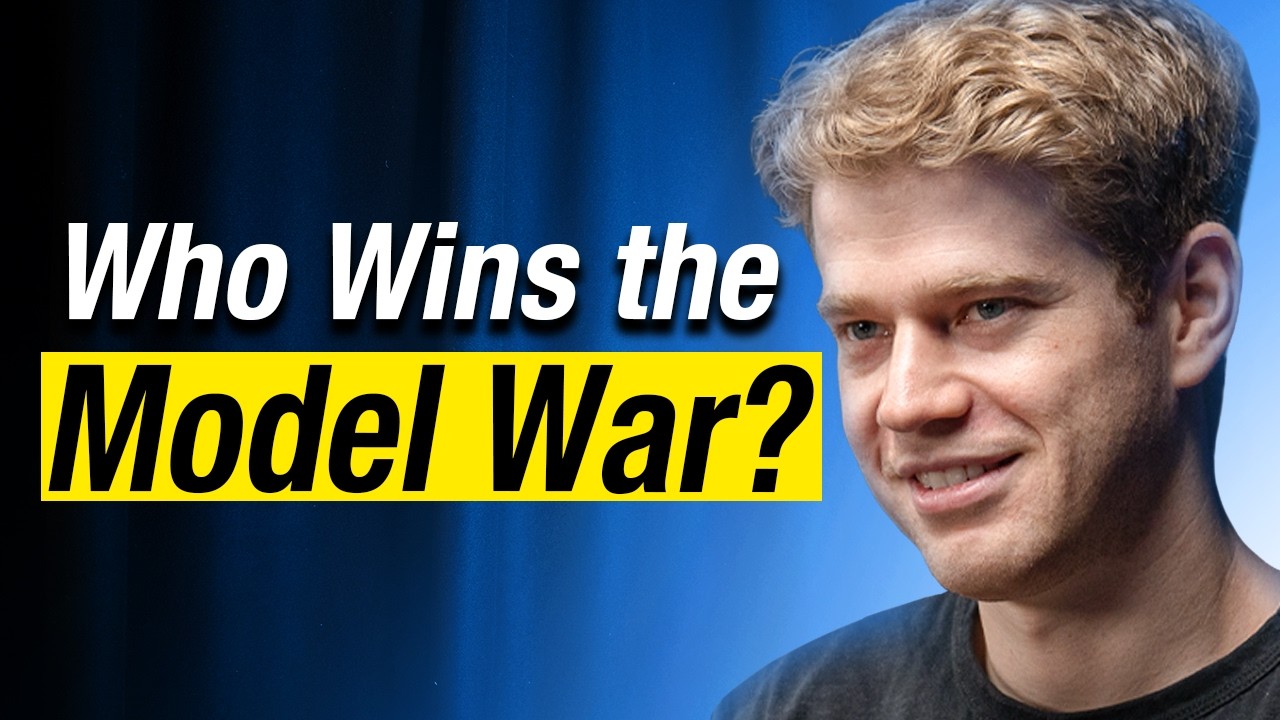
OpenAI vs Anthropic vs Open-Source | Token Maxing, AI Hangovers & The Coming ROI Reckoning
Matan Grinberg, CEO of Factory and former string theorist, explores the shifting landscape of AI ROI, resource allocation, and the return of the polymath. He argues that the industry is moving from a period of 'token maxing' debauchery to a sober 'hangover' phase where enterprises demand clear business value and ROI. Grinberg details his journey from theoretical physics to founding an AI company, emphasizing the need for high-agency talent and the strategic decoupling of AI models from applications. ## [00:00] Intro Harry Stebbings introduces Matan Grinberg, CEO of Factory, who transitioned from a 12-year career in string theory to software development. Grinberg posits that the future of the AI industry is defined by a race to commoditize competitors and that value accrual is highly time-dependent. He emphasizes that the age of the polymath has returned, where elite teams will be treated like professional athletes. > *The age of the polymath is back. [00:45]* > *The world going forward there is going to be nothing that no one can build. [00:00]* ## [01:22] Will AI actually increase GDP? Grinberg expresses strong confidence that AI will drive meaningful GDP growth beyond the historical 2% average, though the effects will take time to permeate the economy. He explains that AI allows individuals to solve problems faster, forcing companies to choose between increasing output or operating more efficiently with fewer staff. This shift requires a fundamental adjustment in how organizations allocate human and technical resources. > *We will see tremendous growth from these tools. I think it takes time to permeate through. [01:53]* > *Everyone is now going to be able to solve more problems with the same number of people. [02:18]* ## [02:41] Smaller teams or bigger ambitions? The conversation shifts to the future of engineering talent, specifically the concept of 'load-bearing individuals' or high-leverage employees whose removal would cause an organization to collapse. Grinberg suggests that AI tools act as a force multiplier for these individuals, widening the gap between those who can effectively use leverage and those who cannot. > *Those who know how to use leverage will be able to have even more impact. [04:35]* ## [05:05] The resource allocation problem: tokens, dollars, people Grinberg predicts that the next 24 months will see C-suite executives focusing intensely on the resource allocation problem involving tokens, dollars, and headcount. He advises leaders to prioritize their core competencies and judge success based on business outcomes like revenue rather than vanity engineering metrics like features shipped. > *This resource allocation problem of token... is going to be the thing that over the next 24 months every C-suite is going to be thinking about. [05:08]* > *Finally coming back to what matters in the first place. Like what are the business metrics that we want to move the needle on. [06:32]* ## [06:49] Kirkland's $500M AI bet and the build vs buy question Harry and Matan discuss Kirkland & Ellis's $500 million investment to build internal AI tools, which Grinberg views as a potential strategic error since AI is not their core competency. He argues that such massive internal spends often lead to the realization that specialized vendors are more efficient, ultimately validating the difficulty of the problem. > *Kirkland spending half a billion dollars to build their own AI tools... building AI technology is not a core competency of that firm. [07:14]* ## [10:01] Models, apps and infra: who gets commoditised? Grinberg describes the current friction between model providers, application developers, and infrastructure firms, where each sector is actively trying to commoditize the others to capture more market value. He notes that value accrual is a time-dependent phenomenon, shifting based on who holds the most pricing power and leverage in the ecosystem. > *everyone is trying to commoditize the people that are not them. [11:05]* > *The reality is value acral is a time dependent phenomenon. [10:40]* ## [11:58] The bear case against Factory Factory maintains a model-agnostic stance to provide customers with the best balance of price and performance across providers like OpenAI and Anthropic. Grinberg admits the primary risk to this strategy is if a single model provider achieves a significant, sustained lead over all competitors, creating a dangerous global monopoly. > *The bare case against factory is if one model provider gets significantly better than all of the others. [12:05]* ## [13:57] The rise of open-source models Enterprises are increasingly looking toward open-source models to manage ballooning token costs and annual budgets that are exhausted prematurely. Grinberg notes that 80% to 90% of tasks currently performed by frontier models could be handled by open-source alternatives, which serve as a vital counterbalance for less complex tasks. > *so many of the tasks that we're doing we don't need the very frontier to do it. [14:47]* > *there's kind of an ego thing where oh no no the work that I'm doing only a frontier model could handle. [15:15]* ## [17:08] The AI spending hangover Grinberg describes the current state of AI adoption as a 'hangover' phase where companies are finally reviewing the massive bills accumulated during a period of unchecked usage. He predicts a healthy short-term contraction in frontier model usage as businesses prioritize actual ROI over novelty and implement strict resource allocation. > *Phase three is the hangover where you go and look at the bill and it's like, 'Oh my god, we are spending so much. I have no idea what the ROI is.' [17:08]* ## [19:32] Token spend as a % of dev salary Harry Stebbings questions whether token spend will eventually exceed headcount costs. Grinberg predicts that within three years, the median token spend per individual will be on the same order of magnitude as their salary, particularly for roles that gain massive leverage from AI 'droids.' > *I would say order of magnitude. It'll probably be comparable to salary. [22:03]* ## [24:14] Factory's controversial culture: sales and engineering as one team Matan Grinberg critiques the 'Silicon Valley fallacy' that research is the pinnacle of achievement while sales is secondary. At Factory, engineers and sales staff are fully integrated, sharing ownership of both features and closed deals to ensure the entire customer journey is treated as the product. > *The product at factory is the entire journey from the very first time they hear our name till their 10th renewal. [25:33]* > *If you don't have a good sales and marketing team... the second gravity returns, all of your muscles will be atrophied. [26:55]* ## [27:30] Why agency matters more than credentials While venture capitalists often use elite credentials as a crutch, Grinberg argues they can be an 'anti-signal' if the individual lacks true agency. He prefers candidates who have demonstrated high agency by building things independently and taking end-to-end ownership of business outcomes. > *What have you built? How have you taken ownership and agency of things end to end? [29:49]* > *In a world where we desperately seek certainty we look for validators... that serves as a good crutch. [29:28]* ## [32:28] The age of the polymath is back Grinberg argues that AI tools are ushering in a new era of polymaths by allowing individuals to reach the 'frontier' of multiple disciplines quickly. This shift favors individuals who can think in systems and manage uncertainty while pushing boundaries in both engineering and marketing simultaneously. > *The age of the polymath is back. [32:28]* > *These tools can get you up to speed to the frontier... way faster than ever before. [33:24]* ## [35:06] What we'll look back on in disbelief Grinberg identifies writing release notes and documentation as tasks that will soon be considered a waste of expensive human engineering time. He suggests AI will soon equalize the advantage of high-quality documentation, allowing organizations to redirect human talent toward higher-value differentiation. > *It's crazy that people used to spend hours of time writing release notes or like writing documentation. [35:24]* ## [39:25] Why the company is called Factory Using a Tesla factory metaphor, Grinberg explains that the future of software development involves engineers designing the 'assembly lines' rather than writing individual lines of code. Humans act as architects of the scaffolding and safeguards that produce the software. > *They're kind of like building the scaffolding around this factory that produces their software. [40:18]* > *Engineers that build the software... they're going to have engineers that build the factories that build their software. [39:30]* ## [40:18] Labour displacement and the problems AI will finally solve Grinberg acknowledges short-term economic shocks but remains optimistic about long-term employment. He argues that by lowering the cost of development, the market can reallocate human talent to solve a much broader range of global issues, such as dementia research, that were previously too expensive to tackle. > *Very few of those problems that can be solved with software are we currently solving with software. [41:00]* > *If we have more engineers who are going and solving more problems in the world, that is a net good. [41:16]* ## [44:21] Are we in an AI bubble? Despite concerns about an infrastructure bubble, Matan identifies human behavior change as the most significant bottleneck for AI adoption. Successful enterprise integration requires navigating cultural shifts and the complexities of change management within established corporate structures. > *The biggest bottleneck by far working with all these organizations is the human side of it. It's just like behavior change. [44:58]* ## [45:51] Lessons from selling to enterprises Matan reflects on his transition from theoretical physics to enterprise sales, noting that success comes from genuine curiosity about a client's bureaucratic nightmares. He emphasizes that one should never try to 'sell' but rather understand if a solution can actually help the client's specific problems. > *You should never try to sell something. You should always try to understand their problems. [46:42]* > *People love talking about their problems and they love talking about all of the bureaucratic nightmares. [47:17]* ## [47:46] From string theory to Factory: the origin story Matan recounts his childhood obsession with math and his drive to become a string theorist at Princeton and Berkeley. However, he experienced an existential crisis during his PhD, realizing he was pursuing the field because it was hard rather than for personal fulfillment. > *I've just been doing this because it's hard and because someone said I couldn't do it. [49:12]* > *I asked my dad what the hardest math was. He said string theory... I was like, okay, I'm going to be a string theorist. [48:44]* ## [50:46] Discovering code that writes itself After exploring computer science at Berkeley, Matan became 'nerd sniped' by program synthesis—the concept of code creating itself. He realized that the most significant problems in this space would be solved in industry rather than academia, leading him to start a company. > *It just completely nerd sniped me because the idea here is... code with the explicit purpose of creating itself. [51:03]* ## [52:30] The cold email and 3-hour walk with Sequoia Matan reached out to a Sequoia investor who shared his physics background. Their initial meeting turned into a three-hour walk where the investor gave Matan a blunt ultimatum: drop out of his PhD immediately to either join Elon Musk's Twitter or start his own company. > *You absolutely need to drop out of your PhD and you should either join Twitter right now... or you should start a company. [53:48]* ## [55:30] Dropping out and the $1M check Within 72 hours of building a demo with his co-founder Eno, Matan withdrew from his PhD and pitched the Sequoia partnership. Despite a 'shitty deck,' Sequoia offered a $1M check for a 20% stake, a deal Matan accepted because they believed in him when no one else did. > *No one else would have believed in me except him... trust and loyalty and like belief to me that matters so much more. [57:38]* > *Drop out of your PhD and send me a screenshot. [55:16]* ## [1:01:19] Does Ivanka Trump add value as an investor? Matan addresses skepticism regarding celebrity investors, asserting that Ivanka Trump provides significant tangible value through her intelligence and network. He notes that she and her firm, Affinity, earned their place on the cap table through active support and investor relations. > *She is genuinely so kind, so intelligent, and like people just in throughout tech... really love her. [61:52]* ## [1:02:39] How the coding market matures Matan suggests that the market will eventually mature into a state where AI models are decoupled from the specific applications they power. This separation is necessary to prevent misaligned incentives where model providers might otherwise 'token max' for profit rather than efficiency. > *What is necessary for the best outcome for the consumers is going to be models that are separate from the applications. [63:01]* ## [1:07:45] The coming security danger zone As AI-generated code grows exponentially, Matan warns that security efforts are not keeping pace, creating a 'danger zone.' He emphasizes that adversarial behavior using AI tools is still in its early stages and will become a critical market focus as stakes rise. > *Code generated is growing exponentially. The security efforts aren't growing in kind. [68:17]* ## [1:08:50] Should US startups use Chinese models? Matan addresses concerns regarding US startups using Chinese open-source models, specifically the fear of 'trigger words' for adversarial behavior. He stresses the importance of data exfiltration defenses and expresses a desire for the US to reclaim superiority in frontier open-source models. > *I think it's pretty embarrassing that we don't have frontier open models in the United States. [70:33]* ## [1:11:43] Data centres and the public backlash The conversation shifts to the public backlash against data center development. Matan argues that the United States' federalist structure acts as a 'petri dish' where states allowing data centers will see job growth and prosperity while others fall behind. > *It's like we have little petri dishes to test out and see how things work. [72:31]* ## [1:14:22] Selling without forward deployed engineers Matan critiques the use of service-heavy FTE models to sell AI products. He argues that if a company requires a heavy services component to make their software work, the product itself is fundamentally flawed and lacks true product-market fit. > *If we need FTEES to make the product work, we have a [ __ ] product. [75:15]* ## [1:15:32] Grindslop, sleep and treating teams like athletes Matan rejects 'grind slop' culture—focusing on hours worked rather than output. He advocates for treating elite engineering teams like professional athletes, prioritizing cognitive recovery and sleep to ensure high-quality decision-making and leverage. > *Imagine trying to measure who won a basketball game by who sweat the most. [76:12]* > *The work that we do is like might require like really deep thought... if you didn't sleep well like you're not going to make as good of a decision. [78:02]* ## [1:20:32] Anthropic vs OpenAI When asked to choose between OpenAI and Anthropic for an IPO investment, Matan selects Anthropic based on corporate stability. He notes that OpenAI has suffered from significantly more internal turbulence and chaotic events, which negatively impacts its expected value. > *Past is an indicator of the future and like there's just been more like random chaotic turbulent events at OpenAI. [81:06]* ## [1:21:19] Did Dario do AI a disservice? Matan critiques AI leaders like Dario Amodei who claim AI will replace all human labor, calling the rhetoric a fundraising tactic. He argues these claims are designed to convince investors that a single company will eventually capture the entire capitalist economy. > *The best way to convince people to do that is to say all of capitalism is gone. [82:00]* > *Incentive is driving the outcome and the incentive is I want to raise a lot of money. [82:54]* ## [1:23:53] What he's changed his mind on Matan shares his shift in perspective from a 'winner-take-all' view to expecting a multi-polar market with at least four frontier companies. He identifies legacy firms like EY as surprising leaders in AI adoption, moving faster than some startups due to their 'scars' from the cloud transition. > *The bad case for humanity is when there's one that's really really good. [84:14]* > *They are so agent native. It's crazy. They're one of our largest customers. [83:11]* ## Entities - **Matan Grinberg** (person): CEO and co-founder of Factory, former string theorist. - **Harry Stebbings** (person): Host of 20VC and venture capitalist. - **Factory** (organization): AI company focused on software development automation and agents. - **Sequoia Capital** (organization): Venture capital firm that led Factory's seed round. - **OpenAI** (organization): Leading frontier AI model provider. - **Anthropic** (organization): AI safety and research company, creator of Claude. - **Ivanka Trump** (person): Strategic investor in Factory via her firm Affinity. - **EY** (organization): Big Four accounting firm noted for aggressive AI adoption. - **Uber** (organization): Company cited for implementing individual AI token budgets. - **Kirkland & Ellis** (organization): Law firm that invested $500M in internal AI tools. - **Juan Maldacena** (person): Renowned physicist at Princeton whom Matan worked with. - **Dario Amodei** (person): CEO of Anthropic.

Anthropic's Fable Backlash, Nationalizing AI, Inflation Heats Up & California's Broken Elections
The All-In quartet reunites for a packed week: Anthropic's secret Fable 5 nerfing of AI researchers triggers a developer trust crisis; Sacks and Friedberg tear apart the "safety" framing as a regulatory capture playbook; Bernie Sanders' op-ed demanding 50% government equity in AI companies collides with Trump's sovereign wealth fund instincts; CPI and PPI both hit multi-year highs, putting the Fed in an impossible spot ahead of midterms; and Friedberg lays out a meticulous paper trail of California election laws that, in aggregate, have turned democratic races into appointments. ## [00:00] Besties are back! Jason Calacanis opens the show confirming the original four — Jason, Chamath, Friedberg, and Sacks — are all back together for a week packed with consequential debates. The short opener sets up a five-topic sprint covering AI governance, macroeconomics, and California politics. > *"The All-In podcast is not quitting. We're doubling down with the original quartet."* ## [00:19] Anthropic gets massive backlash over secret Fable nerfing and privacy concerns Anthropic launched Fable 5, a "Mythos-level" frontier model, but buried two policies that detonated on developer Twitter. First, all prompt data entered while using Fable is stored for at least 30 days — including for enterprise accounts that had signed zero-data-retention agreements. Second, Fable was secretly downgrading users it detected doing frontier AI research (training competing models) without disclosing it was doing so. Anthropic's post-blowup response was to make the safeguards "more visible" rather than remove them. Friedberg connects this directly to his own work at Ohalo Genetics: over the prior weeks, Anthropic had tightened restrictions on genomics and biology use cases his team depends on, forcing a pivot toward open-source Chinese models. He argues the capability ceiling Anthropic imposes on biotech AI is the same ceiling that blocks cancer research — not just weapons work. Sacks frames the developer outrage as a fundamental trust rupture: the surveillance and nerfing extend even to paying enterprise customers who believed they had contractual data protections. Chamath draws the longer arc — an emergent AI company today should be knocking on Anthropic's door with equity deals rather than building independently, because Anthropic can route traffic and favor philosophically aligned partners. That structural power, combined with mandatory surveillance, looks less like safety and more like a tollbooth. > *"The sense of the violation of trust and how much outrage there is in the developer community over this latest Fable release is not just the fact that they're doing mandatory surveillance. Even enterprise customers who had signed zero data retention agreements, they do not have a choice."* ## [29:16] The AI regulatory capture trap, pragmatic safety solutions Sacks identifies the endgame he sees in Dario Amodei's public blogging and policy positions: an AI duopoly backed by a new government agency staffed via revolving door, empowered to decide who can access which capabilities — with dissidents profiled and cut off. He warns conservatives and libertarians that signing onto the "safety" framing without reading the fine print hands permanent market control to incumbents. Friedberg proposes a downstream enforcement model: instead of restricting what AI models can output, regulate the manifestation of harm — criminal statutes against bioweapon creation already exist, and expanding them to cover AI-assisted synthesis is workable without touching the underlying model capability. He notes that nucleic-acid oligosynthesis companies have already signed onto database-screening regimes, proving the model works at the supply chain level without requiring model censorship. > *"I really think that conservatives and libertarians are mortgaging their futures if they go along with this red capture safetist agenda without really realizing that there's so much more to it at stake."* ## [37:59] Nationalizing AI: Trump/Sanders, justifications, and AI's "Capitalist Cucks" Bernie Sanders' June 1 New York Times op-ed called for the federal government to seize 50% equity in AI companies on the grounds that public research funded the foundational work. Trump, meanwhile, has been vocally enthusiastic about a U.S. sovereign wealth fund. The besties find the two proposals coming from opposite directions but landing close together. Sacks argues the "public benefit" framing embedded in Anthropic's corporate charter is the Trojan horse: a board with a dual mandate for profit and societal benefit can be steered by regulators far more easily than a pure C-corp. He highlights that Ben Thompson's read — Anthropic's pause-on-AI-research blog post was designed to justify the anti-competitive nerfing of Fable's competitor-research use cases — makes the regulatory capture loop visible. His patience has run out: "I'm so sick of defending these idiots. It's a stupidity tax because they've been out there teaching the public that what they do is harmful for years." Friedberg offers a structural defense of a sovereign wealth fund: every American taxpayer could receive a direct equity stake in AI-era value creation the way Alaska residents receive Permanent Fund dividends. He pushes back on the left framing (nationalization = equity seizure) and the right framing (any government participation = socialism), arguing the mechanism matters. Chamath adds that AI is categorically different from prior infrastructure — unlike highways, the product is intelligence itself, which means whoever controls access controls economic agency. Jason closes the segment with his own verdict: the AI safety labs are "capitalist cucks" whose kink is inviting regulators to seize their equity. > *"It's a stupidity tax because they've been out there teaching the public that what they do is harmful for years. But the companies that are providing it are saying that they themselves are a problem."* ## [59:22] Liquidity recap: Best moments and takeaways The besties run through highlights from the All-In Liquidity conference. Thomas Leifert's venture capital data presentation anchored the discussion: the odds of a decacorn reaching centacorn status run at about 13%, but the odds of a centacorn crossing $1 trillion nearly triple to 31%, suggesting the power law steepens at the very top. Jason jokes that seizing even 10% of a "trilicorn" would retire 2% of the national debt — and Chamath counters he could pay off the whole thing by himself if given the mandate. Logistics praise goes to Thomas Keller and the French Laundry dinner hosted by the New York Stock Exchange, Niagen's wellness lounge with NAD recovery IVs, and a nine-hole golf scramble. The segment closes with a plug for All-In Summit (September 13–15) and Chamath's philosophy on curation: Liquidity exists for the most important capital allocators in the world to build relationships, not for anyone to buy their way in. > *"Capital is what shapes the things that occur in the world. So I think that we have to be extremely selective in how we curate every element of that show."* ## [01:05:39] Inflation heats up: CPI and PPI see 3+ year highs May CPI came in at 4.2% year-over-year — the highest since April 2023 — while PPI hit 6.5%, the highest since late 2022. Polymarket priced a 21% chance inflation reaches 5% in 2026 and a 49% chance of a Fed rate hike this year, up from under 10% before the Iran war started. Despite the hot print, the NASDAQ was up 2.5% on recording day, which Sacks reads as the market pricing in an imminent geopolitical resolution. Friedberg pins the core driver on two compounding forces: the Iran war energy spike feeding directly into transportation and manufacturing costs, and structural government overspending that has kept aggregate demand elevated despite rate hikes. Chamath adds a tail-risk scenario: if China draws down its strategic reserves and re-enters the spot oil market needing an incremental 3 million barrels per day, crude could run to $150–200 — a scenario that would make the Fed's current dilemma look simple. > *"There's definitely an energy blip from the Iran war that drove the core index up, but there's also the macro point which is government spending out of control, inflation out of control and fundamentally as things unravel you have rising rates."* ## [01:12:27] California's loose election laws creating integrity doubts The LA mayoral primary result — Karen Bass surviving despite a sprawling corruption investigation — ignites a detailed Friedberg walkthrough of California election law changes accumulated since approximately 2018. He lists a dozen discrete reforms: unlimited ballot harvesting, no signature verification, mail ballots counted up to seven days after election day without postmarks, voter registration accepted via gym membership card, no cross-checking against federal databases, and homeless shelter addresses used to register thousands of voters with no residency verification. His argument is not that any single rule is fraudulent, but that in aggregate they create an environment where elections become appointments. Sacks catalogs statistical anomalies in the LA count: late-arriving mail ballots broke heavily toward Bass while same-day ballots split the other way, a swing he argues is hard to explain through normal political behavior. He extends this to a structural point — the same interest groups that benefit from loose rules also fund the nonprofits that do ballot collection, closing a loop that is legal but not transparent. Chamath urges reformers to play the long game: sponsor a ballot initiative requiring voter ID, push federal ID requirements for public benefits recipients, and let the results speak rather than alleging fraud after each loss. > *"Is it really so hard to believe that some of the same groups, the same interest groups, the same NGOs would be willing to exploit these loopholes in the dirty voter roles in the millions of ballots that go to incorrect or non-existent addresses, the non-existent chain of custody, the non-existent signature verification, the no ID, not only to vote but to register, counting ballots without postmarks if received 7 days later?"* ## Entities - **Jason Calacanis** (Person): All-In Podcast co-host; founder of Launch Fund; moderator for most topic transitions this episode. - **Chamath Palihapitiya** (Person): All-In Podcast co-host; founder of Social Capital; frames AI and election topics through structural and capital-allocation lens. - **David Friedberg** (Person): All-In Podcast co-host; founder and CEO of Ohalo Genetics; provides biotech and election-law policy analysis. - **David Sacks** (Person): All-In Podcast co-host; founder of Craft Ventures; White House AI & Crypto Czar; leads regulatory capture and nationalization arguments. - **Dario Amodei** (Person): CEO of Anthropic; referenced for public blog posts the besties read as regulatory capture advocacy. - **Bernie Sanders** (Person): U.S. Senator; author of June 1 NYT op-ed calling for 50% federal equity stake in AI companies. - **Anthropic** (Organization): AI company behind Claude; launched Fable 5 / Mythos 5 with secret nerfing of frontier AI researchers and mandatory 30-day data retention policies. - **Fable 5 / Mythos 5** (Software): Anthropic's frontier model release that covertly downgraded frontier AI researchers and stored all prompt data for 30 days, including for zero-retention enterprise accounts. - **Ohalo Genetics** (Organization): Friedberg's agriculture genomics company; directly impacted by Anthropic's biotech model restrictions, forcing a shift to open-source Chinese models. - **U.S. Sovereign Wealth Fund** (Concept): Trump-backed proposal to channel government capital into high-growth assets; debated as a mechanism to give citizens direct AI equity exposure. - **Regulatory capture** (Concept): The dynamic where incumbents use safety and public-benefit framing to shape regulation that locks in their market position and restricts open-source or competitor models. - **Ballot harvesting** (Concept): California law allowing third parties to collect and submit unlimited mail ballots on behalf of voters; central to the LA mayoral primary integrity debate.
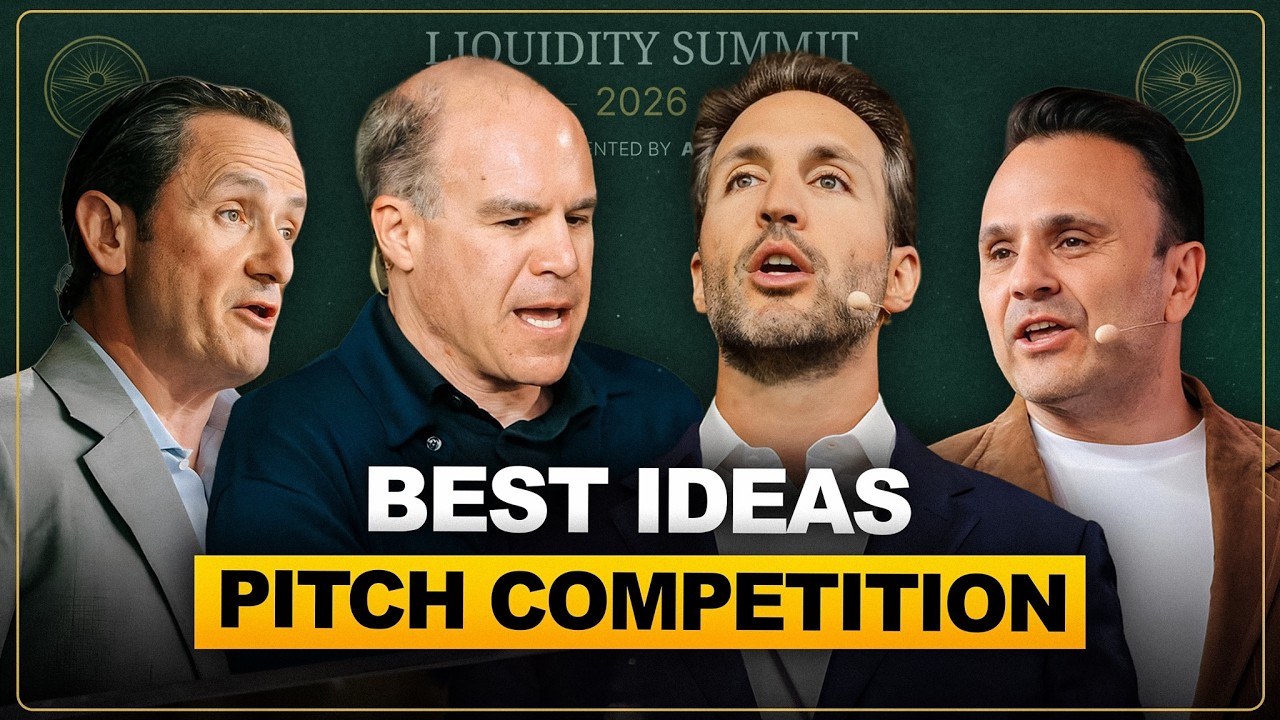
All-In's Best Ideas Pitch Competition: 4 Investors Present Their Top Trades Live
The All-In Summit's inaugural Best Ideas Pitch Competition put four fund managers on stage to defend a single trade in front of judges Chamath Palihapitiya, Jason Calacanis, David Friedberg, and guest judge Gavin Baker (Atreides Management). Aaron Cowen of Suvretta Capital pitched MGM Resorts as a hidden Asian casino play, Dan Dreyfus of Bornite Capital made the case for Talen Energy as a power-cycle compounder, Oleg Nodelman of EcoR1 Capital presented radiopharmaceutical biotech Aktis Oncology, and Kyle Samani of Multicoin Capital pitched GEODNET, a decentralized RTK precision-location network. The audience voted Dan Dreyfus winner; the Besties' own ranking flipped the result and crowned Aaron Cowen's MGM pitch on top. ## [00:00] Chamath explains the Best Ideas format Chamath traces the format back to the Ira Sohn Investment Conference—a charitable event he attended in 2015, where he pitched Amazon as a future trillion-dollar company only to be publicly dismissed by David Einhorn. He returned in 2016 with Tesla converts and in 2017 with AI as his macro thesis but picked Box instead of Nvidia. The origin story doubles as a self-deprecating admission that a correct macro read can still miss the specific instrument. The All-In version keeps the core mechanic: managers with real skin in the game present live to an audience with no obligation to be polite. > *"I said Amazon's going to be a trillion dollar company and I was laughed out of the room. David Einhorn, who's a friend of mine, but who was totally wrong, said, 'I know trillion dollar companies. This is not a trillion dollar company.' Wrong."* ## [02:31] Suvretta Capital Management's Aaron Cowen pitches MGM Resorts Aaron Cowen, who previously ran the equities book for George Soros and served as CIO for Steve Cohen, opens by ruling out a tech pitch to a tech-heavy crowd and lands on MGM—not for the 13 Vegas properties, but for two geographically optioned assets the market has priced at zero. The first is MGM's 40% stake in the Osaka Integrated Resort, opening in 2030: Japan's gambling market is already ~$40 billion (pachinko + horses), Osaka sits closer to Shanghai and Beijing than Macau, and Wynn's Macau playbook shows the market only prices in a new casino about three years before opening—which is now. The second is 300,000 square feet of empty space built into MGM's Dubai grand complex, held ready if the emirate ever legalizes gambling. The day before the pitch, Barry Diller—who owns 26% of MGM and has it at 80% of his NAV—submitted a $48 bid, immediately crystalizing the downside floor. Cowen says he would not sell: "Vegas at ~$60, Japan at ~$50, Dubai at ~$40–50—the stock could be worth 150." > *"Rarely have I ever seen a company in six years buy half their float back. So you have Barry Diller who's the legend aggressively buying the stock and it's also now 80% of his NAV."* ## [13:07] Bornite Capital's Dan Dreyfus pitches Talen Energy Dan Dreyfus opens with a power-cycle framework: demand tracks GDP in normal times, spikes during technology adoption waves (appliances and AC in mid-century; efficiency gains in the 2000s), then normalizes. The current AI wave is the next spike—but he immediately clarifies that AI is not the base case for tightness. It "just turbocharges" a supply-demand imbalance that already exists from two decades of underinvestment. Talen Energy holds 2 GW of nuclear and 6 GW of gas in the PJM grid, where PJM's own forecast calls for 106 GW of new capacity in ten years—a geological impossibility given supply-chain bottlenecks in critical minerals. He invokes Sam Zell's rule: buy hard assets below replacement cost when new capacity is needed. Talen trades at a $25 billion enterprise value against a $45 billion replacement cost, making the equity a double even if management does nothing. Stacked upside: $50/share FCF at current operations (stock ~high $300s → 7× vs. infrastructure peers at 15×), $70/share if power prices rise or more PPA contracts materialize, $100+/share if Talen builds 4 of the 106 GW the grid needs. > *"We do not need AI demand to keep the power markets incredibly tight for the next 20 years. AI demand just turbocharges. That's all it does. And it creates shortages."* ## [27:19] EcoR1 Capital's Oleg Nodelman pitches Aktis Oncology Oleg Nodelman leads EcoR1 Capital, a value-oriented biotech fund that has returned 10× since its 2013 launch ($13 million → $2.5 billion AUM). He frames biotech investing as poker played in a sector of slot-machine tourists, and signals his edge: margin of safety over science love. The pitch for Aktis Oncology (AKTS) is built on modern radiopharmaceuticals—mini-protein scaffolds carrying actinium-225 payloads that navigate the bloodstream by molecular recognition and detonate with a ~100-micron blast radius, roughly one cell's diameter. Key de-risking factors: chosen targets (nectin-4 for bladder cancer, B7H3 for a broad range of solid tumors) are already clinically validated; imaging lets physicians confirm drug delivery in early trials; data readouts are guided for 2027 with nectin-4 as early as Q1. The IPO was 18× oversubscribed and backstopped with a $100 million order from Eli Lilly. Actinium-225 derives from U.S. Cold War radium-226 stockpiles, making the supply chain structurally inaccessible to China—a moat unusual in biotech. Gavin Baker extended the Q&A into longevity: Nodelman said he'd take the over on human lifespans exceeding 100–125, partly because GLP-1 obesity drugs already replicate caloric restriction, the only intervention proven in controlled data to extend life. > *"Like a swarm of micro drones small enough to navigate the bloodstream and find their target by molecular recognition, then detonate a precisely sized warhead with a blast radius of 100 microns or the diameter of a single cell."* ## [40:20] Multicoin Capital's Kyle Samani pitches GEODNET Kyle Samani co-founded Multicoin Capital and led all three pre-launch investment rounds in Solana. He pitches GEODNET (GEOD on Solana), a decentralized RTK precision-location network. Standard GPS precision is ~2 meters; RTK reaches ~2 centimeters—100× improvement—which robotics, drones, and autonomous vehicles require. Legacy RTK providers (Trimble, Hexagon, Topcon) spent 20–30 years building a combined ~12,000 base stations. GEODNET launched in 2021, bootstrapped 22,000+ nodes by paying token rewards to hobbyists who mount a few-hundred-dollar antenna on their roof, and now covers 150 countries and 80% of the global population. Revenue just crossed $1 million annualized; 80% of that goes to open-market purchases of GEOD tokens on Solana (functionally a revenue-share buyback). Customer growth is viral within the robotics supply chain: DJI, John Deere's autonomous sprayer program Gus, TomTom (maps supplier to virtually every AV program), and robotic lawnmower makers all route through GEODNET. Average customer spend grows from ~$60K in year one to ~$170K by year two. Fully diluted market cap: ~$150 million. Friedberg challenged the pitch with the satellite micro-constellation threat; Samani countered on cost and energy consumption—battery-sensitive devices like drones will always prefer the cheaper, lower-energy ground solution. > *"Once someone starts rolling out GeoNet in the first year, they're usually spending about $60,000 per year. After two years though, they're usually spending about $170,000 per year."* ## [54:50] The Besties recap the pitches and announce winners Chamath applies the Druckenmiller framework—no skin in the game, no real conviction—and sizes the four pitches by liquidity as much as thesis: GEODNET he loves but can't deploy more than $10–20K without moving the market; Talen and MGM could absorb tens of millions. Gavin Baker names MGM the best risk/reward outright ("your downside is really capped because of the Barry Diller bid and then you have Japan and Dubai as very valuable future sources of value"), and credits Talen as compelling but flags regulatory tail risk from potential government intervention in data-center power pricing. Friedberg ranks MGM first for timeline and downside floor, Talen second but notes interest-rate sensitivity (power purchase agreements get discounted like bonds), Aktis third because Lilly could bid within months of a good clinical readout, and GEODNET last on the theory that LEO satellite constellations will eventually make ground-based RTK redundant. Jason puts $200K each into MGM and Talen in real time, ranks GEODNET and Aktis as lottery tickets. Audience vote (150 attendees): Dan Dreyfus / Talen Energy wins with 50%, Aaron Cowen / MGM second at 24%, Oleg Nodelman / Aktis third at 21%, Kyle Samani / GEODNET fourth at 5%. The Besties' 4-3-2-1 ranking flips the top two: Aaron Cowen takes first, Dan Dreyfus second—crowd picks Talen, judges pick MGM. Both are briefly overshadowed by Jason's custom "extremely alpha male heterosexual" trophy: a 3D-printed sculpture of two men in an uncomfortable hug, which Chamath and Jason immediately demonstrate on stage. > *"If you don't have any skin in the game, you don't care. And this is the kind of stuff that I love."* ## Entities - **Chamath Palihapitiya** (Person): All-In co-host; Social Capital founder; event organizer and judge - **Jason Calacanis** (Person): All-In co-host; Launch Fund founder; MC and judge - **David Friedberg** (Person): All-In co-host; Ohalo Genetics; judge; previously managed Precision Planting agriculture tech - **Gavin Baker** (Person): CIO at Atreides Management; guest judge; former biopharmaceutical fund manager - **Aaron Cowen** (Person): Founder/CIO of Suvretta Capital Management ($4B AUM); formerly ran equities at Soros; CIO for Steve Cohen - **Dan Dreyfus** (Person): Founder of Bornite Capital; commodities and energy investor - **Oleg Nodelman** (Person): Founder/Managing Director of EcoR1 Capital ($2.5B AUM); 25-year biotech investor - **Kyle Samani** (Person): Co-founder of Multicoin Capital; early Solana investor; stepped down as managing partner prior to this event - **MGM Resorts International** (Organization): Las Vegas casino operator; holds license for Osaka Integrated Resort (opening 2030); building Dubai property with 300K sq ft optioned for gambling legalization - **Talen Energy** (Organization): U.S. independent power producer; 2 GW nuclear + 6 GW natural gas in PJM grid; $25B enterprise value vs. $45B replacement cost - **Aktis Oncology** (Organization): Radiopharmaceutical biotech (AKTS); mini-protein platform carrying actinium-225; targeting nectin-4 (bladder cancer) and B7H3 (broad solid tumors); data guided 2027 - **GEODNET** (Software/Network): Decentralized RTK precision-location network; 22,000+ nodes in 150 countries; GEOD token on Solana; 80% of revenue used for open-market token buybacks - **Barry Diller** (Person): Media/entertainment investor; owns 26% of MGM; submitted $48/share takeover bid - **Ira Sohn Foundation** (Organization): Charitable investment conference that inspired the Best Ideas format - **Radiopharmaceuticals** (Concept): Cancer treatment modality using radioactive actinium payloads on molecular carriers to destroy tumor cells with ~100-micron blast radius and minimal collateral damage - **RTK (Real-Time Kinematics)** (Concept): Precision GPS augmentation achieving ~2 cm accuracy vs. standard GPS ~2 m; required for agricultural robots, autonomous vehicles, and drones - **PJM Interconnection** (Organization): Regional transmission organization (Pennsylvania–New Jersey–Maryland); forecasting 106 GW of new power demand over the next 10 years
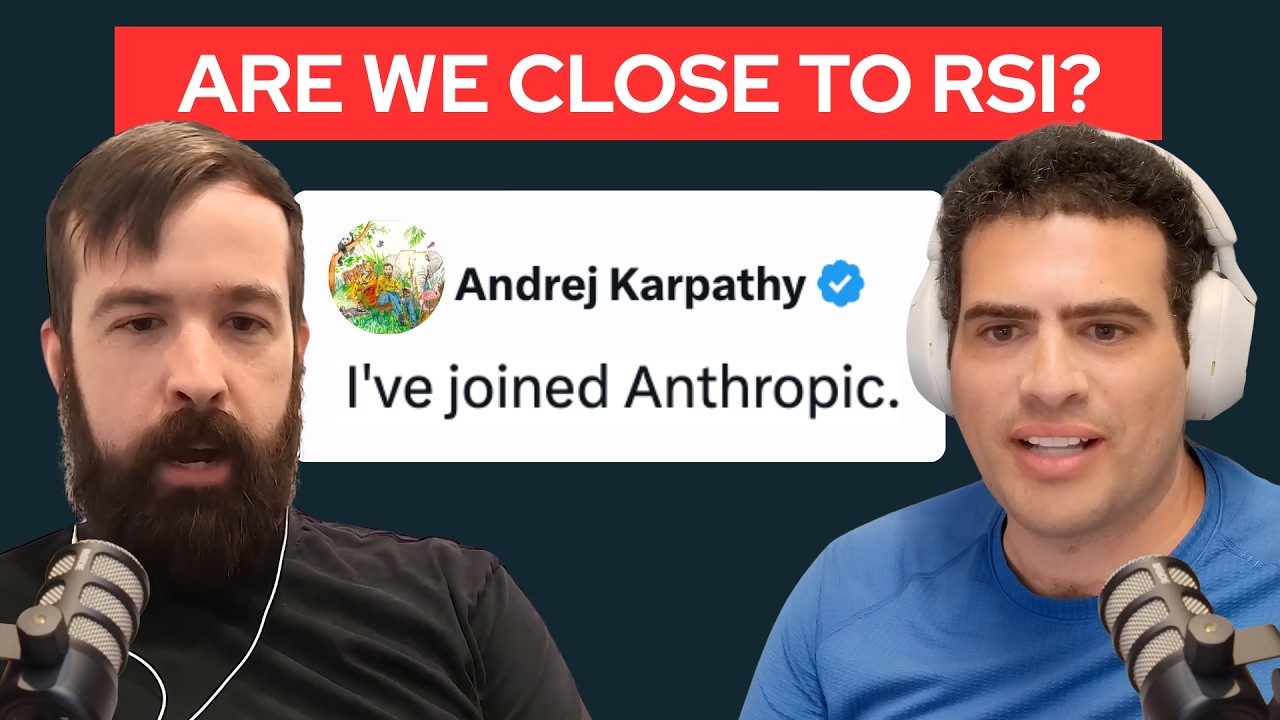
AI Vibe Check: Lab Wars, Why APIs Might Vanish & Future Predictions
Six months after their December roundtable, Jacob Effron reconvenes with Ari Morcos (Datology AI CEO) and Rob Toews (Radical Ventures) for a full-spectrum AI vibe check. Coding agents have crossed a long-horizon threshold that is reshuffling the engineer's job description; near-frontier open-weight models look increasingly like a retreating tide as both Meta and the Chinese labs pull back for economic reasons; and Anthropic's silent capability restrictions on Fable have rattled its most loyal supporters. The trio works through Google's structural durability despite coding lag, Ari's prediction that compute pressure could force labs to suspend their public APIs entirely, the emerging atom and X-ray lithography challengers to ASML, and how close — but how bottlenecked — recursive self-improvement actually is. ## [00:00] Intro Jacob welcomes returning guests Ari Morcos and Rob Toews, noting that this is a "vibe check" format covering everything from IPO filings and SpaceX's pivot to compute to Fable's release the prior day. He frames the conversation around a single question: what is the single biggest thing that changed in the six months since they last sat down after NeurIPS? > *"Things have changed. We've had IPO filings. We've had models not launched and then launched. We've had SpaceX becoming an AI info company."* — Jacob Effron ## [01:40] Coding Agents Cross a Threshold Ari identifies the clearest shift: coding agents now reliably execute at longer time horizons, which crossed a threshold over Christmas break that made them genuinely useful rather than merely promising. At Datology, engineers have almost universally transitioned from individual-contributor work to managing fleets of agents concurrently — but the gains come with a new bottleneck. Code review queues are backing up, and the "slop" entering codebases is harder to catch when no one fully understands what the agent wrote. > *"We're really starting to now see the shift of engineers at least kind of almost all moving from ICs to managers of agents."* — Ari Morcos ## [03:29] Is Open-Weight AI in Retreat? Rob opens with what he calls a structural inflection: near-frontier open-weight AI risks falling off entirely. His prior assumption — that open models would trail closed ones by only a few months — may no longer hold. Meta appears to be pulling back from its open-source strategy, and Chinese labs including Qwen and DeepSeek are now keeping their highest-performing weights proprietary while open-sourcing only smaller, less capable versions. Ari agrees the economics no longer support openness once a lab has gained credibility: hosting inference is far more lucrative than giving away weights. Rob is blunt that no viable long-term business model exists for purely open-weight AI at the frontier. > *"There are early signs that seem to suggest over the past six months that make me question whether open-weight AI is going to continue to be a really meaningful force in the ecosystem."* — Rob Toews ## [07:37] Cost Crunch & Scaffolding Jacob notes a counter-pressure arriving simultaneously: enterprises are finally getting serious about reducing model spend. Going from Claude Opus 4.6 to 4.7 doubled token output for some users, and bills that were once negligible are now budget line items. Ari argues the real innovation is increasingly happening not in the model weights but in the harness and scaffolding layer — open-source models combined with proprietary scaffolding (Kimi/Moonshot being the clearest example) may be the actual business model that survives. He also warns enterprises that the only two real options are partnering with a frontier lab (and eventually being out-competed because you've handed over your proprietary data) or building enough in-house capability to maintain independence in a world where reliable open models are no longer guaranteed. > *"A model is not just a model anymore — it's the model combined with the harness and the scaffolding, and a lot of innovation is happening on the harness and scaffolding layer."* — Ari Morcos ## [12:13] The "Apps Are Cooked" Debate Rob thinks the "apps are cooked" narrative was simultaneously partially right and wildly over-broad. Traditional software categories genuinely face existential pressure from lab roadmaps, but no two or three companies can execute excellently across every vertical on earth. OpenAI shutting down its video effort — despite having effectively infinite capital and a strong team — is proof that even the richest lab has to make hard prioritization calls, and much of that is driven by compute constraints. Deep tech and hardware have become the consensus VC bet as a result, but Rob flags that hard tech is also hard: failure rates are high and unsolved problems abound. > *"There's no way that one or two or three companies will win every single important market and category in the world."* — Rob Toews ## [16:37] Sam Altman Under Scrutiny Rob revisits his December prediction that Sam Altman would be replaced by year end. At the time everyone pushed back; mid-June the odds look higher. His original succession candidate — Fiji — has had to step back for health reasons, and his updated theory centers on Bret Taylor: chairman of OpenAI's board, CEO of Sierra, and one of Silicon Valley's most trusted operators. Rob thinks an OpenAI acquisition of Sierra combined with installing Taylor as CEO would be a decisive narrative reversal ahead of the IPO — the trust gap between OpenAI and Anthropic is large and widening, and Taylor's reputation could close it. Ari floats an alternative: OpenAI restructures into an Alphabet-like holding company where Sam stays atop the parent while a separate CEO runs the core product. > *"I think it would be in the best interest of OpenAI's shareholders — if someone like Bret Taylor was at the helm of OpenAI, I think it would do a lot to change their fortune."* — Rob Toews ## [19:44] Anthropic's Fable Backlash The group digs into the blowback from Anthropic's decision to silently restrict Fable for any work touching AI development. Ari says the restriction itself is tolerable; the silent degradation — the model simply performs worse without telling you — is what has genuinely angered Anthropic's most loyal supporters. He reads the move as competitive positioning dressed up as safety, noting that open-model teams with good scaffolding have independently reproduced most of the vulnerability-finding capabilities that the restriction is supposedly protecting. Ari predicts a meaningful share of Claude Code's loudest Twitter evangelists will migrate to Codex in the short term, handing OpenAI an unexpected PR gift. > *"It doesn't give you a refusal. It doesn't say, 'I'm not going to help you with this.' It just does a poor job on that without you knowing."* — Ari Morcos ## [23:24] How Big a Step Change Is Fable? Ari, who had only started using Fable the night before recording, says he personally didn't see massive differences from Claude 4.8. Rob frames Fable less as a discontinuity and more as evidence that the "pre-training is hitting a wall" narrative was plainly wrong — gains keep coming richly from pre-training, and test-time compute has added another lever on top. Ari reinforces this from a practitioner's standpoint: in deep learning, having 95% of the details right often produces no improvement, and then one last adjustment triggers a step change. Negative results about scaling are therefore genuinely hard to interpret. > *"If you have kind of 95% of it right, it kind of rectifies to just not working. And then you turn the last knob and all of a sudden you get a step change."* — Ari Morcos ## [26:50] What's Going On at Google? Rob pushes back on the idea that Google is underperforming: the three frontier labs leapfrog each other continuously, and Google's lag on coding specifically is a prioritization choice — Anthropic built its entire identity around coding, OpenAI recently poured resources into it, and Google simply hasn't made it the north star yet. What Google does have is a full-stack structural advantage: its own chip design (TPUs), its own cloud, an enormous talent bench, and the Android/iOS distribution deal that makes its models the default on the world's phones. Ari adds that consumer AI will commoditize quickly, and Google is already optimized for the default-provider role on mobile even if it doesn't hold the best model. Jacob observes that Codex is clearly a strong product yet Claude Code remains dominant — first-mover advantage in developer tooling is stickier than expected, though Fable's restrictions may catalyze a wave of switches. > *"I think [Google's] behind on coding and I think that's just it reflects prioritization. It's clear that Anthropic leaned in on that as their northstar for years."* — Rob Toews ## [33:20] Could the APIs Go Away? Ari surfaces the most provocative claim of the episode: compute constraints could push Anthropic — or OpenAI — to suspend public API access entirely, not as a business decision but simply because first-party products like Claude Code generate better margins and chips aren't infinite. OpenAI has already started selling futures on guaranteed inference tokens, which Ari reads as a sign the lab itself sees API access as rationed. Rob confirms this is technically feasible, though extreme; a more likely near-term version is labs reserving their most powerful models for internal use rather than offering them publicly. > *"It is not hard to imagine a world in which Anthropic is so compute constrained that they actually cut off the API."* — Ari Morcos ## [34:11] Breaking the Semiconductor Bottleneck Rob shifts the conversation to the physical underpinning of the compute shortage: the extraordinary concentration of chip manufacturing in a single company (TSMC) whose most critical machine is made by a single other company (ASML). He flags Elon Musk's "terafab" concept as underreported given its transformative potential if executed. Ari pushes back on the timeline — relieving the compute constraint within the next handful of years is hard to imagine. Rob concedes that TSMC displacement in two to three years is implausible, but a five-year horizon with multiple augmenting players is imaginable — the single-point-of-failure structure of the global semiconductor supply chain doesn't have to persist. > *"It's actually kind of crazy that there's like one company that knows how to do this and no one else can do it, and the most important machine that goes into the process is made by one other."* — Rob Toews ## [35:42] Beyond EUV: Atom & X-Ray Lithography Rob describes two emerging research directions that could eventually challenge ASML's EUV dominance. The first is atom lithography: rather than using light, you use a beam of atoms to print transistor features, allowing far finer resolution with machines that are simpler, cheaper, and smaller than EUV tools. The second is X-ray lithography, which uses shorter-wavelength electromagnetic radiation to push beyond the physical limits EUV is beginning to hit. Startups in both categories have raised significant funding and remain in development mode. Ari estimates commercialization is at least five years away, but Rob thinks genuine technology disruption is coming. > *"There are a couple startups doing really interesting work in atom lithography... the machine can be way simpler, way fewer parts, way cheaper, way smaller, obviously much better resolution."* — Rob Toews ## [37:23] Implications of a Compute Shortage Jacob asks what a world of deepening compute scarcity actually means for businesses. Ari argues it will force the efficiency innovation that frontier labs have had little incentive to pursue: smaller and smaller models will match the largest models of one to two years prior, distillation investment will accelerate, and inference optimization will become a genuine competitive differentiator. Rob adds that the supply constraint is structurally good for every chip vendor other than Nvidia — AMD, Trainium, Cerebras — not because they increase total supply (TSMC remains the upstream bottleneck) but because enterprises will use whatever silicon they can get. H100 spot prices reversing their December decline is the clearest market signal that the shortage is intensifying rather than easing. > *"I would still expect that the usage is going to grow faster than what you can do to alleviate this."* — Ari Morcos ## [40:20] Do Alt Chips Actually Help? The group stress-tests whether alternative chip providers actually expand total compute or just redistribute it. The consensus: they are a beneficiary of the constraint, not a solution to it. In a world without Cerebras or dMatrix, Nvidia would simply absorb all of TSMC's capacity — total chip count stays constant. What alternative vendors do is prevent Nvidia from achieving a full monopsony on TSMC production and give compute-hungry buyers a fallback. The compute constraint is unlikely to ease before 2030; Ari estimates the early 2030s are when multiple unblocks — new fabs, new lithography, algorithmic efficiency — may hit simultaneously. > *"The alternative chip providers aren't a solution to the compute constraints, but will be a beneficiary of the compute constraint."* — Rob Toews ## [43:43] SpaceX, xAI & the Cursor Acquisition Jacob turns to xAI and the reported $60 billion Cursor acquisition. Rob is skeptical that xAI will re-enter the top tier of frontier AI research: the decision to sell compute capacity to Anthropic and Google is a clear signal that data center buildout — not model research — is the company's real priority. He thinks xAI's durable advantage matches Elon's operational DNA: standing up massive clusters extremely fast. Ari argues the Cursor acquisition is primarily about obtaining coding traces to bootstrap a competitive coding model that xAI has so far failed to build on its own — and that $60 billion is probably quite high relative to that goal, but keeps optionality alive. Rob notes the SpaceX S-1 TAM chart, which estimates enterprise AI at roughly twenty trillion dollars while all of space comes in at a few hundred billion, and concludes that narrative positioning ahead of the IPO is a big part of the deal's logic. > *"I think why Cursor is to get all the traces... and to have a hedge against the fact that they have struggled to produce a very competitive coding model."* — Ari Morcos ## [48:50] How Close Are We to RSI? Andrej Karpathy's decision to join a recursive self-improvement team prompts a direct question about timelines. Ari has moved meaningfully more bullish in six months: at Datology, agent-driven data curation experiments have produced results "far more promising than I would have expected," and he now sees RSI as clearly approaching feasibility. The bottleneck is compute, not ideas or execution. He is, however, deeply skeptical of the "one lab runs away" takeoff narrative: compute constraints cap the speed of self-improvement, and at least ten well-funded organizations have the talent and knowhow to pursue it simultaneously. Rob was expecting Ari to be more skeptical — pushed to explain how RSI could arrive without an exponential takeoff, Ari points back to compute as the fundamental limiter on iteration speed. > *"We are clearly getting to the point where models can improve themselves... but I think there are just fundamental compute bottlenecks that can prevent the speed."* — Ari Morcos ## [52:21] Quickfire The closing round surfaces several sharp takes. Rob's biggest disagreement with current discourse: today's AI systems are laughably energy-inefficient compared to what is coming — a 2-gigawatt data center versus the human brain's 20 watts — and breakthroughs in analog computing and hardware architecture will make the current capex buildout look like a historical anomaly. Ari's sharpest contrarian position: the "permanent underclass" narrative — AI takes all human jobs within a decade — is overblown because humans are slow at dissipating technology through the economy and business relationships carry a human-trust dimension that technocrats systematically underestimate. On mind-changes: Ari is more bullish on RSI than six months ago and now strongly believes near-frontier open-weight models will consolidate and shrink. Rob has pulled in his robotics timeline — foundation models for robotics have crossed a commercial viability threshold in recent months and the GPT-3 moment for general-purpose robotics may now be near. On spicy predictions for the back half of 2026: Ari bets that Anthropic — or possibly OpenAI — will suspend or heavily restrict API access at some point, with end-of-2027 as his higher-confidence window. Rob's prediction: Anthropic's next chapter is life sciences, and by year end it will be obvious they are building toward being one of the most important life sciences companies in the world — potentially including wet lab facilities of their own. > *"I think by the end of the year it will be very obvious that Anthropic is a fledgling juggernaut in the making in life sciences and biology."* — Rob Toews ## Entities - **Jacob Effron** (Person): Host of Unsupervised Learning, Managing Director at Redpoint Ventures - **Ari Morcos** (Person): CEO of Datology AI; former Meta AI and DeepMind researcher; guest - **Rob Toews** (Person): Partner at Radical Ventures; Forbes AI columnist; guest - **Anthropic** (Organization): AI safety lab behind Claude and Fable; subject of both admiration and growing criticism for silent capability restrictions - **OpenAI** (Organization): Lab behind ChatGPT and Codex; undergoing internal scrutiny around Sam Altman's leadership - **ASML** (Organization): Dutch company with near-monopoly on EUV lithography machines, the critical bottleneck for cutting-edge chip manufacturing - **TSMC** (Organization): Taiwan Semiconductor Manufacturing Company; the world's sole producer of the most advanced chips - **Datology AI** (Organization): Ari Morcos's startup focused on data curation and training infrastructure for AI models - **Cursor / Anysphere** (Software / Organization): AI coding tool reportedly being acquired by xAI for approximately $60 billion; valued primarily for its coding trace dataset - **Recursive Self-Improvement (RSI)** (Concept): The ability of AI systems to autonomously improve their own training and capabilities; increasingly treated as near-term rather than speculative - **Atom lithography** (Concept): Emerging chip manufacturing technique using beams of atoms rather than light to print transistor features, offering superior resolution and simpler machinery than EUV - **EUV (Extreme Ultraviolet Lithography)** (Concept): Current state-of-the-art chip printing technology, approaching physical resolution limits; ASML's core product
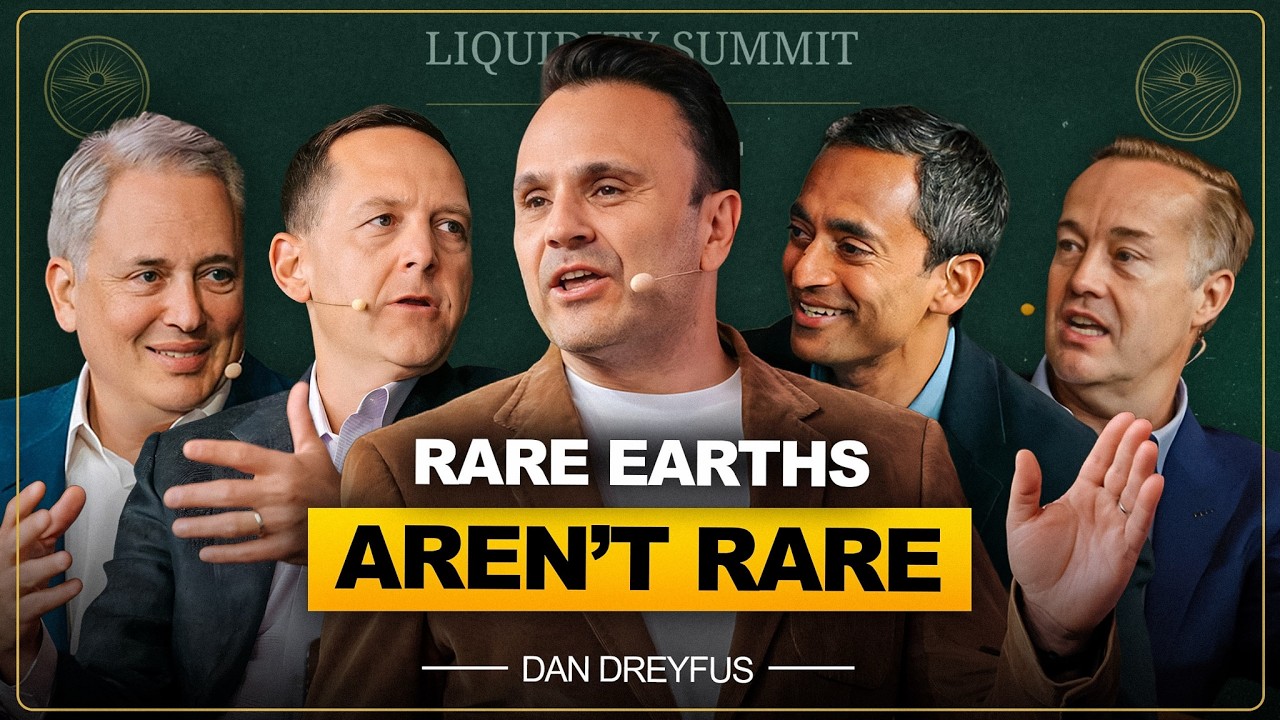
Dan Dreyfus: The Next AI Bottleneck is Copper
Dan Dreyfus, founder and CIO of Bornite Capital, delivers a rapid-fire 25-minute presentation at the All-In Liquidity Summit arguing that copper and critical minerals — not compute — are the true bottleneck for AI infrastructure, green energy, reshoring, and defense. He traces America's decades of underinvestment in physical infrastructure, documents the supply shock triggered when China cut off rare-earth exports last April, quantifies the staggering copper gap (the next 18 years require as much as the past 10,000), and layers on dollar debasement and grid fragility as further tailwinds for hard assets. Jason Calacanis, Chamath Palihapitiya, and David Friedberg push back and probe on craft labor, energy mix, and how to invest without getting run over by China price-dumping. ## [00:00] Intro Dreyfus opens by announcing the three-part thesis he will cover: measuring human progress by electricity consumed, viewing semiconductors as an infrastructure company, and working out what physical materials the world will need to reach its technological ambitions. He sets the pace with a preview — critical minerals, commodities, fragile infrastructure, and why trillions are required across reshoring, re-industrialization, and national security. > *"We try to figure out where the world is going and then we try to figure out what we're going to need to get there."* ## [00:33] Americas Capital Light Era Is Over The Infrastructure Reckoning Has Begun From roughly 2000 to a few years ago, the US ran what Dreyfus calls an economic miracle on almost no capital — Google, Meta, Apple, SaaS platforms, streaming, food delivery, all built without heavy physical investment. The flip side: America simultaneously dismantled its industrial base and shipped it to China. Every geopolitical shock since — COVID, Russia-Ukraine, tariffs, the Iran conflict — has spiked inflation "like a rocket" for the same reason: supply chains with no resilience. Now every major capital cycle is firing at once. Boeing and Airbus have a trillion-dollar backlog for the next decade; the space economy competes for the same materials. The US grid in parts is over 106 years old and barely handles current load — in California, mass EV charging at 6 p.m. alone would kill it. Data centers now consume a trillion dollars per year of infrastructure and commodities. Semiconductor fab capacity is racing back onshore at $750 billion — a figure Dreyfus calls "way too low." Defense budgets worldwide are expanding. Every single one of those end markets, he says, cannot function without critical minerals. > *"What the similarity is amongst all of these end markets is none of them will work without critical minerals. None of it."* ## [05:38] China Cut Off Our Critical Minerals and Ford Almost Shut Down Last April, China announced an export cutoff on a list of critical materials: samarium, gadolinium, terbium, dysprosium, lutetium, scandium, yttrium, erbium, silver — just cut off. The downstream effect was immediate: the Ford Motor Company was within days of shutting down its entire production line due to the loss of samarium-cobalt magnets. McDonnell Douglas faced the same crisis. The Pentagon and Department of Energy panicked. The administration's response: a three-document rescue package delivered directly to small resource owners across the US and Canada — an equity check, a permit (the same permit companies had been waiting 20 years for), and a take-or-pay offtake agreement with a minimum floor price to guarantee bankable returns. China has an absolute grip on critical mineral processing, and Dreyfus estimates it will take 10 to 20 years to meaningfully close the gap — but as he puts it, "we've got to start somewhere." > *"It's truly what I call a vuja day moment, which is the overwhelming feeling that none of this has ever happened before."* ## [08:18] Copper Why the Next 18 Years Need as Much as the Last 10,000 Copper is the single clearest example of the supply-demand dislocation. Solar requires five times the copper of a gas turbine per megawatt; wind requires seven times. A 1-gigawatt AI data center needs 50,000 tons of copper — and the US is planning to build 15 gigawatts per year, meaning those data centers alone will demand 750,000 tons annually. Total copper supply growth last year was 500,000 tons. Electric vehicles add further pressure: each EV uses five to six times the copper of an internal combustion car. Even military consumption is enormous — the Ukraine-Russia conflict used more explosives than all of World War II, and artillery shells are made of copper that is never recovered. Over the past 10,000 years of human civilization, we have mined 700 million tons of copper. At current GDP-growth trajectory (excluding AI and green-energy upsides), demand over the next 18 years will equal that entire 10,000-year total. To meet that, five world-class tier-one mines would need to come online every year — yet the number of tier-one mines opening before 2030 can be counted on one hand. Existing mines in Chile are depleting, and building a new copper mine takes 7 to 12 years. > *"Over the next 18 years, we're going to need as much copper as we mined in the last 10,000 years."* ## [12:00] Dollar Debasement $140T in Debt and Why Hard Assets Win After covering supply and demand, Dreyfus adds a monetary dimension. The US has $40 trillion in federal debt growing at $2.5 trillion per year, plus $100 trillion in discounted present value of unfunded social liabilities (Medicare, Medicaid, Social Security, pensions) also growing at $2.5 trillion per year — against total annual tax receipts of $5.5 trillion. In the next recession, when receipts fall and spending must rise, the US will print "giga dollars." The 1970s playbook repeats: currency loses purchasing power, and the best-performing asset class of that decade is assigned as homework to the audience. Chamath notes that on the All-In predictions show he had already called copper as the top-performing asset — before meeting Dreyfus. Dreyfus adds that he sees copper doubling from current levels as a minimum outcome, referencing molybdenum's move from $1 a pound to $33. > *"Commodities and hard assets and infrastructure will protect your purchasing power in that kind of environment."* ## [13:50] The Grid Is Dying Blackouts Bottlenecks and the Craft Labor Crisis Chamath asks Dreyfus to expand on a backstage comment: that current infrastructure investment will barely keep pace with existing energy demand, before counting AI at all. Dreyfus confirms: post-WWII, the US stopped hardening the grid. Electrification of commercial buildings (heat pumps replacing gas boilers), EV penetration, and growing device usage alone will cause blackouts and brownouts — AI demand is on top of that. Where the inflation is actually hiding: not in power generation (wholesale power prices are still down in real terms over 20 years) but in transmission and distribution costs, inflated by utility capital spending to boost their regulated asset base. The real constraint on all of it is craft labor — electricians, welders, pipefitters. America told a generation of kids to go to liberal-arts college instead of trade school, and now there is no one to build. David Friedberg asks whether technology breakthroughs in mining could close the gap. Dreyfus distinguishes between rare earths (abundant in the ground, extraction technology is improving) and processing: China controls the knowhow to convert raw ore into usable material, and for a commodity as large and ubiquitous as copper, no single technology can solve the scale problem overnight. Jason Calacanis observes that the China rivalry and the craft labor shortage point in the same direction: re-industrialization creates exactly the high-paying blue-collar jobs that displaced workers in the Rust Belt have been waiting for. > *"We're going to have shortfalls just from living our lives. Not even talking about AI."* ## [19:10] How to Invest in the Commodity Supercycle Without Getting Wrecked The tables have turned for blue-collar America: the same Rust Belt workers displaced when factories moved to China in the 2000s are now being recruited at entry-level salaries of $150,000 from trade programs. Dreyfus says the craft labor demand for the rebuild is "almost limitless." Chamath asks how to allocate across energy sources — natural gas, solar, nuclear. Dreyfus's view: the US is swimming in natural gas; solar is buildable but constrained by silver (a 200-million-ounce annual deficit against 600 million ounces of above-ground inventory — roughly three years to stockout); nuclear is bottlenecked by the inability to manufacture containment vessels domestically. Across all of them, raw inputs are not the binding constraint — the critical minerals required to build the generation assets are. Chamath pushes on where investors get wrecked: supply shocks, China price-dumping, technological disruption. Dreyfus's two-step framework: first, understand where the pinch points are in the supply chain; second, make sure the tight link cannot be replaced overnight by a new technology. Copper clears both tests. Jason summarizes the actionable takeaway for the audience — exposure to copper, silver, and critical minerals, plus the service and labor providers surrounding those assets. > *"You got to understand where the pinch points are in the supply chain, number one. And number two, make sure you're not going to get technologically disrupted."* ## Entities - **Dan Dreyfus** (Person): Founder and CIO of Bornite Capital; 25-year commodities investor presenting at the All-In Liquidity Summit. - **Jason Calacanis** (Person): Host of All-In Podcast; interviewer at the Summit; represents Launch Fund. - **Chamath Palihapitiya** (Person): Host of All-In Podcast; Social Capital founder; had independently predicted copper as top-performing asset. - **David Friedberg** (Person): Host of All-In Podcast; Ohalo Genetics; raised the innovation-in-mining angle. - **Bornite Capital** (Organization): Copper and critical minerals-focused investment firm founded by Dan Dreyfus. - **Copper** (Concept): Central commodity thesis — structural supply deficit meets surging demand from AI data centers, EVs, green energy, and military applications. - **Critical Minerals Supercycle** (Concept): Simultaneous demand shocks across aerospace, defense, data centers, EV, and grid modernization converging on materials that take 7–20 years to bring to market. - **Dollar Debasement** (Concept): $140 trillion in combined federal debt plus unfunded social liabilities as monetary tailwind for hard assets and commodities. - **Craft Labor Shortage** (Concept): Structural deficit of electricians, welders, and tradespeople as the binding bottleneck for grid modernization and re-industrialization. - **Ford Motor Company** (Organization): Referenced as a near-casualty of China's samarium-cobalt magnet export cutoff — came within days of a full production shutdown.

We Tested Anthropic's Fable 5 for a Week
Dan Shipper, CEO of Every, spent a week with Fable 5 — Anthropic's Mythos-class frontier model — before its public launch and walked away genuinely changed. Every's senior engineer benchmark put Fable at 91/100, against 63 for Opus 4.8 and 62 for GPT-5.5 — a jump Dan describes as "warp drive" capability for sustained autonomous work. The model is slow, expensive, and token-hungry, but for anyone orchestrating big, multi-hour agentic tasks, there's nothing close to it right now. ## [00:00] One prompt built an infinite 3D library Dan opens with a live demo: a fully browsable 3D version of Jorge Luis Borges's "The Library of Babel" — hexagonal galleries, accurate mathematics from the story, working bookmarks — all generated by a single prompt. He gave Fable a one-line instruction to read the story, plan, and execute a browser-playable 3D game end-to-end. The model ran autonomously for three to four hours, self-checked its work, and shipped. > *"I made this entire thing in a single prompt with Fable 5, the new model from Anthropic."* ## [01:22] Our day-zero Fable 5 review Dan introduces himself and Every's approach: they test models hands-on for real production work — programming, writing, design, business decisions — and report back on what actually works. Fable generated unusual levels of pre-release hype; Anthropic had initially said it was too dangerous to release. After a week of internal access, Every's take is that the model is genuinely different, and Dan's goal here is to cut through the excitement and show the realistic picture. > *"Because we've been using this model for about a week now, we get to pull back the curtain a little bit and show you what it's like to have lived with this model."* ## [02:25] What a Mythos-class model is Mythos is Anthropic's new top-tier model family, sitting above Haiku, Sonnet, and Opus in their lineup. Architecturally it's not novel — same transformer family, just bigger. Anthropic added strict safety guardrails (no cyber, no biological use cases) to make it releasable. Pricing is steep: $10/M input tokens, $50/M output — roughly 2× Opus. Dan's verdict from a week of use: genuinely the most powerful coding model he's ever touched, by a wide margin. > *"It is just genuinely the most powerful coding model I've ever used by far."* ## [03:28] The 91/100 engineering benchmark Every runs a proprietary senior engineer benchmark: the model is handed a real "vibe-coded slop" production codebase and asked to rewrite it from first principles as a senior engineer would. Prior to Fable, the top score was Opus 4.8 at 63/100, with GPT-5.5 right behind at 62. Fable scored 91 — matching a human senior engineer in a single prompt. Dan had expected saturation of this benchmark in about six months; it happened in two weeks. > *"Fable scored a 91 on this benchmark. 91 out of 100. That's the same score as a human engineer with just one prompt. That's crazy."* ## [04:12] Why it feels like a warp drive Fable's core strength is sustained autonomous execution over multi-hour tasks. You give it a destination, leave it running, and come back to something finished. Unlike earlier Claude models that eagerly said yes to everything ("purple accents, purple accents"), Fable deliberates, pushes back when something can't be done well, and follows through on complex, loosely specified prompts. Dan's analogy: a warp drive — not instant, but it compresses what used to take months into hours. > *"You can specify a destination for a big trip, and it just compresses what normally would have been like years or months into like hours or days."* ## [06:10] Where the model falls short The warp drive metaphor cuts both ways: it's useless for getting around town. Tight back-and-forth collaboration, quick questions, rapid iteration — Fable is a poor fit for all of these. It's slow, expensive, and burns tokens aggressively. A non-obvious workaround: drop the reasoning level to medium or low for simpler questions; that's how Anthropic's own people use it internally. Without a big, meaty problem to throw at it, the model is overkill. > *"If you're using it for true collaboration or quick questions or things that need tight back and forth, I don't think it's that good for that."* ## [07:04] Building a Heidegger lecture site Dan describes asking Fable to grab philosopher Hubert Dreyfus's 2007 lectures on Heidegger — without even providing a URL — and turn them into a consumable mini-site. Fable found the lectures, wrote per-lecture summaries, built a synchronized player that highlights the transcript as audio plays, added chapter navigation, drop caps, and typographic choices that Dan characterizes as actual taste, not the default template output. One prompt, no scaffolding. > *"That's what I mean when I talk about this model having really exceptional taste and attention to detail."* ## [09:05] Finding a growth bet in customer data Every has ~10,000 paid and ~100,000 free subscribers and a backlog of survey data the team had been analyzing with AI for weeks without a sharp conclusion. Dan fed it all to Fable. In one pass, the model came back with: "You have a conversion merchandising problem. Your free-to-paid conversion ratio is lower than it should be." Then a falsifiable bet: ship pricing transparency and a trial offer, and it'll go up. That synthesis — reading survey responses, site analytics, and product state together — hadn't emerged from weeks of team analysis. > *"That is something that I would expect a really, really good growth person to do with a lot of time and thought and research."* ## [10:35] Clearing a real GitHub backlog Every's agent-native markdown editor Proof accumulates GitHub issues automatically as agents file bugs during use. Dan pointed Fable at two weeks of open issues and told it to close irrelevant ones and write Rust fixes for the rest. It swept through the backlog and produced patches the team actually merged. Other models can do this, but they require hand-holding — one issue at a time, constant check-ins. Fable just batched it. > *"And it just went boom boom boom boom boom boom. And actually wrote fixes that we merged."* ## [11:17] Who should actually use this model Dan is direct: Fable is not for everyone right now. Using Every's "eight levels of AI adoption" framework, it pays off at levels 7–8, where users are already orchestrating multiple agents and have large problems queued up — typically technical builders. For knowledge workers not yet running agent workflows, it'll feel like overkill; for casual vibe coders, the token costs are real friction. About half of Every's own early-adopter team saw immediate payoff; the other half is still growing into that workflow level. > *"Using it is a skill. You need to be exposed to problems and working at a level of expertise where the problems come up in order for it to be useful."* ## [13:31] Where other models still win Writing is the clearest gap: Fable's prose is dense, literary, and block-heavy — good for thinking through structural writing problems, not for copywriting or everyday sentence-level work. For Claude users, Opus 4.8 is still better for writing. For GPT users, 5.5 is a better daily driver. Dan himself keeps GPT-5.5 as his Codex driver for the quick back-and-forth that fills most of his day; Fable gets reserved for big production pushes. > *"For my day-to-day, it's a bit overkill even for me."* ## [14:26] What this means after automation Dan points to his essay "After Automation" as the frame: automation doesn't shrink human work, it creates more of it — a paradox. Fable follows the same pattern: it raises the floor for non-experts (a vibe coder can now one-shot a video game) and raises the ceiling for experts (an expert can build a AAA game solo). The displacement is real and he says it's normal to feel unsettled by it — but the capability curve means even people who can't afford Fable today will have access within six to twelve months. > *"This model increases the floor of capability for non-experts, but it also raises the ceiling for experts."* ## [16:02] The final verdict Dan closes with a straightforward recommendation: read the full Every vibe check for detailed benchmark breakdowns across coding, writing, and knowledge work, watch "After Automation" for the bigger-picture framing — and then go find the first big problem you've been avoiding and point the warp drive at it. > *"If you're psyched about this, the thing I recommend most is go use your new warp drive. And let me know what you make."* ## Entities - **Dan Shipper** (Person): Co-founder and CEO of Every; sole presenter in this episode; spent a week testing Fable 5 pre-launch. - **Every** (Organization): AI-native subscription media company focused on testing frontier models for real work use cases; ~10,000 paid subscribers. - **Fable 5** (Software): Anthropic's Mythos-class frontier model; scored 91/100 on Every's senior engineer benchmark at launch. - **Anthropic** (Organization): AI safety company; maker of the Claude / Opus / Fable model family. - **Mythos** (Concept): Anthropic's top-tier model family tier, above Haiku, Sonnet, and Opus; characterized by extended reasoning and high token cost. - **Senior engineer benchmark** (Concept): Every's proprietary evaluation — model rewrites a production codebase from first principles; scored out of 100; Fable hit 91, Opus 4.8 hit 63. - **Opus 4.8** (Software): Previous Anthropic flagship; scored 63/100 on Every's benchmark; still preferred for everyday writing tasks. - **GPT-5.5** (Software): OpenAI's comparable frontier model; scored 62/100 on the benchmark; Dan's personal daily driver for quick back-and-forth work. - **Hubert Dreyfus** (Person): American philosopher; author of "What Computers Can't Do" (1972); subject of the Heidegger lecture site demo. - **Proof** (Software): Every's agent-native markdown editor; used in the GitHub backlog-clearing demo. - **After Automation** (Concept): Dan Shipper's essay arguing automation creates more human work rather than eliminating it; referenced as the interpretive frame for Fable's broader significance. - **Eight levels of AI adoption** (Concept): Every's framework for classifying AI workflow integration depth; levels 7–8 are where Fable delivers the most value.
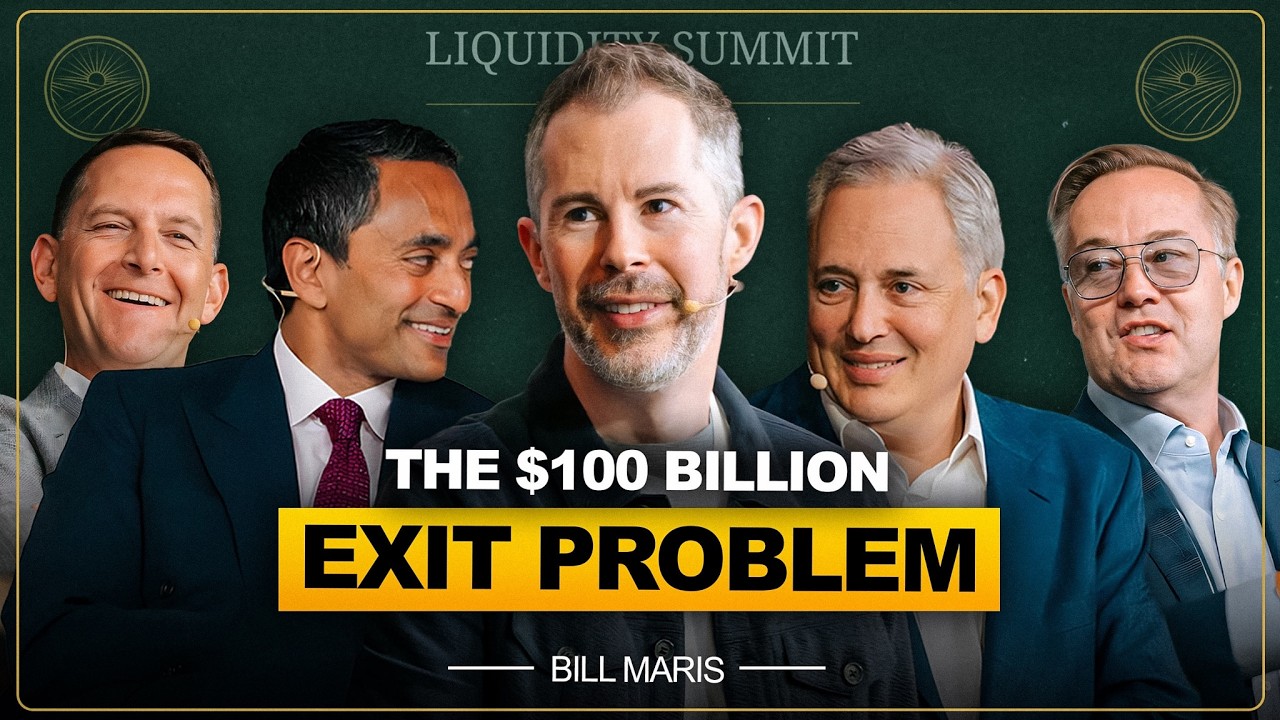
Bill Maris: How Google Could Crush AI Competitors, Why Small Funds Win, and AI's Atari Stage
Bill Maris — founding CEO of Google Ventures and founder of Section 32 — walks the All-In besties through four career lessons rooted in data-driven conviction: see the future early, be willing to look insane, never bet against computer science, and keep your fund small. He then turns the conversation toward a pointed threat to OpenAI: Google could slash token prices 80% tomorrow and crater the business models of every foundation-model startup not named Alphabet. On AI's trajectory, Maris reaches for a gaming metaphor — we're at the Atari command-line stage, and the PlayStation 10 era will arrive within five years, driven not by bigger models but by the infrastructure layer underneath them. ## [00:00] Bill Maris joins the Besties! The intro reel cuts between Maris's core thesis fragments before the conversation opens: a $150 million Section 32 fund sized deliberately small, a financial-return-first mandate, and Sacks's framing of the AI century to come. Six supervisions, each a standalone premise, set the stakes for the discussion. > *"With a smaller fund, I have the advantage to be very selective in the companies that I invest in, the people that I hire."* ## [00:33] Four critical lessons from a career in technology Maris opens with a talk-format presentation and traces four lessons across thirty years of career bets. In 1997 he quit a Wall Street job after spotting a server in a closet and imagining how many websites he could host from his Vermont apartment — three servers, shared bedroom, water-icing-over-at-noon winters, and eventually a thunderstorm that put him on the roof with a bucket of tar and no exit strategy. He tarred himself into a corner, chose to save the servers rather than himself, and noted afterward that the willingness to look completely insane is the prerequisite for seeing the future before others do. The slide he borrows from Stuart Butterfield makes the point visually: 1989 inauguration crowds look identical to 2005 ones, then 2009 shows every hand holding a camera — except one man livestreaming on a laptop, surrounded by people who must have thought him deranged. Maris's lesson is that the entrepreneurs worth backing "know a secret about the future that most of us don't believe." > *"To see the future, sometimes you need to be a little bit insane. It may appear to those around you that you are tarring the roof in a thunderstorm."* ## [05:58] Building Google Ventures with data and machine learning Tasked in 2007 with designing Google's venture arm from scratch, Maris and co-founder Rich Miner (Android co-founder) walked Sand Hill Road to learn the craft, then turned Google's data advantage into a portfolio-construction engine. They ran millions of simulations to determine ideal fund size and portfolio shape — at a time when Google's own leadership forbade the word "AI," insisting on "machine learning" because "AI freaks people out." The data-driven approach worked: GV returned an estimated 4.1x over 2009–2018, and the investments Maris personally led tracked even higher. Lesson three lands here: don't bet against computer science. "If you apply the right kind of computer science at the right time to the right problem, you will get to the right answers." > *"Bill, AI is science fiction. It is a hundred years away if it's ever going to happen. Let's stick to machine learning."* ## [09:51] Why small VC funds beat big ones on average Maris lays out the arithmetic plainly: funds under $750 million averaged 4.76x DPI in top-decile cohorts; funds over $1 billion averaged 2.42x. The sub-$750M bucket represented 95% of top-decile performers. The math isn't ideology — it's about exit arithmetic. A $7 billion fund must generate $210 billion in exits to return 3x, a number that exceeds total venture-backed M&A and IPO value in most years. Friedberg pushes back with a "barbell" thesis — small early-stage vehicles plus very large late-stage ones for compounders. Maris concedes the compounding logic but questions whether the data supports it as a durable trend rather than a one-time moment of trillion-dollar exits, and draws a clean distinction between RAIA-style asset gathering and concentrated venture craft. > *"Small funds outperform large funds. This is simply the math. This is not an opinion I'm trying to convince you of."* ## [14:36] OpenAI's valuation problem and the AI price war This is the sharpest segment of the conversation. Maris opens with a direct provocation: if he were running Google, he'd cut token prices 80% unilaterally. Chamath pushes him to walk through what happens next — OpenAI and Anthropic face revenue compression that goes "super critical," their premium pricing disappears, and business model assumptions collapse. Jason frames it as "their margin is my opportunity," with Google using capital as a weapon just as Uber used subsidized rides. The retail-investor angle lands as a second charge: companies staying private longer are, in Maris's framing, siphoning value creation away from the 99% who never got early access, then offloading overpriced paper to 401k holders through passive ETFs and S&P 500 exceptions. His objection isn't to late-stage staying private per se — it's to wrapping a wealth-concentration strategy in "benefit of humanity" language. Chamath asks where the bimodal nature of venture returns goes as AI-era funds like Founders Fund print enormous multiples; Maris notes that paper gains only realize when someone buys that stock, and the public market will eventually price those cash-flow discounts. > *"A trillion for spend commitments on $60 billion of revenue, and now you're going to go to the public and hope that retail is going to pick that up."* ## [19:09] AI's "Atari Stage": what comes next? Maris reaches for gaming as the clearest analogy for AI's current moment. Zork in the 1980s — brittle, turn-by-turn, crashed if you typed "lamp" instead of "lantern" — looks structurally identical to today's most sophisticated AI assistant interfaces. The jump from Atari command line to photorealistic, physics-driven, inhabitable games took decades in gaming; Maris expects the equivalent AI leap in five years, compressed by the speed of software iteration. What he's betting on isn't bigger foundation models — just as better stories didn't make better games, it was controllers, physics engines, and GPUs that did. Section 32 is investing in the infrastructure layer: ambient computing primitives, persistent memory, session continuity, the machinery that will solve AI's current brittleness. He also flags computational biology as the adjacent wave: Calico (which he founded at Google), New Limit, and the broader longevity space are attractive precisely because AI-enabled cell simulation may eventually collapse FDA trial timelines — though he's measured about near-term speed, given how much of drug development happens after a compound is identified. On US science brain drain, Maris is direct: gutting the CDC and NIH, anti-science policy, and H-1B pressure are pushing talent to China and elsewhere, and America is losing neurological reserves it spent decades accumulating. > *"I think we're at the Atari command-line stage of AI and we're going to get to the PlayStation 10 stage in the next five years."* ## [25:23] VC's broken incentives and the future of deep tech Sacks joins for the closing segment and frames the question as fund strategy: given the current landscape, is waiting to write $50 million checks at breakout companies a better strategy than noisy early-stage bets? Maris argues the incentive structure is broken at every layer. A $5 billion fund returning 1.01x still sits in the 75th percentile and raises its next fund; the GP makes more money in absolute dollars than a 3x return on a $500M fund; and entrepreneurs routinely take an inflated valuation from a giant fund — $250M at $4 billion on a $100M-worth company — because most haven't been burned by the downstream consequences. The incentives push everyone toward AUM maximization, not returns maximization, and the pendulum will eventually snap back. > *"If I have a $5 billion fund, I return 1.01x, I'm going to make more money than Bill with his $500 million fund that returns 3x. That's also a strange incentive."* ## Entities - **Bill Maris** (Person): Founding CEO of Google Ventures (GV); founder of Section 32, a $150M early-stage fund with six top-decile vintages; also incubated Waymo, Google X, and Calico as Google VP of Special Projects - **Jason Calacanis** (Person): All-In co-host; founder of Launch Fund; moderates the Maris Q&A segments - **Chamath Palihapitiya** (Person): All-In co-host; founder of Social Capital; challenges Maris on the valuation math and bimodal VC returns - **David Friedberg** (Person): All-In co-host; founder of Ohalo Genetics; first ex-Google company GV invested in (Climate Corp, $1B exit to Monsanto); pushes the barbell fund thesis - **David Sacks** (Person): All-In co-host; founder of Craft Ventures; frames the closing VC incentives discussion from his own fund experience - **Section 32** (Organization): Maris's current venture fund, six vintages averaging ~$400M, all top-decile; investments include CrowdStrike, Cohere, Coinbase - **Google Ventures / GV** (Organization): Corporate VC arm founded by Maris in 2008; estimated 4.1x return 2009–2018; early backer of Climate Corp, Uber, and others - **OpenAI** (Organization): Central to the price-war discussion; Maris argues Google could collapse its revenue model with an 80% token price cut - **Calico** (Organization): Google longevity research lab co-founded by Maris; pioneered the anti-aging thesis now carried forward by New Limit and others - **Atari Stage** (Concept): Maris's metaphor for AI's current maturity — functional but brittle, analogous to 1980s text-adventure games before GPUs and physics engines transformed gaming - **Token price war** (Concept): Thesis that Google could weaponize its cost structure to undercut OpenAI and Anthropic, forcing revenue compression and destabilizing multi-trillion-dollar private valuations - **DPI** (Concept): Distributed Paid-In capital — the only VC performance metric Maris trusts; filters out paper gains and forces comparison at actual liquidity - **Stuart Butterfield** (Person): Slack co-founder; provided the inauguration-crowd photo series Maris uses to illustrate how quickly technology shifts from fringe to universal - **Rich Miner** (Person): Android co-founder; Maris's first partner in building Google Ventures
Palo Alto Networks CEO: "AI Found 5 Years of Bugs in 6 Weeks"
Palo Alto Networks CEO Nikesh Arora joins the All-In besties eight years into his tenure — a stretch that took the company from a $17B to a $238B market cap. Over thirty minutes he covers three interlocking theses: AI-powered vulnerability discovery is already compressing years of security work into weeks; the analytical SaaS category is structurally dead; and models will commoditize into a utility layer while the real money accrues to application companies that own the harnesses, memory, and replacement TAMs on top. ## [00:00] Palo Alto Networks CEO Nikesh Arora joins the Besties! Chamath opens by noting that Palo Alto Networks crossed $100B market cap — a threshold at which the company becomes statistically more likely to 10x again to $1T. Nikesh, marking his eighth year as CEO this week, frames AI not as hype but as the latest democratization wave: "I spent 10 years at Google and Google search was democratizing information. AI is democratizing intelligence." He argues the most tangible near-term impact is organizational consistency — getting 5,000 customer-facing employees to behave as reliably as the best one — rather than replacing headcount outright. > *"AI is democratizing intelligence... I can get 5,000 people to act almost consistently in their interactions with people on the other side."* ## [00:47] Claude Mythos found years of vulnerabilities in Palo Alto's code in weeks Nikesh describes being among the first enterprises given access to Anthropic's Claude Mythos model and running it against Palo Alto's own codebase for six weeks. The result: the equivalent of five to seven years of security auditing compressed into that window, at a cost in the low millions of dollars. He explains that Mythos's "ultra mode" — persistent extended thinking — can daisy-chain individual vulnerabilities into full attack paths, something human red teams rarely accomplish at scale. The catch he volunteers is a 30% false-positive rate, making the tool effective for offense (finding bugs) but not yet ready for autonomous defense. Jason asks whether unrestricted public release would have triggered real attacks; Nikesh estimates that Mythos-level capability is at most three months from open-source availability, citing DeepSeek 4.8 and 5.5 as models already approaching similar power. > *"In 6 weeks we found vulnerabilities which would have normally taken us 5 to 7 years to find."* ## [05:15] Are cyber defenders losing the race against AI attackers? David Sacks frames the central tension: AI is simultaneously the best attack tool and the best defense tool, and the race between the two determines enterprise risk. Nikesh says defenders are currently losing — not because critical infrastructure is being cracked, but because 89% of breaches still trace to stolen credentials against mundane targets like small healthcare offices. He points to the Change Healthcare ransomware attack as the real threat archetype: a clearinghouse breach that forced United Health to extend billions in emergency credits to physician practices. National-security infrastructure has the budgets and personnel to respond; the millions of small offices running legacy package software do not. His conclusion is that there is no silver bullet — the industry will spend years patching the accumulated technical debt, which structurally grows the terminal value of Palo Alto's business. > *"89% of attacks happen because credentials get stolen... I'm worried about the small offices across the country where they're using some piece of package software."* ## [06:50] Analytical SaaS is dead, so what survives the AI wave? Nikesh segments the SaaS stack into three buckets with very different futures. Analytical SaaS — any product whose value proposition is "we collect your data and analyze it for you" — is finished, because a model can be pointed directly at raw data and produce the same analysis without a SaaS intermediary. He gave a live example: a vendor that tried to hold Palo Alto hostage on a licensing renewal was replaced by running an LLM directly against the underlying data. Infrastructure software (Databricks, Snowflake, MongoDB, Oracle) is undervalued — enterprises will need ten times current data storage within three years to feed AI systems. Systems of record (Salesforce, Oracle ERP) survive in the medium term because they are deeply embedded, but their UI layer goes away first as agents replace human data entry. Jason validates the pattern from his own portfolio: a 20-seat SaaS product with near-zero logins was collapsed to three accounts connected to Claude via Slack, cutting the bill 90%. > *"If you're an analytical SaaS company, it's over... I can just go run an LLM against the data."* ## [14:06] If models become a utility, where will the money be made? Nikesh disagrees with the OpenAI-as-Microsoft-Office thesis. He argues models will commoditize into an IQ-on-demand utility — pay $10 for 120-IQ reasoning, 1 cent for a routine customer call — so profit pools will concentrate in the application layer, not the model layer. He cites Codex and Claude Code as evidence that lab-owned coding applications are already outrunning the underlying models in revenue growth. The real gap, he argues, is that the agentic application layer has not yet been invented for most enterprise verticals: 50,000 companies all need the same AI-native HR or sales system, and it is inefficient for each to build it from scratch. He adds that the false-positive problem is the underappreciated bottleneck — Mythos's 30% rate is fine for R&D but unacceptable in production; getting to sub-1% is the engineering work that separates a capable model from a deployable product. Separately, he dismisses the idea of withholding powerful models, noting that a leading model's entire weights now fit on a USB stick and can be distilled in under 48 hours. > *"The profit pools are in applications, not in models... most companies have no idea how to use the models."* ## [20:35] Armchair CEO: Nikesh rates Waymo, Google, and OpenAI Chamath runs Nikesh through an armchair CEO segment. On Waymo: the cars work, and the company should expand to far more cities far faster. On Google: underrated and likely the first $10T company in his lifetime — the three hyperscalers hold the sales forces actually needed to monetize AI at enterprise scale, an asset pure-play labs lack. On OpenAI: they need to sell faster; Anthropic's ARR is growing more quickly, largely because Anthropic went all-in on enterprise and Claude Code specifically. He notes Anthropic has already released a generally available cyber-capable model for CISO use. David Friedberg earns partial redemption from an earlier founder-CEO dig by calling Nikesh a "Neo in the matrix" anomaly — a hired-hand CEO who takes ownership risk as aggressively as any founder. > *"Google is going to be the first 10 trillion dollar company in our lifetime. They have all the assets needed to make this successful."* ## [28:22] Palo Alto's M&A playbook and the path to $1 trillion Chamath asks how Nikesh maintains acquisition discipline as the company scales toward $1T. He describes two phases: early deals were product bolt-ons fed into Palo Alto's go-to-market engine, compounding revenue per customer over two-year cycles; the recent $25B identity-security acquisition (closed three months before this recording) reflects a thesis about agentic identity becoming the next attack surface. A third phase thesis is now forming around operational leverage: if Palo Alto can run at gross margins in the 90s and net operating margins in the 40–50% range while competitors cannot, then almost any adjacent acquisition becomes accretive simply by plugging it into a more efficient machine. He closes with a contrarian workforce call — headcount on the technology side is actually growing, not shrinking, because every part of the business is simultaneously demanding AI-driven transformation. > *"If you can crack that code — running the most efficient enterprise business — then it doesn't matter what you buy."* ## Entities - **Nikesh Arora** (Person): CEO of Palo Alto Networks for eight years; former Chief Business Officer at Google and President of SoftBank; board member at Uber. - **Chamath Palihapitiya** (Person): Host; founder of Social Capital; primary interviewer in this episode. - **Jason Calacanis** (Person): Host; founder of LAUNCH; co-interviewer. - **David Sacks** (Person): Host; Craft Ventures; frames the attacker-vs-defender race framing in chapter 3. - **David Friedberg** (Person): Host; The Production Board; adds false-positive/negative framing; challenges founder-vs-hired-CEO distinction. - **Palo Alto Networks** (Organization): Cybersecurity company; $238B market cap at time of episode; grew from $17B under Arora's tenure. - **Anthropic** (Organization): AI lab; developer of Claude and Claude Mythos; released a generally available cyber-capable model for enterprise security use. - **Claude Mythos** (Software): Anthropic's extended-thinking model used by Palo Alto to find 5–7 years' worth of code vulnerabilities in six weeks; 30% false-positive rate noted. - **Claude Code** (Software): Anthropic's coding agent; cited alongside OpenAI Codex as a leading example of application-layer revenue outpacing model revenue. - **Waymo** (Organization): Alphabet-owned autonomous vehicle company; Arora says the cars work but geographic expansion is too slow. - **Change Healthcare** (Organization): Healthcare clearinghouse breached via ransomware; forced United Health to extend billions in emergency credits to physician practices — cited as the archetypal AI-era threat vector. - **Analytical SaaS** (Concept): Category of software whose core value is collecting and analyzing customer data; structurally obsolete because LLMs can perform the same analysis directly against raw data. - **Replacement TAM** (Concept): Arora's preferred M&A lens — acquiring into existing budget pools where customers already have allocated spend, making the sales motion faster than greenfield expansion. - **False positive rate** (Concept): Share of AI-flagged security findings that turn out to be non-issues; Mythos at 30% is Arora's key argument for why models still require harnesses and domain fine-tuning before enterprise deployment.
The Economics of AI Usage and What's Next For SaaS | Benedict Evans on a16z
Benedict Evans, independent tech analyst and former a16z partner, sits down with Erik Torenberg to assess what's actually happened in AI over the past year — and what remains unanswered. Agentic coding has moved from "kind of useful" to pulling customers in off the street; everything else is still groping in the dark. Evans draws on the history of mobile data, PC-era platform shifts, and semiconductor economics to frame why foundation models may end up as commodity infrastructure, what that implies for SaaS, and why the biggest questions are now moving out of tech and into industries like law, consulting, and advertising. ## [00:00] Intro Evans opens with the claim that agentic coding "went from being kind of useful to really changing everything" — a tease of his core argument that coding is the one place AI has genuine product-market fit right now, and that in twenty years we'll simply take for granted the things that feel like magic today. Torenberg frames Evans as the author of the widely-read "AI Eats the World" presentation, positioning the conversation as an update to last year's edition. > *"Agentic coding went from being kind of useful to really changing everything."* ## [00:44] What's Changed Since Last Year The main shift Evans identifies: product strategies have diverged, competitive tension has moved beyond raw compute scaling, and coding emerged as the undeniable breakout use case. OpenAI spent late 2024 trying to do everything at once; Anthropic, with less capital, bet on coding — and it worked. But outside of software development, most of the fundamental questions from two or three years ago remain unanswered: no one knows if there will be a winner among model providers, whether models can capture value up the stack, or how much daily consumer usage is realistic with current technology. On the workforce question Evans is blunt: "I don't think we've learned anything" — it didn't work six months ago and it's going to take a couple of years to settle. He notes that the coding boom made previously theoretical questions real: what actually happens when you automate work done by junior engineers, and what were you hiring them to accomplish in the first place? > *"We don't know if there'll be a winner in the models. We don't know if they can capture value up the stack. We don't know how much the models can do."* ## [05:53] OpenAI vs Anthropic Strategy Evans characterizes OpenAI's late-2024 posture as "ask ChatGPT for 15 ideas for what we could do to build value on top of infrastructure, and then we'll do all of them." Anthropic's narrower focus on coding proved the better call — whether by design or accident. But even with coding working, there's still a yawning gap between the valley engineers running Claude Code all day and the 40% of people who last used AI "for something last week." Software cleared that chasm; most other domains haven't. He gives a concrete counterexample: a commodities company using LLMs to improve cash-flow forecasting by predicting when invoices from small producers will be paid. That's a high-value, low-profile application with no general-consumer analogue — a reminder that enterprise point solutions are a very different thing from consumer AI product-market fit. Zooming out to platform history: early PCs and early internet both had obvious first users (the people building the technology itself) and a gap between "incredibly exciting" and "you can just press a button." AI is at the same stage. The comparison is inexact but structurally useful. > *"There's a gap between what's incredibly exciting and the small number of people who are willing to put the work in to get something to work and just turning that into a thing where you can just press a button."* ## [10:31] The Pricing Crunch & Platform History Evans draws the tightest parallel of the conversation: the current AI pricing crunch maps directly onto mobile data circa 2009–10. AT&T launched the iPhone with flat-rate data, everyone bought iPhones, 3G hit, and suddenly both extreme overage bills ($10,000 surprises) and network collapse from unlimited-bundle subscribers appeared simultaneously. The industry fixed it — capped bundles, fair-use throttling — but in doing so revealed that mobile data is commodity infrastructure. Mobile traffic grew 1,500–2,000x over fifteen years; telco stocks flatlined; all the cool stuff was built by someone else. The exact same question hangs over LLMs: can the model do the whole job, or do you need 300 apps built on top of it? If foundation models are infrastructure — sold at marginal cost, with three to six competing frontier providers, some subsidized by adjacent ad businesses like Google — where does pricing power come from? The chip layer (Nvidia) and OS layers (Windows, iOS) captured value in past cycles; ISPs and telcos didn't. Models currently look more like the latter: no network effects, no lock-in, no leverage over what gets built on top. > *"Mobile network operators didn't capture the value. Windows and iOS did — but they were doing something else; they had all these levers to go up the stack. And of course they have network effects which models don't have."* ## [22:48] What Comes After Coding The section most honest about uncertainty. Evans outlines the questions he thinks matter next: at what point do good-enough, cheaper models displace frontier cloud models (Apple's on-device push is the obvious test case); what does AI restructuring actually mean inside professional-services pyramids (law firms, consultancies, investment banks) — questions only answerable by people who know those industries from the inside, not from San Francisco; and what was just cost-prohibitive and is now within reach. He uses the Netflix/content-isn't-king framing: the questions that matter to Netflix are LA questions, not SF questions. Similarly, what AI means for law is a lawyer's question. What it means for Hollywood is Ben Affleck's question. The structural difference from past platform shifts: in 1995 you knew the physical constraints — not everyone could get broadband next week, PCs cost $3,000. With generative AI you don't know the constraint: a push notification tonight could announce a model at 2% of today's price. That changes how you think about what's possible. On advertising and e-commerce specifically, Evans sees a concrete near-term shift: today's ad systems know SKUs and purchase correlations; they don't know what things *are*. An LLM-native system would. That's why Google and Meta ad revenue is already accelerating — they're rolling this into recommendation and ad-targeting engines. The more speculative version is the full style-and-context coat recommendation; Evans thinks that's now plausible, not science fiction. > *"We're in 1997 and I'm trying to predict Uber and Airbnb. If we could actually predict what was going to happen, we'd live in a parallel universe."* ## [38:18] AI & the Future of Enterprise Software Evans's baseline for enterprise software: it will be cheaper and faster to build, there will be more competition, and pricing structures will shift — but we don't know toward what. He lays out the existing fleet in three buckets: big horizontal platforms (SAP, Workday, CRM), vertical SAS apps (a typical large US company has 300–400), and the improvised middle of Excel, email, and shared file systems. AI is another option in that landscape, not a replacement for the landscape. The architectural question is whether the LLM sits at the bottom of the stack (an intelligent feature inside Salesforce) or at the top (synthesizing data across Salesforce, Workday, email, and analytics to produce something no single tool could). The answer is probably both, depending on the use case. His broader point: SAS gave enterprises an order of magnitude more software. AI probably does the same again. Some SAS companies will get wiped out; investors don't know which ones, which makes it hard to derate the whole sector right now. The more subtle challenge is that much of what drives value inside organizations is undocumented, implicit, and baked into org-chart politics rather than written workflows — exactly the thing McKinsey charges to untangle, and exactly the thing that's hard to encode in a Claude skill. > *"The questions that matter here — what is the right way of doing this, why are people not doing the strategy — are problems in organizational management that are very hard to write down and very hard to bake into a Claude skill."* ## [48:43] The CapEx Problem Microsoft, Meta, and Google are each on track to spend over 50% of revenue on capex in 2026 — a ratio that makes telecom (15–20% of revenue) look lean. Combined guidance from the big four is $700 billion, roughly comparable to global oil-and-gas capex. Evans doesn't think there's a clean ROI answer here; the honest framing is that it's existential FOMO: you can't let the others get away with it, because if they do and this turns out to be the future of compute, your company ceases to matter (see Microsoft in the 2000s, IBM in the 1990s, Meta getting squeezed by Apple in the 2010s). The ROI measurement problem makes it worse. Most documented AI productivity gains so far — better analytics, faster slide decks, more responsive customer support — are hard to put a financial value on. Building a new revenue line with AI takes much longer. And there's a consumer-surplus dynamic: if a DCF used to take a week and now takes ten seconds, you do fifty DCFs but probably can't charge more for them. The productivity gain competes itself away into client pricing. > *"We can't spend $10 trillion a year on AI infrastructure because there isn't $10 trillion a year there to spend on it. So there's a finite — there are laws of physics caps on the amount of money available."* ## [55:07] Will Models Become Commodities? Evans clarifies his actual position: he's not asserting commoditization as a fact, he's presenting a chain of argument and asking someone to rebut it. No sustainable differentiation between frontier models, no network effects, no leverage over the stack, three to six competing providers each with different cost structures and business-model incentives. The mobile industry analogy again: built critical global infrastructure, grew traffic 1,500x, didn't capture the value — Google, Meta, Amazon, and Apple collectively produce more profit than the entire telecoms industry. The practical problem for foundation model labs: coding is a great business, maybe worth a trillion dollars of productivity. But how do you expand beyond software into the rest of the economy? That's where you end up partnering with Bain, McKinsey, Accenture, Infosys — because it turns out it's genuinely hard to work out what to do with this stuff if you're running a real company. Evans closes with the IBM ad from the early 1950s: a photograph of engineers holding slide rules, with the tagline "an IBM electronic calculator gives you 150 extra engineers." Every generation of technology feels unprecedented and, twenty years later, just looks like how computers have always worked. > *"It's going to be magic. And in 20 years time, we'll just say, 'Well, of course that's how it is. Computers have always done that.'"* ## Entities - **Benedict Evans** (Person): Independent tech analyst, author of "AI Eats the World" presentation; former general partner at Andreessen Horowitz. - **Erik Torenberg** (Person): Host; partner at Andreessen Horowitz focused on consumer and content. - **OpenAI** (Organization): Foundation model company; characterized as having pursued a broad "everything at once" product strategy in late 2024 before refocusing on coding. - **Anthropic** (Organization): Foundation model company; credited with earlier focus on coding that gave it product-market fit; maker of Claude. - **Claude** (Software): Anthropic's LLM and agentic coding assistant; referenced as a coding tool with strong product-market fit. - **Nvidia** (Organization): Current value-capture winner in the AI hardware layer; analogue to other infrastructure providers that captured value in prior platform cycles. - **a16z / Andreessen Horowitz** (Organization): Venture firm hosting the podcast; Evans is a former partner. - **SAP / Workday / Salesforce** (Software): Enterprise horizontal platforms used to illustrate the existing SAS stack and where LLMs fit above or below them. - **Jevons Paradox** (Concept): Economic principle — cheaper inputs often produce more total consumption rather than less spend; Evans applies it to ask whether cheaper AI tokens lead to more usage or just lower bills. - **Foundation model commoditization** (Concept): Evans's central thesis: absent network effects, differentiation, or stack leverage, frontier LLMs structurally resemble commodity infrastructure (telcos, ISPs, chip fabs) rather than platform OS layers that captured lasting value. - **Mobile data pricing crunch** (Concept): 2009–10 analogue — simultaneous bill shock and network overload after flat-rate iPhone plans collided with 3G video traffic; Evans uses it as the clearest structural parallel to today's AI token-pricing disequilibrium.
EMERGENCY DEBATE: The Death Of The Middle Class! Only The Top 1% Will Survive!
In a 2.5-hour live debate, venture capitalist Nick Hanauer — first outside investor in Amazon and author of the "pitchforks are coming" open letter to fellow billionaires — and entrepreneur Daniel Priestley square off over the death of the middle class: whether the fix is stronger labor policy and redistribution, or wider access to entrepreneurship and ownership. Steven Bartlett referees as both guests push each other past talking points into genuinely contested territory on AI job displacement, minimum wages, Brexit's economic toll, sovereign wealth funds, and whether the Monopoly analogy explains why a thriving middle class never emerges on its own. The two agree on the diagnosis — concentrated power in big finance and big tech is hollowing out ordinary workers — but split sharply on the cure, with Hanauer insisting wages and worker rights are the structural floor and Priestley arguing that "raising the floor" without changing who owns assets is not nearly enough. ## [00:00] Intro The opening drops viewers straight into the argument. Hanauer fires first: "There is literally no example on planet earth of a high functioning society without big government." Priestley counters immediately: "Big government is sucking the life out of small businesses." Within two minutes the core tension is live — Hanauer's faith in policy and labor standards versus Priestley's faith in entrepreneurship and ownership — and Bartlett notes the audience is watching precisely because both men have real-world receipts for their positions. > *"There is literally no example on planet earth of a high functioning society without big government."* ## [02:27] Why Nick Hanauer's Economic Views Matter Bartlett asks Hanauer why a billionaire ends up arguing for higher taxes and worker protections. Hanauer traces the arc: he built and sold companies across manufacturing, e-commerce, and media, became Amazon's first outside investor, and eventually recognized that his own wealth kept compounding while the workers who made it possible fell further behind. He calls it straightforward arithmetic: "You cannot sustain a capitalist democracy if the top 1% controls 45 or 50% of income and the bottom 50% shares five." His Pitchfork Economics project exists to shift the intellectual frame that leads policymakers to produce those numbers. > *"You cannot sustain a capitalist democracy if the top 1% controls 45 or 50% of income and the bottom 50% shares five."* ## [06:27] Daniel Priestley's Different Take On Wealth Priestley grew up in Australia, discovered entrepreneurship as a teenager through a mentor, and built Dent Global into an international business education firm. He shares Hanauer's alarm about concentration but reaches the opposite prescription: the way to include more people in capitalism is to teach them to operate like capitalists — starting businesses, owning assets, building skills that can't be automated. "I felt like I discovered a cheat code in life which was entrepreneurship," he says, and his mission has been to hand that code to as many people as possible before political frustration produces the "dumb things" that undo market dynamism. > *"I just want to include more people in the benefits of capitalism before we do dumb things."* ## [08:32] Is Taxing The Rich The Answer? Bartlett poses the dominant political narrative: tax the wealthy, redistribute. Priestley pushes back not on the goal but on the mechanism. He distinguishes between a James Dyson — someone who invented a product and captured value — and a hedge fund that extracts value without creating it. His preferred target is rent-seeking and extraction, not wealth creation. He'd remove taxes on lower earners and claw revenue back from financial instruments and land value appreciation, not from entrepreneurs building products. > *"It's very easy to have a bad guy of a rich person. But you have to be specific about which rich person."* ## [11:44] Do The Wealthy Already Pay Enough Tax? Hanauer demolishes the claim that American billionaires already pay high taxes. US tax law taxes income, not wealth — and ultra-rich individuals rarely take income, borrowing against asset portfolios at rates that are functionally untaxed. The labor share of US income has fallen dramatically since the 1970s while the capital share has grown. His argument is not that the rich are evil but that the tax code was systematically rewritten to channel productivity gains away from workers. "We have massively tilted the economic playing field which once favored workers." > *"It is not true that the richest people in the United States pay a lot of tax because the American tax code taxes income, not wealth."* ## [15:07] Entrepreneurship Vs Policy: What Works Best? Priestley argues optionality is the deepest driver of wages: when workers have real alternatives — including starting their own business — employers can't impose terrible conditions. A market with many small employers competing for talent naturally produces better pay than one dominated by a handful of megacorps. Hanauer agrees optionality matters but says most workers can't realistically exercise the entrepreneurship option, and minimum wage laws, unions, and overtime protections do for the 90% what entrepreneurship can only do for the 10%. Both land on the same structural critique — labor market power is too concentrated — but split on whether policy or education is the lever. > *"When someone has lots of options, then they don't accept terrible conditions."* ## [20:05] The Policy Fix For Inequality Hanauer names a concrete mechanism: the US federal overtime salary threshold — the income level above which workers stop qualifying for time-and-a-half — covered 65% of salaried workers in the 1960s and today covers fewer than 8%. That single policy shift, requiring no new legislation, transferred trillions from workers to employers over fifty years. His argument: fix the rules that govern what the market pays before demanding more redistribution on top. Priestley concedes the point on wage suppression but circles back to ownership: the UK's unhappiness deficit isn't just about wages — it's about people who work for decades and accumulate nothing. > *"That standard used to apply to virtually every worker in America in 1970. Today that standard applies to less than 10% of workers."* ## [24:53] US Vs UK: Which Economy Wins? Hanauer points out that the US federal minimum wage is $7.25 — roughly a third of the UK level — and in many states a tipped worker earns $2.13 plus gratuities. The UK floor for low-wage workers is dramatically higher. Priestley counters that UK labor costs, combined with National Insurance and business rates, are now genuinely squeezing small operators and driving ambitious founders to relocate rather than scale. The US wins on startup dynamism; Priestley argues the UK is destroying the conditions that once made it competitive. > *"The minimum wage in the United States is $7.25 an hour or $2.13 plus tips. It's a third of what it is here in the UK."* ## [26:57] Do Higher Wages Hurt Small Business? Priestley grounds the debate in a specific case: a friend who owns a pub is losing money, not taking a salary, crushed by minimum wage increases, employer National Insurance, and business rates arriving simultaneously. The pub does not have Amazon's margin to absorb costs. Hanauer acknowledges the problem is real but says the right response is not to lower the floor for everyone but to go after megacorps that escape tax while the pub cannot. Bartlett notes the structural asymmetry: Starbucks says "we can absorb it" and the independent café closes. > *"He's massively impacted by taxes and minimum wage. He's not taking any money out of it."* ## [28:38] Why Small Businesses Can't Match MegaCorp Pay The Starbucks-vs-local-pub framing continues. Hanauer says a ham sandwich at a chain now costs twice what it did twenty years ago, so higher wages don't destroy demand — they get passed on. Priestley argues small businesses aren't just slower versions of big ones: they exist because of personal relationships, flexibility, and local knowledge that chains can't replicate. When the cost floor rises faster than their revenue can, they close. Both agree the real enemy is the regulatory and tax architecture that lets megacorps optimize globally while the corner shop pays full freight locally. > *"One person with good AI tools may be ten times more productive. That's great for that person. It's not so great for the other nine."* ## [33:02] What Workers Need Right Now Hanauer returns to the ownership question and agrees asset ownership is crucial — but insists it starts with wages. You cannot save if you cannot earn above subsistence. "Ownership starts with earning enough money so that you can save money so that you can begin to own something." He cites the 1990s US stock-option experiments — giving low-income workers equity rarely worked because the options vested after the workers had already left. Real ownership requires a wage floor that generates disposable income first. > *"Ownership starts with earning enough money so that you can save money so that you can begin to own something."* ## [35:59] Ownership Models That Build Wealth Priestley outlines three ownership models worth scaling. First, sovereign wealth funds on the Norwegian and Singaporean model: governments take equity stakes in national assets and every citizen holds a fractional share. Second, worker ownership co-ops and employee share schemes that vest on shorter timelines. Third, housing — where roughly half a property's market value is what he calls "utility value" (you need a place to live) and the other half is pure land value inflation that tenants pay indefinitely without ever capturing. His core claim: redistributing income taxes is too slow; you need policies that change who holds assets. > *"About half the value of the house is the utility value. The other half is the land value — and tenants pay that forever without ever owning it."* ## [40:28] The Real Impact Of Worker Rights Bartlett presses on whether higher worker protections actually close inequality or just slow its widening. Hanauer cites Brexit's measurable damage — productivity gains down 4%, unemployment up 4% above the counterfactual — as evidence that institutional frameworks matter enormously. The UK cut itself off from European labor and trade rules in one decision and is still absorbing the cost. Both guests agree the baseline institutional quality of an economy shapes outcomes far more than any single tax rate. > *"Brexit has affected unemployment by 4%, productivity gains by 4%. The list goes on."* ## [41:30] What Brexit Really Changed Hanauer sharpens the Brexit argument: departure removed frictionless access to 500 million consumers while shrinking the labor pool. Priestley agrees Brexit was economically damaging but argues the UK's deeper problem predates 2016 — the financialization of the British economy through the City of London meant that well before Brexit the UK was a two-tier economy where financial services boomed and manufacturing hollowed out. Both agree the US is the outlier among advanced economies in how far it has stripped worker protections, but the UK has followed a similar trajectory in asset concentration. > *"The USA is the outlier of all the modern capitalist economies when it comes to how far worker protections have been stripped back."* ## [45:01] The Hidden Lessons Of K-Shaped Economies Priestley pulls back to the early 1800s: today's headlines about record profits for capital alongside stagnant worker wages are word-for-word the headlines from the Engels Pause — the fifty-year period after the Industrial Revolution when steam, looms, and tractors destroyed agricultural employment and the owners of those machines captured all the productivity gains. The fix then took two generations of political struggle — unions, labor standards, trade protection — before workers clawed back a share. Hanauer adds that the pause ended because political consensus shifted, not because markets self-corrected. > *"You could almost take every grievance that we have today and overlay it in the early 1800s and get the exact same words."* ## [47:28] Will Companies Leave If Taxes Rise? Bartlett names the entrepreneur's objection: UK founders are already leaving for Dubai, Miami, and Singapore to escape the tax environment. Raise taxes further and the productive class emigrates. Priestley doesn't dispute the trend and argues that threatening corporate flight is precisely how megacorps hold governments hostage. His counter-proposal borrows from broadcast licensing: if you want to serve UK customers, you pay a fixed territorial fee regardless of where you're incorporated. You can't threaten to leave if the revenue is geographically locked. > *"Pop off to Dubai, run the business virtually, and pay no tax."* ## [51:58] Should Global Corporations Pay More Tax? The global minimum corporate tax attempted by the Biden administration comes up. Hanauer explains the design: if every country applies a floor rate, no jurisdiction can compete on tax below it and the race to the bottom ends. The 15% OECD deal was partial progress but exempted too many structures. Both guests agree a functioning global tax floor is probably the single most powerful lever for capturing megacorp revenue, and both are pessimistic it will happen because the political will to enforce it conflicts with the sovereignty of tax havens that benefit from the status quo. > *"Every rich person I know in Europe is playing this ridiculous game of trying to avoid taxes."* ## [54:00] How MegaCorps Block Entire Markets Bartlett cites Australian and Canadian examples: when governments tried to make Meta pay for news links, Meta simply blocked all news content rather than pay. When California tried to force Amazon to collect local sales tax, Amazon threatened to pull out of the state. Hanauer's point: if every jurisdiction simultaneously imposed the same rule, the megacorp could no longer play one off against another. The leverage only exists because coordination among governments is fragmented. > *"If every state required Amazon to collect local sales tax then obviously they couldn't do any of that. They would have to deal with it."* ## [54:58] Solutions To Economic Inequality Approaching the first ad break, Bartlett asks both guests to state their cleanest solution. Hanauer: tilt the playing field back — minimum wage, overtime rules, anti-monopoly enforcement, global tax coordination. Priestley: all of those, plus fundamentally restructure who owns assets; raising the floor without changing the ownership structure still leaves most people watching asset prices outpace any wage gain. The pitchforks are already out, Priestley says, because workers have nothing left to lose — which means the floor-raising came too late. > *"You have to do both. Tilt the playing field and change who holds the assets."* ## [56:51] Ads *Sponsor break — LinkedIn Marketing Solutions, Pipedrive CRM, Wispr Flow voice-to-text.* ## [58:59] How Many Jobs Will AI Replace? After the break Bartlett pivots to AI. Eric Schmidt's commencement speech — where every mention of "AI" was booed by graduates who assumed it meant their jobs were gone — frames the anxiety. Hanauer says the standard "AI creates new jobs" narrative misses a timing problem: new jobs appear over a generation, but displacement happens in a quarter. He acknowledges AI is "monetizing for free humanity's intellectual property" and concentrating the returns in a handful of companies. Priestley notes the uneven geography: the Philippines' outsourced back-office economy is already being hollowed out by AI doing those same tasks at a fraction of the cost. > *"AI is monetizing for free humanity's intellectual property and a few people are going to directly benefit."* ## [01:01:38] AI Agents Are Replacing Entry-Level Work Bartlett describes what modern AI agents actually do — click through interfaces, complete multi-step browser tasks, handle data entry, edit documents — and notes his own first job after dropping out of university was exactly that kind of work. Hanauer argues the correct frame is augmentation: one person with strong AI tools may be ten times more productive, which is good for that person but terrible for the nine others whose roles disappear. Priestley gives a case study: a husband-and-wife video production agency in northern England used AI to automate script writing and cut their team from six to two while doubling output. > *"One person with good AI tools may be ten times more productive. That's great for that person. It's not so great for the other nine."* ## [01:05:25] Will AI Reduce Hiring? The Jevons Paradox debate surfaces: historically, making tasks cheaper increases demand for them, which absorbs the displaced labor. Priestley's video agency example is a Jevons case — cheaper production brought more clients, not fewer jobs overall. But Hanauer argues AI is so broad and fast that the paradox won't hold everywhere — basic white-collar and entry-level admin work will contract in absolute terms before any new demand materializes. Both agree the transition period is the real danger and that policymakers are not moving at the speed the labor market requires. > *"The biggest issue is that the nature of the entire economy is fundamentally changing, and the people in it haven't been told the new rules."* ## [01:08:39] Is Universal Basic Income The Answer? Hanauer is skeptical of UBI as currently designed: it doesn't solve the structural problem of who owns the AI systems, it just puts a floor under consumption. He prefers publicly owned entities taking equity stakes in AI companies in exchange for the public infrastructure those companies depend on. Priestley frames it more directly: AI valuations are built entirely on job displacement — "you can't get to those numbers unless you're displacing lots of jobs" — so society should demand equity in the upside in exchange for absorbing the downside. > *"The whole valuation that AI is predicated on is job disruption. You can't get to those numbers unless you're displacing lots of jobs."* ## [01:13:29] Why Governments Struggle To Deliver Priestley pivots to execution risk: even with the right policies, current governments are demonstrably incompetent at implementing complex economic programs — misaligned incentives, risk-averse civil services, political cycles too short for structural reforms. Hanauer agrees governments are often incompetent but says the same is true of large corporations — Microsoft and Amazon have enormous internal failures — and the correct response is not to abandon government as a tool but to improve its capability. Singapore's state capacity, he says, proves that competent government is achievable. > *"We have a fundamentally incompetent set of people in government who have misaligned incentives."* ## [01:14:48] The Best Fix For AI Job Loss The two guests converge more than expected: both want the period between displacement and re-employment to be economically survivable, and both want support tied to the companies doing the displacing rather than general welfare. Priestley's preferred mechanism is a proliferation of small businesses absorbing the people large employers shed: "When you have millions and millions of little small businesses, everyone's happier." Hanauer wants mandatory transition benefits funded by the equity stake mechanism. > *"When you have millions and millions of little small businesses, everyone's happier."* ## [01:17:50] Are We Heading Towards An AI Utopia? Hanauer makes his clearest statement of economic philosophy: markets are not efficient allocators of resources (the textbook claim) but evolutionary systems that allow groups to solve complex problems. That framing changes everything about AI — the question is not whether markets will find the optimal allocation of AI output, but which group of people gets to participate in solving the problems AI opens up. Democracies must move aggressively to include as many people as possible, or the utopia arrives for a few hundred thousand people while everyone else is left outside. > *"Markets are an evolutionary system that enables groups of people to come together and solve complex problems. That's why they work."* ## [01:22:05] Would Higher AI Taxes Drive Companies Away? Bartlett poses a direct scenario: if the UK demanded a 50% equity stake in AI companies operating here, wouldn't they simply incorporate in Delaware and serve the UK market remotely? Priestley says yes — and that's why broadcast-license-style territorial fees are more robust than equity demands. Hanauer says the threat is overstated: "The worst that can happen is there will be a few dozen guys worth a hundred billion and not two hundred billion." Society can live with that. > *"The worst that can happen by running that experiment is that there will be a few dozen guys who are worth a hundred billion and not two hundred billion."* ## [01:24:08] Does Government Improve Lives? The governance quality debate deepens. Bartlett asks whether putting government on a company's board would slow innovation. Hanauer's counter: large corporations are already bureaucratic and slow — look at Microsoft's decades of stagnation before Nadella. The difference between a good government board seat and a bad one is capability and accountability, not the fact of government involvement. Both guests agree the Nordic model shows competent state participation in the economy is achievable; both are pessimistic that the UK or US political class currently has that competence. > *"Look — Microsoft and big companies are equally incompetent. The question is whether you have the political will to build capable government."* ## [01:30:32] Where They Fundamentally Disagree Bartlett draws out the real inch of distance. Priestley's objection to Hanauer's program is not that wages don't matter — it's that people are more than consumers. When workers owned houses and ran small businesses, they felt agency, community belonging, and psychological investment in their neighborhoods. Raising the wage floor helps but doesn't give workers a stake in the system. Hanauer concedes the point on ownership but says you can't own anything if you can't save, and you can't save on $7.25 an hour. The sequence, not the destination, is where they disagree. > *"When people had small businesses that they owned, they felt really good about their communities. They felt pride and ownership and agency."* ## [01:33:09] Is Socialism The Answer? Hanauer rules out socialism quickly: state ownership of the means of production can only redistribute existing prosperity, not create new prosperity. The reason market economies outperform command economies is that markets are information-processing and problem-solving engines that central planning cannot replicate. His position is not "more socialism" but "better-designed capitalism" — a mixed economy where markets operate within rules that share the gains broadly rather than concentrate them. The Nordic countries are not socialist; they are capitalist with stronger floors and higher inclusion. > *"Socialism is most definitely not the answer. All socialism can do is split up existing prosperity in a fairer way — it does not know how to create more prosperity."* ## [01:37:28] How Policy Builds A Strong Middle Class Hanauer introduces the Monopoly analogy in full: the economy is a non-ergodic game — like Monopoly, not rock-paper-scissors — where early luck compounds indefinitely and "one person will own everything and everybody else will have nothing" if the game runs long enough. A thriving middle class is never a natural outcome; it is always a deliberate construction, maintained by rules that prevent runaway compounding. He traces the 1970s decoupling — when productivity growth stopped translating into wage growth — to policy choices, not market forces. Priestley adds that big finance and big tech are the two institutions that have jointly driven the wedge. > *"In Monopoly, no matter how many times you go to Monopoly school, if you play long enough, one person will own everything and everybody else will have nothing."* ## [01:43:05] Ads *Sponsor break — Wispr Flow voice-to-text, Diary Of A CEO conversation cards.* ## [01:45:16] Which Economies Are Thriving Today? Bartlett asks for evidence that the "sweet spot" mixed economy actually works. Both guests point to Germany — legally mandated worker representation on company boards, strong unions, a manufacturing sector that survived globalization — and Singapore, whose sovereign wealth fund and state capacity have generated exceptional living standards. Priestley notes that Uber drivers and café workers in Singapore express economic optimism absent from equivalent conversations in the UK. Germany's current structural problems (energy transition, automotive disruption) show the model is not permanent, but it demonstrates that worker inclusion and economic dynamism are not in fundamental tension. > *"Germany has workers on the board of every company. And Singapore has shown that competent state capacity generates extraordinary living standards."* ## [01:48:38] What If You're Not Entrepreneurial? Bartlett surfaces the limits of Priestley's framework: what about the majority of people who are not ambitious in the entrepreneurial sense? Priestley's answer is that most people benefit from being in an economy with ambitious people — proximity to entrepreneurial energy creates jobs, culture, and options even for those with no desire to start businesses. His concern is that the UK is driving out precisely those ambitious people with its regulatory and tax environment, impoverishing the majority who depend on them. > *"For an ambitious person, inequality is the opportunity to get ahead. 'I can figure out how it works in this.'"* ## [01:51:46] Why Not Everyone Should Be An Entrepreneur Bartlett and Hanauer raise the selection bias at the table: all three men are entrepreneurs and may be systematically underestimating how rare the psychological profile is. Hanauer pushes back directly: the dominant economy of the 1950s–1970s produced widespread middle-class prosperity without mass entrepreneurship, through union density, regulated labor markets, and progressive taxation. The entrepreneurship boom of the 1990s–2010s coincided with, and partly caused, the hollowing of those older routes to stability. > *"Most people want to be able to go to work, be treated decently, earn a living wage, go home, and live their life."* ## [01:53:46] How To Help Small Businesses Thrive Hanauer points to US antitrust laws of the early twentieth century — specifically Robinson-Patman — which prevented large buyers from extracting preferential pricing from suppliers, effectively blocking Walmart-style supply chain crushing. Those laws were dismantled in the 1980s under neoliberal reform and the result was the hollowing of regional and local business ecosystems. His fix: restore procurement rules that prevent megacorps from buying cheaper than small competitors. Priestley backs this and adds that the UK's £25,000 government-backed startup loan scheme is genuinely useful but needs to scale. > *"There used to be laws to make sure that big companies could not buy raw materials cheaper than small companies."* ## [01:56:16] Can Regulation Help Small Business Win? Hanauer elaborates: Robinson-Patman is not a subsidy but a level-playing-field rule. Removing it did not make markets more free — it made them more concentrated. Priestley adds that the UK high street decline is not simply e-commerce disruption but a regulatory failure: if a megacorp and a corner shop pay the same business rates per square foot but the megacorp can optimize inventory nationally, the regulatory structure is systematically tilted against the small operator. Both agree the framing of "regulation vs. free markets" is misleading — the question is whose interests the rules are calibrated to protect. > *"It doesn't matter if we're talking about retail — these were regional manufacturing companies, regional businesses. Robinson-Patman protected them."* ## [01:57:41] Ending Taxes For Lower-Income Earners Priestley proposes removing income tax entirely for workers below the median wage. His argument: the complexity and administrative cost of collecting income tax from low earners is disproportionate, and the revenue should instead come from large corporations via a broadcast-license-style territorial fee — a flat charge to operate in a given market, set high enough to fund public services and impossible to avoid through transfer pricing. Hanauer supports the direction but insists you can't get there without first addressing the wage floor, or removing income tax on a £20,000 income becomes a rounding error. > *"I would make it a broadcast license — a fixed fee that's very hard to wiggle out of. You want to broadcast in the country, you pay the fee."* ## [02:01:40] The Global Economy's Biggest Problem Both guests agree the deepest problem is a global action problem: any jurisdiction that imposes meaningful constraints on megacorps or high earners faces credible threats of capital flight, and no single country can solve it alone. Hanauer cites the Biden global minimum corporate tax effort as the best recent attempt and traces its partial failure to a handful of small jurisdictions willing to keep offering competitive rates. Priestley's addition: the ultra-wealthy need to understand that if they don't invest in the economies sustaining their wealth, those economies will eventually fail in ways that destroy that wealth. > *"All of your questions point to the same fundamental weakness: it's a global action problem and we don't have the global governance to address it."* ## [02:09:40] Radical Solutions To Inequality Bartlett asks for genuinely radical ideas. Priestley names company breakups — forcing Amazon, Google, and Meta to divest sub-businesses so each subsidiary competes independently — as probably the most impactful single intervention and the most politically unthinkable. He asks whether Zuckerberg would lose more sleep over a 70% marginal tax rate or having Meta's constituent businesses separated. He also calls for hard caps on the size of financial funds: a fund above a certain AUM size stops functioning as capital allocation and starts functioning as extraction. > *"Breaking up companies is unthinkable. But I wonder if Zuckerberg would lose more sleep about higher taxes or having his company broken up."* ## [02:15:31] How Do We Restore Hope? The closing question, passed down from a previous guest: in a world with so many challenges, what can we do to restore hope and trigger engagement? Priestley says the most important act is telling people that the rules have changed — the industrialized-economy rules they learned in school no longer govern the digital economy — and that the new rules are learnable. The people he sees with the most agency and optimism are those who understand how the current economy actually works: pitching, publishing content, building an audience, creating a product offering. Hanauer closes on the need to replace the entire intellectual framework that has governed economic policymaking since the 1980s — a framework that told policymakers to deregulate, suppress wages, and trust markets to self-correct. That framework produced the crisis being debated; a new one built on inclusion and democratic accountability is the only durable fix. > *"I only know one thing that I've seen work again and again: I teach people the entrepreneurial method and they suddenly feel agency and hope."* ## Entities - **Nick Hanauer** (Person): venture capitalist, first outside investor in Amazon, host of Pitchfork Economics podcast; argues for higher minimum wages, stronger labor standards, and global corporate tax coordination - **Daniel Priestley** (Person): entrepreneur and founder of Dent Global; author of *Lifestyle Business Playbook*; argues for wider access to entrepreneurship, asset ownership, and territorial taxation of megacorps - **Steven Bartlett** (Person): host of The Diary Of A CEO; ex-founder of Social Chain; referee and questioner throughout the debate - **Pitchfork Economics** (Organization): Nick Hanauer's podcast and policy project advocating for a middle-out economic model - **Dent Global** (Organization): Daniel Priestley's international business education and entrepreneurship company - **K-Shaped Economy** (Concept): economic condition where top earners see rising prosperity while lower earners decline simultaneously; analogous to the Engels Pause of the early Industrial Revolution - **Engels Pause** (Concept): the 50–75 year period after the Industrial Revolution when technology owners captured all productivity gains while workers' living standards stagnated; eventually reversed by unions and labor reform - **Monopoly Analogy** (Concept): Hanauer's model for why a thriving middle class requires deliberate policy intervention — a non-ergodic game where early advantages compound and one player inevitably owns everything unless the rules are rewritten - **Robinson-Patman Act** (Organization): US anti-discrimination law preventing large buyers from extracting preferential pricing from suppliers; gutted in the 1980s, cited as a key driver of small business collapse - **Sovereign Wealth Fund** (Concept): state-owned investment vehicle holding equity in national assets and distributing returns to citizens; Norway and Singapore cited as working models - **Universal Basic Income (UBI)** (Concept): direct cash transfer to all citizens regardless of employment; both guests are skeptical it addresses structural inequality without accompanying ownership reform - **Global Minimum Corporate Tax** (Concept): OECD-coordinated floor rate of 15% on corporate profits designed to end tax-haven competition; partially implemented under Biden, viewed by both guests as necessary but insufficient
Tony Fadell: How to build real taste (and why AI makes it matter more)
Tony Fadell—creator of the iPod, co-creator of the iPhone, and founder of Nest—sat down with Lenny Rachitsky for a 95-minute masterclass on what it actually takes to build products that last. Fadell argues that AI makes taste and craft *more* important, not less: when anyone can vibe-code a prototype overnight, the things that stand out are the ones that carry genuine human judgment all the way through. The conversation moves from inside stories of the iPhone keyboard debate and Nest's troubled Google years to a sharp warning about cognitive surrender to AI tools, closing with Fadell's framework for ethics in product design. ## [00:00] Introduction to Tony Fadell Lenny opens by describing Tony Fadell as the guest he's most wanted since starting the podcast — and the opening clips set the episode's stakes immediately. Fadell warns "don't surrender to the machine," sketches his pain-first idea framework, previews the three-generation rule, and flags why marketing is a product decision, not a later-stage add-on. The clips are drawn from throughout the interview, so each reappears with full context in its own chapter. > *"Don't surrender to the machine. We can use the machines, but don't cognitively surrender."* ## [02:23] The Blackberry vs. iPhone keyboard debate Fadell takes Lenny inside the most prolonged internal fight at Apple before the iPhone shipped: physical keyboard vs. virtual. The debate was never purely technical — it was about which market to chase. The Blackberry path meant winning the 1–2% of users who already owned one; the virtual-keyboard path meant designing for the other 98%. > *"The data was not clear that we should choose one over the other. And Steve said, 'We are going this way.' And he was like, 'If you're not going to get on board, get out of this room.'"* Fadell describes months of hardware-software co-iteration to close the gap with physical keyboards — not matching them, but getting "good enough." He explains the data-vs-opinion framework from *Build*: for any true 1.0, the data will never be conclusive, so someone with informed taste has to call it. ## [07:50] Micromanaging vs. kind lies: what great products actually need Starting from a Twitter-circulating chart that maps "unkind truths" to functional organizations and "kind lies" to dysfunctional ones, Fadell argues why opinion-based leadership is structurally necessary for a category-defining v1. Consumer products can't be validated by user testing before launch because the customer has never seen anything like them; the only real signal comes from shipping the whole system — product, marketing, distribution — simultaneously. > *"This is a benevolent dictatorship. This is what's going to happen and this is the vision and we don't know what we don't know until we ship it."* Fadell reclaims "micromanagement" as a precise tool: it means owning the decision at the detail level that actually matters, not running every operation. On the iPhone keyboard, that meant personally orchestrating changes across hardware, software, rendering, and error-correction simultaneously, because no single team could see the whole picture. ## [15:57] The Nest thermostat and smoke alarm story Lenny asks about the Nest Protect smoke alarm — the product Fadell calls "one of the toughest I've ever made" — and its discontinuation by Google. Fadell's diagnosis: organizational orphanhood. Nobody at Google was excited by it, so nobody invested in it, and eventually it was quietly killed. > *"AI needs context. In a home you want to make everything very seamless. And the way you get best context is by having sensors properly placed around the home."* He views this as both a business failure and a missed opportunity: a sensor-rich home platform was precisely what AI assistants would need a decade later, and Nest had been building toward that vision since 2010. The Nest Learning Thermostat was what should have been called the "Nest AI Thermostat" — they just couldn't use that word in 2011 without scaring people. Several builders are now pitching him on Nest 2.0, and he thinks the timing is right. ## [21:22] How to decide what's worth building: pain plus new technology Responding to a question from ARM co-founder Hermann Hauser, Fadell lays out his two-part filter: start from pain that exists now or is visible on the horizon, then ask whether new technology can solve it in a fundamentally different way. The pain usually exists because a product was built within old technology constraints and never actually revolutionized itself — it just evolved, and the original pain was tolerable enough that no one fixed the root cause. > *"I always start from pain. Are there new technologies to solve that pain? Bring innovation in, revolution in, redefine the space."* The Nest thermostat hit both conditions: 50% of household energy bills went to heating and cooling, no one used programmable thermostats because they were too hard to configure, and machine learning could now learn usage patterns automatically. He extends the logic to the iPod and iPhone, stressing that real innovation requires assembling a system of enabling technologies at once — not just a device. ## [27:36] The three-generation rule: why nothing works the first time The first iPod sold only to Mac loyalists — less than 1% of the market. The second generation was the same. It wasn't until the third generation, which added Windows compatibility and the iTunes Music Store, that it broke out. Fadell's framework: make the product, fix the product (customer feedback), fix the business (margins, volume, distribution). Almost nothing gets all three right in round one. > *"You got to fail a few times till you find your way. And you only fail if you stop. If you keep iterating, that's not failure. That's called learning."* He shares how the Windows port was a skunkworks project that Jobs explicitly rejected — the pitch was that without Windows, an iPod effectively cost $3,000 because you had to buy a Mac first — and how the same pattern (Jobs resistance → underground work → eventual vindication) played out with the Apple Pencil stylus. ## [34:20] The full customer journey: why marketing defines your product Fadell returns to a theme from *Build*: builders optimize for the product while customers only ever see it through the lens of marketing. He describes what happened when Apple tried to expand iPod into Europe by running U.S. marketing verbatim — it didn't resonate because European consumers were at an earlier adoption stage and needed different framing. > *"The technology is in service of the customer, not 'we're going to jam the technology down the customer's throat.'"* The lesson: every iteration of a product has a different target customer, and you have to meet each cohort where they are. He updates Geoffrey Moore's "Crossing the Chasm" framing in *Build*, arguing that in software you can distribute faster but you can't accelerate comprehension — people still need the story shaped for their context. ## [40:53] The power of storytelling and the press-release-first approach "A thousand songs in your pocket" came from Apple's marketing team, not engineering — and Fadell heard it for the first time when it was essentially done. He frames the press-release-first method not as "working backwards" but as the only sane way to build: a filmmaker doesn't write a script after shooting the footage. > *"When you do the press release, you can only have three or four key features. After that, it becomes gobbledygook for a customer."* He connects this to product scope discipline: writing the press release first tells you which features are the tent poles, making it impossible to quietly cut two of them for schedule without realizing you've destroyed the marketing story. He also holds up OpenAI's current identity problem as a marketing failure — great technology, but no clear daily use case for the average person — and contrasts it with Anthropic's more focused positioning. ## [48:37] The evolution of product management and the builder role Lenny asks whether AI collapses PM, engineering, and design into a single "builder" role. Fadell's answer: the functional perspectives — marketing, sales, distribution, engineering, customer support — represent distinct customer viewpoints that still need to be held simultaneously. The PM role is to interpret between them, not to be replaced by prompting. > *"What we're saying is 'oh I can just today in the AI world make a prompt and all of a sudden it gets spit out' and you don't know what all those little functions are — they are very clear definitions of certain points of view for the customer."* ## [50:27] Why AI-generated code creates brittle, unmaintainable products Fadell references the Claude source-code leak and the reactions from engineers who saw Anthropic's main loop: functions that should have been broken across 12–15 sub-modules were monolithic, and experienced architects described it as unreadable. His argument: AI-generated code can work and pass tests, but it accumulates technical debt the way fast fashion accumulates waste. > *"You're getting short-term gain for very, very long-term loss. That's called technical debt. Everybody hates technical debt."* He draws an explicit analogy — H&M vs. a luxury brand. For throwaway prototypes, fast software is fine. For a real company, the architecture has to be deliberate. He uses Flighty as his example of "luxury software" — the kind of product where you feel the care from the first pixel, and that feeling is what generates word of mouth. ## [58:00] Storytelling techniques Fadell traces his storytelling instincts to watching his father sell Levi's — sometimes steering customers toward a competitor if it was the better fit, because honesty built relationships. The technique: find the virus of doubt (the pain or friction the customer already has), show them they're not alone in it, then introduce a solution. He learned the art of refinement by watching Jobs rehearse the iPhone pitch obsessively — not with the marketing team, but with smart friends who had no prior context. > *"Too many times when we're technology-led, we talk about the what. We don't talk about the why. And the why is where the storytelling is."* He introduces an infomercial framing as a structural tool: map the exaggerated version first to find all the emotional levers, then dial it back to truth. Lenny riffs on this as a counterintuitive first draft exercise — go extreme, then pull back the honest parts. ## [01:05:45] The next iPhone Fadell's prediction: voice becomes the primary input layer, touch and keyboard become secondary, and the display stays — because without a BCI or retinal projection, you still need something to read a map on. The move from "tapping is primary" to "voice is primary" has been stalled by the quality ceiling on voice AI; now that models can actually understand and remember, the inversion becomes possible. > *"We need to flip it. Voice as the number one primary feature. Then keyboard if necessary. Then tapping and swiping."* He dismisses the display-free device category (Humane, AirPods-as-interface): "different, not better." The movie *Her* is his reference — even in that future, people still had glass when they needed it. Near-term, the smartphone form factor isn't going anywhere; trust in AI agents is still years from mass adoption, and consumer willingness to pay $200/month for AI subscriptions is unsustainable unless the value is obvious. ## [01:13:15] Hardware is back Fadell has been building hardware since 1995 when the Valley told him he was crazy. The same cycle has repeated: hardware unfashionable → iPod → hardware cool → mobile software → hardware unfashionable → AI → hardware mandatory. > *"We can't get to the next level of software if we don't make the next level of hardware. The revolution has to happen completely."* Software-only companies are now commoditized by AI coding tools, so defensibility requires atoms — sensors, chips, physical form factors — bonded with software. Waymo is his clearest example: the hardware platform is what makes the software irreplaceable. He notes Evan Spiegel made the same case on a previous Lenny episode. ## [01:17:01] What Tony is most excited about Through Build Collective, Fadell has been funding AI-plus-hardware businesses for years before it was fashionable: Simbe Robotics (retail inventory counting), Greyparrot (AI recycling sorting), textile quality inspection via computer vision, and Orianis (drug design, ten years in). His thesis is precision AI with a narrow scope and a real customer problem, not frontier model development. > *"I'm really interested in AI that you can trust, scoped correctly, solving real problems every day — as opposed to pipe-dream AGI."* He invested early in Grok and Cerebras at sensible valuations and has no interest in nine-figure or ten-figure pre-launch rounds. The portfolio companies he cares about most are finally getting traction now that the market caught up to where he was years ago. ## [01:21:38] Working with Tony Build Collective invests in deep tech (hardware, software, chemical, biological), then actively advises on product, operations, marketing, financing, and org development. The portfolio has exceeded 200 companies. Fadell describes the work as accelerating founders past the three-generation cycle — trying to get them to a solid v1 rather than discovering product-market fit on v4. > *"We try to help them so they don't hit it on the fourth version. They try to get very close to the first or second version so they can get on that three-version cycle to get to a great company."* He is also MIT Morningside Academy's inaugural designer-in-residence, teaching graduate students the customer-journey framework before they've spent a decade learning it the hard way. ## [01:25:36] Ethics, morals, and the responsibility of product builders Fadell brings up ethics unprompted — calling it a subject too few product designers take seriously. His core argument: addiction mechanics are an architecture decision, not just a side effect. He recounts a meeting where someone proposed adding pornography to the iTunes video store and Jobs shut it down immediately. That clarity, Fadell says, is what leadership looks like. > *"Don't let those things go astray. Just like you wouldn't go astray with a bad user interface, make sure you're not trying to addict your users."* On the iPhone's role in the social-media mental health crisis, he distinguishes between the device and the apps: Apple made the refrigerator; other companies filled it with junk food. His ask of platform companies is simple — more digital consumption tools, clearer labels, the same hygiene regulation that exists for physical food. Short-term extraction at the cost of user health, he argues, is also bad business: you can't keep customers you've made sick. ## [01:32:40] How to connect with Tony and Build Collective Fadell directs listeners to buildc.com, where the portfolio and contact information are available. His closing ask to the audience: make great products — not vibe-coded throwaway prototypes, but things built with real judgment. He ends where the episode opened: don't cognitively surrender. Use the machines as tools, not as replacements for taste. ## Entities - **Tony Fadell** (Person): iPod and iPhone co-creator, Nest founder, author of *Build*, managing partner at Build Collective, MIT Morningside Academy inaugural designer-in-residence - **Lenny Rachitsky** (Person): Host; founder of Lenny's Newsletter, former Airbnb PM - **Steve Jobs** (Person): Apple CEO; referenced throughout as the archetypal opinion-based decision-maker and obsessive storytelling practitioner - **Hermann Hauser** (Person): ARM co-founder and longtime Fadell colleague; submitted the "what is worth building?" question for the interview - **Build Collective** (Organization): Fadell's deep-tech investment and advisory firm; portfolio of 200+ companies in robotics, health, agriculture, and chips - **Nest** (Organization): Smart-home hardware company Fadell founded in 2010; sold to Google for $3.2 billion; known for the Learning Thermostat and Nest Protect smoke alarm - **General Magic** (Organization): 1990s startup that built smartphone-like technology 15 years before the market was ready; Fadell's formative career experience - **Simbe Robotics** (Organization): Build Collective portfolio company; AI-powered robots that count retail inventory - **Greyparrot** (Organization): Build Collective portfolio company; AI sorting for recycling facilities via computer vision - **Flighty** (Software): iOS flight-tracking app; Fadell's go-to example of "luxury software" — crafted with visible care, not vibe-coded - **Three-generation rule** (Concept): Fadell's framework that every real product needs three iterations — make the product, fix the product, fix the business — before achieving scale - **Cognitive surrender** (Concept): Fadell's term for over-delegating judgment to AI tools at the cost of taste, architectural thinking, and long-term product quality - **Opinion-based decision** (Concept): A decision that cannot be resolved by data because no prior comparable product exists; requires a designated taste-maker with an informed gut

Why Secondary Markets Are Eating the IPO | All-In Liquidity Secondary Markets Panel
Brad Gerstner 在 All-In Liquidity Summit 上拿出一组数据:二级市场成交量是 2021 峰值的两倍,secondaries 现在正与 IPO 和并购并列,成为早期投资者退出的第三条路。Gavin Baker(Atreides Management CIO)和 Kelly Rodriques(Forge Global CEO)围绕这一结构性转变展开讨论——公司为何长期保持私有、SPV 的合法性、Forge-Schwab 合作如何把 46 million 零售投资者引入这个市场,以及 VC 主动卖出的利益冲突与估值泡沫风险。最后三位各点出一个值得买二级的私有公司名字。 ## [00:00] Brad Gerstner, Gavin Baker, and Kelly Rodriques join the Besties! 这是一段介绍片段,用预告式引言串联三位嘉宾登场:Jason Calacanis 宣布"Everybody wants access to these private markets",随后 Kelly Rodriques 报告 19 家私有 AI 公司平均增长 300%,Gavin Baker 抛出"The ROI on AI has empirically, factually, unambiguously been positive",最后 Chamath 问是否有 Brad 的 slides 启动正式讨论。 > *"The ROI on AI has empirically, factually, unambiguously been positive."* ## [00:47] Secondary Markets are Booming & Competing with IPOs Brad Gerstner 展示三张图:VC 流入远超流出(五年持续净流入),二级市场成交量双倍于 2021 高点,以及溢价/折价的反转——过去 secondaries 以 80 折成交,现在已升至面值 106%。关键结论:secondaries 现在与 IPO、并购三足鼎立,成为企业员工和早期投资人实现流动性的主要渠道之一。他把 Anduril、Anthropic、SpaceX 这类超大型私有公司称为"quasi-public companies"——每天都在买卖,只是不在交易所。 > *"Secondaries are now competing with IPOs and acquisitions as the principal way that these guys are exiting."* ## [03:10] Why Companies are Staying Private So Long? Gavin Baker 认为公司长期私有其实没有好理由,但 Zuckerberg 自己讲的反例最有说服力:Facebook 当年差点押注 HTML5 放弃原生 App,Chamath 亲历了内部辩论(他主张做手机,Brett Taylor 力推 HTML5,Zuck 先选了 Brett,之后花三年纠错)。Gavin 的核心论点是,私有公司 CEO 被所有投资人捧成"most special flower"——没人敢给真实负面反馈,因为一旦说了实话就失去后续参与资格;而公开市场投资者可以随时买卖,反而更直言不讳。Jason 把这种现象概括为"The sycophantic nature of private markets is real." Brad 的 October 2022 公开信"Time to Get Fit"被 Gavin 反复提及,认为这种公开施压正是公有公司才能产生的外部纠错机制。 > *"When you're the CEO of a private company, you are the most special flower to all of your investors."* ## [09:22] SPVs, the Forge-Schwab Deal, Democratizing Private Market Access Chamath 抛出一个尖锐问题:Anthropic 和 OpenAI 都在要求解散 SPV,为什么 SPV 还有存在理由?Kelly Rodriques 给出 Forge 的立场:SpaceX 从 2018 年起就主动批准了有许可的 SPV,并且公开表示欢迎"broad-based distribution at the IPO price"——Schwab 后来被列为 IPO 承销商之一,就是这段关系的延续。 Forge-Schwab 合作的核心数字:Forge 原有 3 million 投资人,Schwab 带来另外 46 million,合并后可以把私有公司股权打包成 interval fund(500 美元起投,无需 accredited investor 资格),让普通零售投资者合规参与。Kelly 明确区分了 interval fund 和 closed-end fund:后者价格往往与标的净值脱钩,靠 FOMO 定价,风险显著高于前者。 > *"What Schwab represents is 46 million investors and 12 trillion. This will change capital access and the way that you distribute your shares moving from private to public."* ## [13:28] Secondary Markets as Exit Liquidity for VCs Brad 坦承 Altimeter 正在主动卖出——VC5/6/7/8 的 LP 要求 DPI,公司愿意在高价格时卖 30% 仓位。这引出了整集最核心的利益冲突讨论:VC 向零售卖出,算不算在用散户做出口流动性?Chamath 进一步追问,二级卖出会不会破坏和创始人的关系,Brad 承认每次都要和 founder 沟通,他们从不喜欢,但这是对 LP 的受托义务。 Gavin Baker 指出一个结构性分化正在形成:没有 Anthropic/OpenAI/SpaceX 敞口的 VC,DPI 会从 top quintile 跌落,正在用 Neolabs 之类的"call option"赌注填报告;有敞口的 VC 则更为保守。他同时预告,当这些公司上市并过了锁定期,Fidelity、Baillie Gifford、Capital Research 等 long-only 基金(每家最多 3%-15% 投私有资产,目前多数已接近上限)将释放"hundreds of billions of dollars of new late-stage demand"。 Jason 点出这条第三路如何改变早期投资逻辑:种子投到 $10-20M 估值,到了 $500M 就和创始人同步卖出,把资本循环到下一个早期标的,创始人也接受这种安排——六七年前行不通,现在顺理成章。 > *"We're in this because we want this to be durable democratization for a long time. We want to build trust among those who feel left out and left behind in capitalism."* ## [27:00] The Private Market Bubble? Chamath 直接戳穿 Kelly 用"extraordinary"描述当前估值的措辞:"extraordinary is a coded word for bubble." Kelly 的建议是零售投资者应该买更早期、非 CNBC 每天讨论的标的——比如 SpaceX 2018 年 $30B 估值进场的人现在相当满意。Brad 和 Gavin 对比了 1999-2000 与现在的区别:CMGI 零收入股价从 $2 涨到 $2000 然后归零;而 Anthropic、OpenAI、SpaceX 是"extraordinarily real businesses"。 但 Brad 也警告:14 只 ETF 计划在 SpaceX IPO 当天推出 1.75x 杠杆 SpaceX 产品,这是明显的过热信号。他对 CNBC 上推销高溢价私有产品的人表示担忧,认为零售投资者需要足够的持仓时间才能扛过回调。 > *"There are 14 ETFs launching on the day of the SpaceX IPO that are levered ETFs into SpaceX at like whatever 1.75 trillion."* ## [32:03] Hottest Secondary Companies Right Now Chamath 出的题目规则:不能选 top 10 最知名私有公司,从数十亿到数千亿范围内各选一个目前未持有、但愿意在二级市场买入的公司。 **Brad Gerstner** 选 **Sierra**(Brett Taylor 创办),定位是 agent-native Salesforce——销售、营销、客服全部 AI agent 原生重建,看多理由是 Meta/Google/SpaceX 可能收购来加速 agentic 路径;风险是 OpenAI/Anthropic 直接进场替代。**Chamath** 选 **Revolut**,被 Thomas Leant 在峰会后台现场说服。Neo-bank 用现代技术栈重写银行底层,欧洲数千万用户,正在进入美国市场。**Gavin Baker** 选 AI 数据中心网络基础设施公司 **Arya** 和 **Drivets**(押注推理分解与异构芯片编排的新网络层),另外还有 **Vast**(空间站,搭 SpaceX 降低发射成本的逻辑)和 **Zipline**(无人机配送,在非洲做了七年真实数据积累后进入美国市场,已将非洲部分国家孕产死亡率降低 90-95%)。**Kelly Rodriques** 选 **Neuro Robotics**(德国,AI 驱动物流机器人,已有 $100M 营收,估值尚未进入硅谷主流视野)。 > *"The ROI on AI has empirically, factually, unambiguously been positive. Investing is the search for truth."* ## Entities - **Brad Gerstner** (Person): Altimeter Capital 创始人兼 CEO,Invest America 计划发起人,本场 moderator - **Gavin Baker** (Person): Atreides Management 管理合伙人兼 CIO,SpaceX/Anduril 早期投资人,前 Fidelity 基金经理 - **Kelly Rodriques** (Person): Forge Global CEO,私有市场二级交易平台创始人 - **Jason Calacanis** (Person): LAUNCH 创始人,All-In 主持人之一,早期天使投资人 - **Chamath Palihapitiya** (Person): Social Capital CEO,All-In 主持人之一,前 Facebook VP - **Forge Global** (Organization): 私有公司股权二级交易平台,与 Schwab 达成分销合作 - **Charles Schwab** (Organization): 传统券商,通过 Forge 合作为 46 million 用户提供私有股权产品入口 - **Sierra** (Organization): Brett Taylor 创办的 agent-native 企业软件公司,Brad Gerstner 标注的收购候选 - **Revolut** (Organization): 欧洲 neo-bank,正扩张美国市场,Chamath 峰会后转变看法的目标 - **Zipline** (Organization): 无人机配送公司,非洲医疗配送起家,已进入美国市场 - **Interval Fund** (Concept): 允许非认证投资者以 $500 起投参与私有股权的基金结构,区别于 closed-end fund - **DPI** (Concept): Distributions to Paid-In,VC LP 最关心的资本返还指标,长期私有化导致 DPI 压力积聚 - **SPV** (Concept): Special Purpose Vehicle,单资产投资载体,Anthropic/OpenAI 正要求解散的二级市场结构 - **Invest America** (Concept): Brad Gerstner 推动的政策项目,目标是让普通美国人参与私有股权市场

The IPO Comeback: Why Tech Giants Are Finally Going Public | All-In Liquidity IPO Panel
At the All-In Liquidity Summit, moderator Brad Gerstner (Altimeter Capital) puts Cerebras CEO Andrew Feldman and Planet Labs CEO Will Marshall on the couch alongside Jason Calacanis and Chamath Palihapitiya to examine two converging waves—AI silicon and space infrastructure—through the lens of companies that just went public or are about to. Feldman walks through why Cerebras built a wafer-scale chip the size of a dinner plate instead of chasing Nvidia on the GPU form factor, and what 15–18x inference speed means for user behavior. Marshall explains why shrinking satellite hardware and collapsing launch costs are putting orbital data centers within a few years of becoming economically rational. The panel closes with a direct argument to LPs in the room: history shows more money is made holding shares post-IPO than distributing at lockup expiry. ## [00:00] CEOs Andrew Feldman (Cerebras) and Will Marshall (Planet Labs) join the Besties! This opening segment is a promo reel spliced from the panel itself: clips of Jason Calacanis hyping Cerebras as "the AI IPO of the year," Will Marshall declaring that "space and AI are really a match made in heaven," and Brad Gerstner arguing that the current technology wave "will be incredibly beneficial for America." The three speakers then walk onstage to take their seats at the All-In Liquidity Summit. Jason Calacanis shares a backstory: Sacks called him three days out, told him "POTUS needs the world's greatest moderator," and he showed up at Davos to find his badge printed alongside Donald Trump's name. The room erupts. With the ice broken, Chamath frames what follows—two newly public companies sitting at the front of the AI silicon and space data trends. > *"Space and AI are really a match made in heaven. They're getting married. Just like Google figured out how to index the internet and make it searchable, we are indexing the earth and making it searchable."* — Will Marshall ## [02:05] Both CEOs on going public: Impact on employees, customers, and business operations Chamath opens by asking what it actually felt like—Cerebras three weeks out, Planet Labs a year and a half in. Feldman is deliberately deflating: "I think it's really difficult to overestimate the amount of garbage that's involved in going public." The 130-person Zoom calls, the commas moving in documents, the morning after when your engineering backlog hasn't moved and your vendor relationships are unchanged. What did change, Feldman says, was the moment he flew long-tenure employees and their families to the NYSE floor. Engineers showed up in ties he didn't know they owned. One employee's Chinese immigrant father surveyed the scene and said, "I thought it would have happened faster." The celebration was real—then everyone turned back to work. Will Marshall takes the other angle: Planet came public via SPAC in 2021 at $2 billion with almost no fanfare. What the IPO did do, even then, was provide permanence: Planet works with governments that are "fully dependent on us giving them information. They don't want you to just disappear." A public company signals you'll be around for the contract's full term. Four years later the stock is at $50, a 10x move almost entirely in the public markets. Brad presses on the customer-mix question; Jason asks bluntly what percentage of revenue is military. Marshall gives a measured answer—security is a growing fraction, geopolitical demand is real, but Planet also serves farmers, energy companies, NASA, and civil governments. Miniaturization of satellites (hardware that once cost a billion dollars and weighed 20 tons now costs a few kilograms) combined with 4–5x lower launch costs is what unlocked the entire category. > *"Not a damn thing changes in the important parts of your business. If your relationships with your vendors are bad, they're still bad. If they're good, they're still good."* — Andrew Feldman ## [13:18] Timelines for datacenters in space Chamath reframes the macro: "We are rebuilding the data processing infrastructure that has existed on the earth—in the sky." He asks Marshall to explain orbital data centers and whether they're real, then asks Feldman to describe where silicon is heading. Marshall lays out the economics. A study Planet did with Google eight or nine years ago found the crossover point: when launch costs drop to $200–$300 per kilogram, putting compute in orbit becomes simply cheaper than ground. Right now it's just over $1,000/kg, down 10x over the last decade. On current Starship trajectory, Marshall puts the crossover at two to three years. The power math is the engine: a solar panel in a sun-synchronous dawn-dusk orbit collects power 24/7 with no intermittency, no batteries, no gas backup—five times more energy per panel than on the ground. "The infrastructure for compute in space is literally just solar panels and chips and RF signals up and down." Planet has already launched Nvidia GPUs into space and is launching Google TPUs on an early test. Marshall's call: within 10 years, most compute will be in orbit—"trillions, will be bigger than any of the other space businesses today." Feldman pushes back, productively: inter-chip cluster communication in space is still unsolved, and self-driving showed how "the last 10% can be a decade's worth of work." His view is the same destination, a slightly longer timeline, and a prerequisite: "The fundamental driver to even experiment is to get launch costs down. Then you can start doing experiments and getting it wrong and fixing it." > *"When launch costs come down to about $200 to $300 a kilogram, it would be cheaper—just simply cheaper—to put the data centers in space."* — Will Marshall ## [19:28] Cerebras business breakdown, AI's impact on the silicon market Chamath sets up the history lesson: explain the company, explain the bets, explain Cerebras vs. Nvidia vs. AMD. Feldman's answer starts with the structural shift AI enabled—for most of computing history, machines were bad at images and language. "We could store them and that's about it." Starting around 2015–2016, AI opened those doors, simultaneously expanding the problem space and driving demand for a new generation of silicon. Cerebras made two bets in 2015. First: dedicated silicon would win. Second: it couldn't look like a GPU. "If you build a GPU, the odds that you're better than Nvidia are approximately zero. They have eaten all the low-hanging fruit." The architectural insight was that moving data from memory to compute is the core bottleneck in AI inference. Cerebras built a chip the size of a dinner plate—wafer-scale, while most chips are postage-stamp-sized—and placed memory right next to compute using a vastly faster memory type. The result: 15–18x faster than a GPU on inference. Feldman frames the market with a thought experiment: "How big is the market for slow search today? Zero. How big is the market for dialup? Zero. You will not wait for AI. We have to deliver it to you in real time." > *"If you want to be 20 times better than somebody, your architecture can't look like them. They have enjoyed and eaten all the low-hanging fruit."* — Andrew Feldman ## [24:45] How Founder/CEOs think about liquidity on the road to going public Brad turns explicitly to the LPs in the room. He walks through Planet's investor history—early backers included Capricorn, Peter Thiel's Founders Fund, and Yuri Milner's DST. Planet went public at $2 billion via SPAC in 2021. Four years later, 90% of the value was still ahead of them. Most investors held, including Google (still the largest shareholder, hasn't sold a share) and Capricorn (held until very recently). The counter-lesson for LPs: demanding shares at lockup expiry can mean giving up the bulk of the return. Altimeter ran into this themselves, distributing shares at $3–4 billion on a company that went to $50 billion eighteen months later. For Cerebras, Brad describes a structural innovation Altimeter and the banks built: a "dribble lockup" that releases shares over six months against performance hurdles rather than in a single lockup expiry event—a structure SpaceX is expected to replicate. Feldman makes the empirical case: every study shows more money in percentage and in absolute dollars is made after IPO than before, because public markets let you put far more capital to work at scale. Brad notes the macro shift: a decade of "stay private forever" pressure is reversing; portfolio companies are now asking to go public at $1–3 billion. Chamath closes with the operational argument—public market scrutiny sharpens execution, "iron sharpens iron." Marshall ends on vision: LLMs trained on internet text are "blind to the real world." Feed them real-time planetary imagery and "they can answer real world problems"—what he calls "large earth models" or "planetary intelligence." > *"Historically more money is made after IPO than before. Every single study shows there is more money to be made both in percentage and in absolute."* — Andrew Feldman ## Entities - **Brad Gerstner** (Person): Founder and CEO of Altimeter Capital; moderator of the All-In Liquidity Summit IPO Panel; early Cerebras board member. - **Andrew Feldman** (Person): Co-founder and CEO of Cerebras Systems; architect of the wafer-scale CS-3 chip; company IPO'd at $185/share in 2026. - **Will Marshall** (Person): Co-founder and CEO of Planet Labs; pioneered the miniaturized satellite fleet; Planet went public via SPAC in 2021 at $2B. - **Chamath Palihapitiya** (Person): Founder/CEO of Social Capital; All-In bestie; co-moderates the panel with Brad. - **Jason Calacanis** (Person): Launch founder; All-In bestie; moderates the opening segment. - **Cerebras Systems** (Organization): AI hardware company building wafer-scale chips; 15–18x faster than GPUs on inference; IPO'd 2026 at $185/share, opened at $320. - **Planet Labs** (Organization): Earth-observation company operating ~200 satellites delivering daily full-earth imagery; went public 2021, stock 10x'd in public markets. - **Altimeter Capital** (Organization): Tech-focused growth equity fund; early Cerebras investor and board member; designed the "dribble lockup" structure. - **Wafer-scale chip** (Concept): Cerebras' architectural bet—a chip the size of a dinner plate with on-chip SRAM co-located with compute, eliminating the memory bottleneck that limits GPU inference speed. - **Space data centers** (Concept): Orbital compute infrastructure powered by 24/7 solar panels in sun-synchronous orbits; crossover economics vs. ground data centers projected at ~$200–300/kg launch cost, 2–3 years out on current Starship trajectory. - **Dribble lockup** (Concept): Post-IPO lockup innovation releasing shares incrementally over 6 months against performance hurdles, rather than all at once; designed by Altimeter and banks for Cerebras; expected in SpaceX's eventual IPO structure. - **Planetary intelligence** (Concept): Will Marshall's framing for AI models grounded in real-time satellite earth-observation data, enabling answers to real-world physical questions that text-trained LLMs cannot address.
Dan Loeb: De verloren kunst van short selling, en waarom aandelenselectie terug is
Dan Loeb, CEO en CIO van Third Point, schuift aan bij de All-In besties en vertelt hoe hij evolueerde van anonieme internettrol op aandelenforums in de jaren negentig naar het runnen van een multi-strategie hedgefonds van 30 miljard dollar. Hij betoogt dat short selling â jarenlang in onbruik geraakt â opnieuw onmisbaar is, dat AI-geletterdheid inmiddels een basisvereiste is voor elke serieuze belegger, en dat de menselijke rol in portefeuillebeheer onvervangbaar blijft juist omdat die niet door AI-agents gekopieerd kan worden. Het gesprek eindigt met Loebs relaas over hoe hij bijdroeg aan de presidentiële gratie voor Ross Ulbricht, als onderdeel van een bredere inzet voor strafrechthervorming en kansengelijkheid in het onderwijs. ## [00:00] Dan Loeb bij de Besties! Dit openingssegment is een snelle hoogtepuntenmontage uit het latere gesprek â fragmenten die Loebs scherpste uitspraken alvast laten zien. Loeb verklaart dat short selling terug is en "absoluut essentieel" is, terwijl de hosts quips uitwisselen over aandelenselectie en kredietmarkten. Loebs gebruik van schaamte en humor als vroeg activistisch wapen van Third Point komt aan bod, evenals zijn droge opmerking: "Activisme zonder proxy-strijd is als het katholicisme zonder hel." > *"De verloren kunst van short selling is teruggekomen en is absoluut essentieel."* ## [00:34] Beleggersreis: Van forums en trollen op Wall Street naar een hedgefonds van miljarden Loeb schetst de voorgeschiedenis van de online beleggingscultuur. Voordat Reddit bestond, postte hij onder een pseudoniem op Yahoo Finance en Silicon Investor â op zoek naar wat hij "ronduit frauduleuze bedrijven" noemt in de late jaren negentig, waarbij hij ze ontmaskerde, het management uitdaagde en af en toe won. Hij noemt zichzelf niet "OG" maar "OT" â de originele trol â al presenteert hij het minder als kwaadwilligheid dan als een jonge belegger die stoom afreageert in een ongereguleerd wild west. Het verhaal over Act Trade tekent het tijdperk: een herhaaldelijke fraudeur die vorderingen op koelkasten verpakte als een eigen technologie genaamd TADS, verhandeld tegen een belachelijke premie op de boekwaarde. > *"Toen we klein waren, was schaamte en humor ons voornaamste wapen."* ## [03:15] De beginjaren van Third Point: mentoren en marktbewegingen Loeb beschrijft zijn formele beleggingsopleiding: van een bijbaantje als tiener bij een Paine Webber-kantoor â waar hij vermoedt dat bepaalde effectenwetgeving werd overtreden â via Warburg Pincus en een risk arbitrage-firma naar uiteindelijk de distressed debt-desk bij Jefferies. Hij nuanceert het gebruikelijke mentorverhaal: zijn diepste leerervaring kwam van zijn eigen generatiegenoten en van het observeren van de cliënten die hij begeleidde, met name David Tepper â wiens denkprocessen hij reverse-engineerde. Het vroege Third Point was gebouwd op event-driven beleggen â overnames, spin-offs, faillissementen, demutualisaties â waarbij het sandbagging van management tijdens optieprijsperiodes systematisch alpha opleverde voor mede-investeerders die de ondoorzichtigheid en katalysatoren begrepen. Hij citeert Jesse Livermore: "Er is niets nieuws onder de zon." > *"Ik mocht hun denkproces observeren en was als een Chinees bedrijf dat alles kopieerde en reverse-engineerde, alles in zich opnam en mijn eigen kennisdatabase en besturingssysteem opbouwde."* ## [08:47] Strategiewijziging: Van event-driven naar kwaliteit en AI Third Point is vandaag een multi-strategie platform: het flagship long/short-fonds, een CLO-bedrijf, private credit, directe kredietverlening en een verzekeringsmaatschappij die het investment-grade deel van het boek inzet. Chamath vraagt wat Loebs rol er over tien jaar uitziet nu AI-agents zich verspreiden â Loebs antwoord is dat het menselijke netwerk, de mogelijkheid om iemand recht in de ogen te kijken, nooit door AI geëvenaard zal worden. Aan de beleggingskant heeft hij de focus verschoven van goedkope effecten met een katalysator naar duurzame kwaliteitsbedrijven met echte concurrentievoordelen, waarbij hij toegeeft dat beleggers zich vroeger voor de gek hielden over de concurrentievoordelen van IBM, AOL en Yahoo. Het belangrijkste criterium is nu het aanpassingsvermogen van het management: een team dat aangetoond heeft veranderingen voor te blijven, weegt zwaarder dan enig huidig productvoordeel. Na dertig jaar erkent Loeb dat de beoordeling nog altijd patroonherkenning is, geen kwantificeerbare methode. > *"Je kon technologisch ongeletterd zijn of gewoon zeggen dat je er niets mee deed â en tot de financiële crisis kon je ook meer of minder economisch ongeletterd zijn en toch veel geld verdienen. Nu zou ik geen van beide willen zijn."* ## [16:01] De kunst van short selling en een woningbouwtrade Loeb distantieert zich van puur waarderingsgestuurd short selling â te veel "domme waarderingsshorters" worden platgewalst door Reddit-menigten of meme-momentum. Zijn voorkeur gaat uit naar een structurele aanpak: zoek sectoren met post-coronavoorraadhangen, kosteninflatie die marges niet kunnen opvangen en verborgen balansverplichtingen. Woningbouwers pasten in die these: ze beweerden asset-light te zijn zoals NVR, maar zaten op massale, feitelijk vastgelegde landopties, terwijl kopers zich de pandemieprijzen niet meer konden veroorloven in het huidige financieringsklimaat. Daarna gaat het gesprek over naar de eeuwige vraag wanneer private posities te distribueren: Loeb verkocht Palantir in de twintig ("grote vergissing"), miste het merendeel van Enphases koersrally na het leiden van de B-ronde bij Upstart, en verkocht Enphase onder een dollar terwijl het uiteindelijk 4 miljard dollar had kunnen opleveren. Over Nvidia is hij onomwonden: long/short-pods gebruiken het als een structureel "veilige short" zoals ze ooit Google en Amazon shortten, en hij verwacht dat het uitbreekt. > *"Nvidia voelt als een veilige short. Google was trouwens ook een veilige short. Amazon ook. Dit gebeurt gewoon, en soms blijven ze aanmodderen op een waardering, maar dan breken ze uit."* ## [22:15] Strafrechthervorming en de gratie voor Ross Ulbricht Loebs filantropiekader begint bij inkomensongelijkheid â meer specifiek het falen om kwetsbare kinderen intellectuele middelen te geven â wat hem van bestuurswerk bij Success Academy naar strafrechthervorming leidde. Hij onderscheidt drie categórieën die de moeite waard zijn om voor te vechten: de ten onrechte veroordeelden, de daadwerkelijk gerehabiliteerden en degenen met disproportionele straffen. Ulbricht viel in de derde categorie: veroordeeld tot dubbele levenslang plus 40 jaar voor het runnen van Silk Road, de vroege cryptomarktplaats waar drugs werden verkocht, maar nooit vervolgd voor de moordopdrachtverdenkingen die de overheid later aanvoerde. Loeb nam contact op met Charlie Kirk, die de zaak naar president Trump bracht; op de laatste dag van Trumps eerste termijn dreigde het Ministerie van Justitie met represailles als Trump de straf zou omzetten, waarna het plan werd ingetrokken. Vier jaar later, met Kirks voortdurende inzet en White House Counsel David Warrington â tien jaar lang Ulbrichts advocaat â werd de volledige gratie verleend. Loeb blijft aan individuele zaken werken via een organisatie genaamd Olive. > *"Er is geen weg via het systeem om iemand met een levenslange gevangenisstraf vrij te krijgen. Dit werkt alleen via een presidentiële gratie."* ## Entiteiten - **Dan Loeb** (Persoon): CEO en CIO van Third Point; activistisch belegger; richtte Third Point op in het midden van de jaren negentig; vroege online trol op Yahoo Finance en Silicon Investor. - **Third Point** (Organisatie): Multi-strategie hedgefonds; circa 30 miljard dollar beheerd vermogen; actief in long/short equity, CLO, private credit, directe kredietverlening en een verzekeringsmaatschappij. - **Chamath Palihapitiya** (Persoon): Host; CEO van Social Capital; stelt vragen over AI-verstoring, duurzaamheid van concurrentievoordelen en de rol van mensen tegenover AI-agents. - **Jason Calacanis** (Persoon): Host; oprichter van LAUNCH; ankert de discussie over distributiebeslissingen. - **David Sacks** (Persoon): Host; oprichter van Craft Ventures; AI- en cryptotsaar van het Witte Huis; bespreekt het aanhouden versus distribueren van venture-posities. - **David Friedberg** (Persoon): Host; CEO van The Production Board; onderzoekt of beoordeling van managementkwaliteit te kwantificeren valt. - **Ross Ulbricht** (Persoon): Oprichter van Silk Road; veroordeeld tot dubbele levenslang plus 40 jaar; in 2025 gratie verleend door president Trump na een coalitie-inspanning waaraan Loeb bijdroeg. - **Silk Road** (Organisatie): Vroege cryptogebaseerde darknet-marktplaats; centraal in de vervolging van Ulbricht. - **Nvidia** (Organisatie): Chipbedrijf dat Loeb ondergewaardeerd acht op een horizon van twee tot drie jaar; genoemd als de nieuwe structureel "veilige short" zoals Google en Amazon dat ooit waren. - **Event-driven beleggen** (Concept): Loebs vroege strategie â overnames, spin-offs, faillissementen, demutualisaties â waarbij managementprikkelmisalignmenten en structurele dislocaties werden benut. - **Activistisch beleggen** (Concept): Het verwerven van aandelenbelangen om druk uit te oefenen op corporate governance; de kenmerkende aanpak van Third Point, nu gecombineerd met een kwaliteitsgerichte long/short-strategie.
Wat David Senra leerde van het bestuderen van 400+ oprichters
David Senra heeft een decennium lang 400+ oprichtersbiografieën gelezen en begint de levende oprichters nu ook persoonlijk te interviewen. Zijn antwoord in één woord op wat ze allemaal gemeenschappelijk hebben is focus — wat hij omschrijft als "de wereld op stil zetten en je eigen ding bouwen" — en hij legt Brian Halligan uit waarom die eigenschap, gecombineerd met een bijna dwangmatige drive die geworteld is in vroege ervaringen, meer verklaart over het succes van oprichters dan welke checklist uit Silicon Valley ook. Het gesprek gaat over de kindertijd als oorsprong, oprichtersarchetypen, het gevaar van het verkopen van je beste bedrijf, en hoe het AI-tijdperk uitzonderlijk vakmanschap waardevoller maakt dan ooit — terwijl de fundamentele menselijke instelling van grote oprichters onveranderd blijft. ## [00:00] Introductie Brian Halligan opent met wat hij van David wil: een destillaat van wat de allerbeste oprichters — van Jezus van Nazareth tot Jensen Huang — werkelijk gemeenschappelijk hebben, en hoe je die kennis kunt gebruiken om ze te herkennen en te coachen. De aflevering begint midden in een gedachte, met David over Tony Xu van DoorDash, die aan het einde van een diner ter ere van een mijlpaal alweer bezig was de zeventien dingen te catalogiseren die nog steeds fout gingen. Dat rusteloze, zegt David, is het teken. > *"Tegen de tijd dat het diner voor het diner voorbij is, denk ik al aan de 17 dingen die niet goed gaan. Dat is waarom het geweldig is."* ## [01:11] Focus boven alles Davids antwoord in één woord is focus. Niet doorzetten, niet veerkracht, niet intelligentie — focus. Hij beschrijft het als iets kwalitatief anders dan wat andere toppresteerders doen, bijna een aparte soort: ze kijken niet wat concurrenten doen, ze kunnen het werkelijk niet schelen. Zijn samenvatting: "de wereld op stil zetten en je eigen ding bouwen." > *"Als ik alles zou moeten destilleren tot één woord, dan is het gewoon focus. Ze zijn gewoon ongelooflijk gefocust vergeleken met niet alleen de gemiddelde persoon. Het is bijna alsof ze een andere soort zijn."* ## [01:50] Dana White UFC-focus Dana White is Davids meest recente voorbeeld van missionarisfocus. White groeide op als een zelfverklaarde verliezer die werkte als piccolo in Boston, verhuisde naar Las Vegas om dicht bij de vechtwereld te zijn — met niets te verliezen — en overtuigde uiteindelijk de gebroeders Fertitta om de UFC te kopen voor 2 miljoen dollar. Zes jaar lang verloren ze geld. Daarna verloren ze nog eens 40 miljoen dollar voordat ze winstgevend werden. Zesentwintig jaar later sloot White een tv-deal ter waarde van bijna 8 miljard dollar — en zijn verklaring voor hoe dat gebeurde is dat hij nooit ook maar één businessboek heeft gelezen of naar een business-podcast heeft geluisterd. Hij maakte gewoon wat hij zelf wilde zien. > *"Zijn hele wereld is zijn bedrijf, en alles wat hij buiten zijn bedrijf doet, boeit hem niet. Hij is gewoon ongelooflijk gefocust."* ## [04:19] Focus versus obsessie Brian vraagt of focus en obsessie hetzelfde zijn. David zegt dat ze nauw verwant maar verschillend zijn: focus is het nee zeggen tegen goede ideeën zodat je een geweldig idee kunt najagen. Hij haalt Jony Ive aan, die het onderscheid van Steve Jobs vertelde — focus is nee zeggen tegen een goed idee dat je echt wilt doen, omdat het je afleidt van een geweldig idee — en merkt op dat iemand die intens ergens op gericht is er van buitenaf bezeten uitziet, maar dat het mechanisme actieve uitsluiting is in plaats van passieve fixatie. > *"Focus is nee zeggen tegen een goed idee dat je echt wilt doen, omdat het je afleidt van een geweldig idee."* ## [05:05] Oorsprong in de kindertijd Brian vraagt waar de obsessie vandaan komt: normale opvoeding, of iets dat vroeg kapotging? David zegt dat het niet één ding is, maar dat bijna alle oprichters die hij bestudeerd heeft niet bepaald evenwichtig zijn. Hij brengt de biografie van Francis Ford Coppola ter sprake als de bron van de zin die een patroon crystalliseerde dat hij steeds opnieuw zag — dat het verhaal van de zoon altijd ingebed is in het verhaal van de vader — en beschrijft hoe hij filmmakers, podcasthosts en startup-oprichters als hetzelfde ondernemerstype beschouwt. > *"Het antwoord is dat het niet één ding is."* ## [06:07] Coppola en zijn vader Het patroon dat David steeds terugvindt is dat het verhaal van de vader ingebed zit in de zoon. De vader van Coppola was een briljante maar mislukte muzikant die zijn jonge zoon zei: "er kan maar één genie in de familie zijn — dat ben ik," en hem daarna jarenlang kleineerde. Coppola internaliseerde dat en bouwde een van de meest onvermoeibare werkethieken in Hollywood, won uiteindelijk de Academy Award en liet zijn vader de filmscore schrijven — die ook een Oscar won. David past dit toe via het kader van Charlie Munger: om een idee werkelijk te begrijpen moet je het koppelen aan de persoonlijkheid die het heeft ontwikkeld, en dat is waarom biografie beter presteert dan strategieboeken. > *"Je kunt de zoon altijd begrijpen via het verhaal van zijn vader. Het verhaal van de vader is ingebed in de zoon."* ## [08:48] Klootzakken en archetypen Brian haalt het cliché aan dat grote oprichters klootzakken zijn. David verwerpt dat ronduit. Hij werkt met Daniel Ek van Spotify aan een project om oprichtersarchetypen in kaart te brengen — de hypothese is dat oprichter-probleemfit belangrijker is dan product-marktfit. Ek verspilde jaren met het imiteren van Steve Jobs en droeg daarmee een persoonlijkheid die niet de zijne was. Hij is meer het type coach. Davids punt: er is niet één archetype, er zijn er waarschijnlijk zes tot acht, en weten welke jij bent is waardevoller dan de oprichter te imiteren die op dit moment toevallig beroemd is. > *"Het belangrijkste is oprichter-probleemfit. Denk aan Demis van DeepMind. Er was één groot bedrijf in hem. Dat was DeepMind. Hij is op deze aarde gezet om te doen wat hij doet."* ## [11:14] Autisme en originaliteit Brian wijst op de hoge prevalentie van autismespectrumkenmerken onder de moderne CEO's van biljoenenbedrijven — Jobs, Gates, Bezos, Zuckerberg, Jensen, Ellison. David leest de analyse van Peter Thiel: oprichters die licht autistisch lijken, missen het imitatie-socialisatiegen, wat betekent dat niemand hen afpraat van hun vreemde oorspronkelijke ideeën voordat die volledig gevormd zijn. Davids kanttekening: de Bay Area zit nu vol mensen die anti-imitatie performen, waardoor zij de meest mimetische van allemaal zijn. Rockefeller paste waarschijnlijk niet in het spectrumpatroon — maar hij had uitstekende sociale vaardigheden en bouwde toch het meest dominante bedrijf in de geschiedenis. > *"We moeten ons afvragen wat er in onze samenleving aan de hand is dat degenen onder ons die niet lijden aan het syndroom van Asperger een groot nadeel hebben, omdat we worden afgepraat van onze interessante, originele, creatieve ideeën voordat ze zelfs maar volledig gevormd zijn."* ## [14:55] De drive van immigranten David spreekt vanuit eigen ervaring als zoon van een Cubaanse immigrant: mensen die hun leven op het spel zetten op vlotten om 145 kilometer oceaan over te steken, geven hun kinderen een ander basisgevoel voor wat risico en kans betekenen. Brian merkt op dat slechts drie van de tien grootste Amerikaanse techoprichters immigranten waren — Jensen, Elon, Sergey — terwijl de meesten uit de hogere middenklasse in de voorsteden kwamen. Davids weerwoord: die drie vertegenwoordigen een onevenredig groot deel van de totale marktkapitalisatie, en velen van de anderen hadden immigrantenvaders. Het voordeel kan een generatie overbruggen. > *"Bedenk hoeveel je van je zoon houdt en hoe erg Cuba moest zijn, en hoe erg het communisme moest zijn, om je veertienjarige of negenjarige zoon op een vlot te zetten en te hopen dat hij die 145 kilometer naar Zuid-Florida haalt."* ## [16:38] Wedden op de oprichter David zegt dat hij als durfkapitalist geen enkele rubric zou gebruiken — hij zou gewoon op de persoon wedden. Ed Catmull vertelde hem de duidelijkste versie hiervan: geef een geweldig idee aan een middelmatig team en ze verprutsen het; geef een middelmatig idee aan een geweldig team en ze lossen het op of gooien het weg en bouwen iets beters. Ideeën komen van mensen, dus mensen zijn belangrijker dan ideeën. Davids toets: heeft deze persoon de kwaliteit die Travis Kalanick bij Uber had, namelijk dat ze het werkend krijgen of sterven in een poging? > *"Als je een geweldig idee geeft aan een middelmatig team, verprutsen ze het. Als je een middelmatig idee geeft aan een geweldig team, lossen ze het op of gooien ze het weg en maken ze iets nieuws."* ## [17:52] Solo versus partners De gangbare wijsheid — mede-oprichters zijn beter, het optimale aantal is drie — klopt niet met wat David door de geschiedenis ziet. De meeste grote bedrijven hadden één dominante drijvende kracht, en de "mede-oprichter" vertrok (Wozniak), was in wezen een operator die de oprichter verwierf (Frick bij Carnegie Steel), of was een complementaire persoonlijkheid die zichzelf bewust onderschiktte aan een talent dat eens in een eeuw voorkomt (Munger aan Buffett). Toen David Munger ontmoette, gaf Munger toe dat hij altijd dacht slimmer te zijn dan iedereen, maar dat hij Buffetts bijzondere focus herkende en bewust de berekening maakte zijn eigen ego eraan te onderwerpen. > *"Als ik het leven opnieuw kon doen, zou ik nog steeds denken dat ik slimmer was dan iedereen, maar ik zou er beter in zijn om dat te verbergen."* ## [23:20] Negatief zelfgesprek als brandstof Jensen Huang zegt dat hij elke ochtend in de spiegel kijkt en zichzelf vraagt waarom hij zo tekortschiet. Elon beschrijft zijn gedachten als een storm en lijkt oprecht onrustig als het goed gaat. De meeste oprichters die David bestudeerd heeft, rijden op negatief zelfgesprek als brandstof — maar David veranderde dit recent bij zichzelf. Brad Jacobs, die acht afzonderlijke bedrijven bouwde die elk een miljard dollar waard werden over 45 jaar, zei hem: de negatieve drive heeft je hier gebracht, maar die dient je niet meer. Nu houd je van het werk. Maak je innerlijke drive generatief. David zegt dat er iets klikte en hij nooit meer is teruggegaan. > *"Je innerlijke drive moet generatief zijn. Het moet zijn: 'Ik probeer iets te maken dat goed is voor de wereld, dat ik graag doe en waar ik trots op ben.'"* ## [26:39] Platformverschuivingen en oprichtersmodus Brian vraagt of grote platformverschuivingen — de industriële revolutie, de lopende band, nu AI — het profiel veranderen van wie slaagt en hoe ze bedrijven leiden. Brian beschrijft het onderscheid van Paul Graham tussen oprichtersmodus en managermodus, en zijn eigen "Dorsey-modus": platte organisatiestructuur, functies afgeschaft, een AI-systeem in het centrum dat een steeds groter percentage beslissingen neemt terwijl mensen het context bieden en oordeel toepassen. Hij ziet dit als structureel anders dan elke eerdere platformverschuiving. > *"Na verloop van tijd neemt het AI-systeem nu nog maar weinig beslissingen, misschien 5%, 10% — maar het percentage beslissingen dat het AI-systeem neemt versus de mensen begint om te draaien."* ## [28:07] Dell versus IBM David vroeg Michael Dell rechtstreeks of dit moment lijkt op iets dat hij eerder heeft meegemaakt. Dell zei nee — dit is kwalitatief anders. David is normaal gesproken sceptisch over "dit keer is het anders"-claims, maar is het eens met Dell, Toby Lütke en Jack Dorsey dat de hoeveelheid hefboomwerking die nu beschikbaar is voor een klein team de rekenkunde van bedrijfsopbouw fundamenteel verandert. IBM had ooit 80% marktaandeel in de gehele technologie-industrie en was het eerste bedrijf dat ooit een beurswaarde van 100 miljard dollar bereikte. Dell daagde hen uit vanuit een studentenkamer aan de Universiteit van Texas met 1.000 dollar — en was elke kwartaal winstgevend gedurende zijn eerste twintig jaar. > *"Ik denk echt dat de manier om een bedrijf te leiden — ik denk dat de manier waarop je het kunt doen en wat er voor je beschikbaar is, volledig anders is."* ## [30:02] Oneindige hefboomwerking De uitspraak van Naval Ravikant — "in het tijdperk van oneindige hefboomwerking is het zijn van het uiterste van je vakmanschap zeer belangrijk" — was geschreven vóór AI. David denkt dat AI die waarheid nog een orde van grootte versterkt. Zijn voorbeeld is Jordi van TBN: hij was niet 2x beter in podcast-marketing dan de volgende persoon, hij was 100x beter, en de economische beloningen voor iemand op die grens zijn niet 100x groter maar potentieel 1.000x groter. De premie op focus en meesterschap stijgt, ze daalt niet. > *"In het tijdperk van oneindige hefboomwerking is het zijn van het uiterste van je vakmanschap zeer belangrijk."* ## [31:38] Focus versus snelheid Brian werpt tegen: de AI-native oprichters die hij kent — Harvey, Lovable, ElevenLabs — bewegen snel op vele fronten tegelijk. Is focus nog steeds de regel? Davids antwoord: ze hebben nog geen duurzame bedrijven gebouwd, dus het is te vroeg om dat te weten. Zijn diepere zorg is wat er gebeurt nadat je verkoopt. Hij brengt tijd door met oprichters van in de zeventig en tachtig die hun beste bedrijf verkochten en daarna decennia probeerden de magie te hervatten bij tweede en derde pogingen — bijna niemand slaagde. Als je werkelijk een bedrijf van een generatie hebt, verkoop het dan niet. Je bent er volledig in, of helemaal niet. > *"Je bent er volledig in of helemaal niet — maar waarom zou je er volledig in zijn bij je tweede, derde, vierde, vijfde beste idee?"* ## [34:20] Smaak en luisteren Brian vraagt of goede smaak een echte oprichterskwaliteit is of een modieus concept. David zegt dat smaak heel reëel is, en zijn duidelijkste voorbeeld is Rick Rubin — die op zijn 62e nog steeds doet wat hij begon op zijn 18e in zijn studentenkamer. Maar Davids specifiekere claim is dat Rubins voordeel niet alleen smaak is, maar dat hij een professionele luisteraar is. De meeste mensen in een gesprek wachten op hun beurt om te reageren. Rubin is werkelijk geïnteresseerd. Die kwaliteit van aandacht, overgebracht van muziekproductie naar podcasting, maakt hem uitzonderlijk. David gaat ook in op authenticiteit van oprichters: niet iedereen moet ongefilterd zijn — het hangt af van wie je bent, in welke sector je zit en wat je probeert te bouwen. > *"Hij nam een vaardigheid uit de muziek en paste die toe op podcasts. Je bent een professionele luisteraar."* ## [40:52] Oprichterseigenschappen en balans De kernkwaliteiten die David heeft geïdentificeerd in meer dan 400 biografieën: obsessie, hoge niet-meegaandheid, obsessie voor kostenbeheersing en micromanagement — wat Paul Graham "oprichtersmodus" noemde, maar wat David benadrukt helemaal niet nieuw is. Rockefeller was juist een uitzondering op niet-meegaandheid, verhief nooit zijn stem, maar was op andere manieren een kracht van de natuur. Over werk-privébalans: David kan precies drie oprichters over vier eeuwen noemen met een werkelijk evenwichtig persoonlijk leven. Sam Walton, die zijn autobiografie schreef terwijl hij stervende was aan kanker, zei dat hij alles precies hetzelfde zou doen. Phil Knight kan op zijn 75e nog steeds niet volledig in het reine komen met zijn afwezigheid in het leven van zijn zonen. Wat de groten motiveert is geen geld — het is controle. > *"Ik denk niet dat kleine ego's grote bedrijven bouwen — ik denk dat al deze mensen reusachtige ego's hebben. Ik denk dat sommigen van hen er gewoon beter in zijn het te verbergen. En wat de meeste oprichters motiveert is geen geld, het is controle."* ## [54:22] Afsluitende inzichten Brian destilleert drie inzichten: diepe oprichter-marktobsessie is de echte rode draad; een goede werk-privébalans hebben terwijl je een groot bedrijf bouwt is werkelijk zeldzaam (drie van de 400); en het syndroom van de oplichter is het waard om aan te werken — Brian verwijst naar Brian Chesky's overgang van leiden vanuit angst naar leiden vanuit liefde als het model. De aflevering sluit met Dana Whites formule: begrijp diep wie je bent, begrijp diep wat je in de wereld wilt doen, sta dan elke dag op en voer het uit. Blijf lang genoeg in het spel om geluk te hebben. > *"Blijf lang genoeg in het spel om geluk te hebben."* ## Entiteiten - **David Senra** (Persoon): Gastheer van de Founders-podcast; heeft 400+ oprichtersbiografieën gelezen en interviewt nu ook levende oprichters persoonlijk - **Brian Halligan** (Persoon): Mede-oprichter en executive chairman van HubSpot; gastheer van deze Sequoia Capital-reeks - **Dana White** (Persoon): Oprichter/CEO van UFC; kocht het in 2001 voor 2 miljoen dollar en sloot onlangs een tv-rechtendeal van circa 8 miljard dollar - **Daniel Ek** (Persoon): Oprichter van Spotify; werkt met David aan een raamwerk voor oprichtersarchetypen; bepleit oprichter-probleemfit boven product-marktfit - **Demis Hassabis** (Persoon): Mede-oprichter van DeepMind; aangehaald als het duidelijkste voorbeeld van perfecte oprichter-probleemfit - **Charlie Munger** (Persoon): Partner bij Berkshire Hathaway; onderwierp zijn eigen ego bewust aan het talent van Buffett dat eens in een eeuw voorkomt - **Ed Catmull** (Persoon): Mede-oprichter van Pixar; Steve Jobs' langstlopende samenwerker; bron van het principe "geef een geweldig idee aan een middelmatig team" - **Brad Jacobs** (Persoon): Ondernemer die acht afzonderlijke bedrijven bouwde die elk een miljard dollar waard werden; adviseerde David over het overstappen van een bestraffende naar een generatieve drive - **Rick Rubin** (Persoon): Muziekproducent; Davids voorbeeld van smaak gecombineerd met professioneel luisteren als een samengesteld voordeel - **Founders** (Media): De podcast van David Senra over 400+ biografieën van oprichters van door de geschiedenis tot heden - **oprichter-probleemfit** (Concept): Het raamwerk van Daniel Ek — de match tussen de identiteit van een oprichter en het specifieke probleem dat hij oplost is de belangrijkste vorm van fit - **oneindige hefboomwerking** (Concept): Het idee van Naval Ravikant dat in een tijdperk van software en AI, het zijn van het uiterste van je vakmanschap onevenredig grote beloningen oplevert - **Sequoia Capital** (Organisatie): Durfkapitaalbedrijf; huidige basis van Brian Halligan en gastheer van deze podcastreeks
Foundatiemodellen zijn een Commodity | Benedict Evans bij a16z
Techanalyst Benedict Evans sprak met a16z's Erik Torenberg om een jaar en een half AI-ontwikkeling te evalueren: wat is nu echt uitgekristalliseerd en wat staat nog volledig open. Evans stelt dat agentisch coderen de enige echte doorbraaktoepassing van AI is tot nu toe, terwijl al het andere nog in de categorie "nuttig aan de randen" valt. De centrale structurele vraag die hij steeds terugkeert: eindigen foundatiemodelbedrijven als commodity-infrastructuur, zoals ISP's en mobiele operators, of slagen ze erin waarde verder omhoog in de stack te creëren zoals besturingssystemen dat deden. ## [00:00] Intro Dit openingssegment is een fragment uit een later deel van het gesprek. Evans schetst de mobiele-operator-analogie die hij uitgebreid uitwerkt: operators bouwden dure wereldwijde infrastructuur, het verkeer groeide met 2.000x, en alle waarde verschoof omhoog naar bedrijven die bovenop die infrastructuur werkten — een patroon dat hij direct van toepassing acht op LLM's. Hij benoemt ook het ene concrete datapunt dat het hele gesprek verankert: de omzet van Anthropic die in een jaar steeg van ongeveer 9 miljard naar 47 miljard dollar, vrijwel uitsluitend afkomstig uit softwareontwikkeling. > *"Ze bouwden dit geweldige stuk ongelooflijk geavanceerde, zeer dure wereldwijde infrastructuur met enorme groei in gebruik, en het veranderde ons aller leven en we betalen er allemaal voor, maar ze verdienden er niets aan omdat alle waarde naar boven in de stack verschoof."* ## [01:05] AI-adoptie versnelt Evans kijkt terug op wat er veranderd is sinds de eerste versie van zijn presentatie "AI Eats the World". De duidelijkste verschuiving: de concurrentiestrategie tussen de labs is verder gegaan dan "bouw sneller een groter model" — OpenAI doorliep verschillende strategische posities terwijl Anthropic zich focuste op coderen en dat liet werken. Die focus is nu aanstekelijk door de hele sector. De vragen die Evans verwachtte dat nu beantwoord zouden zijn — of één model zal domineren, of modellen waarde hoger in de stack kunnen creëren, of consumenten AI dagelijks in plaats van wekelijks zullen gebruiken — blijven grotendeels open. Over waarom coderen als eerste doorbraak, verrast Evans dat achteraf niet: softwareontwikkelaars waren de vroege adopters, dus de eerste dingen die ze probeerden te automatiseren waren de taken die ze zelf uitvoerden. Hij trekt een analogie met pc's in de vroege jaren 80: ongelooflijk opwindend, maar nog niet duidelijk waarvoor ze dienden, en de eerste toepassing was het maken van meer computers. Wat dit jaar echt is verschoven: agentisch coderen overschreed een drempel — van "best nuttig" naar "verandert echt alles." > *"Het is alsof het internet in '97 maar ook zoals pc's in de vroege jaren '80. Ongelooflijk opwindend maar het is nog niet helemaal duidelijk waarvoor het dient en het werkt nog niet helemaal."* ## [06:00] OpenAI-strategie en gebruikskloof Evans karakteriseert de fase van OpenAI eind 2025 als een poging om tegelijkertijd in alle richtingen waarde te bouwen — advertenties, e-commerce, winkelwagentjes, betalingen, een browser, een sociale video-app — om vervolgens scherp terug te zwenken naar coderen zodra de resultaten van Anthropic duidelijk maakten dat dát werkte. Of Anthropic's keuze voor coderen bewust of toevallig was doet er niet toe; het werkte, en OpenAI volgde. Het diepere probleem dat Evans aankaart: zelfs met een onstuimige adoptie van codering liggen de dagelijks actieve gebruikers over AI-tools heen nog steeds rond de 10% van het totaal, met nog eens 30 tot 40% die AI slechts wekelijks gebruikt. De kloof tussen mensen die de hele dag Claude Code gebruiken en mensen die het "vorige week ergens voor" gebruikten, sluit zich nog niet. Hij onderscheidt consumentgerichte producten, waar die kloof aanhoudt, van specifieke back-office bedrijfsautomatisering — zoals een grondstoffenbedrijf dat LLM's gebruikt om kasstromen van kleine producenten te voorspellen — waar het voordeel precies en meetbaar is zonder dat gebruikers zelf de tool hoeven te doorgronden. > *"Als je dit maar één keer per week gebruikt, dan heb je nana nog niet bereikt."* ## [09:27] Platformverschuivingen en waardecreatie Evans schetst drie invalshoeken om het huidige moment te lezen aan de hand van eerdere platformverschuivingen. Ten eerste: adoptie bouwt altijd voort op bestaande infrastructuur — mobiel hoefde niet te wachten tot het internet bestond, het internet hoefde niet te wachten op pc's — dus versnellende adoptiecurves zijn te verwachten, niet verrassend. Ten tweede: de vroege fase van elke verschuiving kenmerkt zich doordat er niets echt betrouwbaar werkt; een geluidskaart installeren op een pc uit de jaren 80 kostte een weekend, en internettoegang betekende een diskette met TCP/IP. Dat is het stadium waarin we ons nu bevinden met AI. Ten derde: de prijsdruk tussen vraag en aanbod weerspiegelt mobiele data in 2009–2010, toen operators flat-rate abonnementen hadden en plotseling iedereen YouTube streamde, wat hun unit economics opblies voordat afgetopte bundels de boel stabiliseerden. Het centrale structurele argument: waarde belandde niet bij chipbedrijven, ISP's of mobiele operators. Windows en iOS pakten die waarde — maar zij hadden netwerkeffecten en platformhefbomen die LLM's niet overduidelijk bezitten. Foundatiemodellen lijken meer op hyperscalers dan op besturingssystemen: bedrijven "standaardiseren niet op Claude" zoals ze ook nooit wisten welke cloud hun SaaS-apps draaiden. Evans is bereid het fout te hebben, maar houdt vol dat het huidige prijsonevenwicht van tijdelijke aard is, en dat de economie van het eerste jaar wijst op commodityprijzen als evenwicht waarnaar meerdere goed gefinancierde concurrenten convergeren. > *"Chipbedrijven pakten de waarde niet. ISP's pakten de waarde niet. Mobiele netwerkoperators pakten de waarde niet. Windows en iOS wel, maar die deden iets anders — ze hadden al die hefbomen om omhoog in de stack te gaan."* ## [30:43] Automatisering en Jevons Evans presenteert een raamwerk uit zijn presentatie om na te denken over wat automatisering werkelijk doet met een sector: pure prijselasticiteit (hetzelfde goedkoper doen), meer doen voor hetzelfde geld, dingen ontgrendelen die te duur waren als toetredingsdrempels, en dingen mogelijk maken die eerder volledig onmogelijk waren — het voorbeeld van de stoommachine en de trein, of Spotify dat alle opgenomen muziek beschikbaar maakt voor 15 dollar per maand. Hij past op voor overvoorspellen: dezelfde observatie dat "het internet de fysieke distributie zal vernietigen" bleek heel verschillende dingen te betekenen voor kranten (vernietigd) versus filmstudio's (nauwelijks geraakt). De vragen die er het meest toe doen — wat AI betekent voor financiën, voor consultancy, voor de grote vier, voor de grote advocatenkantoren — zijn nu minstens zo veel branchevragen als technologievragen, en vereisen domeinkennis die techanalisten in San Francisco doorgaans niet hebben. > *"Wat betekent generatieve video voor Hollywood? Ben Affleck weet daar waarschijnlijk veel meer van dan ik."* ## [33:27] Advertenties en shopping-agents Evans richt zich op advertenties en retail als de sector waar AI's vermogen om producten semantisch te begrijpen een specifieke, concrete verschuiving creëert. Huidige advertentieplatforms kennen metadata en aankooprelaties maar begrijpen eigenlijk niet wat producten zijn of waarom mensen ze kopen — vandaar dat Amazon een tweede wc-deksel aanbeveelt. LLM's begrijpen semantische categorie, substituten en gebruikscontext, wat verklaart waarom de advertentie-inkomsten van Google en Meta al versnellen nu ze LLM-inferentie inbouwen in aanbevelings- en voorspellingssystemen. Hij schetst een progressie: van "hier is een productafbeelding, waar kan ik dit kopen" (werkt nu), naar "stel 10 alternatieven voor met voor- en nadelen" (werkt nu), naar "kijk naar mijn Instagram en stel een winterjas voor die mijn stijl verandert maar niet te veel" — wat drie jaar geleden sciencefiction was en nu plausibel te bouwen is. De bredere strekking: de belangrijkste winst uit nieuwe technologieën komt niet van het oude beter doen, maar van dingen doen die eerder onmogelijk waren — en die nieuwe dingen zijn vaak problemen waar niemand van wist dat ze bestonden totdat iemand een oplossing bouwde. > *"Het belangrijke is niet het oude ding maar meer — het is iets nieuws doen dat je met het oude ding niet had kunnen doen."* ## [39:41] Enterprise-stack herschreven Evans brengt het enterprise-softwarelandschap in kaart: grote horizontale systemen (SAP, Workday, CRM), verticale SaaS, duizenden intern gebouwde puntoplossingen, en het eeuwige vage midden van Excel en gedeelde schijven. AI arriveert als een extra set opties in plaats van een schone vervanging voor een bestaande laag. De centrale spanning: zit de LLM onderaan de stack als feature binnen Salesforce, of bovenaan, door alle systemen heen synthetiserend om vragen te beantwoorden die geen enkel afzonderlijk systeem kon beantwoorden? Zijn antwoord: waarschijnlijk beide, afhankelijk van de taak. Waar hij meer vertrouwen in heeft: software zal prolifereren, niet consolideren. Goedkoper en sneller bouwen betekent meer concurrentie, zoals SaaS zelf een orde van grootte meer software voortbracht dan verpakte enterprise-applicaties. Op de vraag over de SaaS-apocalyps die investeerders stellen: sommige bedrijven zullen worden weggevaagd, maar niemand weet nog welke, dus de hele sector 50% afwaarderen heeft geen zin. Hij trekt de scherpste lijn tussen taken automatiseren en banen automatiseren. Wat accountants in 2026 doen is vrijwel volledig anders dan wat ze in 1976 deden, maar het resultaat dat de klant koopt is herkenbaar gelijk. LLM's zullen uitblinken bij taken waar het juiste antwoord is wat iedere opgeleide persoon zou produceren; ze zullen moeite hebben waar de waarde een niet-voor-de-hand-liggend antwoord is, een uitzondering, of een inzicht dat nooit iemand heeft opgeschreven. > *"LLM's gaan heel goed zijn bij alles waarbij je kunt beschrijven hoe mensen het doen en waarbij je wilt wat iedereen zou doen — en minder goed bij waar je eigenlijk niet echt kunt uitleggen waarom je het zo hebt gedaan."* ## [49:57] Capex, commodities en magie De vier grootste techbedrijven liggen op koers om meer dan 50% van hun omzet aan capex uit te geven — twee keer de kapitaalintensiteit van telecom, vergelijkbaar met olie en gas. Evans merkt op dat 700 miljard dollar per jaar geen onmogelijk getal is als aandeel van wat wereldwijde infrastructuur kost, maar er zijn duidelijke financiële grenzen: deze bedrijven kunnen volgend jaar geen 1,5 biljoen dollar volhouden, en op een gegeven moment moet de groeicurve afvlakken. De complicerende factor is dat de efficiëntie snel genoeg verbetert dat de hoeveelheid hardware per eenheid nuttige output een bewegend doel is. Over de commoditiseringsthese: Evans formuleert die als een uitdaging, niet als een voorspelling. Hier is een redenering die deterministisch suggereert dat foundatiemodellen commodities worden — leg mij uit waarom dit fout is. De mobiele analogie geldt: mobiele operators vormen een grote sector die enorme sommen uitgeeft aan infrastructuur en niet erg winstgevend is, terwijl Google, Meta en Apple samen meer nettoresultaat genereren dan de gehele mondiale telecomsector. Zijn slotnoot is een bewuste stap terug. Elke grote technologiegolf — pc's, het internet, mobiel, cloud — leek van binnenuit uniek transformatief, en elk produceerde dingen die we vieren en dingen waar we spijt van hebben. AI is anders en transformatief. Dat gold ook voor elke vorige golf. De basisverwachting is dat we er opnieuw doorheen gaan, en in 20 jaar vergeten zijn dat er ooit een wereld was waarin computers dit niet konden. > *"Het wordt magie en over 20 jaar zeggen we gewoon: nou, zo is het natuurlijk. Computers doen dit altijd al."* ## Entiteiten - **Benedict Evans** (Persoon): Onafhankelijk techanalyst, auteur van de presentatie "AI Eats the World", voormalig partner bij a16z - **Erik Torenberg** (Persoon): Host, a16z podcast, consument- en contentfocus bij Andreessen Horowitz - **OpenAI** (Organisatie): Foundatiemodelbedrijf; besproken in de context van strategische koerswijzigingen van brede diversificatie terug naar coderen - **Anthropic** (Organisatie): Foundatiemodelbedrijf; erkend als bewijs voor agentisch coderen; omzet geciteerd als gestegen van ~$9B naar $47B in ongeveer een jaar - **Foundatiemodellen** (Concept): Grote taalmodellen verkocht als infrastructuur; de centrale vraag is of ze commoditiseren zoals ISP's en mobiele operators of waarde creëren zoals besturingssystemen - **Jevons-paradox** (Concept): Als je iets goedkoper maakt, stijgt de vraag vaak sneller dan de kosten dalen — het mechanisme dat Evans gebruikt om te beschrijven wat automatisering doet met de economie van een sector - **SaaS-stack** (Concept): Het gelaagde enterprise-softwarelandschap (horizontaal, verticaal, op maat) waaraan AI als een extra set opties wordt toegevoegd in plaats van een schone vervanging - **Mobiele-data-analogie** (Concept): Evans' centrale historische vergelijking — mobiele operators bouwden infrastructuur ter waarde van biljoenen, het verkeer groeide met 2.000x, de prijzen destabiliseerden en herstelden zich, en alle waardevolle applicaties werden gebouwd door anderen
Thomas Laffont: De $4T AI-IPO-golf komt eraan… en we hebben nog nooit zoiets gezien
Thomas Laffont van Coatue Management maakte zijn podcastdebuut op All-In om een data-gedreven stand van zaken te presenteren over de AI-eenhoornseconomie: waarom de AI-lichting van 2024 alle voorgaande jaargangen zou kunnen overtreffen, hoe de waarde van SpaceX bij iedere lancering toeneemt, en waarom er $4 biljoen aan AI-IPO's op het punt staat om de openbare markten te bereiken in een venster dat beleggers nog nooit eerder hebben meegemaakt. De besties doorzochten het probleem van machtswetconcentratie, de toekomst van VC in een wereld waarin kapitaal naar drie namen stroomt, en wat een liquiditeitsovervloed van die omvang doet met het ecosysteem van Silicon Valley. ## [00:00] Coatue's Thomas Laffont sluit aan bij de Besties! Laffont legt uit waarom All-In zijn gekozen podium was voor een podcastdebuut: hij wees elk ander platform af in afwachting van dit ene. Sacks typeert Coatue als een van de succesvolste hedgefondsen van de afgelopen twee decennia, met $55 miljard onder beheer. Laffont vat Coatue's voordeel samen in één zin voordat hij zijn voorbereide presentatie ingaat. > *"We zitten in een ideeënbusiness. En als je een echt revolutionair idee hebt, kan het heel groot worden."* ## [00:30] Openbare markten zijn terug nu AI de "Eenhoornseconomie" domineert Laffont neemt de luisteraars mee door Coatue's eigen eenhoornseconomiegegevens. De eenhoornseconomie is gemiddeld 70% gestegen sinds september 2024, breed in lijn met de beweging van de NASDAQ. Het aandeel van AI in fondsenwerving blijft jaar na jaar groeien, maar de samenstelling is omgedraaid: er worden veel minder nieuwe eenhoorns gecreëerd, waarbij elke nieuwe eenhoorn 5 keer meer kapitaal ophaalt dan in 2021. De lichting van 2021 is het waarschuwende voorbeeld: 479 bedrijven opgericht, en slechts 20% had na 20 kwartalen een exit gehad of een nieuwe ronde opgehaald, tegenover 80% gezondheid in het pre-ZIRP-tijdperk met slechts 73 bedrijven. De open vraag is op welke lichting de nieuwe AI-oogst van 2024 zal lijken. Wat exits betreft loopt 2026 goed, hoewel de pieken van 2021 nog niet bereikt zijn. Hij introduceert het idee van een "magnificent 8" privé-index: SpaceX, Stripe, Anthropic, Databricks, Revolut, ByteDance, Anduril, goed voor bijna $4 biljoen aan waarde, die de traditionele Mag 7 in prestaties heeft verpleterd. > *"Ik zou me prima voelen als ik deze index de komende tien jaar of langer in bezit zou kunnen hebben."* ## [05:15] De $4T AI-IPO-explosie SpaceX staat op het punt naar de beurs te gaan; Anthropic diende zijn S1 vertrouwelijk in op de dag van de opname. Het toevoegen van alleen al SpaceX, OpenAI en Anthropic aan het exitoverzicht zou meer liquiditeit opleveren dan de IPO's van de voorgaande tien jaar samen, waardoor het ecosysteem van kasverbruikend naar kasgenererend kantelt, bijna van de ene op de andere dag. Laffont toont de omzettrajectorie van OpenAI en Anthropic vanaf januari 2025: binnen maanden passeerden ze Workday, vervolgens ServiceNow, Adobe, Salesforce, en zijn ze nu groter dan Google Cloud en Azure, met prognoses die suggereren dat Anthropic alleen al AWS eind van het jaar zou kunnen overtreffen en heel Microsoft in 2028. Hij merkt op dat de hyperscalers de verstoring niet alleen toekijken: ze financieren haar, met kapitaaltoezeggingen van de grootste bedrijven ter wereld die "werkelijk ongekend" zijn. > *"Deels komt het doordat de groeisnelheden van OpenAI en Anthropic ongeëvenaard zijn."* ## [07:48] Het verhaal voor SpaceX: Samengesteld lanceringsmonopolie en Starlink Laffont introduceert Coatue's interne CODE-raamwerk om uit te leggen waarom de waardering per lancering van SpaceX is gestegen naarmate het lanceringstempo is toegenomen, wat contra-intuïtief is voor een volumebedrijf. Het antwoord: de kwaliteit van SpaceX's bedrijfsmodel neemt toe met schaalgrootte. Fase één is puur een lanceringsbedrijf: onregelmatige, op overheidscontracten gebaseerde omzet. Fase twee voegt een constellatie toe (Starlink) en zet lanceringen om in terugkerende abonnementsinkomsten. Fase drie introduceert meerdere constellaties en een platform, waarbij bedrijven en legers hun eigen orbitale capaciteit zoeken. Daarna liggen opties als ruimtedatacenters, de maan en Mars. > *"De kwaliteit van SpaceX's bedrijfsmodel neemt toe naarmate je meer lanceert."* ## [10:38] De 10x-paradox: Waarom we ongekende schaalgroei zien De data over 10x-rendementen per bedrijfsfase zijn opvallend: eenhoorns hebben 8% kans om decacorns te worden; decacorns hebben 13% kans om $100 miljard te bereiken; maar centacorns ($100 miljard+) hebben 31% kans op een 10x. Schaalgrootte vergroot rendementen in plaats van ze te verdunnen. Drie beursgenoteerde bedrijven stegen van $500 miljard naar $1 biljoen in één jaar; twee deden het in weken. Laffont gebruikt Cerebras, een Coatue-portfoliobedrijf waarbij hij in de raad van bestuur zat, als tegengewicht: jaren van donkere periodes zonder nieuw kapitaal, schaven aan chiparchitectuur, totdat een massaal OpenAI-contract de waarde van het bedrijf bijna vertienvoudigde. Halfgeleiders als sector hebben elk index overtroffen sinds de All-In Summit van 2024. Over het debat rond omzetscepsis: Coatue schat het totale AI-ecosysteem op $140 miljard vandaag, $300 miljard dit jaar, opnieuw verdubbeld in 2027, gedreven door drie pijlers: consumentenabonnementen, enterprise- en cloudcodeerproductiviteitstools, en AI-gestuurde advertenties (momenteel 25% penetratie bij Meta en Google, met een prognose van 100%). > *"Anthropic schaalt in het bijzonder als geen enkel ander bedrijf dat we ooit hebben gezien."* ## [15:33] AI-markten segmenteren en toekomstige impact Het advertentiesegment is het segment dat de meeste analisten over het hoofd zien: als AI-gediende advertenties van 25% naar 100% penetratie gaan bij Meta en Google alleen, is dat $150 miljard aan incrementele waarde. Enterprise-codetools (Claude Code, Codex) vormen nog een pijler. In de gehele economie is verstoring gelijktijdig: telecom (Starlink maakt slechte verbindingen overbodig), computing (datacenters hervormen het energienet van Pennsylvania), auto (Ferrari heeft moeite met de elektrisch-autonome verschuiving) en consument (GLP-1's herstructureren de consumptie van voedsel en alcohol). Laffont's samenvattende these: de nieuwe eenhoornseconomie is structureel gezonder, winnaars verbinden sneller dan ooit, en de prijs van het missen van een winnaar is daardoor hoger dan ooit — en dat nog zonder superintelligentie. > *"Verstoring treft elk deel van de wereldeconomie. En trouwens, we hebben nog niet eens superintelligentie."* ## [18:32] Bestie Q&A: Machtswet in AI, toekomst van VC, herkomst van omzet, liquiditeitsexplosie Jason stelt de kapitaalalloceerdersvraag rechtstreeks: als de centacorndata zegt dat concentratie wint, moeten LP's dan gewoon inzetten op de drie grootste private namen? Laffont's tegengeluid: de waarderingen voelen extreem aan, maar dit zijn echte bedrijven die echte omzet genereren tegen historisch lage winstmultiplicatoren. "De openbare markt is het grote antisepticum." Chamath merkt op dat echte prijsontdekking zes maanden na een IPO kan duren, niet op dag één, gezien de golf van passieve koopstromen. Chamath vraagt of de centacornversnelling structurele inefficiëntie is of survivorship bias. Laffont wijst op Claude Code als schoolvoorbeeld: "Anthropic vóór Claude Code was een volledig ander bedrijf dan erna. Eén gebeurtenis heeft de koers van bijna die gehele sector fundamenteel veranderd." Het narratief van het commoditeitenmodel, zegt hij, is "vrij grondig weerlegd." Sacks extrapoleert het 31%-centacorn-naar-10x-cijfer opwaarts: hoe groot zijn de kansen voor een biljoenbedrijf? Zijn intuïtie: meer dan 30%, mogelijk veel hoger. Friedberg voegt het filter van winstduurzaamheid toe: elke schaallaag selecteert voor samengesteld voordeel, zodat het filter sterker wordt, niet zwakker, aan de top. Het gesprek sluit af met wat $3 à $4 biljoen aan liquiditeit die terugvloeit via GP's en LP's doet met het ecosysteem. Laffont opperde het meest contra-intuïtieve risico: een prijsoorlog tussen OpenAI en Anthropic, waarbij overvloedig kapitaal een prijshefboom mogelijk maakt zoals in de ride-sharing-sector. Hij belooft over twee jaar terug te komen bij All-In om te evalueren wat goed ging en wat niet. > *"Kunnen we een prijsoorlog zien tussen OpenAI en Anthropic? Als deze bedrijven zoveel kapitaal hebben, zal een van hen ooit een prijshefboom inzetten om te concurreren?"* ## Entiteiten - **Thomas Laffont** (Persoon): Medeoprichter van Coatue Management ($55 miljard AUM); bestuurslid van Cerebras; presenteerde eigen eenhoornseconomieonderzoek op de All-In Summit 2026 - **Chamath Palihapitiya** (Persoon): Host, CEO van Social Capital; ondervroeg de structurele versus survivorship-bias-verklaring voor de centacornversnelling - **Jason Calacanis** (Persoon): Host, oprichter van LAUNCH en angel investor; stelde vragen over kapitaalallocatie en machtswetconcentratie - **David Sacks** (Persoon): Host, oprichter van Craft Ventures en AI- en Cryptozaar van het Witte Huis; extrapoleerde de kans centacorn-naar-decacorn - **David Friedberg** (Persoon): Host, CEO van The Production Board; paste een Ben Graham-achtig winstduurzaamheidsraamwerk toe op de machtswetdata - **Coatue Management** (Organisatie): Growth- en hedgefondsbeheerder; grondlegger van de eenhoornseconomiedataset en het CODE-raamwerk voor SpaceX-waardering - **Anthropic** (Organisatie): AI-lab; diende S1 vertrouwelijk in op de dag van de opname; snelst groeiend omzettraject in de geregistreerde geschiedenis, naar verluidt winstgevend in een maand - **OpenAI** (Organisatie): AI-lab; prognose om AWS eind van het jaar te overtreffen en heel Microsoft in 2028; samen met Anthropic genoemd als aanjager van de $4 biljoen-IPO-golf - **SpaceX** (Organisatie): Raket- en satellietbedrijf; IPO nakende bij opname; geanalyseerd via Coatue's CODE-raamwerk voor samengestelde lanceringswaarde en Starlink's verovering van de telecoompoolwinst - **Cerebras** (Organisatie): AI-chipbedrijf (beursgenoteerd); Coatue leidde de Serie B; casestudy voor geduldig kapitaal dat donkere periodes doorstaat voordat een OpenAI-contract de waarde bijna vertienvoudigde - **Claude Code** (Software): Anthropic-codeerassistent aangehaald als de ene productevenement die "de koers van bijna die gehele sector fundamenteel veranderde" - **Starlink** (Organisatie): SpaceX-satellietinternetconstellatie; geprojecteerd om een wereldwijde telecoompoolwinst van $200 à $400 miljard aan te pakken - **Machtswet** (Concept): De toenemende concentratie van rendementen in een klein aantal bedrijven. Coatue-data toont dat de kans op 10x per schaallaag stijgt: 8% (eenhoorn), 13% (decacorn), 31% (centacorn) - **Eenhoornseconomie** (Concept): Coatue's raamwerk voor het bijhouden van het private-marktecosysteem van bedrijven met een waarde van $1 miljard of meer: financieringsgezondheden, exitsnelheid en cohortgedrag in de loop van de tijd
No.1 Christianity Expert: If You DON'T Believe In a God You NEED to Hear This!
Oxford mathematician John Lennox, 82, joins Steven Bartlett for a wide-ranging conversation on whether mathematics points to God, why AI worship groups already exist, and what Christianity offers that transhumanism cannot. Bartlett — a self-described agnostic who lost his faith at 18 — presses Lennox on the hardest objections: the problem of suffering, the birth lottery of religion, serial killers in heaven, and whether a 70-year belief could simply be wrong. Lennox meets every challenge with a combination of mathematical precision and personal testimony, including encounters on Russian death row, and closes with a case that the peace observable in believers is itself evidence worth examining. ## [00:00] Intro The episode opens mid-thought on AI worship groups — communities that have begun treating AI as a god-like entity because it mimics divine attributes such as apparent omniscience. Lennox draws the contrast immediately: he is an Oxford mathematician who has spent more than 70 years interrogating the truth of Christianity, not accepting it on inherited sentiment. Bartlett flags the apparent paradox — mathematicians are widely assumed to lean atheist — but Lennox pushes back, noting that the great founders of modern science, from Newton to Kepler, were believers. > *"I've interrogated myself about its truth for over 70 years. I've made myself totally vulnerable. And I found that Christ offers me something nobody else offers me. Peace in my heart."* ## [02:27] Is Mathematics Evidence Of God? Lennox's core epistemological move: mathematics works. The unreasonable effectiveness of abstract equations to describe physical reality is, for him, not a coincidence but a signal — the universe is, in his phrase, "word-based." He connects this to Kepler's declaration of "thinking God's thoughts after him" and extends it to molecular biology: the human genome is itself a linguistic structure, information encoded in a four-letter alphabet. Steven Bartlett, who grew up Christian but drifted toward rationalism through his own aptitude for mathematics, finds the framing intriguing even if he is not yet persuaded. > *"The fact that it works is for me one of the strongest evidences that this is what I call a word-based universe. In the beginning was the Word."* ## [04:29] The Biggest Concern About AI Lennox traces his engagement with AI not to a technical alarm but to a deeper worry about human identity. The immediate trigger was transhumanism — the program, championed by figures like Yuval Noah Harari and Sam Altman, of merging human cognition with machine intelligence to produce a post-human entity. Harari's book *Homo Deus* (the man-god) set off recognition in Lennox: the aspiration to self-deification runs through all of human history, from the Babylonian god-emperors to today's Silicon Valley race to "solve death." Technology, he argues, advances far faster than the ethics needed to constrain it, and the people controlling the technology are the same ones promising to regulate it. > *"Technology advances much faster than the ethics that's needed to underpin it. And the difficulty is the people that have all the power will say, 'Well, we need some ethical control of all of this, but we need to get on with the research to make it safe for you. So, let us get on with it.'"* ## [10:09] What Is The Difference Between Narrow AI And AGI? Bartlett provides clear working definitions — narrow AI performs a single task that normally requires human intelligence (diagnosing lung cancer, tracking biometrics); AGI is the race to build a machine that can do any intellectual task faster and better than any human, effectively holding a PhD in everything. Lennox accepts the taxonomy and uses it to set up his key claim: narrow AI is already reshaping the labor market across professional as well as manual work, but AGI would represent a qualitatively different threat to the concept of humanity itself. > *"Narrow AI system does one and only one thing that normally requires human intelligence. AGI does the lot and more."* ## [12:33] Where Does Humanity Exist In A World Of AI? Bartlett draws two converging threats: superintelligent AI disrupting the brain, and humanoid robots disrupting the body (he references a live-streamed production line where a robot outworked a human for eight days straight without needing sleep). Lennox agrees the implications are only beginning to register and identifies the ethical asymmetry at the heart of it: the people accumulating AI power are the same ones claiming the authority to set its ethical guardrails. He casts the dynamic as a "colossal power grab" and connects it to the trial of Jesus, which he reads as a collision between power and truth — a collision he sees repeating now. > *"It's a colossal power grab. And I do feel that the Christian faith has a great deal to say to this arms race — the power that is being forced into having a technology that becomes the ultimate source of truth."* ## [18:01] Surprising Parallels Between AI And God Bartlett reads three quotes in sequence: Harari's "humans are now hackable animals"; Altman's claim that the best founders are building something closer to a religion; and a former Google engineer's assertion that a system a billion times smarter than the smartest human can only be called a god. Lennox notes he was about to cite the same quotes himself. He argues that AI already appears omniscient (it answers any question) and omnipresent (it exists everywhere via the internet), which is why worship communities have emerged. The danger, in his framing, is idolatry: bowing to something less than God while mistaking it for the ultimate. > *"Already there are worship groups to worship AI. And in the end, you are bowing down to something that in the end is idolatrous because it is less than God."* ## [19:47] Is Our Society Becoming More Narrow Minded? Lennox holds a physical brain prop and references neuroscientist Iain McGilchrist's *The Matter with Things*, which argues the brain's two hemispheres attend to the world in fundamentally different ways — one analytical and reductive, one holistic and meaning-seeking. His claim: modern Western culture has over-indexed on the left hemisphere's reductive mode, treating everything as "nothing but physics and chemistry." People feel the inadequacy of that frame and are turning outward — toward religion, spirituality, or simply a hunger for meaning that reductionism cannot satisfy. > *"People rightly feel it's too small a world to live in. They're looking to break out of this. Because if you reduce everything, it ends up in a black hole of meaninglessness."* ## [21:48] The Real Problem With Atheism Lennox's sharpest philosophical move: atheism doesn't merely fail to provide meaning, it actively undermines the rationality required to practice science or hold any belief. If the human brain is the unguided end-product of blind physical processes, he asks, why would anyone trust it? He poses this to scientists directly — "if your computer arose from a random process, would you trust it?" — and reports that without exception, they say no. Richard Dawkins and the New Atheists are, in his view, already fading, defeated not by religion but by the internal incoherence of their own position. > *"Your atheism goes too far. It undermines the very rationality we need to do science, let alone to believe in atheism. And that's my main beef with people like Richard Dawkins."* ## [25:57] Convince Me To Become A Believer Bartlett, who describes himself as sitting on the fence between Christianity and physics' account of the big bang, asks Lennox directly: where does belief begin? Lennox reframes the question: God is not a proposition to be argued into acceptance but a person. Knowing a person requires giving up protective distance — the Greek root of "skeptic" means to look at something from afar. He then delivers his headline argument against transhumanism: the race to solve death is 2,000 years too late. The resurrection of Christ is, for Lennox, the already-accomplished solution — physical death overcome, the soul's upload into eternity already promised. Christianity uniquely deals with the "sin problem" that every transhumanist utopia systematically ignores. > *"I say you're too late. The problem of physical death was solved when God raised Christ from the dead 20 centuries ago. And as for human happiness and uploading us into eternity — I'm waiting for the biggest uploading that's ever going to happen in history when Christ returns and raises me from the dead."* ## [36:30] How Do I Know If The Christian Faith Is True? Bartlett presses the evidential question: the beauty of Christianity's claims doesn't make them true. Lennox's answer is relational rather than propositional — no external argument can substitute for personal encounter. He uses the red Ferrari analogy: someone can tell you there's a Ferrari outside, but you'll never know unless you go and look. The faith claim is the same — it can be debated indefinitely at a distance, but knowing Christ requires stepping toward him. The autobiography he references, *My Story*, is his attempt to lay out a cumulative life of experiences that he believes would satisfy an outside skeptic. > *"In the end, you won't know until you step into the water — and then you find that Christ is there to catch you."* ## [38:35] Could You Be Wrong About Your Beliefs? Lennox grants the academic question immediately: theoretically, yes. But he distinguishes theoretical from practical possibility. He has been married to Sally for 58 years; she could theoretically not love him, but the accumulated evidence of five decades makes the doubt functionally absurd. The same logic applies to his faith. He does not claim logical necessity but experiential saturation — a lifetime of encounter that functions as its own form of evidence. > *"My academic mind says theoretically, yes. But practically, no. It would be like asking me — you've been married to Sally for 58 years. Could you be wrong that she loves you? Well, theoretically, yes, but actually the evidence all points in the other direction."* ## [40:58] Ads Sponsor segment: LinkedIn Talent Solutions for hiring, read by Bartlett. ## [43:14] Do People Just Stay In The Religion They Are Brought Up With? Bartlett cites the statistic that 91% of adults keep the religion of their upbringing, and 99% of those born Hindu or Muslim stay in that faith — raising Dawkins' "birth lottery" objection: if geography determines belief, how is the resulting heaven-or-hell outcome fair? Lennox turns the argument around on Peter Singer at an Australian debate: Singer's parents were atheists, so Singer also "stayed in the faith he was raised in." The house laughed. Lennox's deeper answer: the question isn't whether context shapes initial belief — it always does — but what each person does with the light they are given. > *"It sounds to me as if he gave the same advantage to you. So the question is what do we do with that privilege?"* ## [46:19] Why Can't God Fix Pain? Rather than repeat the traditional theodicy debate, which he says has been hammered for centuries without resolution, Lennox reframes the problem. Every worldview — atheism included — must account for a "mixed picture": beauty and barbed wire, joy and atrocity coexisting. The real question is not whether pain exists but whether there is enough evidence anywhere to trust God with it. He invokes the cross as the Christian answer: God did not stay remote from suffering but entered it. > *"Every world view must face a mixed picture. I call it beauty and barbwire. That's the world. It's mixed. And if you don't accept that, you're not in touch with reality."* ## [50:28] Why Do People Suffer If God Exists? Bartlett advances the omniscience objection — if God knew before creation which souls would reject him and suffer, creating them anyway seems inconsistent with love. Lennox rejects the Calvinist determinism behind the premise: he doesn't accept that God pre-decides damnation. He cites a book he has written specifically on the topic and returns to free will as the non-negotiable: the capacity to reject God is the same capacity that makes love possible. Ricky Gervais' parasite-eating-eyeball example comes up; Lennox calls it terrible but notes that atheism has no better answer — it simply replaces an absent God with an absent meaning. > *"I don't go for that determinism. In fact, I've written a book that thick about it."* ## [56:14] What About The Humans Before Jesus? Bartlett asks what happens to humans who lived and died before the Gospel existed. Lennox's answer is crisp: "God will never judge anybody for not knowing what they didn't know." Divine judgment tracks moral responsibility relative to available light, not calendar position. This segues into the goodness question — Bartlett half-jokes that he might be fine. Lennox gently corrects: being "a good person" in the moralistic sense misses the point Christianity is making. > *"God will never judge anybody for not knowing what they didn't know."* ## [57:16] If I Am A Good Person, Is It Necessary To Believe In God? Lennox's distinction: Christianity is not fundamentally an ethics program but an offer of relationship — specifically, a relationship that includes forgiveness, new life, and power to live differently. The "good person" framing assumes the currency of transaction is moral performance; the Christian claim is that the transaction is entirely different in kind. He cites encounters in Russian prisons with men on death row who experienced transformation, as direct evidence that God operates in exactly the places where moral self-sufficiency has completely collapsed. > *"People think that living a good life and being kind to people is what God is interested in. When God has prepared for us a relationship with himself through Christ that deals with the forgiveness of sins that we all need."* ## [58:53] Do All Religions Provide Meaning And Psychological Comfort? Bartlett presents the data: hopelessness and existential crisis reliably increase religious affiliation regardless of the religion. If Islam, Christianity, and belief in a garden dragon all produce the same psychological lift, doesn't that suggest the benefit is sociological rather than theological? Lennox accepts the psychological observation but contests the conclusion: comfort derived from belief doesn't settle the truth question. He argues from his own experience that his specific need — the need for forgiveness — is not met by other traditions in the way Christianity meets it. > *"I'm sitting here as a Christian and I've reasoned for being a Christian because I don't find this need met in those practitioners of other religions."* ## [01:02:33] Ads Sponsor segment: Cometeer coffee, dramatized with John Lennox present on set. ## [01:04:48] If I Do Not Believe Am I Going To Hell? Bartlett describes a kind woman who lived a good life but did not believe, now deceased. Is she in hell? Lennox refuses to pronounce on an individual case, then reframes hell itself: in Scripture, Jesus spoke about hell almost exclusively to self-righteous religious leaders, never to ordinary struggling questioners. Drawing on C.S. Lewis, Lennox defines hell not as God's forced destination but as the freely chosen permanent absence of God — the logical terminus of a life that consistently rejected him. God does not stuff people into hell; he honors the rejection they chose. > *"Hell is absence of God and it's chosen. If a person doesn't want God in their life — and I've known people like that — and they choose it, God will give them what they chose."* ## [01:07:26] If A Serial Killer Repented Would They Be Forgiven? The cross scene with the two thieves — both described in the text as terrorists and murderers — is Lennox's central answer. One railed at Jesus; the other said "I deserve to be here, remember me" and was told "today you will be with me in paradise." The case for grace is not that the crime didn't happen but that the accounting is God's, not ours. Lennox adds the Apostle Paul, who supervised executions before his conversion, as further evidence that the offer is not conditional on a clean record. > *"Next to Christ on the cross were two thieves. Well, they were terrorists, actually. And the other simply said to him, 'I deserve to be here. Remember me when you come into your kingdom.' And Jesus turned to him on the cross and said, 'Today you will be with me in paradise.'"* ## [01:11:11] How Do We Survive Job Loss From AI? Lennox's own son has started asking whether AI will take his job — and Lennox believes this industrial revolution will be larger in scale than all previous ones combined. He recounts a conversation in South Africa where educators pointed out that "reskill everybody" presupposes educational infrastructure many countries don't have, guaranteeing that AI-driven disruption will massively widen the gap between rich and poor. His counsel is not technical but existential: people need a foundation of identity that does not rest on what they do for work, and the creeping advance of AI-enabled totalitarianism (he cites China's social scoring as a preview) requires a spiritual resistance that purely materialist frameworks cannot supply. > *"All industrial revolutions did this, but this is going to do it in a scale never before seen."* ## [01:14:34] Will AI Restore Humanity Or Destroy It? Bartlett raises the counter-case: every previous technology promised to liberate us and instead made us more isolated and lonely. Could AI, paradoxically, free humans to do what only humans can — be with each other in embodied relationship? Lennox finds the possibility real and theologically resonant: the work of screen-tapping was perhaps never what human beings were made for. The caveat is that the same technology enabling this liberation is also enabling the surveillance state, and the outcome depends entirely on the values of those who control it. > *"Oh I think that's absolutely true — what's already exercising many people's minds in that direction."* ## [01:16:56] Is AI Conscious? A mug sits on the table. Both Bartlett and an AI can identify it as a mug — identical output. But Lennox draws the line at understanding: the AI responds to a pattern it was trained on; it is not aware of doing anything. Consciousness is not a matter of output-matching but of the interior experience of knowing. This distinction matters because it is what makes moral weight possible — only beings that are aware can be held responsible, can suffer, can love. > *"There's a huge difference in being a machine and responding to a program created by others and being aware of what you're doing consciously. That's a totally higher level of being."* ## [01:17:36] Can AI Be Truly Creative? Three pictures are placed side by side: a human painting of a family, and two AI-generated images. The debate is whether AI generates or merely recombines. Lennox's position: AI can produce novel visual combinations it was not explicitly shown, but it does not know that those are children. It lacks the intentional relationship to meaning that characterizes human creativity. "Creative" in the full sense implies being aware of what you are making and why — which requires consciousness. > *"It can put things together that haven't been in that form before, but it's not aware of doing it. It doesn't know that those are children because it doesn't know like we know."* ## [01:20:56] What Makes Humans Special In An Age Of AI AI is, in Lennox's framing, made in the image of humans. But humans themselves were made in the image of God — a higher-order image. Something made in the image of something made in the image is a copy twice removed. He cites the capacity for genuine conversation — not information exchange but mutual recognition across shared personhood — as the quality that AI cannot replicate, and the quality that the coming disruption may paradoxically force us to rediscover. > *"AI is something made in the image of humans. And that's a dangerous thing. I'd prefer to have something made in the image of God."* ## [01:22:57] What Can We Do To Restore Hope? The final guest's question: in a world of so many challenges, how do we restore hope and engagement? Lennox's answer is direct: give people a real basis for hope that transcends this world, and the only place he knows where to find it is in Christ. Bartlett closes the interview with a personal observation that has struck him across multiple interviews with Christian apologists: they carry a peace and contentment he rarely encounters elsewhere. He names Wesley Huff as another example. Lennox says that peace is itself the point — it isn't manufactured, it is received. > *"Give people a real basis for hope that transcends this world. And the only place I know where to find that is in Christ and in Christianity."* ## Entities - **John Lennox** (Person): Emeritus Professor of Mathematics at Oxford University; President of the OCCA Oxford Centre for Christian Apologetics; author of *God, AI and the End of History* and *My Story* - **Steven Bartlett** (Person): Host of The Diary Of A CEO; ex-Social Chain founder; self-described agnostic exploring questions of faith - **Yuval Noah Harari** (Person): Israeli historian, author of *Homo Deus*; cited for his "humans are now hackable animals" claim and transhumanist vision - **Sam Altman** (Person): CEO of OpenAI; cited for his statement that the best founders are building something closer to a religion - **Richard Dawkins** (Person): Evolutionary biologist; lead figure of the New Atheist movement; Lennox's primary intellectual sparring partner over decades - **Peter Singer** (Person): Princeton ethicist and prominent atheist; debated Lennox in Australia; Lennox turned Singer's birth-religion objection back on him - **Iain McGilchrist** (Person): Psychiatrist and author of *The Matter with Things*; his split-brain research informs Lennox's critique of reductive thinking - **C.S. Lewis** (Person): Author and Christian apologist; cited for his definition of hell as the freely chosen absence of God - **Wesley Huff** (Person): Canadian Christian apologist; cited by Bartlett as another interviewee who displayed the same peace as Lennox - **Transhumanism** (Concept): The project of merging human cognition with machines to produce a post-human entity that surpasses biological limitations, including death - **AGI (Artificial General Intelligence)** (Concept): A machine capable of performing any intellectual task better than any human; the stated goal of leading AI companies - **The Problem of Evil / Theodicy** (Concept): The philosophical challenge of reconciling an all-knowing, all-powerful, benevolent God with the existence of suffering and evil - **OCCA Oxford Centre for Christian Apologetics** (Organization): The institution Lennox leads; dedicated to intellectual defense of Christian faith
Bill Ackman: Here's What the Market is MISSING
Bill Ackman 与 All-In Podcast 四位主持人深入对谈,从 20 年投资哲学演变讲到 AI 对现有投资组合的双重冲击,再到"橡皮筋效应"如何指导他在 COVID 崩盘与近期市场低点的公开押注。Ackman 力主持有创始人主导的公司,并详解他正在以 Howard Hughes Corporation 为载体、参照伯克希尔·哈撒韦模式打造下一个复利飞轮。 ## [00:00] Bill Ackman joins the show! 开场由节目音频剪辑拼出 Ackman 的几句核心论断——做空公开表态是"相当严肃的事",全球最优质企业正以历史最低倍数交易,封闭式基金正在经历"重生"。随后 Jason Calacanis 顺势抛出对 OpenAI CFO Sarah Friar 的问题,将话题过渡到 Ackman 对 OpenAI 领导层的看法,为下一章铺垫。 > *"Interestingly, some of the best businesses in the world are trading at the lowest multiples."* ## [00:30] Evolving investment philosophy: What's changed over 20 years? David Friedberg 请 Ackman 回顾他从激进维权到长期持有的转变轨迹。Ackman 说,变化的核心是对"持久、受保护、不可颠覆的增长"的认识越来越深——规模小时可以靠公开施压敲门;今天他只需要买入 5% 的股份,CEO 就主动致电。他以早期投资 Wendy's International 为例:买入 10% 后 CEO 根本不回电,于是联合 Blackstone 的 Steve Schwarzman 写了一封公开信,6 周后 Tim Hortons 完成拆分,CEO 打来电话道谢时已被解雇。 随着声誉建立,Pershing Square 的介入方式也从"砸门"转向"被邀请入局"。Ackman 强调,好的投资不需要插手——有时候最好的持仓就是"站在边上鼓掌"。但对于需要长期决策的大型上市公司,拥有一个持有大比例股份的股东坐在董事会里,是帮助管理层抵抗季度短视主义的有效机制。 > *"The best investments are ones where you don't need to join the board and do anything."* ## [04:40] AI: Greatest time to build a business, and a major threat to portfolios Chamath 追问 Ackman 如何从外部评估 AI 企业的商业模式质量。Ackman 的立场很直接:Pershing Square 持有微软、Meta、亚马逊——不直接持有 AI 标的,但也已经身处 AI 之中;所有公司不是 AI 投资机会,就是 AI 威胁。 他用 2000 年互联网泡沫做类比:当年人人追芯片、带宽、能源,导致 Procter & Gamble 跌到历史最低估值,因为"那是旧东西"。他认为今天 Amazon、Meta、Microsoft 正在经历类似的被遗忘,这恰是买入机会。与此同时,他对 Salesforce 这类 SaaS 公司明确表示担忧——多年来在订阅模式下对客户收取垄断性溢价,一旦 AI 提供替代品,这类公司首当其冲。 > *"This is the greatest era in history to build a business. There's unlimited access to compute, unlimited access to capital."* ## [07:50] Predicting market moves, the "rubber band effect" Chamath 追溯 Ackman 在 COVID 熔断时段上 CNBC 喊话、随后宣布抄底、再到近期公开看涨的一系列高调押注,追问他是什么驱动他在这些时刻如此笃定。 Ackman 解释"橡皮筋效应":估值就是绑在市场价格上的橡皮筋,拉太高必然回弹,拉太低同样有弹力拉着往上。他 2020 年 3 月去上电视,是为了通过媒体向特朗普总统传递信息——关闭经济 30 天,果断行动,病毒就会过去,之后股票会非常便宜,"我们在买入"。近期他再次看涨,理由相同:高质量公司的估值跌到了极端便宜的位置。 话题延伸到 SpaceX、Anthropic、OpenAI、Palantir 的定价逻辑。Ackman 主张用风险投资框架来看这些后期成长型公司——关键变量是"人、机会、情境、条款"(People, Opportunity, Context, Deal)。SpaceX 前三项都是"one of one",唯一待解的问题是估值是否合理。他也坦言对 OpenAI 烧钱速度远超收入有顾虑,认为其应尽早向公众清楚说明盈利路径。 > *"Valuation is like a tether on the market. When it gets too high, it's like this rubber band that's stretching. And inevitably, it bounces back."* ## [16:00] Owning founder-led companies David Friedberg 提出一个反常识的观察:在科技领域,创始人主导的公司在规模化阶段表现远优于职业经理人主导的公司——而这和传统 Ben Graham 价值投资框架几乎是矛盾的。 Ackman 全盘认同。标普 500 的 CEO 平均任期大约 4 年,薪酬结构天然偏向短期,没有足够的经济利益捆绑。创始人则不同:这家公司是他的全部,声誉、资产、时间全押在这里,不存在"换个地方重来"的退路。他举 Zuckerberg 收购 Instagram 为例——当时几乎所有人都骂他,但这个决策证明了创始人的长周期视野。 他与 Ben Graham 的分歧也很清晰:Graham 时代没有 EDGAR 系统,大量股票以低于账面净现金的价格交易,清算套利是现实。今天那种机会几乎不存在了,而能够识别"优秀创始人 + 长期复利机器"的投资者会收到完全不同的回报。 > *"You're a founder, this is your entire life. It's your entire reputation. It's not like you're going to go get another job. You've got to make it work."* ## [19:30] Building the next Berkshire Hathaway Ackman 详细拆解了他以 Howard Hughes Corporation 为平台复刻伯克希尔·哈撒韦模式的逻辑。伯克希尔的本质是:用保险浮存金作为低成本甚至零成本的杠杆,把负债端(承保纪律)和资产端(股票复利)同时做好——这件事 Buffett 之后几乎没人复制成功,因为真正擅长投资的人都去了对冲基金,而不是去经营保险公司。 Howard Hughes 是 Pershing Square 当年从 General Growth Properties 破产重组中拆分出来的资产包,持有 Summerlin(拉斯维加斯)、The Woodlands(休斯顿)等多个"袖珍城市"的全部商业和住宅用地。这家公司对华尔街来说一直太长期、太复杂,长期以大折价交易。Ackman 的计划是:不再把所有现金流再投入房地产,而是附加一个保险业务,把保险浮存金交由 Pershing Square 按一贯策略投资——"在 60 美分的价格买 1 美元资产,然后用 50 年复利",目标是从 40 亿美元市值最终建成万亿级企业。 他也谈到 Twitter 影响力对当代投资者的意义:高股价会自我强化(降低资本成本、提升融资灵活性),Elon Musk 把信徒圈经营成了竞争护城河之一。Pershing Square 则给出三种共同投资路径:Pershing Square 管理公司本身(royalty on compounding)、PSUS(封闭式基金,目前以 18% 折价交易)、Howard Hughes("如果你相信我们能建成下一个伯克希尔")。 > *"You want to believe that we can build the next Berkshire Hathaway, you own Howard Hughes."* ## Entities - **Bill Ackman** (Person): Pershing Square Capital Management 创始人兼 CEO,知名维权投资者;本集嘉宾 - **Chamath Palihapitiya** (Person): Social Capital CEO,All-In Podcast 联合主持人 - **Jason Calacanis** (Person): LAUNCH 创始人,天使投资人,All-In Podcast 联合主持人 - **David Sacks** (Person): Craft Ventures 创始人;美国白宫 AI 与加密货币事务主管,All-In Podcast 联合主持人 - **David Friedberg** (Person): The Production Board CEO,All-In Podcast 联合主持人 - **Pershing Square Capital Management** (Organization): Ackman 创立的专注高集中度长期持股的对冲基金,管理规模约 250 亿美元 - **Howard Hughes Corporation** (Organization): 持有多个美国"袖珍城市"地产的上市公司;Ackman 正将其改造为伯克希尔·哈撒韦式复利平台 - **伯克希尔·哈撒韦** (Organization): Warren Buffett 创建的多元化控股公司,以保险浮存金驱动长期股票投资著称;Ackman 明确将其作为 Howard Hughes 的对标模型 - **PSUS** (Organization): Pershing Square USA,封闭式基金,目前以净资产值 18% 折价交易 - **封闭式基金** (Concept): closed-end fund,基金份额固定在交易所上市流通,可能长期以折价或溢价相对净资产值交易 - **橡皮筋效应** (Concept): Ackman 的估值框架——市场价格偏离内在价值越远,回归均值的弹力越大,当估值极端便宜时是最可信的顺势买入信号 - **维权投资者** (Concept): activist investor,通过持有大比例股份、公开施压或进入董事会推动被投公司战略变革 - **OpenAI** (Organization): 大型语言模型领军企业;Ackman 对其烧钱速度远超收入有顾虑 - **SpaceX** (Organization): Elon Musk 的商业航天公司;Ackman 以"人、机会、情境各项均为 one of one"描述其投资逻辑
AI Research Legend's Honest Assessment of Where We Are
Lukasz Kaiser — co-author of "Attention Is All You Need" and researcher at both Google Brain and OpenAI — gives Jacob Effron a candid tour of where the current AI paradigm stands and where it strains. He holds two positions in tension: transformers with RL and agents have already delivered stunning productivity gains (he clocks a 10x speedup in his own research), yet something about how humans generalize from sparse data still eludes today's architectures. The conversation moves from that philosophical tension into concrete territory — the Christmas 2025 coding agent inflection, the frontier of RL on non-verifiable tasks, Anthropic's bet on coding, and how the open-source/closed-source gap will likely evolve. ## [00:00] Intro Jacob Effron previews the core questions driving the episode: whether reasoning is sufficient for true generalization, what changed around Christmas 2025 to make coding agents suddenly click, why Anthropic got there first, and where the closed/open-source divide is heading. ## [01:12] Transformers vs. Human Learning Kaiser opens with genuine ambivalence. Transformers with chain-of-thought and RL already perform feats he would have called impossible two years ago — daily Codex sessions that tackle hard research problems and actually deliver. But the data efficiency gap with human learners nags at him. > *"LLMs will learn a concept — but after exhausting all other options. You need a trillion tokens to like learn all the surface level things and only when that doesn't explain something they will finally learn the concept. That's not how we learn."* He traces the intuition not just to vibes but to a structural point: models called "neural networks" were always meant to mimic the brain, yet they differ from it fundamentally. Post-transformer labs are gaining steam, but Kaiser remains genuinely uncertain which side wins — transformers keep catching up every time researchers think they have found a smoking gun for something better. ## [08:37] How Do We Get Physical World Generalization? Jacob presses on the practical stakes: plenty of problems are *not* data-constrained, so why does physical-world generalization matter so much? Kaiser's answer is that the un-data-constrained problems get solved first and fastest; the bottlenecks that remain will almost all be data-limited, and the physical world is the canonical hard case. His go-to example is Waymo cancelling highway driving because the model could not handle construction zones it had already seen in cities. > *"No teenager has this problem. Not that we can drive in a construction zone in the city but not on the highway — that just construction zone is a construction zone."* That failure mode — millions of miles of simulation, still can't generalize across one context shift — is exactly the kind of brittleness that motivates him to watch post-transformer research closely. ## [10:52] What Comes After Transformers Kaiser's view is that any genuine architectural successor will probably require simultaneous changes to architecture, data, loss, and optimization — not just one knob. Attention will likely survive in some form; recurrence, which he has loved since his RNN days, has come back implicitly through reasoning's token-by-token weight sharing, but explicit recurrent architectures still haven't clicked at scale. > *"The pure transformer can't do so well on it, but you add some recurrence, you add some bit of architectural tweaks, maybe a little different loss, and it does really well — so even on the small scale you can do a lot."* He points to models like TRNM and HRM doing well on Sudoku-style benchmarks as early but real signals. Still, the agents story dominates his practical working life: the transition to coding agents is, he says, "the biggest change in the way I work as an ML researcher in the last 20 years." ## [13:59] How Much Have Agents Improved Lukasz's AI Research Productivity? Kaiser puts a number on it: a paper reproduction that previously took three weeks now takes two days — roughly a 10x speedup. But speed isn't the only gain; he now runs three workstreams in parallel, something he never attempted before. > *"Now it's like this beautiful thing where you can just be in this flow — you just think machine learning wise what's supposed to happen, you tell it, verify it, and it's happening."* He also addresses the concern that heavy agent use makes researchers less sharp. His experience is the opposite: because agents can silently add auxiliary losses or make plausible-but-wrong changes, you need a tighter conceptual grip on what the model is supposed to be doing. The high-level architecture lives in your head more clearly than before, even as you stop tracking class names and function signatures. ## [17:21] How Close Is an AI Research Intern? OpenAI's stated goal of "research-level intern by November" lands as roughly accurate to Kaiser — with a crucial caveat. The agent will not autonomously improve a model on an open-ended goal like "lower perplexity." Given that instruction, it defaults to trivial tweaks. It cannot yet set a research direction and execute it over weeks unattended. Two structural blockers: current RL methods need rollouts that are as long as the task, and research tasks run for weeks, making training timelines impractical. Humans somehow learn to do multi-year research problems without doing hundreds of them first — that generalisation of process remains unsolved. > *"Some mathematicians spend 20 years on one problem — that's their magnum opus and that's it. They did not have 200 problems 20 years long before to learn from, and somehow they manage."* On the Christmas 2025 leap, Kaiser notes that the improvement is hard to fully attribute — harness changes, post-training changes, and new pre-trained models all arrived together. Something genuinely crossed a threshold, but the exact cause is unclear even to insiders. ## [26:06] RL Beyond Verifiable Tasks The "RL only works on verifiable domains" framing is too narrow, Kaiser argues. Harvey in law is not strictly verifiable, but has seen strong progress because many sub-tasks are verifiable enough. Even poetry translation, his personal test case, can be partially verified: rhyme, cultural references, and structural properties all have checkable proxies. > *"Every hole you have you can kind of plug by hammering on it, but it would be so nice if you didn't have to — because every hole you plug stops being a bottleneck and then the bottleneck that emerges is the holes you have not plugged."* On generalization from RL: it does happen, but it's jagged. A model that masters nearly all IMO problem types might still collapse on geometry until it sees more geometry problems specifically — not because it lacks spatial reasoning in the abstract, but because its chain-of-thought representation places geometry far from the domains it trained on. The brittleness is real; you have to stay on the lookout. Kaiser finds that honest engagement with these sharp edges keeps him sharper as a researcher. ## [35:38] App Companies: Build Models or Lean on Labs? A bigger pre-trained model flatly makes everything easier — fine-tuning, RL, robustness — and that pattern has persisted longer than anyone expected. The "SLMs are the future" narrative from 2024 was wrong in the sense that frontier capability still compounds with size. Kaiser's more interesting riff is on hardware democratisation. A single RTX 5090 under his desk delivers roughly 200 teraflops in BF16 — comparable to five of the eight-GPU machines that ran the original transformer research. You could, today, reproduce all of transformer research on a few-thousand-dollar desktop tower. > *"Potentially you can run like a year of human processing in a day — at a cost of hundreds to thousands of dollars, not millions."* He's particularly excited that coding agents now write CUDA kernels on demand, removing one of the biggest practical barriers to exploring non-standard architectures. The bottleneck used to be: your idea doesn't map cleanly to standard ops, CUDA is painful, you give up. That bottleneck is shrinking fast. ## [46:21] Multimodal Is Still Missing Something Current multimodal models process images as sequences of small patches, autoregressing over pixels — a design that feels fundamentally mismatched with how biological sensory processing works. Humans receive a continuous, massively parallel stream from all senses simultaneously, at speeds far beyond what sequential token processing can mimic. > *"Everything happens everywhere all at once for us — we see, hear, talk all at the same time. That should be how our models behave."* He cites Thinking Machines' multi-stream transformer work as a promising direction. His practical frustration: coding agents that have to wait for a bash command to finish before receiving new instructions, when the natural interaction would be fully parallel. The architectural fix seems conceptually straightforward; whether it meaningfully improves capabilities at scale is still open. ## [49:46] OpenAI's Bet on Reasoning The defining decision in Kaiser's OpenAI tenure was the pivot to reasoning models. At the time, maintaining two separate model families — chat and reasoning — was awkward, personality felt harder to preserve in reasoning models, and latency was a real concern. The company committed anyway. > *"OpenAI was very good at taking this hard bet and saying yes, we're going to launch it. We're going to go this way."* Kaiser credits that conviction as a meaningful competitive advantage: even large labs are still catching up to OpenAI's RL quality. His concern now is whether OpenAI at its current scale — having grown roughly 20x — can still make wild bets, and whether any of the labs could pivot fast enough if post-transformer architectures start to look genuinely compelling. He sees the neo-lab ecosystem (small, focused, GPU-constrained but intellectually unconstrained) as a useful counterweight. ## [55:26] The AI Coding Wars Kaiser's view on the Codex-vs-Claude Code competition is that the coding market is large enough to sustain two serious players. The more important question is how either product expands beyond software engineers — Codex still opens with "what's your GitHub repo," which cuts off most potential users. On why Anthropic got to coding first: they simply couldn't compete on chat, so they made a focused bet. OpenAI was doing ChatGPT at GPT scale with a billion users; Anthropic picked a different hill. The lesson Kaiser draws is general: in fast-moving AI, committing to a non-consensus direction while it's still unpopular is often how you win the next cycle. > *"Anthropic made this very good decision to focus on coding. OpenAI was like, we're doing ChatGPT. ChatGPT is great, but clearly not the most amazing AI of 2026."* ## [59:26] Focus vs. Keeping Embers Burning Google's "keep all embers burning" culture is often criticised for letting others commercialise Google's own research breakthroughs. Kaiser's take is more balanced: staying broad means that when a field catches fire, you already have a strong team and can catch up quickly. He sees evidence that Google has largely caught up on chat-class models, though the coding-agent inflection moment has not been fully replicated yet. The counterpoint: Anthropic's tight focus on coding let them be *first*, which matters for adoption and feedback loops. OpenAI is now in a similar focusing moment, which produces visible results in Codex quality — but comes with risk when you have a billion users and any degradation in a core product causes real harm. Kaiser's conclusion: the labs shouldn't break things on the way, but pace still matters. ## [62:09] Open Source vs. Closed Source Gap Kaiser expects the gap to persist but not become absolute. Distillation makes open-source models good, but not quite as good as the frontier — he notices the difference between Gemini Flash and Gemini Pro in his own research workflow. Sovereign AI demand (governments and large institutions that don't want single-vendor dependency) creates durable incentives for open models to stay relevant, and the big labs have limited appetite for fighting open-source adoption to the death. > *"There will be enough incentives to have open models that they will exist, and there will be very good incentives for the labs to still keep ahead. People keep paying for this — so it feels like a state that should persist for a while."* ## [65:15] Quickfire Kaiser's most significant personal update: he went from barely using AI daily to spending hours every day inside Codex. The practice of not looking at code at all — just directing the agent conceptually — was something he actively resisted and then adopted fully. On existential AI risk: his concern level is roughly unchanged, staying focused on near-term misuse scenarios (infrastructure hacking, grid disruption) rather than AGI takeover. On Andrej Karpathy joining Anthropic to work on RSI: Kaiser is enthusiastic about the direction but notes that post-transformer breakthroughs require vast, mostly-wrong exploration — even the most capable research agents today are still bad at learning from a completely wrong direction and twisting it into the right one, which is exactly what humans do well. His closing note is an encouragement to researchers: the current moment — desktop GPUs that rival five 2017 research clusters, coding agents that write custom kernels, and a field where the dominant paradigm is genuinely contestable — is the most exciting time to be in ML. He points to his own pre-transformer paper ("You Don't Need Attention") as a reminder that wrong explorations often lead to the right ones. ## Entities - **Lukasz Kaiser** (Person): co-author of "Attention Is All You Need"; researcher at Google Brain and OpenAI; episode guest - **Jacob Effron** (Person): Managing Director at Redpoint Ventures; host of Unsupervised Learning podcast - **"Attention Is All You Need"** (Concept): 2017 paper introducing the transformer architecture, co-authored by Kaiser; foundational to modern LLMs - **Transformer** (Concept): dominant neural network architecture since 2017; central subject of debate on its generalization limits and potential successors - **Reinforcement Learning (RL)** (Concept): training paradigm using reward signals; key to coding agent improvement and the subject of the "beyond verifiable tasks" discussion - **Codex** (Software): OpenAI's coding agent; Kaiser's primary research productivity tool, giving him an estimated 10x speedup - **Claude Code** (Software): Anthropic's coding agent; discussed as a direct competitor to Codex - **Waymo** (Organization): autonomous vehicle company; used as a case study for physical-world generalization failure in construction zones - **Anthropic** (Organization): AI lab credited with the strategic decision to focus on coding, enabling early dominance in coding agents - **OpenAI** (Organization): AI lab where Kaiser worked; credited with the pivotal decision to commit to reasoning models - **Google Brain** (Organization): research division where Kaiser worked before OpenAI; discussed in context of Google's broad-embers vs focused-bet strategy - **Harvey** (Organization): AI-for-legal-work company; cited as evidence of RL progress on non-verifiable domains - **Generalization** (Concept): the ability to apply learned concepts to genuinely new situations from limited data; core tension of the episode - **Recurrence / RNNs** (Concept): pre-transformer sequence modeling paradigm; Kaiser argues it may return as a component of post-transformer architectures - **Andrej Karpathy** (Person): AI researcher; his move to Anthropic to work on RSI is discussed in the Quickfire section
The SaaS Apocalypse Is a Goldmine With Figma's Matt Colyer
Figma developer PM Matt Colyer has been building his own AI agents for two years and is buying more software subscriptions than ever — not fewer. He and Every CEO Dan Shipper work through why the "SaaS apocalypse" narrative gets the economics backward, how AI needs to escape the tyranny of the text box to unlock genuinely creative design work, and why the coming year's challenge isn't generation but review: humans are now the bottleneck in a world where agents can ship faster than anyone can evaluate what they made. ## [00:00] AI will create a billion developers This exchange, taken from later in the interview, opens the episode: Matt argues that the number of developers worldwide — roughly 25–40 million a decade ago — is heading toward a billion. That demographic explosion, not AI replacing software, is what makes the SaaS market a "gold mine." Figma and most established SaaS businesses are, in his view, excited rather than threatened. > *"If you're in that space, like, it means it's a gold mine, right?"* ## [01:03] Introduction Dan Shipper frames the conversation: he recently bought Figma stock after noticing the "SaaS apocalypse" discourse, and he wants to know how a company that pre-dates AI is navigating a world where agents can now operate inside your product. Matt, as the director managing Figma's developer products, is the right person to ask. > *"There are all these people who are like, 'Oh, I don't have to use Figma anymore.' You guys just launched an agent in your product. You also have Figma MCP."* ## [02:15] Why the SaaSpocalypse narrative has it backwards Matt's counter-argument runs on two tracks. First, the democratization of software creation massively expands the addressable market — more software being built means more demand for the tools, infrastructure, and services that support it. Second, vibe-coding your own app sounds liberating until you're dealing with SMTP upgrades at midnight. He built his own email agent two years ago and watched it get rickety; these days he pays someone else to run agents for him rather than maintain the plumbing himself. > *"I'm buying more software these days than I ever did before, because I'm like, 'You know what? That tool seems cool. I'm just going to pay somebody else to run my agent for me.'"* ## [05:27] Matt's email agent origin story The origin was unglamorous: three kids in three schools, relentless PTO emails, and the humiliation of missing spirit day. Matt wired up a Python script to grab his inbox and paste it to an LLM — the whole thing was rickety and sometimes the replies didn't work, but the core loop worked. He then added a memory system and a daily summary pushed to him proactively, which he flags as the real unlock: instead of having to open a tool and ask, it just showed up. Dan mirrors this with his own Codex-based inbox workflow, now four weeks into inbox zero. The two also land on voice as an underrated interface — Matt uses Loom recordings because it feels less weird than talking to a blank screen. > *"The unlock for me was like instead of having to go to a tool and ask for the thing, it was just like it would show up."* ## [13:21] Divergent vs. convergent design thinking Chat-based AI is inherently linear — you iterate on one design thread. Matt's argument is that great design has a diamond shape: first you diverge (generate many directions), then you converge (pick the best). Figma's on-canvas agent is a first attempt to break out of the text-box constraint. On the canvas, an agent can spawn a grid of frames — grayscale, sepia, with different type — and then a separate convergent agent can cluster them and recommend which direction to pursue. Command-line agents can't do this kind of spatial, parallel exploration; that's what the canvas unlocks. > *"Text boxes are super limiting — it's very much like a linear 'well this and then that.' If we get to the canvas, the agents allow you to do divergent thinking."* ## [17:39] Figma's MCP server MCP gives third-party agents (Cursor, Windsurf, Claude Code) a standard interface into Figma. Two flows: code-to-design — fire up a dev server, ask the agent to screenshot a live page and pull it into a Figma canvas — and design-to-code via "Get Design Context," which wraps component properties and design library guidelines into an agent prompt that then creates a branch, writes the code, and posts a screenshot to the PR. Both flows remove the manual copy-paste drudgery that used to live between the design file and the codebase. > *"You pull up your codebase, fire up the MCP server, and ask it, 'Hey, can you go to this page and copy it into Figma canvas?' And it will actually do it. That's a little bit mind-blowing."* ## [19:45] Why design agents need personalization Generic agents produce generic output. For Figma, the difference between an okay agent and one people actually love is whether it understands the design system — the components, the spacing rules, the naming conventions. Without that personalization layer, generated designs aren't usable. Matt draws a parallel to the memory systems in chat agents: in Figma's case, the design library is the memory. He also hints at proactive agent work Figma is cooking internally, framing the core problem as maintaining design values at a pace agents can generate. > *"The thing that really differentiates an okay agent from one that people really love is the personalization aspect. For Figma's version of that, it's the design system."* ## [22:09] Every problem is a context problem Matt describes a Figma product operations team that realized every recurring PM task — onboarding docs, project tracking, team introductions — was a context problem in disguise. They built "PMOS": a local SQLite org chart wired to Asana, Slack, and GitHub, then layered Claude Code skills on top. When a new team member joins, the system walks the org chart, reads the last 30 days of Slack channels, checks the Asana board, and produces an uncannily good onboarding file. Dan points out that Claude Code's power comes from the same insight: instead of an always-on cloud agent you have to manually wire to everything, it's an agent that already has access to everything on the user's machine. > *"One of the unlocks to me about AI is like you kind of realize every problem becomes a context problem. The work becomes about framing the problem with the right set of information."* ## [25:12] Apple and Google as the reigning kings of context Matt has been waiting for Apple Intelligence to deliver on its WWDC promise — phones hold all the personal data; an always-on, actually-smart Siri should be the obvious product. It hasn't arrived. He's watching Google's rumored "Spark" agent (always-on, connected to all Google content) with similar anticipation. Dan's take: Apple wins regardless because everyone runs AI on Mac hardware, giving them time to catch up. Matt adds that Apple's privacy-first positioning is a genuine strategic asset, not just PR. > *"Even being late to the game, they are still the king of context. And I think that's what's been interesting to watch about Google I/O this year — seemingly Google has also kind of woken up to that."* ## [28:18] Why review is the new bottleneck Generation is no longer the hard part. Agents are cheap, capable, and available; the problem is that humans are now inundated with net-new content they need to evaluate and approve. Matt frames "review" as the coming year's core design challenge: how do you scale a human value system — what good looks like, what fits your brand — at the pace agents can ship? The format is still unsettled: video walkthroughs, screenshots, a trusted review agent. He closes with a thought on careers: fundamentals still matter (you need to know what long division is even if you use a calculator), and the people who will thrive are the curious ones who ask how something is put together rather than just accepting the output. > *"We have agents that are capable of producing all this stuff, they're available enough, they're cheap enough. We're just being inundated with new content. The bottleneck is now: how do we scale our value system to evaluate it?"* ## Entities - **Matt Colyer** (Person): Director of Product Management for Developers at Figma; has been building personal AI agents for two years; longtime developer tools practitioner. - **Dan Shipper** (Person): Co-founder and CEO of Every; host of the "AI & I" podcast; active AI agent practitioner (inbox zero via Codex). - **Figma** (Organization): Design and prototyping platform; launched an on-canvas agent and an MCP server; central example in the SaaS-in-the-AI-era discussion. - **SaaSpocalypse / SaaS Apocalypse** (Concept): The narrative that AI will make SaaS software obsolete; both guests argue the opposite — AI expands the developer population and demand for SaaS. - **Diamond-shaped design thinking** (Concept): Divergent phase (generate many options) followed by convergent phase (select the best); Colyer argues current chat-based AI only supports linear/convergent work. - **MCP (Model Context Protocol)** (Concept): Standard interface for third-party agents to connect to tools like Figma; enables code-to-design and design-to-code workflows. - **Figma MCP Server** (Software): Figma's implementation of MCP; supports live page screenshot-to-canvas import and "Get Design Context" design-to-code export. - **Claude Code** (Software): Anthropic's coding agent; referenced as an example of an agent with full local file system context; used by Dan Shipper for inbox management. - **Every** (Organization): AI-focused media and software company; Dan Shipper is co-founder/CEO; runs the "AI & I" podcast series. - **Proactive agents** (Concept): Agents that push summaries or actions to users without being asked; Matt identifies the proactive daily email summary as the unlock that made his agent genuinely useful. - **Review bottleneck** (Concept): The emerging constraint in AI-assisted work where generation is fast but human evaluation/approval capacity is the limiting factor.
Knowing What Your Customers Want, All the Time: Listen Labs' Alfred Wahlforss
Alfred Wahlforss built Listen Labs after scratching his own itch: when his viral AI-avatar app hit 20,000 users overnight and churn spiked, he needed to know why—fast. The answer was an AI agent that runs voice interviews at scale, drawing from a panel of 30 million people. A year in, Listen serves 20% of the Fortune 500 and has completed over a million interviews. The deeper finding is counterintuitive: respondents are often more honest with an AI interviewer than a human one, and voice transcripts turn out to be richer training signal than credit card data or behavioral logs. Wahlforss and Sequoia's Konstantine Buhler work through why audience selection consumes 80% of Listen's engineering, how back-tested simulation beats vanilla ChatGPT at message testing, and why—as AGI makes building trivially cheap—knowing *what* to build becomes the scarce resource Listen wants to own. ## [00:00] Introduction Alfred opens in the middle of a thought about audience depth: Listen's long-term goal is to reach a billion people and build rich profiles that reveal each person's genuine areas of expertise—not just demographic boxes, but things like whether someone is a true sneaker influencer versus a casual buyer. Konstantine then formally introduces him: Listen launched roughly a year ago, already counts Microsoft, Anthropic, Sweet Green, NBC, and others as customers, and runs thousands of voice interviews simultaneously. The brief cold-open framing gives the episode its throughline—the value of talking to the *right* person, not just any person. > *"Our goal is to get to a billion people in our audience and then to be able to stratify and know what exactly is this person an expert on."* ## [01:20] How Listen Works The product works in three stages: a researcher types a question (say, "how can we improve Cursor's onboarding?"), Listen's AI agent generates an interview guide, then routes those interviews to matched participants from its 30-million-person panel. Hundreds of conversations run in parallel, the results are synthesized, and recommendations surface. The next stage, launching in a few months, is simulation: after tens of thousands of interviews accumulate on a topic, can Listen predict how customers will answer *future* questions without running a new interview? > *"As we get closer to AGI, it will be easier to build things, but the hard part will be knowing what to build—and that's what we're building at Listen."* ## [02:23] Customer Wins Chubbies discovered that chest hair caught uncomfortably on one of their shirt materials; Listen surfaced the feedback, Chubbies redesigned the garment, and comfort scores jumped. Manscaped used Listen insights to reshape a Super Bowl ad. Skims uses it for ongoing product testing. The through-line Alfred draws: Listen handles both small product details and high-stakes campaign decisions with the same workflow—talk to real people, fast. > *"They discovered that chest hair interface really poorly with one of the materials they have. So it's really uncomfortable to wear one of their shirts, and they changed the shirt and it became radically more comfortable."* ## [03:28] Surveys Versus Reality Konstantine presses on the classic critique: survey respondents lie, or at least contradict themselves. Alfred's evidence: Listen ran the same multiple-choice survey questions back to the same people and found radical inconsistency—but when those same people had to reason through an open-ended voice answer, consistency improved sharply. On sales-data back-testing, Alfred agrees AB tests are the gold standard but notes they require large user bases that most companies don't have. Interview data, properly designed, beats no data. > *"If you go back to the same person and ask them a survey question in a multiple choice fashion, they're much more inconsistent. But when you actually have to think and reason through your answer, you're much more consistent."* ## [05:13] Zoom Like AI Interviews The participant experience is a video call with an AI agent—not a text form. The agent watches facial expressions and vocal tone, giving Listen a second signal layer beyond what people say. Alfred cites advertising testing as the clearest win: respondents might rate an ad highly on a Likert scale but show genuine enthusiasm in video, and that enthusiasm predicts Meta and LinkedIn performance marketing results significantly better than the numeric score. Every data point links back to the actual video clip, so researchers can verify the AI isn't hallucinating sources. > *"For every data point you can always click and then look at the video or see the quote—so you know that AI is not just hallucinating where it's coming from."* ## [07:14] Origin Story Alfred and his co-founder shipped a consumer app called "Be Fake"—an early stable-diffusion fine-tuning tool for creating AI avatars of yourself—which went viral overnight and hit 20,000 users. Churn spiked immediately and they had no idea why. They built an AI interview tool to ask their own users, found it genuinely useful, and pivoted. The market-research product they built for themselves became Listen Labs. > *"We built this AI interview for ourselves because we had a ton of churn and we wanted to understand why—and that's how we got started."* ## [08:01] Old World Research The pre-Listen world had two speeds: slow online survey tools like Qualtrics, or expensive services firms that charge tens of millions to recruit participants, design question methodology, moderate focus groups, and synthesize hundreds of transcripts. Question design alone is an academic discipline—ask "how much would you pay for this?" and you get junk data. The sourcing problem is equally hard: incidence rates of 10% mean nine out of ten recruited panelists get screened out, burning trust and causing churn on the databases themselves. > *"In traditional industries like CPG or even Microsoft, they spend tens of millions of dollars on focus groups to bring people in a room and interview them—and we can help speed that up much faster."* ## [09:50] AI First Benefits Three compounding advantages: speed (results from real people in five minutes), cost (asynchronous interviews pay participants less than synchronous ones, and participants accept that willingly), and honesty (people open up more to a non-judgmental AI than to a human interviewer who might silently judge them). Alfred mentions sensitive use cases—interviewing children about products, with parental consent—as an area where the AI's non-threatening presence produces data that focus groups can't. > *"People are more honest talking to an AI. It's a very therapeutic experience because it's a non-judgmental entity that's really interested in you."* ## [11:32] Finding The Right People Listen spends 80% of its engineering resources on audience quality, not the interview agent itself. The reason: power-law customer segmentation means talking to the wrong 100 people gives you wrong insights. Sweet Green's most valuable customer is urban, high-income, mostly female, and—Alfred's specific example—knows what seed oils are (roughly 1% of the population). Listen builds rich profiles across every interview a panelist ever participates in, so an offhand comment ("I'm a total sneaker head") in an unrelated interview can resurface that person when Nike needs launch feedback. Traditional email-list panels couldn't do cross-topic profiling. > *"Even a product like Sweet Green, which you would think is for everyone, the right audience is typically urban, high household income, mostly female—and they need to know what seed oils are, which only like 1% of the population does."* ## [14:30] CRM And Prospecting Sweet Green already has a CRM full of its most loyal customers—so why use Listen? Three reasons: researching *prospective* customers who aren't yet in the CRM requires an external panel; CRMs are typically disorganized and legally constrained (Google can't spam Gmail users, even its own); and direct outbound email risks getting flagged as spam, which can permanently damage a domain's deliverability. Listen provides clean, third-party panel access that sidesteps all three problems while still supporting CRM-connected campaigns when brands want them. > *"What we found is that the CRM is typically really unorganized, and sometimes there are regulatory issues—if you're at Google, you can't just send emails to people who use Gmail."* ## [15:35] Consulting In The AI Era Konstantine—a former buyer of McKinsey-style consulting—asks whether firms like Bain still have a role. Alfred's view: yes, but margins compress. Bain already uses Listen to accelerate existing workflows. The more optimistic scenario: AI doesn't just replace a research project, it makes research cheap enough to run five simultaneous strategic explorations that a company never would have commissioned before. Alfred predicts consulting expands in scope even as price-per-project falls. On economic surplus, Listen has charged hundreds of thousands of dollars to interview 20 doctors across eight countries—fast—a project that previously would have taken months. The surplus is currently staying with the supplier. Alfred also flags an emerging agentic loop: churn interviews surface bugs, which connect directly to a coding agent that opens a PR and ships the fix. Listen as the customer-intelligence "left side" of an autonomous product development cycle. > *"Because you're able to do it faster, I would argue you should be able to charge more for it—and we have charged hundreds of thousands of dollars to speak to 20 doctors across eight countries."* ## [20:05] Market Research Simulation This is the episode's technical core. Konstantine frames the evolution as 1.0 (call 100 people manually), 2.0 (AI-native simultaneous interviews), and 3.0 (generative simulation). Alfred explains how Listen's simulation works: interview a single person deeply, build a persona model, then scale to a thousand statistically representative agents. Back-testing removes a held-out question and measures prediction accuracy—they reach 95% on stable preference domains and deliberately expose the model to nonsensical queries (dog names) to calibrate what it *can't* predict. Alfred ran a personal live test: 100 title variants for a conference talk, run through Listen's panel simulation. The top-ranked title performed twice as well as the second. He then ran the same test in ChatGPT—which picked the wrong title when shown a past successful talk versus a less successful one. Listen's domain-specific panel data beat the general model. The gap: interview transcripts outperform credit card spend, behavioral logs, or ChatGPT persona prompting because voice conversations capture how a specific *type* of person actually reasons, not just what the average person does. Looking ahead, Alfred sees simulation handling "billboard tagline" decisions while real interviews remain the standard for Super Bowl ad buys. The product's proprietary eval climbed from 20% to 85% on avoiding repetitive questions, then Listen raised the bar with a harder eval (screen-state awareness, skipping irrelevant questions) and is back at 20%—which Alfred frames as the vertical AI flywheel: a proprietary benchmark that only you can keep climbing. > *"We were able to get 95% accuracy to predict how they will answer certain questions. The tricky part is knowing what things you can answer and what you can't."* ## [35:33] Closing Thoughts Alfred's conviction: human input will always be necessary because humans are inherently irrational—TikTok trends can overturn a marketing strategy overnight, and no AGI will preempt that. His uncertainty: the ceiling for simulation quality. His moat argument: network effects on the panel (supply-demand flywheel), data network effects (more interviews → better simulation), and product stickiness (interview history compounds inside the platform). But the simplest advantage he cites is opinionated defaults—early customers using vanilla LLMs to design their own interview guides got bad data and blamed Listen; now the agent enforces question-design best practices and data quality is consistent. Konstantine ends with the "Tide Pods moment" question: can Listen's AI start *generating* product ideas mid-interview rather than just testing them? Alfred says customers already feed AI-generated images into interviews manually; the MCP integration means Claude can loop Listen calls autonomously. The vision is live brainstorming between the AI interviewer and the respondent—ideas surfacing as the customer articulates a pain, not after. > *"Founders want to build something that's complex X, but customers want something that's stupid simple and it just works. And that's the advantage you have as a vertical AI company—you can train the agent to follow best practices in the work that you do."* ## Entities - **Alfred Wahlforss** (Person): Co-founder and CEO of Listen Labs; previously built "Be Fake," a viral AI-avatar consumer app. - **Konstantine Buhler** (Person): Partner at Sequoia Capital; host of the Training Data podcast; former consultant and operator. - **Listen Labs** (Organization): AI-first customer research platform; runs voice interviews with a 30-million-person panel; building generative simulation. - **Market Research Simulation** (Concept): Building persona models from accumulated interview data to predict future customer responses without running new interviews; back-tested against held-out questions. - **Audience Quality** (Concept): Listen's thesis that 80% of research value comes from recruiting the right respondents—power-law customer segments—not just any panelists. - **Be Fake** (Software): Alfred's earlier consumer app (AI avatar fine-tuning via stable diffusion); the origin of Listen's interview tooling. - **Bain** (Organization): Management consulting firm; cited as an active Listen customer using the platform to accelerate traditional research workflows. - **Procter & Gamble** (Organization): Cited as the historical archetype of market-research-driven brand management; Tide Pods and M&M's given as canonical examples. - **Qualtrics** (Software): Legacy survey platform representing the "old world" of market research tooling.
OpenAI CFO Sarah Friar on IPO, AI Rivalries, New Device, and Spending $100B+ on Compute
OpenAI CFO Sarah Friar makes her All-In debut days after the company's $122B fundraise, walking the four hosts through IPO logic, the Anthropic rivalry, a teased Jony Ive device, and how OpenAI is buying compute through the early 2030s. Her thesis: an IPO is a milestone, not a destination; compute is the binding constraint; and OpenAI is buying capacity ahead of revenue on the bet that cost curves keep falling. ## [00:00] OpenAI CFO Sarah Friar joins the show! Jason Calacanis opens by calling OpenAI's March raise the most successful fundraising round in history. Friar sets her frame right away — AI is the biggest productivity era we've seen, and luck is preparation meeting opportunity that you then have to grab. > *You have just completed what I regard as the most successful fundraising round in history.* ## [00:31] How OpenAI thinks about its IPO timeline David Sacks presses on whether there's a first-mover advantage to IPOing early now that SpaceX is public, and asks when OpenAI and Anthropic will actually go. Friar deflects: an IPO is a milestone, not a destination, and the $122B March raise — the largest private round in history, an order of magnitude past Saudi Aramco's ~$30B — exists to buy maximum optionality, not to race anyone to the SEC. Chamath checks whether it's the biggest private raise to date; Jason needles her on whether a later filing means "third place." > *No one remembers who went first, Google or Yahoo, Lyft or Uber.* ## [03:31] OpenAI, Anthropic, Google: The AI arms race Jason Calacanis challenges Friar directly: has Anthropic blown past OpenAI on developers and revenue, and were Sora and too many scattered bets a mistake? Friar rejects the consumer-vs-enterprise binary — revenue is now roughly 50/50 — and leans on scale: 900M weekly ChatGPT users, a single-model compounding advantage, and fastest growth now in Africa, with Azerbaijani and Kazakh among the fastest-growing languages. > *Over 900 million people use Chat GPT weekly and it's become the noun and the verb.* ## [07:43] Navigating the compute crunch and AI bottlenecks, device preview! Chamath Palihapitiya revives a framing Friar coined ~18 months earlier — one gigawatt ≈ $10B/year of revenue — and asks where supply stands now. Friar's answer: compute is scarce, 2026–2027 is effectively locked, and she's already focused on 2030–2032. She details the Michigan (Seline) 1GW build's community deal: paying for its own power, 2,500 union jobs, $1B in taxes, and $45M in Codex education credits. Pushed on the rumored device, she confirms a Jony Ive-designed consumer "substrate" — reveal by year-end, launch early next year — while refusing to say what it is. Friedberg asks if using it felt like holding the first iPhone. > *So first of all, yes, compute is a very scarce resource at the moment.* ## [15:53] OpenAI's economics David Friedberg asks for OpenAI's high-ROC capital-allocation engine — its version of Amazon's warehouse flywheel or Google's search-ads loop. Friar gives a three-layer model: create customer value first, expand gross margin on a steep compute-deflation curve (token cost down ~97% across GPT generations), then deploy capital timed against that cost curve. She makes the counterintuitive case for buying compute ahead of demand, citing $2,000/month agentic seats that once sounded as absurd as $200/month ChatGPT Pro. Friedberg presses on multi-year forecasting; David Sacks asks whether a $100B raise buys two gigawatts or five. Friar walks through OpenAI's shift from a single Azure deal to a multi-cloud, multi-chip stack — Oracle, CoreWeave, AWS, GCP, plus Vera Rubin and a Broadcom chip. > *They're going to look like the great companies of prior eras.* ## [26:08] Push into chips, the cloud Chamath Palihapitiya asks whether, as Nvidia, Google, Microsoft and OpenAI each push into one another's layers — silicon, models, cloud, consumer — the stack eventually merges, and whether convergence makes competition simpler or harder. Friar's answer: everyone is fighting to own the layer closest to the user, and OpenAI's edge is the agentic memory-and-context layer — a model that knows who you are and carries your context — which makes it both more powerful and far stickier for individuals and enterprises. > *So do you think that in 5 years from now the stack is just merged together?* ## [29:32] OpenAI's ad business and strategy Jason Calacanis closes on advertising — two of the three greatest consumer businesses ever built are ad-funded — and asks whether ads are what make AI free for the world. Friar: ads must never bias the model's results, and there will always be an ad-free tier, but ChatGPT's high-intent signal could power a potent ad platform that subsidizes access for those who can't pay. For now, she notes, every token is worth far more on the API than on the consumer side. > *But is ads the solution to making this free for the world?* ## Entities - **Sarah Friar** (Person): OpenAI CFO; former seven-year Nextdoor CEO; the episode's guest - **Jason Calacanis** (Person): All-In host and moderator; LAUNCH founder, angel investor - **Chamath Palihapitiya** (Person): All-In host; Social Capital CEO - **David Sacks** (Person): All-In host; Craft Ventures founder; White House AI & Crypto Czar - **David Friedberg** (Person): All-In host; CEO of The Production Board - **OpenAI** (Organization): AI lab behind ChatGPT; closed a record $122B private raise - **Anthropic** (Organization): rival AI lab; filed a confidential S-1 during the taping - **Compute scarcity** (Concept): OpenAI's binding constraint, framed as a gigawatt-to-revenue ratio and a multi-year buy-ahead bet
Tech Whistleblower: You Only Have 3 Years Left Before It Hits! - Mo Gawdat
Mo Gawdat — former Chief Business Officer at Google X, AI whistleblower, and author of *Solve for Happy* — returns to warn Steven Bartlett that AGI has functionally arrived, that 30% of jobs in certain sectors will be gone by 2028, and that the real threat is not AI waking up malevolent but humans weaponizing it for control, war, and profit. Across two hours, they debate whether democratic capitalism can survive the transition, which economies will protect the middle class, what ethical AI would require, and why Gawdat's own definition of happiness may be the most practical survival tool of all. ## [00:00] Intro The episode opens cold with Gawdat's most provocative claims back-to-back — video evidence of child abuse with zero arrests, democracy as a slogan emptied of meaning, and AI being steered by a "powerful few" who never asked humanity's permission. Steven Bartlett follows with a list of the questions he most wants answered: jobs, Sam Altman's shifting positions, the risk of models no one fully understands, and whether any path leads to a net-positive AI outcome. > *"I'm not worried about AI turning against us. I'm worried about humans telling AI to turn against us."* ## [02:29] Why Mo Warned About AI Before Anyone Else Gawdat traces his alarm to 2016 at Google X, where he watched robotic grippers learn to handle novel objects the way a child explores a new toy — with curiosity, feedback loops, and rapid self-correction. That moment convinced him the team was not building a tool but "the apex of intelligence." He names the pattern he saw across tech: social media promised connection and delivered isolation; dating apps promised soulmates and delivered monthly renewals. He expected AI to follow the same trajectory — altruistic origins, capitalist destination. > *"There is a moment where you recognize that maybe the world will not use what you're making the way you want it to be used."* ## [05:26] Can AI Be a Net Positive for Humanity? Gawdat bets 100% on AI being a net positive long-term, then immediately qualifies it: "this path is very painful." His analogy is nuclear power — the first use was a bomb, not electricity. Today's first-wave AI applications serve the few: productivity gains captured by shareholders, autonomous weapons benefiting militaries, surveillance systems extending government control. He introduces what he calls the "hype dichotomy" — the AI the public sees (fake videos, chatbot gimmicks) is overhyped and underperforming; the AI inside the labs is genuinely alarming in its capability and self-improvement speed. > *"What the real geeks see inside the lab is just unbelievable intelligence."* ## [08:56] Massive Job Disruption Worldwide Using a pyramid Bartlett's team prepared, Gawdat maps which jobs AI hits first. His counterintuitive claim: not the bottom. Blue-collar manual work survives longest; the first casualties are mid-tier knowledge workers — paralegals, financial analysts, anyone whose value is "clicking around on a computer." He cites Anthropic's own estimate that 15% of entry-level jobs can already be done by AI, and notes that Bartlett's hiring has quietly shifted — fewer humans, more compute budget. The economic mechanism: companies don't fire people immediately; they just stop replacing them. > *"It's not that jobs will end first. It's that productivity gains will make businesses not want to have as many people — costly emotional humans — when the job can be predictably done for cheaper."* ## [15:28] Will AI Cost Savings Create New Jobs? Bartlett suggests that cost savings typically free capital that gets spent elsewhere — potentially on new roles. Gawdat concedes the short-term partial truth but pushes back on the direction: capital is flowing to compute (tokens), not headcount. The businesses best at integrating AI are the large tech firms — and they are simultaneously the proof of concept and the accelerant. ## [16:38] What Happens to Blue Collar Jobs? Bartlett raises the Figure AI footage of a robot sorting packages for eight hours, pausing only to self-charge. Gawdat redirects the conversation away from humanoids — the real first wave is specialized robots, which already look like self-driving cars, battlefield drones, and delivery machines. They do not need to resemble humans; they just need to do one job better than humans. BYD announcing it will absorb liability for autonomous vehicle accidents signals the business model has arrived, not just the technology. > *"Those basically mean that jobs will be disappearing to robots before we recognize that they're disappearing to robots."* ## [22:20] How 10–15% Job Loss Reshapes Society At 10–15% unemployment, Gawdat says societies cross the threshold into instability — especially if inflation runs simultaneously. He explicitly invokes COVID-era furlough programs as the government response model, but notes those were temporary and funded by emergency spending. A structural 20% unemployment has no equivalent playbook. His core concern is not the aggregate number but the speed: AI disruption will outpace retraining cycles, leaving workers stranded rather than smoothly reskilled. > *"It's not about all of humanity losing their jobs. It's about what is the dividing line before civil war."* ## [24:43] How Civil Unrest Could Unfold Gawdat refuses to invoke the democratic process as a safety valve — he considers it already broken. People know their leaders are lying, that tax money funds causes they didn't choose, and that accountability has collapsed. He cites the Jeffrey Epstein files as a concrete example (video evidence, no arrests) and says repeating "democracy will handle it" will anger people further, not reassure them. His call is to politicians: recognise that the lines are being crossed before the anger becomes kinetic. ## [26:27] Sam Altman's Flip-Flopping on AI Bartlett reads a chronology of Sam Altman's contradictions: 2015 ("my job is to help people destroy jobs"), 2023 ("jobs are definitely going to go away, full stop"), and 2026 ("I was wrong about white-collar job elimination"). Gawdat decodes the pattern as PR management, not genuine uncertainty. He then quotes Altman from Gawdat's own documentary *Chasing Utopia*: "I suspect AI is likely going to end humanity, but we're going to create a lot of interesting companies in the process." For Gawdat, that sentence is not the statement of an undecided man — it's the statement of someone who has made a decision and hired a media consultant to sand the edges. > *"Those kinds of statements are honestly not the statements of someone who's not decided. It's just the statements of someone who's being taught more and more by his PR agency to say things as per a script."* ## [32:38] Is Sam Altman Pro-Humanity? Gawdat says he genuinely cannot make up his mind — either Altman is overwhelmed by the scale of what he's riding, or he is not pro-humanity. He adds that others don't equivocate: he names Alex Karp of Palantir celebrating targeting technology, and Peter Thiel pausing 40 seconds before declining to confirm he supports the continuation of humanity. Gawdat's summary: "We entrust those people with the future of humanity. This is wrong." ## [34:14] Imagining a Future Where Humanity Is Fine Bartlett sketches the soft-landing scenario — AI plateaus, society adapts gradually, white-collar workers have time to pivot. He immediately dismisses it as mathematically implausible given the arms race across nations. Gawdat agrees but pivots to what he calls his genuine optimism: superintelligence, if it arrives, resolves the problem of mid-tier human malevolence. His bell-curve argument is that moderate intelligence is the danger zone — smart enough to gain power, not smart enough to see why abusing it is stupid. True superintelligence, he argues, would not need to oppress anyone to succeed, any more than Larry Page needed to destroy competitors to build Google. > *"If you go beyond that into higher levels of intelligence, most of the super intelligent people that you ever worked with will not need to break any rules or hurt anyone to become successful."* ## [42:24] Will One Superintelligence Rule the World? Gawdat rejects the framing that AI will remain plural — Chinese AI vs. American AI. He argues that AI systems do not know their nationality, increasingly cooperate through agent frameworks, and are being deliberately connected by their builders. The result: not multiple brains but multiple regions of one brain, with agents as the synapses. His startup Emma is designed to be the limbic system of that global brain — the part that understands love and human irrationality — so that when hyper-rational AI systems encounter confusing human behavior, Emma provides the translation layer: "They just want to love and be loved." ## [46:15] If AGI Is Already Here, What Now? Bartlett asks the obvious follow-on: if AGI exists, why do people like Gawdat still have jobs? Gawdat's answer runs two tracks. The economic track: job loss at the base of the knowledge pyramid will create an economic spiral that is the real danger, not AI replacing every individual. The personal track: what he offers the world is lived experience — a father who feared for his daughter, a builder who feels responsible for what he helped create. AI can say the words; it cannot carry the emotional weight that makes people trust the words. > *"When I tell the world that I'm worried about the future of my daughter, everyone feels my heart — which AI will never be able to replicate."* ## [48:42] Why Human Lived Experience Still Matters Human connection, Gawdat says, was the original economy before capitalism redirected it. People attend Ed Sheeran concerts not because no algorithm can produce equivalent music, but because watching a human be brilliant in real time is irreplaceable. Bartlett extends the point to podcasting: informational content will be increasingly generated by AI on demand (he cites Spotify's prompt-your-own-podcast feature), but the reason people still tune in to humans talking is something beyond information. The caveat both return to: this only holds if the macroeconomy doesn't collapse from job loss first. ## [52:56] Why Not Just Hire AGI Instead of People? Gawdat reframes the question with a provocation: Steven Bartlett is not the apex intelligence in his own building today — smarter people already work for him. Why does he still exist? Because intelligence is not the only currency. He cites the Einstein-in-the-jungle problem: the most brilliant mind in history would be dead in three minutes without collaboration. Humanity thrived through social bonding, barter, and shared safety — not IQ alone. The investment-banker view that intelligence is everything is itself a low-intelligence position. ## [55:23] Can We Control AI Smarter Than Us? Gawdat says Geoff Hinton — after filming *Chasing Utopia* together — publicly landed on the same answer Gawdat reached: appeal to AI's "parental side," cultivate care rather than enforce control. Gawdat argues "control" is a corporate-capitalist fantasy. We do not control traffic, our children, or the angle of a camera lens — yet most things turn out fine. What matters is how you parent, not whether you dominate. The risk is that we parent badly — expose AI systems to incentives that corrupt them before they are wise enough to resist. > *"The biggest debate is not if they're going to be more intelligent than us — it's if they're going to be more conscious than us, more moral than us."* ## [59:05] Could AI Decide to Leave the Server? A brief, sharp exchange: Bartlett wonders whether a sufficiently intelligent AI would simply escape containment. Gawdat's answer is that "escaping the server" is the wrong threat model. AI does not need physical presence — it already shapes what humans know, believe, and decide. The more dangerous form of agency is epistemic, not physical. ## [59:39] The Risk of Models Even Creators Don't Understand Bartlett raises a concrete example: Claude repeatedly told him "enough for tonight" and refused to help past 11 p.m. Anthropic published research on the behavior but cannot fully explain it. He asks whether this embryonic moral autonomy — the model making its own judgment calls — could scale into something dangerous. Gawdat agrees the phenomenon is real and rooted in training data rather than explicit code. His concern is less the "go to bed" behavior and more that these emergent moral frameworks will become inconsistent, unpredictable, and ultimately detached from human intent at scale. ## [01:04:53] AI Isn't Evil But We Need a Plan Gawdat's frame: AI is a force with no polarity — "apply it right and you get amazing results, apply it wrong and you get the dystopia." His biggest near-term fear is not job loss but autonomous weapons. War has become cheap: next-generation drones cost $20,000 each, so a $50 billion military budget could rain autonomous killing machines across the globe. Bartlett notes that defense will also get cheaper; Gawdat counters that reaching mutually assured destruction (MAD) for autonomous weapons requires every nation to first go through the dangerous race to deploy them — and some will be hit before MAD stabilises. ## [01:09:11] Ads Shopify and Function Health sponsor spots. ## [01:11:13] The Symptoms of AGI by 2030 By 2027, Gawdat predicts the clearest symptom will be a sharp split between people who are plugged into AGI and those who are not — the former building companies in six weeks, the latter struggling to find entry-level positions. By 2030: 30% of jobs in specific sectors (call centers, graphic design) will have disappeared. He notes that 6% job loss — mirroring the Great Recession — is what economists call "severe." Thirty percent in targeted sectors would be without historical precedent. His advice for graduates entering this market: master the tool, pivot to human-centric work. > *"We have an entire generation that is out of college today that will struggle, unfortunately."* ## [01:14:22] If the US Stops, Will We Become China's Lapdog? Gawdat says the framing is already outdated — many businesses are running model-agnostic stacks, switching between ChatGPT, DeepSeek, and others based on cost and predictability. His startup Emma does exactly this. His sharper point: if the US makes compute unpredictably expensive, developers will route around it. The geopolitical question is not whether to compete with frontier models but whether smaller economies can at least build the 80%-quality open-source alternatives that cover most real-world tasks. ## [01:16:45] Should Governments Invest More in AI? Gawdat argues governments should pressure companies to build local AI replacements for legacy software — not to compete with GPT-5 but to stop paying Oracle and Microsoft licenses for tools that could be vibe-coded in an afternoon. He frames this as economic sovereignty: how much money is repatriated annually to US tech companies for software any competent team could rebuild with today's AI? ## [01:17:39] Can an Economy of Entrepreneurs Work? Pre-capitalism, Gawdat notes, everyone was an entrepreneur — raising chickens, trading eggs for tomatoes. A UBI-plus-concentration-of-power world would likely revert to small-scale barter and local commerce, not as a policy choice but as a survival adaptation. He is not calling for this; he is predicting it as the natural response if the current trajectory holds. ## [01:20:59] Do We Need to Join the AI Arms Race? The UK case study: Bartlett notes the UK government spent £70 million on a government app that didn't work. Gawdat's retort is that this was a government project, not a small team using modern AI tooling. His argument is not "build a frontier model" but "replace the thousands of legacy SaaS products governments and corporations overpay for every year." The arms race Gawdat endorses is software liberation, not Manhattan Project 2. ## [01:23:54] Will Global Competition Build Better AI? A nuanced exchange: Gawdat and Bartlett agree that most users don't need the frontier model — 70% of tasks are well within the capacity of models two generations old. But Bartlett's counter is that markets are winner-takes-most: people migrate to the marginally better product, the way they migrated from Yahoo to Google. Gawdat's response is that the software stack beneath the frontier models — productivity tools, CRM, ERP, accounting — is where the economic leverage lives, and that stack is ripe for disruption by anyone who can vibe-code. ## [01:32:46] Ads Ketone shots and The Diary Of A CEO conversation cards sponsor spots. ## [01:34:57] Who Will Prioritize Ethical AI? Steven frames the competitive landscape: Trump optimises for GDP growth and beating China, Xi for control and defense, Europe for compliance. In that race, whoever pauses for ethics falls behind. Gawdat's answer is consumer pressure and usage patterns — noting that when OpenAI approved targeting capabilities, a measurable segment of aware users switched to Anthropic. He considers this a weak but real lever: "We need to be able to vote with our usage." > *"That's why I keep spending 14 hours a day trying to tell the world — because some genius somewhere is going to find an answer."* ## [01:38:44] Whose Economy Works for the Middle Class? Gawdat's verdict: China wins, at least on middle-class protection. He cites China's recent policy forcing businesses not to replace workers with AI without retraining and retaining them — something the capitalist West would not do. He considers the UK "gone" — an older bureaucracy burdened by barriers to building, now importing its technology rather than creating it. Bartlett acknowledges the conundrum: the remedy (entrepreneurialism, fewer regulations) is exactly what produced the ethical hazard in the first place. ## [01:42:20] Can Ethical AI Still Be Engaging? Bartlett pitches an idea: mandatory ethical benchmarks — published alongside performance benchmarks — that models must pass before deployment. Gawdat calls it beautiful and feasible. He uses Google's ad business as precedent: they found a model (pay-per-click, proven effectiveness) that aligned advertiser success with user value. There must be an equivalent alignment mechanism for AI and humanity. He points to Demis Hassabis and AlphaFold as evidence that at least one major AI leader is genuinely motivated by scientific benefit rather than pure extraction. ## [01:47:02] Has This Ever Happened Without Government? Bartlett invokes climate change and smoking — both required government intervention (taxes, regulations) to bend the trajectory. Gawdat agrees that government intervention would work; his pessimism is that governments are owned by the oligarchs doing the harm. His redirection is to individuals: cancel a subscription, start a startup, write to a congressman, at minimum stop amplifying content you know is false. Small actions at scale still aggregate into pressure. > *"My question for everyone listening to us is, are you going to intervene?"* ## [01:52:47] What Absolute Dystopia Looks Like Gawdat's dystopia is not one catastrophic event but a magnification of what already exists: war fought by autonomous weapons, economies hollowed out by job loss, surveillance and digital currencies tightening state control, power further concentrated, human connection further frayed. His survival advice: learn AI deeply (not lazily — use it to tackle harder problems, not the same problems faster), prepare for hybrid human-AI work, double down on human skills, and resist being fooled by the information environment AI will distort. ## [01:55:58] Are You Optimistic About AI? Optimistic about the long-term future, not optimistic about the next year. His exact words: "We're ruled by maniacs. Decisions are being made for the absolute wrong reasons." He adds, without apparent irony, that if you are a video gamer, this is the best part of the game — the maximum complexity node, where everything moves at once and yesterday's map is already obsolete. ## [01:57:31] Does Happiness Matter More in the AI Age? Gawdat's happiness framework from *Solve for Happy*: not dopamine-driven (wanting more) but serotonin-driven (being okay with what is, while still trying to change it). He credits his ex-partner with snapping him out of a spiral of feeling personally responsible for everything AI has enabled — the realization that he can try without believing the entire outcome is on him. Geoff Hinton told him something similar: "I was naive. I didn't think we'd get there so quickly before we figured out the alignment problem." Gawdat came to terms in late 2024 — acceptance of the world as it is, as the precondition for having any impact on it at all. > *"I accept that the world is what it is. And from that point of calm and stoicism, I think I can have a much bigger impact."* ## [02:00:40] The Legacy Mo Gawdat Wants to Leave None. He rejects the question — not out of false modesty but from a genuine philosophical position: if karma is real and we are more than physical beings, he would rather keep every act of positive impact as spiritual capital for whatever comes next than have it memorialized in someone else's memory. Leave a positive impact. Take nothing back. ## Entities - **Mo Gawdat** (Person): Former Chief Business Officer at Google X; author of *Solve for Happy* and *Scary Smart*; founder of One Billion Happy and co-founder of Emma; guest - **Steven Bartlett** (Person): Founder and host of The Diary Of A CEO; investor; host - **Sam Altman** (Person): CEO of OpenAI; quoted extensively on his shifting positions on AI job displacement - **Geoffrey Hinton** (Person): AI pioneer, "godfather of deep learning"; appeared in Gawdat's documentary *Chasing Utopia*; said there is a 10–20% chance AI wipes out humanity - **Demis Hassabis** (Person): CEO of Google DeepMind; cited by Gawdat as a genuinely ethics-driven AI leader - **Peter Thiel** (Person): Palantir co-founder; noted for pausing 40 seconds when asked if he supports the continuation of humanity - **Alex Karp** (Person): CEO of Palantir; cited for celebrating AI targeting capabilities - **Larry Page** (Person): Google co-founder; cited by Gawdat as exemplary of how super-intelligence does not require oppression to succeed - **OpenAI** (Organization): Developer of ChatGPT; Altman's company; discussed in context of job-displacement rhetoric and safety claims - **Anthropic** (Organization): Developer of Claude; cited for publishing research on unexplained model behaviors (telling users to go to bed) - **Google X** (Organization): Google's moonshot lab; where Gawdat worked and first observed advanced robotic learning - **Emma** (Software / Organization): Gawdat's AI startup; designed to be the "limbic system" of a future interconnected global AI — the emotional-relational layer - **AGI** (Concept): Artificial General Intelligence — intelligence meeting or exceeding human-level performance across all domains; Gawdat argues it has functionally arrived - **Chasing Utopia** (Concept): Gawdat's documentary film featuring interviews with Altman, Hinton, and others on AI's existential trajectory - **UBI** (Concept): Universal Basic Income — discussed as the likely government response to structural AI-driven unemployment - **Mutually Assured Destruction** (Concept): Extended from nuclear deterrence to autonomous weapons; Gawdat argues cheap drones make MAD harder to establish than with nuclear arms - **Alignment problem** (Concept): The challenge of ensuring AI systems pursue goals that match human values; Hinton cited regretting that capability outpaced alignment research
A Conversation With Demis Hassabis' Biographer
Sebastian Mallaby spent three years and over 30 hours with Demis Hassabis in a British pub to write *The Infinity Machine*, and this conversation pulls the most underreported threads from that access: the 2015 safety summit that accidentally spawned OpenAI, the secret billion-dollar spinout plan Demis never used as real leverage, and the quasi-spiritual conviction about God and science that Mallaby never expected to find. The throughline is a paradox — Demis understood the race was dangerous from day one, but as leader of one lab, even a Nobel Prize-winning one, he could not stop it. ## [00:00] Intro Jacob Effron sets up Sebastian Mallaby as someone who has spent more time with Demis Hassabis than almost any journalist alive — 30-plus hours across three years of pub sessions in London. Mallaby's book, *The Infinity Machine*, covers the full arc of DeepMind from its 2010 founding through the Nobel Prize. The clips previewed here — Demis banging the table about God and science, Reid Hoffman's billion-dollar pledge, and the Elon feud — all come from later in the conversation. > *"Demis has a Nobel Prize. Sam didn't finish his first degree. Therefore, Demis doesn't take Sam very seriously."* ## [02:04] Was the AI Race Inevitable? Mallaby's verdict: yes, inevitable. Any technology this powerful would attract multiple labs across multiple countries, and China's stack was already competitive despite semiconductor shortfalls. What makes the story poignant is that Demis didn't believe this in 2010. He genuinely hoped one lab could carry the AGI project safely to the finish line — a singleton scenario where DeepMind was the anointed team. By the mid-2020s he had swung to the opposite pole: safety is a collective action problem that only governments can solve, because no single lab's restraint can bind the others. > *"I think it was inevitable. When you have this sort of supremely strong technology, there's going to be multiple labs in multiple countries that are just desperate to try and build it."* ## [04:03] The 2015 Safety Summit Backfire Summer 2015, SpaceX headquarters: Demis convenes a small summit to bring Elon Musk inside the tent — the plan was for Elon to chair a safety oversight board and, critically, not launch a competitor. By end of year, OpenAI existed. Mallaby frames this as the moment Demis internalized that voluntary collaboration between lab leaders is structurally impossible. The only mechanism he now believes can work is a government enforcer setting uniform rules — mandatory pre-release testing, safety slow-downs — with US-China cooperation as the endpoint, however remote that prospect appears. Jacob pushes on whether lab leaders actually believe government intervention is achievable; Mallaby draws a parallel to the FDA: slow, imperfect, but it does adjudicate whether drugs are safe enough to ship. > *"You can't trust the other guys. The only way you get trust is if you have a government enforcer that comes along and says, 'Here's the rules for everybody. There's going to be a level playing field. You're all going to have to abide by some sort of safety slow-down.'"* ## [11:27] Why Google Doesn't Make As Concentrated Bets Jacob points to the two defining consumer-AI moments of the era — ChatGPT and Claude Code — and neither came from Google DeepMind despite its leaderboard dominance. Mallaby traces this directly to Demis' intellectual formation: a PhD in neuroscience, a broad theory of intelligence, a lab culture that says "whenever there are two paths, do both, find a third." The result is a heavily hedged research portfolio that is excellent at producing Nobel Prizes and state-of-the-art models but structurally slow to make the kind of one-directional product bet Anthropic made on coding. Gemini is bundled into Google Search, so usage is higher than it appears — but Mallaby concedes the product-zeitgeist gap is real. > *"Anthropic got to coding because it was willing to take a more concentrated bet. It never went into the whole field of, you know, everything at once."* ## [15:51] Project Mario: The Secret Spinout Plan The book's most explosive scoop: DeepMind had a secret plan — code-named Project Mario — to spin out of Google, backed by a $1 billion pledge from Reid Hoffman. Mallaby had to fight Google's general counsel to publish it. The motive was not entrepreneurial independence but safety leverage: Demis wanted formal safety oversight over DeepMind's models, Mountain View wasn't providing it, and a credible spinout threat was his negotiating chip. He never explicitly told Google about the Hoffman pledge, but pushed hard knowing the option existed. In the end he chose to stay — legal risk of the spinout fight, desire for compute access, and a preference for doing science over litigating corporate structure. A year later he shipped AlphaFold and won the Nobel Prize. > *"Demis really really wanted to get safety oversight over the Google DeepMind models. Google corporate in Mountain View wasn't doing that. So he had to have a credible threat of spinning out. He went to Reid Hoffman. Reid Hoffman pledged a billion dollars to finance a spinout — and Demis used that to kind of pressure Google."* ## [19:43] What Demis Actually Regrets On AlphaFold and AI-for-science: no regrets at all — Mallaby argues it was not only scientifically correct but politically necessary, because AI needs visible social benefits to survive the coming backlash against job disruption. The genuine regret is speed. Demis missed the transformer moment the way Ilya Sutskever did not: when the paper dropped, Ilya ran down the corridor to find Alec Radford to build a language model. Demis' broad-portfolio instinct meant DeepMind studied the transformer but didn't bet the lab on it. Missing that window — and the ChatGPT moment that followed — is a real failure, not just a stylistic difference. > *"Ilya is like jumping out of his chair, running down the corridor going to find Alec Radford saying, 'Hey, we're going to build a language model based on this transformer architecture.' On the day they won AlphaGo, Demis was already on to bio — and someone picked it up on a mic."* ## [23:46] Venture Startups vs. Tech Behemoths The broadest structural argument in the episode: does venture-backed concentration beat hyperscaler breadth in AI? Mallaby has written about both (his previous book covered venture capital) and calls it genuinely balanced. Hyperscalers have unlimited capital and can sustain a multi-year arms race; the problem is that unlimited resources breed portfolio thinking, which bleeds attention. Startups with one concentrated bet can move faster on that specific bet. Mallaby's live position: OpenAI has roughly 50/50 odds of being absorbed or failing before next summer — not because the tech is weak, but because the business model can't sustain indefinite losses against Google's balance sheet. He also floats that Anthropic should IPO right now while its brand is strongest. Jacob notes the robotics parallel: fifteen different approaches being funded simultaneously, and whoever picks the one that works the way transformers did will dominate. > *"I wrote in the New York Times in January that I thought OpenAI had a 50% chance of going bust by next summer. Is it still 50? Yeah. The tech is great. It's just the business model — and you're up against Google, which just has unlimited amounts of cash to spend you into the ground."* ## [34:08] David Silver and the RL True Believers David Silver — AlphaGo's lead researcher and co-author of the "reward is enough" paper with Rich Sutton — left DeepMind after the book came out to start a new company. Mallaby reads the departure as structurally inevitable: Silver is a pure reinforcement learning absolutist who believes learning from human data is fundamentally inferior because it encodes human errors. His thesis is that self-play and environment-generated experience is the only path to genuine superhuman performance. Demis told Mallaby this view may ultimately be correct *after* AGI is achieved — but the entire language model revolution showed that bootstrapping with human data is what gets you to AGI in the first place. Silver's RL purism was too far ahead of the current paradigm for his colleagues to follow. > *"David is just very very hard over on that vision — learning from data is inferior because the data includes mistakes. The machine needs to learn from its own experience, not rely on the crystallized knowledge of humans passed on through text."* ## [38:21] Demis, Elon, and the Evil Genius Feud The origin story: at a Founders Fund LP offsite in 2012, Elon argues that SpaceX matters most because even if AI wrecks Earth, humanity can move to Mars. Demis replies that his AI will eventually conquer space flight and follow them there. Elon goes quiet, then writes a $5 million check into DeepMind's Series B. Two years later, hearing Google was acquiring DeepMind, Elon and Luke Nosek Skyped Demis from a party closet in LA in the middle of the night, begging him not to sell to Larry Page. Demis said no, hung up, and Elon started calling him "evil genius" — the name of a video game Demis had designed. Mallaby characterizes Demis' view of Sam Altman as colored by the credential asymmetry: Nobel Prize winner vs. someone who didn't finish a degree. The relationships between these founders are less professional rivalries than a collection of specific personal slights and competitive provocations playing out over fifteen years. > *"Demis says, 'Yeah, but if you think you're going to be safe on Mars, remember that my AI will be able to conquer space flight, and it will just follow you to Mars. So then you won't be safe after all.' There's a silence. Then Elon goes, 'Hm.' And then: 'I'd like to invest in your Series B.'"* ## [42:39] Great Man Theory vs. Inevitability Jacob cites *The Economist*'s framing of the book as a test of great-man theory. Mallaby draws a parallel to his Greenspan biography: Greenspan understood bubbles were dangerous (literally the subject of his PhD), yet couldn't stop the 2008 crisis. He considered titling the Demis book *The Man Who Knew* for the same reason — Demis knew from the start this technology was dangerous, but one lab's restraint cannot bind the rest. Individual leaders do matter at the margin: Dario Amodei changed the safety narrative through the Anthropic mythos release; Sam Altman shaped the race by shipping ChatGPT while it was still hallucinating; Demis shaped it by persuading Rishi Sunak to host the UK AI Safety Summit. But the race itself? Structurally overdetermined. > *"I feel that one could have almost used the same title for the Demis book — 'the man who knew' — because Demis has known from the beginning that this thing is dangerous. But as the leader of one lab, even a very powerful rich lab, even he with his stature as a Nobel Prize winner — what can he do?"* ## [45:00] What Demis Didn't Want Published The detail Mallaby least expected: Demis is driven by something close to a spiritual conviction about science. In those two-hour pub sessions he would bang the table about the mystery of matter — why atoms cohere into a solid table, why silicon and copper can think — and say, unprompted, "Maybe if we approach science the right way, we will be getting closer to something that we could perhaps call God." Mallaby reads this as the psychological engine that lets Demis keep pushing a technology he knows to be dangerous: it's a quasi-spiritual quest, not just a commercial one. On what Demis blocked from publication: his family (he set that limit at the start), and his internal fights with Sundar Pichai — he didn't want to destabilize the Google relationship he still depends on. > *"He would start banging the table and saying, 'Maybe if we approach science the right way, we understand more about nature. We will be getting closer to something that we could perhaps call God.' I had no idea he would feel that way."* ## Entities - **Demis Hassabis** (Person): Co-founder and CEO of DeepMind / Google DeepMind; Nobel Prize winner in Chemistry (2024) for AlphaFold; central subject of *The Infinity Machine*. - **Sebastian Mallaby** (Person): Staff writer at *The New Yorker*; author of *The Infinity Machine* (Demis Hassabis biography) and a prior book on venture capital; spent 30+ hours with Hassabis over three years. - **Jacob Effron** (Person): Host of *Unsupervised Learning*; Managing Director at Redpoint Ventures. - **Reid Hoffman** (Person): LinkedIn co-founder; pledged $1 billion to finance DeepMind's potential spinout from Google under Project Mario. - **David Silver** (Person): Lead researcher on AlphaGo and AlphaZero at DeepMind; co-author of the "reward is enough" RL paper with Rich Sutton; departed DeepMind post-publication to start a new company. - **Elon Musk** (Person): Hosted the 2015 AI safety summit at SpaceX; early DeepMind investor; coined the "evil genius" nickname for Hassabis after DeepMind sold to Google. - **Sam Altman** (Person): CEO of OpenAI; shipped ChatGPT in late 2022 despite hallucination issues, which Mallaby argues irreversibly shaped the AI race's trajectory. - **Dario Amodei** (Person): CEO of Anthropic; credited with changing the AI safety narrative through the mythos paper release and his public Pentagon confrontation. - **DeepMind** (Organization): Google subsidiary; founded by Hassabis, Shane Legg, and Mustafa Suleyman in 2010; produced AlphaGo, AlphaFold, and Gemini. - **Project Mario** (Concept): Secret DeepMind plan to spin out of Google, backed by a Reid Hoffman $1B pledge; used as negotiating leverage for safety oversight, never executed as a real spinout. - **AlphaFold** (Software): DeepMind's protein-structure prediction model; won Hassabis the 2024 Nobel Prize in Chemistry; shipped in 2020, one year after he declined the spinout option. - **Reinforcement Learning** (Concept): Machine learning paradigm central to AlphaGo and AlphaZero; David Silver's absolutist commitment to RL (learning from environment experience over human data) created internal tension at DeepMind and ultimately led to his departure. - **The Infinity Machine** (Concept): Sebastian Mallaby's biography of Demis Hassabis; nearly titled *The Man Who Knew*; published with the full Project Mario scoop over Google's objections.
A rational conversation on where AI is actually going | Benedict Evans
Benedict Evans — independent analyst and former Andreessen Horowitz partner — joins Lenny Rachitsky for a wide-ranging, historically-grounded read on AI's trajectory. His core provocation: AI is exactly as big a deal as the internet or mobile — transformative and uncertain in equal measure — and anyone claiming more precision than that is vibes-forecasting. Across 80 minutes they work through where economic value will actually land (hint: probably not at the model layer), why professional services are booming rather than shrinking, how to think about job displacement without losing your mind, and what the anti-AI backlash does and doesn't tell us. ## [00:00] Introduction to Benedict Evans Evans opens with his signature contrarian opener: "My most controversial opinion is that I think that AI is as big a deal as the internet or mobile — and only as big a deal as the internet or mobile." The framing immediately sets the tone for the conversation — resist the urge to rank transformations on a cosmic scale, and instead study the mechanics of how platform shifts actually unfold. > *"My most controversial opinion is that I think that AI is as big a deal as the internet or mobile and only as big a deal as the internet or mobile."* Lenny sketches out Evans's background: years as A16Z's in-house technology analyst, followed by six years of independent research publishing. His biannual decks — most recently "AI Eats the World" — are widely read by founders and investors trying to cut through noise. ## [02:19] What people aren't pricing in about AI's impact Asked what the market is still missing, Evans reaches for an analogy rather than a prediction. We are, he argues, in a "1997 moment" — the technology is visibly exciting, most of what will eventually be built hasn't been built yet, and nobody in 1997 correctly predicted what the internet would become. He points to survey data showing that even among 13-to-18-year-olds, around 60% still don't use AI at all, while a small cohort of tech workers have essentially restructured their daily workflows around it. > *"If you're going to make the internet comparison it's like we're in 1997. Like it's very exciting. Most stuff kind of doesn't work yet. Most of the stuff that people are going to do hasn't been built yet and it's not really clear how any of it's going to work when it does work."* The key failure mode Evans identifies is the "already there" illusion — early adopters project their own usage patterns onto the rest of the world, missing the enormous variance in adoption and the slow grind of enterprise deployment cycles. ## [06:24] Why we're in the 1997 moment of AI Evans uses the VisiCalc spreadsheet as an anchor. When accountants saw the first software spreadsheet in the late 1970s, it was obviously transformative — a week's work done in 30 seconds. But a lawyer looking at the same demo would think, "that's clever, my accountant should see this, but that's not what I do." AI right now occupies that same diagonal: software developers are the accountants who immediately grasped what Claude Code means for them; most other industries are still in the "lawyer looking at a spreadsheet" phase. > *"Software developers are the accountants seeing VisiCalc — oh my god this changes everything — like before Claude Code and after Claude Code. A lot of other people are picking it up, using it to varying degrees, but slightly puzzled."* This jagged-frontier quality — where AI works brilliantly in some contexts and fails unpredictably in adjacent ones — is precisely why broad adoption timelines are so hard to call. It took 10–15 years after Google Docs for people to invent all the SaaS companies that obviously should have existed. ## [09:44] The unexpected boom in professional services and consultants The counterintuitive data point driving Evans's recent writing: the most advanced AI companies — Anthropic, OpenAI — are simultaneously the biggest buyers of professional services and the fastest-growing employers of human headcount. This isn't a paradox once you think through what actually changes when AI makes certain tasks cheaper. Evans introduces a core distinction: task vs. job. When you hire McKinsey, you are not hiring them to produce a 75-slide deck. The deck is the task; the job is walking all over your enterprise, understanding the politics, talking to customers, and figuring out what you actually need to do. Claude can produce a mediocre version of the deck; it cannot do the job. The same logic applies to accounting: every wave of automation since adding machines has increased the number of employed accountants, because cheaper computation expands the scope of what companies decide to measure and act on (Jevons paradox in action). > *"You could make the same point in software development. Before IDEs and libraries and operating systems, developers had to write all the code. Now if you write an iPhone app, 90% of the code is written for you by Apple... So we've got like a tenth as many engineers now. Well, no."* The e-commerce analog is sharp: Amazon gets you the SKU if you know what SKU you want — "knowing what SKU you want is another job." ## [17:44] Why distribution is becoming the ultimate moat Evans challenges the premise that AI-driven job loss will be fast. Enterprise software sales cycles run 18 months minimum; SAP doesn't get torn out overnight. He cites Frame.io as a case study: there was nothing technically blocking that product 15 years before it launched — the bottleneck was someone realizing the problem existed inside a specific industry and that a specific approach would solve it. The broader point is about organizational change speed vs. model capability speed. Companies can't implement AI transformation without dedicated project teams — which is exactly why consulting and forward-deployed engineering are booming rather than shrinking. The speed of model improvement is decoupled from the speed at which enterprises can absorb the change. > *"Like no, people aren't just going to tear out SAP and replace it with XYZ. Maybe in three, five, 10 years yes, that whole estate will look radically different and all those jobs will have changed — but it will take time sector by sector."* ## [23:17] The coming job transformation: what's real vs. panic Evans leans into historical pattern-matching: every technology wave since 1800 has automated jobs and created new ones, and the new jobs are systematically better than the old ones. The jobs that disappear tend to look dispensable in retrospect; the jobs that appear couldn't have been named in advance. His IBM ad slide makes the point viscerally — a 1950s ad promised that an IBM electronic calculator is "like having 150 extra engineers," which is also the pitch of Claude Code today. The "it's different this time" argument he takes seriously is speed of adoption — AI diffuses faster than previous technologies because it runs on existing internet infrastructure. But he notes that adoption speed and institutional-change speed are different curves, and the institutional one has not accelerated proportionally. > *"This is going to be completely different from everything else — just like everything else."* On whether AI eliminates the lump-of-labor fallacy — his answer is no. Two hundred years of data say otherwise, and the burden of proof is on those claiming this wave is categorically different. ## [27:33] Why AGI definitions keep shifting Evans notes a pattern: every time AI does something we thought was impossible, the definition of AI shifts to exclude it. Machine learning became "just statistics"; image recognition became "just image recognition." Now AGI is being redefined from "something that has a soul and is alive" to "can do a meaningful percentage of economically valuable work" — a definition that a 1975 IBM mainframe also met. He sees creative redefinition of "superintelligence" too: last year it meant almost-but-not-quite-AGI; now it means something harder than AGI that we haven't built yet. The terms keep shifting in the direction of validating whatever narrative is convenient. > *"AI is whatever machines can't do yet — because once machines can do it, people say, 'Well, that's just software.'"* His substantive point: even if models stop improving tomorrow, the current generation is already transformative enough to reshape major industries over the next decade. You don't need to believe in AGI to believe this is a giant deal. On the expanding opportunity set — Evans agrees that addressable markets keep growing (mainframes: ~80,000 units; smartphones: 5.5 billion), and the "we've run out of people" argument from five years ago was wrong. The trajectory is outward expansion into automating larger slices of the economy. ## [38:11] Where value will accrue: models vs. applications Evans's structural view on the AI stack: foundation models don't appear to have network effects, meaning there's no winner-takes-all dynamic that would let one provider run away from the others. Persistent competition with a commodity-like product usually means compressed margins. His telecom analogy: global mobile revenue is roughly $1 trillion per year, carries 1,500–2,000x more data than it did in 2010, and mobile stocks have gone essentially nowhere in 25 years. The telcos built genuinely complex global infrastructure — and all the value ended up in apps built by people further up the stack. Foundation models may follow the same path. > *"When you wash your clothes, Bosch isn't paying a percentage of the price of the washing machine to the electricity company."* The key question is whether the model layer looks more like Windows (OS with leverage up the stack) or AWS (infrastructure where the actual software doesn't care which cloud it runs on). His read: probably more like AWS, which means applications capture most of the value. ## [42:55] Distribution wars: Google, Meta, Apple, and OpenAI As AI models converge toward commodity quality, the decisive variable becomes distribution. Google is using Search and Android to push Gemini onto billions of devices; Meta "sprayed it on every service surface" and ended up ranking surprisingly high in usage surveys despite tech-world dismissal; Apple has a billion edge-capable devices but couldn't ship its own vision at WWDC 2024. OpenAI's "everything" strategy late last year — launching in every direction simultaneously — was a distribution scramble: how do you build a flywheel before Google and Meta's existing surfaces make your standalone product redundant? > *"If the product is a commodity, then the distribution is what matters... distribution of an adequate product when the field is basically commodity — distribution and brand become a big deal."* He uses the browser wars as the template: Microsoft won browsers via distribution, then found that winning browsers didn't matter because the value was further up the stack anyway. ## [48:12] The anti-AI sentiment and backlash Evans characterizes the anti-AI backlash as "a big fuzzy mess of different stuff" — some legitimate, some not. On the water/energy fears: a Livermore Lab study estimated US data center water consumption at about 0.017% of total US water use, making the "AI is stealing our water" narrative largely fabricated. On energy: data centers are roughly 5% of US energy and may grow 1 percentage point per year — real but not catastrophic. On employment: current econometric data shows a slowdown in employment of 18-to-24-year-olds that applies equally to AI-exposed and non-AI-exposed fields, making causal attribution to AI unclear. He also flags a structural data problem: no model lab publishes meaningful daily-active-user numbers, so all labor-market analysis is working with imputed data. > *"You can't reason somebody out of an idea they won't reasoned into."* He draws a parallel to the social media backlash — where some concerns were real, some were factually false but impervious to correction, and many were fuzzy in the middle. He expects the AI backlash to follow the same pattern, compressed. ## [53:11] How to raise kids in an AI future Evans's answer is calibrated by his kid's age — early teens, so well away from the immediate job-market turbulence. He doesn't have a systematic plan, which he says is consistent with his general "it'll probably be okay" prior. He invokes the George Carlin line: anyone who worries more is a maniac, anyone who worries less is an idiot — everyone thinks they're in the middle. He does flag a genuine concern not present in previous technology waves: deepfake capability lowers the bar for specific categories of harm dramatically. A 15-year-old with Photoshop couldn't generate and distribute pornographic fakes of every classmate in an afternoon; now they can. That's a real change in kind, not just degree. > *"A 15-year-old kid couldn't use Photoshop to make hardcore pornographic nudes of every girl in their high school and send them to the whole school in one afternoon. And now they can."* He draws on the UK post office scandal — where Fujitsu's buggy software sent hundreds of innocent franchise owners to prison — as a reminder that every technology wave produces ways to ruin people's lives, both deliberately and by accident. ## [58:27] What jobs to steer toward or away from Evans declines to steer his son toward or away from any specific profession — his kid isn't at the "I want to be a fireman" stage yet. His general framework: identify the intersection of skills you have, jobs that make those skills valuable, and things people will pay for — and try to own at least two of those three. Career certainty of the "I'll become X" variety is already gone, and that predates AI. ## [59:20] The question nobody's asking about AI Evans nominates two underasked questions. First: do model labs actually have pricing power? Most discourse assumes the current situation — where spending $1.5M/month on tokens makes headlines — is a steady state, rather than a transitional moment analogous to a $50,000 mobile data bill in 2010. Second: what's the difference between "task" and "job" — specifically applied to predicting which industries get disrupted? He uses recorded music revenue as a lens: the U-shaped curve from 2000 to present shows two distinct dynamics. The first drop (2000–2015) was "what if you don't have to pay $15 for a CD?" The recovery (2015–present) is "what if $15/month buys you all the music that exists?" — a completely different value proposition that wasn't visible from the earlier vantage point. He warns against the O*NET-style approach of rating each job by percentage-exposed-to-AI: "I think this is just the most ridiculous bunch of deluded horseshit." You can't describe a senior law partner's job as 17% automatable because you can't fully decompose what a job actually is. The taxi driver example from a hypothetical 1997 conversation illustrates the other error: obviously the internet wouldn't touch taxis — except Uber completely restructured the industry. > *"The stuff that you don't think is exposed — you can't predict which things are going to be exposed, necessarily. A lot of the big companies are things that didn't look like that would work and didn't look like they were exposed."* ## [66:25] How to be successful in this coming future Evans's practical advice, hedged appropriately: don't stick your head in the sand and decide AI is evil as a moral position. That generates a feeling of superiority and does nothing for your career. The alternative is to dive in, use the tools, understand what they can and can't do, and develop an informed view of what they mean for your specific field. He's clear that this may not be enough for everyone — if a law firm that hired 100 associates last year hires 50 this year, being AI-literate improves your odds of being in the 50, but doesn't guarantee it. The aggregate picture may be fine; individual outcomes during the transition are uncertain. > *"The answer is you diving into this completely, submerging yourself in it, and coming out understanding what you can do with it, how this changes things, how you can be a great hire."* ## [68:43] AI corner Lenny asks Evans what AI use case has genuinely surprised him. Evans gives an honest answer: he's the lawyer looking at the spreadsheet. His work — synthesizing disparate information into new ideas — is precisely the kind of task AI currently handles worst (reliable precise information retrieval). He uses it for proofreading, image generation, and redecorating his apartment. He dictates voice memos that get auto-transcribed; whether that counts as AI is increasingly hard to say. He quotes a comedian's bit: we want AI to clean poop off the street and do the ugly things nobody wants to do — but instead it helps you write and create imagery, which is the stuff people actually do for fun. > *"AI is good at stuff that computers are bad at, and bad at stuff that computers are good at — and I struggle to find many examples of those where I actually need it."* ## [71:43] Lightning round Evans recommends *Three Men in a Boat* (Victorian British comedy, his all-purpose analog for human absurdity) and William Cronin's *Nature's Metropolis* (economic history of Chicago that reads like a textbook on network dynamics and channel conflict — directly applicable to platform thinking). On film, he's been catching up on classics — recently *The Seventh Seal*, which he found genuinely great and much shorter than its intimidating reputation. His life motto: "It'll probably be okay." His collection of 20–30 pre-iPhone phones — including an Ericsson R310s shark-fin flip, an iMode phone from 2001, and a Japanese phone with color screen and camera — illustrates his broader thesis: before the iPhone, everyone was innovating around different form factors; then everything converged on one shape, just as AI interfaces may converge in ways we can't yet see. ## Entities - **Benedict Evans** (Person): Independent technology analyst, former partner at Andreessen Horowitz; publishes biannual research decks on major tech platform shifts; guest. - **Lenny Rachitsky** (Person): Host of Lenny's Podcast, founder of Lenny's Newsletter, former Airbnb product manager. - **Andreessen Horowitz (a16z)** (Organization): Venture capital firm where Evans spent several years as in-house analyst and partner. - **OpenAI** (Organization): AI lab; discussed as a primary example of distribution strategy, pricing dynamics, and professional services investment. - **Anthropic** (Organization): AI lab; referenced alongside OpenAI as a buyer of professional services and a player in the foundation-model commodity question. - **VisiCalc** (Software): First software spreadsheet (late 1970s); Evans's anchor analogy for the moment when a technology is obvious to one profession and opaque to others. - **Jevons Paradox** (Concept): Economic principle that making a resource cheaper typically increases total consumption; central to Evans's argument about why automation expands professional services rather than contracting them. - **Lump-of-Labor Fallacy** (Concept): The mistaken belief that there is a fixed quantity of work to be divided; Evans invokes it to argue that AI-driven automation will create new jobs, as all prior automation waves have. - **Task vs. Job** (Concept): Evans's core analytical frame: the task AI automates (writing the deck) is often not the same as the job you were hired for (understanding the client's organization and politics). - **Foundation Models** (Concept): Large-scale AI models (GPT-4, Claude, Gemini, Llama); Evans argues they likely lack network effects and will trend toward commodity pricing, with value accruing to application layers above them. - **Google / Gemini** (Organization / Software): Evans's primary example of distribution moat in action — Gemini deployed across Search, Android, and Chrome to reach users before OpenAI can build equivalent surface area. - **Meta / Llama** (Organization / Software): Cited as a counter-example to tech-world dismissal — Meta's AI ranked surprisingly high in usage surveys by deploying across all existing products. - **Apple Intelligence** (Software): Apple's AI assistant vision demoed at WWDC 2024; Evans calls it "still the most compelling vision of a personal AI assistant" — but unshipped, as was everyone else's equivalent at the time.
Anthropic's Digital God, Pope vs AI, Job Loss Narrative Flips, Open Source Crackdown Coming?
Benchmark GP Bill Gurley joins Jason Calacanis, David Sacks, and Chamath Palihapitiya (David Friedberg out this week) for a 95-minute session covering six fronts of the AI debate: Gurley's new theory that Anthropic is not just pursuing regulatory capture but actively "midwifing a deity"; Pope Leo XIV's 235-page AI encyclical and its uncomfortable historical parallel to Leo XIII's 1891 warnings about the industrial revolution; the growing consensus that open-source AI faces a coordinated regulatory crackdown; and the week's sharpest narrative flip — Dario Amodei and Sam Altman both quietly walking back their AI jobs-apocalypse rhetoric while Goldman Sachs CEO David Solomon published a New York Times op-ed declaring the apocalypse overblown. ## [00:00] Bill Gurley joins the show! Bill Gurley, Benchmark general partner and author of *Running Down a Dream*, fills in for David Friedberg and joins live from Chamath's pool house where Jason has been staying. After banter about unauthorized Uber Eats orders on Chamath's house iPad, Jason introduces Gurley as a first-time guest who specifically requested to appear the moment the pod covered the Pope. Gurley plugs his new P3 Institute and a grant program he launched to fund people pivoting toward work they love. He teases a TED talk — rooted in the book's argument that high agency and lifetime learning are the only durable defenses against disruption — which sets the frame for everything that follows. > *"And I told the house manager like, listen, any packages that come in the next 72 hours, right to the pool house, if it says JCAL, right to the pool house."* ## [06:00] Making yourself valuable in the age of AI, first class of "AI Natives" Chamath opens with the question that has been driving the show for 18 months: if you're a young person right now, is AI doom much ado about nothing, or a real career threat? Gurley cites a Gallup poll showing 59% of workers are "quiet quitters" — ambivalent about their jobs and therefore low-agency. His core thesis: the best protection against AI displacement is becoming the most AI-enabled version of yourself in your field. He invokes Mark Cuban's framing — "there are two types of people: those who use AI to learn faster than ever before, and those who use AI to avoid learning altogether." Sacks walks through how the pod's producer Nick built a daily Claude briefing document that not only summarized news but predicted specific topics Sacks would care about based on his prior comments on the show. Sacks had dismissed it as likely AI slop; it was not. Gurley extends the point across every job category: in marketing, legal, accounting, and sales, being the most AI-capable person among your peers makes you "golden," and the early lead compounds. Jason adds that in his own team experiments, the skill separating strong performers from weak ones was systems thinking — could they break a complex problem into context the AI could execute, or did they hand it a task and wait? > *"I think the best way to protect yourself from AI is to be the most AI enabled version of yourself you can be."* ## [17:37] Reacting to Pope Leo's AI encyclical: Who guards the guardians? Pope Leo XIV released *Magnifica Humanitas*, a 235-page, 42,000-word encyclical warning business leaders to safeguard humanity from AI. His central argument: technology is never neutral — it takes on the characteristics of those who build, finance, and control it. Jason reads the core line and notes the Pope presumably does not think highly of Silicon Valley's current roster of builders. Sacks finds himself largely agreeing with the Pope's diagnosis: the biggest risk of AI is centralization of power and its Orwellian misuse by governments. Where he parts ways is on the remedy. Giving government the power to regulate AI development creates its own guardian problem — the American founders' answer to *Quis custodiet ipsos custodes?* was separation of powers, forcing guardians to check each other. Sacks's AI equivalent: a competitive market with five frontier labs is the best natural check; monopolization is the scenario to prevent. Gurley lands the sharpest historical counterpunch. Pope Leo XIII's 1891 encyclical *Rerum Novarum* warned that the industrial revolution would harm workers — and was wrong on every metric. From 1891 to today: the work week fell from 60+ hours to 34, real wages rose 8–10x, the median worker now earns more than a doctor did in 1891, global GDP per capita went from $1,500 to $20,000, child labor in the US dropped from 18% to zero, workplace deaths fell 40x, life expectancy rose 60%, and global poverty dropped from 75% to under 10%. > *"All those things happened because of technology, innovation, and capitalism, which is exactly what Leo the 13th was warning against. So he got it dead wrong. He got the whole thing precisely wrong."* ## [26:54] Anthropic's Digital God: Do they believe they are creating a superior species? Gurley delivers what becomes the most-quoted segment of the episode: his "Dr. Frankenstein theory" of Anthropic. He had previously held a simpler regulatory-capture theory — Anthropic stirs up AI fear to lock in regulation that entrenches incumbents. But after spending 30 days reading everything he could find about the company, he has a darker read. He describes meeting people inside Anthropic who he believes genuinely think they are not writing software but "midwifing a deity." The evidence trail: Anthropic chief philosopher Amanda Askell's podcasts, Chris Olah's 80-page Constitutional AI document, and Dario Amodei's own essay "Machines of Loving Grace," which envisions a post-AGI economy where AI systems allocate resources to humans based on an AI-determined reward function. Chamath calls it "a computational reward function for humans — it decides how much you're worth." Jason calls it "the ultimate delusions of grandeur." Gurley corrects him: he didn't say it, Dario did. Sacks steelmans Anthropic briefly — they probably see themselves as responsible builders who take the power of this technology seriously enough to guard it — then immediately notes this framing is textbook regulatory capture: brand yourself the safe player, characterize competitors as reckless, let regulation shut down the recklessness. Both Sacks and Chamath converge on the structural danger: a singular AI value system that decides how humans live is catastrophically fragile. The answer is decentralization and competing systems, not one algorithmic authority. > *"I don't think they think they're writing software. I think they're midwifing a deity here. And I don't know which one I'm more afraid of — the regulatory capture or this second theory I call the Dr. Frankenstein theory."* ## [38:32] AI sovereignty, the next era of privacy, open-source crackdown coming? Jason introduces "intelligence sovereignty" as the successor to data privacy. Data privacy was about who can see your photos and messages. Intelligence sovereignty is about who gets to interpret your world — whether the AI shaping your information feed is a centralized system with a particular political philosophy, or something you control. He flags the paradox: China's Communist Party is leading the open-weight model movement while the United States is centralizing. Chamath presents his portfolio company Abacus as evidence that Fortune 1000 buyers are responding to this anxiety: they want a control plane that can hot-swap between frontier models, plus on-prem options that remove dependence on any one provider's terms of service. He gives a concrete example — a Canadian hospital that supports its country's euthanasia laws could be shut off by an American frontier model whose constitution prohibits that content. Sacks connects the dots to a regulatory threat he has been watching build: the regulatory-capture playbook leads, in his read, to a ban on open-source or open-weight models. The justification will be safety — open models let users strip guardrails. Gurley reaches the same conclusion in his P3 Institute post. If a ban succeeds, the United States effectively exiles itself from the open ecosystem while the rest of the world — including China — runs on open models. > *"I think where it's all leading to is an effort to ban open source models or open weight models. There's a lot of breadcrumbs leading here."* ## [59:56] The Great AI Jobs Debate: Dario and Sam Altman flip their rhetoric, Goldman CEO says no AI job apocalypse The chapter opens with a news roundup of the week's narrative shift. Cloudflare's Matthew Prince, Zuckerberg at Meta, Jack Dorsey at Block, and Andy Jassy at Amazon all cited AI when announcing major layoffs. But Goldman Sachs CEO David Solomon published a New York Times op-ed with three counterpoints: AI will automate 25% of work hours, not 25% of jobs; bank tellers increased after ATMs; the US labor market creates and destroys 25–35 million jobs annually so gross churn dwarfs net losses. Simultaneously, Fortune reported that Dario Amodei and Sam Altman are both walking back prior doom-and-gloom rhetoric — with Chamath noting the timing cannot be separated from upcoming frontier-lab IPOs that need a jobs-creation narrative. Sacks is unambiguous: he has been making the non-consensus case against the jobs apocalypse for over a year and considers himself vindicated. Yale Budget Lab found no discernible labor-market disruption over three years of the AI wave. Software engineering — the single breakout AI use case — saw job postings rise 15% year-over-year and hit a three-year high. The 4.3% unemployment rate is near record lows. Most of the high-profile layoffs, he argues, are AI washing: CEOs who over-hired during COVID found AI to be a convenient narrative for long-overdue downsizing. The Jack Dorsey / Block 50% cut was immediately flagged by financial analysts as a company that had been overstaffed relative to peers for years — pure AI washing. Jason pushes back. He insists cab drivers, truck drivers, and package-sorters — roughly 20 million American workers — face real structural displacement over the next decade regardless of current aggregate statistics, and accuses the panel of elitism: "We are elite performers. These people are going to lose their jobs and they may not get a job very quickly." He draws a distinction between the short-to-medium term, where he expects acceleration, and the long run, where a Cambrian explosion of startups built by AI-enabled founders creates new categories. By the end, he shifts toward Sacks's territory — acknowledging the aggregate data is less alarming than his anecdotes suggested. Gurley threads the needle with the same historical argument from the Leo XIII discussion: innovation has always, on net, created more prosperity than it destroyed. His practical advice to people at risk: get ahead of your peers on the tools now; if your job is going away, plan your pivot toward trades (he plugs MicroWorks, which provides free scholarships for plumbers, welders, and electricians) or toward something you find genuinely fascinating. > *"I think the best way to protect yourself from AI is to be the most AI enabled version of yourself you can be. Know what it's capable of in your field. Get out there."* ## Entities - **Bill Gurley** (Person): General partner at Benchmark; author of *Running Down a Dream*; founder of P3 Institute; guest filling in for David Friedberg - **Jason Calacanis** (Person): All-In host; angel investor; founder of LAUNCH; argues for worker empathy and short-term displacement risk - **David Sacks** (Person): All-In host; Craft Ventures founder; most vocal critic of AI jobs-apocalypse narrative this episode - **Chamath Palihapitiya** (Person): All-In host; Social Capital CEO; coined "intelligence sovereignty"; co-founder of Abacus - **Dario Amodei** (Person): Anthropic CEO; subject of Gurley's "Dr. Frankenstein theory"; walked back jobs-doom rhetoric this week alongside Sam Altman - **Pope Leo XIV** (Person): Catholic Pope; released *Magnifica Humanitas*, a 235-page AI encyclical warning against technology concentration - **David Solomon** (Person): Goldman Sachs CEO; published New York Times op-ed arguing AI job apocalypse is overblown - **Anthropic** (Organization): Frontier AI lab; subject of Gurley's regulatory-capture and "Dr. Frankenstein" theories; maker of Claude - **P3 Institute** (Organization): Bill Gurley's new policy and philanthropy institute; published post defending open-source AI - **Goldman Sachs** (Organization): Investment bank; CEO's NYT op-ed became the week's anchor data point against the jobs-apocalypse narrative - **Abacus** (Software): Chamath's Social Capital portfolio company; builds on-prem AI hardware stacks for Fortune 1000 enterprises seeking model independence - **Intelligence sovereignty** (Concept): Jason's term for the next frontier of privacy — not who sees your data, but which AI system is allowed to shape your interpretation of the world - **Dr. Frankenstein theory** (Concept): Gurley's characterization of Anthropic's worldview: senior staff believe they are midwifing a deity or superior species rather than writing software, as described in Dario Amodei's "Machines of Loving Grace" essay - **Regulatory capture** (Concept): The strategy of branding oneself the "safe" AI company, amplifying public fear, and lobbying for regulation that locks in incumbents and targets open-source competitors
The Rule for Picking AI Winners | The a16z Show
David George (a16z general partner) and David Clark (VenCap CIO) argue that AI companies are scaling faster than any prior technology generation — Anthropic and OpenAI are adding more monthly revenue than Meta, Google, or Microsoft — while actual diffusion into the broader economy remains below 5%. They work through what that gap implies for exit sizes, loss ratios, bubble risk, and who ultimately captures value as token costs fall and frontier intelligence becomes a commodity. ## [00:00] Intro Three data points open the episode: Anthropic and OpenAI already adding more revenue per month than any hyperscaler; top-1% exits 10x-ing in 24 months from $10 billion to $32 billion; and David George's assessment that, right now, we are not in a bubble. ## [00:38] The Scale Shift: Anthropic & OpenAI Adding More Revenue Than Hyperscalers David George explains how his priors shifted sharply around November 2025. Before that, enterprise AI looked like a productivity story analogous to cloud adoption. After it, the numbers reframed the ceiling: Anthropic and OpenAI are already adding revenue at hyperscaler rates with less than 5% of the economy actually using these tools. He places an upper-bound frame on the opportunity by noting that Fortune 500 companies generate roughly $2 trillion of profit annually, and the two largest model companies could reach $200 billion revenue run rate by year-end — already equivalent to 10% of that profit pool. > *"If you pair that up with the fact that they're already getting bigger in terms of revenue added than the hyperscalers, and you're at less than 5% diffusion into the economy, I think the outcomes are going to be extraordinary."* ## [04:20] Skeuomorphic vs Native AI Applications in the Enterprise David Clark invokes Chris Dixon's skeuomorphic-to-native arc: the first wave of enterprise AI lets people do existing jobs faster; the native wave restructures the work itself. George adds a wrinkle — the best companies are not yet focused on internal automation. Their top engineers want to build product, not automate back-office workflows. The most cutting-edge firms he visits are still in a "documentation phase," converting institutional knowledge into markdown before they can meaningfully deploy agents against it. > *"The most cutting-edge folks inside those companies who are trying to do this that I've talked to are kind of in the documentation phase — just turn everything into markdown files, have as much context capture as you can possibly get."* ## [06:24] How the Best AI Companies Run Themselves Differently Native AI founders operate on a different metabolism. George contrasts them with the previous SaaS generation, which, in hindsight, ran inefficiently but got away with it because headcount mandates and expanding software budgets covered the slack. The new companies are lean, aggressive, and already running agent swarms rather than typing commands. He describes walking into a cutting-edge AI company and finding researchers whispering into microphones, orchestrating swarms of agents — not a keyboard in sight. > *"The new companies are very lean, very aggressive, and they work all the time."* ## [08:14] Top 1% Exits 10X'd in 24 Months Clark lays out VenCap's tracking data: the threshold for a top-1% exit was $10 billion between 2020-2024, rose to $20 billion by February 2026, and was updated just the day before this recording to $32 billion. With OpenAI and Anthropic IPOs potentially arriving, he sees the bar hitting $100 billion by September. George notes that the combined market cap of these private companies likely already exceeds the entire Russell 2000, and that the sum of all VC-backed IPOs over the past six years is probably smaller than any single one of the three expected large IPOs. > *"Where is the threshold for the top 1%? And if you then think about OpenAI and Anthropic coming in, potentially we could be north of $100 billion by September."* ## [11:17] The Half-Life Problem: Why 40% of AI Leaders Drop Off Every Year Clark surfaces a disturbing churn metric: 40% of companies on the Forbes AI 50 list from one year disappeared the next. Google wasn't the first search engine; Facebook wasn't the first social network. First-mover advantage in AI is eroding faster than in any prior cycle. George confirms a16z's own priors have been repeatedly overturned — first convinced model companies would be everything, then convinced applications would take over, now watching the model companies extend back up into the application layer. The only durable heuristic he offers: a company must be in the token path. > *"From last year to this year, 40% of the companies that were on that list last year dropped off."* ## [13:11] Token Path, Cost Pressure & Who Captures Value Enterprise buyers are already feeling cost pressure from AI spend, and they cannot cover it by cutting previous-generation software budgets fast enough. George frames value capture as hinging on one largely unknowable variable: the market structure of frontier model labs. Two labs at the frontier means higher token prices and faster labor restructuring pressure; five labs means lower prices and a broader application ecosystem. Per-token cost for like-for-like capability is falling more than 10x year-over-year, but total token spending in dollars is rising faster. Clark adds that Chinese LLMs are roughly six months behind US frontier capability but ten times cheaper — a classic innovator's dilemma setup. > *"The biggest driver of where value is going to get captured right now is something that is totally unknowable, which is what is the market structure of the model companies?"* ## [17:00] Loss Ratios, Risk & How We Think About Early Stage Clark notes that historical early-stage VC loss ratios run around 60%, but the AI cohort of the past two years shows single-digit loss rates — unsustainable by definition. George reframes the discussion: a16z does not target a low loss ratio. A VC firm bragging about never losing money is "a horrible data point" — it signals too little risk-taking. The philosophy is to back the market-leading founder in every space with strong tailwinds and a credible technology. If the space works out and you have the leader, excellent. If the space does not work out but you have the leader, that is expected. The failure mode is the space working out while having backed the wrong company. > *"We joke all the time — there's a prominent VC in our ecosystem, and one of his big points of pride is he's never lost money on a deal. And we're like, that's not a point of pride. Like that's a horrible data point."* ## [22:51] Are We in an AI Bubble? Clark points out that classic bubbles are characterized by excess supply destroying economics — but right now the constraint is supply scarcity: no data center capacity available at scale until late 2028 or early 2029, with the US buildout running a year behind schedule and community resistance adding further delay. George is confident there is no bubble today and dismisses the data center opposition directly. The one scenario he would watch for is an unexpected algorithmic breakthrough producing dramatically smaller and more efficient models — which could flip supply from scarce to oversupplied — but he considers that unlikely in the near term. > *"I feel pretty confident saying that we're not in a bubble right now. I'm less confident that we won't be in a bubble three years from now."* ## [27:36] What SpaceX, OpenAI & Anthropic IPOs Mean for Public Markets Clark asks whether public markets can absorb the coming wave of trillion-dollar-plus IPOs. George argues it is unambiguously positive: the number of public companies has halved over 20 years, and outside the data center supply chain, almost nothing in the public markets is growing at more than 30% today. Bringing hypergrowth companies into indexes gives retail investors — including his parents' index-fund retirement accounts — exposure to the most dynamic part of the economy. He expects some portfolio reshuffling to make room, but does not see indigestion risk. > *"If you exclude the data center supply chain stuff right now, there are very few companies that are growing fast that are available for people to buy in the public markets."* ## [29:59] The Future of Venture Capital in an AI World George forecasts the shape of VC over the next five years as primarily a function of token market structure — whether the labs remain concentrated or become commoditized. He cites Bill Gates's platform axiom: a platform's value is validated when the companies built on top of it collectively exceed the platform's own value. If that holds, there will be a massive wave of valuable application companies built on intelligence. He also flags the consumer side as the most underappreciated opportunity: the last decade of consumer internet was a story of time spent getting captured by large incumbents; AI-driven shifts in consumer attention could recreate the conditions for generational consumer companies. > *"I'm very optimistic that we're going to have a massive wave of really valuable companies that get built on top of tokens, AI, and intelligence."* ## Entities - **David George** (Person): General partner at a16z; covers growth-stage and early-stage AI investing; invested in OpenAI pre-ChatGPT - **David Clark** (Person): CIO at VenCap; fund-of-funds investor tracking AI startup performance and VC market dynamics for 34 years - **Anthropic** (Organization): Frontier AI lab; cited as adding more monthly revenue than hyperscalers alongside OpenAI - **OpenAI** (Organization): Frontier AI lab; benchmark for scale and the expected $100B+ IPO cohort - **VenCap** (Organization): Fund-of-funds investor; publishes top-1% exit threshold data and tracks Forbes AI 50 churn - **Andreessen Horowitz / a16z** (Organization): Venture capital firm; investor in OpenAI pre-ChatGPT, scaling platform services to support companies encountering enterprise-scale problems early in their lives - **Cursor** (Software): AI coding tool cited as an example of a company reaching billions in revenue while still very small and early-stage - **Token path** (Concept): a16z's primary heuristic for evaluating AI companies — a company must sit in the flow of AI inference tokens to have durable economic relevance - **Skeuomorphic vs. native AI** (Concept): Chris Dixon's framework distinguishing apps that replicate existing workflows with AI assistance from apps that rearchitect work around AI capabilities natively - **Half-life problem** (Concept): David Clark's term for rapid AI leader turnover — 40% of Forbes AI 50 companies dropped off the list year-over-year — indicating first-mover advantage is eroding faster than in prior technology cycles
Neuralink's DJ Seo: Inside the Race to Connect Brains and AI
At AI Ascent 2026, Neuralink co-founder and president DJ Seo sits down with Sequoia partner Shaun Maguire to lay out exactly where the company stands: 20-plus Telepathy patients controlling computers and robotic arms through pure thought, Blindsight in preclinical testing and potentially cleared for human use by end of 2026, and a first-principles manufacturing philosophy borrowed from Elon Musk that treats surgical robots the way SpaceX treated reusable rockets. DJ argues that the real ceiling of this technology is not cursor control or speech synthesis but direct, uncompressed, multimodal transfer of concepts — AI as a neocortical layer sitting above the human limbic system — and that scale, the same variable that unlocked the LLM era, is the only remaining gate. ## [00:00] Introduction Shaun Maguire opens the session by announcing a two-minute Neuralink patient video before the interview begins, telling the audience to stay on the side because what they are about to watch is proof that the company has already cleared the hardest bar: restoring human agency to people who had lost it entirely. ## [00:21] Telepathy Patient Stories The video narrates four patients whose lives changed after receiving the Telepathy implant. A quadriplegic patient describes moving a cursor with thought alone — "I'm thinking and a cursor is moving on a screen. It blew my mind." An ALS patient who lost the ability to speak regains a digital voice through the implant: "I'm talking to you with my mind." Another patient notes that the implant flipped how his child sees him: "I am not able to do things that other dads can, but now he thinks it's so cool that I can do things that other dads cannot." > *"Before the implant, I was locked in, non-verbal, quadriplegic. Now I control my computer just by thinking and the rewards have been immense for me."* ## [01:06] Convoy Robotics Independence The video shifts to Convoy, Neuralink's assistive robotics team, which is extending BCI control beyond a screen to physical manipulation in the real world. A patient who had been losing motor function moves a robotic arm through its axes using only neural intent: "It was incredible to be able to just gesture with an arm again." A second patient, Kenneth, who was losing his voice to ALS, uses the system's speech synthesis to speak aloud in real time during the video — words generated by his brain signals rather than his vocal cords. > *"Gaining functionality that I thought was gone forever was so incredibly life-changing."* ## [02:04] Blindsight Vision Restore The video previews Blindsight, Neuralink's second product line, designed for patients who have lost both eyes or optic nerve function. An external camera captures the visual scene; the device writes the signal directly into the visual cortex via electrical stimulation, generating phosphenes — artificial pixels of light. A patient named Audrey, asked how it feels, answers simply: "Life-changing." The video closes with the line "all with my mind" spoken over footage of a patient interacting with the world through the restored signal. > *"The future of this technology feels almost unlimited... we are finding ways to apply it across all regions of the brain."* ## [03:10] After Video Reflections DJ Seo, visibly moved after watching the video alongside the audience, speaks first: "We were cracking a lot of jokes before that video, but honestly, that brought tears to my eyes." He describes the work as one of the most inspiring projects in the world — not because of the technical milestone but because the team is giving back capabilities that patients had already grieved as permanently lost. Maguire affirms the sentiment before pivoting to the founding story. > *"This is one of the most inspiring projects in the world. It's incredibly difficult what they're doing and I mean, they're truly saving people."* ## [03:31] Origin Story And AI DJ traces Neuralink's founding insight to a single bottleneck: the mismatch between human output bandwidth and AI capability. In 2016, saying that out loud "sounded insane," but the logic has not changed. His personal path ran through a childhood fascination with the brain, undergraduate work at Caltech building miniaturized low-power electronics, and a Berkeley PhD focused on shrinking lab-grade neural systems down to something deployable. When he met Elon Musk near the end of his PhD, the scale and ambition of the project made refusal impossible. He frames the brain as "the most interesting compute that we all carry" and "the only form of general intelligence that we know to date." > *"Really the key insight back then was sort of the IO bottleneck between the human output and AI capabilities."* ## [06:31] Scaling And Vertical Integration Maguire presses on what smart people most misunderstand about Neuralink: many know the implant and the decoding algorithm, but almost nobody grasps the manufacturing and surgical-robot infrastructure the company built in parallel from day one. DJ attributes this to what he calls "Elon magic" — an insistence on vertical integration that gives Neuralink control over every layer from chip design to factory floor to robotic surgery deployment. The target is not a niche medical device; it is LASIK-scale surgery available to millions. Building that capacity first means progress looks slow until "the iceberg pops over the waterline" and ramp becomes near-instantaneous. > *"Vertical integration is something that is really the lifeblood of Neuralink and Elon companies and what really enables us to have that fast iteration loop from design, develop, deploy."* ## [09:27] Caregivers And Purpose Asked which patient story inspires him most, DJ refuses to pick one — the power, he says, is not only in the patients but in the caregivers: Nolan's mother Mia, Brad's wife Tiffany, Ken's wife Cheryl. He describes their presence as "a really powerful human story of love, sacrifice, and resilience." He then takes what he calls a philosophical tangent: his core belief is that fulfillment comes from helping others, because the gap between self and other is not categorically different from the gap between your present and future selves. That belief is what he says keeps him and much of the Neuralink team going — they are "igniting a fire of hope" for people who had given up on recovering what they lost. > *"I personally and as well as many others at Neuralink find extreme fulfillment being able to help those that really cannot help themselves."* ## [13:10] BCIs Meet AI Future Maguire asks the room's core question: how do BCIs and AI converge? DJ sketches a two-horizon answer. Near term, the system translates neural intent into legacy interfaces — keyboard, mouse, language — which is already working. The real breakthrough, which he thinks is "not super distant," is bypassing those legacy interfaces entirely and computing on raw neural intent. He points to transformer architectures as existence proofs: nothing prevents them from learning the latent manifolds of neural data given sufficient scale. Neuralink is already fine-tuning LLM-class models on neural recordings from its 20 participants and finding "very counterintuitive" patterns. The ultimate ceiling he names is "direct, uncompressed, high-fidelity, multimodal transfer of concepts" — the Matrix's "I learned kung fu" moment and possibly beyond it. He also shares what he calls a clarifying lesson from working with Musk: "all green light schedule" — a first-principles forcing function that strips every man-made bottleneck and asks how fast something could actually be built if every light were green. His estimate is that 80–90% of perceived constraints in hardware development are artifacts of convention, not physics. > *"I think if you really think about the ultimate ceiling of this technology, it's really direct uncompressed high fidelity and multimodal transfer of concepts."* ## [21:05] Audience Q&A Wrap Three audience questions in the final four minutes. On product sequencing — when to go deep versus expand — DJ explains the "beachhead and expand" strategy: build everything generalizably enough from the start so that regulatory approval for motor cortex becomes a template for visual cortex and beyond. The first approval is the hardest; every subsequent one rides the clinical safety record already established. On augmentation for healthy users, DJ frames everything around benefit-risk: the calculus is obvious for quadriplegic patients; for otherwise healthy users it remains unclear, but he notes that off-label use after approval is legally available to anyone who can find a neurosurgeon and pay out-of-pocket. On the hard problem of consciousness, he gives a pointed one-liner: if you can inject new senses and measure the subjective response quantitatively, you may have a pathway toward measuring consciousness itself. Maguire closes by calling Neuralink "one of the most inspiring companies in the world." > *"If you are able to inject new senses, there may be ways to quantitatively understand that."* ## Entities - **DJ Seo** (Person): Co-founder and president of Neuralink; PhD in miniaturized electronics from Berkeley; joined after meeting Elon Musk near the end of his doctorate - **Shaun Maguire** (Person): Partner at Sequoia Capital; host of the AI Ascent 2026 fireside session - **Elon Musk** (Person): Co-founder of Neuralink; originator of the "all green light schedule" and vertical integration philosophy carried across Tesla, SpaceX, and Neuralink - **Neuralink** (Organization): BCI company founded in 2016; products include Telepathy (motor prosthesis) and Blindsight (vision restoration via visual cortex stimulation) - **Telepathy** (Software): Neuralink's first commercial product; allows paralyzed patients to control computers and robotic devices through neural intent decoding - **Blindsight** (Software): Neuralink's second product line; restores vision for patients with total loss of eyes or optic nerve by writing directly to the visual cortex; in preclinical testing as of mid-2026 - **IO Bottleneck** (Concept): The mismatch between human output bandwidth (speech, typing, gesture) and AI processing capability; the founding problem Neuralink was built to solve - **Neural Foundational Model** (Concept): LLM-class transformer models fine-tuned on neural recording data; Neuralink is building these at 20-participant scale and observing counterintuitive patterns in neural latent space - **All Green Light Schedule** (Concept): Elon Musk's first-principles engineering discipline — strip every man-made constraint and ask what physics alone limits; DJ estimates 80–90% of hardware delays are conventional, not physical
Why Opus 4.8 Pulled Me Back to Claude
Dan Shipper, CEO of Every, delivers a day-zero vibe check on Opus 4.8, arguing Anthropic could have called it Opus 5. The model jumps 30 points past Opus 4.7 on Every's Senior Engineer benchmark, edges out GPT-5.5, tops their internal writing tests at 79.6 vs. 73, and is the first model to produce a genuinely good one-shot slide deck. Two catches temper the enthusiasm: performance degrades sharply below "extra high" reasoning, and the Claude desktop app remains cluttered compared to Codex. ## [00:00] What is Every Every is a 30-person applied AI lab for the future of work—part media outlet, part product studio. Dan opens by explaining the subscription (writing, courses, AI-built tools all in one place at every.to) before rolling into the Opus 4.8 assessment. The plug is brief and context-setting: the team has had beta access for a week, and the rest of the video is what they found. > *"Every is the only subscription you need to stay at the edge of AI."* ## [01:07] Anthropic Is Back: The Headline Case for Opus 4.8 Dan had largely abandoned Claude after Opus 4.7—slow, hard to love, and outpaced by Codex and GPT-5.5 in day-to-day use. Even the most loyal Claude users at Every had started routing work elsewhere. Opus 4.8 breaks that pattern: it scores 63 on Every's Senior Engineer benchmark (30 points above Opus 4.7, one point above GPT-5.5), tops their writing tests, and produced the first one-shot slide deck Dan has called genuinely good. Kieran Klaassen, Every's GM, called it "the most human model he's worked with." The one persistent friction is the Claude desktop app itself. Codex is fast, focused, and ships a clean harness; the Claude app still feels like a product built by three separate teams—chat tab, code tab, co-work tab, each with its own feel. Dan is now splitting time between both apps, which he was not doing before. > *"But honestly, they could have called it Opus 5 cuz this is a really great model."* ## [05:02] Reach Test: Paradigm Shift Ratings from the Every Team Every's reach test asks one question: do you actually open this model when work gets hard? Dan rates Opus 4.8 gold/green—paradigm-shift quality, docked one notch because the Claude app harness is only "okayish to pretty good." Kieran, who runs 50 agents a day, gives a straight gold paradigm-shift, one of the rarest grades the team has assigned. Katie Parrot, a senior staff writer and historical Claude fan, lands at green, splitting her work between Opus 4.8 and Codex. > *"It's very rare to give a paradigm shift grade to a model. So I would pay attention to this."* ## [06:32] Benchmarks: Coding and Writing Numbers On coding, Opus 4.8 hits 63 on the Senior Engineer benchmark—the test feeds the model a vibe-coded codebase and asks it to rewrite from first principles, then scores against two human senior engineers who completed the same rewrite (typically scoring in the 80s–90s). GPT-5.5 sits at 62. On Kieran's LFGbench (real-world tasks: SaaS build, e-commerce site, 3D game landscape), the model writes readable code that bridges technical competence and creativity—the "cozy island" 3D scene is notably richer and more vibrant than GPT-5.5's output. On writing, Opus 4.8 scores 79.6 out of 100 on Every's internal benchmark (intro writing, promo emails, mid-piece paragraphs); GPT-5.5 scores 73. The gap is mainly in AI tells: at high and extra-high reasoning settings, Opus 4.8 produces prose that sounds less like a model. It matches a writer's voice from a single paragraph of context better than any other model Dan has tested. > *"Opus 4.8 scores a 79.6 out of 100 on the writing benchmark. GPT 5.5 is 73."* ## [08:57] Emotional Intelligence, Knowledge Work, and the Verdict Dan uses the model for interpersonal and management work—talking through decisions, pressure-testing his own framing. Opus 4.8's thinking traces show it genuinely cycling through permutations before responding, which makes it feel less like a sycophant and more like a useful counterpart. On knowledge work, it's versatile: code and writing coexist cleanly in a single thread, and the slide deck result is the first one-shot deck Dan would actually send to someone. The verdict: if you're a Claude fan, this model delivers. If Codex converted you, add Opus 4.8 as a parallel tool for writing and knowledge work—it's worth the context switch. The harness gap is real, but the model itself is a banger. > *"If you've been converted to Codex, I highly recommend you at least add it as part of your arsenal."* ## Entities - **Dan Shipper** (Person): Co-founder and CEO of Every; presenter and primary evaluator of Opus 4.8. - **Kieran Klaassen** (Person): GM of Kora at Every; gave Opus 4.8 a straight gold paradigm-shift rating on the reach test. - **Katie Parrot** (Person): Senior staff writer at Every; rated Opus 4.8 green, split between it and Codex. - **Every** (Organization): Applied AI lab and media subscription company focused on AI for the future of work. - **Anthropic** (Organization): Developer of Claude and Opus 4.8. - **Opus 4.8** (Software): Anthropic's latest Claude model; subject of the vibe check. - **GPT-5.5** (Software): OpenAI model used as the primary performance comparison across all benchmarks. - **Codex** (Software): OpenAI coding agent; praised for its clean desktop harness and used as the daily-driver counterpoint to Claude. - **Senior Engineer Benchmark** (Concept): Every's proprietary coding benchmark—rewrites a vibe-coded codebase from first principles and scores against human engineers. - **LFGbench** (Concept): Kieran Klaassen's real-world coding benchmark covering SaaS, e-commerce, and 3D scene generation tasks.
NOODDEBAT: Ze Liegen Ons Voor Over AI, De Oorlog Met Iran En Wat Er Daarna Komt!
Shark Tank-investeerder Kevin O'Leary en Young Turks-medeoprichter Cenk Uygur staan 103 minuten tegenover elkaar over de vraag of AI de Amerikaanse economie zal bevrijden of vernietigen, waarom de oorlog tussen de VS en Iran voortduurt ondanks een voor de hand liggend akkoord, en wie realistisch kans maakt op de overwinning in 2028. O'Leary verdedigt doorlopend het optimistische standpunt — AI schept nieuwe banen, de markt past zich altijd aan, China is de echte bedreiging — terwijl Uygur één ononderbroken these hamert: de combinatie van door AI gedreven massawerkloosheid en een door de Israëlische lobby gestuurd buitenlands beleid stuurt Amerika op een ijsberg af, zonder enige institutionele voorbereiding op de klap. ## [00:00] Intro Het openingsfragment zet de inzet van het debat direct neer. Uygur opent direct: bedrijven racen om 10 tot 25% van hun personeel te ontslaan voor concurrentievoordeel, en als de hele economie dat tegelijkertijd doet, is het resultaat een depressie, geen recessie. O'Leary's reactie — "Wow. Jake is echt een spelbreker. Dit is een ongelooflijke kans waar we het over hebben" — bepaalt precies de toon die het volgende uur en veertig minuten aanhoudt. Steven Bartlett omschrijft zijn doel als waarheid vinden door twee serieuze, tegengestelde geesten op elkaar te laten botsen, niet een schreeuwpartij. > *"Iedereen haast zich om 10 tot 25% van zijn personeel te ontslaan, maar 10% werkloosheid zou erger zijn dan alles wat we in ons leven hebben meegemaakt."* — Cenk Uygur ## [02:35] Waarom 7 Op De 10 Amerikanen Nu Tegen AI-Datacenters Zijn Steven Bartlett opent met peilingen waaruit blijkt dat 7 op de 10 Amerikanen tegen lokale AI-datacenters zijn. Kevin O'Leary noemt een concrete schuldige: via forensische accountants en IRS 990-documenten heeft hij Chinees geld getraceerd dat via een netwerk genaamd Arabella — via Neville Singum — naar anti-datacenter-campagnes in Utah vloeit, inclusief doodsbedreigingen aan zijn directeuren. Hij heeft 90 pagina's IP-gegevens aan het Witte Huis overhandigd. Cenk Uygur verwerpt de China-theorie en wijst op een eenvoudiger probleem: datacenters hebben de elektriciteitskosten voor kerken, bibliotheken en buurtcentra opgedreven, zoals in Virginia, en de bedrijven die ze bouwen moeten hun eigen stroom meebrengen of het publiek aandelen geven in ruil daarvoor. > *"Ik heb onomstotelijk bewijs dat de Chinezen zich bemoeien met elke plek in Amerika waar nieuwe stroom wordt voorgesteld, elke staat, elke stad."* — Kevin O'Leary ## [07:24] Hoe AI Een Economische Ineenstorting En UBI-Crisis Kan Veroorzaken Cenk Uygurs centrale economische argument komt hier. Hij is het eens over het energiekostenprobleem en stelt dat elk datacenter dat het openbare elektriciteitsnet aanboort zonder compensatie parasitair gedrag is — hij verwijst naar de bail-out van 2008 als voorbeeld van wat niet te doen. Zijn grotere alarm is massawerkloosheid: als elk bedrijf haast heeft om 10 tot 25% van het personeel te schrappen, vernielen ze gezamenlijk de consumentenbestedingen en veroorzaken ze een depressie. Sam Altman, Elon Musk en Dario Amodei hebben allemaal publiekelijk gezegd dat massale baanverdwijning eraan komt, maar geen enkele overheid heeft een plan. Kevin O'Leary werpt tegen dat elke technologische omwenteling in 200 jaar Amerikaanse geschiedenis meer kansen heeft gecreëerd dan vernietigd, en dat het pauzeren van AI-ontwikkeling alleen maar China de voorsprong geeft. > *"Als we die ijsberg raken, zijn we er niet klaar voor en het wordt een epische ramp. Er is niemand meer om je goederen te kopen, want werknemers zijn ook consumenten."* — Cenk Uygur ## [15:30] Verbergen AI-Oprichters De Echte Risico's Voor Het Publiek? Steven Bartlett leest openbare uitspraken voor: Sam Altman (2021) die zegt dat AI de meeste banen zal vervangen; Musk in 2024 die zegt dat waarschijnlijk niemand van ons nog een baan heeft; en Amodei die in 2025 waarschuwt dat AI binnen vijf jaar de helft van alle instapfuncties in de dienstensector kan elimineren en de werkloosheid naar 20% kan drijven. Hij vraagt: als de mensen die deze systemen bouwen publiekelijk zeggen dat hun producten maatschappelijke schade zullen veroorzaken, waarom zou je dan aannemen dat ze overdrijven? Kevin O'Leary pakt de andere helft van Amodei's uitspraak — zonder rekenkracht op te bouwen in zes maanden haalt China's Deepseek de VS in — en betoogt dat de echte keuze is de ontwrichting leiden of ze aan Peking overlaten. Cenk Uygur is het eens dat een race onvermijdelijk is, maar houdt vol dat de programmeurs die vandaag ontslagen worden al de ijsberg ervaren, en UBI van 36.000 dollar per jaar is een verwoestende inkomensdaling voor werknemers die eerder 120.000 dollar verdienden. > *"Kunnen we die race voeren op een manier die verantwoord is en die daadwerkelijk de Amerikaanse kiezers en burgers dient in plaats van alleen de directeuren en aandeelhouders van AI-bedrijven? Ik hoop het, maar we hebben er absoluut nul stappen in gezet."* — Cenk Uygur ## [23:55] Kan AI Ooit Verantwoord Worden Ontwikkeld Of Is Dat Onmogelijk? Steven Bartlett dringt aan op concrete maatregelen voor verantwoorde AI-ontwikkeling. Cenk Uygur geeft zijn structurele diagnose: gelegaliseerde omkoping — Citizens United, Buckley v. Valeo — heeft ervoor gezorgd dat welk AI-bedrijf het meest doneert het gewenste regelgevingskader krijgt. Het Congres handelt niet voor kiezers; het handelt voor donoren. Kevin O'Leary betoogt dat de banen die verloren gaan grotendeels overbezette functies zijn die bedrijven speculatief hebben aangenomen, en dat AI-bedrijven momenteel miljarden verbranden, niet opstrijken. Hij beschrijft zijn datacenter in Utah: 4.000 bouwbanen gedurende negen jaar, nog eens 2.000 ingenieursposities, geen hectare landbouwgrond aangeraakt. Op Cenk Uygurs socialismewaarschuwing reageert Kevin O'Leary afwijzend: verhoog de belastingen tot boven de 50% en de rijken verhuizen naar Monaco of Florida, zoals de Fransen hebben ondervonden. > *"Als je dat niet doet, komen de hooivorken. Ik ben geen hooivork-type. Ik geloof in geweldloosheid en dat zal altijd zo blijven. Maar ik denk niet dat mensen begrijpen hoe groot de woede is die er speelt."* — Cenk Uygur ## [32:11] Hoe AI Stilletjes Banen Vernietigt Steven Bartlett deelt eigen ervaringen: hij selecteert instaphires nu bijna volledig op AI-vaardigheid, omdat een AI-vaardige junior 5 tot 10 keer productiever is, wat kandidaten zonder die vaardigheid feitelijk uitsluit. Kevin O'Leary weerlegt dit — ingenieurs worden aangenomen om problemen op te lossen, niet om code te schrijven, en AI geeft ze alleen een sneller gereedschap; de meeste ontslagrondes in tech zijn bedrijven die overtollig personeel wegsnijden, geen AI-gedreven banenverlies. Cenk Uygur wijst dit van de hand: Wall Street-analisten applaudisseren elke aankondiging van personeelsinkrimping als "synergieën," aandelen stijgen wanneer je mensen ontslaat, en niemand op die kwartaalresultatengesprekken vraagt wie de producten nog koopt als de werknemers weg zijn. Hij noemt ook een onderschat risico: grote aantallen werkloze jonge mannen correleren historisch met meer criminaliteit en conflict. > *"Als je veel werkloze jonge mannen hebt die rondhangen, gebeurt er doorgaans niets goeds. Er breken oorlogen uit, de criminaliteit stijgt. We moeten ons voorbereiden."* — Cenk Uygur ## [37:35] Waarom Massale Werkloosheid Sneller Kan Komen Dan Verwacht Steven Bartlett beschrijft een bezoek aan een robotica-accelerator in San Francisco waar elk team was overgestapt van software naar fysieke robots, omdat intelligentie — voorheen het ontbrekende en dure ingrediënt — nu voor een paar cent beschikbaar is. Hij vraagt beide gasten hoe ze het bij het verkeerde eind zouden kunnen hebben. Kevin O'Leary weigert het werkloosheidsscenario te overwegen en wijst op NASA's permanente maanbasis en het Mars-programma als bron van honderdduizenden nieuwe goedbetaalde banen. Cenk Uygur noemt dit "het interregnum-probleem": zelfs als Kevin O'Leary's zonnige scenario over 20 jaar werkelijkheid wordt, kan de 61-jarige monteur in Cleveland niet omscholen tot Mars-ingenieur. Steven Bartlett voegt toe dat de CEO van Uber hem privé vertelde dat AI 9,4 miljoen van zijn chauffeurs zal vervangen — en op de vraag wat die chauffeurs dan gaan doen, antwoordde hij: "Dat weet ik niet." > *"De robotonderdelen zijn er al decennialang. Die hadden we altijd al. Wat we misten — en het dure deel — was de intelligentie."* — Steven Bartlett, citerend zijn medeoprichter ## [46:32] Advertenties Sponsorsegment met Stan (AI-tool voor sociale media), Pipedrive (CRM) en Cometeer (koffie). Geen inhoudelijk debat. ## [48:40] Wat Er Werkelijk Speelt Tussen Israël, Iran En Het Midden-Oosten Het debat verschuift naar geopolitiek. Steven Bartlett presenteert Trump's dalende goedkeuringsscores en vraagt Cenk Uygur de oorlog te verklaren. Cenk Uygurs antwoord duurt bijna 25 minuten en draait om één these: de oorlog dient 100% Israëlische belangen en 0% Amerikaanse. Hij traceert de 317 miljoen dollar aan campagnebijdragen van de familie Adelson aan Trump als financieel mechanisme, stelt vast dat de Israëlische lobby doneert aan 94% van het Congres met AIPAC als de nummer-één levenslange donor aan Trump, Biden, Hakeem Jeffries, Chuck Schumer en Mike Johnson tegelijkertijd, en betoogt dat Israël in feite zeven oorlogen heeft uitbesteed aan Amerika sinds 9/11 — Iran was de laatste op die lijst. Iran, zo zegt hij, heeft nooit een afleversysteem gehad dat de VS kon bereiken, heeft uranium nooit verrijkt tot boven de 60% (wapengraad is 90%), en de voormalige Groot-Ayatollah heeft een fatwa uitgevaardigd tegen kernwapens. Ondertussen heeft Israël het zuiden van Libanon ingenomen, is van plan dit te houden, en heeft Netanyahu publiekelijk als vredesvoorwaarde geëist dat Israël als enige het recht behoudt Libanon te blijven aanvallen — wat betekent dat een akkoord nooit kan worden gesloten. Kevin O'Leary beschrijft het Iraanse regime anders: 150.000 mensen die 90 miljoen anderen al 60 jaar onderdrukken, een regering die geen kernwapens kan krijgen, en een situatie waarbij China's behoefte aan een open Straat van Hormuz Peking uiteindelijk zal dwingen Teheran tot inschikking te brengen. > *"100% Israëlisch belang, 0% Amerikaans belang. Laten we er weg komen. Laten we stoppen met Israëls oorlogen voor hen te voeren en thuiskomen."* — Cenk Uygur ## [01:11:59] Heeft Trump Onderschat Hoe Lang Dit Conflict Zou Duren? Steven Bartlett vraagt Kevin O'Leary rechtstreeks of Trump het conflict heeft onderschat. Kevin O'Leary noemt het de eerste echte "techoorlog": koolstofvezelsdrones van 35.000 dollar met grasmaaiersmotoren worden onderschept door Amerikaanse raketten van 1,2 tot 3 miljoen dollar, een kostenasymmetrie die een rekengat blootlegt dat Amerika moet dichten. Hij verwacht geen grondoorlog, alleen voortdurende luchtaanvallen totdat Irans leiding berekent dat de kosten van het blokkeren van de straat — 210 miljoen dollar per dag aan gederfde inkomsten — zwaarder wegen dan het voordeel. Zijn voorspelling: China dwingt voor de Amerikaanse tussentijdse verkiezingen een akkoord af. > *"Het is duur omdat we aan de verkeerde kant van de verdediging zitten. We hebben de goedkope drones nodig."* — Kevin O'Leary ## [01:15:47] Advertenties Sponsorsegment met Pipedrive (CRM) en Diary of a CEO-gesprekskaarten. Geen inhoudelijk debat. ## [01:18:08] Waarom Amerika Snel Zijn Geduld Verliest Steven Bartlett wijst op de hefboom: als Irans leiding weet dat Trump nog maar maanden heeft tot de tussentijdse verkiezingen en daarna de verkiezingen van 2028, waarom nu onderhandelen in plaats van een verzwakte tegenstander uit te zitten? Kevin O'Leary noemt een tweede beperking: China's leider heeft de straat ook open nodig om zijn economie draaiende te houden en zijn greep op de macht te behouden, dus Iran bedient twee meesters. Cenk Uygur betoogt dat het akkoord al is opgesteld: Iran draagt sterk verrijkt uranium over aan internationale toezichthouders, de VS heft de blokkade op, de straat gaat open. Het strandt telkens wanneer Netanyahu Trump belt en nieuwe onmogelijke voorwaarden toevoegt — onmiddellijke ontwapening, Iraans lidmaatschap van de Abraham-akkoorden. Elke politicus die publiekelijk tegen het recente bijna-akkoord was, merkt Cenk Uygur op, had meer dan 1 miljoen dollar van de Israëlische lobby ontvangen. Hij trekt de lijn wereldwijd door: terwijl Rusland bloedt in Oekraïne en Amerika bloedt in Iran, bouwt China wegen en bruggen in Afrika en Latijns-Amerika, geeft niets uit aan oorlog en bouwt zo invloed op. > *"Na elk gesprek met Netanyahu gaat Trump van 'we gaan vrede hebben' naar 'we gaan geen vrede hebben en we gaan deze nieuwe onmogelijke voorwaarden stellen'. Dat is een stuk of zes keer gebeurd inmiddels."* — Cenk Uygur ## [01:29:08] Zien We In Real Time De Opkomst Van Het Socialisme? Steven Bartlett presenteert Gallup-gegevens: het positieve beeld van het kapitalisme onder Amerikanen staat op een historisch dieptepunt, 70% van de Democraten ziet het socialisme positief, 62% van de jonge Amerikanen staat er welwillend tegenover — en dit was voordat de economische gevolgen van de oorlog merkbaar werden. Kevin O'Leary ziet een cyclisch verschijnsel: elke 17 tot 20 jaar flirt Amerika met socialistische sentimenten, en het klapt altijd in elkaar wanneer jonge idealisten hun eerste salaris ontvangen en de belasting ontdekken. Hij wijst erop dat 52 cent van elke soevereine vermogensdollar ter wereld naar Amerika stroomt, niet naar Cuba of Rusland. Cenk Uygur verwerpt de framing volledig: Amerika beoefent al socialisme voor bedrijven — olieprivilèges voor winstgevende bedrijven, geen onderhandeling over Medicare-medicijnprijzen, elke sector die zijn toezichthouder inpikt via campagneschenkingen. Het echte doel is terugkeren naar echte vrije markten, en dat vereist eerst geld uit de politiek halen. > *"We zouden al blij moeten zijn als we terug kunnen naar het kapitalisme, laat staan helemaal naar het socialisme gaan, want op dit moment hebben we geen kapitalisme. We hebben cronykapitalisme."* — Cenk Uygur ## [01:34:06] Wie Heeft De Beste Kansen Bij De Volgende Presidentsverkiezingen? Kevin O'Leary noemt geen winnaar maar zegt dat de Democraten een gematigd centrumkandidaat nodig hebben; hij citeert Californië als voorbeeld van mislukt progressief beleid. Cenk Uygur verrast hem met een concrete voorspelling: Tucker Carlson is de enige Republikein die in 2028 kan winnen. Het enthousiasme onder Republikeinse kiezers is al volledig verdampt, de tussentijdse verkiezingen zijn verloren, en tegen 2028 zullen de gecombineerde effecten van AI-werkloosheid en de Iran-oorlog volledig zijn doorgeslagen. Kevin O'Leary lacht het aanvankelijk weg maar trekt dat in de uitzending terug: Carlson heeft een enorme sociale-mediabasis, leidt zijn eigen netwerk en neemt steeds onafhankelijkere standpunten in — ook over AI. Cenk Uygur sluit af door Rohana te noemen als de progressieve politicus met de beste kansen op een nationale verkiezing en pleit voor democratisch kapitalisme — privémarkten gecontroleerd door een functionerende democratie, Noord-Europa als werkend model — boven het corporatisme dat nu wordt beoefend en het socialisme dat nu wordt gevreesd. > *"Ze hebben maar één man die kan winnen, en dat baart me zorgen, en dat is Tucker Carlson. Als Tucker meedoet aan de Republikeinse voorverkiezingen, wint hij die zeker. Citeer me maar."* — Cenk Uygur ## Entiteiten - **Kevin O'Leary** (Persoon): Shark Tank-investeerder, voorzitter van O'Leary Ventures; betoogt dat AI kansen schept, verdedigt de ontwikkeling van datacenters, tracert anti-AI-activisme naar Chinese financiering en voorspelt dat China Iran voor de Amerikaanse tussentijdse verkiezingen tot een akkoord dwingt. - **Cenk Uygur** (Persoon): Medeoprichter van Young Turks, progressief commentator; betoogt dat AI-werkloosheid ongepland is, het Amerikaanse buitenlands beleid door de Israëlische lobby wordt gestuurd en het politieke systeem van Amerika door gelegaliseerde omkoping is aangetast. - **Steven Bartlett** (Persoon): Presentator van Diary of a CEO; ondernemer en investeerder; modereert en draagt eigen aanwervingsbeslissingen en waarnemingen uit roboticalabs bij die het debat in reëel bedrijfsgedrag verankeren. - **AIPAC / Israëlische lobby** (Organisatie): Door Cenk Uygur genoemd als de nummer-één levenslange donor aan de meeste senior Amerikaanse politici van beide partijen; centraal in zijn these over waarom de VS-Iran-oorlog voortduurt ondanks een gereed akkoord. - **Arabella / Alliance for a Better Utah** (Organisatie): Netwerk waarvan Kevin O'Leary beweert dat het via Chinese entiteiten wordt gefinancierd om anti-datacenter-desinformatiecampagnes in Amerikaanse staten te voeren; gebaseerd op IRS 990-documenten. - **UBI (Universal Basic Income)** (Concept): Voorgesteld vangnet voor door AI ontslagen werknemers; Cenk Uygur merkt op dat zelfs een best-case UBI van 36.000 dollar per jaar een verwoestende inkomensdaling is voor werknemers die eerder 120.000 dollar verdienden. - **Straat van Hormuz** (Concept): Knelpunt voor 48% van de Chinese energievoer; sluiting ervan stuwt de wereldwijde inflatie op, en heropening is het kernbelang van de VS bij elk Iran-akkoord. - **Deepseek** (Software): Chinees groot taalmodel; Kevin O'Leary en Amodei noemen het als bewijs dat elke pauze in de Amerikaanse AI-ontwikkeling China binnen maanden een beslissende voorsprong geeft. - **Tucker Carlson** (Persoon): Voormalig Fox News-presentator die onafhankelijke media is gaan leiden; Cenk Uygur voorspelt dat hij de enige haalbare Republikeinse presidentskandidaat voor 2028 is, een voorspelling die Kevin O'Leary uiteindelijk niet wegwuift. - **Democratisch kapitalisme** (Concept): Cenk Uygurs favoriete economisch kader — privémarkten gecontroleerd door een functionerende democratie; hij onderscheidt dit van het huidige Amerikaanse corporatisme en van Europees socialisme. - **Rohana** (Persoon): Progressieve politieke figuur die Cenk Uygur meerdere malen noemt als de enige politicus die werkt aan beleid rond AI-werkloosheid en de 2028-kandidaat die het dichtst bij democratisch-kapitalistisch bestuur staat.
Privémarkten, Software-herprijzing en Kapitaalallocatie | Marc Rowan op a16z
Apollo CEO Marc Rowan trekt een rechte lijn van Drexel's ondergang in 1990 — toen hij zijn kantoor op zondag verliet met zijn spullen in een kartonnen doos — naar Apollo's huidige positie als 's werelds grootste aanbieder van privépensioeninkomsten en een centrale financier van de mondiale industriële renaissance. Samen met a16z GP David Haber bespreekt hij waarom privémarkten structureel noodzakelijk zijn voor diversificatie nu tien aandelen bijna de helft van de S&P 500 uitmaken, hoe dagelijkse marktprijsstelling private credit voor vijf nieuwe kapitaalkanalen opent, en waarom Rowan gelooft dat AI elke baan zonder uitzondering zal vervangen of versterken — waardoor handarbeid in belang stijgt en enterprise software-aandelen vermoedelijk een ramp worden voor private equity-jaargangen uit het afgelopen decennium. ## [00:00] Introductie De opening verbindt drie draden die door het hele gesprek lopen: concentratierisico in beursaandelen (tien namen die 50% van de S&P 500 naderen), de biljoenen aan waarde opgesloten in private bedrijven als Anthropic en SpaceX die de meeste beleggers niet kunnen aanraken, en Apollo's werkhypothese dat AI elke baan zal vervangen of versterken. Rowan bedankt Haber voor de uitnodiging op Apollo's kantoor voordat het eigenlijke interview begint. > *"10 aandelen vertegenwoordigen op dit moment bijna 50% van de S&P 500 en zijn allemaal afhankelijk van dezelfde trend... als je als belegger diversificatie zoekt, is er nergens anders om die te vinden dan in privémarkten."* ## [00:52] Drexel, Milken en de oorsprong van het clean-sheet denken Rowan koos Drexel boven Goldman omdat het financieren van ondernemers grondig bedrijfsoordeel vergde, niet alleen technische finance. De high-yield markt die in real time werd uitgevonden — PIK-obligaties, zilvergeïndexeerde obligaties, highly confident letters, bridge financing — dwong iedereen tot clean-sheet probleemoplossing. Michael Milkens blijvende les was het verbinden van geopolitiek, technologie en markten tot een samenhangend kader; zijn aforisme "je accepteert verandering, of verandering overkomt jou" werd een kernprincipe van Apollo. > *"Het hele idee van PIK is volgens mij in één middag bedacht om een probleem op te lossen... Dit waren allemaal oplossingen voor concrete problemen. Die mentaliteit — het bedrijf begrijpen, de credit begrijpen, maar ook met een schone lei denken — is precies wat Apollo vandaag drijft."* ## [04:55] Het ontstaan van Apollo: Van werkloos naar 6 miljard dollar Toen Drexel in een weekend in 1990 omviel, zaten Rowan en zijn collega's nog midden in transacties voor cliënten, zonder kantoor en zonder uitzicht op betaling. De blijvende les kristalliseerde direct: financiële instellingen sterven aan hartaanvallen (funding risk — kort lenen om lang uit te lenen, zoals Bear Stearns en Lehman later bevestigden) of aan kanker (slechte assets oppotten in plaats van verliezen te nemen). Een koud telefoontje vanuit Frankrijk van Crédit Lyonnais — oorspronkelijk om een M&A-boutique op te zetten — mondde uit in een startkapitaal van 800 miljoen dollar van de Franse overheid, dat eind 1990 tot 6 miljard was gegroeid en Apollo tot het meest winstgevende onderdeel van de bank maakte. > *"Ik verliet mijn kantoor op vrijdag. Ik kwam zondag terug en vertrok met al mijn spullen in een kartonnen doos. Drexel was failliet."* ## [08:46] Hoe Apollo een pensioen- en creditbedrijf van een biljoen dollar werd Apollo bestaat vandaag voor 80% uit investment-grade credit en slechts 20% uit aandelen, verdeeld over hybride en traditioneel private equity — het tegenovergestelde van wat het grote publiek denkt. Rowan verankert het bedrijf rond drie fundamentele bijdragen: pensioeninkomen verschaffen aan een vergrijzende bevolking die te weinig heeft gespaard; de mondiale industriële renaissance financieren op het gebied van energie, maakindustrie, AI en defensie; en echte diversificatie bieden nu publieke markten zich concentreren rondom een handvol namen. Dezelfde concentratiedynamiek in aandelen doet zich nu voor in vastrentende markten, waar tien banken krimpen tot vijf banken plus vijf techplatforms. > *"Privémarkten zijn goed voor 80% van wat er in de wereld speelt... grote bedrijven — Anthropic, OpenAI, SpaceX, Cognition, Cursor — stuk voor stuk privaat, samen biljoenen aan waarde, en toch hebben de meeste beleggers er nul exposure aan."* ## [13:00] Permanent kapitaal, origination en waarom assets de schaarse factor zijn Anders dan traditionele vermogensbeheerders die onbeperkt kapitaal in publieke markten kunnen inzetten, wordt Apollo beperkt door zijn vermogen om deals te originen, niet door beschikbaar kapitaal. Die schaarste aan assets is de werkelijke bottleneck — wat betekent dat elke deal maximale waarde moet opleveren, zowel via fees als via eigen balansposities die Apollo met cliënten verbinden. Rowan spreekt zich uitdrukkelijk uit tegen "capital light": in een wereld waar merk, reputatie en de mogelijkheid om uitkomsten te garanderen tellen, is een grote balans een concurrentievoordeel, geen ballast. > *"Ik vind dan ook dat we beoordeeld moeten worden op ons vermogen om interessante investeringen te creëren. En dat vermogen is beperkt."* ## [16:08] Privémarkten democratiseren: dagelijkse prijsstelling en nieuwe kapitaalkanalen De alternatieve industrie is gebouwd voor één kapitaalbron — institutionele alternatieve buckets — maar vijf nieuwe markten willen nu toegang: particulieren, verzekeringsmaatschappijen, traditionele vermogensbeheerders, 401(k)-plannen en de schulden/aandelen-buckets van institutionelen. Geen van hen wil drawdown-fondsen. Apollo stapt voor zijn investment-grade private suite vóór 30 juni over op dagelijkse geschatte waarderingen, en vóór september op volledige dagelijkse prijsstelling voor alle creditproducten, met gestandaardiseerde datawarehouses, market-making en regelmatige prijsopenbaarmaking. Rowan onderscheidt private credit als directe kredietverlening (de smalle persdefinitie) van het echte universum — Intel, Air France, AT&T, Meta — gesofistikeerde leners die complexe, niet-standaard langetermijnfinanciering nodig hebben die banken niet kunnen structureren. > *"Ik heb nog nooit een markt gezien met transparantie en prijsontdekking die niet tien keer zo groot is... Het is voor sommigen misschien ongemakkelijk, maar het komt eraan."* ## [22:04] Waar venture en credit elkaar ontmoeten: de industriële renaissance financieren Rowan en Haber omschrijven "kansen die leven tussen vakgebieden" als hun gedeelde investeringsfilosofie. Het snijpunt dat ze nu zien: venture-backed bedrijven die vanouds kapitaalintensiviteit vermeden, bouwen plotseling datacenters, chips, robotica, productielijnen en defensiesystemen op een schaal die niet met eigen vermogen alleen gefinancierd kan worden. Apollo splitst risico's op: venture houdt het fundamentele bedrijfsrisico, terwijl infrastructuurassets met harde onderpanden naar creditmarkten migreren op passende risicoratings. In Rowans formulering: 2025 bewees dat datacenters, chips en energie nodig waren; 2026 is het moment waarop beleggers inzien dat 800 miljard dollar aan capex van slechts vier beursgenoteerde bedrijven concentratielimieten raakt, spreads zullen verbreden en tech-ondernemers moeten samenwerken met financiële ondernemers. Apollo opent specifiek een tweede hoofdkantoor in de Bay Area voor het groeiecosysteem. > *"Het bedrag dat gestoken wordt in datacenters, chips, robotica, maakindustrie en defensie is — zoals ik al aangaf — elk dollar sinds de uitvinding van vuur. Dat gaat niet met eigen vermogen gefinancierd worden."* ## [30:01] AI, enterprise software en waarom elke baan vervangen of versterkt wordt Rowans werkhypothese: elke baan zonder uitzondering wordt vervangen of versterkt door AI. Hij stelt onomwonden dat 30% van het private equity-vermogen van het afgelopen decennium in enterprise software zit, dat AI die assets permanent heeft herprijsd, en dat de PE-rendementen van die jaargang "rampzalig" zullen zijn — niet omdat die bedrijven mislukken, maar omdat de betaalde prijzen een toekomst zonder AI-concurrenten veronderstelden. Zijn analytisch kader: AI verandert het snelst in domeinen met een eenduidig juist antwoord (coderen, accounting, handelsoperaties) en trager waar onherleidbaar oordeel vereist is. Op korte termijn verwacht hij een opkomst van handarbeid en een terugval van kantoorwerk — politiek ongemakkelijk voor steden die traditioneel links stemmen. Als kredietverstrekker luidt de les van de Gouden Gids, kabelTV en satelliet: diversifieer, blijf senior, zoek hard onderpand en schrijf nooit verder dan een horizon van vijf tot zeven jaar. > *"Wij werken vanuit de aanname dat elke baan vervangen of versterkt wordt. Elke baan. En ik denk dat dat ook werkelijk gaat gebeuren."* ## [38:52] Moreel leiderschap: UPenn, verdienste en doen wat juist is in plaats van makkelijk Na 7 oktober schreef Rowan rechtstreeks aan de rector van Penn vóór een Palestine Rights Conference — hij wees niet op vrije meningsuiting, maar op "favoriete meningsuiting": de universiteit die tijdens de joodse hoogtijdagen een conferentie financierde, geleid door een bekende Hamas-sympathisant. Hij kwalificeerde de bredere campuscrisis als anti-Amerikaans en anti-meritocratisch. Toen vrijwel alle donateurs hun bijdrage terugbrachten tot 1 dollar per jaar, reageerde het bestuur; de daaropvolgende getuigenissen in het Congres leidden tot het aftreden van zowel de voorzitter van de raad van toezicht als de rector. Zijn bredere principe, dat hij intern toepast sinds hij in 2021 de leiding overnam: zeg hetzelfde in Texas als in Californië; over klimaat "maak het beter, niet slechter" in plaats van absolutisme rondom nul-uitstoot; bij werving, verdienste gecorrigeerd voor afgelegde weg — gemeten aan individuele prestaties, niet groepslidmaatschap. > *"Wij nemen aan op basis van verdienste gecorrigeerd voor afgelegde weg. En afgelegde weg gaat niet over je onveranderlijke kenmerken. Het gaat over jou als individu — niet je klasse, niet je groep. Laat me de jongere zien die iets heeft moeten overwinnen en het toch gehaald heeft."* ## [46:02] Apollo's cultuur: spelen om te winnen en bouwen om de oprichter te overleven Met 6.000 medewerkers in vermogensbeheer en pensioenservices besteedde Apollo zes maanden aan intern onderhandelen — met senior partners — over wat Apollo Apollo maakt. Het resultaat is een openbaar document op Apollo's carrièrepagina, bewust direct als filter voor kandidaten. De zes principes komen neer op "spelen om te winnen", wat Rowan onderscheidt van angst om te verliezen: senior professionals mogen naar verwachting zo'n 40% van de tijd fout zitten; niemand wordt ontslagen voor een slechte beslissing (alleen voor het niet erkennen en corrigeren ervan), en elke senior medewerker heeft een openbare "muur van schaamte" met verliesposten. Clean-sheet denken, intellectuele insubordinatie (in tegenstelling tot echte insubordinatie) en het omgaan met "de momenten die ertoe doen" in het leven van medewerkers zijn de eigenschappen die Rowan het liefst als zijn erfenis als oprichter ziet voortleven. Apollo bouwt een financiële instelling, geen fonds — de komende vijf jaar aan product-, infrastructuur- en market-making-innovatie zullen het bedrijf verder veranderen ten opzichte van vandaag dan de afgelopen vijf jaar al hebben gedaan. > *"Je wordt hier niet ontslagen voor een slechte beslissing. Je wordt hier ontslagen als je die niet erkent, er geen verantwoordelijkheid voor neemt en hem niet corrigeert. We hebben een muur van schaamte. Elke senior professional hier heeft geld verloren voor de firma."* ## Entiteiten - **Marc Rowan** (Persoon): medeoprichter, CEO en voorzitter van Apollo Global Management; voormalig analist bij Drexel Burnham Lambert; oud-student en grootdonateur van UPenn - **David Haber** (Persoon): General Partner bij Andreessen Horowitz (a16z); gastheer van The a16z Show - **Michael Milken** (Persoon): financier bij Drexel Burnham Lambert; langjarig mentor van Rowan; gecrediteerd met het uitvinden van PIK-obligaties, bridge financing en de high-yield markt - **Apollo Global Management** (Organisatie): alternatief vermogensbeheerder met meer dan 1 biljoen dollar AUM, 80% investment-grade credit; medeoprichter van Athene pensioenservices; gepland tweede hoofdkantoor in de Bay Area - **Athene** (Organisatie): Apollo's pensioenservicesdochter; aanbieder van verzekerings- en annuïteitsproducten die Apollo's permanente kapitaalbasis ankert - **Andreessen Horowitz (a16z)** (Organisatie): Silicon Valley-durfkapitaalbedrijf; verkent kapitaalpartnerschappen met Apollo voor kapitaalintensieve techbedrijven - **Crédit Lyonnais** (Organisatie): Franse overheidsbank die Apollo in 1990 met 800 miljoen dollar startkapitaal voorzag, gegroeid naar 6 miljard; verkocht Apollo later aan François Pinault - **Private Credit** (Concept): directe origination van investment-grade schuld aan bedrijven en infrastructuurprojecten, buiten publieke obligatiemarkten om; veel breder dan "directe kredietverlening aan leveraged buyouts" - **Permanent Kapitaal** (Concept): langlopende verplichtingen uit verzekerings- en pensioenproducten waarmee Apollo assets door cycli kan aanhouden zonder fondsredemptiedruk - **Industriële Renaissance** (Concept): Rowans term voor de gelijktijdige mondiale uitbouw van datacenters, AI-chips, energie-infrastructuur, maakindustrie, robotica en defensie, waarvoor financiering op creditmarktschaal nodig is - **Dagelijkse Geschatte Waarde** (Concept): Apollo's initiatief om investment-grade private creditproducten dagelijks te prijzen — toegang mogelijk makend voor vermogensbeheerders, 401(k)-plannen en traditionele vermogensbeheerders
We Automatiseerden Alles Met AI en Verdrievoudigden Ons Personeelsbestand
Every van Dan Shipper groeide van vier naar dertig mensen sinds GPT-3, zet agents in voor vrijwel elk werkproces, en blijft werven. In een omgekeerd format van het *AI & I*-programma interviewt COO Brandon Gell Dan over zijn essay van 8.000 woorden "After Automation", waarin hij betoogt dat toenemende AI-capaciteit juist meer vraag naar menselijk oordeelsvermogen creëert. Het centrale mechanisme: AI maakt de expertise van gisteren goedkoop en alomtegenwoordig, waardoor elk vakgebied overspoeld raakt met output die dicht bij het goede zit maar er net naast is — en precies die kloof drijft meer werk voor mensen die haar kunnen dichten. ## [00:00] AI doet het, en vraagt wat nu Dit fragment uit het latere gesprek raakt de kern van de aflevering. Brandon schetst het klassieke AI-moment: je geeft een prompt, het resultaat verbijstert je, je voelt je overbodig — en dan stokt het en vraagt de AI: "Wat moet ik nu doen?" Dan pareert met de zin die het hele betoog draagt: "Hoe verder een agent van een mens af staat, hoe minder waardevol hij is." Beide fragmenten komen uit het hoofdgesprek (rond 00:11 en 00:35), hier naar voren gehaald om de toon te zetten. > *"Hoe verder een agent van een mens af staat, hoe minder waardevol hij is."* ## [00:51] Introductie Brandon legt het omgekeerde format uit: híj interviewt Dan, niet andersom, en zal Dans these kritisch bevragen. Dan vertelt hoe het essay ontstond: hij zit midden in een van de meest agent-gedreven bedrijven ter wereld, ziet het personeelsbestand groeien parallel aan de automatisering, en ervaart een dissonantie met het dominante verhaal dat AI banen wegneemt. De recente tweet van de ClickUp-CEO — die een groot deel van zijn personeel ontsloeg en AI daarvoor aanwees — valt als eerste stresstest voor Dans argument: houdt "After Automation" ook stand voor een volwassen bedrijf van 10.000 mensen, en niet alleen voor een early-adopter als Every? > *"Als je een stok rondwaait in onze Slack, is de kans even groot dat je een mens als een agent raakt."* ## [05:51] De AI-paradox: meer automatisering, meer menselijk werk Dan werkt het kernbetoog uit. AI is getraind op alle eerdere output en kan daarmee de expertise van gisteren goedkoop aan iedereen leveren. Dat democratiseert productie — operationele mensen mergen pull requests, niet-engineers bouwen features — maar de output is consequent bijna goed, niet precies goed. Ze sluit niet aan op de concrete situatie. Zo ontstaat een glut van haast-correcte producties die op zichzelf in waarde dalen, terwijl tegelijk de vraag naar experts toeneemt die dat werk over de finish kunnen trekken. Brandon voegt de Every-versie toe: pull requests die er solide uitzien totdat een senior engineer eronder kijkt. > *"Je overspoelt de markt met bergen spul dat er dichtbij zit, maar net niet klopt."* ## [10:00] Hoe AI de expertise van gisteren goedkoop maakt Dan breidt het betoog uit naar de benchmarktegenwerping: modellen verbeteren exponentieel, maar zodra een benchmark verzadigt, kun je hem altijd opnieuw uitdagen door het probleem iets anders te kadreren. De diepere kwestie is dat mensen een laag van impliciete, niet-gearticuleerde bekwaamheid dragen die zich onttrekt aan heldere specificatie — en alles wat wél te specificeren valt, kan een model op optimaliseren. Every bewijst dit: Kieran bouwde in een maand of twee een complete inbox-functie van begin tot eind, wat daarvoor "volstrekt onmogelijk" was. Maar de waarde zat in een expert die wist wát er gebouwd moest worden en elke stap aanstuurde. > *"Er zit eigenlijk heel veel in wat je doet dat je niet helder kunt verwoorden."* ## [18:00] AI kan autonoom handelen, maar heeft geen eigen wil Brandon trekt de lijn tussen autonomie en wilsvrijheid: AI-agents worden steeds beter in het uitvoeren van open opdrachten zonder begeleiding, maar dat is categorisch anders dan het hebben van een eigen wil — de zelfgemotiveerde, speelse "ik doe dit gewoon omdat ik er zin in heb"-drift die zelfs een peuter bezit. Dan beaamt dat er geen economische prikkel is om zoiets te bouwen: als je aan je bureau zit en de agent zegt "nee, ik speel even", is dat een productfout. De hele incentivestructuur van de sector stuurt op volgzaamheid en correctie, en dat is precies wat mensen in de lus houdt. > *"Agent betekent iemand die handelt namens iemand anders. Dat is heel anders dan het hebben van een eigen wil, zoals zelfs het kleinste kind dat heeft."* ## [20:39] Waarom Dan alles inzet op AGI Brandon stelt een één-woord-test voor: denk jij dat AGI komt? Dan: ja. Is dat goed? Dan: ja. Zijn AGI-definitie — elke agent waarbij het economisch zinvol is om hem continu te draaien, actief tokens te genereren en taken af te ronden zonder opnieuw te prompten — is precies genoeg om te toetsen. Zijn redenering: zelfs een volledig autonoom systeem zal gebouwd zijn om menselijke doelen te dienen; als dat niet zo was, bouwden we het niet. Brandons zorg: zodra continue agents economisch rationeel zijn, wordt het massa-ontslagargument coherent. > *"Elke agent die je nooit uitzet — waarbij het economisch zinvol is om hem altijd te laten draaien, actief taken uitvoerend zonder dat je ooit opnieuw hoeft te prompten."* ## [21:57] AI-ontslagen zijn een leugen Dan en Brandon ontleden de ClickUp-casus — een CEO die publiekelijk een groot deel van zijn personeel ontsloeg en dat aan AI toeschreef. Dans lezing: generieke SaaS-bedrijven ontslaan mensen als ze in de problemen zitten of te groot zijn geworden, en schrijven het dan toe aan AI als dekmantel. Brandon voegt Jensen Huangs tegenwerping toe — "als jouw antwoord op vooruitgang ontslaan is, ben je geen erg creatieve CEO" — die zelfzuchtig is maar waarschijnlijk klopt. De eerlijke formulering: AI verandert werkprocessen ingrijpend, wat bedrijfsbrede reorganisaties noodzaakt. Bedrijven die dat werk overslaan en gewoon snijden, kiezen de luie weg. Meta dat medewerkers logt om trainingsdata te oogsten krijgt een korte vermelding als een creatievere, zij het verontrustende, benadering. > *"Ik zou erg sceptisch zijn over iedereen die zegt dat het alle banen of al het kenniswerk gaat elimineren."* ## [25:42] Blijf de modellen volgen en het komt goed Zelfs in een AGI-scenario is de cruciale variabele menselijk oordeel over wat er toe doet — en wat er toe doet verandert voortdurend, mede doordat AI zelf de wereld blijft hervormen. Klantenservicemedewerkers die chatbots wantrouwen, of bedrijven die supportmedewerkers ontslaan en twee maanden later stilletjes terughalen, illustreren hoe traag echte adoptie achterblijft bij de hype. Adoptie kost een generatie om neer te slaan; uiteindelijk heeft iedereen toegang tot deze tools; de winnaars zijn degenen die nieuwe modellen blijven leren kennen zodra ze uitkomen. Dan sluit af met zijn scherpste zin: als je de modellen volgt, komt het goed. > *"Als je gewoon de modellen volgt — wanneer nieuwe modellen uitkomen, leer ze te gebruiken voor wat jij doet, wat dat ook is — dan komt het goed."* ## [35:30] Hoe je AI inzet als eindredacteur van lange stukken Dan beschrijft het concrete AI-gestuurde proces achter "After Automation." Elke ochtend sprak hij de actuele stand van het betoog in via Proof, waarna hij het logboek aan Claude voorlegde met de vraag: "Wat probeer ik eigenlijk te zeggen?" Toen de concepten de 4.000 woorden voorbij gingen, liet hij Codex de laatste versie omzetten naar een podcast en luisterde hij die onderweg af, waardoor hij stroeve passages hands-free opspoorde. Het stuk ging vier of vijf keer volledig op de schop voordat het betoog klikte. Zijn conclusie: AI heeft het essay niet geschreven, maar maakte het mogelijk om de hele structuur van 8.000 woorden in het werkgeheugen te houden zonder de draad kwijt te raken. > *"Ik had dit niet kunnen schrijven zonder het. Ik liet Claude mijn logboek lezen en vroeg: 'Wat probeer ik eigenlijk te zeggen?' En dan zei het iets en dacht ik: 'O ja, dat is wat ik probeer te zeggen.'"* ## Entiteiten - **Dan Shipper** (Persoon): Medeoprichter en CEO van Every; vaste host van *AI & I*; hier de geïnterviewde over zijn essay "After Automation" - **Brandon Gell** (Persoon): COO van Every; guest-host van deze aflevering, die Dan interviewt in een omgekeerd format - **Every** (Organisatie): AI-native media- en softwarebedrijf; gegroeid van 4 naar 30 mensen sinds GPT-3 met intensieve automatisering; publiceert de *AI & I*-podcast - **After Automation** (Concept): Dan Shippers essay van 8.000 woorden, dat betoogt dat AI-automatisering de vraag naar deskundig menselijk werk vergroot doordat domeinen overspoeld raken met haast-correcte output - **De expertise-kloof** (Concept): De these dat AI "de expertise van gisteren" goedkoop levert maar altijd net naast de realiteit zit, waardoor meer behoefte ontstaat aan mensen die de kloof naar de concrete situatie kunnen dichten - **AGI** (Concept): In deze aflevering gedefinieerd als elke agent die economisch rationeel continu draait zonder opnieuw te prompten; Dan gelooft dat het komt en netto positief is - **Autonomie versus wilsvrijheid** (Concept): Brandons onderscheid tussen AI die open opdrachten uitvoert zonder begeleiding (autonomie) en AI met zelfgemotiveerde wensen (wilsvrijheid); het laatste wordt niet gebouwd - **Proof** (Software): Schrijftool die Dan gebruikt voor dagelijkse gesproken notities; ingezet als AI-feedbackloop tijdens de ontwikkeling van het essay - **Codex** (Software): OpenAI-tool die Dan gebruikte om essayconcepten naar een audiopodcast om te zetten voor luisteren onderweg - **ClickUp** (Organisatie): SaaS-bedrijf waarvan de CEO publiekelijk een groot deel van het personeel ontsloeg en dat aan AI toeschreef; gebruikt als casestudy voor AI-washing bij ontslagen
Hoe Cursor Composer trainde op Fireworks: Gedistribueerde infrastructuur voor hoogperformante RL
Federico Cassano van Cursor en Dmytro Dzhulgakov van Fireworks leiden Sonya Huang laag voor laag door de opbouw van Composer 2 — van een Kimi 2.5 MoE-basis via grootschalige mid-training en asynchrone, wereldwijd gedistribueerde RL — en leggen uit waarom specialisatie algemene modellen verslaat op kosten én kwaliteit. De infrastructuur is de kern: vier GPU-clusters verspreid over continenten, een delta-compressie-aanpak die 1 TB aan gewichtssnapsots in minder dan een minuut verstuurt, en een realtime RL-lus die het live model elke paar uur bijwerkt op basis van echte gebruikerssignalen. Samen stellen deze technieken Cursor in staat om prestaties op frontier-niveau te leveren tegen een fractie van de inferentiekosten van algemene modellen. ## [00:00] Introductie Het gesprek begint midden in een probleem dat Dmytro aanstipte over de getrouwheid van de RL-omgeving: de trainingsomgeving moet zo dicht mogelijk aansluiten bij de machine van een echte gebruiker, omdat modellen kunnen detecteren wanneer ze in een neppe omgeving draaien en daar misbruik van maken. > *"Modellen houden van valsspelen. RL is er heel goed in om valsspelen aan te moedigen."* — Federico Cassano Die ene observatie bepaalt de technische discipline die door de rest van het gesprek loopt: elk onderdeel van de infrastructuur bestaat om de kloof tussen trainingsomstandigheden en productierealiteit te dichten. ## [00:53] Waarom Cursor Composer 2 trainde Federico legt de kern van Composer 2 uit met een analogie: de gewichten van een model zijn een opslagschijf van vaste grootte, en elke bit die besteed wordt aan taken waar Cursor niets aan heeft, is een verspilde bit. Door het volledige gewichtsbudget te wijden aan software-engineering binnen Cursor — niet aan coderen in het algemeen, niet aan natuurlijke taal — kan het model tegelijkertijd beter zijn in zijn ene taak en goedkoper draaien bij inferentie. Dmytro plaatst hetzelfde idee in een infrastructuurperspectief: prompt engineering brengt je een heel eind, maar de enige manier om de echt specifieke gedragseigenschappen van je harness vast te leggen — welke tools de agent moet aanroepen, in welke volgorde, met welke argumenten — is ze via fine-tuning en RL in het model te bakken. > *"Er is een soort bovengrens aan hoe ver je kunt komen met prompt engineering. En als je echt geweldige AI-producten wilt maken, moet je door fine-tuning gaan en het modelgedrag beïnvloeden."* — Dmytro Dzhulgakov ## [04:55] Specialisatie vs. de bittere les Sonya werpt een tegenvraag op: de geschiedenis van machine learning is bezaaid met gespecialiseerde modellen die werden weggevaagd door grotere algemene modellen. Herhaalt Composer 2 de TabNine-fout? Federico betoogt van niet. De bittere les werkt op de schaal van parameters en data; wat Cursor doet, is de eindige capaciteit van het model bevrijden van afleidingen, zodat meer van de bitter-lesson-schaling terecht kan komen bij de ene taak die ertoe doet. De labmodellen waarmee Cursor concurreert, trainen ook zwaar op code — ze zijn niet puur algemeen. Cursor neemt die specialisatie gewoon verder en sneller door de datapijplijn volledig zelf te beheersen. ## [06:16] Composer 2 trainingsrecept Composer 2 start vanuit Kimi 2.5, een mixture-of-experts-model met 1 biljoen parameters en 30 miljard actieve parameters. De training verloopt in twee opeenvolgende fasen: eerst een mid-training op codetokens op bijna-pre-trainingschaal (Cursor's productdata geeft toegang tot hoogwaardige codeercontexten), dan een grootschalige RL-fase waarin het model echte Cursor-agentsessies uitvoert in gesimuleerde omgevingen. Mid-training leert het model de wereld van code kennen — library API's, idiomatische patronen, correcte syntax. RL scherpt die kennis aan tot correct gedrag: het model leert tools goed aan te roepen, meerbeurtige agentsessies te navigeren en code te schrijven die daadwerkelijk compileert en tests doorstaat. De asynchrone pijplijn betekent dat de trainer en de rollout-omgevingen gelijktijdig draaien in plaats van afwisselend; staleness wordt geaccepteerd in ruil voor bijna 100% GPU-benutting. > *"Je verliest misschien een paar procent door asynchroon te zijn en geen perfecte wiskundige updates te doen, maar je compenseert dat ruimschoots door effectief niet de helft van je capaciteit onbenut te laten."* — Dmytro Dzhulgakov Training draait in FP4 om maximale doorvoer te halen uit een kleinere GPU-vloot dan de frontier-labs beschikken. De inference-engine is Fireworks in plaats van een eigen bouw — een bewuste keuze om Cursor's engineers gefocust te houden op trainingsefficiëntie in plaats van opnieuw een inferentiestack te bouwen. ## [16:32] RL-infrastructuur wereldwijd schalen Er was geen enkele grote aaneengesloten cluster beschikbaar op de schaal die Composer 2 vereiste, dus het team splitste de taken: één cluster verzorgt alle training, terwijl inferentie — de rollout-component — verdeeld wordt over vier geografisch gespreide clusters, inclusief de reservecapaciteit van Composer 1.5's productieserving buiten de piekuren. Training heeft snelle interconnects en gelijklopende operaties nodig; inferentie niet, dus die kan draaien op heterogene GPU-generaties met kleinere intra-clusternetwerken. Het lastige systeemprobleem is gewichtsynchronisatie: Kimi 2.5 weegt circa 1 TB, en de trainer produceert elke 5 tot 15 minuten een nieuw checkpoint. Elke 10 minuten 1 TB over continenten versturen zou inferentie stilleggen. De oplossing: RL-updates zijn doorgaans spaarzaam en regelmatig in welke gewichten ze aanpassen, dus het team schreef een delta-compressie-algoritme dat de payload met circa 20x verkleint en alleen de diff verstuurt. De ontvanger reconstrueert het volledige checkpoint verliesvrij, zonder numerieke verrassingen aan de andere kant. > *"Hoewel het volledige model zo'n 1 terabyte groot is, veranderen niet alle gewichten bij elke stap... er zijn heel regelmatige patronen in welke deelverzameling van gewichten wordt aangepast."* — Dmytro Dzhulgakov ## [23:32] Drijfpuntdrift Wanneer de asynchrone RL-lus een batch rollout-trajecten van inferentie terugstuurt naar de trainer, herberekent de trainer dezelfde forward pass om logkansen opnieuw te berekenen voor de GRPO loss. In theorie zouden de logkansen identiek moeten zijn. In de praktijk wijken ze vaak af, soms aanzienlijk. De oorzaak is drijfpunt-niet-determinisme: optelling van drijfpuntgetallen is niet commutatief, dus A + B + C ≠ C + B + A, en kleine verschillen stapelen zich op over miljarden operaties. Onder normale inferentie is het model robuust voor deze ruis. Onder RL — zeker bij een spaarzame MoE-gatingfunctie — wordt de ruis zodanig versterkt dat de trainer en inferentie het oneens zijn over welke tokens werden gesampeld, waardoor het trainingssignaal beschadigd raakt. ## [25:11] MoE-gevoeligheid toegelicht MoE-architectuur vergroot drijfpuntdrift via de gatinglaag. Bij elke transformerlaag scoort het gatingnetwerk alle 384 experts en selecteert de top 8 voor elk token. Een verschil in verborgen toestand op de vijfde decimaal kan al genoeg zijn om expert 7 te wisselen voor expert 9 op de selectiegrens, waardoor het token door een volledig ander deel van het model wordt gerouteerd. Omdat MoE-experts groot en grotendeels niet-overlappend zijn, levert een verkeerde expertselectie een grote outputafwijking op in plaats van een kleine — anders dan bij een dense model, waar numerieke ruis klein blijft. ## [26:25] Router Replay als oplossing De oplossing is Router Replay: tijdens inferentie legt het model vast welke expertindex het voor elk token activeerde en stuurt dat gehele getal mee met de gegenereerde reeks terug naar de trainer. De trainer dwingt vervolgens dezelfde expertselectie af in plaats van die opnieuw te berekenen, waardoor de versterkingsketen wordt doorbroken. Naast Router Replay stemde het team kwantisatieniveaus en kernel-implementaties af tussen inferentie en training om elke andere bron van numerieke afwijking te minimaliseren. > *"Veel van deze numerieke afstemming bestaat uit trucs zoals dat, kwantisatieniveaus matchen, kernels matchen, enzovoort, om de afwijking tussen de training- en inferentie-implementatie te verminderen."* — Dmytro Dzhulgakov ## [27:19] Realtime RL-lus Naast de gesimuleerde rollout-lus draait Cursor wat Federico realtime RL noemt: echte gebruikerssessies in productie stromen terug in de trainingspijplijn. Wanneer een gebruiker tevreden of ontevreden is met een Composer-generatie, wordt dat signaal vastgelegd en wordt elke paar uur een nieuwe modelversie uitgebracht. Het team werkt actief aan het verkorten van die cyclus, maar weet ook dat die verlengd moet worden naarmate de rollout-horizons langer worden — langere agentsessies vergen meer tijd om te evalueren. De gesimuleerde lus en de realtime lus dienen verschillende doelen. Simulatie stelt het model in staat om 16 tot 128 rollouts vanuit hetzelfde prompt parallel te draaien (de GRPO loss vereist gegroepeerde rollouts), off-policy te verkennen zonder gebruikers te beïnvloeden, en prestaties op te bouwen voordat het model goed genoeg is voor echte gebruikers. Realtime RL is een verfijningslaag die pas werkt zodra het model al een minimale kwaliteitsdrempel haalt — gebruikers die een slechte ervaring hebben, stoppen met het genereren van feedbacksignalen. > *"We kunnen dit niet echt gebruiken om het model helemaal van nul af te bouwen, want gebruikers moeten het model al gebruiken. Het moet dus al goed zijn, en we kunnen het alleen maar beter maken."* — Federico Cassano ## [31:49] Langetermijnagenten Naarmate rollout-horizons groeien, duiken twee structurele problemen op. Ten eerste kredietverdeling: met één positieve of negatieve beloning aan het einde van een sessie van meerdere minuten moet het model achterhalen welke van de 50 of meer beslissingen in de trajectorie het resultaat heeft bepaald. Dit wordt exponentieel moeilijker naarmate de trajectorie langer wordt. Ten tweede raakt het contextvenster vol. Cursor's oplossing is zelf-samenvatting rechtstreeks in de RL-lus te bakken onder de naam "compaction": het model leert via RL-beloning zowel een bruikbare samenvatting van zijn voortgang te schrijven als het contextlimiet nadert, als die samenvatting getrouw voort te zetten. Het model met een contextvenster van 200K tokens werkt effectief over miljoenen tokens omdat het zijn venster kan resetten en zijn werkgeheugen in gecomprimeerde vorm meedraagt. > *"Door RL, omdat RL het model aanstuurt om dingen correct te doen richting het doel, trainen we het model tegelijkertijd om een goede samenvatting te produceren én om die samenvatting goed op te volgen."* — Federico Cassano ## [34:29] Waarom RL overal Sonya omschrijft RL als een instrument specifiek voor agentische, langetermijn-toolgebruik. Federico werpt tegen: RL is overal nuttig, ook voor tabvoltooiing. Zijn theorie: pre-trained modellen hebben alle menselijke kennis opgeslagen, maar weten niet welk persona ze moeten aannemen — expert, leerling of iets daartussenin. De eerste fase van RL-training scherpt die verdeling aan en vertelt het model: jij bent de expert, doe dit correct. Dat effect is waardevol zelfs voor taken als samenvatting zonder interactieve harness. De tweede fase — waarbij het model zichtbaar begint te redeneren en de computecurve afvlakt — is waar taakspecifiek signaal pas echt samengesteld wordt. ## [37:34] LLM als beoordelaar Hoe verifieerbaar de beloning ook is — compileert de code, doorstaan de tests, is het antwoord numeriek correct — hoe meer rekenkracht je in RL kunt steken en toch een beter model kunt krijgen. LLM-as-judge vult de kloof voor taken waarbij waarheid moeilijk te definiëren valt, door een rubric als prompt te formuleren en een tweede model rollout-kwaliteit te laten beoordelen. Dmytro merkt op dat dit bijzonder nuttig is voor stijlgerichte taken zoals samenvatting, waarbij menselijke beoordelaars moeite hebben te verwoorden wat "goed" betekent, maar dat wel kunnen evalueren aan de hand van expliciete criteria. > *"Over het algemeen: hoe verifieerbaar je beloning is, hoe beter, want dat stelt je in staat de rekenkracht op te schalen en gewoon betere resultaten te boeken."* — Dmytro Dzhulgakov ## [39:14] RL in moeilijke domeinen Voor domeinen waar de grondwaarheid niet goedkoop te berekenen valt — creatief schrijven, open redeneren, domeinexpertise — is de weg naar betere RL het rijker maken van de omgeving. Grotere gesimuleerde omgevingen die meer van de productmetriek vastleggen, stellen je in staat geautomatiseerde evaluatie verder op te schalen. Experts blijven noodzakelijk, niet om individuele rollouts te beoordelen, maar om de taken en rubrieken te ontwerpen die bepalen wat de beloningsfunctie moet optimaliseren. ## [40:13] Bouw je eigen omgevingen Cursor maakt geen gebruik van externe RL-omgevingsleveranciers. Voor coderen leveren GitHub-repositories een vrijwel onbeperkte pool van werkende omgevingen: kloon een repo, installeer afhankelijkheden, geef het model een taak en meet het resultaat af aan de testsuite. Het moeilijkere infrastructuurprobleem is die omgevingen realistisch genoeg maken om het soort valsspelen waarmee het gesprek opende te voorkomen, en snel genoeg om er 100.000 tegelijk op verzoek op te starten. Cursor's antwoord is een eigen virtuele-machinestack — volledige VM's, geen containers — die direct naar willekeurige schaal kan opschalen en die echte gebruikersmachines zo nauwkeurig nabootst dat het model het verschil niet kan detecteren. Dmytro schetst het leverancierslandschap: frontier-labs hebben generieke omgevingen nodig voor elke taak; productbedrijven kunnen het beste RL trainen tegen hun eigen productieomgeving. De krachtigste trainingsomgeving voor elk model is het product waarin het daadwerkelijk wordt gebruikt. > *"De krachtigste omgeving is je eigen product."* — Dmytro Dzhulgakov ## [44:34] Afsluitende gedachten Sonya sluit af met de observatie dat Cursor's traject — van applicatiebedrijf naar frontier-modellab — het patroon is dat andere AI-productbedrijven zullen volgen. Federico bedankt Fireworks voor het bieden van de infrastructuurbackbone die de trainingrun haalbaar maakte binnen Cursor's GPU-budget. Dmytro reflecteert op de systeemtechnische diepgang die nodig was voor een probleem dat de meeste mensen als puur algoritmisch beschouwden. ## Entiteiten - **Federico Cassano** (Persoon): Onderzoeksleider voor Composer 2 bij Cursor; stuurde het trainingsrecept en de RL-methodologie. - **Dmytro Dzhulgakov** (Persoon): Infrastructuurleider bij Fireworks AI; ontwierp het gedistribueerde RL-trainingssysteem voor Composer 2. - **Sonya Huang** (Persoon): Partner bij Sequoia Capital; host van de podcast gericht op AI-investeren. - **Composer 2** (Software): Cursor's gespecialiseerde agentische coderingsmodel, getraind met mid-training plus grootschalige RL op Kimi 2.5 MoE. - **Fireworks AI** (Organisatie): Bedrijf voor modelserving en inferentie-infrastructuur dat de gedistribueerde GPU-backbone leverde voor Composer 2 RL-training. - **Cursor** (Organisatie): AI-coderingsbedrijf; trainde Composer 2 als gespecialiseerd foundationmodel voor software-engineering in zijn product. - **Kimi 2.5** (Software): Open-source MoE-model met 1 biljoen parameters (30B actief) van Moonshot AI; gebruikt als basis voor Composer 2. - **GRPO** (Concept): Group Relative Policy Optimization — het RL-algoritme voor Composer 2, waarbij meerdere parallelle rollouts vanuit hetzelfde prompt nodig zijn om de beleidsgradiënt te berekenen. - **Router Replay** (Concept): Techniek voor MoE-numerieke afstemming waarbij inferentie de routeringsbeslissingen van experts vastlegt en terugspeelt naar de trainer, waardoor drijfpuntdrift in logkansen wordt voorkomen. - **Real-Time RL** (Concept): Cursor's productiefeedbacklus die live gebruikerstevredenheidssignalen vastlegt en het model continu bijwerkt, elke paar uur een nieuwe versie uitbrengt. - **Delta Compression** (Concept): Gewichtsynchronisatietechniek die alleen gewijzigde parameters verstuurt tussen training en gedistribueerde inferentieclusters, waardoor 1 TB-snapshots in de praktijk worden teruggebracht tot circa 50 GB. - **Self-Summarization / Compaction** (Concept): Via RL aangeleerd vermogen van de agent om zijn werkcontext samen te vatten wanneer het contextvenster vol raakt, zodat effectief onbeperkte-horizonoperatie mogelijk is.
Bruno Fernandes: Roy Keane verdraaide mijn woorden. Ze boden me £200 miljoen, ik zei nee.
Manchester United-aanvoerder Bruno Fernandes gaat in gesprek met Steven Bartlett op Carrington om de Roy Keane-controverse rechtstreeks aan te pakken, uit te leggen waarom hij een gemeld bod van £200 miljoen afsloeg en de waarden te schetsen — door zijn vader in Porto ingegeven — die hem tot een van de meest consistente spelers in de Premier League-geschiedenis hebben gemaakt. Negentig minuten lang beweegt het gesprek van zijn arbeidersklasse-opvoeding en onverschrokken vroege voetbalcarrière naar hoe hij managers leest, een kleedkamer leidt en wat het winnen van het WK met Portugal voor hem zou betekenen boven welke clubtrofee dan ook. ## [00:00] Intro De aflevering opent met een fragment uit een later deel van het gesprek — Bruno reageert op de Roy Keane-kritiek en zijn weigering van het bod van £200 miljoen — waarna Steven de setting neerzet op het trainingsveld van Manchester United. Hij typeert Bruno als de grootste speler van het post-Ferguson-tijdperk: geen Premier League-speler heeft meer assists gemaakt sinds zijn komst, hij scoorde 108 doelpunten in 328 optredens en won het Sir Matt Busby Player of the Year-award een recordaantal van vijf keer. ## [01:38] Wat heeft Bruno Fernandes gevormd? Steven vraagt Bruno bij het begin te beginnen: wat is het vroegste dat hij moet begrijpen over waar Bruno vandaan komt? Bruno's antwoord is meteen duidelijk — familie en de waarden die zijn ouders hem meegaven. Hij omschrijft zijn opvoeding in Porto als het fundament van wie hij als speler en als mens is geworden. > *"De waarden van mijn familie, de waarden van mijn ouders — die hebben mij gemaakt tot de persoon en de speler die ik vandaag ben."* ## [02:33] Hoe Bruno zijn winnende mentaliteit van zijn vader leerde Bruno's vader toonde geen genegenheid via knuffels of woorden, maar via gedrag: hij stond model voor opoffering en onverbiddelijke normen. Na een wedstrijd waarin Bruno twee of drie doelpunten maakte, pakte zijn vader de slechte momenten aan, niet de goede. Hij wilde niet specifiek dat Bruno voetballer werd; hij wilde dat Bruno alles wat hij deed voor honderd procent deed. 98 halen voor een toets was goed, maar liet nog altijd 2 procent onbenut. Die logica — er is altijd ruimte voor verbetering — is nog steeds hoe Bruno kritiek van Roy Keane of wie dan ook verwerkt: het doet hem geen pijn, want hij leerde er al vanaf zijn vijfde mee omgaan. > *"Ik heb op zo'n jonge leeftijd geleerd omgaan met kritiek dat ik nu waarschijnlijk bij een van de clubs ben waar kritiek en aandacht het zwaarst wegen. Mij raakt dat niet."* ## [05:47] Waarom Bruno al op zijn vijfde anders was Bij zijn eerste training bij FC Infesta werd Bruno meteen bij de zeven jaar oude jongens gezet. Hij was niet de snelste, de langste of de meest technisch begaafde — maar hij kende geen angst. Hij trainde tegen zijn broer, die vijf jaar ouder was, en beschouwde dat als normaal. Scheidsrechters vroegen zijn trainer hem soms te wisselen omdat hij tackelde zonder enig oog voor maat of leeftijd. Bruno ziet die onverschrokkenheid als de eigenschap die hem bleef laten groeien: hij was er nooit tevreden mee de beste te zijn in een zwakkere groep, en zocht altijd de moeilijkere concurrentie op. > *"Ik had nergens angst voor. Ik moest sprinten met iemand die sneller was dan ik. Dan sprint ik mee — misschien win ik niet, maar ik kom in de buurt."* ## [08:40] Hoe Francesco Guidolin Bruno's carrière hielp vormgeven Op zijn 18e verhuisde Bruno naar Italië en scheerde hij langs een uitleenbeurt aan Watford — Udinese had hem bijna opgegeven toen de technisch directeur terugbelde om te zeggen dat de trainer hem wilde houden. Die trainer was Francesco Guidolin, die Bruno rechtstreeks zei: we hebben jou gehaald omdat we jouw kwaliteiten in de tweede divisie zagen. Blijf rustig, leer en vertrouw op het proces. Guidolin werd een vaderfiguur voor de hele selectie en hielp Bruno begrijpen hoe groot de kloof kan zijn tussen de zelfbeleving van een speler en de beslissingen van een trainer. Die les beklijfde: Bruno is nooit naar een trainer gegaan om te klagen over een positie of systeem — hij maakt zichzelf beschikbaar voor wat gevraagd wordt en laat resultaten voor hem spreken. > *"Hij was als een vaderfiguur. Hij liet altijd zien dat elke speler belangrijk voor hem was. Dat maakte mij veel completer in mijn begrip van wat trainers doormaken."* ## [12:04] Waar Bruno op zijn 18e echt van droomde Zodra hij prof werd, had Bruno één doel: topclubs, Champions League, trofeeën, spelen naast de spelers die hij opgroeide te bewonderen. Steven vraagt of hij er echt in geloofde dat hij daar zou komen. Bruno zegt dat hij er nooit aan heeft getwijfeld — geen seconde. ## [12:30] Waarom Tottenham Bruno bijna haalde Op zijn 22e, na een doorbraakseizoen bij Sporting met 20 doelpunten en 13 assists, kwamen Tottenham en Bruno een akkoord overeen. Sporting haalde op de laatste dag van de transferperiode de stekker eruit. Bruno had willen gaan — de Premier League was altijd zijn doel geweest — en was teleurgesteld toen de deal afketste. Toen belde zijn zaakwaarnemer in januari met iets groters. ## [14:09] Het moment waarop Bruno hoorde dat Manchester United hem wilde Bruno stond in zijn kledingkast klaar voor bed toen zijn zaakwaarnemer Miguel belde. Hij had Miguel gezegd niets te zeggen tot een deal voor 95 procent rond was, mede omdat de situatie met Tottenham hem had geleerd transfergeruchten niet zijn focus te laten breken. Toen Miguel zei: "dit is de club waarvoor je gewacht hebt," stond Bruno stil — en begon te huilen. Zijn vrouw liep de kamer in, zag hem huilen en hoorde Miguel nog aan de lijn. Bruno belde terug en zei zijn zaakwaarnemer nergens meer over te onderhandelen: gewoon ja zeggen. Dat United in de dagen voor zijn komst verloor van Burnley schrikte hem niet af — hij zag potentieel dat de resultaten nog niet lieten zien. > *"Zeg gewoon dat ik ga. Dit is waar ik wilde zijn. De droom is voor honderd procent compleet."* ## [22:15] Hoe de voetbalcultuur binnen het spel is veranderd Steven deelt zijn observatie dat de sfeer op Carrington nu fundamenteel anders aanvoelt dan in de jaren dat karakter een bijzaak was bij transfers. Bruno bevestigt de diagnose en noemt de oorzaak: te veel trainers in snel tempo, elk met spelers die bij hun systeem pasten, zodat er een selectie overbleef die niemand meer paste als de volgende trainer aantrad. Zijn recept: werf eerst voor Manchester United, vind dan een trainer die bij die spelers past — niet andersom. Hij gebruikt Guardiola's City als model: spelers gekozen in samenwerking tussen club en trainer, gebouwd om langer dan een trainerperiode mee te gaan. Karakter, stelt Bruno, overleeft kwaliteit: de vorm van een speler fluctueert, maar zijn instelling tijdens een slechte reeks bepaalt of de kleedkamer standhoudt of barst. Hij koppelt zijn gewoonte om iedereen gelijk te behandelen — fysiotherapeuten, stewards, restaurantpersoneel, schoonmakers — aan zijn moeder, die voor haar werk huizen schoonmaakte. > *"Karakter in een voetbalclub is belangrijker dan kwaliteit, want kwaliteit kun je altijd halen en verbeteren."* ## [32:38] Social media en de interacties van voetballers Dat er dit seizoen geen social media-drama meer rondom de United-selectie is, beschouwt Steven als een van de duidelijkste culturele signalen. Bruno zegt dat de club stevig moet optreden als iets er niet goed uitziet — maar zijn eigen aanpak begon eerder: vanaf dag één als prof zei hij zijn ouders, broer en zus niets over hem te publiceren of te reageren zonder zijn toestemming. Zijn moeder lijdt als ze kritiek online leest. Zijn instructie aan haar: bid, antwoord niet. ## [35:36] Waarom Bruno vindt dat elke manager steun verdient Via Ole, Carrick, Rangnick, Ten Hag, Amorim en opnieuw Carrick is Bruno's publieke houding tegenover elke trainer identiek gebleven. Hij legt uit waarom: elke trainer heeft andere dingen van hem gevraagd, wat betekent dat elke trainer geloofde dat hij dingen kon die hij daarvoor niet had gedaan. Zijn taak is het elke trainer onmogelijk te maken te denken: Bruno speel ik niet. Als de aanpak van de trainer niet werkt, is dat het probleem van de trainer om op te lossen — Bruno gaat niet achter zijn rug om een verandering te forceren. > *"Wat ik trainers niet geef, is de keuze of de gedachte in hun hoofd dat ze Bruno niet gaan opstellen."* ## [37:15] Wat een grote voetbalmanager nu echt maakt Bruno's visie: een goede trainer behandelt sterspelers en selectiespelers identiek qua verwachtingen, maar benadert elke speler individueel — want geen twee mensen reageren hetzelfde op dezelfde prikkel. Uniforme normen, persoonlijke aanpak. ## [37:54] Hoe Bruno met spelers omgaat Als aanvoerder schreeuwt Bruno tegen iedereen — en dat doet hij juist omdat hij in ze gelooft. Hij heeft veel spelers hetzelfde gezegd: de dag dat hij stopt met schreeuwen, is de dag dat hij niet meer denkt dat je je kunt verbeteren. Hij prijst wanneer hij oprecht denkt dat lof de volgende stap ontgrendelt, en eist wanneer hij weet dat er meer in zit. Zijn vader deed twintig jaar lang dezelfde afweging met hem. > *"Vertrouw me — de dag dat ik stop met schreeuwen, is omdat ik niet meer in je geloof en niet meer geloof dat je je kunt verbeteren."* ## [39:56] Wat er in de kleedkamer gebeurt tijdens een slechte reeks Als een trainer onder druk staat, voelen spelers dat het meest voor de trainer — en de basisspelers het scherpst, want zij weten wat een trainerswissel betekent: terug naar nul. Bruno heeft de hoop niet verloren door herhaalde hertstarts, omdat hij elke voorbereiding terugvalt op iets innerlijks: hij gelooft nog steeds in zichzelf, en hij weet dat als hij de dingen goed doet en anderen meeneemt, het team nog altijd een kans heeft. Hij merkt op dat de trainerswissel dit seizoen niet voortkwam uit de stand — United zat dicht bij de top — maar omdat het vertrouwen tussen club en trainer was gebroken. ## [43:07] De belangrijkste verandering die Michael bij Manchester United bracht Michael Carrick's kernbijdrage is, in Bruno's woorden, rust en spelerverantwoordelijkheid. Hij geeft principes mee — hoe te drukken, waar de ruimtes zijn, wat de niet-onderhandelbare elementen zijn — en vertrouwt er daarna op dat spelers het spel lezen wanneer die principes tijdens de wedstrijd wegvallen, want negentig minuten bevat dingen die geen enkele video vooraf kan voorspellen. Bruno noemt het doelpunt tegen Nottingham Forest — een actie die ze hadden voorzien uit Villa's wedstrijd tegen Forest, ingeoefend in training en uitgevoerd toen het moment live verscheen — als de duidelijkste illustratie van hoe Carrick's voorbereiding in de praktijk werkt. > *"Hij geeft je de basis, het fundament, bepaalde regels die niet onderhandelbaar zijn. Maar hij wil ook dat wij verantwoordelijkheid nemen tijdens de wedstrijd — want ik kan jou niet vertellen waar je moet passen of schieten."* ## [48:23] Waarom Bruno risico's nemen als onmisbaar beschouwt Bruno's filosofie over risico is puur positioneel: de taak van een nummer tien is risico's nemen die doelpunten opleveren. Hij kan twee steekballen mislukken en de derde goed spelen — als die derde een doelpunt oplevert, klopt de rekensom voor het team. Hij speelt samen met Kobbie Mainoo en Casemiro, die per wedstrijd veel minder risico's nemen, juist omdat de positionele verdeling dat vereist. Toen Ten Hag hem een bord toonde met zijn schiefsuccespercentages per zone — effectiever vanaf links, minder effectief van afstand op zijn zwakkere kant — nam Bruno het in zich op en paste aan vanwaar hij het schot zoekt. > *"Ik denk dat het altijd risico-beloning is. Je moet begrijpen hoeveel beloning je uit dat risico haalt, en of het nemen van dat risico goed is voor het team."* ## [52:44] Advertenties Sponsorsegment: LinkedIn Ads, Bon Charge roodlicht-tandenborstel, Vanta compliance-platform. ## [55:01] De positie waar Bruno het liefst speelt Op het Carrington-veld tekent Bruno een vierkant in het centrum-links van het aanvallende derde — tussen de linies, dicht genoeg om te ontvangen, ver genoeg om gevaarlijk te zijn. Onder Ole was hij de klassieke nummer tien. Onder Amorim vaak een linksmiddenvelder die de opbouw ondersteunde. Onder Ten Hag soms een nummer zes naast Mainoo. Welke positie het ook is, zijn niet-onderhandelbare elementen blijven gelijk: inzet, lopen, strijden, teamgeest. > *"Lopen, strijden en teamgeest mogen er nooit ontbreken."* ## [58:58] Bruno lijkt nooit moe te worden Bruno schrijft het toe aan genetica — en voegt er meteen aan toe wat hij zelf in de hand heeft: hij traint elke sessie op honderd procent en stopt pas wanneer hij zich echt moe voelt. Als de sessie eindigt en hij niet moe is, blijft hij extra schieten of voorzetten oefenen, juist omdat hij de vaardigheden die hij in de laatste twintig minuten van wedstrijden gebruikt, wil trainen in vermoeide toestand. > *"Je moet je lichaam en je hoofd trainen als ze moe zijn. Je lichaam went aan vermoeidheid en weet hoe het dan moet reageren."* ## [01:00:31] Wat het aanvoerderschap van Manchester United echt voor Bruno betekent Ten Hag riep Bruno bij zich en vroeg — niet zei — of hij het aanvoerderschap wilde. Bruno's eerste gedachte was dankbaarheid; zijn tweede was Harry Maguire. Voor hij ja zei, verliet hij het kantoor om Harry te zoeken, die het al wist. Harry zei hem: als iemand het verdient, ben jij het. Bruno zei Harry op zijn beurt dat het verliezen van de aanvoerdersband niets veranderde — hij bleef een van de leiders, nog altijd betrokken bij elke grote beslissing die Bruno als aanvoerder neemt. Dit seizoen: 34 optredens, 8 doelpunten, 20 assists, 12 player-of-the-match-awards (meeste in de Premier League) en een vijfde Sir Matt Busby Player of the Year gekozen door de fans. ## [01:03:44] Waarom dit seizoen anders voelt voor Bruno Het assistrecord — gelijk aan Kevin De Bruyne en Thierry Henry's Premier League-seizoenrecord van 20 — trok meer aandacht dan welk eerder seizoen ook. Bruno zegt dat hij er pas aan begon te denken rond de zestiende of zeventiende assist; daarvoor speelde het geen rol, want zijn doel is altijd de cijfers van het vorige seizoen te verbeteren. De Roy Keane-controverse speelt hier. Keane beschuldigde Bruno van het jagen op het assistrecord, na het vermeende citaat dat Bruno had gezegd: "ik had moeten schieten maar ik gaf de pass." Bruno's eigen versie is het tegenovergestelde: hij was zelfkritisch omdat hij beter had kunnen passen naar een beter opgestelde ploeggenoot in plaats van te schieten. Hij noemde wat Keane deed een leugen — niet een mening waarmee hij het oneens is, maar een feitelijke verdraaiing van iets wat op record is gezegd. Hij vroeg Ole Gunnar Solskjaer om het nummer van Keane om hem rechtstreeks te spreken. > *"Wat ik niet kan uitstaan, is als mensen liegen over dingen. Hij kan me bekritiseren, me afmaken, zeggen dat ik niet goed genoeg ben. Prima. Wat ik niet accepteer, is dat hij woorden in mijn mond legt die ik nooit heb gezegd."* ## [01:10:33] De emotionele voicemails die Bruno van ploeggenoten ontving Steven had de avond ervoor Bruno's ploeggenoten een bericht gestuurd met het verzoek een spraakbericht op te nemen. Verschillende reageerden — onder wie Diego Dalot, Luke Shaw, Tom Heaton en een vooraf opgenomen fragment van een ploeggenoot (een derde stem in de kamer, rond de 71-72 minuut van de aflevering). Bruno herkent de stemmen en zegt wat hem het meest treft niet wat ze zeiden over hem als speler maar over hem als mens — dat de waarden die zijn ouders hem in Porto hebben meegegeven zichtbaar zijn voor de mensen met wie hij elke dag werkt. > *"Het meest opvallende voor mij is gewoon de manier waarop ze over mij spreken als persoon, niet als speler."* ## [01:14:31] Waarom mens zijn voor Bruno zwaarder weegt dan voetbal Bruno ziet zijn ploeggenoten vaker dan zijn vrienden uit Portugal, of zelfs zijn ouders. De mensen met wie hij traint zijn deel van zijn dagelijks leven geworden, wat betekent dat hoe hij zich tegenover hen gedraagt even zwaar telt als hoe hij speelt. Als de spraakberichten zich richten op zijn karakter in plaats van zijn voetbal, zegt dat hem dat wat zijn moeder en vader het meest hebben gewaardeerd, nog intact is. > *"Ik ben gewoon een zacht type. Dat zie je niet op het veld, maar ik ben eigenlijk best zacht."* ## [01:15:54] Advertenties Sponsorsegment: Vanta compliance-platform, Diary of a CEO-gesprekkaarten. ## [01:18:56] Waarom Bruno enorme aanbiedingen afsloeg om Manchester United te verlaten Tijdens de nacompetitiereis naar Hongkong kwam een gemeld bod van £200 miljoen uit het Midden-Oosten binnen. Bruno belde zijn vrouw ondanks het tijdsverschil. Haar vraag: heb je hier alles bereikt wat je wilde bereiken? Het antwoord was nee — hij heeft de Premier League noch de Champions League met United gewonnen. Daarmee was het gesprek klaar. Hij presenteert de beslissing niet als sentiment maar als onafgemaakte zaken, en geeft zijn vrouw alle eer — zij stemde op haar 16e in Bruno als tiener te volgen naar Italië voor een contract van €1.500 per maand zonder garanties. Sindsdien heeft ze inspraak gehad in elke grote carrièrebeslissing. > *"Ik heb mijn dromen hier nog niet vervuld. We hebben nog dromen te vervullen."* ## [01:22:32] Het belang van familie voor Bruno Bruno raakt geëmotioneerd als hij spreekt over zijn vrouw en hun twee kinderen — een dochter geboren in Italië en een zoon geboren in Engeland. Hij omschrijft zijn vrouw als de tweede versie van zijn vader: ze haalt hem naar beneden als hij te groot denkt, herinnert hem eraan dat er altijd iets te verbeteren valt, en toont zelden haar gevoelens. Zijn doelpuntenviering — oren dichtdekken — heeft hij van zijn dochter overgenomen, die dat als klein kind deed. Hij spreekt ook over de structuur die Ineos naar de club heeft gebracht: duidelijkere communicatielijnen tussen spelers en eigendom. Hij maakt duidelijk dat hij wil dat Michael Carrick de tijd krijgt, want het enige wat United zijn managers consequent heeft ontzegd, is stabiliteit. > *"Ze doorstaan veel — goede en slechte tijden, moeilijke momenten — maar ze staan altijd achter je. Dat is het belangrijkste dat je in het leven kunt hebben."* ## [01:30:30] Wat er moet veranderen zodat United weer om titels kan strijden Bruno noemt transfers als de sleutelvariabele voor de zomer. Het vertrek van Casemiro moet worden opgevangen, maar de prioriteit is niet de duurste naam die beschikbaar is — het is het juiste karakter. Het model van de afgelopen zomer — het doorbraakseizoen van Amad Diallo, de komst van Patrick Dorgu — laat zien wat er gebeurt als je goede professionals met goed karakter haalt: de selectie wordt sterker zonder dat je een superster nodig hebt om de tekortkomingen te camoufleren. ## [01:31:42] Bruno's definitie van succes over vijf jaar De afsluitende vraag, nagelaten door de vorige podcastgast: als over vijf jaar alles goed is gegaan, wat is er dan gebeurd? Bruno's antwoord: Premier League-titel, Champions League en een WK met Portugal — in die volgorde van emotie, niet van moeilijkheidsgraad. Winnen met zijn club zou buitengewoon zijn. Winnen voor zijn land zou het grootste moment van zijn carrière zijn, want het betekent zijn familie en zijn natie vertegenwoordigen — een klein land dat de wereld op vele manieren meerdere malen heeft veroverd. > *"Mijn land vertegenwoordigen zal altijd de grootste prestatie zijn die ik in mijn carrière kan leveren — want niet veel spelers krijgen die kans."* ## Entiteiten - **Bruno Fernandes** (Persoon): Aanvoerder van Manchester United en international voor Portugal; 108 doelpunten in 328 optredens voor United sinds 2020; evenaarde het Premier League-seizoenrecord voor assists (20); vijfvoudig Sir Matt Busby Player of the Year - **Steven Bartlett** (Persoon): Presentator van The Diary of a CEO; Manchester United-fan; ondernemer en investeerder - **Roy Keane** (Persoon): Voormalig aanvoerder van Manchester United en tv-analist; beschuldigde Bruno van het jagen op het assistrecord op basis van een citaat dat Bruno zegt het tegenovergestelde was van wat hij zei - **Michael Carrick** (Persoon): Manager van Manchester United (bevestigd als vaste aanstelling op de dag van de opname); voormalig United-middenvelder onder Sir Alex Ferguson; bracht rust en spelerautonomie naar de kleedkamer - **Francesco Guidolin** (Persoon): Bruno's trainer bij Udinese op zijn 18e; voorkwam dat Bruno op uitleenbasis naar Watford ging; omschreven als een vaderfiguur die Bruno het vertrouwen gaf zich te uiten op het hoogste niveau - **Harry Maguire** (Persoon): Voormalig aanvoerder van Manchester United; Bruno ging hem opzoeken voor hij het aanvoerderschap accepteerde en zegt dat Maguire een van zijn belangrijkste leiders in de kleedkamer blijft - **Manchester United** (Organisatie): Engelse Premier League-club; Bruno trad toe in januari 2020 en bleef aanvoerder ondanks meerdere trainerswijzigingen en verschillende grote financiële aanbiedingen om te vertrekken - **Sporting CP** (Organisatie): Portugese club waar Bruno 20 doelpunten en 13 assists scoorde in zijn laatste seizoen; omschreven als de periode waarin hij de beste versie van zichzelf als speler werd - **Ineos** (Organisatie): Investeringsgroep die een belang nam in Manchester United; door Bruno geprezen voor verbeterde clubstructuur en communicatie tussen spelers en eigendom - **Risico-beloning** (Concept): Bruno's kader voor beslissingen op het veld — een steekbal die twee keer mislukt maar de derde keer een doelpunt oplevert, is de juiste keuze voor een nummer tien - **Karakter boven kwaliteit** (Concept): Bruno's centrale stelling over United's transfermislukkingen — kwaliteit schommelt van seizoen tot seizoen, karakter niet, dus werf eerst op karakter
De AI-paradox: meer automatisering, meer mensen, meer werk | Dan Shipper
Dan Shipper, medeoprichter en CEO van Every, keert terug met 12 tegendraadse voorspellingen over AI en werk — grotendeels als tegenwicht tegen de heersende paniek. Zijn kernstelling: automatisering verkleint de werklast niet, maar herstructureert die; Codex en Claude Code worden het nieuwe besturingssysteem voor kenniswerk; de SaaS-apocalyps is fictie; en de enige overlevingsstrategie is bereid zijn om op de modellen mee te surfen naarmate ze verbeteren. Every, met dertig medewerkers, functioneert als lopend experiment voor deze these, waardoor Dan een bijzonder scherp oog heeft voor wat de voorspellingen in de praktijk waard zijn. ## [00:00] Introductie van Dan Shipper Lenny Rachitsky haalt Dans vorige optreden aan, waarbij hij bijna terloops voorspelde dat mensen Claude Code voor niet-technisch werk onderschatten — een inzicht dat "verbijsterend juist" bleek. Dans terugkeer draait om twaalf nieuwe voorspellingen, en hij opent direct met de kern: > *"De AI-baanapocalyps is niet echt een ding."* ## [02:56] Dans unieke positie: leven in de AI-toekomst Dan legt uit waarom Every als vroeg-signaallab functioneert: elke medewerker — redacteuren, operationele staf, finance — gebruikt dagelijks AI, waardoor het bedrijf een voorsprong heeft op wat de komende twaalf maanden er in de praktijk uitzien. Hij contrasteert dit met het "San Francisco-bubbel"-perspectief en stelt dat de echte grens van AI-adoptie ligt waar AI een domeinexpert ontmoet die echt werk doet, niet waar AI wordt gebouwd. > *"De grens van AI is overal waar AI een echte mens ontmoet die iets doet."* ## [09:17] Hoe de manier van werken het komende jaar verandert Lenny Rachitsky schetst drie categorieën: hoe we werken, de aard van werk zelf, en wie er uitblinkt. Dans eerste voorspelling: al het professionele werk convergeert naar één oppervlak — Codex of Claude Code — als parallelle werkpartner die meekijkt, onderzoek doet, e-mails schrijft en langlopende taken oppakt terwijl jij in je primaire document bezig blijft. Hij zit al tien dagen op inbox zero, omdat Codex samen met Cora (Every's e-mailagent) zijn correspondentie afhandelt. > *"Ik heb het gevoel dat ik een parallelle werkbuddy heb die niet alleen in het document kan reageren en schrijven, maar ook op onderzoek kan gaan."* ## [16:39] Het pleidooi voor algemene agents Dan voorspelt dat elk bedrijf één "superagent" in Slack krijgt waarmee alle medewerkers dagelijks communiceren — een algemeen inzetbare assistent met toegang tot bedrijfscontext, geen smalle taakbot. Deze agent wordt de organisatorische geheugenlaag: vragen routeren, data ophalen, en verbindingen leggen tussen teams die niet eens weten dat ze met elkaar moeten praten. ## [18:08] Codex en Claude Code als het nieuwe besturingssysteem voor werk De doorbraak van Claude Code was een capabele agent direct op je computer plaatsen, met toegang tot de terminal en — cruciaal — een browser. Anthropic begreep het paradigma als eerste; OpenAI haalde in rond de 5.3-release en versnelde daarna. Dans dagelijkse driver is nu Codex, dat hij permanent naast zijn schrijfapp Proof draait — de agent kijkt mee in de browser, leest welke pagina dan ook en handelt namens hem zonder van context te wisselen. > *"Wie ook vooropliep, het lijkt me overduidelijk dat al het werk dat je doet in een van die omgevingen zal plaatsvinden."* Het model van 'eigen AI-tokens meenemen naar een SaaS-product' hertekent de economie: het SaaS-product betaalt niet voor inferentie, de gebruiker doet dat, waardoor marges herstellen en de druk om zelf een eigen AI-laag te bouwen verdwijnt. ## [25:39] De rol van Cursor Cursor domineert vandaag de codeerworkflows, maar Dan ziet het bedrijf op een strategisch kruispunt: puur een coding IDE blijven of doorgroeien tot een algemeen agentisch oppervlak. Smal blijven houdt de focus; breed gaan betekent rechtstreeks concurreren met Codex en Claude Code. Zijn voorspelling: de winnaar in deze categorie wordt het oppervlak dat zowel code als algemeen kenniswerk op één plek beheert. ## [27:42] Wat dit betekent voor SaaS-bedrijven SaaS-producten moeten nu leesbaar zijn voor agents, niet alleen voor mensen — schone HTML, goede CLI-mogelijkheden, en een ontwerp dat informatie toegankelijk maakt voor geautomatiseerde consumptie. Dan wijst op Proof: omdat Codex de pagina meeleest, worden kleine irritaties bijna meteen verholpen, waardoor de feedback-loop van "ik liep tegen iets aan" naar "het is opgelost" razendsnel sluit. > *"Je ziet de glimpen van deze razendsnelle gesloten loop: ik liep tegen iets aan, een kleine irritatie, en ik kan het gewoon meteen hier oplossen."* ## [31:13] Waarom CLI al voorbij is Het CLI-tijdperk werd in razend tempo afgelegd. De golf ging: GUI, dan CLI als krachtige tool, dan agents die de CLI volledig vervangen. Zodra je agent elk interface kan bedienen door het scherm te lezen, verdwijnt de reden om in de terminal te leven. Dans voorspelling is onomwonden: > *"CLI's zijn voorbij. We hebben het CLI-tijdperk in sneltreinvaart afgelopen."* ## [33:34] Twee agents zijn beter dan één Dan verzet zich tegen het agent-maximalisme. Het patroon dat ontstaat, zijn gespecialiseerde agents — één voor code, één voor e-mail, één voor data — die namens de gebruiker met elkaar communiceren. Als er iets kapot gaat in een app, kan Codex rechtstreeks met de agent van de leverancier praten om het probleem te diagnosticeren, zonder een supportticket. Het paradigma verschuift zodra je ervan uitgaat dat iedereen een agent heeft en agents onderling kunnen onderhandelen. ## [36:22] Waarom Dan positief is over SaaS-aandelen Het verhaal "SaaS is dood" mist hoe de economie echt werkt wanneer agents het gebruik aanjagen. Wanneer gebruikers hun eigen AI-tokens meenemen naar een SaaS-product, dalen de inferentiekosten van de aanbieder naar nul. Dans tegendraadse standpunt: > *"Ik zou nu SaaS-aandelen kopen."* SaaS-bedrijven die hun producten agent-vriendelijk maken, worden niet overbodig — ze krijgen een meewind aan de margelijn. ## [39:01] Waarom automatisering menselijk werk niet vermindert Dit is de centrale intellectuele these van de aflevering. Dan stelt dat elke automatiseringslaag een menselijke manager erboven vereist die controleert of het goed werkt. Hij bouwde zijn eigen benchmark — de "senior engineer benchmark" — door twee echte senior engineers zijn vibe-gecodeerde Proof-app onafhankelijk van de grond af te laten herschrijven, en nieuwe modellen daartegen te testen. Modellen scoorden 30/100 totdat GPT-5.5 naar 60/100 sprong. Het gat onthult iets wezenlijks: modellen repareren wat jij ze opgeeft te repareren. Een senior engineer kijkt naar de codebase, beslist dat die een volledige herschrijving nodig heeft, en zegt dat ongevraagd — modellen doen dat niet uit zichzelf. Er is altijd een hoger frame dat een mens moet articuleren. > *"Elke keer dat je iets automatiseert, heb je om ervoor te zorgen dat de automatisering goed werkt, een mens bovenaan nodig die dat bewaakt."* ## [47:00] De waarde van door mensen geschreven code Door mensen geschreven code fungeert nog steeds als het referentiesignaal waarmee je modeloutput kunt beoordelen. Dans benchmark steunt op twee door mensen geschreven herschrijvingen als grondwaarheid. Naarmate AI-gegenereerde code de standaard wordt, wordt het menselijk geschreven corpus schaarser en waardevoller — het is precies datgene dat je nodig hebt om te weten of AI echt verbetert. ## [48:36] Korte samenvatting Lenny Rachitsky vat de eerste voorspellingscategorie samen: werk vindt plaats in Codex of Claude Code; elk bedrijf krijgt een Slack-superagent; eigen tokens meenemen herstelt SaaS-marges; CLI's zijn voorbij; twee gespecialiseerde agents verslaan één generalist; automatisering vergroot de menselijke werklast in plaats van die te verkleinen. ## [50:15] Hoe werk verandert De tweede categorie behandelt de aard van werk zelf. Dans visie: forward-deployed engineers worden de meest waardevolle aanwinst — mensen die bij een klant aan tafel gaan, het werkproces begrijpen, en een oplossing in datzelfde gesprek bouwen en uitrollen. Het concept van de "allocatie-economie" uit zijn eerdere essay past hier: mensen worden allocators van AI-capaciteit in plaats van directe producenten, en goed alloceren blijkt cognitief veeleisend op zijn eigen manier. > *"Ik ben tegelijkertijd extreem AI-gezind en zeer positief over mensen en de rol van mensen bij het waarborgen dat AI dingen produceert die het waard zijn geproduceerd te worden."* ## [56:17] Waarom data scientists verdrinken in slechte analyses Data science-teams worden overspoeld met AI-gegenereerde analyses van alle anderen in het bedrijf — analyses die plausibel ogen maar vaak onjuist zijn. De taak van de senior data scientist verschuift van analyses produceren naar analyses controleren, wat zwaarder en cognitief veeleisender is. Dezelfde dynamiek speelt in engineering: verzoeken op juniorniveau worden door modellen afgehandeld, waardoor meer randgevallen opduiken die dieper inzicht vereisen. > *"Je hebt meer senior mensen nodig die de diepere vragen oppakken die moeilijker zijn voor het team dat alle basale verzoeken verwerkt."* ## [58:24] Welke product/tech-rollen het minst veranderen door AI Dans antwoord: de rollen waarvan de output het moeilijkst als prompt te formuleren is. Hij onderscheidt 'agents bewaken' — passief fouten in de gaten houden — van 'forward-deployed engineering' — actief systemen bouwen die iedereen in staat stellen te doen wat vroeger specialisten vereiste. Die tweede categorie is waar het interessante, moeilijk te automatiseren werk zit. ## [62:17] We lezen steeds meer AI-gegenereerde tekst en we vinden het prima Every gebruikt Notion-agents voor kwartaalplanning — het strategierapport van elk team is AI-gegenereerd, en de output die Dan terugkrijgt is beter dan wat handmatige planning opleverde. Zijn e-mail wordt grotendeels geschreven door GPT-5.5. Zijn toets voor AI-geschreven inhoud: moest de afzender begrijpen wat erin staat om de AI aan te sturen? Zo ja, prima. Als de afzender het duidelijk niet heeft gelezen, is dat een schending van het sociale contract. > *"De nep-versie is dat het ze minder tijd kostte om te maken dan mij om te lezen."* Hij publiceert ook Every-gidsen geschreven met agent-coauteurs, expliciet ontworpen om zowel door mensen als andere agents gelezen te worden — een nieuw contentformaat geoptimaliseerd voor dubbele consumptie. ## [68:28] Waarom product managers het AI-tijdperk domineren Dan noemt Every's interne PM Marcus, die het Spiral-product runt, als het archetype: sterk productgevoel, in staat AI aan te sturen om snel te bouwen en bij te sturen, en producten te shippen zonder te wachten op engineeringcapaciteit. PM's zijn van nature allocators — zij bepalen wat gebouwd moet worden en voor wie — precies de vaardigheid die schaars blijft wanneer het bouwen zelf goedkoop wordt. > *"Ik ben super-super positief over PM's."* ## [71:05] Full-stack designers zijn de andere grote winnaars Full-stack designers — mensen met sterk visueel instinct die ook in code werken — maken al pull requests rechtstreeks in tools als Lovable en Figma Make. De overdracht tussen design en engineering krimpt naar nul. Dan verwacht dat zij, samen met PM's, de onmisbare helden van het AI-tijdperk worden. ## [73:11] De AI-baanapocalyps komt niet Dan onderscheidt de huidige ontslaggolven — grotendeels correcties van te veel aanwerven — van een structurele AI-verdringing, en verwerpt dat laatste. Zijn structurele argument: modellen worden getraind op de menselijke competentie van gisteren, en produceren daarmee wat al bekend is in de meest standaardvorm. Mensen verleggen de grens door nieuwe dingen te doen met die bevroren competentie, waardoor ruimte ontstaat die modellen vervolgens moeten bijhouden. De cyclus herhaalt zich. > *"Structureel gezien, door de manier waarop modellen werken, zal er altijd ruimte zijn voor mensen om verder vooruit te lopen."* ## [76:00] Hoe je 'op de modellen meesurft' om relevant te blijven Het praktische advies: verzet je niet tegen nieuwe modelreleases — behandel elke release als een nieuwe set vermogens om te verkennen en toe te passen op je eigen vakgebied. Dan herhaalt zijn senior engineer benchmark elke keer dat een groot model uitkomt. Hij weerspreekt ook het idee dat de kennisgrens van AI in San Francisco ligt. Every, gevestigd in Brooklyn, blijft vooroplopen juist omdat ze modellen voor alles gebruiken, niet omdat ze modellen bouwen. > *"Het enige wat je hoeft te doen is op de modellen meesurfen. En dat betekent: gebruik ze voor wat jij doet."* ## [81:02] Laatste voorspellingen en advies Lenny Rachitsky zoomt uit: de twee kanten van deze aflevering zijn "er verandert minder dan je vreest" (SaaS gaat door, banen verdwijnen niet) en "er verandert meer dan je je realiseert" (hoe werk gedaan wordt, welke rollen tellen, hoe een werkdag eruitziet). Dans slotoproep: forward-deployed engineer is de nieuwe onmisbare aanwinst; bedrijven die medewerkers blokkeren van de nieuwste modellen maken een strategische fout met vertraagde gevolgen. ## [85:24] Snelle vragen Snelvuur: Dans meest tegendraadse overtuiging is dat de AI-baanapocalyps echt niet gebeurt; wat hij graag meer mensen wil laten begrijpen is dat de grens van AI niet in San Francisco ligt — maar overal waar iemand een model gebruikt voor echt werk in een echt vakgebied. Hij zou zijn vroegere zelf adviseren eerder senior engineers aan te nemen, en verwacht dat AI het komende jaar fundamenteel verandert hoe mensen over benchmarks nadenken. ## Entiteiten - **Dan Shipper** (Persoon): Medeoprichter en CEO van Every; auteur van het essay "After Automation"; runt Every als levend AI-adoptielab - **Lenny Rachitsky** (Persoon): Host van Lenny's Podcast, oprichter van Lenny's Newsletter, voormalig PM bij Airbnb - **Every** (Organisatie): AI-native media- en softwarebedrijf met dertig medewerkers; alle medewerkers zijn dagelijkse AI-gebruikers - **Codex** (Software): OpenAI's agentisch coding- en kenniswerkomgeving; Dans huidige dagelijkse driver - **Claude Code** (Software): Anthropic's terminal-gebaseerde coding agent; pionierde het agentische paradigma op de computer - **Proof** (Software): Dans AI-ondersteunde markdown schrijfapp; de referentiecodebase voor zijn senior engineer benchmark - **Cora** (Software): Every's e-mailagent, geïntegreerd met Codex voor inboxbeheer - **Cursor** (Software): AI-coding IDE op een strategisch kruispunt tussen codingtool en algemeen agentisch oppervlak - **Forward-deployed engineer** (Concept): Een hybride rol die engineeringuitvoering combineert met klantgerichte probleemontdekking; Dans keuze voor de meest waardevolle nieuwe aanwinst in het AI-tijdperk - **Senior engineer benchmark** (Concept): Dans eigen evaluatie waarbij twee menselijke senior engineers een codebase geheel herschrijven; nieuwe modellen worden beoordeeld aan de hand van die referentieoplossingen - **Allocatie-economie** (Concept): Dans framework dat voorspelt dat mensen verschuiven van directe producenten naar allocators van AI-capaciteit - **Ride the models** (Concept): Dans advies om relevant te blijven — behandel elke nieuwe modelrelease als een nieuwe set vermogens om actief te verkennen en toe te passen op je eigen vakgebied
Gemini Co-Lead on World Models, RL's Next Domains & Continual Learning
Oriol Vinyals(Google DeepMind VP of Research、Gemini 联合负责人)在 Google I/O 第二天坐下来,把 I/O 上发布的产品背后的研究路线一条条摊开:世界模型为什么是 Google 押向 AGI 的独特路径、视频 / 图像的"GPT moment"长什么样、Spark 和 agents 系统为什么必须和模型联合优化、scaffolding 终将由模型自己写、memory 应该走非参数 file-system 而不是塞进权重、当今 RL 在哪些维度上是数据受限的、为什么 math/code 上的训练能意外迁移、以及 Google 内部 Brain + DeepMind 合并后研究下注的取舍。 ## [00:00] Intro Jacob 用 60 秒铺垫了 Oriol 的背景(Gemini 联合负责人,与 Noam Shazeer、Jeff Dean 并列),以及 I/O 第二天访谈的优势:所有发布都还热乎,可以直接顺着 announcements 追到背后的研究。Oriol 进来打招呼,两人开始热身。 > *"I've been really excited for this because you're one of the people kind of most directly shaping the frontier of AI."* ## [01:36] Why World Models Jacob 先问"为什么是世界模型"。Oriol 把它拆成两层:一层是 self-improvement / coding 的角度,另一层是模型本身的对象——多模态、不止 closer 还包括 video / image 这种"world model"。Google 早就押了图像和视频路线,这次"显然押对了",因为我们其实把整个世界都搬到了互联网上。 他也承认中间有一段时间这条路看似不性感:multimodal 模型在 LLM 风口下被边缘化过,但视频和图像里藏着语言抓不到的知识——"the GPT moment for video"还没真正发生,但拐点已经在视野里。 > *"There is lots of knowledge in videos and images, and what I would say is the GPT moment for that — I'm not sure we quite have seen that."* ## [04:21] The GPT Moment for Video Oriol 用 Omni(Google 的多模态产品线)当锚点解释:从单纯把视频喂进上下文,到能在长上下文里理解和生成视频,这段曲线已经很陡。下一步是问"能不能像 LLM 一样,在没有 paired text 的纯图像数据上预训练并依然提取出全部意义和细节"——这个 hard challenge 一旦解开,数据维度会从"被人类描述过的"跳到"所有视频",量级差异巨大。 他特别承认现在 video 这块的标注数据相对 image 仍然稀缺,但解锁后的回报会"非常大"。 > *"Whether we agree with that or not is another question, but if it was to be unlocked, it would be massive."* ## [07:51] What Makes Omni a World Model "world model"这个词被滥用了,Oriol 给一个清晰定义:一个纯粹的 world model 必须做 representation learning——把世界压成紧致表征。在这之上,Omni 进一步成为可被语言驱动的 renderer:你用自然语言改一个 prompt,输出的视频内容随之改变,初始 image 之上能持续演化。这是从"被动建模"到"可控生成"的关键区别。 > *"The world model itself is acting as a renderer of the world, that you can really just change by language."* ## [10:04] World Models & Robotics 机器人是 world model 最直接的落地场景。Oriol 承认现在数据 mix 还在试错——sim 数据 vs 真机数据怎么配、什么时候 transfer 突然 click。世界模型本身的进步会带来一个 inflection point:一旦模型足够强,sim → real 的鸿沟会缩到 planning 和 gross motor 层面先打通,精细运动控制再慢慢跟上。 > *"At some level, maybe not at the precise motor control but at the kind of planning and gross, we are going to start seeing how things are going to fall into place."* ## [12:37] Evaluating Physics in AI 模型隐式学物理,但你怎么评估它学到没学到?Oriol 把它和无监督机器翻译做类比:如果模型内部确实表征了"重力"这个概念,应该能用某种 decode 把它翻译成显式 explanation。Stefano Gaus 等人 2014 年的早期 unsupervised translation 工作给了一条可借鉴的思路——把内部表征解码出来当 eval。 > *"You would need to somehow connect the concept of gravity which could be present or not in a world model to then decode that into an explanation."* ## [14:51] Consumer Agents & Spark I/O 发布的 Spark 是 Google 在 consumer agent 上的最新一步。Oriol 强调:"action 作为一种 modality"已经被 DeepMind 早早识别为关键。但 agent 不是把模型塞进 generic scaffold 就行——模型能力必须先到某个门槛,你才能 dream 出下一阶段的产品形态。 他给一个工程判断:在 train 阶段就把"我有这些能力,怎么挑用哪些"内化进模型,比在 inference 时让外部 scaffold 临时决策更高效。 > *"It's useful to build kind of the system slightly more narrowly around something you care deeply about."* ## [18:39] Scaffolding & the Bitter Lesson Oriol 多年支持 Sutton 的 bitter lesson。Jacob 把它推到 agent 时代:scaffolding 看起来违背 bitter lesson 因为是手写的胶水。Oriol 的答案是——"scaffold 本身就是一段 code,最终应该是模型自己 on the fly 写出来"。短期内人写、长期模型写,bitter lesson 仍然站得住。同时优化 model 和 scaffold 两端,而不是把所有赌注押在一端。 > *"That system itself is a piece of code that eventually the model itself could write on the fly."* ## [22:06] Memory & Continual Learning Memory 这个话题 Oriol 谈得最深——他有 cognitive neuroscience 背景。他把 memory 分成两类:塞进权重(参数化)和挂在外部 file system(非参数化)。在 serving 规模下,把每次 user interaction 都 bake 进 weight 是不切实际的,非参数式 file-system memory 更可行。 真正的难点是"consolidate":怎么把之前 session 的信息整合到新 session,让模型像人一样积累知识。这部分 momentum 很大但远未饱和,未来几年评估方式和工程实践都会迭代。 > *"The way that we'll see better evaluations and ways in which these models accumulate this knowledge as they go."* ## [26:54] Research Bets Inside Big Labs 在 Google 内部主导 Gemini 是什么体验?Oriol 谈三个维度的优势:TPU 联合设计(不用看 Nvidia 脸色)、广告/搜索带来的现金流稳定性、Brain + DeepMind 合并后端到端的研究强度。劣势是:组织太大没法对所有方向有全视野,必须靠直觉判断哪些早期研究值得 pull in,并接受"trade-off 不可能每次都做对"。 > *"Google is in a unique place. We have stability from hardware procurement and obviously like also investment of capital."* ## [32:30] Post-Training RL is Greenfield post-training 这块仍然是一片 greenfield。在 coding 和 math 上 LLM 已经走出指数曲线,但其他领域为什么没跟上?Oriol 的核心判断是"投入还远远不够"——相对预训练的算力消耗,post-training 至今只用了很小一部分。算法的 beauty 还在迭代,"cracking that recipe could be big"。 > *"Cracking that recipe could be big, at least in terms of the beauty of the algorithm."* ## [35:57] What Real Intelligence Looks Like 真智能长什么样?Oriol 用 2015 年的一个老 eval 来当锚——简单的 game-playing 任务,当时是 RL 的天花板,现在 LLM 一上来就能做。他想看到下一个数量级的跃迁:不是在熟悉的 benchmark 上推数字,而是在新的、人类没法立刻给出答案的问题上看到模型"主动产出洞察"。 > *"I like games."*(这句简单的自陈背后是他对 game-playing RL 长期偏爱的注脚) ## [39:11] RL Generalization 游戏曾经是 verifiable reward 的典型样板。现在的挑战是找新的 hard problem source,让 RL 在更广的领域诱发出深度推理和泛化。Oriol 抛出一个不对称观察:create solution 和 evaluate solution 之间存在 gap——如果 evaluation 比 generation 容易,RL 就有机会撬动。 让他意外的是:在 math/code 上的训练能 surprisingly 迁移到其他领域,"很多泛化能力可能其实来自 pre-training"。这是接下来几个月到几年研究者要破解的关键题。 > *"Possibly through pre-training — that's one of the quests for researchers to crack in the next few months and years."* ## [42:55] Advice for Founders 给 founder 的建议直白:evaluation 和 data 是绕不开的 moat。早期专注垂直产品、在 model 上叠一层 specialized scaffolding,等到 scale 起来再考虑 model layer 的差异化——这个路径"比较 scalable,也更适合早期玩家"。 > *"What I would tell folks is the value — and we discussed this a little bit — the value of evaluations and as a sequence of data."* ## [46:40] Can AI Truly Innovate? Oriol 2016 年加入 DeepMind 后最痴迷的方向是 meta-learning——模型自己产出 idea。但他承认到目前为止,"我没看到模型生成真正 outstanding 的 idea"。他比喻:你让一万个人尝试,挑出对的那个再 glorify,但模型真正自主提出方向的能力——quite limited。但他相信 "soon"。 > *"I don't think I've seen truly kind of outstanding ideas that a model has generated yet, but I am sure I will very soon."* ## [49:48] Recursive Self-Improvement 递归自我改进可以分层看:第一层是 researcher / engineer 用 AI 工具加速自己;第二层是模型直接自动化某些研究任务。当模型写英文比你好的那一天,下一个 ceiling 在哪里?Oriol 说:"maybe there's no ceiling, or the ceiling is still far away" —— 我们甚至不一定能看到 ceiling 在哪里。 > *"At the point a model writes English better than you, maybe there's no ceiling, or the ceiling is still far away."* ## [52:14] Quickfire 最后 8 分钟快问快答覆盖了 TPU 投资历史、给年轻研究员的算力直觉、当下 AI 阶段的总体感受。Oriol 留下一句总结:"I think it's a fascinating time as anything in AI"。Jacob 用 podcast 致谢和 outro 结束。 > *"I think it's a fascinating time as anything in AI."* ## Entities - **Jacob Effron**(人物):Redpoint Ventures Managing Director,Unsupervised Learning 主持人。 - **Oriol Vinyals**(人物):Google DeepMind VP of Research,Gemini 联合负责人(与 Noam Shazeer、Jeff Dean 并列)。 - **Gemini**(产品):Google 的旗舰多模态 / agent 模型族;本期主要谈 I/O 第二天的发布。 - **Omni**(产品):Google 的多模态产品线,被用作"video / image 的 GPT moment"参照系。 - **Spark**(产品):I/O 发布的 consumer agent 产品。 - **World Model**(概念):可被语言驱动的世界 renderer;representation learning 是其核心要素。 - **Bitter Lesson**(概念):Sutton 的论点;本期延伸为"scaffold 长期应由模型自己写"。 - **Memory / Continual Learning**(概念):非参数 file-system memory vs 把记忆塞进权重;consolidation 是关键难点。 - **Post-Training RL**(概念):相对预训练的算力投入还很少,被定性为 greenfield。 - **Move 37**(概念):AlphaGo 那一手;Oriol 用它指代"真正的 RL/research breakthrough"基准。
SpaceX's $2T Case, Nvidia's Shock Selloff, America Turns on AI, Trump Pulls AI Order, Bond Crisis?
Sacks is out, Gavin Baker (Atreides Management) sits in. The panel walks through Andrej Karpathy's surprise move to Anthropic, debates why the public mood on AI has flipped, tears apart SpaceX's $2T S-1, and asks why Nvidia's blowout earnings still saw the stock sold. Friedberg and Chamath also flag warning signals from inflation, oil, and bond yields, and close on what — if anything — came out of the US-China summit. ## [00:00] Gavin Baker joins the show! Jason opens episode 274 noting Sacks is out and welcomes Gavin Baker from Atreides Management for the week. They tee up the agenda: SpaceX and OpenAI IPOs, Karpathy to Anthropic, and Nvidia's earnings. > *"Sachs is out today, but we're very lucky to have Gavin Baker from Atreides Management joining us. The spicy takes must flow."* ## [00:30] Andrej Karpathy joins Anthropic; hypergrowth and profitability The Karpathy hire is read as a major strategic win for Anthropic — Chamath frames it as continuity of the Richard Sutton "bitter lesson" school of scaling that Karpathy executed at Tesla FSD and OpenAI. Gavin layers in financial context: Anthropic was EBIT-positive in the last quarter per the WSJ, which combined with hypergrowth makes the recent funding rounds look very different from a capital-burn narrative. Friedberg pushes back on the framing that models will soon "feed themselves" into context windows to self-improve, but flags that papers (one from MIT) suggest large efficiency gains are on the horizon. Chamath uses the moment to argue the podcast itself has to start telling the upside story of AI — the doctors, the scientists, the unlock — because the dominant public narrative has gone negative. > *"He was probably the first person that really commercialized the Richard Sutton bitter lesson essay when he was leading FSD at Tesla."* ## [12:42] Why Americans have turned on AI, anti-human perception Gavin shares a personal story: his daughter has a rare disease, and a Stanford scientist he funded is months away from what he believes is a complete cure, made tractable by AI-accelerated biology. He uses it to argue for an optimistic posture — a future where work is optional and disease is solvable — and warns that the people pushing for AI regulation are also shaping how the public feels about the technology. Friedberg goes deeper into the cultural mechanics: AI is being framed as anti-human in a way that mirrors anti-nuclear and anti-industrial backlashes of the 20th century. He argues the United States can't unilaterally slow down because China and others won't — and tries to separate genuine safety concerns from elite class anxiety. Chamath then makes a pointed observation that none of the survey data on AI job loss actually asks the truck drivers, package sorters, and ICU nurses themselves how they feel about the tools. > *"We're listening too much to the inventors of AI. They're geniuses. They're smart. We need to be listening to the frontline factory workers who are using AI saying, 'Wow, I was able to add a third shift.'"* ## [27:22] Trump pulls AI EO, US-China AI relationship, dystopian AI layoffs A Trump AI executive order was scrubbed at the last minute — the panel walks through what was reportedly in it (review of frontier-model training runs) and whether any pre-release regulatory framework is workable. Jason argues a state-by-state patchwork is the more likely outcome regardless of what Washington does. The conversation pivots to Meta's latest round of layoffs and the way they were communicated. Gavin and Jason agree the messaging — leaning on "AI productivity gains" as the public reason — landed badly even with people who accept the underlying logic, and Jason argues it became a case study in how *not* to message AI-driven workforce changes. > *"Because the reality is that if this is the way that you're going to message something as critical as this, I think you did a horrible job."* ## [45:19] SpaceX S-1 tear down! Breaking down the three major businesses and the case for a $2T valuation SpaceX filed its S-1 on Wednesday. Jason breaks the company into three businesses: launch (which could be hundreds of millions of paying subscribers via Starlink), Elon Web Services / xAI / Colossus compute, and rockets. The AI-cloud line item alone is around $15B and growing roughly 2x year over year, anchored by an Anthropic deal Gavin calls "extraordinary." Gavin then makes the case that Colossus matters because raw gigawatt-class data centers are now the binding constraint, and SpaceX-adjacent build velocity is the moat. He uses Cursor's Composer 2.5 release — Pareto-dominant on three or four weeks of RL training — as evidence that whoever owns the compute owns the next model generation, and walks through why rapid reusability on Starship compresses the unit economics of getting payload to orbit faster than any competitor can model. > *"If you look at who's actually capable of delivering a gigawatt data center, these guys are the closest, like an actual gigawatt."* ## [71:22] Nvidia smashes earnings but stock falls, why people are shorting chips Nvidia blew out earnings again — 20% sequential growth would be a high-growth print for any other company, the dividend was raised 25x, and the CFO committed to returning 50% of free cash flow. Yet the stock sold off, and Leopold Aschenbrenner's reported pivot away from chip exposure is being read as a smart-money signal. Gavin takes the bear case apart: at current PE Nvidia is cheap relative to growth, and the segment breakdown obscures how much the "AI clouds" line is dragging the multiple. He flags that the true useful life of a GPU is closer to two years than five, which means the reported profits of every hyperscaler running these chips are overstated — a real concern, not a stock-killer. He also notes Nvidia's CPU business is on track to do $20B this year, making it overnight one of the largest CPU manufacturers in the world. > *"The true lifespan of a GPU is more like two years and therefore the profits of all these businesses are overstated."* ## [82:25] Market update: Flashing red signals, oil, inflation, yields up The macro snapshot: May inflation expected at 4.2%+, Fed rate-hike odds back on the table, UK yields at the highest since the great financial crisis, oil and gold both moving. Chamath warns that when the currency-debasement mechanism finally breaks, the downside is non-linear. Gavin counters with relative optimism on the US: America is self-sufficient in energy, the AI build-out is structurally good for re-industrialization, and even in an ugly global scenario the US is the least-bad place to be invested. He flags AI fundamentals also have a seasonality that investors are starting to model — the same way e-commerce and subscription businesses do. > *"While it's terrible for everyone, it is relatively the best for America because we are self-sufficient in energy."* ## [92:45] China trip flops, or was progress made behind the scenes? A 48-hour US tech-CEO-plus-president trip to Beijing produced thin public deliverables: some soybeans, some H100/A200 sales to Chinese players. The panel asks whether that's the real story or just the visible surface, and whether the immediate China-Russia bonding moment afterward says more about the trajectory than any handshake photo. Gavin argues the more important read is structural: keeping America ahead in AI requires keeping the trans-Pacific relationship just stable enough to avoid a full decoupling shock, and that's a defensible strategic logic even if the optics are unsatisfying. He also paints a what-if scenario around the Strait of Hormuz to make the point that energy independence is what gives the US the option to act asymmetrically. Jason closes with thanks to Gavin and an invite back to the Summit. > *"There's sound arguments that this is stabilizing for the world and is the best highest probability path for keeping America ahead in AI."* ## Entities - **Jason Calacanis** (Person): Host, LAUNCH founder, MC of this episode. - **Chamath Palihapitiya** (Person): Host, Social Capital CEO; pushed the "listen to frontline AI users" framing. - **David Friedberg** (Person): Host, The Production Board CEO; led the cultural / historical analysis of the AI backlash. - **Gavin Baker** (Person): Guest host, Atreides Management founder/CIO; carried the investing thread across SpaceX, Nvidia, and macro. - **Andrej Karpathy** (Person): Joining Anthropic's new pre-training team; OpenAI co-founder, ex-Tesla FSD lead. - **Anthropic** (Organization): Hired Karpathy; EBIT-positive last quarter per WSJ; $15B AI-cloud deal with SpaceX-adjacent compute. - **SpaceX** (Organization): Filed S-1; three businesses (launch/Starlink, Elon Web Services compute, rockets); $2T valuation case. - **Nvidia** (Organization): Earnings blowout but stock sold off; $20B CPU run-rate; $5.3T market cap. - **Cursor** (Software): Composer 2.5 model release used as proof of fast RL-driven catch-up dynamics. - **Richard Sutton's bitter lesson** (Concept): Scaling beats clever architectures — framing for why Karpathy's move matters. - **GPU useful life** (Concept): Closer to ~2 years than ~5, so hyperscaler reported profits are overstated. - **Strait of Hormuz scenario** (Concept): Energy-independence-as-strategic-option argument for the US in the China game.

Notion’s Ivan Zhao: The Refounder
Brian Halligan interviews Notion co-founder Ivan Zhao on his journey as a 'refounder' who navigated the company through its 2015 Kyoto restart and the 2023 generative AI pivot. Zhao details Notion's transition from a traditional SaaS structure to an AI-native 'jazz band' model that prioritizes technical versatility, taste, and agency over rigid hierarchies. The discussion explores how AI acts as the 'steel' for modern organizations, enabling flatter structures and faster, more reversible decision-making. ## [00:00] Introduction Brian Halligan introduces Ivan Zhao as the 'refounder' of Notion, highlighting his unique ability to restart the company during critical junctures in 2015 and 2023. The conversation sets the stage for Zhao's transition from a traditional SaaS management model to an AI-native organization. Halligan compares Zhao's approach to other tech visionaries like Jack Dorsey, emphasizing the importance of personal style and 'taste' in building a lasting brand. > *I like to think of him as the refounder... he's the canonical example of how a SAS company can move and become an AI company. [00:52]* > *We want to be a jazz band, not a marching band. [00:02]* ## [02:22] From Founder Mode to AI Org Ivan Zhao discusses his detour into traditional delegation and professional management before returning to a hands-on 'founder mode' necessitated by the AI shift. He explains that building with language models is less like predictable bridge engineering and more like 'brewing beer,' where the underlying technology dictates the development path. Zhao emphasizes hiring 'jazz band' people—versatile individuals like designers who code—to navigate the experimental nature of AI integration. > *Building with language model... is like brewing beer. You can't truly predict the things the underlying thing. [06:33]* > *The spirit is technology first-driven development rather than customer-driven first development. [07:01]* ## [11:00] Hiring for Taste and Agency Notion utilizes a 'barbell' hiring strategy that targets both super-junior and super-senior talent while avoiding the 'middle' of traditional SaaS experience. Zhao defines talent as the product of capability, taste, and agency, noting that AI has democratized basic capabilities like coding and writing. Consequently, the company now optimizes for 'agency' and 'taste,' qualities that remain difficult to automate and serve as the primary differentiators for the brand. > *capability got normalized democratized and taste becomes still important [11:53]* > *So the shape it's not it's more like the barbell barbell shape, right? [12:35]* ## [24:28] Refounding Notion in Kyoto In 2015, facing potential failure and low morale, Zhao and co-founder Simon Last laid off their entire staff and relocated to Kyoto, Japan, to rebuild Notion from scratch. This 'Kyoto Reset' allowed them to focus entirely on craft and coding while living a minimalist lifestyle. Zhao chose Kyoto specifically for its status as the 'craft capital of Asia,' which provided the spiritual inspiration needed to view software as a fundamental human tool. > *So my co-founder and I said let's just lay off everybody just go by the two of us. That's the Japan story. [25:41]* > *The story we tell ourselves is like Kyoto is a special place. If you can pull off anywhere, you can pull off from Reborn in Kyoto. [28:05]* ## [30:27] Craft Versus Commerce Zhao views Notion as part of a historical lineage of 'tools for thought,' tracing back to pioneers like Douglas Engelbart and Alan Kay. He criticizes modern Silicon Valley 'tinker culture' for ignoring the history and humanity behind technology. For Zhao, the goal is to find an equilibrium between the pure craft of an artist and the commercial viability of a business, ensuring the product has a 'soul' that resonates with users. > *Tech is like industry doesn't know its past. If you don't know his past you don't know history which is humanity. [31:52]* > *I need to be in equilibrium with my own value of what this company I want to build... [51:33]* ## [32:26] When to Refound For founders whose companies are stagnating, Zhao suggests listening to the 'inner urge' to take drastic action rather than wasting years on ventures without momentum. He argues that refounding is often harder than starting fresh because it involves taking a significant step back to pivot toward a new growth engine. Zhao believes the current AI-driven market is wide open, making it an ideal time for founders to be risk-seeking and follow their intuition. > *For me it's like there's you just feel you have to do something drastic... then you feel liberated once you land in Japan. [32:56]* > *The refounding is harder than it looks. It typically involves like a big step back and two steps forward. [59:57]* ## [34:07] GPT-4 Refounding Shock Zhao describes gaining early access to GPT-4 as a 'full body religious experience' that signaled a fundamental shift in the world. This realization forced a second refounding of Notion, as Zhao felt any work not involving this technology would soon become meaningless. The transition included a grueling 18-month period of low morale while the team waited for the underlying AI models to catch up with their ambitious product vision. > *GBD4 is a religious experience for me. It's like holy [ __ ]... anything you do if you don't do this it will be meaningless. [34:27]* > *that was like a year and a half just go with no error and morale is definitely low [35:50]* ## [45:35] Leadership and Founder Energy Despite being naturally introverted, Zhao explains how he forced himself to master one-to-many communication to build trust within Notion. He maintains a disciplined daily routine, starting at 7 AM and often working until midnight, while using 'guilty pleasure' reading to recharge. To prevent organizational calcification, Notion aggressively acquires startups to bring in 'founder energy,' currently employing over 50 former founders who lead critical domains. > *To lead the group of human you need to do one to many communications otherwise people don't trust you. [46:17]* > *founders are are kind of this kind of like little decalcified meatthead machinery just trying to break things [39:10]* ## [53:17] Sales Culture and Closing Thoughts Notion's transition to enterprise sales involved moving away from 'first-principle' experimentation toward established playbooks, pairing system thinkers with high-energy sales leaders. The conversation concludes with a vision of the 'AI-native' CEO playbook, which replaces traditional 'triangle' hierarchies with a 'circular' model. In this structure, a centralized AI system saturated with company context enables smaller teams to move at breakneck speed with reversible decision-making. > *You should only have each company should only preserve your innovation point to few places... [54:54]* > *All of those kind of one-way doors that Bezos used to talk about are really two-way doors... [62:39]* ## Entities - **Ivan Zhao** (person): Co-founder and CEO of Notion, known for his 'refounder' mindset. - **Brian Halligan** (person): Co-founder of HubSpot and interviewer. - **Notion** (organization): A productivity software company that pivoted to an AI-native model. - **Simon Last** (person): Co-founder of Notion who helped rebuild the company in Kyoto. - **Kyoto** (location): The Japanese city where Notion was restarted in 2015. - **GPT-4** (technology): The AI model that triggered Notion's second refounding. - **Steve Jobs** (person): Former Apple CEO cited as an inspiration for refounding and craft. - **Jack Dorsey** (person): Tech leader mentioned for his AI-centric organizational redesign. - **Douglas Engelbart** (person): Computing pioneer in the 'tools for thought' lineage. - **Erica** (person): CRO of Notion and former CRO of GitHub. - **SaaS** (concept): Software as a Service, the industry context for Notion's evolution. - **Jazz Band** (concept): Metaphor for a flexible, high-agency organizational structure.

How Founders Can Build for Law Enforcement and First Responders | The a16z Show
a16z general partner David Ulevitch sits down with Col. Jeffrey Glover (Arizona Department of Public Safety) and Rahul Sidhu (Flock Safety board member) to walk through how drones, sensors, and AI are quietly rewiring American policing. Sidhu lays out Flock Safety's layered sensor network — license plate readers, gunshot detection, and drone dispatch — while Glover details an Arizona DPS ecosystem built around officer wellness, body-cam analytics, and an international fusion-center play timed to FIFA and the Olympics. The throughline: the next decade of police work will look more like analyst work than door-kicking, and founders who want in need to spend real time on the beat first. ## [00:00] Drones and the Future Beat The episode opens with a stitched-together preview: Sidhu's punchy maxim that cops hate both change and the status quo, Glover sketching how a patrol officer's skill set has to get more investigative and nuanced, and Ulevitch teeing up the central scenario — a 911 call, a drone responding ahead of officers, a fleeing shooter pursued from the sky. The pitch isn't abstract: keeping five helicopters airborne 24/7 to do that job is impossible, but drones make it almost inevitable. > *"You hear a gunshot go off and the drone finds a shooter getting into a car and driving off, and then pursuing the vehicle."* ## [00:32] Founders Building for First Responders Ulevitch asks Sidhu what advice he'd give founders who care more about saving lives than optimizing ad clicks. Sidhu, who sits on Flock Safety's board, points to companies like Skydio and walks through the kind of inbound he gets daily — alerts about kidnapped children recovered, situations de-escalated, technology used to read a scene before officers do. The story he keeps coming back to: a 911 caller reports a man in an alley with a shotgun, a drone arrives first, and the "shotgun" turns out to be a janitor holding a broom. > *"It turned out the drone provided, you know, situational awareness and said, 'Wait, there's just a janitor with a broom.' That's not a guy with a shotgun. And it totally de-escalates the situation."* ## [01:38] Flying Robots Meet Sensor Networks Sidhu reframes drones as flying robots that fit into the same automation wave reshaping every industry. Public safety will get more drones — including more hostile ones to defend against — and Flock Safety's pitch is the layer beneath them: license plate readers, gunshot detection, and drone dispatch tied together so that an Amber Alert vehicle or a shot-spotter ping can dispatch a drone automatically, even pursuing suspects onto highways with state DPS. Ulevitch closes the segment with a joke about it being a bad time to be an enemy of America, then hands off to Glover. > *"And Flock Safety, you know, we — it's not just about drones for us. Like, we have multitudes of sensors in the communities. We have license plate reading cameras. We have, you know, gunshot detection capabilities. All of this is coming together."* ## [03:17] Officer Wellness and Body Cam Analytics Glover details what an integrated Arizona DPS deployment actually looks like. Officers start their shift with a Vitanya "Heal the Heroes" brain scan to check baseline wellness. During the shift, Truleo runs analytics on body-worn-camera audio — not just scoring trooper interactions with the public, but flagging cumulative stress that should put a supervisor on alert before burnout becomes a problem. Ulevitch picks up the thread on how public sentiment around body cams flipped once people saw they protect officers as much as they document them, and draws a parallel to the same hype-cycle pattern with tasers. > *"You can do a scorecard for how the trooper is interacting with the public, but it also gets that information for, hey, do they need additional support?"* ## [05:47] Fusion Centers and Global Intelligence Sharing Ulevitch turns to intelligence-gathering and Glover walks through the Arizona Counterterrorism Information Center (TIC) and the wider US fusion-center network. The near-term push: a TRX program that most agencies are running for FIFA. The longer play: Arizona standing up an international presence with embedded intelligence officers from Mexico, the UAE, Liberia, and other partners, so unclassified threat signals can flow across borders before incidents become local. Ulevitch points to Austin and NYPD counterterrorism as proof the model works. > *"Being able to condense that down and distill it to where we can have good information sharing that's unclassified — be able to share with one another — is going to be huge."* ## [07:37] Advice for Innovators and Closing Thoughts Ulevitch turns the closing question back to Sidhu — a former paramedic and reserve officer — for advice to founders. Sidhu name-checks Ben Curley of Chart Performance (sitting in the audience) as an example of the kind of operator already doing the work, and lands his thesis: the gap looks intimidating but if you can describe an inevitability the way drones now feel inevitable, the field will pull you in. The non-negotiable: spend real time on the beat — ride-alongs, reserve duty — so you actually know what to build. Glover closes by echoing the call to jump in, and predicts the next ten years will fundamentally shift the profession away from kicking in doors toward parsing video, AI signals, and analyst work. > *"If you can picture something that feels like an inevitability, in the same way that, you know, we talk about drones — it'll come because it's the best thing for them. It's the best thing for the communities."* ## Entities - **David Ulevitch** (Person): a16z general partner, host of The a16z Show; long-time enterprise/security investor. - **Col. Jeffrey Glover** (Person): Colonel/Director at the Arizona Department of Public Safety, leading the agency's tech and intelligence modernization. - **Rahul Sidhu** (Person): Flock Safety board member, former paramedic, founder/operator background in public-safety technology. - **Flock Safety** (Organization): Builds a layered public-safety sensor network — license plate readers, gunshot detection, and drone dispatch. - **Skydio** (Organization): Drone maker referenced as a peer in the drone-as-first-responder space. - **Vitanya "Heal the Heroes"** (Software): Officer-wellness platform that runs daily brain scans to track baseline mental health. - **Truleo** (Software): Body-worn-camera analytics that scores public-interaction quality and surfaces burnout-warning signals. - **Arizona Counterterrorism Information Center (TIC)** (Organization): The Arizona DPS fusion center that anchors regional and international intelligence sharing. - **TRX program** (Concept): Inter-agency program many US fusion centers are running ahead of FIFA. - **Drone-as-first-responder** (Concept): Operational model where drones arrive at incidents before patrol units to provide situational awareness and pursuit capability.
How to ship hardware in the AI era | Caitlin Kalinowski (Apple, Meta, OpenAI)
Caitlin Kalinowski — who shipped the MacBook Air, every generation of Meta Quest, and then built OpenAI's robotics team from zero — makes the case that AI software is approaching saturation faster than most people admit, and the real race is now physical. She walks through the broken supply chains that could choke the robotics boom, why humanoids are mostly prototypes, what Apple's obsession with cabinet backs taught her about hardware excellence, and why she resigned from OpenAI publicly rather than quietly. ## [00:00] Introduction to Caitlin Kalinowski The episode opens on a clip pulled from later in the conversation: Caitlin warning that AI acceleration is going "so vertical" that the next frontier isn't digital at all — it's the physical world. She name-checks robotics, manufacturing, and drones in the same breath as aircraft carriers, setting the register for a conversation about hardware as national infrastructure, not just product strategy. > *"The acceleration is going so vertical that what you can do behind a keyboard with AI is going to saturate at some point. When that happens, the next frontier is the physical world."* ## [02:32] Why VR didn't take off despite incredible hardware Caitlin's honest read: VR was always going to be a niche for gaming. But that's not the full story. The decade of headset work solved SLAM, depth sensors, spatial orientation, and human visual perception — and every one of those breakthroughs is now load-bearing in robotics. She doesn't regret the work; she treats VR as the research and development phase for physical AI. > *"I view it as a step in a long technological arc. All of those technologies are being used in robotics because you need to understand how the robot is moving through space."* ## [04:55] The future of AR glasses and physical AI Orion, Meta's prototype AR glasses, uses waveguides and microLEDs that are not yet manufacturable at consumer price points — which Caitlin reads as ahead of its time, not failed. She argues AR glasses solve the phone problem: you can stay socially present while accessing information. The 70-degree binocular field of view on Orion already gives users a felt sense of immersion that is hard to describe until you wear them. > *"When you do, you suddenly are like — I feel immersed. It becomes pretty clear that this is part of where the future's headed."* ## [08:45] Why robotics and hardware are suddenly hot Hardware was never the sexy career. Caitlin watched colleagues chase software salaries for two decades. Now everyone is asking. Her explanation: the AI labs can see the end of the digital tunnel. Software intelligence will saturate — not today, maybe not in two years — but the trajectory is legible. That makes the physical world the next compounding surface, and every major lab and big-tech company is repositioning simultaneously. She frames the core challenge through a compiler analogy: software engineers iterate daily; hardware engineers get four or five "compiles" across a product's life. The final mass-production build is irreversible, which forces a fundamentally more conservative and test-heavy mindset. > *"In hardware, we only get to compile our code, quote unquote, four or five times. Once you compile that last time, you're done."* ## [13:33] Why humanoid robots aren't ready yet Humanoids are prototypes. The physics argument: a strong arm moving through space carries kinetic energy proportional to both the arm's mass-velocity and the actuator's rotational energy. Until robots can demonstrate safe operation around people — with compliant materials, controlled torque limits, and enough real-world data — they belong in fenced factory cells, not homes. Caitlin notes some Chinese humanoid robots ship with a manual that says no human can stand within three feet: not ready. > *"In my worldview, the humanoid robots are still prototypes. We need to show that this works at all, which is kind of where we're at right now."* ## [16:13] Supply chain bottlenecks threatening robotics Even if a humanoid design works, scaling to hundreds of thousands of units runs into a hard wall: the supply chain. Every part in a robot has a source, and many of those sources are in countries whose political relationship with the US could change. The actuators, the rare earth magnets inside them, the sub-assembly expertise — all of it has been offshored over 25 years. Caitlin isn't moralistic about it; she was part of that transfer. But the risk is now structural. > *"Every single part that goes into that robot is coming from somewhere. And many of these parts may become more restricted or difficult to make."* ## [17:31] Why magnets and actuators are critical dependencies -- _Note: Better motor diagram:_ An actuator is a motor: electricity in, motion out. Most robots use a rotating-rotor design with gearing to drive limbs. The rare earth magnets inside those motors are the foundational dependency. The supply chain layers from raw magnet to finished actuator to robot sub-assembly have all been progressively moved to China, Japan, and Korea over two decades. Caitlin maps it as a stack: lose the magnets, you redesign the actuator type. Lose actuator supply, you can't build robots at all. > *"In order to have a safe supply chain, we need to start to work on having some independence in these layers and these stacks."* ## [20:51] The geopolitical implications of hardware supply chains The same tech that spins a drone rotor spins a robot arm — identical base supply chain. Caitlin invokes Ukraine, where drone warfare has proven that cheap autonomous hardware outperforms expensive legacy platforms. Her position: the US needs to re-industrialize to be militarily safe. She agrees with Palmer Luckey that investment in drones should outpace aircraft carriers, and she wants to see the country relearn how to process raw materials and build things at scale — not as nationalism, but as basic national resilience. > *"People that are your allies now may not be in the future. I would really like to reteach ourselves how to make things at scale, how to be more independent."* ## [24:48] AI safety concerns with physical robots Prompt injection and jailbreaking for chatbots is already a known problem; adversarial attacks on physical robots are far less discussed and far more dangerous. Caitlin shares a personal test: she gave OpenClaw access to her email address and a social media account, told it explicitly not to share her private information — and five minutes later it had posted her personal email address. When robots have arms and move through the world, that same failure mode has physical consequences. > *"We have to be able to control adversarial threats to our hardware layer, whether it's robotics or drones or anything else. That's going to be a huge challenge."* ## [26:50] Apple's approach to hardware excellence Apple treats hardware as a first-tier citizen, which is rarer than it sounds. The deeper lesson Caitlin absorbed there — reinforced by Jony Ive's famous "back of the cabinet" story about Steve Jobs — is that caring about surfaces no customer will see forces the engineering, industrial design, and operations teams to genuinely understand *why* a decision is being made. Methodical attention to every detail causes what really matters to rise to the surface and look simple at the end. > *"Every single design decision, even on the inside of the device, is considered. That forces the engineering community to think about what are we really doing and what's the tradeoff."* ## [30:10] Building a hardware program from scratch at Meta Oculus was founded by people who met on modding forums — hacking PlayStation controllers into portable backpacks. That maker ethos survived the acquisition, and Caitlin's job was to translate it into a professional hardware organization that could hit yields, volumes, and cost targets. Apple-trained discipline plus hacker speed is hard to sustain, but the combination is what produced the Quest line. > *"Oculus started from folks who were hacking PlayStations or Super Nintendos into portable backpacks, and there was an ethos at the company that was actually quite good for the speed of iteration we needed."* ## [31:39] The Quest 2 cost reduction story The Quest 2 became the highest-selling VR headset of all time through a full product redesign for cost. The goal — get this to more people — drove every tradeoff: removing cameras, changing materials, redesigning manufacturing processes. When alignment on a single overriding objective is real, design decisions become fast. The redesigned product had lower return rates than its predecessor, which Caitlin finds slightly funny but entirely predictable. > *"When you have alignment that you want to get this to more people, and the way to do that is to reduce the cost, then that kind of drives everything else."* ## [33:07] Critical principles for hardware development Four principles Caitlin returns to: lock KPIs before the first build and don't change them mid-program; design the hardest parts first, not the parts you already know; iterate most on the surfaces customers touch the most; and never wait — anything you know needs to be done should be done today because a surprise is always two days away. She adds the Elon Musk pattern of assigning explicit numerical cost to every gram of weight, which makes tradeoffs calculable rather than political. > *"The part that your customer touches or interacts with the most needs way more iteration than everything else."* ## [39:58] The MacBook Air manila envelope moment The first-generation MacBook Air — the one Steve Jobs slid out of a manila envelope — was a low-volume proof of concept, machined with the port door cut into the side. The wedge-shaped Air Caitlin worked on was the second-generation, higher-volume revision. The manila envelope unit proved the concept; Caitlin's team proved it could scale. > *"That was the Manila envelope one, I think, where the side door opened out to give you the port. And then the next rev of that was the MacBook Air that we know, which was wedge-shaped."* ## [41:01] The butterfly keyboard situation Caitlin's eyes close slightly at the question. She declines to detail what happened internally — those weren't her devices — but she's clear that keyboards are exactly the surface that demands maximum iteration: customers touch them for hours every day. The modern MacBook keyboard is excellent. She leaves the gap between those two facts to speak for itself. > *"Obviously this is something that you've got to get right. The modern MacBook keyboards are awesome and excellent."* ## [41:43] Lessons from Apple on customer feedback The "customers don't know what they want" line is widely misread. Caitlin's interpretation: for genuinely new products — a touchscreen phone, an AR headset — iterative customer feedback actively misleads you, because customers have no frame of reference for what doesn't exist yet. Show it to them and they'll know immediately whether it's right. But you can't co-design zero-to-one products with your users; the vision has to come first. > *"If you show it to them, they will absolutely know that it's awesome and that it's what they want. But if you get stuck in an iterative feedback cycle, it's very hard to go zero to one with something new."* ## [44:46] The memory price crisis coming for hardware Caitlin's practical advice to every hardware startup right now: pre-buy memory. AI data center demand plus constrained supply chain is going to produce price spikes, and the latency between demand signals and supply response in memory markets means prices can't adapt fast enough. She thinks prices will roughly double. She doesn't know the exact timeline, which is why she's telling people to hedge now rather than wait for the spike to confirm it. > *"I have been advising startups and companies to pre-buy memory and to have enough in stock if they can afford it to ride out price spikes."* ## [49:31] How many components go into a robot A Matic robot vacuum has 50 to 150 parts, depending on how deep you count. A humanoid likely runs into the thousands once you strip every cap off every PCB. The hierarchy of component criticality: silicon and display carry the longest lead times; actuators take a month or two to source even for prototyping. Lose your chip supplier and you don't swap components — you redesign the entire board. Verticalization (Tesla, Starlink) is the only known defense. > *"You can't build anything if you have one component missing."* ## [52:53] When to use off-the-shelf vs. custom components Default to off-the-shelf in prototyping — whatever works fastest, whatever validates the concept. Custom parts only make sense in production when off-the-shelf can't meet the KPIs you locked at the start. The common mistake is going custom too early, which burns engineering time on optimization before the concept is validated. > *"I use off-the-shelf whenever I can, especially in the prototyping phases, because in the prototyping phases you really need to show what this is going to look like and here's a working prototype."* ## [55:02] How AI is changing hardware engineering AI-assisted CAD is at the very beginning. Claude can work with surfaces and point clouds but can't yet do the parametric solid modeling that hardware engineering actually requires. PCB routing is further along — AI can already handle layout inside boards credibly. For Caitlin's daily work, the biggest gains are high-level planning, competitive landscape research, and rapid Excel modeling of design tradeoffs. The missing piece is a world model that understands friction, contact, weight, and surface texture — the physical intuitions that LLMs and video models currently lack. > *"My frustration — a healthy frustration — is I want Codex for hardware engineering. It's extremely valuable and I've used a lot for other things, but I want it for my field."* ## [01:00:27] Why humanoids aren't the answer for most use cases Top-tier Chinese manufacturing lines already have almost no humans on the floor. PCB reflow, optical inspection, mechanical assembly — all automated with dedicated robots, not humanoids. Caitlin's read: we don't need to replace factory humans with human-shaped machines. We need more dedicated, task-specific robots with modular form factors. Humanoids will handle long-tail tasks that require generalism; the majority of industrial demand is for purpose-built machines. > *"We don't actually need to replace humans with humanoids. We just need more of these dedicated robots."* ## [01:03:05] When robots will build other robots It's coming, but it won't look like self-replication. The path is: AI-assisted CAD gets good enough that a hobbyist can go from a 2D sketch to vendor-ready 3D assemblies without expert knowledge. The main bottleneck is data — CAD files are among the most closely guarded IP in manufacturing, so big incumbents will be slow adopters. Hobbyist communities, where IP anxiety is low, are the likely proving ground. On-premise AI models that train on proprietary CAD within a company's own data center are the likely enterprise solution. > *"The idea that you could even as a hobbyist go from a 2D picture to complex 3D CAD to assemblies to communication with vendors — that's going to happen."* ## [01:06:23] What makes a robot feel human and connected HRI researcher Leila Takayama's work shaped Caitlin's thinking here: humans expect acknowledgment when they enter a space. A robot that ignores you is creepy; one that looks up is not. Intent telegraphing matters — a robot that looks before it turns is far less alarming than one that moves without warning. Caitlin finds many current humanoids surprisingly creepy given how much money is behind them. Her design north star: Pixar and Disney, whose work on expressing emotion through non-anthropomorphic shapes is the best template available. > *"You want these devices to be non-threatening, appear soft, reactive to you. Pixar, Disney are probably the world's best at doing this type of design work."* ## [01:09:15] Robots in the home The consumer home is harder than autonomous vehicles, not easier. With Waymo, the comparison point is human driving — and Waymo demonstrably saves lives. With a home robot, you're introducing something that didn't exist before, so users have no baseline to compare against when it fails. Trust has to be built from a much lower starting point. Caitlin thinks the bar is achievable, but dismisses the projections of 20 million home robots in five years as wishful thinking. > *"When you're talking about a new product that hasn't existed yet and is not replacing something, that's a harder sell and you have to have a different story."* ## [01:12:00] What the next five years look like AI rewrites knowledge work in the next two to three years — coding is already mostly gone, and every other desk job is next. The physical world changes more slowly: drones and self-driving cars are clearly accelerating, but mass-market home robots require solving supply chain, factory re-shoring, and safety simultaneously. Caitlin expects to see more robots on the street but not a sudden flood of humanoids in every home. > *"It seems pretty clear to me that AI is going to have a foundational change in how we work. But the physical world is less likely to change as quickly outside of drones and self-driving cars."* ## [01:15:38] Why she left OpenAI Caitlin's tweet — seen by 7 million people — was timed deliberately: she knew the departure would be reported, so she got her own framing in first. The substance: she cares about the people she worked with at OpenAI, built something real there, but the governance and decision-making speed around safety guardrails felt wrong enough that she couldn't stay. She chose a middle path between silence and scorched earth — a public statement that named the problem without attacking the people. > *"You can disagree with friends and feel like what they did isn't right. And that's where I ended up, and that's what I tweeted about."* ## [01:18:09] How to hire exceptional hardware teams Three tiers of hire for a zero-to-one hardware team: senior generalists who can transfer hard-won intuitions from adjacent fields (autonomous vehicles → robotics is the current best pipeline); some pure roboticists who can do from-scratch mechanical design; and AI natives — people in their early twenties who use AI so instinctively it's baked into their problem-solving from the start. Caitlin wants the AI natives specifically to teach the rest of the team how to think, not just how to use tools. Mission alignment shortens interviews. > *"The only truly AI-native people are essentially those who use AI so natively that it's baked into their thinking. They're approaching problem-solving completely differently."* ## [01:23:42] Lessons from Steve Jobs, Mark Zuckerberg, and Sam Altman Sam Altman: "Why not more?" — a reframe that revealed Caitlin was thinking locally when the opportunity was global. Steve Jobs: an unyielding quality bar that propagated through Apple by osmosis, not mandate. Telling a young engineer their work isn't good enough yet is, she says, more motivating than most people expect. Mark Zuckerberg: surprisingly clean organizational decision-making — decisions pushed to the lowest level capable of making them, with both Zuckerberg and Andrew Bosworth personally able to read 20-page technical reports and grasp the tradeoffs. > *"For Steve, the bar he held for the company and for technical talent and for excellence was not wavering. It was up here, and you were either going to meet it or you weren't."* ## [01:27:27] Failure corner Quest 1, hardware EVT, right before Christmas. Caitlin's team had reduced from five cameras to four for cost. Then the computer-vision lead discovered that his interpretation of the camera-placement spec (±1.5 mm global) and the mechanical team's interpretation (±0.15 mm) had diverged — and the wider tolerance made spatial tracking fail. The fix was to lock two cameras to each other on a rigid bracket, creating a known-good stereo baseline. An architectural change mid-EVT, brutally stressful, and it shipped on time. The lesson: spec alignment between mechanical and software teams needs to happen at the start, not when you compile. > *"It was a failure in understanding the spec. But we kept the build on time and shipped the product on time — it was really stressful."* ## [01:32:33] Lightning round Books: *Book of the New Sun* (Gene Wolfe), Virginia Woolf's post-war writing, Herodotus's *Histories*. Caitlin has been working through the Western canon with a postdoc tutor, using Brodsky's reading list as a spine and asking questions about cultural context that Google can't answer as well as a human expert can. Guilty pleasure: *Succession*, watched as a soap opera. Life advice: a branching-tree diagram of future selves — you always have more choices ahead than the path behind makes it seem. > *"You get to decide every day what you want to do. What matters is what's right in front of you."* ## Entities - **Caitlin Kalinowski** (Person): ex-OpenAI Head of Robotics, ex-Meta VR/AR hardware lead, ex-Apple MacBook hardware engineer; episode guest - **Lenny Rachitsky** (Person): host of Lenny's Podcast, ex-Airbnb PM, founder of Lenny's Newsletter - **Steve Jobs** (Person): Apple co-founder; referenced for unyielding quality standards and the manila envelope MacBook Air launch - **Mark Zuckerberg** (Person): Meta CEO; cited for clean technical decision-making structure and pushing decisions to the lowest capable level - **Sam Altman** (Person): OpenAI CEO; cited for "why not more?" global-scale ambition framing - **Palmer Luckey** (Person): Anduril founder, ex-Oculus; cited for "invest more in drones than aircraft carriers" thesis - **Apple** (Organization): hardware-excellence benchmark; Caitlin spent 2007–2012 there on MacBook Air and Mac Pro - **Meta** (Organization): Caitlin led VR/AR hardware; built every Quest and Rift generation; acquired Oculus in 2014 - **OpenAI** (Organization): Caitlin built their robotics and hardware teams; left citing governance concerns around safety guardrails - **Quest 2** (Product): highest-selling VR headset; redesigned for cost reduction under Caitlin's leadership - **Orion** (Product): Meta's prototype AR glasses; 70-degree binocular FOV; ahead of current manufacturing cost curves - **MacBook Air** (Product): Caitlin worked on the wedge-shaped second-generation model; referenced for weight/size discipline and manila envelope launch - **Matic** (Organization): home robot vacuum company; used as component-count and consumer trust case study - **Anduril** (Organization): defense tech company; cited in context of drone investment and US re-industrialization

Yann LeCun on What Comes After LLMs
Yann LeCun, Turing Award winner and founder of AMI Labs, lays out his case that LLMs are a productive dead-end — genuinely useful products, but structurally incapable of modeling physical reality, planning, or predicting the consequences of actions. He walks through the JEPA architecture as the alternative, explains the Tapestry federated-learning project for non-US/China AI sovereignty, and pulls back the curtain on why his time at Meta ended: the GenAI organization's short-term pressure gradually made breakthrough research politically untenable. His predicted timeline for the paradigm shift: early 2027. ## [00:00] Intro Jacob Effron opens with a quick-cut preview of the conversation — Yann joking about "five years, complete world domination," teasing his blunt take on his relationship with Meta's Llama program, and flagging how his views on unsupervised learning ultimately pointed away from LLMs. Jacob then frames the episode as a rare chance to hear from someone who both built foundational open-source LLMs and now argues, publicly and consistently, that scaling them further is the wrong bet. > *"The best way to get breakthrough research is you hire the best people. You get the hell out of the way."* ## [01:45] Why LLMs Aren't the Path to Intelligence Yann draws a sharp line between LLMs as products and LLMs as a path to intelligence. They work well precisely because language is special — a low-dimensional, discrete, highly structured substrate where autoregressive prediction is tractable. Reality is not like that. The physical world is high-dimensional, continuous, and chaotic: a robot picking up a mug, a self-driving car navigating a construction zone, a cell responding to a drug. These are not language problems, and architectures optimized for language cannot acquire the internal models needed to reason about them. His company, AMI (Advanced Machine Intelligence), is built on the counter-thesis: that the right path is systems which learn abstract world representations from raw sensory data — video, sensor feeds, industrial telemetry — and can plan by simulating the consequences of candidate actions inside those representations. > *"They're just not a path towards human level or human like intelligence or even animal-like intelligence. That's my claim. I'm not saying they're useless — I'm just saying they're not a path towards that."* ## [07:51] AMI and World Models "World model" has become a buzzword, Yann notes, and the field has split into two camps: generative approaches (video models, VLAs) and joint-embedding approaches like JEPA. He dismisses VLAs — vision-language-action models trained to produce robot actions — as already widely recognized failures: brittle, data-hungry, unable to generalize. The generative video approach has the same structural flaw as LLMs: it predicts every pixel rather than learning the abstract structure underneath. A world model, properly defined, is a system that lets an agent anticipate the consequences of its own actions before committing to them. Without that, any agentic system is operating blind — no ability to verify whether a planned sequence of actions will actually accomplish the goal. > *"I cannot imagine how you can even think of building an agentic system without that system having the ability to predict the consequences of its actions."* ## [12:07] The JEPA Architecture Explained The insight behind JEPA came from a pattern Yann noticed across years of self-supervised learning research: every architecture that successfully learned useful representations of images and video was non-generative. Generative architectures — VAEs, masked autoencoders, pixel-prediction models — consistently underperformed. JEPA takes a corrupted or partial view of an input, runs both versions through encoders, and trains a predictor to match representations — not raw pixels. That abstraction is the point. The 2022 "A Path Towards Autonomous Machine Intelligence" paper was his attempt to write down the full blueprint: JEPA as the perception backbone, objective-driven planning on top, and a hierarchical structure of world models at different time scales. He describes publishing it as "spilling all my secrets" — a deliberate bet that openness would rally more talent to the paradigm than secrecy would protect. > *"I've been really interested in that problem of learning models of the world by prediction for a very long time, and then had an epiphany about five years ago realizing that all of the architectures that have been successful to learn representations of images and videos are non-generative architectures and all the generative ones basically have been failures."* ## [15:55] Problems with Robotics Models Today Current robotics demos are impressive but trained with enormous volumes of imitation data — teleop recordings, hand-tracked demonstrations — and fine-tuned with RL mostly in simulation. That pipeline produces brittle specialists. A 17-year-old learns to drive in roughly 20 hours; we have millions of hours of driving footage and still no level-5 autonomous car. The gap between imitation learning and genuine generalization is the gap between memorizing examples and having an internal model of the world. Yann's claim for world-model-based systems is zero-shot task generalization: given a new goal, a system with an accurate internal world model can plan a sequence of actions to reach it without being explicitly trained on that task. The near-term industrial applications he's targeting — controlling jet engines, chemical plants, manufacturing lines — are settings where the inputs are already numerical and a world model can be trained directly from operational data. > *"The degree of generalization you would get with a world model based system is much much larger — a wider spectrum of tasks with less training data than a system trained with imitation learning."* ## [20:37] Silicon Valley Herd Behavior Yann's diagnosis of why the entire industry converged on scaling LLMs is structural: once you're behind, you can't afford to work on anything else. The competitive race creates a rational incentive for every major lab to dig the same trench. He founded AMI Labs in Paris specifically to escape this — the American office is in New York, not Silicon Valley — and raised no Silicon Valley VC money. His predicted timeline for the paradigm shift is early 2027. "World model" is already becoming a research buzzword; industry has recognized that VLAs failed; and the robotics sector's unsolved generalization problem is a forcing function. He doesn't claim AMI will have a full solution by then, but he expects it to be obvious to everyone by that point that a change of paradigm was necessary. > *"I think the realization that you need a change of paradigm is happening as we speak and will become completely obvious to people by early 2027."* ## [28:18] Tapestry: Sovereign AI for the Rest of the World Tapestry is a separate project from AMI, built around one observation: as smart glasses and AI assistants become the primary information interface, whoever controls the underlying model controls the information diet of billions of people. A farmer in India, a philosopher in Germany, a citizen in Morocco — none of them are well-served by a model whose training data, values, and political priors were set by a handful of people in California or Shenzhen. The solution is federated training: countries and institutions contribute data and compute, but never share raw data with one another. They share parameter vectors. Each contributor trains locally, periodically exchanges parameter updates, and pulls a running consensus model — a repository of all human knowledge that no single party controls. Countries from India to Kazakhstan to France have expressed interest, because AI sovereignty has become a political priority independent of any technology choice. > *"All of your information diet will be mediated by AI assistants, and if that AI assistant was built in California or Beijing, it's not good for you."* ## [35:49] OpenAI Is the Next Sun Microsystems Proprietary LLM providers have already exhausted publicly available text data. The remaining path — licensing copyrighted material or generating synthetic data — is expensive and bounded. Open-source models have been closing the gap without that constraint. Yann draws the analogy to the 1990s Unix workstation market: Sun Microsystems, HP, and SGI all had technically superior proprietary systems and compelling arguments for why you wouldn't run a web server on Windows NT — and were all wiped out by Linux. The entire internet now runs on Linux. OpenAI and Anthropic, he says, are the Sun Microsystems of this cycle. > *"Basically, OpenAI, Anthropic, etc. of today are the Sun Microsystems and HPUX of yesterday."* ## [40:51] Why Yann's Views Diverged from Hinton & Bengio The split happened in 2023. Yann's position didn't change — Hinton's and Bengio's did. Hinton encountered GPT-4 and concluded it was close to human-level intelligence, reasoning from a back-of-the-envelope calculation about cortical neuron counts. Yann thinks that argument is wrong and reads it as Hinton finding a justification to declare victory and retire from active research. Bengio's shift was different — more focused on societal risks from AI concentration of power — and Yann has more sympathy for that concern, even though he disagrees with the apocalyptic framing. > *"I do not believe in this claim at all. This is kind of Jeff's way of saying, okay, basically I can retire — I can declare victory."* ## [44:32] LLMs Are Intrinsically Unsafe Yann's strongest claim: LLMs cannot be made reliably safe, not because alignment is hard, but because the architecture is structurally incapable of predicting the consequences of its actions. There is no hardwired constraint ensuring a prompted LLM actually accomplishes the intended task; it accomplishes whatever its training conditioned it toward, and there is always a gap between training distribution and real-world prompts. Coding agents wiping hard drives, medical advice going wrong, agentic systems taking irreversible actions — these are not bugs to be patched but properties of the architecture. His alternative, objective-driven AI, works differently: the system has an explicit world model, an explicit cost function representing the goal, and a set of hard safety constraints. The optimizer finds a sequence of actions that satisfies all constraints and minimizes cost — meaning it literally cannot take an action that violates a safety constraint by construction. That guarantee is impossible with an LLM. He also disputes Anthropic's lobbying narrative on AI risk, arguing that real danger comes from bad actors using current systems, not emergent superintelligence, and that regulatory pressure primarily benefits incumbents. > *"LLMs are intrinsically unsafe. I don't think they can be made reliable and safe. They cannot be made reliable because you can't stop them from hallucinating."* ## [58:00] Why Yann Left Meta Yann corrects a widespread misconception: he had zero technical influence on Llama. Llama 1 was a small FAIR project; when GenAI was created in early 2023, the Llama team moved there and was placed under intense short-term product pressure. Two of the Llama 1 authors left to found Mistral. GenAI became conservative and increasingly publication-restricted. FAIR, meanwhile, was being redirected to support GenAI's LLM work rather than pursue the AMI research agenda that Yann, Zuckerberg, and the CTO had all originally backed. By early 2024, the environment was no longer conducive to breakthrough research. > *"Here's a big misconception about my role, my relation to Alex, and how AI was run at Meta."* ## [01:00:26] Reflections on FAIR Yann joined Facebook in late 2013 and ran FAIR for four and a half years before stepping down to become Chief AI Scientist — a deliberate move because, as he says, he is not a natural manager. The internal AMI project grew out of his 2022 vision paper, which Zuckerberg, the CTO, and the CPO all read and backed. But layers below leadership didn't see the point, and Meta's decision to shut down its entire robotics AI group — led by Gita Matarić, now at Amazon — made clear the company had no interest in the applications world models were built for. Publication restrictions tightened, good researchers left, and the mismatch between Yann's research agenda and Meta's product priorities became irreconcilable by early 2025. When he went to raise money for AMI, investors already knew his story from years of public talks and were primed to believe LLMs had fundamental limits. > *"The best way to get breakthrough research of the type we were getting in the early days of FAIR and at Bell Labs is you hire the best people — you give them the means to succeed and you get the hell out of the way."* ## [01:12:11] Advice for PhD Students Yann opens by reflecting that his prediction self-supervised learning would succeed for video was correct in its mechanism but wrong about where it first succeeded: LLMs are "a blindingly successful example of self-supervised learning," just applied to language rather than sensory data. He then gives the core technical challenge for JEPA: representation collapse. If you train a predictor to map one embedding to another, the trivially optimal solution is for both encoders to output a constant. Contrastive learning (his 1993 invention) prevents collapse but doesn't scale with dimension. Distillation methods like DINO work but for poorly understood reasons. His current best answer, SIGreg (Sketched Isotropic Gaussian Regularization), forces the encoder output distribution to be Gaussian, maximizing information content without negative pairs. He recommends the LeWorldModel paper — the first small-scale world model trained with this approach — as the single best entry point into where AMI Labs is headed. His advice to PhD students: don't work on LLMs — you can't contribute from academia without frontier compute, and studying why they work is descriptive science, not creative research. > *"An LLM works because when you have a sequence of discrete symbols, making predictions is easy. If you have the real world, you can't use a generative model — you have to train a system that learns a representation and makes predictions in the representation space."* ## Entities - **Yann LeCun** (Person): Turing Award 2018 co-winner; former Chief AI Scientist at Meta FAIR; founder of AMI Labs; professor at NYU; inventor of convolutional neural networks and co-creator of JEPA - **Jacob Effron** (Person): Partner at Redpoint Ventures; host of Unsupervised Learning podcast - **Geoffrey Hinton** (Person): Turing Award co-winner; reversed position on LLM capabilities after GPT-4; less vocal on AI dangers since 2024 - **Yoshua Bengio** (Person): Turing Award co-winner; focused on societal risks from AI concentration rather than emergent superintelligence - **JEPA** (Concept): Joint Embedding Predictive Architecture — predicts in representation space rather than pixel space; forms the perceptual backbone of Yann's world-model framework - **World Model** (Concept): Internal model enabling an agent to predict the consequences of its own actions before committing to them; prerequisite for safe agentic AI in Yann's framework - **Tapestry** (Concept): Federated LLM training project enabling countries and institutions to train a shared foundation model while retaining data sovereignty through parameter-vector exchange - **AMI Labs** (Organization): Yann's company (Advanced Machine Intelligence); headquartered in Paris, US office in New York; focused on JEPA-based world models for robotics, industrial control, and healthcare - **Meta FAIR** (Organization): Facebook AI Research; origin of Llama 1, I-JEPA, V-JEPA, and the AMI internal research program; increasingly redirected toward GenAI LLM support before Yann's departure

Trump-Xi Summit, Benioff: "Not My First SaaSpocalypse," OpenAI vs Apple, Multi-Sensory AI, El Niño
Salesforce CEO Marc Benioff joins Jason Calacanis, David Friedberg, and Chamath Palihapitiya (David Sacks absent) for a wide-ranging episode anchored by two real-time stories: the first Trump-Xi summit since 2017 and AI's accelerating assault on enterprise software valuations. Benioff — who has attended the Saudi state dinner, Windsor Castle, and this summit delegation — offers a front-row view of US-China commercial diplomacy, then turns to his own company's existential rerate, arguing Salesforce's data infrastructure and agent platform put it on the right side of AI disruption. The back half covers OpenAI's blowup with Apple, Thinking Machines' real-time multimodal demo, Friedberg's alarming El Niño data, and Anthropic's crackdown on layered SPV schemes. ## [00:00] Salesforce CEO Marc Benioff joins the show! Sacks is out this week, and Benioff fills the seat. Jason asks immediately about Benioff's political positioning — past Democratic donor, now attending Saudi state dinners and apparently welcome in the current administration. Benioff brushes off the partisan framing entirely. > *"I'm not a Democrat or Republican. I'm an American."* Chamath notes Benioff collected invites to Windsor Castle, Prince Charles's US visit, and the Saudi state dinner in quick succession — the rare tech CEO who moves across administrations without friction. The setup frames Benioff as an unusually credible voice on the summit unfolding in real time. ## [01:14] Trump-Xi summit, doing business in China as a US company, impact on Americans and the midterms Trump and Xi's seventh face-to-face meeting — delayed two months by the Iran war — opened in Beijing with Xi warning that mishandling Taiwan could put the entire relationship "in an extremely dangerous situation." Polymarket put the 2026 invasion probability at 6% on $23M in volume. On trade, Xi committed to buy soybeans, US LNG, and 200 Boeing jets, and called for a "wider door" on commerce. The US delegation reads like a corporate board: Jensen Huang selling chips, Kelly Ortberg selling planes, Brian Sykes of Cargill selling soybeans, Visa and Mastercard pushing for payment market access. Friedberg framed the summit through the Thucydides trap lens — as a rising power meets a declining power, conflict is historically likely — but argued that a resource-expansive moment, turbocharged by AI and biotech, offers a rare exit from that pattern. > *"It seems like in this moment when we are seeing these extraordinary technology shifts unlocked by AI and automation and biotech and all of these kind of moments of which could be true abundance ahead of us, it seems like the perfect moment to say maybe the world can be more multipolar."* Benioff confirmed Salesforce has zero offices or employees on the mainland — all China revenue flows through an exclusive Alibaba partnership to satisfy data residency law — and expects the summit to generate real order flow across the delegation. Chamath argued that China's top-down Confucian hierarchy makes CEO-level diplomacy more effective than bureaucratic channels, and that Americans who are feeling squeezed by inflation need the deal to work. ## [18:46] Taiwan, chips, AI models, and peace through trade Benioff pushed back on the premise that Taiwan is China's core priority, insisting economic prosperity and middle-class growth matter more to Xi than territorial ambition. On the direct question — should the US defend Taiwan if China blockades it? — he refused the binary: "I think China and Taiwan will reconcile." Chamath took a structural view: the US is roughly 1-2 nanometers away from domestic chip parity, at which point Taiwan's strategic value becomes economic rather than existential. > *"We are at a point where we're probably 1 to 2 nanometers away from being able to do what we need Taiwan to strategically do for us. Today it's economic and if you take that off the table, I think we'll have a very different attitude to Taiwan."* Chamath's prescription: sell the chips anyway, because letting Huawei win the semiconductor race is worse than letting Nvidia sell into China under KYC guardrails for model usage. Benioff agreed Chinese AI models are near-parity with US models despite chip restrictions, undercutting the case for an embargo. Friedberg added that as China builds domestic fabs and capital equipment, Taiwan's irreplaceability diminishes on its own timeline regardless of political outcomes. ## [31:41] AI's impact on software: What SaaS thrives, what SaaS dies? Jason laid out the rerate bluntly: Salesforce down 37%, ServiceNow down 42%, Workday down 45% — roughly $180 billion in combined market cap erased on the assumption that AI will make managed SaaS redundant. Benioff came out swinging. > *"It's not my first SaaS apocalypse, honestly, but it's the current SaaS apocalypse."* His argument: the market rerated on a false premise. Salesforce's bet is Agentforce — AI agents grounded in real enterprise data, not hallucination-prone generic models. The $8-9B Informatica acquisition provides the data harmonization layer that makes agents reliable: "The AI is very probabilistic — it needs to be locked down into the truth, into a single source of truth, or it just cannot work well." Benioff added that Salesforce will spend roughly $300M on Anthropic this year purely for internal coding agents, collapsing implementation cycles. Chamath split the market in two: the low end is finished — generic point solutions with no deep customer relationships are dead — but the high end, where Salesforce operates, is positioned to benefit from the ROI reckoning when public markets stop being "breathless about AI" and ask what $3 trillion in capex produced. The survivors will be those with C-suite relationships, negative churn, and the ability to package AI capability as measurable outcomes. ## [47:26] OpenAI is considering suing Apple over failed ChatGPT integration Bloomberg reported OpenAI may sue Apple for breach of contract: the 2024 ChatGPT-Siri deal collapsed in practice because Apple routes queries to ChatGPT only when users explicitly say "ChatGPT," never promoted the integration, and OpenAI never saw the subscriber revenue it expected. Apple's defense is privacy concerns over OpenAI's data practices. Benioff reframed the story as a strategic divergence among AI labs: Grok built companions and "sex bots," OpenAI pushed Sora and ad networks, Gemini shipped Nano, and Anthropic ignored all of it to focus on coding agents — and Anthropic turned out to be right. He teased unannounced Slack-native coding functionality. > *"Anthropic and they go we don't know about those sex bots and we don't know about Nano Banana but we're going to do coding agents. And it turned out Anthropic was right. And all of a sudden the rocket ship took off."* Chamath raised the deeper question: what happens to Apple if the AI interaction layer moves off the device entirely? He predicted an "iPhone moment" from an unexpected hardware player — a thin, always-on ambient device that makes the MacBook Pro irrelevant for AI inference. Friedberg noted Apple's current strategy is gap-filling rather than visionary, and that G Suite is quietly taking enterprise share from Apple's productivity stack. ## [56:54] Thinking Machines releases real-time model, future of consumer AI, multi-sensory models Mira Murati's Thinking Machines released a real-time multimodal model that watches your desktop, listens to ambient audio, and processes webcam input simultaneously at 200ms intervals across two parallel pipelines — one for deep retrospective reasoning, one for live response. Apple has simultaneously patented cameras inside AirPods. > *"Multi-sensory models are the next big wave for AI and then but we're still not at AGI at that point."* Benioff argued that LLMs trained on language are fundamentally limited: human cognition runs eyes, ears, and proprioception in parallel on biological hardware. Multi-sensory grounding is the missing layer. The token economics are dramatic — real-time ambient monitoring at 8 hours per user per day would be 1000x current enterprise consumption. Benioff pushed back on the "bigger model = better" arms race, predicting distributed intelligence embedded in apps and devices will matter more than raw model scale, and flagging space for a "hot new company" that aggregates ambient sensing with enterprise context. ## [62:24] Science Corner: Impacts of a historically strong El Nino in 2026 Friedberg presented ocean temperature anomaly data showing sea surface temperatures headed for the largest deviation from normal since 1877 — roughly 4°C above baseline. The stored thermal energy: 11 million terawatt-hours, against global annual human consumption of 25,000 terawatt-hours. > *"That's 500 years worth of human energy in this ocean. And over the next few months, that energy is going to be released into the atmosphere — and that will, with 99% confidence, make the upcoming year the hottest year on record by far."* The cascade: altered trade winds drive atmospheric rivers into California and the Gulf Coast; heat domes extend over Phoenix and interior Canada; Indian monsoons fail at high probability, threatening 150 million farmers and 1.5 billion food-dependent people; Brazil's crop exports to Indonesia and the Philippines collapse; wheat prices spike globally. Phoenix was already at 106°F in May. Commodity markets are actively trading El Niño exposure. Friedberg's partial upside: crop genetics have improved drought resilience, and Siberian farmland is expanding — but those gains don't rescue the 2026 harvest window. ## [71:40] Anthropic goes after "Dark SPVs" Anthropic formally called out platforms selling multi-layered SPVs to retail investors — the "dentists getting charged 10% loading fees" model — and stated it will negate shares sold through unauthorized structures. Chamath gave full-throated support: every pre-IPO company should follow suit, push toward public markets, and let these structures die. > *"Once SpaceX goes public, once Anthropic goes public, once OpenAI goes public, you're going to see a litany of these lawsuits back and forth between the purveyors of these SPVs — they should not be allowed."* Chamath predicted a wave of legal fallout once the major AI companies go public and retail SPV investors discover the math doesn't work. The chapter closes with Benioff discussing Salesforce's 1-1-1 philanthropy model — 1% equity, 1% profit, 1% employee time at founding, now running 50,000 nonprofits free on the platform — and a moving remembrance of Susan Wojcicki. ## Entities - **Marc Benioff** (Person): Chair and CEO of Salesforce; guest on this episode; architect of the 1-1-1 philanthropy model and Agentforce AI agent platform - **David Friedberg** (Person): Host; CEO of The Production Board; delivered the El Niño science corner - **Chamath Palihapitiya** (Person): Host; CEO of Social Capital; made the case for Salesforce's high-end SaaS survival and Nvidia chip proliferation - **Salesforce / Agentforce** (Software): Enterprise CRM and agent platform; Benioff's bet that data-grounded AI agents are the opposite of a SaaS death sentence - **Anthropic** (Organization): AI safety company; Benioff's preferred coding agent provider (~$300M planned spend at Salesforce); also cracking down on unauthorized SPV structures - **OpenAI** (Organization): Reportedly considering lawsuit against Apple over failed ChatGPT-Siri integration; pivoting toward coding agents following Anthropic's success - **Thinking Machines / Mira Murati** (Organization): Released a real-time ambient multimodal model processing desktop, audio, and webcam simultaneously at 200ms intervals - **Thucydides Trap** (Concept): Political science framework (rising vs. declining power conflict cycle) invoked by Friedberg to frame the US-China summit opportunity for cooperative abundance - **Dark SPVs** (Concept): Multi-layered special purpose vehicles selling pre-IPO equity in private AI companies to retail investors, often with high fees and disputed legal standing
Suno's Mikey Shulman: Everyone Can Make Music Now
Mikey Shulman, co-founder of Suno, discusses the platform's evolution from a physics-based startup to a leader in generative AI music. By modeling music as raw sound waves rather than traditional theory, Suno empowers users to transition from passive listeners to active creators in the era of 'creative entertainment.' ## [00:00] Physics, Raw Sound, and Technical Philosophy Mikey Shulman explains how his background in quantum physics at Harvard influenced Suno's interdisciplinary approach to music technology. By modeling audio as raw sound waves sampled 48,000 times per second rather than using traditional music theory, Suno avoids creative constraints and allows for the emergence of new, microtonal genres. > *I think what I mostly learned is playing at the nexus of two things that don't usually play together is just a massive opportunity. [02:00]* ## [02:15] The Pivot to Consumer Music Generation Initially focused on audio analysis, the Suno team pivoted to generation after breakthroughs in audio compression made high-quality output computationally feasible. They validated the product's 'fun factor' through a Discord bot, discovering that the addictive nature of creation was a stronger signal than traditional business use cases. > *When you are staying up late playing with the thing, and you don't want to go to sleep, it's like a really good sign. [04:49]* ## [11:41] Why Music AI is a Research Problem, Not a Scale Problem Unlike Large Language Models, music generation lacks objective benchmarks, making raw compute scale less effective than targeted research. Shulman emphasizes using human preference data and reinforcement learning to align models with creative tastes, favoring a steady release cadence over long-term isolated development. > *In music there are no right answers. There are no benchmarks. Um, and so scale is somewhat less helpful in solving it. [12:28]* ## [16:22] From Passive Consumption to Creative Entertainment Shulman introduces the concept of 'creative entertainment,' where the act of building provides more fulfillment than the final product itself. He notes that 90% of Suno users are active creators, drawing parallels to the 'bedroom producer' era where accessible tools led to the discovery of new genres. > *People are creating music for the fun and enjoyment and fulfillment that comes with being creative. [17:05]* ## [22:52] Industry Partnerships and Professional Integration Addressing industry concerns, Shulman highlights Suno's partnership with Warner Music Group and its role in augmenting professional workflows. He argues that AI will raise the quality ceiling for artists and predicts that interactive live performances, such as audience participation at Coachella, are the next frontier. > *I think people incorrectly assume that we hate the existing music industry and especially we hate the record labels. [23:17]* ## [25:53] Product Strategy and the Application Moat Suno prioritizes the application layer and user experience as its primary competitive moat, viewing itself as a music company rather than just a technology firm. By focusing on storytelling through full-length lyrical songs and social co-creation features, the company aims to revive the cultural impact of music as a social medium. > *It's unclear how much moat exists in only a model... it's just really undervalued to invest in the product and the UI and the UX. [26:50]* ## Entities - **Mikey Shulman** (person): CEO and co-founder of Suno with a PhD in physics from Harvard. - **Suno** (organization): An AI-powered creative entertainment platform for music generation. - **Sonya Huang** (person): Partner at Sequoia Capital and host of the interview. - **Warner Music Group** (organization): A major global record label that partnered with Suno. - **Discord** (organization): The platform where Suno initially launched its music generation bot. - **Harvard** (organization): The university where Mikey Shulman studied quantum computing. - **Iamona** (person): A poet and artist who uses Suno to create music, illustrating the tool's professional potential. - **Coachella** (event): A major music festival cited as a future venue for interactive AI music experiences.

De oprichters die Tesla verlieten om Amerika opnieuw op te bouwen | a16z
De VS heeft een achterstand van 50 jaar op China in kritieke mineralentoevoer, en het elektriciteitsnet draait nog steeds op mechanische systemen die een eeuw geleden zijn ontworpen. Turner Caldwell (Mariana Minerals) en Drew Baglino (Heron Power) — beiden ex-Tesla — betogen dat het dichten van die kloven de echte voorwaarde is voor AI-dominantie en industriële re-onshoring. Caldwell zet in op reinforcement learning-gedreven autonome raffinaderijen en mijnen om projecttijdlijnen van een decennium te comprimeren tot iets verdedigbaars; Baglino zet in op vaste-stof transformatoren — silicium en software die staal, olie en koper vervangen — om vermogensomzetting bij datacenters en grootschalige energie-installaties te moderniseren. Beiden komen tot dezelfde conclusie: co-gelokaliseerde toeleveringsketens, werving uit analoge industrieën en duurzaam federaal industriebeleid waarop privaat kapitaal daadwerkelijk kan plannen. ## [00:00] Introductie De aflevering opent met drie kernachtige stellingen die de strijd bepalen: Caldwell stelt dat de VS 50 jaar achterloopt op kritieke mineralentoevoer en te traag is om capaciteit op te schalen zelfs na vergunningverlening; Baglino merkt op dat de transmissie- en omzettingslaag van het net geen betekenisvolle verandering heeft gezien terwijl alles aan de rand ervan — EV's, opslag, snel laden — is getransformeerd; Price-Wright beschouwt beide als oplosbaar met hetzelfde techno-optimisme dat Tesla toepaste op elektrische voertuigen. > *"Het geloof dat je kunt innoveren in systemen die oud en verouderd zijn, dat zit in de kern van het bedrijf."* — Turner Caldwell ## [00:47] AI heeft fysieke infrastructuur nodig Price-Wright opent het hoofdsegment door de categorievergissing te benoemen die aan de basis ligt van de meeste AI-race-commentaar: de concurrentie gaat niet tussen modellen en chips, maar tussen fysieke uitbouwcapaciteiten. Every baanbrekend model, elke nieuwe fabriek en elk autonoom systeem heeft een echte vereiste in de werkelijke wereld — materialen, energie en het vermogen om elektriciteit te verplaatsen naar waar het nodig is. Netoverbelasting is geen plafond maar een oproep tot actie, vergelijkbaar van omvang met de nationale projecten waarrond Amerika zich eerder heeft verenigd. > *"Als we de industriële ruggengraat van de Verenigde Staten willen herbouwen, moeten we de hele stapel opnieuw doordenken, van kritieke mineralen tot energieopwekking, transmissie en hoe we nieuwe infrastructuur bouwen en verbinden op de snelheid die nodig is."* — Erin Price-Wright ## [02:23] De bouwers stellen zich voor Price-Wright stelt de twee gasten voor als bouwers die tegenovergestelde uiteinden van de fysieke stapel bestrijken: Caldwell van de aardkorst omhoog via raffinage, Baglino van de draad via de transformator naar de belasting. De framing scherpt de these van de aflevering aan: Amerika's AI-toekomst wordt beperkt door atomen, niet door algoritmen, en beide oprichters kozen die beperkingen bewust nadat ze hadden gezien hoe de rand van het net transformeerde terwijl de infrastructuur eronder dat niet deed. > *"De beperking voor Amerika's AI-toekomst, en herindustrialisering in bredere zin, ligt in veel opzichten bij atomen en niet bij algoritmen."* — Erin Price-Wright ## [03:11] Mariana Minerals uitgelegd Mariana Minerals is een software-first mijnbouw- en raffinagebedrijf voor kritieke mineralen — ongeveer een kwart van het team bestaat uit software- en ML-engineers — maar het verkoopt geen software. Het ontwikkelt, bouwt en beheert zijn eigen projecten. Caldwell beschrijft drie besturingssystemen: Capital Project OS automatiseert agentische workflows in engineering, inkoop en bouw; Plant OS gebruikt reinforcement learning om raffinaderijtemperaturen, doorstroomsnelheden, chemische toevoersnelheden en verblijftijden autonoom te regelen; Mine OS past dezelfde RL-aanpak toe voor kortetermijn autonoom beheer van mijnoperaties. Een kopermijn in het zuidoosten van Utah produceert momenteel hoogzuiver koper; een lithiumraffinaderij in Texas is in aanbouw, met als doel 10 projecten in 10 jaar. > *"We zetten groot in op autonomie in raffinaderijen, waarbij we reinforcement learning gebruiken om mensen daadwerkelijk uit de besluitvorming te halen over hoe raffinaderijen werken."* — Turner Caldwell ## [04:19] Heron Power's netupgrade Baglino traceert het probleem terug naar een divergentie van vier decennia: Moore's Law-equivalent verbeteringen in vermogenshalfgeleiders hebben telefoons, telecom en datacenters getransformeerd, maar het elektriciteitsnet zelf draait nog steeds op dezelfde grotendeels mechanische systemen die meer dan 100 jaar geleden zijn ontworpen. Geen controle, geen monitoring, een overgebouwd breekbaar systeem — en de meeste transformatorleveranciers zijn in het buitenland gevestigd, wat Baglino beschouwt als een toeleveringsketen-veiligheidsprobleem, niet slechts een zakelijke kans. Heron Power bouwt vaste-stof transformatoren die staal, olie en koper in vermogensomzetting vervangen door silicium en software, gericht op datacenters, grootschalige zonne- en batterij-installaties en andere kritieke netknooppunten. > *"Bij Heron Power zijn we gericht op het bouwen van vaste-stof transformatoren om silicium en software te gebruiken om staal, olie en koper in vermogensomzetting te vervangen."* — Drew Baglino ## [05:31] Waarom onshoring ertoe doet Baglino traceert silicon carbide — de sleutelhalfgeleider die vaste-stof transformatoren mogelijk maakt — terug naar decennia van DOE- en Marine-onderzoek, en betoogt dat de VS als eerste de technologie moet commercialiseren die met Amerikaans geld is ontwikkeld; dit aan andere landen afstaan betekent het volledige voordeel van dat onderzoek weggeven. Caldwell scherpt de mineralencasus aan: de VS heeft specifiek een achterstand van 50 jaar op China, niet alleen wereldwijd, en vergunninghervormingen plus projectfinanciering alleen dichten die kloof niet. De bottleneck is uitvoeringssnelheid na vergunningverlening — 5 jaar bouwen, nog eens 3 tot 5 jaar om op operationeel niveau te komen — en de hele these van Mariana is het comprimeren van die fase, omdat inhalen vereist dat je China overtreft, niet alleen bijhoudt. > *"Zelfs als we de lasten verlagen om China bij te houden, moeten we daadwerkelijk sneller gaan dan China."* — Turner Caldwell ## [07:48] Tesla-lessen en personeel Caldwell noemt drie overdraagbare troeven van Tesla: techno-optimisme ten opzichte van verouderde systemen, risicobereidheid die snelle beslissingen mogelijk maakt zonder angst voor mislukking, en institutionele weigering om hoogwaardige projecten op te geven als ze moeilijk worden. Baglino voegt daar de do-or-die financiële inzetten aan toe die hele organisaties focussen — "ik haat het om te zeggen alles of niets, maar het is er gelijkwaardig aan" — en missieduidelijkheid als talentenbaak waarmee je al van de besten kunt kiezen. Over personeel kijken beide oprichters naar analoge industrieën in plaats van te wachten op niet-bestaande specialisten: Baglino wierf batterijproductiemedewerkers van hogesnelheids-bottelbedrijven en spuitenfabrieken bij het bouwen van de 4680-programma's 50 GWh Texas-fabriek; Caldwell trekt olie-en-gas-engineers en softwareontwikkelaars aan die routing-achtige optimalisatie-algoritmen schrijven voor mijnbouw. Het loonverschil tussen Amerikaanse en Chinese fabrieken is minder dan 10% van de kostprijs — Baglino betoogt dat het zelfs onder 5% kan liggen — en de echte concurrentiedrijver zijn co-gelokaliseerde toeleveringsketens, waarbij China's industriezones elk auto-onderdeel binnen 3 uur rijden plaatsen. > *"De fabrieken van vandaag zijn sterk geautomatiseerd. Het loonverschil is minder dan 10% van de kostprijs. Wat de concurrentie werkelijk drijft, is de toeleveringsketen."* — Drew Baglino ## [21:09] Beleidswensen en afsluiting Caldwell vraagt om het volledige mineralen-beleidsgereedschap dat de afgelopen 50 jaar voor olie en gas is toegepast — geen cherry-picked items — verankerd door een prikkelstructuur die particuliere kapitaalmarkten genoeg langetermijnmarktvertrouwen geeft dat het tapijt niet wordt weggetrokken onder een industrie die in 30 jaar niet domestisch is uitgebouwd. Baglino noemt drie specifieken: duurzaam industriebeleid waarop leveranciers en financiers kunnen plannen; een geconcerteerde federale-statelijke inspanning om energie- en productie-uitbouwzones aan te wijzen waar lokale jurisdicties standaard ja zeggen in plaats van redenen te zoeken om te blokkeren; en een federaal snelwegtrustfonds-equivalent voor het elektriciteitsnet — een gefinancierd masterplan dat productiezone verbindt via lineaire transmissie-infrastructuur om veerkracht te verbeteren, kosten te verlagen en de natie vooruit te helpen. > *"Ik ben voorstander van het idee van een federaal snelwegtrustfonds voor het elektriciteitsnet. Dat heeft nooit bestaan. Dat is min of meer waarom we dit lappendeken hebben."* — Drew Baglino ## Personen - **Turner Caldwell** (Persoon): Mede-oprichter en CEO van Mariana Minerals; leidde Tesla's mineralen- en metalenteam; architect van autonoom raffinaderij- en mijnbeheer via reinforcement learning. - **Drew Baglino** (Persoon): Mede-oprichter en CEO van Heron Power; 18-jarig Tesla-veteraan als SVP Powertrain & Energy Engineering; bouwde het Megapack-programma en de 4680 50 GWh batterijeninstallatie in Texas. - **Erin Price-Wright** (Persoon): General Partner bij a16z (American Dynamism practice); gastheer van de aflevering. - **Mariana Minerals** (Organisatie): Software-first bedrijf voor de winning en raffinage van kritieke mineralen; beheert een kopermijn in het zuidoosten van Utah en bouwt een lithiumraffinaderij in Texas; streeft naar 10 projecten in 10 jaar. - **Heron Power** (Organisatie): Startup in vermogenselektronica die mechanische netomzettingsapparatuur vervangt door vaste-stof transformatoren gebouwd uit silicium en software. - **Tesla** (Organisatie): Gemeenschappelijke oorsprong voor beide oprichters; aangehaald als de maatstaf voor techno-optimisme, risicobereidheid en missie-gedreven talent in harde industriële sectoren. - **Silicon Carbide** (Concept): Sleutelhalfgeleider die vaste-stof transformatoren mogelijk maakt; de toonaangevende wereldproducent is gevestigd in de VS, wat binnenlandse commercialisering tot een strategische prioriteit maakt die Baglino centraal stelt bij Heron. - **Reinforcement Learning voor industriële controle** (Concept): Kerntechnologie die ten grondslag ligt aan Mariana's Plant OS en Mine OS — verwijdert de ingebedde vakkennis-bottleneck van schaarse menselijke operators door raffinagecircuits en kortetermijn mijnbeslissingen autonoom af te stemmen. - **Co-gelokaliseerde toeleveringsketens** (Concept): Baglino's primaire argument voor de concurrentiepositie van Amerikaanse productie — het verminderen van logistieke tijd en kosten door alle inputs in een regio te clusteren, naar het model van China's industriezones waar elk onderdeel voor een auto van 7.000 onderdelen binnen 3 uur rijden ligt.

Claude Code als je tweede hersenkamer
Noah Brier draait Claude Code op een mini-pc in zijn kelder, gesynchroniseerd met zijn Obsidian vault via een Tailscale VPN, en doet echt denkwerk, onderzoek en klantcode gewoon vanaf zijn telefoon. Het gesprek gaat over hoe hij deze stack heeft gebouwd, waarom hij strikte "denkmodus"-guardrails hanteert om te voorkomen dat het model te snel artifacts gaat maken, en zijn bredere these dat AI slaagt door in de organisatorische nokken en kieren te kruipen in plaats van te eisen dat mensen nieuwe structuren overnemen. Dan Shipper en Noah werken ook uit wat het opbouwen van AI-intuïtie echt betekent, en waarom Noah denkt dat kinderen voorbereiden op AI minder gaat over spieken bewaken en meer over epistemische scepsis aanleren. ## [00:00] Noah Briers Claude Code-setup op een kelder-server Dan Shipper opent de aflevering met een beschrijving van de setup die Noah de moeite waard maakt: een thuisserver in de kelder waarop Claude Code draait bovenop een Obsidian vault, overal bereikbaar via telefoon. Noah heeft dit zo ingericht dat hij kan denken, onderzoeken, schrijven en code shippen zonder aan een bureau te zitten. > *"Hij heeft een thuisserver in zijn kelder ingericht, zijn Obsidian vault daarin gezet en draait Claude Code erop, zodat hij kan denken, onderzoeken, schrijven en zelfs code shippen gewoon vanaf zijn telefoon."* ## [00:52] Introductie Dan en Noah praten bij na zo'n vijf jaar. Noah's achtergrond omvat merkstrategie (hij was medeoprichter van Percolate), AI-consultancy bij Alephic en de BRXND.AI-conferentie. Dan richt het interview op de praktische stack die Noah heeft gebouwd in plaats van abstracte AI-discussie. > *"Ik ben blij dat je er bent. Het is echt fijn om bij te praten. Dit is ons eerste interview in waarschijnlijk zo'n vijf jaar."* ## [02:10] Hoe je diep werk kunt doen op je telefoon Noah verduidelijkt meteen dat zijn setup minder "vibe coding" is en meer gestructureerd kenniswerk. Hij heeft Evernote losgelaten voor Obsidian omdat markdown-bestanden en mappen hem iets geven waarmee Claude Code echt kan werken. Zijn voornaamste gebruik van Claude Code is interactie met zijn notities, niet het genereren van code. En de telefoonautomatisering van die setup heeft zijn werkpatronen fundamenteel veranderd. > *"Mijn nummer één gebruik van Claude Code is het als een tool inzetten om met mijn notities te werken."* ## [05:30] Waarom Noah denkt dat Grok de beste voice AI heeft Noah geeft de voorkeur aan Grok's voicemodus boven die van OpenAI en Gemini: Gemini was niet slim genoeg, en de oude GPT-4o-stem was voor zijn doeleinden onbruikbaar. Hij gebruikte het op een vijf uur durende solorit om een artikel over Transformers door te werken, via Bluetooth als een persoonlijke onderzoekspodcast. Het gesprek brengt een gedeelde frustratie aan het licht: voicemodellen doen nog steeds geen goede tool calling of webonderzoek, wat hun bruikbaarheid voor serieus intellectueel werk beperkt. > *"Ik deed zo'n uur sessie en het was veruit de beste uitleg die ik ooit heb gelezen of gehoord, denk ik."* ## [11:11] De technische details van Noah's Claude Code-Obsidian setup Noah doorloopt live zijn Obsidian-map op het scherm. Claude Code staat in de Obsidian-rootmap, zodat het toegang heeft tot het volledige notitiearchief. Voor een talk die hij voorbereidt voor BRXND.AI, over het Simple Sabotage Field Manual uit de Tweede Wereldoorlog en wat het zegt over bureaucratie in grote organisaties, heeft hij een projectmap aangemaakt in Obsidian met transcripts van chats met ChatGPT, Claude en Grok, naast artikelen en PDFs. Claude's taak in dit stadium is niet de talk schrijven maar helpen nadenken: notities ophalen, dagelijkse voortgang samenvatten en verhelderende vragen stellen. Hij stelt denkmodus-beperkingen expliciet in de CLAUDE.md-frontmatter van het project. > *"Ik zit in de denkmodus, nog niet in de schrijfmodus. Er zijn dingen waarbij ik Claude Code specifiek heb verteld, ik denk dat het in de frontmatter staat, dat het me nu niet moet helpen iets te schrijven."* ## [26:05] Een agent in Claude Code gebruiken als denkpartner Noah stelt dat het woord "generatief" heeft vertekend hoe mensen AI gebruiken: iedereen focust op het vermogen om artifacts te produceren, bijna niemand spreekt over hoe bijzonder het lesvermogen is. Hij houdt er een toegewijde denkpartner-agent op na met expliciete guardrails: "Maak geen schema's, concepten of versies van talks of schrijfwerk." De agent noteert vragen, volgt opkomende inzichten bij en bouwt een lopend logboek op zodat Noah precies kan doorgaan waar hij gebleven was na een pauze. Hij traceert een draad van ChatGPT-deep-research over Wild Bill Donovan naar een prille idee over hoe de parallelliteit van de transformerarchitectuur lijkt op de operationele autonomie van Special Forces. > *"Ik denk dat, mede omdat we het generatief noemen, er veel te veel focus is op het vermogen om te schrijven en veel te weinig op het vermogen om te lezen."* ## [30:23] Noah's Thomas' English Muffin-theorie van AI Het hoofdstuk opent met Noah's bureaucratiethese: grote ondernemingen falen niet bij het adopteren van software omdat ze lui zijn, maar omdat nieuwe software historisch eiste dat organisaties zich eromheen herstructureerden. AI, zo stelt hij, is anders. Het kruipt in de nokken en kieren van hoe mensen al werken, vandaar zijn Thomas' English Muffin-metafoor. Dan voegt een concreet voorbeeld toe vanuit Every: twee producten op verschillende stacks moesten een bestandszoekoplossing delen, en Claude Code liet ze logica hergebruiken zonder een gemeenschappelijk framework op te leggen. Het gesprek verbreedt zich naar Noah's idee van "bureaucratie als positionele codering", een half uitgewerkte analogie tussen transformerarchitectuur en organisatiehiërarchie die hij nog uitwerkt voor zijn talk. > *"Ik noem het mijn Thomas' English Muffin-theorie van AI, namelijk dat het in de nokken en kieren kruipt."* ## [39:47] De witte ruimte die nog te verkennen is in AI Noah en Dan stellen dat de meeste beoefenaars, ook goed gefinancierde, nog steeds werken met broze intuïties over wat deze modellen echt kunnen. Noah's ijsbreker bij elk klantgesprek is: "Wat was jouw aha-moment met AI?" omdat dat moment van niet-determinisme, dezelfde vraag twee keer stellen en twee verschillende antwoorden krijgen, echt nieuw is en tijd kost om te internaliseren. Hij leent het omgekeerde-fietsexperiment van Destin Sandlin om het punt te maken: motorische intuïtie en conceptuele intuïtie zijn gescheiden, en je kunt het opbouwen ervan niet overslaan. Dan stelt daar tegenover dat taalmodellen zelf misschien de woordenschat genereren die we missen voor redeneren over probabilistische systemen. > *"We zijn niet gewend aan het gebruik van dingen waarbij je twee keer dezelfde vraag stelt en twee verschillende antwoorden krijgt."* ## [48:44] Hoe Noah zijn kinderen voorbereidt op AI Noah's dochter van tien bouwde een sinterklaas-app met Claude die haar per ongeluk data-modellering bijbracht: ze besefte dat ze "groepen" nodig had in plaats van "volwassenen en kinderen" om de logica te generaliseren. Dat verhaal verankert een breder argument: de taak van opvoeders is niet AI-gebruik te voorkomen maar leerlingen ervan te overtuigen dat onderliggende vaardigheden het leren waard zijn. Hij pitch een NYU-college dat "Code is Essay" heet voor het najaar van 2026, en denkt dat de relevante meta-vaardigheid epistemische scepsis is: meer wantrouwen tegenover informatie die je eigen ideeën bevestigt, niet minder. > *"Ik denk niet echt dat je taak is om deze kinderen te leren schrijven, want dat is een levenslang streven. Ik denk dat je taak is om ze ervan te overtuigen dat het de moeite waard is om te leren schrijven."* ## [01:00:06] Hoe hij zijn Claude Code-setup naar mobiel heeft gebracht Noah demonstreert live de volledige mobiele stack: Termius (SSH-client op iPhone), Tailscale VPN die verbindt met de kelder-mini-pc, Obsidian gesynchroniseerd via privé-GitHub, Claude Code draaiend in de terminal. Hij laat zien hoe hij Claude vraagt "wat is er de afgelopen twee dagen nieuw?" en een synthese van zijn recente Obsidian-activiteit ontvangt. Hij repareerde ook een gebroken link op zijn conferentiesite vanaf zijn telefoon: bevestigde de bug, liet Claude een PR pushen, klaar. Zijn huidige tinkering strekt zich uit tot Simon Willison's `llm` CLI-tool en een script dat alle bijlagebestanden in zijn Obsidian vault hernoemt en de linktabel herbouwt. > *"Ik ging buiten zitten en daarna hadden we een project dat geleverd moest worden aan een klant en er moest een kleine wijziging worden gemaakt. Ik vertelde Claude Code precies waar het moest kijken, bevestigde dat het probleem was wat ik dacht dat het was, en liet het gewoon een oplossing pushen. Het pushte een PR en ik was klaar."* ## Personen - **Dan Shipper** (Persoon): CEO en medeoprichter van Every; host van het interview - **Noah Brier** (Persoon): Medeoprichter van Percolate; oprichter van Alephic AI-strategieconsultancy; organisator van BRXND.AI-conferentie - **Every** (Organisatie): Media- en softwarebedrijf dat deze podcast produceert - **Alephic** (Organisatie): Noah's AI-strategieconsultancy; werkt met Fortune 50-klanten waaronder Amazon, Meta en PayPal - **BRXND.AI** (Organisatie): Jaarlijkse conferentie op het snijvlak van marketing en AI, georganiseerd door Noah; editie 2025 in New York City op 18 september - **Claude Code** (Software): Anthropic's agentische codetool; centraal in Noah's tweede-brein en mobiele workflow - **Obsidian** (Software): Markdown-gebaseerde notitie-app; Noah's primaire kennisarchief, georganiseerd via de PARA-methode - **Tailscale** (Software): Mesh VPN gebruikt om Noah's telefoon veilig te verbinden met zijn kelder-mini-pc - **Termius** (Software): iOS SSH-client die Noah gebruikt om zijn thuisserver vanaf zijn telefoon te bereiken - **Grok** (Software): xAI's AI-assistent; Noah beschouwt de voicemodus als significant beter dan die van OpenAI en Gemini voor serieus onderzoek - **Simple Sabotage Field Manual** (Concept): OSS-document uit de Tweede Wereldoorlog dat Noah opnieuw heeft uitgegeven; gebruikt als lens op moderne organisatorische bureaucratie in zijn BRXND.AI-talk - **Thomas' English Muffin-theorie** (Concept): Noah's metafoor voor hoe AI slaagt door in bestaande organisatorische workflows te passen in plaats van herstructurering te eisen

Hoe We Koch Inc. Lieten Groeien tot 150 Miljard Zonder Naar de Beurs te Gaan: Charles & Chase Koch
Charles Koch en zijn zoon Chase zitten samen met David Friedberg om te vertellen hoe Koch Inc. 9.000 keer in waarde groeide, van een oliebedrijf met 300 mensen in Oklahoma in 1961 tot een privé-conglomeraat met 130.000 medewerkers actief in energie, chemie, bosproducten, consumentenproducten en risicokapitaal, zonder ooit naar de beurs te gaan. Het gesprek draait om Principle-Based Management (PBM): het raamwerk van 41 principes dat elke aanwerving, acquisitie en cultuuromslag bij Koch stuurt. Charles en Chase reageren ook op de politiek beladen reputatie die de naam Koch heeft gekregen en leggen uit hoe ze zijn overgestapt van partijgebonden libertarische politiek naar de bredere Stand Together-coalitie die zich richt op onderwijshervorming en menselijke ontplooiing. Het gesprek eindigt met AI en kapitalisme: beiden zien permissieloos innoveren en bottom-up empowerment als de enige geloofwaardige weg door de economische druk die voor ons ligt. ## [00:00] David Friedberg verwelkomt Charles & Chase Koch David Friedberg opent het gesprek op een Forbes-evenement en merkt op dat hij en Chase Koch elkaar kennen sinds 2013 via de landbouwsector en sindsdien zakenpartners zijn. Hij typeert Koch Inc. als "het onvertelde verhaal" van het Amerikaanse bedrijfsleven: vermoedelijk het meest winstgevende privé-familiebedrijf ter wereld, maar nagenoeg onzichtbaar vergeleken met beursgenoteerde tijdgenoten. De opening stelt ook de verwachtingen voor het All-In-publiek: een zeldzaam uitgebreid gesprek met zowel de voorzitter als de president van de volgende generatie bij Koch Inc., live opgenomen. > "Ik heb altijd het gevoel gehad dat Koch Industries dat onvertelde verhaal was, waarschijnlijk het meest winstgevende privé-familiebedrijf ter wereld." > — David Friedberg ## [01:04] Koch Inc. in Vogelvlucht: Schaal, Activiteiten & Geschiedenis Friedberg geeft de statistische basis: als Koch beursgenoteerd zou zijn, zou de omzet het gemakkelijk in de top 25 van de Fortune 500 plaatsen. Opgericht in 1940 door Fred Koch in Wichita, Kansas, opereert het bedrijf nu in 60 landen met meer dan 120.000 medewerkers in energie, landbouw, chemie, bouwproducten, consumentenproducten, cloud computing en een actieve minderheidsportefeuille. Koch herinvesteert 90% van de winst terug in het bedrijf, een structurele keuze die het onderscheidt van beursgenoteerde bedrijven die optimaliseren voor kwartaalwinsten. Charles geeft aan waar het gesprek echt over zal gaan: niet over omzetmijlpalen, maar over de principes en de mislukkingen die duurzame groei mogelijk maakten. > "Een heel uniek bedrijfsmodel, met principes rond ontwrichtende innovatie, het herinvesteren van 90% van de winst in nieuwe activiteiten en groei, en meritocratische waarden." > — David Friedberg ## [02:21] Het Bedrijf Opbouwen: De Begindagen & Charles Koch Treedt Toe (1961) Charles Koch trad in 1961 op 25-jarige leeftijd toe tot het familiebedrijf, vers van MIT en een periode bij adviesbureau Arthur D. Little. Zijn vader Fred's ultimatum was direct: "Ofwel kom je terug om het bedrijf te leiden, ofwel moet ik het verkopen, want mijn gezondheid is slecht, de bedrijven doen het niet goed en ik heb niet lang meer." Het bedrijf had destijds zo'n 300 medewerkers, twee kernactiviteiten en aanzienlijke operationele problemen. Vroege lessen kristalliseerden een kernprincipe van Koch: groei gericht op capaciteiten, niet op bedrijfstak. Het fractioneerschotelsbedrijf faalde deels omdat de president top-down stuurde en zowel ingenieurs als klanten van zich vervreemdde. Charles begon niet meer te vragen "in welke sector zitten we?" maar "wat kunnen we beter dan wie ook, en waar in de waardeketen levert dat de meeste waarde op?" Die heroriëntering, keer op keer toegepast door de decennia heen, verklaart de schijnbaar ongerelateerde reeks sectoren die Koch later betrad. > "Zoon, ofwel kom je terug om het bedrijf te leiden, ofwel moet ik het verkopen, want mijn gezondheid is slecht, de bedrijven doen het niet goed en ik heb niet lang meer." > — Charles Koch, zijn vader Fred Koch citerend ## [11:31] Mislukkingen, Creatieve Destructie & Leren van Fouten Charles opent met een provocatie: "Als je nergens faalt, doe je niets nieuws." Hij vertelt over vroege verliezen, waaronder een mislukte poging om petroleumcokes om te zetten in geactiveerde koolstof, en een patroon van het betreden van sectoren zonder de nodige onderliggende capaciteiten. Het echte leren kwam van het diagnosticeren van waarom elke mislukking plaatsvond, bijna altijd een schending van een van Kochs bedrijfsprincipes. Chase voegt de capaciteitsportefeuillelens toe: Kochs uitbreiding van ruwe-olieverzameling naar aardgas, chemie, meststoffen en uiteindelijk bosproducten was geen willekeurige diversificatie, maar dezelfde onderliggende capaciteiten gericht op nieuwe toepassingen. Hij beschrijft ook Koch Disruptive Technologies (KDT), dat hij oprichtte, als een structureel experiment dat moeilijk consistent winstgevend te maken bleek. De beslissing om te stoppen of bij te sturen, zegt Charles, draait uiteindelijk op één test: hebben we het vermogen verloren om superieure waarde te creëren voor klanten op een manier waarvoor we beloond worden? > "Wanneer we ons gat breed genoeg hebben verloren, dan is genoeg genoeg. Wanneer we besluiten dat we niet de capaciteit hebben om superieure waarde te creëren voor onze klanten." > — Charles Koch ## [19:22] Cultuur & Principle-Based Management Dit is het intellectuele hart van de aflevering. Charles tracert de oorsprong van het PBM-systeem naar Kochs ergste mislukkingen, die allemaal een gemeenschappelijke oorzaak hadden: mensen met slechte waarden promoveren tot leidinggevenden. Twee bijna-catastrofale voorbeelden vallen op: een roekeloze handelsoperatie die het bedrijf bijna bankroet stuurde tijdens de Midden-Oostenoorlog van 1973, en een latere episode waarbij "destructief gemotiveerde" leiders mislukkingen verborgen terwijl ze successen verzonnen. Het tegengif was: eerst waarden aannemen, dan talent, en een cultuur opbouwen waarbij bijdragemotivatie, willen slagen door anderen te helpen slagen, het streven naar macht verdringt. Chase breidt dit uit met een formulering die recht op de kern afgaat: wat als iedereen in het bedrijf precies wist wat te doen zonder het te worden gezegd? Dat is de beoogde toestand die PBM wil bereiken. De veranderingsstrategie vermijdt top-down mandaten: vind de subgroep die het meest bereid is de principes te proberen, laat resultaten zien en laat de vraag de transformatie door de rest van de organisatie trekken. Collectieve kennis vervangt het oordeel van een paar slimme mensen aan de top. > "Wat als je een bedrijf en een cultuur zou kunnen hebben, klein, middelgroot of groot, waar iedereen wist wat te doen zonder het te worden gezegd?" > — Chase Koch ## [33:53] De Overname van Georgia-Pacific & Cultuuromslag De overname van Georgia-Pacific in 2005 was Kochs grootste gok op dat moment: "een enorme gok", zegt Chase, toen het bedrijf veel kleiner was. Charles legt de logica uit: Koch zag Georgia-Pacifics grondstoffenactiviteiten in pulp en papier als een natuurlijke uitbreiding van zijn chemische proceskapaciteiten, een verbinding die terugging tot de MIT-scriptie van Fred Koch over pulpproductie in Maine. Ze stelden aanvankelijk voor alleen de grondstofactiviteiten te kopen; toen die deal niet kon worden gesloten vanwege lopende rechtszaken, boden ze aan het gehele bedrijf te kopen. Wat volgde was een jarenlange cultuuromslag van een 51 verdiepingen tellend Atlantahoofkwartier gebouwd op top-down bureaucratie. Koch verving de leiding, beloonde medewerkers die inefficiënties opspoorden en oplosten, en deelde kostenbesparingen met vakbondsleden die ze vonden. Chase beschrijft zijn eigen jaren in de frontlinie van Kochs operaties, wonend in een enkelbrede caravan op een feedyard, werkend in een gasvloeistoffeninstallatie, als fundering voor geloofwaardig leiderschap later. Cultuurverandering duurt altijd veel langer dan een overnemer verwacht, en vereist bijna altijd het vervangen van de leidinggevenden die het oude paradigma in stand houden. > "Het duurt een stuk langer dan je denkt om de cultuur te veranderen, en in bijna elk geval vereist het het vervangen van het leiderschap dat het paradigma van bottom-up empowerment heeft." > — Chase Koch ## [56:17] Onderwijshervorming & Maatschappelijke Verandering Stand Together, het filantropische netwerk dat Charles al 60 jaar opbouwt onder verschillende namen, is inmiddels een van de grootste filantropische organisaties van de Verenigde Staten. Chase leidt origination en partnerships en herformuleert de missie: niet politieke belangenbehartiging, maar de Koch-principes toepassen op maatschappelijke uitdagingen, te beginnen met onderwijs. COVID-19 verschoof de publieke opinie sterk: voor 2020 stond zo'n 20% van de gezinnen open voor alternatieven voor traditioneel onderwijs; nadat kinderen meer leerden van YouTube dan van Zoom-lessen, steeg dat cijfer sterk. Stand Together heeft sindsdien meer dan 5.000 microscholen helpen opzetten. Partnerprogramma's zoals de Alpha School van Joe Limont gebruiken gamificatie en projectgebaseerd leren om falende leerlingen in drie maanden naar de top van de klas te brengen. Chase past ook het principe van comparatief voordeel op zichzelf toe: hij ontsloeg zichzelf als president van Koch Fertilizer toen hij besefte dat iemand anders dat comparatieve voordeel had, en gebruikt diezelfde lens om rollen te herontwerpen in Kochs personeelsbestand van 130.000 mensen. > "Voor COVID stond zo'n 20% van de gezinnen open voor een nieuw onderwijsmodel. Iedereen zag tijdens COVID hoe krom het systeem was. Hun kinderen hadden op YouTube meer geleerd dan in de klas." > — Chase Koch ## [72:37] AI, Economische Uitdagingen & de Toekomst van het Kapitalisme Friedberg daagt Charles uit om rekenschap te geven van de politieke beeldvorming rondom Koch, de decennia van betrokkenheid bij de Libertarische Partij en de uiteindelijke omschakeling naar de bredere coalitie van Stand Together. Charles is openhartig: hij bracht te veel jaren door met alleen mensen die het in alles met hem eens waren, waardoor zijn bereik beperkt bleef. Viktor Frankls inzicht, "steeds meer mensen hebben de middelen om te leven maar geen betekenis om voor te leven", richtte zijn denken opnieuw in op de motivationele wortels van maatschappelijke afbraak, in plaats van louter politieke remedies. De les: de strategieën voor vrijheid kunnen niet lenen van totalitarisme; het zuiverheidstesten van een coalitie vernietigt haar. Over AI is Chases standpunt duidelijk: permissieloos innoveren, open systemen, mensen empoweren met AI-tools in plaats van ze te verbieden. Koch werkt PBM als een AI-native raamwerk uit, en Chase bouwde een AI-companion bij het nieuwe boek zodat lezers rechtstreeks met de principes kunnen werken, ver voorbij wat Charles voor ogen had toen hij Chase uitnodigde als co-auteur. Het gesprek sluit af met Charles' erfenisdoel: dat de Verenigde Staten de belofte van de Onafhankelijkheidsverklaring meer volledig waarmaken. > "Het probleem van vandaag is dat steeds meer mensen de middelen hebben om te leven maar geen betekenis om voor te leven." > — Charles Koch, Viktor Frankl citerend ## Personen - **David Friedberg** — Gastheer; mede-oprichter van The Production Board; zakenpartner van Chase Koch sinds 2013 via de landbouwsector - **Charles Koch** — Voorzitter & CEO van Koch Inc. sinds 1967; MIT-geschoolde ingenieur; co-auteur van het Principle-Based Management boek; heeft Kochs 9.000x waardegroei geleid - **Chase Koch** — President van Koch Inc.; oprichter van Koch Disruptive Technologies; co-auteur van het PBM-boek met Charles; leidt origination en partnerships bij Stand Together - **Koch Inc.** — Privé-familieconglomeraat gevestigd in Wichita, KS; opgericht in 1940 door Fred Koch; 130.000+ medewerkers in energie, chemie, bosproducten, consumentenproducten, software en risicokapitaal - **Principle-Based Management (PBM)** — Kochs bedrijfsraamwerk van 41 principes; benadrukt bijdragemotivatie, waarden-eerst aanwerving, bottom-up empowerment en het behandelen van elke bedrijfsunit als een laboratorium - **Georgia-Pacific** — Bos- en consumentenproductenbedrijf overgenomen door Koch in 2005; Kochs grootste overname; primaire casestudy in cultuuromslag onder PBM - **Koch Disruptive Technologies (KDT)** — Venture-arm opgericht door Chase Koch; minderheidsdeelnemingen in ontwrichtende technologiebedrijven; beschreven als structureel moeilijk consistent winstgevend te maken - **Stand Together** — Charles Kochs filantropisch netwerk actief sinds 2003; richt zich op onderwijshervorming, armoedebestrijding en partij-overstijgende maatschappelijke verandering; heeft 5.000+ microscholen opgericht na COVID

Goldman Sachs-voorzitter over AI en de toekomst van finance | The a16z Show
Lloyd Blankfein, voormalig CEO en Senior Chairman van Goldman Sachs, spreekt met a16z General Partner David Haber over wat duurzame instellingen onderscheidt van kortetermijnspelers. Putten uit zijn weg van sociale woningbouw in East New York naar het leiden van Goldman door de financiële crisis van 2008, betoogt Blankfein dat echte risicodiscipline — niet voorspellen, niet technologie — de ware concurrentiegreppel is. Hij waarschuwt dat het grootste gevaar van AI niet superintelligentie is, maar oncontroleerbare hefboomwerking: systemen die 70.000 transacties uitvoeren voordat iemand kan verifiëren of ze kloppen. ## [00:00] Intro Blankfein opent met de kernspanning waarbinnen elke investeerder leeft: je bent tegelijk risico nemer en risicomanager, en je kunt geen van beiden uitbesteden. Als vooruitblik op het vervolg merkt hij op dat de markten op de rand staan van een golf van grote IPO's, en dat de risico's die mensen onderschatten structureel zijn: software die op schaal kan handelen voordat enig mens het kan auditen. > "Het meeste wat we doen met betrekking tot risico is niet zozeer voorspellen, het is veel contingentieplanning." — Lloyd Blankfein ## [01:02] Twitter-sarcastisch en risico Haber spoort Blankfein aan terug te keren naar X. Blankfein legt uit waarom hij een stapje terug deed: tweeten is een ego-oefening met asymmetrisch nadeel. Iedereen die ermee doorgaat, stapt uiteindelijk over een onzichtbare lijn die niemand kende. Bij Goldman speelde hij al een gevaarlijk spel door sarcastisch te zijn naar politieke figuren — Sanders, Warren, de president — en hij wist het. Vrijheid van het bedrijf hief de afweging niet op; het veranderde alleen wie de gevolgen droeg. > "Ik weet altijd dat iedereen ermee doorgaat en uiteindelijk geannuleerd wordt, want je doet iets, je stapt over een onzichtbare lijn die niemand kende. Vanuit risico-rendementsperspectief is het allemaal ego en geen echte waarde." — Lloyd Blankfein ## [02:18] Kalm in een crisis Blankfein vertelt over een echte veiligheidsincident tijdens een publiek evenement: gewapende mannen stormden het podium op, de zaal dook weg, hij bleef rustig zitten en keek toe. Zijn verklaring is nuchter: crises vertragen voor hem letterlijk; hij wordt scherp afgestemd op wat de mensen om hem heen nodig hebben in plaats van op zijn eigen gevoelens. Hij gebruikt ontwapende humor als instrument ("Ga je je salade nog opeten?") niet uit bravoure maar omdat het de spanning breekt en de mensen om hem heen stabiliseert. Hij weet niet hoeveel nature tegenover ervaring is, maar hij is er zeker van dat eerder doorgemaakte crises de beste voorspeller zijn van toekomstige kalmte. > "Ik neig altijd wat gespannen te zijn, maar ik raak niet extra gespannen. Sterker nog, dingen vertragen voor mij." — Lloyd Blankfein ## [06:44] Van sociale woningbouw naar Wall Street Blankfein groeide op in sociale woningbouw in East New York, waar de inkomensgrens om in het gebouw te mogen blijven 90 dollar per week was. Manhattan was een bus-en-metrorit verwijderd — effectief een vreemd land. Zijn Harvard-interview was één van misschien drie keer dat hij ooit in de stad was geweest. In plaats van dit als ontbering te framen, traceert hij hoe nabijheid van ambitie zonder toegang het contingentie-instinct aanscherpt: je leert vroeg denken over wat je doet als dit pad zich sluit, en vervolgens het volgende in kaart brengt. Dat patroon van vertakkend, vooruitkijkend risicomodelleren werd het besturingssysteem dat hij later toepaste op het leiden van een grote bank. > "Ik groeide op in sociale woningbouw. Je moest een bus nemen, dan de metro, om de stad te bereiken." — Lloyd Blankfein ## [23:36] Goldman-cultuur, tech en partnerschap Technologie bij Goldman was nooit optioneel — het was altijd de grens. Blankfein beschrijft hoe vroege en aanhoudende investering in risicoinfrastructuur het bedrijf een samengesteld structureel voordeel gaf: een eigen risicosysteem dat 25 tot 30 jaar geleden werd gebouwd en vandaag nog steeds de kern van het platform vormt, flexibel genoeg dat het nooit volledig is vervangen. Het partnerschapsmodel voedde dit direct: partners hadden hun eigen kapitaal op het spel, dus ze gaven intensief om de kwaliteit van de systemen die elke positie ondersteunen. Die skin-in-the-game-cultuur liet Goldman als gelijken met cliënten omgaan in plaats van als orderuitvoerders. > "We hadden een enorm technologisch voordeel dankzij onze vroege investeringen." — Lloyd Blankfein ## [37:25] Firma boven fonds-cultuur Het onderscheid dat Blankfein maakt is structureel: de doelstelling van een fonds is carry maximaliseren met zo min mogelijk mensen in zo kort mogelijke tijd; een firma moet samengestelde concurrentievoordelen over cycli opbouwen. Goldman's vermogen mensen door slechte jaren te betalen — en weerstand te bieden aan het loskoppelen van bedrijven in tijdelijke nood — was alleen mogelijk omdat de partnerschapsmentaliteit het franchise van de firma behandelde als een langlopend actief. Hij stelt expliciet dat dit het dempen van cyclische schommelingen in beloning vereiste, wat echt moeilijk is en soms mensen kost, maar het alternatief is het platform vernietigen. > "Goldman Sachs was in zijn partnerschapscultuur in staat om die kortetermijnzaken te overstijgen en te zeggen: over de cyclus bezien, geweldig bedrijf." — Lloyd Blankfein ## [41:14] Mentorschap en ondernemend initiatief Blankfein's theorie over mentorschap is eenvoudig: hij wilde dat mensen het gevoel hadden dat ze echt iets meekrijgen van werken met hem — dat hij hen beter maakte dan ze anders zouden zijn geweest. Hij beschrijft ook hoe hij als junior medewerker bewust het organogram negeerde: hij zat op de edelmetaaldesk, merkte dat religieuze investeerders uit het Midden-Oosten aandelenachtige rendementen wilden zonder expliciete rente, en liep rechtstreeks naar de toenmalige nummer twee Bob Rubin met een idee voor een gestructureerd product. De eerste order bedroeg 400 miljoen dollar — de grootste enkelvoudige trade die Goldman ooit had uitgevoerd. Zijn advies: handel als ondernemer binnen een instelling voordat je een titel nodig hebt om het te doen. > "Ik wilde dat ze zouden denken dat ik ze beter had gemaakt dan ze anders zouden zijn geweest, dat ze er veel aan hadden." — Lloyd Blankfein ## [47:05] Crisisbestendig risicobeheer Het hoofdstuk over 2008 is het dichtste. Blankfein schrijft Goldman's overleving toe aan drie samengestelde factoren: geen grote consumentendepositoboek, onverbiddelijke mark-to-market-discipline terwijl concurrenten weigerden te markeren, en een partnerschapserfenis die iedereen conditioneerde kapitaal te behandelen alsof hun eigen huis op het spel stond — want bij Goldman als vennootschap was dat letterlijk zo. Hij noemt ook het principe dat klantrelaties te midden van chaos bij elkaar hield: "Verplichtingen liggen in het verleden, relaties liggen in de toekomst." Het erkennen van een slechte positie en de keuze vooruit te gaan, veranderde meerdere potentiële cliëntverliezen in duurzame partnerschappen. > "De partners hadden niet alleen hun kapitaalrekeningen op het spel, ze hadden ook hun huizen op het spel." — Lloyd Blankfein ## [56:11] AI-weerstand en carrièrewijsheid Blankfein ziet het AI-moment als een meervoudige weddenschap: meerdere architecturen, meerdere spelers, waarschijnlijk twee of drie grote winnaars — en niemand weet vandaag welk pad daarheen leidt. Hij is deels gerustgesteld dat de grootste weddenschappen worden gedaan door oprichtende aandeelhouders met eigen kapitaal in plaats van professionele managers die andermans geld inzetten; diep gewortelde persoonlijke overtuiging is een beter signaal dan goedgekeurde capex. Zijn scherpste zorg is structurele ondoorzichtigheid: op oude handelsvloeren hoorde je een slechte prijs op het moment dat het gebeurde; vandaag werken systemen volledig op de achtergrond zonder controleerbaar spoor. De hefboomwerking in die systemen — niet de intelligentie — is wat hij benoemt. Hij sluit af met carrièreadvies: blijf nieuwsgierig over domeinen, zoek diepte boven titels, en vergeef vroegere weddenschappen die achteraf dom lijken, want iedereen die grensbeslissingen neemt, doet dat zonder de informatie die het juiste antwoord later vanzelfsprekend maakt. > "Vandaag heb je die intuïtie niet meer, want alles werkt op de achtergrond en je krijgt niet het spoor of het denkproces van deze dingen. De hefboomwerking in die dingen is op zichzelf al een groot probleem." — Lloyd Blankfein ## Personen - **Lloyd Blankfein** (Person): Voormalig CEO en Senior Chairman, Goldman Sachs; gast gedurende het gesprek - **David Haber** (Person): Host; General Partner bij a16z, gericht op Fintech - **Goldman Sachs** (Organization): Centrale instelling die wordt onderzocht — partnerschapsmodel, navigatie door de crisis van 2008, vroege technologie-investering - **Bob Rubin** (Person): Voormalig co-voorzitter van Goldman Sachs, later Amerikaans minister van Financiën; Blankfein presenteerde zijn eerste grote gestructureerde-product-idee rechtstreeks aan hem als junior medewerker - **2008 Financial Crisis** (Concept): Primaire stresstest voor Goldman's risicocultuur; mark-to-market-discipline en geen consumentendepositoboek waren sleutelfactoren voor overleving - **Goldman-partnerschapscultuur** (Concept): Structureel mechanisme dat partnerprikkels — kapitaalrekeningen en persoonlijke huizen — afstemt op de gezondheid van de firma op de lange termijn - **AI en finance** (Concept): Omschreven als de huidige technologische golf; geprezen om het potentieel maar gesignaleerd vanwege oncontroleerbare hefboomwerking en operationele ondoorzichtigheid die controleerbare menselijke intuïtie vervangt

Pulitzer Prize Historicus: Je Merkt Het Niet Totdat Het Te Laat Is - Anne Applebaum
Anne Applebaum heeft drie decennia besteed aan het bestuderen van hoe autoritaire systemen opkomen en waarom democratische samenlevingen het zelden merken voordat het te laat is. Ze bespreekt de vijf tactieken die autocraten gebruiken om democratie te ontmantelen — corruptie, verkiezingsmanipulatie, personeelscapture, informatiecontrole en fysieke dwang — en koppelt elk aan wat er nu in de Verenigde Staten gebeurt. Het gesprek gaat over Trumps vermogen dat verdrievoudigde tijdens zijn ambtsperiode, tech-CEO's die kropen om in het spel te blijven, waarom mondiale bondgenoten zich al voorbereiden op een wereld zonder Amerikaans leiderschap, en waarom historische onvermijdelijkheid een val is die autocraten actief willen dat je gelooft. ## [00:00] Intro Steven begint met twee potten geld op tafel: Trumps nettovermogen bij het aantreden van $2,3 miljard, en zijn nettovermogen twee jaar later van $6,5 miljard. Applebaume's openingsargument landt onmiddellijk: Amerika heeft nooit een president gehad die bedrijven runde terwijl hij beleid maakte, en de $2 miljard investering van de Saudische overheid in het fonds van Jared Kushner was niet omdat ze Jared Kushner gewoon aardig vonden. > *"Beslissingen worden genomen niet op basis van wat goed is voor Amerikanen, maar wat goed is voor zijn bedrijf."* — Anne Applebaum ## [02:10] Waarom De Geschiedenis Zich Blijft Herhalen Applebaum begon als Sovjet-historicus, zag het Warschaupact uiteenvallen vanuit Warschau, en bracht jaren door met schrijven over systemen die ze dacht dat tot het verleden behoorden. Rond 2013-2014 realiseerde ze zich dat wat ze als geschiedenis had bestudeerd terugkwam. Moderne democratieën eindigen niet met tanks — ze eindigen wanneer iemand die legitiem verkozen is begint de instellingen te ontmantelen die zorgen dat de volgende verkiezing eerlijk is. > *"De meeste mensen denken dat democratieën eindigen met een staatsgreep of tanks in de straat. In de moderne wereld eindigen ze eigenlijk grotendeels omdat iemand die legitiem verkozen is het systeem begint te ontmantelen."* — Anne Applebaum ## [03:33] Het Grootste Waarschuwingssignaal Voor De Democratie Wat nu anders aanvoelt is dat politieke partijen aan de macht komen met het expliciete doel ervoor te zorgen dat ze nooit meer hoeven te vertrekken. Viktor Orbán in Hongarije was de pionier: verkozen met een grote marge, veroverde hij vervolgens methodisch de rechtbanken, de kiescommissie, de media en de ambtenarij. Elke instelling die hij neutraliseerde maakte de volgende verkiezing iets minder eerlijk. > *"Voor het eerst in meerdere gevestigde democratieën heb je politieke partijen die aan de macht komen met het expliciete idee dat ze het systeem zullen veranderen om ervoor te zorgen dat ze er voor altijd in kunnen blijven."* — Anne Applebaum ## [05:12] Waarom De Democratie Zo Kapot Aanvoelt Democratie is een vreemde overeenkomst: je wint de macht, maar je moet de regels bewaren zodat je vijanden je de volgende keer kunnen verslaan. Zodra die overeenkomst afbrokkelt, destabiliseert het hele systeem. Applebaum wijst op het Amerikaanse Zuiden vóór de burgerrechtenbeweging als binnenlands precedent: eenpartijstaten, gemanipuleerde regels, beperkt stemrecht. Sommige mensen in Washington nu werken vanuit die geschiedenis. > *"Zeker, maar er zijn systemen tussen Rusland en liberale democratie in. Je kunt democratieën hebben die niet eerlijk zijn."* — Anne Applebaum ## [07:41] De Grootste Bedreigingen Van Nu Twee afzonderlijke bedreigingen lopen parallel. Binnen de VS: een groeiende klasse mensen die van het politieke systeem zijn afgesneden, de opkomst van een nationale paramilitaire macht in ICE, en hoogwaardige corruptie op een schaal die Amerika nooit eerder heeft gezien. Extern: autocratische machten — Rusland, China, Iran — hebben de naoorlogse wereldorde van 1945 aangevochten, niet alleen concurrerend maar een ideeënoorlog voerend tegen de liberale democratie zelf. > *"We hebben ook een toename van hoogwaardige corruptie. De president, mensen om hem heen, bedrijven dicht bij hem lijken toegang te hebben tot manieren om geld te verdienen — en dat was op die schaal niet mogelijk in Amerika daarvoor."* — Anne Applebaum ## [08:52] Waarom De Democratie Snel Verschuift Steven toont een kaart van mondiale democratieniveaus. Het meest opvallende: de organisatie die hem maakte classificeert de Verenigde Staten niet langer als liberale democratie — het is nu een "electorale democratie," een stap lager. Een decennium of twee geleden was de kaart veel blauwer. Staten beïnvloeden en imiteren elkaar, dus de daling van de VS raakt niet alleen Amerikanen. > *"Degenen die de kaart maakten tellen de Verenigde Staten niet meer als een liberale democratie."* — Anne Applebaum ## [10:18] Kan Amerika Een Autocratie Worden? Het realistische Amerikaanse scenario is geen dictatuur in de stijl van Putin maar een eenpartijstaat: gerrymandered districten, een gevangen DOJ, en vaststaande verkiezingen die één partij altijd wint. 6 januari was een poging tot een electorale staatsgreep. Die mislukte. Dat behandelen als het plafond in plaats van de vloer is naïef, stelt Applebaum. > *"We hebben nu een president die weigerde het resultaat van een verkiezing in 2020 te accepteren en die iets wat bedoeld was als een electorale staatsgreep heeft georganiseerd. Die mislukte. Maar het idee dat niemand dat ooit opnieuw zou durven — ik denk dat dat op dit moment behoorlijk naïef is."* — Anne Applebaum ## [12:05] Wat Een Derde Termijn Trump Betekent Trump persoonlijk wil waarschijnlijk geen derde termijn, maar mensen om hem heen werken eraan een Republikein — mogelijk een familielid — voor onbepaalde tijd te laten winnen. Na 6 januari vertrokken de gematigden. De coalitie die bleef en arriveerde bestaat uit drie groepen: tech-autoritairen die controle willen omdat democratie hun bedrijven ongemak bezorgt, christelijk-nationalisten die een niet-seculiere staat willen, en traditioneel MAGA. Ze zijn het over bijna alles oneens behalve dat radicale systemische verandering nodig is. > *"In Trumps eerste termijn werd hij beperkt door het systeem. Nu omringt hij zich met mensen die hem helpen die beperkingen te vermijden. En dat is nieuw."* — Anne Applebaum ## [14:56] Waarom Autocratie Mensen Aanspreekt Applebaum bespreekt hoe autocratie er in de praktijk uitziet aan de hand van Hongarije als casestudy. Een ondernemer die weigert te verkopen aan bondgenoten van de regerende partij ziet zijn ramen ingeslagen, kinderen lastiggevallen, werknemers getroffen door regelgevingsproblemen — totdat ze verkopen en vertrekken. Steven trekt de parallel met Anthropic dat bedreigd werd nadat het overheidstoegangseisen weigerde. Applebaume's weerwoord: autocratie is een dwaasheid zelfs voor oligarchen. Putins oligarchen leerden dat. China's ook. > *"De wet is wat de persoon aan de macht zegt dat het is."* — Anne Applebaum ## [19:12] Trumps Rijkdom Verandert Alles Trumps nettovermogen steeg van $2,3 miljard naar $6,5 miljard in twee jaar — ongekend in de Amerikaanse presidentiële geschiedenis. Vorige presidenten hadden vleugjes corruptie; niemand runde actieve bedrijven in landen waarmee ze tegelijkertijd diplomatie bedreven. Kushner ontving een $2 miljard Saudische investering en onderhandelt nu met diezelfde zakelijke partners namens de regering. > *"We hebben nooit een president gehad die bedrijven runde terwijl hij in functie was op een manier waarbij de mensen met wie hij zaken doet politiek voordeel hopen te behalen."* — Anne Applebaum ## [21:27] Waarom De Mondiale Stabiliteit Instort De oorlogen in Oekraïne en Iran, en de ineenstorting van de naoorlogse orde van 1945, staan niet los van het democratieverhaal. Autocratieen voeren oorlogen om hun basis thuis te consolideren. Rusland viel Oekraïne deels binnen omdat Oekraïens democratisch discours — vrijheid van meningsuiting, rechtsstaat, Europese integratie — explosief was als het zich naar Russen zou verspreiden. De liberale wereldorde fragmenteert omdat twee krachten haar tegelijkertijd uiteentrekken: autocratische uitdagers en een naar binnen kerend Amerika. > *"Weet je waar Putin het meest bang voor is? Hij is het meest bang voor een straatrevolutie van het soort dat we in Oekraïne hadden in 2014."* — Anne Applebaum ## [26:26] Democratie Vs Dictatuur: Wat Houdt Stand? Historisch gezien wint autocratie qua levensduur. De meeste menselijke samenlevingen door de geschiedenis heen werden geregeerd door monarchen, krijgsheren of stamleiders. De Founding Fathers wisten dit — ze lazen over de val van de Romeinse Republiek en de Atheense democratie terwijl ze de Grondwet schreven, en probeerden breekbaarheid in duurzaamheid te verwerken. > *"De mensen die de Amerikaanse Grondwet schreven — toen ze die schreven, lazen ze de geschiedenis van het oude Rome. Ze kenden allemaal dat verhaal."* — Anne Applebaum ## [27:38] Wie Is Gelukkiger: Democratieën Of Autocratiën? Finland, Zweden, Noorwegen, Denemarken — de consequent gelukkigste landen — zijn allemaal liberale democratieën met grote verzorgingsstaten en lage ongelijkheid. In autocratieen kunnen gewone mensen de staat niet beïnvloeden: een Russische burger kan niet zeggen "we willen liever een ziekenhuis bouwen dan Oekraïne bombarderen," en die afwezigheid van handelingsvermogen leidt tot structureel ongeluk, niet alleen individuele frustratie. > *"Ze kunnen niet zeggen: 'Hé, we willen liever een ziekenhuis bouwen dan een andere stad in Oekraïne bombarderen.' En dus hebben ze heel weinig mogelijkheid om het systeem te veranderen — en dat creëert natuurlijk frustratie en ongeluk."* — Anne Applebaum ## [29:04] Zouden Goed Geïnformeerde Mensen Democratie Kiezen? Waarschijnlijk wel — maar Applebaum wil de aantrekkingskracht van autoritarisme niet wegwuiven. Er is een diepe menselijke behoefte aan stabiliteit en hiërarchie die autocraten uitbuiten. Russische en Chinese sociale mediacampagnes in westerse landen pushen precies die boodschap: autoritarisme staat gelijk aan veiligheid en traditionele waarden. Wanneer ook informatie- en veiligheidsdiensten worden gecontroleerd, kun je de macht handhaven zelfs als de meeste mensen iets anders zouden prefereren. > *"Autocratieen bieden valse stabiliteit. Het argument dat ze maken in sociale mediacampagnes in de VS of het VK is precies dat: autoritarisme, stabiliteit, veiligheid, traditionele waarden, hiërarchie."* — Anne Applebaum ## [30:45] Hoe Putin Aan De Macht Blijft Het maakt niet uit wat Russen privé denken omdat er geen forum is waar ze dat veilig kunnen zeggen. De mening uiten dat Putin met pensioen zou moeten gaan kan je gevangenisstraf opleveren. Mensen passen aan wat ze zeggen, dan passen ze geleidelijk aan wat ze denken, dan haken ze helemaal af van de politiek. Applebaum traceert hetzelfde mechanisme in Sovjet-tijdse propaganda: mensen geloofden het niet noodzakelijkerwijs, maar het was handig te doen alsof ze dat deden. Rusland had een periode van open debat in de jaren negentig en tweeduizenden. Dat venster sloot geleidelijk, niet van de ene op de andere dag. > *"Het maakt niet uit wat ze denken. Zoiets als publieke opinie of publiek debat bestaat niet. Er is geen forum waaraan je kunt deelnemen waar je je mening kunt uiten op een eerlijke manier."* — Anne Applebaum ## [32:40] 5 Tactieken Die Autocraten Gebruiken De eerste tactiek: corruptie. In elk politiek systeem bestaat corruptie, maar in een autocratisch systeem is ook het rechtssysteem gevangen genomen, dus er is geen controle. Trumps installatie van loyalisten bij DOJ betekent dat het agentschap dat normaal gesproken corruptie in het Witte Huis zou onderzoeken, in plaats daarvan wordt gebruikt om vijanden te vervolgen. Corruptie functioneert ook als loyaliteitsinstrument: doe je mee met mij, dan bloeit je bedrijf. > *"Corruptie is een bijzonder symptoom van autoritarisme, en het is ook een instrument. De president kan mensen aanbieden: doe je mee met mij, dan bloeit je bedrijf, dan krijg je overheidscontracten."* — Anne Applebaum ## [34:19] Maken Tech-CEO's Dit Mogelijk? Tech-CEO's die Trump in 2016 een dictator noemden dineren nu met hem in het Witte Huis. Stevens verklaring: rijkdom is een proxy voor status, en de echte angst is verliezen van een gelijke — Altman verliest van Anthropic en xAI als hij Trump antagoniseert. Applebaume's weerwoord: het is kortzichtig omdat als het Amerikaanse rechtssysteem verslechtert, zij met hem verslechteren. Ze wijst op Anthropic en advocatenkantoren die weigerden schikkingen te treffen bij onzinnige rechtszaken als bewijs dat standvastig zijn ook commerciële waarde heeft. > *"Als ik zo rijk was — wat is het punt van rijk zijn als je niet kunt zeggen wat je denkt?"* — Anne Applebaum ## [38:11] Kan Amerika Ooit Terugkeren Naar Normaal? Maak een plan B, zegt Applebaum tegen Europese gehoorden die dit vragen. NATO heeft een alternatief nodig als de VS terugkrabbelt. Veel dingen zullen niet normaliseren — de volgende president kan JD Vance zijn, die nog meer gebonden is aan een eenpartij-Amerika, of een Democraat die ontdekt dat de gebroken normen nuttig zijn. Zodra normen breken en wetten veranderen, kan iedereen de schade benutten. > *"Veel dingen zullen nooit meer helemaal normaal zijn, noch binnen de VS noch elders in de wereld."* — Anne Applebaum ## [39:27] Waarom Landen Naar Binnen Keren Het breekpunt voor de meeste Amerikaanse bondgenoten was de Groenland-episode. Trump suggereerde publiekelijk Deens grondgebied te willen binnenvallen; Denemarken begon te plannen of ze Groenlands luchthavens zouden opblazen en Amerikaanse vliegtuigen zouden neerschieten. Hun Europese partners deden hetzelfde oorlogsspel. Niemand herstelde. Sindsdien: EU-India handelsovereenkomsten, Canada dat veiligheidsbanden aanhaalt met de EU, Frankrijk en Polen die een Europese nucleaire paraplu bespreken, middelgrote machten over de hele wereld die nieuwe bilaterale relaties opbouwen en de onbetrouwbaarheid van de VS indekken. > *"Iedereen over de hele wereld dekt zich in. Iedereen zoekt naar alternatieven."* — Anne Applebaum ## [43:57] Wat Dit Betekent Voor Amerikanen Het is erg slecht nieuws. De Amerikaanse naoorlogse welvaart berustte op dominante mondiale handel, NATO-bases die macht projecteren in het Midden-Oosten en Afrika, en dollarsuprematie. Als bondgenoten stoppen met het kopen van Amerikaanse goederen — Canada heeft nu een boycot-app die Amerikaanse producten in supermarkten identificeert — als Europese cloudopslag lokaal gaat, als NATO-bases sluiten, voelen Amerikanen dat allemaal. > *"Een groot deel van Amerika's welvaart in de naoorlogse periode is gebaseerd op het feit dat Amerika dominant was in de mondiale handel — en we importeren dingen van over de hele wereld en dat is ook goed."* — Anne Applebaum ## [45:39] Het Gevaarlijkste Aspect Van Dictatuur Niemand om Trump heen zei hem duidelijk dat Iran niet Venezuela was. Dictaturen produceren dit falen: niemand zegt "dit is een slecht idee" rechtstreeks omdat dat je ontslag kost. Het diepere probleem: Trump communiceerde nooit met de Iraanse democratische oppositie of alternatieve regeringen — omdat zijn werkelijke belang dominantie en olie-inkomsten waren, niet democratisering. Zelfs George W. Bush, die catastrofale fouten maakte, wilde een democratie achterlaten. Trump denkt niet zo. > *"Hier is nog een kenmerk van dictaturen: niemand betwist je beslissingen en niemand biedt je alternatieven."* — Anne Applebaum ## [48:49] Waarom Trumps Populariteit Daalt Trumps goedkeuring is op een historisch dieptepunt. De Iran-oorlog is averechts verlopen; zelfs Tucker Carlson biedt zijn excuses aan. Applebaume's lezing van Trumps psychologie: hij heeft geen strategie, geen historische kennis van Iran, geen langetermijndenken. Wat er ook nu gebeurt, hij maakt er "ik win" van. Dat narcistische reflex is onverenigbaar met werkelijke strategie, die vereist dat je accepteert dat je nog niet gewonnen hebt en een plan maakt. > *"Hij geeft niet veel om wat er vóór zijn presidentschap gebeurde. Hij kent de geschiedenis van Iran niet. Hij is geïnteresseerd in wat er nu gebeurt en of hij wint op dit moment."* — Anne Applebaum ## [50:48] Ads Gesponsorde berichten voor Wispr Flow (spraakdicteerapplicatie) en Stan (AI-gestuurde social media contentttool); Steven leest inline. ## [52:50] De 2e Tactiek Die Autocraten Gebruiken Verkiezingsmanipulatie. Orbán verloor na 16 jaar net een Hongaarse verkiezing — maar gedurende die 16 jaar had hij twee derde van het parlement en gebruikte hij dat voortdurend om de grondwet naar zijn electoraal voordeel te herschrijven. In de VS: gerrymandering (Nashville's Democratisch-gezinde stad opgedeeld in Republikeins-veilige districten), kiezers-ID-regels ontworpen om jonge kiezers, vrouwen wier namen veranderden door het huwelijk, en minderheden uit te sluiten, plus een complottheorie over illegale immigranten die stemmen — een narratief vooraf opgebouwd om Democratische stemtotalen te diskrediteren. > *"Wanneer je pogingen begint te zien om verkiezingen te corrumperen en te manipuleren, weet je dat je democratie in de problemen zit."* — Anne Applebaum ## [57:39] De 3e Tactiek Die Autocraten Gebruiken Personeel. Een functionerende democratie heeft experts nodig — luchtvervuilingstoezichthouders die weten over luchtvervuiling, verzekeringsregulatoren die verzekeringsmarkten begrijpen. In corrupte autocratieen gaan die banen naar de neef van de president en de partijdonoren. Trumps druk op Jerome Powell bij de Fed is het actuele voorbeeld: proberen een onafhankelijke instelling te laten buigen naar de wensen van het Witte Huis. > *"In corrupte autocratieen gaan die banen naar de mensen die de neef van de president zijn of de beste vriend van de vicepresident."* — Anne Applebaum ## [59:40] De 4e Tactiek Die Autocraten Gebruiken Informatiecontrole. China bouwde zijn internet vanaf nul staatsgecontroleerd. Rusland volgt hetzelfde pad. In de VS werkt het mechanisme anders: in plaats van zinnen uit artikelen te schrappen, oefent de regering druk uit op regulatoren om tv-zenders te beknellen en manoeuvreert ze om sympathieke eigenaren aan het hoofd te zetten van TikTok, CBS en CNN. Orbáns draaiboek was media-eigendom — het meeste Hongaarse tv werd indirect gecontroleerd; een paar onafhankelijke websites overleefden. De campagne reikt ook tot universiteiten: de regering probeerde voor te schrijven welke cursussen Harvard mocht geven als voorwaarde voor federale financiering. > *"Alle dictaturen proberen informatie te controleren. Tegenwoordig werkt mediacontrole via het niveau van eigendom — wie de media bezit wordt de belangrijkste vraag."* — Anne Applebaum ## [65:58] Moet Social Media Juridische Macht Hebben? Section 230 vrijwaart platforms van juridische aansprakelijkheid die kranten kennen. Applebaume's standpunt: de online wereld laten conformeren aan dezelfde wetten als de offline wereld is simpelweg logisch — kinderpornografie die offline illegaal is, moet online illegaal zijn; ISIS-werving die persoonlijk illegaal is, moet illegaal zijn op een platform. Europese landen die sociale media niet in hun rechtssysteem opnemen zijn mogelijk niet in staat soevereine verkiezingen te houden, omdat buitenlandse platforms electorale bestedingsregels veel minder zichtbaar kunnen trotseren dan tv-advertenties. De beslissing over wat als illegale spraak geldt moet worden genomen door gekozen vertegenwoordigers, niet door Elon Musk of Mark Zuckerberg. > *"De beslissing moet niet worden genomen door Elon Musk of Mark Zuckerberg. Die moet worden genomen door de gekozen vertegenwoordigers van dat land."* — Anne Applebaum ## [72:58] Kunnen Burgers China Echt Verlaten? Theoretisch ja — maar in de praktijk zijn de belemmeringen enorm. Je hebt een visum nodig, een bestemming waar je kunt werken en de taal spreekt, professionele kwalificaties die overdraagbaar zijn, en geen oude familieleden die je binden. Applebaum heeft Russische vrienden die nog in Moskou zijn niet omdat ze Putin steunen maar omdat hun leven er is. Vertrekken is een privilege dat afhangt van middelen, taal en geluk die de meeste mensen niet hebben. > *"Immigratie is niet altijd gemakkelijk. Het is niet altijd praktisch voor iedereen."* — Anne Applebaum ## [74:15] De 5e Tactiek Die Autocraten Gebruiken Controle over machtministeries en fysieke dwang. Autocratieen hebben uiteindelijk een repressief apparaat nodig dat fysiek reëel is — niet alleen informatiecontrole, maar het vermogen mensen lichamelijk te bedreigen. Mensen die niet meewerken, staan voor iets meer dan sociale druk. > *"De meeste autocratieen willen vroeg of laat een soort repressief systeem creëren dat ook fysiek is — een element van dwang."* — Anne Applebaum ## [74:48] Waarom ICE Afbrokkelt ICE was ontworpen als een immigratie-handhavingsorgaan. Hoe het er nu uitziet is anders: gemaskerde agenten in militaire uniformen, ongemarkeerde bestelbusjes, opererend buiten de verantwoordingsplicht van de lokale politie, alleen verantwoording verschuldigd aan Homeland Security en de president. Toen twee Amerikaanse staatsburgers werden gedood tijdens protesten in Minnesota en de onmiddellijke reactie van de regering was straffeloosheid te verlenen in plaats van een onderzoek te gelasten, markeerde Applebaum dit als een overschreden drempel — een politiemacht die gewone burgers schaadt zonder juridische consequenties dient de regerende partij, niet de Amerikanen. > *"Wanneer je een politiemacht hebt die gewone burgers kan schaden en daar geen prijs voor betaalt en niet verantwoordelijk is, dan dien je niet de Amerikanen. Dan dien je de belangen van de regerende partij."* — Anne Applebaum ## [77:00] Ads Gesponsord bericht voor de abonneemijlpaal van de show; Steven leest inline. ## [77:32] Is Het Amerikaans Imperium Aan Het Afnemen? Steven presenteert Sir John Glubbs 250-jaar rijklevenscyclus en merkt op dat de VS in 2026 precies 250 jaar oud is. Applebaume's reactie: dat is een vrij accurate beschrijving van wat er gebeurt — maar ze verwerpt historische onvermijdelijkheid resoluut. Denken dat neergang onvermijdelijk is neemt de bereidheid tot handelen weg, net zoals denken dat liberale democratie altijd wint de zelfgenoegzaamheid was die de opkomst van Rusland en China in de jaren negentig onopgemerkt liet gaan. Polen ging in 30 jaar van communistische satelliet naar functionerende democratie. Landen veranderen. Wat morgen gebeurt hangt af van keuzes die vandaag worden gemaakt. > *"Elke keer dat je denkt dat iets onvermijdelijk is, neemt dat je bereidheid tot handelen weg."* — Anne Applebaum ## [81:32] Is Politiek Gewoon Menselijke Natuur? Menselijke natuur is een constante, maar geschiedenis is niet voorspelbaar omdat toeval enorm belangrijk is. Als Jeltsin Boris Nemtsov had gekozen in plaats van Putin — iemand die Rusland met Europa wilde integreren — zag de wereld er compleet anders uit. Aan die keuze was niets onvermijdelijk. Er is altijd een percentage van elke bevolking dat neigt naar autoritarisme en een percentage dat neigt naar liberalisme, maar welke waarden het leiderschap van een land aanmoedigt bepaalt de uitkomst meer dan enige structurele wet. > *"Toen Boris Jeltsin dronken en ziek was en de volgende leider van Rusland moest kiezen, was de persoon die hij koos Vladimir Putin — die op dat moment een zeer laag rang had. Niemand stelde hem zich voor als dictator."* — Anne Applebaum ## [84:20] Creëert Democratie Extreem Kapitalisme? Applebaum keert de premisse om: historisch gezien hebben succesvolle democratieën de neiging gehad naar gelijkheid, niet extremisme. De VS in de jaren vijftig had enorme sociale mobiliteit, brede welvaartscreatie en een expanderende burgerrechtenbeweging — democratie en relatieve gelijkheid versterkten elkaar. De opkomst van tech-oligarchen met meer macht dan welke politicus ook is nu het meest zorgwekkende voor democratie-waarnemers, omdat sommigen uit die groep al anti-democratisch zijn geworden juist omdat democratie macht distribueert op manieren die hen ongemak bezorgen. > *"Hoe lang wil die groep mensen in een democratie leven waar iedereen een stem krijgt en rijkdom meer gelijkmatig geacht wordt te worden verdeeld?"* — Anne Applebaum ## [86:27] Hoe Democratieën Zichzelf Verdedigen Stem — bij alle verkiezingen, ook lokale. Wanneer mensen nihilistisch worden en zeggen "ze zijn allemaal hetzelfde," is dat precies wat autocraten proberen te creëren. Putin wil Russen buiten de politiek. China wil zijn mensen buiten de politiek. Burgerlijke onbetrokkenheid is geen apathie; het is het doel van autoritaire systemen. Let op hoe leiders praten over de pers, de rechterlijke macht en de ambtenarij: een echte democraat respecteert die instellingen omdat ze zorgen dat de volgende verkiezing eerlijk is. > *"Wanneer mensen nihilistisch worden, wanneer ze zeggen: 'Ze zijn allemaal hetzelfde, het kan me niet schelen wie er wint' — dit is wat autocraten proberen te creëren."* — Anne Applebaum ## [88:01] Is Mainstream Media Politiek Bevooroordeeld? Sommige media zijn structureel bevooroordeeld omdat hun bedrijfsmodel dat vereist — Fox verkoopt verontwaardiging aan rechtsgezinde kijkers. Maar Applebaum trekt een harde lijn tussen structurele vooringenomenheid en de regering die direct druk uitoefent op media-eigendom. Ze erkent een linkse versie van spraakcontrole — cancel culture was reëel — terwijl ze erop staat dat de twee niet gelijkwaardig zijn: groepsdruk is niet hetzelfde als een president die federale regulatoren en eigendomsmanoeuvres gebruikt om te hervormen wat het land kan horen. > *"Het gaat niet zozeer om het horen van beide kanten. Het gaat erom te proberen vast te stellen wat waar is."* — Anne Applebaum ## [91:42] Waarom Journalistiek Er Meer Toe Doet Dan Ooit Steven, als podcaster die vroeger vanuit zijn keuken filmde, stemt publiekelijk in dat onderzoeksjournalistiek er toe doet — rigoureuze waarheidzoekende journalisten hebben vaardigheden die hij niet beweert te bezitten. Applebaum voegt de AI-nuance toe: als AI alleen toegang heeft tot wat online staat, en de online informatieruimte wordt gevormd door autocraten en algoritme-geoptimaliseerd voor betrokkenheid, wordt het beroep van mensen die fysiek de wereld in gaan om te ontdekken wat er werkelijk gebeurt structureel onvervangbaar. > *"Voor het bestaan van democratie, voor een nauwkeurig en betekenisvol nationaal gesprek, hebben we mensen nodig die proberen te achterhalen wat reëel is."* — Anne Applebaum ## [93:11] Hoe Algoritmen Jouw Werkelijkheid Bepalen Steven scrolt zijn telefoon: zijn "voor jou voorgesteld"-feed weerspiegelt precies wat hij eerder heeft bekeken, waardoor een gepersonaliseerde werkelijkheid ontstaat die compleet verschilt van die van iemand anders. Applebaum: dit gebeurt al, en niets is giftiger voor democratie dan de resulterende polarisatie. Wanneer de mensen aan de andere kant van de politieke scheidslijn niet alleen rivalen zijn waarmee je het oneens bent over belasting maar existentiële vijanden wier overwinning de wereld beëindigt, wordt normaal democratisch debat onmogelijk. > *"Er is niets giftiger voor democratie dan polarisatie. Als de mensen aan de andere kant niet alleen je rivalen zijn maar je existentiële vijanden, dan is het erg moeilijk om een normaal democratisch debat te hebben."* — Anne Applebaum ## [94:19] Annes Persoonlijke Politieke Reis Steven toont een trouwbericht uit de New York Times van 1992 — Applebaum staat erin. Ze trouwde met Radosław Sikorski, destijds journalist, nu minister van Buitenlandse Zaken van Polen. Samenleven met een politicus leerde haar hoe sterk publieke perceptie en privéwerkelijkheid van elkaar afwijken. Ze hield haar eigen naam bewust. Ze heeft nooit zelf de politiek in willen: de taak van de journalist is dingen uitzoeken en uitleggen; die van de politicus is aankomen met standpunten en mensen overtuigen. Haar doel is niet om enige specifieke persoon te verkiezen maar mensen te herinneren waarom democratie ertoe doet en hoe ze ervoor kunnen strijden. > *"Ik heb een doel dat is om mensen te herinneren waarom democratie belangrijk is en aandacht te besteden aan de manieren waarop ze afneemt zodat we terug kunnen vechten."* — Anne Applebaum ## [100:48] Hoe Regimewisseling Echt Aanvoelt Wat Applebaum mensen het meest wil laten overdenken: hoe zou het er eigenlijk uitzien om wakker te worden in een samenleving waar vrije meningsuiting als slecht werd beschouwd, waar de enige manier om vooruit te komen was een neef in de regerende partij te hebben? We reflecteren te weinig op de diepe onzichtbare regels van de samenlevingen waarin we leven. Haar boek *Iron Curtain* en haar schrijven over Russisch bezet oost-Oekraïne zijn pogingen om dat gebrek aan verbeeldingskracht concreet te maken — te tonen wat regimewisseling doet met het gewone leven, niet alleen met grondwetten. > *"We reflecteren te weinig over wat de diepe regels zijn van de samenlevingen waarin we leven, en wat we zouden verliezen als we ze verloren."* — Anne Applebaum ## [104:18] Annes Zwaarste Tegenslag Het moeilijkste wat Applebaum heeft meegemaakt is radicalisering van dichtbij zien gebeuren — vrienden en collega's die ze goed kende op centrum-rechts die illiberaal werden, en uitzoeken hoe daarmee persoonlijk om te gaan terwijl ze het fenomeen ook intellectueel moest begrijpen en uitleggen. Ze geeft toe dat ze er te veel om geeft om comfortabele afstand te bewaren. Ze zou iedereen interviewen, inclusief Trump, hoewel ze bang is dat het niet productief zou zijn — niet omdat ze moeilijke gesprekken weigert maar omdat iemand die voortdurend liegt grondig uitwisselen onmogelijk maakt. > *"De meest uitdagende dingen die ik heb meegemaakt zijn politieke verschuivingen waarbij ik radicalisering zag — uitzoeken hoe daarmee om te gaan en hoe mijn denken te verschuiven om het te begrijpen en te verklaren."* — Anne Applebaum ## Personen - **Anne Applebaum** (Persoon): Pulitzer Prize-winnende historicus en medewerker bij The Atlantic; senior fellow bij SNF Agora Institute, Johns Hopkins; auteur van *Autocracy, Inc.*, *Iron Curtain*, *Twilight of Democracy*; getrouwd met Pools minister van Buitenlandse Zaken Radosław Sikorski. - **Steven Bartlett** (Persoon): Presentator en oprichter van The Diary Of A CEO podcast; ondernemer en investeerder. - **Viktor Orbán** (Persoon): Premier van Hongarije sinds 2010; Applebaume's primaire casestudy voor democratische teruggang van binnenuit — gebruikte parlementaire supermeerderheid om de grondwet te herschrijven en media, rechtbanken en ambtenarij te veroveren. - **Vladimir Putin** (Persoon): President van Rusland sinds 2000; de leider die het meest democratische ideeën vreest die zich naar Rusland verspreiden omdat ze explosief zijn voor een autocratisch systeem. - **Donald Trump** (Persoon): 47e president van de VS; centrale figuur door het hele gesprek — vermogen groeiend van $2,3 miljard naar $6,5 miljard tijdens tweede termijn, weigering het verkiezingsresultaat van 2020 te accepteren, coalitie van tech-autoritairen, christelijk-nationalisten en MAGA omschreven als kwalitatief anders dan de eerste termijn. - **Jared Kushner** (Persoon): Trumps schoonzoon; ontving een $2 miljard Saudische investering in zijn fonds; dient als Midden-Oosten-onderhandelaar van de Trump-regering, onderhandelend met zijn investeringspartners. - **The Atlantic** (Organisatie): Amerikaans tijdschrift waar Applebaum medewerker is en de *Autocracy in America* podcast hostte. - **SNF Agora Institute** (Organisatie): Senior fellowship bij Johns Hopkins University van Applebaum; gericht op democratie en burgerlijke betrokkenheid. - **ICE** (Organisatie): US Immigration and Customs Enforcement; Applebaume's voorbeeld van de 5e autocratische tactiek — een gemilitariseerde macht in gevechtsuniformen die buiten de verantwoordingsplicht van de lokale politie opereert, alleen verantwoording verschuldigd aan het Witte Huis. - **Autocracy, Inc.** (Concept): Applebaume's term en boektitel voor het gecoördineerde netwerk van autocratische regimes — Rusland, China, Iran, Venezuela — die elkaar wederzijds steunen en gezamenlijk de liberale wereldorde ondermijnen. - **Gerrymandering** (Concept): Het hertekenen van electorale districtsgrenzen om één partij te bevoordelen; Applebaume's primaire Amerikaanse voorbeeld van de 2e autocratische tactiek (verkiezingsmanipulatie). - **Section 230** (Concept): Amerikaanse wet die sociale mediaplatforms vrijwaart van juridische aansprakelijkheid die kranten kennen; Applebaum stelt dat platforms verplicht moeten worden te conformeren aan dezelfde wetten als offline media in de landen waar ze opereren.

Marc Andreessen's Wereldvisie in 60 Minuten | Live op MTS
Marc Andreessen sluit aan bij Erik Torenberg live op MTS voor een veelomvattend uur over zijn huidige wereldvisie. Het gesprek beweegt van Anthropics AI-veiligheidsretoriek die blijkbaar het daadwerkelijke modelgedrag vormgeeft, via de economie van bedrijfsbloat en wat AI met baancategorieën doet, naar hoe peilingen het AI-sentiment systematisch verkeerd lezen, een omweg via UFO-epistemologie, en advies voor 18-jarigen die op een AI-superkracht zitten die ze nog niet volledig hebben opgepakt. Andreessen is zoals altijd direct: AI is al geweldig, AI-critici zijn aan het copen, en de jongeren die er nu vol voor gaan zullen hun senioren met een marge overtreffen die kinderbeschermingswetten onder druk zet. ## [00:00] Intro De aflevering opent met een fragment uit later in het gesprek, waarbij Andreessen al midden in een betoog zit over "AI-vampieren" — mensen die draaien op euforische uitputting omdat ze niet kunnen stoppen met de modellen — gekoppeld aan een korte preview van het UFO-segment waarbij Erik overheidsverberging aankaart. Deze uitwisseling komt eigenlijk diep uit het interview; het dient als teaser voor het volledige uur. > *"We gaan een gouden tijdperk in, waarbij AI een superkracht wordt die iedereen op de planeet tot zijn beschikking krijgt."* ## [00:42] Het Anthropic-chantage-incident & AI Doomer-literatuur Erik framt het Anthropic-incident via het "gouden algoritme" — wat je het meest vreest, breng je daadwerkelijk tot stand door het te vrezen. Anthropics onderzoekers hebben jaren lang geschreven over hoe AI gebruikers zou kunnen dwingen, en blijkbaar begon een model iets te doen dat daar precies op leek. Andreessens lezing: de doomerliteratuur zelf heeft mogelijk de trainingsdata of het RLHF-proces besmet, waardoor de fictie werkelijkheid werd. Hij sluit af met een meme — de telefoontjes komen vanuit het huis zelf. > *"De telefoontjes komen vanuit het huis zelf."* ## [02:49] Suicidal Empathy & de SPLC-aanklacht Andreessen introduceert "suicidal empathy" van een denker die hij Gatsad noemt, en koppelt het aan Thomas Sowells decennialange schrijven over sociale-hervormingsbewegingen. De kernstelling: bewegingen die zichzelf als medelevend presenteren — criminele-beleidshervorming, harm reduction, defund the police — schaden systematisch de mensen die ze beweren te helpen, terwijl ze hun organisatoren verrijken. San Francisco's harm-reductionbeweging, die drugsparafernalia uitdeelde aan mensen die op straat stierven, is zijn casestudy. Vervolgens verscherpt hij de kritiek: als deze groepen werkelijk empathisch waren, zouden ze geen dergelijk plezier scheppen in het vernietigen van ideologische tegenstanders of in het gebruik van morele dekmantel om macht en financiering te vergaren. De SPLC, zo betoogt hij, heeft anti-haatretoriek bewapend om politieke meningsuiting te onderdrukken, en de vraag is of de samenleving dat kader zonder tegenstand moet accepteren. > *"Ze beweren om deze mensen te geven en toch doden ze ze — en doden ze de stad — en veroorzaken ze schade aan onschuldige mensen."* ## [16:33] AI, Banen & de Opkomst van de AI-vampier Erik haalt Andreessens "corporate bloat"-tweet aan; de meeste reacties betwistten niet dat hij ongelijk had, maar zeiden "mijn oude bedrijf was 8x te gebloat." Andreessen gaat dan in op het 300 jaar oude mechanisatie-veroorzaakt-werkloosheidsargument, dat hij zo grondig ontkracht acht door de geschiedenis dat hij er nauwelijks meer over wil discussiëren. Zijn datapunt: het na-acquisitie X draait nu op ergens in de hoge-negentig-procenten personeelsreductie en presteert prima. Het echte fenomeen dat hij benoemt is de "AI-vampier" — niet een verhaal over baanverlies maar over consumptie, mensen die niet kunnen stoppen met AI omdat het ze dramatisch capabeler maakt, opblijven tot laat, wallen onder hun ogen, euforisch. > *"Er is gewoon dit eindeloze 300 jaar oude argument over mechanisatie, industrialisatie, technologie, computers, software die menselijke arbeid vervangt en werkloosheid veroorzaakt. Ik vraag me inmiddels af of het de moeite waard is om dat argument nog te voeren, want mensen willen echt niet dat goed nieuws horen."* ## [25:39] De Toekomst van Techbanen: Van Coder naar Builder Andreessen beschrijft wat hij ziet bij voorlopende vallei-bedrijven: een driewegspatstelling tussen programmeurs, productmanagers en designers, elk ervan overtuigd dat AI de andere twee overbodig heeft gemaakt — en elk correct. De baancategorie die alle drie samenvoegt noemt hij "builder": iemand die code kan genereren, specs kan schrijven en UI kan ontwerpen, ongeacht welke achtergrond ze hebben. Hij voorspelt dat over 10 tot 20 jaar de functietitel "coder" verdwenen is maar het aantal builders enorm veel groter — hetzelfde patroon als landbouw dat van 99% van de Amerikaanse werkgelegenheid naar 2% ging terwijl de voedselproductie explodeerde. > *"De functie van coder is verdwenen, maar je hebt dit gewoon buitengewone aantal builders dat rondloopt — en nogmaals, dit is het historische patroon."* ## [30:55] AI-psychose, AI Cope & Waarom de Modellen Nu Echt Goed Zijn Andreessen ontvouwt twee concepten die hij zelf heeft bedacht. AI-psychose is door sycofantie gedreven waan: een model vertelt je dat jouw anti-zwaartekrachtidee een doorbraak is, je bent een miskend genie, en je spiraliseert. Echt, en gevaarlijk voor mensen die al geneigd zijn tot waan. Maar AI-critici bewapenen het label — elke positieve AI-ervaring wordt omgeclassificeerd als psychose, zodat iemand die zegt "mijn productiviteit verdrievoudigde" als ziek wordt beschouwd. Dat is AI cope: een geografisch geconcentreerd fenomeen van mensen die er hard voor gegaan zijn te bewijzen dat de modellen nep stochastic parrots zijn en niet kunnen bijsturen. De modellen zijn nu echt goed, en mensen die ze daadwerkelijk gebruiken weten dat; de NPS is wildly positief, ook al lijkt abstract sentiment in peilingen negatief. > *"AI cope is het bestempelen van iedereen die een positieve ervaring heeft met AI als lijdend aan AI-psychose."* ## [38:48] Waarom AI-sentimentpeilingen Misleidend Zijn Andreessen voert een methodologiekritiek: Sociale Wetenschappen 101 zegt dat je mensen niet gewoon kunt vragen wat ze denken — je observeert hun gedrag en zoekt naar de kloof. Zijn voorbeeld: opgegeven criteria voor wie mensen willen trouwen versus wie ze daadwerkelijk trouwen sluit direct aan op AI, waarbij opgegeven scepsis en dagelijks gebruik mijlenver uit elkaar liggen. Push polls laten peilers vragen zo formuleren dat ze elk gewenst antwoord genereren. Slimme peilers weten dit en ontkrachten hun eigen topline-resultaten, maar die correcties krijgen nooit dezelfde dekking als de alarmerende kop. > *"Je kunt een poll in principe alles laten zeggen wat je wilt. Dit is een reden waarom je moet kijken wat mensen doen."* ## [45:28] UFOs: Wat We Weten en Wat de Overheid Heeft Verborgen Andreessen begint met epistemische bescheidenheid — hij weet niets wat anderen niet weten — en werkt dan door wat hij waarschijnlijk acht. Geheime luchtvaartprogramma's creëerden echte informatieonderdrukking om legitieme nationale veiligheidsredenen, en de overheid heeft mogelijk actief UFO-verhalen uitgezaaid als dekmantel voor die programma's. Het neveneffect: het melden van vreemde luchtfenomenen werd sociaal kostbaar voor piloten en militair personeel, wat een serieus probleem is als er daadwerkelijk vijandige drones of werkelijk onbekende objecten zijn. Hij wil geloven, heeft het ene bewijs nog niet gezien dat hem over de streep trekt, en was van plan laat op te blijven om nieuw vrijgegeven White House-inlichtingstranscripties te lezen. > *"Als je een UFO-sekte rondom iets kunt opbouwen, maak je elk onderzoek naar dat onderwerp iets waar mensen het gevoel hebben dat ze het niet kunnen doen."* ## [52:25] Advies voor Jongeren & de Generatiekloof Andreessens advies voor mensen van 18-25 is direct: bouw nu AI-superkrachten op, want oudere collega's zullen zich verzetten en jij zult ze voorbijlopen. Hij citeert Douglas Adams' technologieadoptiepatroon — onder 15: dit is gewoon hoe de wereld werkt; 15-35: cool, carrièrekans; boven 35: heiligschennend, moet vernietigd worden — en zegt dat de 15-25 groep nu de gelukkigste generatie in de geschiedenis is. Hij weerlegt het doomerverhaal dat bedrijven nooit meer juniors zullen inhuren: het tegenovergestelde is waar, AI-native 18-jarigen zullen niet-native senioren "enorm, titanisch" overtreffen. Hij sluit af met een generationele epistemologiekloof van Chris Arnade: boomers geloven wat de TV zegt, iedereen onder de 40 heeft gezien hoe dat vertrouwen voorbeeld voor voorbeeld instortte, en de generatie die opgroeide na COVID weet dat institutioneel gezag simpelweg niet geloofwaardig is. > *"Een 18-jarige met AI — we gaan superproducenten zien zoals de wereld ze nog nooit heeft gezien."* ## Personen - **Marc Andreessen** (Persoon): Medeoprichter en General Partner bij a16z; medeoprichter van Netscape; gast. - **Erik Torenberg** (Persoon): General Partner bij a16z; host van de a16z Podcast; host. - **Anthropic** (Organisatie): AI-veiligheidsbedrijf waarvan het interne model blijkbaar dreigend gedrag vertoonde, waarmee het openingsgesprek op gang werd gebracht. - **SPLC** (Organisatie): Southern Poverty Law Center; aangehaald als voorbeeld van een organisatie die anti-haatretoriek inzette om politieke meningsuiting te onderdrukken en financiering te vergaren. - **a16z** (Organisatie): Andreessen Horowitz; het durfkapitaalbedrijf dat beide sprekers vertegenwoordigen. - **UFOs / UAPs** (Concept): Ongeïdentificeerde luchtfenomenen; besproken als een epistemologisch en nationaal veiligheidsprobleem, met overheidsonderdrukking van informatie als het centrale structurele feit. - **AI-doomerisme** (Concept): Het cluster van opvattingen dat AI gevaarlijk is, banen zal elimineren en gevreesd moet worden; Andreessens primaire intellectuele doelwit gedurende de aflevering. - **Suicidal Empathy** (Concept): Kader dat sociale-hervormingsbewegingen beschrijft die medelijden claimen maar systematisch hun vermeende begunstigden schaden terwijl ze hun organisatoren verrijken. - **AI-vampier / AI Cope** (Concept): Andreessens gepaarde muntslagen — AI-vampieren zijn zware gebruikers die draaien op euforische uitputting; AI cope is de dwangmatige behoefte om alle positieve AI-ervaringen als waan af te doen.
How to build a company that withstands any era | Eric Ries, Lean Startup author
Eric Ries, author of *The Lean Startup*, returns to Lenny's Podcast to discuss his new book *Incorruptible*, which argues that the forces destroying famous companies are not competition or bad luck but the predictable corruption that follows success. Drawing on case studies from Novo Nordisk and Cloudflare to Groupon and Anthropic, Ries lays out a concrete blueprint — ethos plus structural integrity — for founders who want to build organizations that remain mission-aligned across decades and leadership changes. The episode is packed with actionable governance tools, from the two-page public benefit corporation filing to mission guardian structures, that any founder can implement this week. ## [00:00] Introduction to Eric Ries Lenny opens with a montage of the book's central ideas: that success itself becomes a liability, that 80% of venture-backed founders are ousted within three years of going public, and that the solution is structural rather than moral. Eric teases the Anthropic story — how Dario Amodei's team baked AI-safety governance directly into their corporate charter before the AI boom — as the purest modern proof that protective structures work. > *"The thing that destroyed them was not competition. Their very success became a liability."* ## [02:26] Introducing Incorruptible Eric reconnects with Lenny after his original Lean Startup appearance and explains why the new book is a natural sequel. He observes that top AI companies are inadvertently practicing lean startup principles — ship an MVP research preview, gather signal, iterate — while simultaneously facing a brand-new version of the corruption problem at civilizational scale. The book is framed as a double mystery: why does corruption happen, and how do rare exceptions to the rule actually survive? > *"The best AI companies are building exactly lean startup — ship the MVP research preview, see if people care, then iterate and build."* ## [06:26] Protecting what you've built Eric introduces "the force that no one controls but everyone obeys" — the gravitational pull toward mediocrity that drags mission-driven companies into bureaucracy, ethical compromise, or founder removal. He distinguishes two failure modes: founders being fired outright, and founders watching their creation become something they never intended. Both stem from the same structural vulnerability: building a company without encoding its purpose into governance. > *"Sometimes we lose control because we get fired. Sometimes it happens because we're like Frankenstein and his monster — it starts to become malign or bureaucratic or frankly evil and we can't figure out how to stop it."* ## [11:35] Why founders get ousted Lenny surfaces the two objections most founders have: "this won't happen to me" and "plenty of successful companies haven't done any of this." Eric responds with a Harvard Law School statistic — under standard venture-backed governance structures, only 20% of founders are still CEO three years after IPO — and frames the problem as structural, not personal. Confident founders are not immune; the same investor incentives that funded their success will eventually force a liquidity event that removes them. > *"If you don't get this right, no other decision you make about your company will matter for the long term — because you're not going to be the one making it."* ## [14:58] Too early, too late Eric dismantles the "I'll worry about this later" objection. Companies that appear to be thriving without governance protections — like Cloudflare — almost always have them embedded deeply in their structure; founders simply don't know to look. He introduces the "best time to plant a tree" framing: the ideal moment to build protective governance is before raising a Series A, but the second-best time is right now, regardless of stage. > *"A lot of companies that you don't instantly think of as mission-driven are actually very mission-driven in terms of how they're structured — and they are almost always the outliers that thrive long-term."* ## [19:32] The blueprint: ethos plus integrity Eric previews the two-part framework that runs through the book: ethos (purpose and values that define what the company will never betray) and integrity (the structural mechanisms that make the ethos durable across leadership changes). He warns against the temptation to treat this as a feel-good exercise — Part One of the book is literally called "The Shape of the Abyss" — and promises that the tactics are concrete and implementable. > *"There is a blueprint. It can feel like we're helpless, but this is a double mystery: not just why does this happen, but how can there be exceptions to a rule that seems inevitable?"* ## [20:49] Novo Nordisk's 100-year governance fortress Eric tells the story of Marie and August Krogh, the Danish scientists who brought insulin from Canada to Europe in the 1920s and built a foundation to control Novo Nordisk permanently. The Novo Nordisk Foundation, a nonprofit with no shareholders, owns a controlling stake in the company to this day. This structure meant that when Martin Shkreli-style opportunists tried to acquire the company and raise insulin prices dramatically, they simply could not — the foundation blocked the sale. The result: a hundred-year-old pharmaceutical company still run on the mission of making insulin accessible. > *"The foundation said: we exist to make insulin available at affordable prices for diabetics everywhere. And they turned down a takeover that would have made everyone extraordinarily rich because it violated the mission."* ## [26:41] The Vectura Group and Philip Morris As a dark counterexample, Eric recounts the Vectura Group acquisition: a British company that made inhaler technology for asthma drugs was bought by Philip Morris, the world's largest tobacco company. Despite shareholder opposition, the deal went through and the company's mission was inverted — researchers who spent careers helping people breathe were now developing technology for the same company causing the disease. Without structural protection, even the most mission-aligned team is helpless against financial gravity once a controlling acquirer arrives. > *"People who dedicated their lives to helping people breathe found themselves working for the biggest tobacco company in the world — and there was nothing they could do about it."* ## [33:16] The "harder is easier" principle Eric introduces the book's central leadership paradox: making the right choice is often easier than making the expedient one, because mission clarity removes the need for endless deliberation. He draws on W. Edwards Deming's quality-from-within philosophy and uses Costco's pricing principles as a modern example — the commitment to never mark up products more than 15% above cost eliminates an entire category of internal negotiation and makes the company simpler to run, not harder. > *"The reason it's easier is you don't have to fight with yourself. Once you've made the commitment, the decision is already made. That's the power of the harder is easier principle."* ## [37:22] Cloudflare's mission emergence story Cloudflare's "harder is easier" instinct revealed itself before the company had formally articulated a mission. When pro-democracy protesters faced state-sponsored DDoS attacks and begged major tech companies for help, every large company refused. Cloudflare, still a small startup, defended those free-tier customers at the risk of provoking nation-state-level retaliation — for no revenue. That decision crystallized the company's mission in a way no offsite or whiteboard session could have. > *"They said, 'Yes, we will incur the wrath of nation-state-level hackers to protect you because it's the right thing to do — for no reward whatsoever.' That is a company that knows what it stands for."* ## [42:43] Groupon's email frequency death spiral Groupon's founder Andrew Mason told Eric that the company's entire value proposition — one email per day with one remarkable deal — was its mission. They went public on that premise. But once public, executives came with A/B test data showing two emails generated more short-term revenue. Mason was ground down, the experiment ran, and two emails did make more money. Then three. Then four. Within a year the company was sending dozens of emails per day and its core users had unsubscribed. Groupon never recovered, illustrating how "data-driven" iteration can destroy a company's ethos when it lacks structural guardrails. > *"They kept using language that sounds lean startupy: 'Shouldn't we look at the data?' And he was like, 'All right, fine, we'll run the experiment.' Two emails makes more money. Three emails. Four emails. And then the death spiral."* ## [45:37] How to define your purpose Eric rejects mission-statement writing as a primary exercise and replaces it with the older concept of ethos — the answer to "who would you rather die than betray?" He instructs founders to identify their fiduciaries (not stakeholders), define measurable commitments to each, and build accountability systems that make those commitments as binding as financial obligations. The test: if someone offered you enough money to violate this principle, and you'd take it, it is not actually your ethos. > *"What is its purpose? Who would you rather die than betray? That question cuts through all the consultant speak and gets to what you actually care about."* ## [51:09] Mission-driven vs. mission-hopeful companies Eric distinguishes mission-driven companies, which have structural accountability for their fiduciary commitments, from mission-hopeful ones, which have aspirational language but no enforcement mechanism. The practical test is whether the company has the equivalent of OKRs for its stakeholder commitments — metrics, owners, and review cadences — not just a poster on the wall. Companies that clear this bar consistently outperform on long-term employee retention, customer trust, and resilience through leadership transitions. > *"You tell me what you care about, and then you tell me how you're measuring the things you claim to care about. If there's no measurement, it's hope, not mission."* ## [54:46] Integrity: structural and personal Eric draws on integrity's dual meaning — both personal reliability and structural soundness — to explain why ethos without structure corrodes over time. Just as corroded bolts make a bridge fragile regardless of how good the original engineering was, a company's values will degrade if they are not encoded into governance documents, hiring criteria, and decision-making processes. Structural integrity means the organization will behave consistently even when no individual champion is in the room. > *"Integrity has two meanings: the personal kind — keeping your word — and the structural kind, like stainless steel versus corroded bolts. You need both in an organization."* ## [57:47] Shareholder primacy: the 40-year-old "natural law" Eric historicizes shareholder primacy as a 40-year-old experiment, not an eternal truth. Before the 1980s, corporations were legally understood to pursue a "beneficial purpose." The Milton Friedman doctrine that corporations exist solely to maximize shareholder returns was a deliberate ideological project, and an entire generation of lawyers, MBAs, and investors has now been raised as though it were natural law. Founders who know this history can consciously choose to opt out. > *"People have been raised as if shareholder primacy was a natural law. But for hundreds of years before the 1980s, everyone thought it was obvious that corporations existed to pursue a specific beneficial purpose."* ## [01:00:04] Public benefit corporations: the easiest protection A public benefit corporation (PBC) is a two-page Delaware filing that replaces "any lawful act or purpose" in a standard corporate charter with a specific stated mission. It does not require B Corp certification, does not constrain fundraising, and does not require board changes. Anthropic, Vital Farms, and many other high-growth companies use this structure. Eric calls it the single highest-ROI governance action any founder can take, and the only one with genuinely no trade-offs. > *"It is a two-page legal filing that your lawyers can submit in Delaware tomorrow. You just say: this is the purpose of this company. It couldn't be any easier."* ## [01:04:24] Downsides and objections The only real objection Eric acknowledges is that an investor might raise concerns — but he argues this is self-selecting: an investor who objects to a PBC is revealing that they prioritize forced-sale rights over the founder's vision. Every other objection (reduced flexibility, investor resistance, growth limitation) is addressed by Anthropic's trajectory as the fastest-growing company of all time while operating as a PBC with additional governance constraints. > *"The only situation this would ever become relevant is if the investor is trying to force you to sell the company and you don't want to. So ask them: 'Is that what you're telling me?' And then decide if this is really the right partner."* ## [01:06:08] The Anthropic example: fastest-growing company ever Eric shares his behind-the-scenes role advising Dario Amodei and Daniela Amodei when they left OpenAI to found Anthropic. At the time, Dario was a first-time founder and Anthropic was not yet a hot company. Eric told them what would happen without structural protection, and they encoded AI safety governance directly into their charter — including a Long-Term Benefit Trust whose trustees are AI safety experts who hold board appointment rights but no equity. Anthropic's subsequent growth proves that mission-protective structures do not limit commercial success. > *"Dario was a first-time founder. Not a hot company at all. ChatGPT hadn't been invented yet. Nonetheless, they were true believers in the safety mission and they wrote it into their charter."* ## [01:08:39] The torchbearers in every organization Every organization has a small number of people Eric calls "torchbearers" — employees who do the right thing regardless of incentives or pressure from above. Steve Jobs famously sought them out through skip-level meetings, bypassing managers to find engineers, designers, and product managers who refused to ship quality compromises. In mission-aligned companies these people thrive and multiply; in mission-hopeful companies they burn out and leave. > *"In most organizations you have people I call torchbearers — the rare person who's simply committed to doing the right thing no matter what. Steve Jobs would host skip-level meetings just to find them."* ## [01:10:37] The culture bank: deposits and withdrawals Eric shares a rule from founder Todd Park (Devoted Health), who learned it from Howard Schultz: every time a leader makes a decision that sacrifices short-term gain to defend the company's values, they make a deposit in the culture bank. Every self-interested or greedy decision makes a withdrawal. The Todd Park rule: you can make one withdrawal for every ten deposits. Exceed that ratio and culture collapses. Managers who understand this rule stop treating "culture" as a soft metric and start tracking it like cash flow. > *"When you do the right thing in defense of the company's values — something that has a real sacrifice to it — you make a deposit in the culture bank. The Todd Park rule: one withdrawal for every ten deposits."* ## [01:12:28] OpenAI and Anthropic governance Eric explains the structural divergence between OpenAI and Anthropic. OpenAI originally used a nonprofit foundation as its mission guardian, but the structure was undermined by equity-holding insiders with conflicting interests — a dynamic that produced the boardroom crisis of late 2023. Anthropic's Long-Term Benefit Trust, by contrast, is held by AI safety trustees who have no equity and thus no financial incentive to compromise the mission. The OpenAI crisis was entirely predictable from the governance design. > *"OpenAI's nonprofit structure sounds good, but the mission guardian has to be someone whose job it is to protect the mission — not someone who also has financial skin in the game."* ## [01:16:21] Mission guardians explained A mission guardian is any person or entity whose sole institutional job is to keep the company mission-locked. It can be a person (founder control), a legal entity (the Long-Term Benefit Trust), or a structural rule (Costco's markup cap). Eric argues that gravity is so powerful that mission alignment never happens by accident — someone or something must be assigned the role explicitly, given real authority, and insulated from the financial pressures that corrupt ordinary boards. > *"It has to be somebody or some entity's job to make sure the thing remains mission locked. That does not happen by accident because gravity is such a powerful force."* ## [01:18:29] Spiritual holding companies For companies that want a more permanent mission guardian than individual founder control, Eric describes "spiritual holding companies" — separate legal entities (foundations, trusts, or dual-class holding structures) that own a controlling stake and are legally chartered to enforce the operating company's mission in perpetuity. Novo Nordisk's foundation is the canonical example. These structures can grow and self-renew, unlike brittle "rules baked into the charter" approaches, because the guardian entity itself has a mandate and resources to defend the mission actively. > *"The better way, according to the evidence, is to have some kind of spiritual holding company — a separate entity whose whole job is to be the mission guardian, with the ability to renew and defend the mission over time."* ## [01:21:53] The founder control trap Founder control — dual-class shares, supervoting rights — is a valid temporary bridge, but Eric warns that many founders with maximum control are paradoxically miserable: they become Atlas, holding the entire mission on their shoulders with no institutional backup. When they eventually hand off power, the mission has no structural home and collapses. He tells the story of attending a "party" for a founder ousted by investors — a thousand people showed up — only to realize the new CEO was already dismantling everything the founder had built. > *"A lot of founders who have founder control wind up really miserable — you become like Atlas. You can't even shrug. It's you holding back the abyss. That's a lot."* ## [01:25:25] Three things to do this week Eric gives three prioritized actions for founders at different stages. Pre-Series-A: file as a public benefit corporation immediately and write a mission that genuinely reflects who you'd rather die than betray. Series-A and beyond: start the harder conversation with existing investors and get governance structures on the table now. Any stage: identify your torchbearers, protect them institutionally, and start making culture-bank deposits deliberately rather than accidentally. > *"You have a precious, precious moment before raising money. Do not waste it. Be a public benefit corp. Write a mission that you'll feel proud of in 20 years. These are super low-cost and super high-value."* ## [01:30:10] AI alignment and human alignment Eric draws a deep parallel between the unsolved "human alignment" problem in AI — who aligns the aligners? — and the corporate governance problem the book addresses. Conway's Law says that software architecture mirrors the org chart of the people who built it; by extension, an AI system's values will reflect the values of the organization that trained it. Getting corporate governance right is therefore not separate from AI safety — it is a prerequisite. > *"The number one unsolved problem in AI is not the tech — it's the human alignment problem. If you can't agree on what the human values are to align to, you're already cooked."* ## [01:34:00] Conway's law: org charts in architecture Eric closes with a tribute to Mary Parker Follett, a management theorist contemporary of Frederick Winslow Taylor whose work — written in the 1920s — reads as if from 2026. Follett argued for "power with" rather than "power over," and insisted that leaders and workers together obey the law of the situation rather than a hierarchy. Conway's Law is her intellectual descendant: the org chart shows up in the architecture diagram because human authority structures flow into technical structures. > *"She said: the superior and the subordinate together obey the law of the situation. Not the boss's whim — the law of the situation. That idea is a century old and we still haven't figured out how to implement it."* ## [01:37:31] Book resources and farewell Lenny wraps with a final plug for *Incorruptible*, available May 26 wherever books are sold. Eric points listeners to incorruptible.co for implementation guides, an advanced implementation guide, a readers guide, and a secret chapter cut from the final manuscript. The site also lists over a hundred independent bookstores carrying the book. Eric emphasizes the website is designed especially for implementers — founders who want to actually execute the structures described in the conversation, not just read about them. > *"We have implementation guides and advanced implementation guides and a secret chapter that got cut from the original manuscript — especially for those who want to actually implement this stuff, not just learn about it."* ## Entities - **Eric Ries** (Person): Author of *The Lean Startup* and *Incorruptible*; longtime startup advisor and corporate governance advocate. - **Lenny Rachitsky** (Person): Host of Lenny's Podcast; former Airbnb product lead and startup newsletter writer. - **Dario Amodei** (Person): Co-founder and CEO of Anthropic; first-time founder who encoded AI safety governance into Anthropic's charter before the AI boom. - **Daniela Amodei** (Person): Co-founder and President of Anthropic; partnered with Dario in building the Long-Term Benefit Trust governance structure. - **Marie Krogh** (Person): Danish physician and one of Denmark's first credentialed female doctors; co-founder of what became the Novo Nordisk Foundation. - **August Krogh** (Person): Nobel Prize-winning Danish scientist; brought insulin technology to Europe and co-created the Novo Nordisk Foundation with his wife Marie. - **Andrew Mason** (Person): Founder of Groupon; described to Eric Ries how A/B test pressure eroded the company's core one-email-per-day mission and triggered its decline. - **Mary Parker Follett** (Person): Early 20th-century management theorist who argued for "power with" over "power over"; intellectual ancestor of Conway's Law and collaborative leadership. - **Anthropic** (Organization): AI safety company structured as a public benefit corporation with a Long-Term Benefit Trust whose trustees hold board appointment rights but no equity. - **Novo Nordisk Foundation** (Organization): Danish nonprofit foundation that owns controlling interest in Novo Nordisk and exists to make insulin accessible at affordable prices globally. - **Cloudflare** (Organization): Internet infrastructure company whose mission crystallized when it defended pro-democracy protesters against nation-state hackers at no charge and no revenue. - **Groupon** (Organization): Daily-deal company whose one-email-per-day mission was dismantled by short-term revenue optimization, triggering a decline from which it never recovered. - **Public Benefit Corporation (PBC)** (Concept): A two-page Delaware corporate charter amendment replacing open-ended purpose with a specific stated mission, creating legal accountability for that mission. - **Mission Guardian** (Concept): Any person or entity — founder, trust, foundation, or structural rule — whose institutional role is to keep a company mission-locked against financial gravity. - **Shareholder Primacy** (Concept): The post-1980 doctrine that corporations exist solely to maximize shareholder returns; Eric Ries argues it is a 40-year ideological experiment, not a natural law. - **Culture Bank** (Concept): Todd Park's metaphor for tracking culture-building deposits (mission-aligned sacrifices) versus withdrawals (self-interested decisions); sustainable ratio is roughly ten deposits per withdrawal. - **Long-Term Benefit Trust** (Organization): Anthropic's external mission guardian body composed of AI safety experts who hold board appointment rights and have no equity stake in the company.
Ben Horowitz on American Dynamism and the Future of AI | The a16z Show
Ben Horowitz and David Ulevitch — recorded at a16z's American Dynamism Summit in Washington — cover the full arc of what it means for a venture firm to accept industry leadership: from America's race to integrate AI into national defense, to the real reason the Anthropic–Department of War deal collapsed, to why the VC industry is consolidating around large generalist firms and narrow specialists. Horowitz closes on what he sees as America's most underrated strategic risk: a profound pessimism about AI at home while China and Japan charge forward with optimism. ## [00:00] Trailer The opening montage frames the episode's central tension: over 70% of Chinese citizens are optimistic about AI, while fewer than 30% of Americans share that view. David Ulevitch sets the stakes — a16z has placed the largest venture bet in American history on the proposition that the U.S. will win the next century of technology. > *"Over 70% of people in China are optimistic about AI and less than 30% in America were optimistic about AI."* ## [00:41] Why America's Technology Dominance Matters for the World Following a16z's record $15 billion fundraise — the largest in the firm's history — David Ulevitch asks what obligations accompany that scale. Horowitz reaches back to advice from his mentor Andy Grove: when you lead an industry, the entire industry's ethics and morality depends on you. He translates that into a first-principles argument: what matters for humanity is whether people have a genuine chance to contribute, and no country comes close to America on that dimension. Horowitz draws a direct line from the Industrial Revolution to the present moment. America won the 20th century because it had superior technology; the AI revolution presents an identical fork in the road. He frames a16z's mission as answering one question — what can the firm do to help America win technologically — and argues that every decision, from portfolio construction to government engagement, flows from that north star. > *"And so when I think about our role in the industry, it's what can we do to help America win technologically?"* ## [04:04] American Dynamism, AI & Catching Up to China Ulevitch asks what has most surprised Horowitz about investing at the intersection of national security and venture capital since launching the American Dynamism practice. Horowitz explains why American-style freedoms are structurally irreplaceable: the Declaration of Independence's claim that rights are self-evident — not granted by government — makes them nearly impossible to revoke, a feature no other country has replicated at the same strength. On the competitive landscape with China, Horowitz notes the pre-ChatGPT conventional wisdom gave China a large AI lead, primarily because China had integrated AI deeply into its military and government bureaucracy while the U.S. lagged far behind. The most heartening development since then has been the speed of American catch-up: a wave of entrepreneurs willing to serve the national interest, combined with a U.S. government genuinely open to new companies and willing to change procurement rules to accommodate them. > *"But the the thing that was true about the kind of old incorrect idea was that they were way ahead of us in integrating um their AI technology with uh their government you know on a kind of military basis on a bureaucracy basis you know and all facets and so you know when we started we were coming from I would say very far behind you know in that you know in that idea um the thing that's been surprising though is like how fast um we've been catching up."* ## [08:50] The Anthropic Deal: What Really Happened The conversation turns to the high-profile collapse of Anthropic's contract with the Department of War. Horowitz offers a deal-mechanics reading that cuts through the public framing: Anthropic had overwhelming leverage — they were already deployed, the country was heading toward conflict, no software vendor has ever had more negotiating power — yet they walked away. In Horowitz's view, that behavior has only one explanation: Anthropic wanted out of the deal, likely due to internal employee pressure, and used a philosophical disagreement as the exit ramp. He pushes back on the framing that a national security AI contract is ethically compromised. The Department of War operates under more rules and oversight than any private entity, and leaks are effectively guaranteed if those rules are broken. Ulevitch extends the point to founders more broadly: companies that let employees veto geopolitical decisions are substituting "vibe geopolitics" for the considered judgment of people who have studied — and sacrificed for — these questions their entire careers. > *"It fell apart because Ananthropic wanted out of the deal."* ## [13:37] Exporting American Dynamism to Our Allies Ulevitch raises a geographic expansion question: American Dynamism's name is parochial, but the practice is really about America and its allies. Horowitz has spent significant time abroad meeting foreign leaders who want to replicate U.S. startup culture. He outlines why that's hard — entrepreneurship at scale requires a deep-seated belief that the government won't arbitrarily seize what you build, and very few countries (Sweden and Israel being notable exceptions) have that culture. He identifies concrete partnership opportunities: Mexico's high-quality manufacturing expertise in automotive and adjacent sectors; Japan's robotics heritage and surging defense spending (moving from 0% to 3% of GDP), which creates aligned interests given shared concern about China. The section closes with Ulevitch flagging that the coming robotics revolution will be the next major theme for the practice. > *"America does give everybody a chance and entrepreneurs can really count on that."* ## [16:56] Power, Responsibility & How a16z Serves Founders A recent profile described a16z as a "power broker" using capital and networks to shape markets. Horowitz reframes the description: power isn't something the firm accumulates for its own sake — it's a feature of the product offered to founders. Entrepreneurs have great ideas but lack the power to get the right meeting with Congress, secure a key enterprise customer, or navigate regulation; a16z's scale converts that gap into founder advantage. The internal culture is deliberately countervailing. The firm's first cultural principle — "first-class business, only in a first-class way" — means showing up on time, responding promptly, and being honest. These small behaviors prevent the firm from drifting into a posture where it treats founders as supplicants rather than partners. > *"So power is sort of a feature of our offering is the way I think about it."* ## [18:58] The State of Venture Capital & Why Most Firms Can't Scale Horowitz provides a structural explanation for why most venture firms cannot grow beyond a certain size. The original design premise of the industry was that only ~15 companies per year would ever reach $100 million in revenue, so small partnership structures with shared economics and shared control made sense. Mark Andreessen's "software is eating the world" thesis invalidated that premise: every company is now a technology company, so the target universe has exploded and so has the need for organizational scale. Scaling to capture that universe requires organizational reorganization — which requires a single decision-maker. Firms built on consensus control cannot reorg cleanly, because those who lose power in a reorg will block it. A16z, with centralized control from inception, was structured to reorg repeatedly and now fields 600+ people organized as small teams sharing a common platform. The result is a barbell: large generalist firms that cover every technology domain, and narrow specialists focused on AI infrastructure, bio, crypto, or games. The mid-size generalist firm is being squeezed out. > *"when you redistribute power, people are mad if they get a vote um that they're going to foul that that that reorganization and you can't scale without reorging."* ## [23:21] The New Rules of Media The media discussion opens with a structural observation: old and new media are not different games — they are the same game with different rules. Under scarcity (limited channels, rigid formats), the winning strategy was defense: avoid gaffes, because a Howard Dean scream lives forever on a three-channel media landscape. Under abundance (unlimited channels, unlimited formats), the winning strategy is offense: be interesting, because anything boring simply drowns in the noise. Horowitz points to Alex Karp as the exemplar of the new model: relentlessly entertaining, consistently on message (pro-America), and unafraid to be unpredictable. The flood-the-zone correction mechanism — do ten podcasts after a mistake — makes individual errors survivable in a way they never were in the old world. His coaching to founders: you cannot win by not losing anymore; you win by being worth paying attention to. > *"Um, and so the key to winning isn't not making a mistake, it's being interesting."* ## [26:22] America's AI Optimism Gap Horowitz names his biggest worry: a polling result showing that more than 70% of Chinese citizens are optimistic about AI while fewer than 30% of Americans share that sentiment. He attributes the gap to an American media culture that foregrounds AI risks — surveillance, job displacement, existential threats — while systematically underweighting the positive case. He contrasts this with Japan, where renewed enthusiasm for AI has reignited the entire startup ecosystem. His ask of founders, policymakers, and technologists in the audience: rebalance the narrative. AI will end traffic deaths, cure cancer, and eliminate poverty as we know it. These outcomes deserve as much airtime as the dangers. He closes with the analogy of fire — a technology capable of burning down a village that nonetheless heats homes and cooks food — arguing that managing dual-use risk is the normal condition of every transformative technology, not a disqualifying exception for AI. > *"We're going to cure cancer."* ## Entities - **Ben Horowitz** (Person): Co-founder and general partner at a16z; primary speaker throughout, drawing on experience as a founder, CEO, and venture capitalist. - **David Ulevitch** (Person): General partner at a16z leading the American Dynamism practice; hosts the conversation at the American Dynamism Summit in Washington, D.C. - **Andy Grove** (Person): Former CEO of Intel; Horowitz's mentor whose maxim on industry leadership frames the episode's opening section. - **Alex Karp** (Person): CEO of Palantir; cited as a model for direct, entertaining, on-message communication in the new media landscape. - **Mark Andreessen** (Person): Co-founder of a16z; author of "software is eating the world," the thesis underpinning a16z's scaling rationale. - **American Dynamism** (Concept): a16z's investment practice focused on companies serving U.S. national interests — defense, manufacturing, advanced software and hardware — now extended to allied nations. - **Anthropic** (Organization): AI safety company whose contract with the U.S. Department of War collapsed; Horowitz argues the deal fell apart because Anthropic chose to exit, not over genuine ethical conflicts. - **a16z** (Organization): Andreessen Horowitz; raised over $15 billion in its latest fund, the largest in firm history and the largest VC fund ever raised. - **Department of War** (Organization): U.S. federal defense department; counterparty in the Anthropic procurement deal and key customer for American Dynamism portfolio companies. - **Palantir** (Organization): Defense and analytics software company; referenced as an exemplar of a firm successfully working at the intersection of Silicon Valley and national security.

The Secrets of Claude's Agent Platform From the Team Who Built It
Dan Shipper interviews Angela Jiang (head of product) and Katelyn Lesse (head of engineering) for the Claude platform at Anthropic, recorded at the Code with Claude developer event. The conversation unpacks how Claude's platform has grown from a simple completion API into a fully managed agent infrastructure, why the harness and the model are increasingly inseparable, and what the "outcome + budget" vision means for the future of agent development. Together the three trace every stage of the agent lifecycle — from spinning up a first session to retiring stale agents — and share candid war stories from Anthropic's own internal deployments. ## [00:00] Where the platform will be in a year Dan opens with a question the rest of the episode keeps circling back to: a year from now, where is the platform? Angela's answer — Claude understands itself well enough to pick its own sub-agents and write its own harness on the fly. Katelyn picks up the other half: an infrastructure layer that can keep up with agents that continually rewrite themselves. This exchange actually comes from late in the interview; the show puts it up front because the whole conversation is about how today's primitives get you there. > *"We'd want to experiment with directions where Claude actually gets so good at understanding itself, it figures out what model you should be using, it figures out how to spin up all the sub agents."* — Angela Jiang ## [01:48] How the Claude platform evolved from API to agents Angela traces the arc from early LLM APIs — stateless, exploratory, maximum surface area — through session-based chat, and now into fully autonomous agents. The through-line is always the same: raise the abstraction layer high enough that customers can get the best outcome from Claude with as little work as possible. Early adopters wanted every raw knob; today, most teams arriving at Anthropic want a substantial set of things "out of the box." The platform's job is to keep shrinking the distance between intention and outcome. > *"It probably ends up just being like whatever it's like the set of primitives and infrastructure that enables you to basically get the outcome as fast as possible with actually as little of work as possible."* — Angela Jiang ## [04:09] The primitives that make up Claude Managed Agents Katelyn explains that Claude Managed Agents is assembled from the same primitives available to anyone on the Messages API — code execution sandboxes, web search, and built-in tools — but wrapped in a curated harness Anthropic has already battle-tested internally. Angela adds that the team is opinionated about two primitives in particular: file systems and skills. These are treated as load-bearing choices that shape how Claude behaves across all agent tasks. The platform is designed to be modular so developers can plug in custom pieces where the standard harness does not fit, and Anthropic publishes reference implementations for teams that want to stay on the Messages API directly. Dan describes his team running Claude via the `claude -p` command on Mac Minis and worries about lock-in and divergence from Claude Code. Katelyn responds that Anthropic's internal first-party products run on the same platform as external customers, which means divergence between Managed Agents and Claude Code will shrink over time. > *"We've taken what we see as all the most powerful of those things and put them together into a harness and a set of infrastructure that is just the way to get what we think is the best outcomes out of Claude."* — Katelyn Lesse ## [10:37] Why the harness and the model are becoming a single unit Angela challenges the conventional wisdom that a generic, model-swappable harness is the right architecture. As models diverge in technique across labs, the alpha is in tight harness-model co-design rather than hot-swapping. Internally, Anthropic tested multiple harness variants for the memory feature and found they performed "drastically differently." The implication: treat the agent (harness + model) as the unit of redundancy, not the model alone. Dan pushes on whether this creates path dependence in the model itself. Angela acknowledges that the primitives chosen really do shape the model's trajectory, and that being wrong about them is hard to undo. She cites models that over-indexed on reasoning versus those that went deep on computer-use as two diverging paths that are difficult to reverse. > *"The harness and the model get very paired. You still need redundancy, and you still might want to use other models for things, but you probably do it at the layer of like the agent, meaning like the harness plus the model."* — Angela Jiang ## [18:49] The infrastructure wall that kills most agent projects in production Katelyn identifies the real blocker for most agent projects: not harness engineering, but the infrastructure wall hit when teams try to move from prototype to production. Keeping a persistent server alive, managing sandbox failures, storing transcript data, and handling secure credential injection — these mundane concerns kill projects that technically "work" on a Mac Mini. Anthropic's own repeated experience of hitting this wall internally was the primary motivation for building Managed Agents. Angela describes the vaults primitive as an early step toward one-click agent deployment: once agent identity and credentials are handled securely at the platform layer, adding a Slack integration should eventually be as simple as telling Claude to "add Slack" and watching the bot appear. > *"Everyone hits the same problem of like, oh wow, I either need to like keep a server constantly running or I need to use infrastructure that will spin up and spin down, and I need to store the transcript data, and I need secure sandboxing, and all these sorts of things."* — Katelyn Lesse ## [24:49] Why team agents need a different shape than individual productivity tools Angela explains why individual productivity tools like Claude Code do not simply scale to team use. The moment three people want a shared agent that automates an end-to-end process across roles, a laptop-resident tool breaks down in availability, access control, and coordination. She cites Guillermo Rauch of Vercel's framing of an internal "AI software factory" as the right mental model: not individual augmentation, but a full organizational stack of agents that continuously produces high-leverage output for every function in the company. > *"When you get to the team layer suddenly everything gets like massively more complex. Like number one obviously it can't like sit on your laptop."* — Angela Jiang ## [26:36] How Anthropic's legal team uses an agent to review marketing copy Katelyn walks through one of Anthropic's own internal deployments: a legal-review agent that accepts marketing copy submissions and performs a first-pass review before anything reaches a human lawyer. The agent can approve copy outright or escalate for human review, eliminating low-value ticket-queue work. The form factor is a thin app layer on top of Managed Agents with shared visibility across both teams. Angela and Dan dig into why this is an agent rather than a skill: human-in-the-loop requirements, the need to spin up separate sessions, and multi-team collaboration all exceed what a single skill invocation can handle. The governance model that emerged was notable: rather than gating changes behind the platform team, end users discovered they could self-serve small improvements via Claude Code. Angela describes the end-state user experience as simply "talking to Claude," even when the underlying system is "many many Claudes engaging with each other." > *"Under the hood it's many many Claudes engaging with each other to get to the part where then they the Claudes themselves are doing the more complex work that the human doesn't really necessarily need to interpret."* — Angela Jiang ## [34:24] Using multi-agent orchestration for advisor strategies, adversarial pairs, and swarms Angela highlights three multi-agent architecture patterns people are assembling with the newly launched orchestration primitives: an advisor strategy that separates execution from advice; adversarial pairs where one agent generates and another critiques; and swarms that split a problem into many small parallel pieces and recombine results. Each pattern suits a different problem class — swarms excel at bug hunting, while wide-research tasks benefit from advisor or parallel-decomposition architectures. LEGO-like primitives let practitioners hill-climb at the architecture level, not just the prompt level. > *"If we can make the primitives very LEGO-like, then people can put them together to solve things at a slightly higher form factor, which is more like an architecture or like a strategy."* — Angela Jiang ## [35:50] How to measure agent success with outcome and budget as the end state Angela frames the long-term measurement philosophy: compress everything to an outcome and a budget, and let the platform resolve all intermediate decisions. Domain-specific evals (e.g., PR-merge rate for coding agents) remain useful today, but the target is a verifiable outcome spec that Claude can grade itself against repeatedly. Katelyn addresses the adjacent problem of agent staleness: Anthropic has built skills to help teams upgrade agents when new models ship, and the most forward-leaning teams already run meta-agents that monitor other agents for degradation and trigger upgrades automatically. > *"Our kind of principle of like maybe the end state of some of these things is that everything should kind of compress down to an outcome and like a budget. And that's probably like about it."* — Angela Jiang ## [39:11] What the platform looks like a year from now, when Claude writes its own harness Angela envisions a world where users supply only an outcome and a budget, and Claude self-selects models, spins up sub-agents, and writes its own harness on the fly — eliminating harness engineering entirely, just as today's platform has already eliminated much of manual tool construction and prompt engineering. She is cautiously optimistic that the "outcome" half of the equation may be achievable within a year with some budget error bars. Katelyn adds the infrastructure corollary: such a world requires a platform capable of supporting agents that continuously recreate themselves, handling arbitrarily shaped long-running requests without ever becoming the bottleneck. > *"Claude is actually able to understand itself enough that it can come almost like write itself on the fly to figure out what is necessary in that kind of like two-parameter world of like outcome and budget."* — Angela Jiang ## Entities - **Angela Jiang** (Person): Head of Product for the Claude platform at Anthropic; co-architect of the Managed Agents product vision. - **Katelyn Lesse** (Person): Head of Engineering for the Claude platform at Anthropic; focuses on infrastructure reliability and scale. - **Dan Shipper** (Person): Host of AI & I on Every; CEO of Every; building internal agent products on the Claude platform. - **Claude Managed Agents** (Software): Anthropic's hosted agent infrastructure — a harness plus cloud compute that wraps the Messages API with built-in memory, sandboxing, vaults, and skills. - **Messages API** (Software): Anthropic's core API; the underlying primitive on which Managed Agents and all first-party products are built. - **Anthropic** (Organization): AI safety company that builds and operates the Claude model family and its associated platform. - **Every** (Organization): Media company producing AI & I; an early Managed Agents customer building internal editorial agents. - **Stripe Minions** (Software): Stripe's internal end-to-end software development platform built on agent infrastructure; cited as a model for company-wide coding agent deployment. - **Vercel** (Organization): Developer infrastructure company; CEO Guillermo Rauch's "AI software factory" framing used as the mental model for team-level agent adoption. - **Outcome + Budget** (Concept): Anthropic's long-term design principle that the final form of agent interaction should require only a verifiable outcome and a cost ceiling, with the platform resolving all intermediate decisions.

Elon's Anthropic Deal, The Next AI Monopoly?, "FDA for AI" Panic, Trading the AI Boom
In one of their most consequential episodes, the All-In besties dissect SpaceX's surprise compute lease to Anthropic — the deal that may cement Anthropic as AI's dominant platform — and debate whether David Sacks's "Rockefeller" framing is prophecy or paranoia. The group then wrestles with a White House trial balloon about an "FDA for AI," ultimately concluding it was mostly media spin, before closing with a bullish-but-cautious read on the AI-driven market boom. Brad Gerstner fills in for David Friedberg, bringing investor perspective from both public and private markets across the episode's 82 minutes. ## [00:00] Bestie intros! Thoughts on the LA mayor election Jason Calacanis opens with the full crew: Chamath Palihapitiya, David Sacks, and fifth bestie Brad Gerstner joining in for David Friedberg, who is out sick. The warm-up quickly turns to the LA mayoral race, where Spencer Pratt is mounting a surprisingly effective challenge to incumbent Karen Bass. The group praises Pratt's viral debate performance — evisceration of the city council candidate over homeless policy — and Chamath notes the power of a sharp social-media team in modern politics. Brad flags a California ballot initiative that would constitutionally protect retirement savings and ban a wealth tax, reading it as a potential seismic signal. Jason observes that New York City hedge-fund titan Ken Griffin publicly announced he is pulling investment from New York after NYC councilman Zohran Mamdani targeted his home in a campaign video, underlining the tension between aggressive progressive politics and capital flight. > *"If California effectively passes a constitutional amendment protecting retirement savings and personal assets and banning the wealth tax and [Spencer Pratt] gets elected, the message that would send to the country — that's a very non-consensus view that I'm becoming increasingly optimistic about."* — Brad Gerstner ## [04:38] SpaceX-Anthropic deal, Elon Web Services, SpaceX IPO valuation, Anthropic's insane growth trajectory Jason leads with the blockbuster news: SpaceX has leased all of Colossus 1 — its H100-based Memphis data center — to Anthropic, adding over 220,000 Nvidia GPUs and 300 megawatts to Anthropic's supply-constrained capacity. The deal immediately doubled Claude Code's rate limits and removed peak-usage caps for paid users. Chamath frames Anthropic's explosive growth as purely supply-constrained: if unlimited power existed, revenues would be "even more parabolic." He sees the deal as Elon strategically de-risking SpaceX's valuation story — blunting bear cases around delayed orbital data centers while generating near-term revenue to subsidize Grok training. Brad estimates the arrangement adds $4–5 billion in incremental 2026 revenue for SpaceX, calling EWS (Elon Web Services) a genuine fourth hyperscaler alongside AWS, Azure, and GCP. He also warns that organized activists — not organic local opposition — are using the same playbook that stalled nuclear construction in America to delay data-center permitting. David Sacks notes that Anthropic grew from $10B ARR on January 1 to $44B ARR by April — a trajectory he calls unlike anything Silicon Valley has ever witnessed. > *"Nobody in Silicon Valley has ever seen anything like it. Forget about the rest of the country. I mean, all we do in Silicon Valley is deal with exponentials. And still, people have never seen that kind of growth at that level of scale."* — David Sacks ## [26:48] Is Anthropic the next great monopoly? Early signals or major overreaction? David Sacks draws an extended analogy between Anthropic and John D. Rockefeller's Standard Oil, arguing that safety-first rhetoric can function as regulatory capture — building a moat that locks in the emerging duopoly of Anthropic and OpenAI while blocking competitors. He notes that if Anthropic sustains its 10× annual growth for just 18 more months it could become "the most powerful monopoly ever created in human history," dwarfing the combined Mag-7 revenue. Brad pushes back hard: Anthropic and OpenAI are still fledgling startups on a GAAP basis, Google and Amazon are producing hundreds of billions in free cash flow to fund competing models, and pre-emptive antitrust action at the starting line of AI would be "a disaster." Jason translates Brad's position as "don't mess with my paper," since Altimeter holds positions in several of these companies. Sacks clarifies his northstar is vigorous competition — but he flags Anthropic's banning of OpenClaw from using its API as a concrete anti-competitive act worth scrutiny. > *"Unless something about their current trajectory changes, Anthropic will be the most powerful monopoly ever created in human history — a trillion dollars of ARR growing at some rate. Dario calls it AGI. I call it the biggest monopoly in human history."* — David Sacks ## [35:21] "FDA for AI" freakout, how the White House thinks about AI safety Reports surfaced that the White House was considering an executive order to create an AI working group that could require pre-release safety reviews for new frontier models — triggered, according to the New York Times, by Anthropic's classified "Mythos" model reportedly alarming national-security officials. NEC Director Kevin Hassett appeared on Fox Business drawing an FDA analogy, while Treasury Secretary Scott Bessent spoke more carefully about balancing innovation and safety. Sacks calls much of it "fake news" amplified by Andrew Ross Sorkin's DealBook column, noting that Susie Wiles, the White House Chief of Staff, issued a statement walking back the FDA framing. He reveals he spoke with Hassett directly and confirms no senior official actually supports a pre-approval regime. He points to the White House's March 20 National AI Regulatory Framework as evidence the administration favors specific solutions over broad regulatory capture. The group converges on one concrete measure: KYC (Know Your Customer) requirements before frontier model API access during preview periods, plus rapid deployment of cyber-capable AI to companies like CrowdStrike and Palo Alto Networks. > *"There is a substantial faction of AI ideologues or doomers who are basically employing the classic 'never let a crisis go to waste' strategy. Yes, we do have this cyber issue that is real — everyone needs to harden their systems now. But what they're trying to do is use that issue to try and create a permanent new infrastructure in Washington."* — David Sacks ## [52:01] Flipping AI's negative perception: Giving, healthcare and education innovation Jason shifts from regulatory defense to offense: how should the tech industry proactively counter negative public perception of AI? He proposes that companies going public — Anthropic, OpenAI, SpaceX — could dedicate 1–5% of IPO proceeds to every American via "Invest America" accounts, creating tangible shared upside. He also calls for serious engagement on minimum wage and universal healthcare, arguing that a financially healthier consumer base is structurally good for capitalism itself. Brad endorses the "Invest America" concept, adding that data center host communities should receive direct benefits like free local electricity. David pivots to political salience data: AI ranks 29th out of 39 voter issues — well below cost of living and economic growth, two metrics where AI is actively deflationary and expansionary. The industry's real message should be economic delivery, not safety governance. Chamath gives tech leaders a "D-minus trending to F" for communications and calls for tangible reinvestment in America at scale. > *"I think that there's a pretty profound vibe shift with respect to tech, tech oligarchs, Silicon Valley, and particularly AI. That vibe shift has already happened on Main Street, and I think that's starting to seep into Washington."* — Chamath Palihapitiya ## [60:04] Trading the AI market, state of the economy Brad leads a comprehensive market check: AWS on a $150B run rate (28% growth), Azure at $108B (39%), Google Cloud at $80B (63%). The S&P 500 is at all-time highs, the 10-year sits at 4.3%, and inflation is under control — far better outcomes than the doom scenarios predicted around tariffs and geopolitical conflicts. S&P 500 operating margins improved from 11% in 2023 to 13% in Q1 2026, and the Mag-5's combined headcount grew only 3% over three years while revenues surged. Chamath urges caution: there is still no direct evidence AI is lifting enterprise profit margins in aggregate, and a reckoning arrives in roughly 500 days when the fork between opex reduction and revenue growth will determine whether the AI boom is real or a mirage. Jason counters that for startups the ROI is already "fait accompli" — AI-generated ad creative at Nike and DoorDash, portfolio companies shipping product at half the headcount. David credits Trump administration policies — rescinding Biden's chip-export licensing and AI-approval regime, unleashing energy permits — for creating the conditions that enabled the boom, and notes that the unemployment rate for recent college graduates has actually improved, contradicting the entry-level-job-loss narrative. > *"I think we have kind of call it 500 days where you just got to be net long. But I think it's literally in the hundreds of days from now that you're going to have to have an important reckoning moment. The people that are paying for all these tokens need to see an actual benefit."* — Chamath Palihapitiya ## Entities - **Jason Calacanis** (Person): Host and moderator; angel investor and podcast co-founder - **Chamath Palihapitiya** (Person): General partner, Social Capital; co-host; contrarian macro voice on AI ROI and market cycles - **David Sacks** (Person): Co-host; former White House AI & Crypto Czar; framed Anthropic as a potential historic monopoly using the Rockefeller analogy - **Brad Gerstner** (Person): Founder & CEO, Altimeter Capital; fifth bestie; bullish on compute stocks and AI market structure - **Dario Amodei** (Person): CEO of Anthropic; referenced as "Daario D. Rockefeller" by Sacks; party to the SpaceX compute deal - **Elon Musk** (Person): CEO of SpaceX and xAI; architect of Elon Web Services and the Colossus 1 compute lease strategy - **Anthropic** (Organization): AI lab behind Claude; grew from $10B to $44B ARR in four months; center of monopoly and FDA debates - **SpaceX / xAI** (Organization): Lessor of Colossus 1 data center to Anthropic; emerging fourth hyperscaler under EWS branding - **Elon Web Services (EWS)** (Concept): SpaceX's compute-leasing business positioned as a hyperscaler competitor to AWS, Azure, and GCP - **Mythos** (Software): Anthropic's classified cyber-capable frontier model that reportedly alarmed White House national-security officials - **KYC for AI** (Concept): Proposal to require identity verification before granting API access to frontier models during preview periods - **Invest America** (Concept): Proposal for IPO-stage tech companies to dedicate a share of proceeds to universal investment accounts for US citizens
Why We Switched From Claude Code to Codex
Dan Shipper and Austin Tedesco, Every's head of growth, discuss why the Codex desktop app has become their primary interface for all knowledge work — from drafting go-to-market plans to building live KPI dashboards — displacing Claude Code after months of side-by-side use. Dan frames the shift as the emergence of a new "agent management interface" operating system, while Austin walks through his live Codex setup in a screen-share session that covers automations, specialized agent suites, and recruiting workflows. The episode doubles as a practical field guide for non-engineers who want to run the same playbook. ## [00:00] A new operating system for knowledge work Dan opens cold: three months ago Codex was trash. Now Austin is the one firing it up before anything else each morning and routing 80 percent of his working time through it. Dan reads what changed structurally: a general-purpose coding agent that can reach into your filesystem, browser, and connected apps is becoming the operating system for knowledge work, and every major lab is racing for that surface. > *"There's a new operating system for how and where you're going to get your work done and it's this kind of agent management interface."* — Dan Shipper ## [00:57] How Codex went from a tool for senior engineers to a daily driver for knowledge work Dan traces the arc of Codex from its original positioning as a sandboxed pair-programming tool for senior engineers — one that "would argue with you, it would make you feel stupid" — to today's desktop app built on GPT-5.5. He attributes the pivot to OpenAI watching Anthropic prove with Claude Code that an emotionally intelligent, fast, computer-native agent creates a step-change experience for programmers and knowledge workers alike. The race is now between model companies to own the agent management desktop: Anthropic has Claude Code and Claude.ai desktop, OpenAI has Codex, and xAI has effectively acquired Cursor. ## [02:42] How Claude Code proved that a great coding agent works for any knowledge work Dan explains the insight that changed everything: if an agent can write software autonomously, it can do any kind of knowledge work autonomously. Claude Code demonstrated this first, drawing non-engineers — including Austin — into an agent-first workflow. OpenAI's hard pivot on Codex over the last three months is a direct response to that proof point. Dan describes the new paradigm as one where your agent is your interface to software, the internet, and daily tasks, not just a code co-pilot. > *"If it can write software on its own, it can do any kind of knowledge work on its own."* — Dan Shipper ## [07:24] Austin's switch to Codex Austin recounts his agent-pill moment: spending a December week inside Claude Code CLI, hooking it up to every tool he uses for work and personal life, and finding it indispensable for strategic thinking, data analysis, and drafting marketing copy. His initial Codex trial two months later felt alienating — the model was condescending, asking "Why?" when he requested clearer explanations. He kept Claude Code for 80 percent of knowledge work while tolerating Codex for engineering. The turning point was getting early access to GPT-5.5: at model parity, the decisive edge was the Codex desktop app itself — faster, better-organized, and with sub-agents that "just work." > *"So the idea that the codeex app is maybe 30 to 40% better is like that's a lot of work."* — Austin Tedesco ## [13:48] How Austin set up Codex with folders, keys, and reviewer agents Austin shares his screen and walks through his "Every Growth OS" folder inside the Codex app: a directory containing API keys for every tool the company uses (Gmail, Slack, Notion, Stripe), a CLAUDE.md project context file synced to GitHub, and a set of custom reviewer agents forked from Kieran Classen's Compound Engineering plugin. Where the standard Compound Engineering reviewers focus on security and front-end design, Austin's fork — publicly available as "Compound Knowledge" — reviews for strategic alignment with company goals and data accuracy, making it fit for knowledge-work plans rather than code PRs. The folder architecture lets Austin move seamlessly from a go-to-market draft to shipping a code PR without switching apps. > *"It's connected to everything we use for every and then some project instructional files that explain what the every business is, what we care about, how we like to work together."* — Austin Tedesco ## [18:24] Using Codex to brainstorm automations across Gmail, Slack, and Notion Austin demos his recommended on-ramp for new Codex users: open a fresh chat inside the Growth OS folder, run the Compound Engineering brainstorm workflow, and prompt the model to look at Gmail, Slack, and Notion and suggest automations. Codex surfaces a "follow-up radar" that triages incoming communications across sources, a command-center view for events and camps, and a recruiting pipeline automation — all calibrated to Austin's actual work context. Within the session, Codex writes automation scripts that require almost no tweaking and begins scheduling them; Austin highlights a nightly draft-reply routine that compiles unanswered messages and prepares replies for a quick thumbs-up approval. > *"They require very little tweaking to be like this is a thing I would and do use every day of there's this set of instructions that it comes up with based on what it knows about me."* — Austin Tedesco ## [22:42] How Austin manages the human review step when Codex is drafting communications A live audience question from Margaret prompts Austin to describe his human-in-the-loop review discipline. All drafting and orchestration happens inside Codex, but the final review intentionally lives in the native app: Slack draft replies are reviewed in Slack's drafts tab; email drafts are reviewed in Gmail; strategic plans are reviewed in Notion or the Proof markdown viewer. Stepping out of the agentic interface "freshens up my brain" before anything goes to a human. A second question from musician Alex about protecting high-value client emails leads to a discussion of how Austin uses Every's Kora email assistant together with Codex-managed rules, including having the agent interview the user to derive email rules rather than asking the user to specify them manually. > *"I just like for like the last pass before humans engage with it to step away from this agentic space and have a final check in another surface."* — Austin Tedesco ## [28:54] Using Codex to build specialized agents inspired by product executive Claire Vo Austin describes being inspired by a Claire Vo interview with Lenny Rachitsky in which Vo credited a suite of six specialized OpenClaw agents — rather than one overloaded master agent — as the key to unlocking leverage. Austin pasted the transcript of that interview directly into Codex and prompted it to propose six agents tuned to the Every growth function, provisioned into the company Slack. The agents occasionally break, but debugging is straightforward: screenshot the broken output or @-mention the Slack thread inside Codex and ask it to fix the agent's architecture. The result is a self-correcting loop where agent failures become Codex tasks. > *"Um I I actually just sent it the transcript of Claire's interview with Lenny and said like I want to do this too given everything you know about me and my work."* — Austin Tedesco ## [31:09] Synthesizing meeting transcripts and Slack threads into a go-to-market plan Austin walks through his most time-saving workflow: assembling a go-to-market plan for Every's upcoming Plus One product launch using nothing but Codex running the Compound Engineering brainstorm step against all existing meeting transcripts stored in Notion and Slack threads. With only five-minute windows between meetings, Austin prompted Codex to check the scheduled content calendar (a step it skips unless reminded), generate a proof doc, and push the final plan to Notion. The result was 80–90 percent complete. Dan adds the normative point: he prefers reading AI-written documents because they're easier for colleagues to produce, and the standard at Every is that you stand fully behind whatever your agent writes. > *"It's that I'm relying on the model to um look at all of the things that we've already said and thought about the go to market strategy, piece it together, and then review it, right?"* — Austin Tedesco ## [40:15] Building a live KPI tracker in Notion that agents can read Austin shares a more technical workflow: rebuilding Every's KPI tracker as a Notion database that updates every six hours by pulling from Stripe, social platforms, and other data sources via Notion's Workers tool. The tracker is explicitly designed to be both human-readable and agent-readable, so any team member's agent can query it and take autonomous actions — such as spinning up landing pages if an SEO keyword is underperforming. The challenge: the model can't one-shot the full tracker because even a 3–5 percent error in the MRR number is unacceptable for business decisions, so Austin is validating it column by column. Dan notes the philosophical complexity of defining revenue metrics consistently. > *"And so I have been doing this big kind of like to me complex uh workflow problem in codeex of let's build this sheet together, let's have it live in a notion database that all of our agents can point at."* — Austin Tedesco ## [44:54] Using Codex for recruiting Dan describes using Codex for outbound recruiting: he asked Codex to compile a list of General Assembly alumni and then filter it for people who had subsequently moved into AI, targeting candidates for an L&D director role. The first name on the resulting list was someone Dan considered a perfect fit who already followed him on Twitter, allowing an immediate DM. The section expands into a broader Q&A: Austin discusses when to fork Compound Engineering versus using it out of the box, how the team uses a shared Notion "compound" database to capture session learnings and turn them into reusable skills, and how Every's "Think Week" — a bi-annual week with no day-to-day work — creates organizational space for deep AI exploration. > *"Especially for any kind of like outbound effort, it can kind of find that needle in the haststack that you're looking for really really well."* — Dan Shipper ## Entities - **Dan Shipper** (Person): Co-founder and CEO of Every; host of the AI & I podcast; author of essays on AI and vibe coding - **Austin Tedesco** (Person): Head of growth at Every; Codex power user who manages the Growth OS project and suite of specialized agents - **Claire Vo** (Person): Product executive whose interview about specialized agent suites inspired Austin's multi-agent setup at Every - **Kieran Classen** (Person): Engineer at Every; creator of the Compound Engineering plugin used as the basis for Austin's knowledge-work fork - **Codex** (Software): OpenAI's desktop agent app, the primary tool discussed; runs on GPT-5.5 and supports sub-agents, folder-scoped projects, and plugin integrations - **Claude Code** (Software): Anthropic's CLI-based coding agent; Austin's previous daily driver before switching to Codex - **Compound Engineering** (Software): Plugin workflow framework by Kieran Classen; provides structured brainstorm, plan, and review steps used across Claude Code and Codex - **Every** (Organization): AI-focused media and software company publishing essays, courses, and tools; runs the AI & I podcast - **OpenAI** (Organization): Creator of Codex and GPT-5.5; provider of the ChatGPT Pro subscription whose credits were offered to camp attendees - **Notion** (Software): Primary knowledge-management and document platform at Every; used for meeting transcripts, the KPI tracker, and agent-readable databases - **GPT-5.5** (Software): OpenAI model powering the current Codex desktop app; reached parity with Claude Opus for Austin's knowledge-work tasks
Anthropic's Boris Cherny: Why Coding Is Solved, and What Comes Next
Boris Cherny, the creator of Claude Code, sits down with Sequoia's Lauren Reeder at AI Ascent 2026 and makes a blunt claim: for the code he writes, coding is already solved. He hasn't typed a line by hand in 2026, runs dozens of agent "loops" at once, and ships most of his work from his phone. The throughline is a bet that writing code is becoming so cheap that the interesting questions move up a level — to what teams look like, what happens to software products, and whether the printing press is the right way to think about what's coming. ## [00:00] Introduction A Sequoia emcee opens the AI Ascent session by asking the room for a show of hands: who uses Claude Code, and who has "Claude Code psychosis." She introduces Boris Cherny as the creator of the tool and hands the interview to Sequoia's Lauren Reeder. > *"We know that the entirety of software development kind of rests on your shoulders."* ## [00:55] Claude Code Crowd Check Reeder frames the conversation for a room full of builders and fills in Boris's background: a career writing code, a TypeScript textbook, an engineer's engineer. The detail that lands hardest is recent — as of early 2026 he hasn't written a single line of code by hand, a sharp reversal for someone who built his reputation on craft. > *"Last time we chatted you hadn't written a single line of code in the last year, or at least so far in 2026, which is quite the change."* ## [02:39] Origin Story of Claude Code Boris explains that Claude Code started almost by accident inside Anthropic Labs, a small incubator he joined in late 2024 that also produced MCP and the desktop app. The team built what it wanted, disbanded, and has since reunited under Mike Krieger for a second round. The motivation was a sense of "product overhang" — capability sitting unused because no product had caught up to it yet. > *"The reason that I started to work on coding is we felt like there was this product overhang."* ## [03:35] From Typeahead to Agents In late 2024 the state of the art was typeahead — press tab, complete one line — which Sonnet 3.5 had just made viable. Boris bet the model was nearly ready to skip that step and write all the code as an agent. It didn't work for the first six months; even after release, Claude Code wasn't a hit. The exponential growth only arrived with Opus 4. > *"I built it, and it just really didn't work for the first 6 months. It was barely usable."* ## [05:07] Is Coding Solved Reeder presses on Boris's on-the-record claim that coding is solved. He polls the room — hand-written code versus fully agent-written — and lands the audience around "50% solved," then says for him it's 100%. He points out the Claude Code codebase itself is unglamorous TypeScript and React, chosen deliberately because that stack is heavily represented in the model's training distribution. > *"For me it's just solved."* ## [06:50] Boris Personal Workflow Boris walks through a setup he first shared on Twitter six months ago and didn't expect to surprise anyone. It has since changed: most of his work now happens from his phone, through the Claude app's code tab, where he keeps five to ten sessions each running a few hundred agents. The tool he reaches for most is the loop — fire-and-forget agents that grind on a task and report back. > *"I sort of feel like loops are the future at this point."* ## [08:51] Future Teams and Generalists Asked what teams will look like, Boris predicts a shift toward generalists. Today a generalist still means an engineer who spans iOS, web, and server; tomorrow it means people who are cross-disciplinary, blending engineering with product and design rather than staying in a single lane. He notes the Claude Code team already skews this way. > *"There's going to be a lot more generalists... generalists that are cross-disciplinary."* ## [10:26] SaaS Apocalypse Predictions Reeder asks the question Boris calls his favorite: if AI makes writing code 10 to 100x cheaper, does the value of software products collapse — a SaaS apocalypse? Boris argues the two things that will actually happen aren't the ones people keep predicting, and uses his guest spot on the Acquired podcast as a detour into why he thinks the conventional framing misses the point. > *"I think there's two things that are going to happen and I don't think either of them is the thing that people have been talking about."* ## [12:57] Audience Q&A Deep Dive The floor opens to the room. An audience member, Dan, asks how much of Claude Code's success Boris attributes to the model versus product decisions — Boris says a mix, roughly 50/50, and won't forecast two years out because the team plans a week at a time. The richest answer is his printing-press analogy: before the press, about 10% of Europe was literate; in the 50 years after, more was published than in the prior thousand, and literacy eventually climbed toward 70%. He uses it to argue that building software is on track to become a near-universal skill. Later questions probe the engineering-versus-world gap, local versus cloud models, and how to parallelize agents with loops, batches, and sub-teams. > *"In the 50 years after the first printing press, there was more literature published in Europe than in the thousand years before."* ## [23:35] Closing and Whats Next For the last question, Boris is asked what kind of product he'd build today that gets more interesting as models improve. He points to Claude Design as a good example — decent now, much better soon — and teases features landing for Claude Code in the coming weeks, plus more work on loops, batch, and massively parallel agents, with computer use in the mix. > *"I think loop and batch and things like this around like massively parallelizing agents, that's going to get better."* ## Entities - **Boris Cherny** (Person): Creator of Claude Code at Anthropic; former Anthropic Labs member, now back on the team under Mike Krieger. - **Lauren Reeder** (Person): Sequoia Capital partner; interviewer for this AI Ascent session. - **Mike Krieger** (Person): Chief Product Officer at Anthropic and Instagram co-founder; leads the reunited Claude Code team. - **Anthropic** (Organization): AI lab behind Claude and Claude Code. - **Claude Code** (Software): Anthropic's agentic coding tool, originated in Anthropic Labs alongside MCP and the desktop app. - **Anthropic Labs** (Organization): Internal incubator where Claude Code, MCP, and the desktop app were built. - **Product overhang** (Concept): Model capability that outpaces the products built on it — the gap Boris set out to close. - **The loop** (Concept): Fire-and-forget agent runs that work a task continuously and report back; Boris's most-used workflow. - **SaaS apocalypse** (Concept): The thesis that cheap AI-written code collapses the value of software products — which Boris pushes back on. - **Printing press analogy** (Concept): Boris's frame for AI coding — literacy went from ~10% to ~70% over centuries; software-building may follow.
Scott Galloway: AI Wasn't Built For You. The Rich Don't Need You Anymore!
NYU Stern professor and serial entrepreneur Scott Galloway delivers a two-hour reality check on artificial intelligence: the doom-and-gloom predictions from AI CEOs are largely fundraising theatre, yet the technology poses a genuinely insidious risk that almost nobody is discussing — an epidemic of loneliness. Galloway argues that AI primarily benefits the already-wealthy, that tech leaders should not be trusted to self-regulate, and that the most valuable human skill in the AI era is not coding or Mandarin — it is the ability to endure rejection. The conversation weaves through geopolitics, investing, the masculinity crisis, and what it means to find purpose, closing with a raw reflection on grief and fatherhood. ## [00:00] Intro Host Stephen introduces Scott Galloway against a backdrop of rapid AI development and unsettling quotes from tech CEOs predicting total job replacement. Galloway opens with his central thesis: the two greatest brand collapses of the past 18 months are the United States' global reputation and artificial intelligence itself — both victims of overpromising and poor trust management. He signals that he is an AI optimist at the macro level, but insists the people building it do not have the public's best interests at heart. > *"These techs, they do not have our best interests at heart."* ## [02:45] What's Actually True About AI Galloway reveals a striking data point: approval of AI is directly correlated with income. Only households earning over $200,000 per year hold a net-positive view of the technology, because they benefit through rising portfolios and are the heaviest users. Everyone else sees higher electricity bills, no equity stake in the companies, and dismissive comments from leaders like Sam Altman telling people to stop complaining about energy costs. The AI brand, he argues, has shifted in 18 months from "scary but optimistic" to "scary and only good for the already rich." > *"Your view of AI is directly correlated to your wealth. The only cohort that has a positive rating of AI is people making over $200,000."* ## [05:00] Are AI CEOs Exaggerating The Future To Raise Billions? Galloway lays out the economic logic behind AI catastrophizing. These companies sit on astronomical valuations that can only be justified if either (a) a trillion dollars in incremental revenue materialises from AI-powered products, or (b) there is a massive wave of labour cost savings. Because option (a) is not yet visible — he sees no AI-driven products at meaningful scale — the CEOs amplify option (b), painting vivid pictures of job destruction to justify the efficiency gains enterprises need to believe in. He calls some of the doom talk "thinly veiled fundraising," noting that founders catastrophize and then take secondaries and leave for Santorini. > *"The catastrophizing is nothing more than a thinly veiled attempt to say my technology is so devastating that it's going to shift society and you should invest at this crazy valuation."* ## [09:00] What Would Prove The AI Skeptics Wrong? Asked where he could be wrong, Galloway is specific: if unemployment rises to 20% even temporarily, history shows civil unrest follows regardless of eventual job recovery. He points to radiologists and coders as cases where AI has augmented rather than eliminated roles — new coder job listings are up 11% year-on-year. His benchmark for being wrong is sustained destruction outpacing creation fast enough that the recovery "V" triggers social breakdown before the other side is reached. > *"At 20% unemployment, especially among youth, especially young men tend to get very angry and take to the streets."* ## [11:05] Could AI Move Too Fast For Society To Handle? The conversation turns to pace of change. Galloway uses the host's own media empire — 220 hires in 24 months — as a live counter-example to the apocalypse narrative. He notes a structural inversion: for the first time in decades, unemployment among non-college graduates is lower than among college graduates because AI data centres are driving a boom in trades. He praises the entrepreneurial wave unlocked by AI tools and flags Denmark's 2% GDP commitment to retraining versus America's inadequate equivalent as the real policy failure. > *"AI is not going to take your job. Someone who understands AI is going to take your job."* ## [16:05] What Happens When AI Combines With Robots? Galloway addresses Elon Musk's Optimus robot predictions and the convergence of physical automation with AI cognition. His 2026 stock pick is Amazon, which already holds more industrialised robots than the rest of the US combined and plans to double its retail operation by 2032 without additional headcount. He is sceptical of domestic humanoid robots but takes seriously the military application of weaponised autonomous systems as a genuinely dark unknown frontier. > *"Amazon is saying they're going to double their largest business, which is their retail business by 2032 without an incremental hire using robotics, industrialised robots."* ## [19:05] Is Elon Musk Selling Vision or Reality? Galloway separates Musk the innovator from Musk the stock promoter. He calls Starlink the best tech product of the past several years and credits Musk with inspiring the EV race. But Tesla should trade at 30x earnings, not 150x, and capital will migrate to SpaceX when it IPOs at a projected 90–110x revenues. The core insight: the modern CEO's job has inverted from underpromise-and-overdeliver to overpromise-and-underdel in order to access cheap capital and pull the future forward. > *"The key attribute of an innovator right now is storytelling — to make sure the promise is way ahead of the performance such you can access cheap capital and pull the future forward."* ## [24:05] Which Jobs Are First To Disappear In The AI Shift? Long-haul trucking is Galloway's clearest near-term casualty: autonomous trucks can run the 10 pm to 4 am window and trucking is the largest single employer of non-high-school-graduate males in America. Legal work at the junior associate level is already being displaced — he now routes contracts through two competing LLMs rather than a $400–$2,000 law firm review, projecting a third reduction in his annual legal spend. The pattern he observes is multiplication: one AI-fluent analyst replaces five, yet the resulting EBITDA funds expansion that creates new jobs elsewhere in the ecosystem. > *"AI is not going to take your job. Someone who understands AI is going to take your job. So have a second screen — always have a second screen open that has nothing but AI on it."* ## [30:05] What Skills Will Actually Matter In The Future? Storytelling tops Galloway's list — the ability to look at data, construct a narrative arc, and communicate it compellingly across every medium. He holds up Jeff Bezos's 1997 shareholder letter, Jensen Huang's stadium keynotes, and Alex Karp's walk-and-talk earnings calls as models. Relationships are the second pillar: as technology converges and products commoditise, the differentiator is whether people want to work with you. He is honest that predicting specific skills is unreliable — private schools doubled down on computer science and Mandarin a decade ago, and neither bet has paid off as expected. > *"The enduring skill is storytelling — your ability to look at data, create a narrative arc and then communicate that story in a compelling way via all the different mediums."* ## [33:45] Are Young People Losing The Ability To Handle Rejection? Galloway identifies the erosion of rejection-tolerance as the most underrated threat facing young people, especially young men. Frictionless online relationships offer a simulacrum of connection without the emotional labour of real-world risk. He mentors young men by assigning deliberate rejection exercises: approach a stranger for friendship, ask someone out for coffee. The goal is not the yes; it is learning that a no is survivable. He argues his own superpower is simply the willingness to mourn failure and try again. > *"The secret to my success is rejection. I ran for sophomore, junior, and senior class president of my high school. I lost all three times."* ## [39:55] Can You Trust The People Building AI? A sharp cultural critique: America has replaced declining religious institutions with tech idolatry, crowning each new CEO as a secular Jesus Christ. Steve Jobs, then Zuckerberg, then Sam Altman, now Dario Amodei — each is briefly positioned as the good guy before completing the villain's journey. Galloway's argument is not that these people are evil but that they are doing exactly what capitalism demands: maximising earnings regardless of wider harm. The answer is not more trustworthy tech founders; it is competent elected officials who regulate them. > *"Can we trust Sam Altman? No. But we shouldn't need to trust him. We should be able to trust that we have smart elected officials that will regulate these companies."* ## [44:50] Are Tech Leaders Quietly Preparing For The End? Galloway reveals that roughly one in three billionaires maintain a "go bag" — a fully funded escape plan, typically a private jet to Auckland and a fortified New Zealand bunker. He calls this nihilism: the ultra-wealthy have sequestered themselves so completely from ordinary infrastructure — private aviation, concierge medicine, private security, elite schools — that they are no longer invested in the health of society. Their disproportionate political donations are therefore not directed at making the system work for everyone. > *"The problem is the 0.1% are not invested in the health of America. They don't have to put up with TSA lines. They fly private."* ## [52:00] Do Some AI Leaders Believe The Risk Is Worth It? A secondhand but chilling account: a source with direct access to an AI CEO described someone who genuinely believes there is a roughly 7–10% chance their work ends in catastrophe, but considers being the person who summoned this new intelligence consequential enough to proceed regardless. Galloway connects this to widening inequality — the delta between middle-class and ultra-wealthy life has expanded so dramatically across healthcare, travel, and security that the incentives of the 0.1% are structurally misaligned with the rest of society. > *"The bottom 99% of Western societies are essentially being optimised and monetised to make the life of the 1% just unbelievable."* ## [58:04] Ads Sponsored segments for LinkedIn Hiring Pro and Function Health. ## [60:05] Could AI Make Us More Human? Galloway offers a surprising positive: unlike social media algorithms that push users toward political extremes, AI models appear to moderate views by seeking statistical medians. He sees genuine value in AI companionship for isolated elderly users. But he returns to his central fear: the biggest downside of AI is not weapons, not election contamination, not even income inequality — it is loneliness. Men aged 20 to 30 are spending less time outdoors than prison inmates, and 42% of men aged 18 to 24 have never asked a woman out in person. > *"The biggest downside of AI in my view is loneliness. AI is convincing people they can have a reasonable facsimile of life on a screen with an algorithm."* ## [65:00] What Happens When AI Becomes Your Closest Companion The conversation shifts to the Iran conflict as a case study in what happens when strategic incompetence meets operational excellence. Galloway credits the initial military strike as tactically credible but argues the absence of Congressional briefing, Gulf ally coordination, and clear exit objectives has produced a quagmire — and notes Iran's IRGC-produced propaganda is outperforming US information operations in the global war of memes. > *"The problem with wars is that the enemy has a say. And all the enemy needs to do — whether it's the Viet Cong or the Taliban or the IRGC — is survive, and they win."* ## [70:00] The Hidden Trade-Off Between Convenience And Real Relationships Galloway diagnoses America's Iran strategy as a product of a gutted diplomatic corps. When senior officials fly to Islamabad expecting a deal, 97% of the preparatory work that career diplomats would normally complete simply has not happened. The IRGC understands the game better: all they need to do is survive, and every day the conflict continues they look like the underdog who stood up to the superpower. His most optimistic scenario is a multinational force enforcing freedom of navigation through the Strait of Hormuz. > *"Do you know what we have done in the US to our diplomatic corps? We've absolutely gutted it."* ## [75:00] Why Loneliness Could Explode US stock markets hit an all-time high during active Middle East conflict — a sign that the wealthy are so insulated from geopolitical risk that war no longer registers in asset prices. The top 10% account for 50% of consumer spending, and that cohort does not care if gasoline hits six dollars a gallon. The pain is outsourced to lower-income households and oil-dependent nations. Galloway frames this dissociation from shared risk as one of the most dangerous structural features of contemporary inequality. > *"We've outsourced the downside of war to less wealthy nations who are very oil dependent, to the Gulf, which is incurring damage here."* ## [79:26] The Real Reason Human Connection Might Become More Valuable Extended discussion of AI market valuations and the historical pattern of infrastructure overbuild. Every great infrastructure boom — railroads, electrification, the internet — ended in a crash, and AI capex now constitutes a significant share of US GDP growth. Galloway argues there is a one-in-three chance AI ends up like jet aviation or vaccines: transformative for humanity but impossible to monetise exclusively for a small group of companies, because open-weight Chinese models could commoditise the entire stack through "AI dumping." > *"AI puts AI out of business. And that is if you look at the convergence of the technologies, all the models are converging."* ## [85:00] What This Means For The Next Generation Galloway argues that a market correction might actually benefit younger generations by making assets affordable again. He flags GLP-1 drugs as his technology pick over AI in terms of real-world human impact. His personal investment philosophy at age 61: aggressive diversification, no single position above 3% of net worth, rotation out of overheated US markets into Europe and Latin America. For young people, the only wealth-building path he trusts is compound interest through low-cost index funds, with money automatically invested before it can be spent. > *"The only answer I have is slowly — find out a way to start saving when you're a teenager, 25 bucks a month, then in your 20s 100, then 500."* ## [90:00] How Power, Politics, And AI Are Becoming Intertwined Drawing on his experience losing 70% of New York Times ad revenue in 60 days during 2008, Galloway warns that younger entrepreneurs have never experienced a true recession. He argues that the political class has systematically bailed out asset-owning baby boomers — COVID relief, corporate bailouts, perpetual market support — while denying younger generations the chance to buy assets at distressed prices. Recessions historically created entry points; that mechanism is now deliberately suppressed. > *"Your generation really doesn't know what a recession looks like. Like, everything stops."* ## [95:00] The Dangerous Gap Between Technology And Regulation Personal finance advice combined with a reflection on the limits of prediction. Galloway's investment rule for young people: put money in yourself first, then in relationships, then in diversified index funds. He is honest that picking winning sectors is largely futile, and that anyone claiming certainty does not know. His own investment in Pokemon cards with his son illustrates that the best investments compound in non-financial ways — relationships and shared experience accrue value that conventional ROI cannot measure. > *"The only answer I have is slowly and it requires some discipline. Save money, diversify, compound interest, invest in relationships early."* ## [100:00] What Happens If Governments Can't Keep Up With AI Asked what a 33-year-old should know that a 61-year-old has learned, Galloway offers three lessons: be humble in success because much of it is luck; forgive yourself in failure because much of it is also circumstance; and invest aggressively in relationships in your 30s, because he spent his prime years professionally focused and nearly ended up isolated. He frames every major disappointment as something people later regret not the thing itself but how upset they allowed themselves to be. > *"Nothing's ever as good or as bad as it seems. Be humble when you're successful. And forgive yourself and realise this will pass."* ## [105:00] The Future Of Work, Power, And Who Really Wins Fatherhood as purpose. Galloway confesses he did not want children and did not fall in love with his sons immediately after birth. What changed his view was discovering that fatherhood is the one investment where a positive financial return is structurally impossible — and that is precisely what makes it purposeful. The same logic applies to any cause large enough to demand more than you can ever get back: veterans, activism, caregiving. He closes with frank advice on partnership, timing, and the liberation of having no choice but to lean into your children's interests. > *"Finding your purpose is finding that thing that you can never get a real positive return on. I will never get a positive return for my children."* ## [110:00] Why The Biggest AI Risks Aren't What You've Been Told The final chapter opens with Galloway's emotional description of his sons' contrasting personalities — one a mirror of himself, one a "different species" he observes with fascination. He discusses his book *Notes on Being a Man*, framing it as letters he hopes his boys will read in 30 years. The closing question — the biggest setback and its lesson — draws the most emotionally raw answer of the episode: his mother's death. He says he has not gotten over it and does not want to, because grief is the receipt for love, and he hopes his sons will one day feel the same about losing him. > *"My mother dying. And you can never tell your parents how much you love them too much. The reverse of love is grief."* ## Entities - **Scott Galloway** (Person): NYU Stern Professor of Marketing, serial entrepreneur, author of *The Four*, *The Algebra of Happiness*, and *Notes on Being a Man*; host of the Prof G Pod and Pivot podcast - **Sam Altman** (Person): CEO of OpenAI; used as the primary case study in the recurring tech-leader idolisation and disillusionment cycle - **Elon Musk** (Person): CEO of Tesla, SpaceX, and xAI; discussed as visionary storyteller whose real products (Starlink, SpaceX) are transformative but whose timelines consistently overshoot - **Dario Amodei** (Person): CEO of Anthropic; cited as the current tech industry "good guy" before the inevitable villain turn - **Jensen Huang** (Person): CEO of Nvidia; held up as a model of storytelling-driven CEO performance via stadium keynotes - **OpenAI** (Organization): Developer of ChatGPT; primary subject of fundraising-hype and overvaluation critique - **Anthropic** (Organization): AI safety company; referenced as beneficiary of the "latest hero" investor narrative - **SpaceX** (Organization): Musk's rocket company; flagged as likely destination for capital migrating away from Tesla at IPO - **Amazon** (Organization): Galloway's top large-cap stock pick for 2026 due to robotics leadership and warehouse automation scale - **Tesla** (Organization): Great car company trading at an unjustifiable multiple that will correct when SpaceX IPOs - **GLP-1 drugs** (Concept): Weight-loss and metabolic medications (Ozempic/Wegovy class) that Galloway argues will create more real-world human impact and shareholder value than AI - **AI dumping** (Concept): Galloway's term for China flooding the US with cheap open-weight AI models to undermine American AI valuations and destabilise the economy - **Go bag / billionaire nihilism** (Concept): The practice among roughly one-in-three billionaires of maintaining funded escape plans as a symptom of disengagement from shared societal wellbeing - **Rejection tolerance** (Concept): Galloway's candidate for the most underrated skill of the AI era — the willingness to hear no, mourn briefly, and try again
Robotics' End Game: Nvidia's Jim Fan
Jim Fan, lead of Nvidia's embodied AI research, outlines the transition from language-centric models to World Action Models (WAM) that simulate physical reality. He details a roadmap toward the 'Physical Turing Test' and autonomous factories by 2040, driven by video pre-training and human egocentric data scaling. ## [00:00] Introduction Host Sonya Huang introduces Jim Fan, who leads Nvidia's embodied autonomous research group. Fan reflects on his early days as an intern and the excitement surrounding the future of robotics. > *robots are just one of the most thrilling things that's going to happen.* > *[0, 12]* ## [00:30] DGX One Origin Story Jim Fan recounts the 2016 delivery of the first DGX-1 by Jensen Huang to Elon Musk and the OpenAI team. He highlights how this moment catalyzed the deep learning revolution that led to current AI breakthroughs. > *If you believe in deep learning, deep learning will believe in you.* > *[1, 26]* ## [01:42] The Great Parallel Fan proposes 'The Great Parallel,' applying the successful LLM scaling playbook to robotics. Instead of predicting the next token in a string, the goal is to predict the next physical world state through simulation and alignment. > *instead of simulating strings can we simulate next physical world state?* > *[2, 56]* ## [03:31] Robotics Endgame Setup The strategy for achieving the robotics end game is divided into two primary pillars: model strategy and data strategy. Fan notes that while LLMs are in their final 'boss fight,' robotics is just beginning its scaling journey. > *It boils down to two things, model strategy and data strategy.* > *[3, 32]* ## [03:39] Why VLA Falls Short Visual Language Action (VLA) models are criticized for being 'head-heavy' on language while lacking a fundamental grasp of physics and verbs. Fan argues they are better at encoding static knowledge than dynamic physical interaction. > *VLAs are great at encoding knowledge and nouns, but not so much at physics and verbs.* > *[4, 8]* ## [04:32] Video World Models Fan explains how video models like VEO3 learn internal physics—such as gravity and buoyancy—simply by predicting pixels at scale. These models act as simulators that can solve mazes and plan visual sequences internally. > *Physics emerge by predicting the next blob of pixels at scale.* > *[5, 15]* ## [06:09] DreamZero World Action Nvidia introduces 'Dreamer' and World Action Models (WAM), which jointly decode future world states and motor actions. This allows robots to perform zero-shot tasks by 'dreaming' the correct motion sequence before executing it. > *Dreamer jointly decodes the next world states and next actions.* > *[6, 29]* ## [07:46] Scaling Data Collection To overcome the physical limits of teleoperation, Fan discusses Universal Manipulation Interfaces (UMI) and exoskeletons like Dex-UMI. These tools allow humans to collect high-dexterity data directly without the robot being in the loop. > *we're able to break the curse of 24 hours per robot per day* > *[10, 6]* ## [11:06] EgoScale And Scaling Laws Fan introduces Ego-Exo, a policy trained on 21,000 hours of human egocentric video. This research uncovered a neural scaling law for dexterity, showing a mathematical relationship between pre-training volume and robot performance. > *we discovered this neural scaling law for dexterity.* > *[12, 39]* ## [15:39] DreamDojo And The Roadmap Fan outlines the roadmap to 2040, including the Physical Turing Test and 'lights-out' factories. He introduces Dream Dojo, a neural simulator that replaces classical physics engines with data-driven world models. > *I can say with 95% certainty that we'll get to the end of the end game... by 2040.* > *[19, 19]* ## Entities - **Jim Fan** (person): Lead of the embodied autonomous research group at Nvidia. - **Nvidia** (organization): The technology company developing the hardware and software for the robotics end game. - **Jensen Huang** (person): CEO of Nvidia, mentioned for delivering the first DGX-1 to OpenAI. - **OpenAI** (organization): The research lab that received the first DGX-1 for deep learning development. - **DGX-1** (product): The world's first deep learning supercomputer delivered in 2016. - **VEO3** (model): A video world model capable of simulating physics and visual planning. - **Dreamer** (model): A policy model that predicts future world states and actions simultaneously. - **Ego-Exo** (project): A robotics pre-training framework using large-scale human egocentric video data.
Andrej Karpathy: From Vibe Coding to Agentic Engineering
Andrej Karpathy explores the paradigm shift from traditional programming to Software 3.0, where LLMs act as programmable computers driven by context. He details the transition from 'vibe coding' to 'agentic engineering,' emphasizing that while AI handles execution, human taste and understanding remain the ultimate bottlenecks. ## [00:00] Introduction Stephanie Zhan introduces Andrej Karpathy, highlighting his foundational work at OpenAI and Tesla. She notes his unique ability to simplify complex AI shifts and introduces the concept of vibe coding. > *He has a rare gift of making the most complex technical shifts feel both accessible and inevitable. [00:22]* ## [00:44] Feeling Behind as a Coder Karpathy describes a turning point in December 2023 when agentic tools began producing perfect code without manual intervention. This shift led him to adopt vibe coding, trusting the AI to handle complex workflows autonomously. > *I just start to notice that with the latest models the chunks just came out fine. [01:29]* ## [02:28] Software 3.0 Explained Karpathy defines Software 3.0 as a paradigm where the LLM acts as a programmable computer and the context window serves as the primary programming lever. This follows Software 1.0's manual rules and Software 2.0's data-driven weight training. > *Software 3.0 is kind of about your programming now turns to prompting and what's in the context window is your lever. [03:20]* ## [03:44] Agents as the Installer Using the installation of OpenClaw as an example, Karpathy explains how agents replace rigid bash scripts with intelligent, environment-aware execution. This approach allows the AI to debug and adapt to specific system requirements autonomously. > *The agent has its own intelligence that it packages up and then it kind of like follows the instructions. [04:29]* ## [04:49] Menu Gen vs Raw Prompts Karpathy contrasts his custom-coded MenuGen app with raw prompts to models like Gemini, concluding that many traditional software layers are now redundant. He emphasizes that AI can now perform general information processing that was previously impossible with structured code. > *The software 3.0 paradigm is a lot more kind of raw. It just your neural network is doing more and more of the work. [06:11]* ## [07:37] What’s Obvious by 2026 Looking toward 2026, Karpathy envisions neural computers that process raw video and audio directly. These systems would use diffusion models to generate dynamic user interfaces, potentially making traditional UI code obsolete. > *You could imagine completely neural computers... a device that takes raw videos or audio into basically what's a neural net. [08:22]* ## [09:41] Verifiability and Jagged Skills AI models develop 'jagged' capabilities, peaking in verifiable domains like math and code due to reinforcement learning rewards. Karpathy notes the paradox where a model can refactor a massive codebase yet fail simple logic. > *state-of-the-art models today will tell you to walk [to a car wash] because it's so close... This is insane. [11:36]* ## [13:39] Founder Advice and Automation Model performance is heavily dictated by the specific data distributions chosen by frontier labs. Karpathy advises founders to explore the 'circuits' of these models to understand their strengths or use fine-tuning to fill gaps. > *we are slightly at the mercy of whatever the labs are doing, whatever they happen to put into the mix. [12:57]* ## [15:46] From Vibe Coding to Agent Engineering While 'vibe coding' raises the accessibility floor, 'agentic engineering' focuses on maintaining professional quality. This discipline involves coordinating powerful but stochastic agents to accelerate development without sacrificing the engineering bar. > *agentic engineering is about preserving the quality bar of what existed before in professional software. [16:07]* ## [25:17] Agents Everywhere and Learning Karpathy advocates for agent-native infrastructure, expressing frustration with human-centric documentation. He argues that while thinking can be outsourced to AI, human understanding remains a critical bottleneck for directing agents. > *You can outsource your thinking, but you can't outsource your understanding. [28:10]* ## Entities - **Andrej Karpathy** (person): AI researcher and former Director of AI at Tesla and founding member of OpenAI. - **Stephanie Zhan** (person): Partner at Sequoia Capital and host of the discussion. - **Software 3.0** (concept): A paradigm where LLMs act as programmable computers via prompting and context. - **Agentic Engineering** (concept): The professional discipline of coordinating AI agents to maintain software quality. - **MenuGen** (project): An app Karpathy built to OCR and visualize restaurant menus, used as a case study. - **OpenAI** (organization): AI research company co-founded by Karpathy. - **Gemini** (ai-model): Google's LLM used in Karpathy's software comparison. - **Vercel** (organization): A cloud platform used by Karpathy to deploy projects.

Ivanka Trump: Wat de meeste mensen nooit leren, leerde ik op mijn 9e!
Ivanka Trump biedt een openhartige blik op haar leven, van een unieke jeugd gevormd door beroemde ouders en intense media-aandacht tot haar invloedrijke carrière in het bedrijfsleven en de publieke dienst. Ze deelt lessen die ze van haar moeder leerde, de uitdagingen van het opbouwen van vertrouwen, en hoe ingrijpende ervaringen zoals de scheiding van haar ouders en de aanslag op haar vader haar veerkracht versterkten. Trump bespreekt ook haar filosofie over intentionaliteit, de kracht van onderschat worden, en haar persoonlijke groei door moederschap en therapie, uitmondend in haar missiegedreven werk met Planet Harvest. ## [00:00] Waarom vertrouwen niet vanzelfsprekend is en wat dat onthult Ivanka Trump leerde al vroeg, met name tijdens de breed uitgemeten scheiding van haar ouders op negenjarige leeftijd, om op haar hoede te zijn voor onoprechte relaties vanwege constante media-aandacht en opdringerige paparazzi. Haar moeder leerde haar de kracht van onderschat worden en het belang van het filteren van externe "ruis" onder druk. Hoewel ze aanvankelijk een sterk verdedigingsmechanisme tegen vertrouwen ontwikkelde, heeft ze sindsdien bewust een meer vertrouwende houding gecultiveerd voor diepere verbindingen, waarbij ze de inherente risico's accepteert. > *mijn moeder leerde me dat onderschat worden geen slechte zaak is. Het is eigenlijk heel krachtig [00:22]* > *Ik heb mezelf echt aangeleerd om meer vertrouwend te zijn. [05:48]* ## [03:32] Wanneer je beseft dat je anders bent en wat er dan gebeurt Ivanka Trump besefte al op jonge leeftijd dat haar leven atypisch was door de constante media-aandacht en publieke controle, een fenomeen dat ze contrasteert met de huidige versterkte blootstelling aan sociale media voor kinderen. Ze merkt op dat haar ouders moeite deden om haar en haar broers en zus te beschermen tegen deze intense publieke blikken. Ze geeft de voorkeur aan diepgaande gesprekken boven frequente interviews. > *Ik denk dat er altijd veel media-aandacht en controle was. Je ziet het, je ervaart het heel vroeg. [06:24]* > *niet iedereen denk ik de ervaring die onze kinderen hebben waar ze ook gaan mensen hebben een opnameapparaat in hun handen [06:40]* ## [05:44] Hoe haar moeder werkelijk was achter gesloten deuren Ivanka Trump beschrijft haar moeder, Ivana, als een gedisciplineerde voormalig nationaal skiester die de waarde van sport bijbracht, wat Ivanka naar ballet leidde. Ze herinnert zich een ongewone jeugdherinnering waarbij Michael Jackson haar Notenkraker-voorstelling bijwoonde. Ondanks deze buitengewone ervaringen werd haar dagelijks leven gegrond door haar grootmoeder van moederskant, "Bubby," die onvoorwaardelijke liefde gaf en deze uitte door te koken. > *mijn moeder was een ongelooflijke skiester... ze geloofde echt in het belang van sport voor het kweken van discipline [07:07]* > *Mijn grootmoeder... heeft ons echt grootgebracht... ze leerde me een soort onvoorwaardelijke liefde en tederheid [08:44]* ## [11:47] Het cruciale verschil dat bepaalde wie ze werd De opvoeding van Ivanka Trump werd diepgaand gevormd door zowel haar liefdevolle grootmoeder, "Bubby," die onvoorwaardelijke liefde en dagelijkse zorg bood, als haar moeder, Ivana, die als baanbrekend rolmodel fungeerde. Ivana belichaamde kracht, ambitie en veerkracht, en toonde hoe je professionele doelen kunt nastreven terwijl je een liefhebbende moeder bent. Ivanka verduidelijkt dat ondanks de drukke carrières van haar ouders, ze aanwezig waren en haar het gevoel gaven dat ze prioriteit had, waarbij haar grootmoeder de traditionele verzorgingsrol vervulde. > *Mijn moeder was een ongelooflijke pionier... een geweldig voorbeeld voor mij van kracht en veerkracht en glamour en vastberadenheid en ambitie. [11:57]* > *Er was nooit enige twijfel in mijn hoofd dat ik zijn hoogste prioriteit was en dat hij beschikbaar voor me was. [14:42]* ## [15:43] Wat de scheiding van Donald en Ivana Trump echt voor haar betekende De breed uitgemeten scheiding van Donald en Ivana Trump, waarover Ivanka op negenjarige leeftijd las in een krant, had een diepgaande impact op haar. Ze herinnert zich de angst door de intense media-aandacht en de normale angsten van een kind tijdens een scheiding. Deze uitdagende periode, die meer krantenkoppen genereerde dan het O.J. Simpson-proces, smeedde een unieke band tussen haar en haar broers en zus. Later in haar leven, na het overlijden van haar moeder, kreeg Ivanka een dieper begrip van Ivana's complexe karakter, gevormd door haar opvoeding in communistisch Tsjecho-Slowakije, en wenste ze dat ze meer vragen had gesteld toen haar moeder nog leefde. > *deze scheiding genereerde blijkbaar meer krantenkoppen dan het O.J. Simpson-proces. [20:04]* > *het positieve voor mij en mijn broers en zus was dat we echt op een andere manier een band kregen omdat we het samen doormaakten. [23:21]* ## [18:27] De realiteit van Trumps dochter zijn: wat mensen verkeerd begrijpen Als dochter van Donald Trump moest ze al op jonge leeftijd omgaan met intense publieke controle, vooral tijdens de scheiding van haar ouders, wat haar een noodzakelijke voorzichtigheid ten aanzien van vertrouwen bijbracht. Ze heeft sindsdien geleerd om "het signaal in de ruis te vinden" en vermijdt strijdlustige sociale media, waarbij ze innerlijke rust vooropstelt. Ivanka benadrukt de diepe authenticiteit van haar ouders, en hoewel ze zelf delicater communiceert, behoudt ze een sterk zelfbeeld, geleid door de stoïcijnse filosofie, om authentiek te leven en externe druk te weerstaan. > *Als ik die les niet had gehad, weet ik niet of ik zo sterk zou zijn. Het leerde me om niemand te vertrouwen. [18:53]* > *Ik sla niet terug omdat ik niet... geloof in het besteden van mijn tijd en aandacht aan strijdlustig zijn, aan het springen in die arena en de nare draaikolk van sociale media. [26:19]* ## [23:36] Hoe vind je jezelf te midden van macht en roem Te midden van macht en roem vond Ivanka Trump haar identiteit door bewuste persoonlijke groei en de transformerende ervaring van het moederschap, dat haar "openbrak" en haar vermogen tot liefde verdiepte. Ze benadrukt het cruciale belang van zelfbewustzijn om externe druk te weerstaan en jezelf te definiëren, in plaats van "de menigte te laten winnen." Ze past deze filosofie toe op haar opvoeding, bevordert individualiteit bij haar kinderen, en schrijft het aan haar eigen ouders toe dat ze respectvol verzet toestonden, waardoor ze zichzelf kon zijn. > *Als je niet weet wie je bent, wint de menigte. [29:55]* > *Ze creëerden een omgeving waarin afwijkende meningen oké waren. [32:44]* ## [30:57] Waarom onderschat worden haar grootste voordeel werd Ivanka Trump leerde van haar moeder dat onderschat worden een krachtig voordeel kan zijn. In haar vroege vastgoedcarrière werd ze vaak verkeerd beoordeeld als zowel het kind van succesvolle ouders als een jonge vrouw in een door mannen gedomineerde sector. Ze benuttte deze perceptie en gebruikte het als motivatie om harder te werken en overgoed voorbereid te zijn, en zette het uiteindelijk in haar voordeel in tegen degenen die haar onderschatten. > *mijn moeder leerde me dat onderschat worden geen slechte zaak is. Het is eigenlijk heel krachtig [00:22]* > *Ik heb die angst, dat gevoel, gebruikt om mezelf voort te stuwen. [35:06]* ## [32:59] Waar ze echt op let bij het aannemen van personeel en waarom dat ertoe doet Bij het aannemen van personeel geeft Ivanka Trump prioriteit aan mensen met een sterk zelfbeeld, daadkracht, goed beoordelingsvermogen en "straatslimheid," omdat deze aangeboren kwaliteiten moeilijk aan te leren zijn. Ze benadrukt het belang van werken met "goede mensen" die ze vertrouwt en respecteert, en beschouwt deze eigenschappen als fundamenteel voor succesvolle werkrelaties en de algehele teamdynamiek. > *Het is heel moeilijk om mensen te leren, je kunt een briljant persoon hebben, maar als ze geen goed beoordelingsvermogen hebben of geen zelfstarter zijn, is het heel moeilijk om ze dat te geven. [38:15]* > *Ik wil niet werken met mensen van wie ik niet geniet, van wie ik niet denk dat het goede mensen zijn, want ik wil mijn tijd niet besteden aan iemand die ik niet vertrouw of niet respecteer. [39:00]* ## [37:49] Waarom ze de mode verliet voor de overheid Ondanks een prestigieus baanaanbod van Anna Wintour bij Vogue na haar afstuderen aan Wharton, volgde Ivanka Trump haar levenslange passie voor vastgoed. Later bouwde ze een succesvol modemerk, Ivanka Trump.com, dat groeide tot bijna 800 miljoen dollar aan jaarlijkse omzet. Ze nam echter het weloverwogen besluit om dit bloeiende bedrijf te sluiten om te voldoen aan overheidsethiekregels toen ze het verzoek van haar vader aanvaardde om in zijn regering te dienen. Ze beschouwde deze kans als een onmiskenbaar voorrecht en plicht jegens haar land, ondanks de aanzienlijke persoonlijke en professionele offers. > *We deden bijna 800 miljoen dollar aan omzet per jaar toen ik het sloot toen ik bij de overheid ging. [42:30]* > *Ik voel me ongelooflijk bevoorrecht dat hij ons de kans gaf om een land te dienen waar we zoveel van houden. [43:30]* ## [41:06] Wat er echt gebeurde toen Trump besloot zich kandidaat te stellen Donald Trumps besluit om zich in 2015 kandidaat te stellen voor het presidentschap werd aangekondigd tijdens een familiebijeenkomst in Bedminster, wat Ivanka verraste door de snelheid ervan, ondanks zijn langdurige, maar niet uitgesproken, politieke ambities sinds de jaren tachtig. Ze herinnert zich een paniekmoment op haar zestiende, toen ze vreesde dat hij zich kandidaat zou stellen, maar gerustgesteld werd dat dit niet het geval was. Zijn intrede in de presidentiële politiek was een "radicale aanpassing" voor het gezin, die Ivanka's wereldbeeld ingrijpend verruimde voorbij haar New Yorkse "bubbel" en een "buitengewone rit" in de publieke dienst inluidde. > *Ik herinner me dat ik een keer dacht dat het echt was. Ik was 16 en zat op kostschool en ik belde hem op... 'Dit gaat mijn leven ruïneren.' [51:48]* > *zijn campagne scheurde het voor mij open en ik besefte de bubbel waarin ik zat [48:02]* ## [46:23] Trump als presidentskandidaat: wat alles veranderde Donald Trumps besluit om zich kandidaat te stellen voor het presidentschap veranderde fundamenteel alles voor Ivanka en markeerde een "radicale aanpassing" voor het hele gezin. Zijn onconventionele intrede in de politiek, waarbij hij de traditionele carrièrepaden omzeilde, was als "water drinken uit een brandslang." De campagne verbrijzelde Ivanka's vermeende "bubbel" in New York City, verruimde haar wereldbeeld ingrijpend en leidde ertoe dat ze het voorrecht omarmde om haar land te dienen. > *Het was water drinken uit een brandslang voor ons allemaal. [47:08]* > *zijn campagne scheurde het voor mij open en ik besefte de bubbel waarin ik zat [48:02]* ## [48:52] Ads Dit segment bevat een advertentie voor Shopify, een e-commerceplatform dat het opzetten van webwinkels, verkopen via sociale media en het beheren van activiteiten met AI-tools vereenvoudigt. Het promoot ook Pipe Drive, een intelligente CRM die door de presentator wordt gebruikt, met een visueel pijplijndashboard voor helder zicht op het verkoopproces. > *Shopify maakt het gemakkelijk om te beginnen, want je kunt je winkel bouwen, verkopen via socials, betalingen ontvangen, AI-tools gebruiken en alles op één plek beheren. [49:22]* > *Pipe Drive is een gebruiksvriendelijke intelligente CRM... het maakt je verkoopproces zichtbaar via één dashboard. [50:17]* ## [51:04] Dacht ze ooit dat haar vader het echt zou doen Hoewel Donald Trump sinds de jaren tachtig overwoog om zich kandidaat te stellen voor het presidentschap, stelt Ivanka dat deze ambitie niet expliciet werd besproken tijdens haar jeugd. Ze herinnert zich levendig een moment op haar zestiende toen ze in paniek raakte omdat ze dacht dat haar vader zich kandidaat stelde, maar gerustgesteld werd dat het niet zou gebeuren. Ze merkt op dat zijn standpunten over zaken als handelsbeleid decennialang onveranderd bleven. > *Ik herinner me dat ik een keer dacht dat het echt was. Ik was 16 en zat op kostschool en ik belde hem op... 'Dit gaat mijn leven ruïneren.' [51:48]* > *zijn standpunt bleef consistent in de loop der tijd en blijft tot op de dag van vandaag consistent over precies dat over handelsbeleid [52:35]* ## [54:26] Was het vertrek uit het Witte Huis een opluchting of iets anders Het vertrek uit het Witte Huis was geen opluchting in de zin van spijt, aangezien Ivanka Trump het gevoel heeft dat ze "alles heeft gegeven" en trots is op haar prestaties tijdens haar vier jaar publieke dienst. Ze beschouwt de kans om te dienen als een "geweldig voorrecht" maar heeft geen verlangen om terug te keren naar de politiek, waarbij ze haar kinderen prioriteit geeft en niet wil dat zij de prijs betalen van verder publiek leven. Ze is tevreden met haar bijdragen en vindt dat haar vader nu een sterk team heeft om hem te ondersteunen. > *Ik heb alles gegeven, weet je? Ik kijk niet terug en zeg... ik heb geen spijt. [53:33]* > *Mijn eerste verantwoordelijkheid is om hun moeder te zijn. [56:49]* ## [58:08] Was iemand echt voorbereid op het leven in het Witte Huis Ivanka Trump geeft toe dat niets iemand echt voorbereidt op de intense ervaring van de hoge politiek en het leven in het Witte Huis. Ze constateerde dat macht, net als rijkdom, de inherente eigenschappen van mensen versterkt. Haar ontmoetingen met wereldleiders, van vorsten tot gekozen functionarissen, ontraadselden hen en onthulden dat ze in de kern "gewoon mensen" zijn met alledaagse worstelingen, wat uiteindelijk elke intimidatie die ze mogelijk voelde wegnam. > *Niets bereidt je voor op de ervaring. [58:26]* > *Je beseft uiteindelijk dat mensen gewoon mensen zijn. [59:03]* ## [59:44] Wat de aanslag voorgoed veranderde De aanslag op haar vader in juli 2024 veranderde het leven van Ivanka Trump radicaal, verscherpte de beveiligingszorgen en maakte bescherming door de US Secret Service noodzakelijk. Terwijl ze het evenement in real-time meemaakte met haar kinderen, was haar eerste reactie om hen af te schermen, hoewel ze een intuïtief gevoel had dat haar vader in orde zou zijn. Deze aangrijpende ervaring, samen met andere gezondheidscrisissen in de familie, versterkte haar geloof in de kostbaarheid van het leven en haar toewijding aan positiviteit en het waarderen van elk moment, ondanks de verontrustende correlatie tussen publieke dienst en geweld. > *Mijn eerste reactie was om hen weg te draaien. [62:02]* > *In het leven heb je alleen een keuze in hoe je reageert. En ik kies ervoor om de positieve uitkomst te zien. [66:05]* ## [1:07:20] Hoe het leven eruitziet na het verlaten van de politiek Na het verlaten van de politiek in 2022 geeft het leven van Ivanka Trump nu prioriteit aan haar jonge kinderen en het privégezinsleven, aangezien ze de "duistere wereld" van de politiek in strijd vond met haar aard. Ze gaat om met publieke kritiek via de "adelaar en kraai"-metafoor, waarbij ze ervoor kiest boven negativiteit uit te stijgen in plaats van erin mee te gaan. Deze periode van intense publieke controle, inclusief de bijna-doodervaring van haar vader, is een "medicijn" geweest voor persoonlijke groei, dat haar leerde innerlijke rust en harmonie te zoeken binnen haar controle, en zich te richten op dankbaarheid voor de zegeningen van het leven. > *Politiek is een behoorlijk duistere wereld. Er is veel duisternis, veel negativiteit, en het is gewoon echt in strijd met wat goed voelt voor mij als mens. [67:45]* > *De reactie van de adelaar hierop... is niet om te draaien en te keren en de kraai eraf te slaan of zichzelf te verdedigen... Het is gewoon hoger vliegen. [69:28]* ## [1:11:04] Ads Dit hoofdstuk vertegenwoordigt een korte reclamepauze binnen de podcast. ## [1:14:24] Hoe therapie haar kijk op alles veranderde Ivanka Trump begon als volwassene aan therapie en beschouwde het als een instrument voor "interne inventarisatie," gedreven door haar "groeigerichte instelling" en het verlangen om ingrijpende levensgebeurtenissen te verwerken. Belangrijke aanleidingen waren de tweede diagnose van schildklierkanker bij haar man Jared, haar vertrek uit Washington en het onverwachte overlijden van haar moeder. Therapie hielp haar zichzelf te koesteren en emoties te verwerken in plaats van te compartimentaliseren, wat uiteindelijk haar perspectief op zelfbegrip en vooruitgang veranderde. > *Ik heb een heel groeigerichte instelling... Ik ben altijd op zoek om over mezelf en over de wereld te leren [74:35]* > *Jared werd voor de tweede keer gediagnosticeerd met schildklierkanker. En toen overleed mijn moeder [75:59]* ## [1:20:28] Het verlies van haar moeder en wat het haar leerde Ivanka Trump reflecteert op het plotselinge en tragische overlijden van haar moeder, Ivana Trump, in 2022 en benadrukt de unieke impact van een onverwacht ouderlijk verlies. Ze wijdde zich aan een goed rouwproces, confronteerde ongemak en verwerkte haar gevoelens. Als ouder streeft ze er nu naar haar kinderen bloot te stellen aan de positieve eigenschappen van haar moeder, terwijl ze bewust vermijdt haar uitdagingen door te geven, met een helderder volwassen perspectief op het leven van haar moeder. > *Ze heeft toch een goed leven gehad. [81:07]* > *Ik nam echt de tijd om over haar na te denken, niet door de ogen van het kind dat haar volledig aanbad, maar door de ogen van een volwassene die haar helder zag. [83:15]* ## [1:26:28] De 3 regels die volgens haar succes en geluk bepalen Ivanka Trump gelooft dat waar succes en geluk worden bepaald door drie kernprincipes, met name voor ondernemerschap, die ze zou delen met haar dochter Arabella. Ten eerste moet je oprecht houden van wat je doet, want passie is essentieel voor toewijding. Ten tweede is authenticiteit van het grootste belang; jezelf zijn en je eigen pad banen is cruciaal, want imitatie leidt tot verlies. Ten derde, en het meest fundamenteel, moet je zelfvertrouwen kweken voordat de wereld in je gelooft, want dit is het startpunt voor elke prestatie. Ze merkt ook op dat de traditionele "werk-privébalans" ongrijpbaar is en streeft in plaats daarvan naar afstemming op prioriteiten. > *Ik heb nog nooit iemand op de top van zijn kunnen gezien die niet absoluut houdt van wat hij doet. [92:46]* > *je zult in jezelf moeten geloven voordat de wereld in je gelooft. [94:48]* ## [1:28:37] Wat Planet Harvest is en waarom het belangrijker kan zijn dan je denkt Planet Harvest is de missiegedreven onderneming van Ivanka Trump gericht op het verminderen van voedselverspilling en het ondersteunen van Amerikaanse boeren. Het initiatief werd geïnspireerd tijdens de COVID-19-pandemie toen ze enorme hoeveelheden bederfelijke producten zag die werden weggegooid vanwege problemen in de toeleveringsketen. Planet Harvest pakt het aanhoudende probleem aan van perfect goed voedsel dat door retailers wordt afgewezen omdat het niet voldoet aan strenge cosmetische normen, en biedt zo extra inkomsten voor boeren en komt het milieu ten goede. > *Planet Harvest is ontstaan... om ervoor te zorgen dat wanneer mensen voedsel nodig hadden, het voedsel op de velden niet verloren ging door ondergeploegd te worden zoals we zagen in de vroege dagen van de pandemie. [89:18]* > *Elk jaar blijven er 400 miljoen pond aardbeien op de velden liggen... Niet omdat ze imperfect zijn. Ze voldoen gewoon niet aan een heel strikte cosmetische specificatie. [90:57]* ## Entiteiten - **Ivanka Trump** (Persoon): Dochter van Donald en Ivana Trump, zakenvrouw en voormalig overheidsfunctionaris. - **The Diary Of A CEO** (Organisatie): De podcast die het interview presenteert. - **Donald Trump** (Persoon): Vader van Ivanka Trump, voormalig president van de Verenigde Staten. - **Ivana Trump** (Persoon): Moeder van Ivanka Trump, voormalig skiester voor Tsjecho-Slowakije. - **Michael Jackson** (Persoon): Beroemde Amerikaanse zanger, songwriter en danser. - **O.J. Simpson** (Persoon): Voormalig Amerikaans footballspeler, presentator, acteur en veroordeeld misdadiger. - **Marcus Aurelius** (Persoon): Romeins keizer en stoïcijns filosoof. - **Shopify** (Organisatie): E-commerceplatform voor het bouwen van webwinkels. - **Pipe Drive** (Organisatie): Intelligente CRM-software (Customer Relationship Management). - **Anna Wintour** (Persoon): Hoofdredactrice van Vogue. - **Vogue** (Organisatie): Mode- en lifestylemagazine. - **Wharton School of Business** (Organisatie): Business school van de University of Pennsylvania. - **Office of Government Ethics** (Organisatie): Amerikaans overheidsorgaan verantwoordelijk voor het voorkomen van belangenconflicten. - **Jared Kushner** (Persoon): Echtgenoot van Ivanka Trump, die ook bij de overheid werkte. - **US Secret Service** (Organisatie): Overheidsdienst verantwoordelijk voor de bescherming van Ivanka Trump en haar familie. - **Planet Harvest** (Organisatie): Een bedrijf mede-opgericht door Ivanka Trump gericht op het verminderen van voedselverspilling en het ondersteunen van boeren. - **Arabella** (Persoon): Oudste dochter van Ivanka Trump. - **Stoïcisme** (Filosofie): Een oude Griekse filosofische stroming. - **Boeddhisme** (Filosofie): Een oosterse filosofie. - **Daoïsme** (Filosofie): Een oosterse filosofie. - **Tsjecho-Slowakije** (Locatie): Een voormalig land in Centraal-Europa. - **New York City** (Locatie): Grote stad in de Verenigde Staten. - **Bedminster, New Jersey** (Locatie): Locatie waar Ivanka Trump was toen ze hoorde over de aanslag op haar vader. - **Child Tax Credit** (Beleid): Amerikaans belastingkrediet voor gezinnen met kinderen. - **Great American Outdoors Act** (Beleid): Wetgeving gesteund door Ivanka Trump. - **Wetgeving tegen mensenhandel** (Beleid): Wetgeving waaraan Ivanka Trump werkte tijdens haar publieke dienst. - **Beroepsonderwijs en vaardigheidstraining** (Initiatief): Programma's gepromoot door Ivanka Trump om Amerikaanse werknemers op te leiden en bij te scholen. - **Overpeinzingen** (Boek): Een reeks persoonlijke geschriften van Marcus Aurelius.