PodcastsHear the voice. See the shape of the thought.
Kanalen verkennen
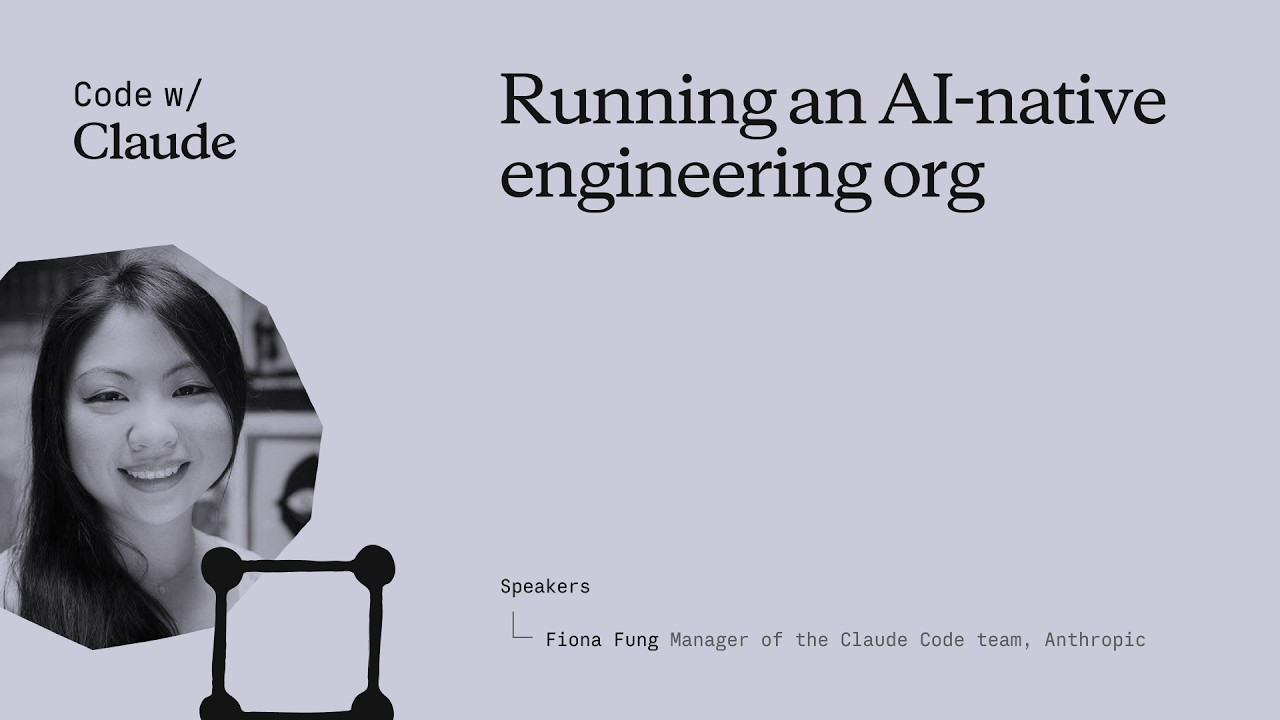
Running an AI-native engineering org
Fiona Fung, who runs engineering and product for Claude Code and Cowie at Anthropic, walks through what broke when agentic coding became the team's default — review, ownership, planning, hiring — and the norms they rewrote to keep shipping. The throughline: when coding stops being the bottleneck, every process built around protecting expensive engineering bandwidth quietly stops working, and the manager's job is to notice and rewrite them fast. ## [00:00] Intro and the five themes Fiona opens with a confession that the room is much fuller than she expected (Boris and Jared's session is still letting out), takes a selfie with the audience, and frames the talk. Background: she grew teams at Meta and Microsoft before Anthropic, and is now responsible for Claude Code and Cowie engineering and product. The deck she's about to walk through has already been rewritten in the past month — routines didn't exist when she first wrote the slides. She previews five threads: bottlenecks have shifted, team norms had to be rewritten, how they rolled them out, what signals say the changes are working, and the open questions she's still sitting with. > *"I did this slide deck maybe like a month ago and already I've had to change some of the content cuz when I started this deck, there were no routines."* ## [02:10] The shift: bottlenecks have moved Fiona's subtitle for the whole talk is *what served you prior may not serve you any longer*. She takes the audience back to shipping Visual Studio 2005 on CD-ROMs — hard deadlines because the manufacturing lab had to print discs — and points out that the move from CDs to online distribution already rewired how teams ship. The new shift is bigger: for years coding throughput and engineering bandwidth were the expensive things, and that's quietly stopped being true on Claude Code. When the bottleneck moves, it doesn't disappear — it relocates to verification, review, cross-functional handoffs, and security. The questions that matter now are "is this code correct?" and "is this safe?", and the old planning and ownership norms quietly stop serving the team. > *"What served you prior may not serve you any longer."* ## [07:40] Rewriting team norms: code review, JIT planning, technical debates Inside Claude Code the team had to rewrite the norms one by one. Code review is the first — human judgment shifts to "who actually needs to look at this." Planning is the second — Fiona calls it JIT planning, like JIT compiling, because prototyping is no longer the expensive step that justifies a six-month roadmap. Technical debates are the third: code wins. Instead of two engineers arguing on a doc, both prototype the API and look at impact on callers, and Fiona made a point of caring about the API's downstream effects as much as the implementation itself. The unifying rule: when building is cheap and arguing is expensive, you don't let the last person who checks in win — you build the routines that get *you* the last word. > *"When building is cheap, arguing expensive, again, how does that shift your team norms a bit?"* ## [13:30] Routines and Claude as a second pair of hands With morning coffee Fiona now reads what a routine produced overnight rather than kicking off the work herself. The team leans on Claude code review heavily — Claude babysits PRs, handles styling, lint, and feedback requests, catches bugs before commit, and adds tests — while humans focus on the calls where trust is still being built. She also stresses product sense in tooling: she themed Claude's terminal output ice blue with snowflakes over the holidays, then pulls back to the bigger point that catching bugs earlier (shift left) and automating the double-click question matter more than any one tool. > *"Where do you trust Claude a lot, but then where do you still want a human?"* ## [16:45] Cross-functional gaps and hiring for the hard parts Fiona walks through a survey-update story: she didn't have a dedicated content designer, so Claude became her partner for terse, terminal-appropriate copy. Meanwhile PMs on the team write code, and engineers lean into PM work. The flip-side conclusion for hiring: non-traditional coders can now do more engineering, so the leader's job is to double down on the hard parts the team is actually missing. When she joined, Claude Code was strong on product generalists and creative folks but thin on distributed-systems expertise — that's where she pushed recruiting. > *"With Claude, you have non-traditional coders now being able to do more engineering, but you also have engineers that we can also now lean in to do other roles."* ## [18:51] Flat org and answering customer feedback yourself Fiona pushed her recruiters into an uncomfortable place: hire managers, but have them start as ICs first. The recruiter thought she was crazy; Fiona's answer is that dogfooding Claude Code is the job, and if a candidate isn't up for it the team is better off finding out early. Flat structure plus Claude as a context-switching aid is what lets her, as a manager, still ship code and answer customer requests directly from her desktop Claude Code — instead of routing every customer question through a triage system, she pulls up the local repository and answers it herself. > *"You want to hire managers and they will start as an IC first. No manager would be interested in that."* ## [25:00] Signals you're trending right and open questions The team's working metric is unglamorous and direct: every commit is cloud-assisted by default, and Fiona hasn't seen a non-Claude commit in roughly four months. But she warns against fetishizing the "X percent of code generated by AI" headline — throughput is one signal, not the goal. The end question is what product you're making more delightful and what problem you're solving, with quality and reliability watched alongside volume. She closes with the section she calls "audit your own effort," opens up the questions she's still asking herself, and hands suggestions back to the audience to take to their own teams. > *"For us, it's by default every commit is cloud-assisted. I don't think I've seen a non-cloud-assisted commit probably in the last 4 months or so."* ## Entities - **Fiona Fung** (Person): Director of Engineering at Anthropic, runs Claude Code and Cowie engineering + product; previously led teams at Meta and Microsoft. - **Boris** (Person): Engineering lead on Claude Code, frequent collaborator referenced throughout. - **Kat (Cat)** (Person): Anthropic colleague who gave a keynote earlier the same day on Claude code review. - **Claude Code** (Software): Anthropic's agentic coding tool that is now the default for the team Fiona runs. - **Cowie** (Software): Sister product Fiona's team also owns engineering + product for. - **Anthropic** (Organization): The company building Claude and Claude Code. - **JIT planning** (Concept): Fiona's term for shifting from a six-month roadmap to just-in-time planning, modeled on JIT compilation. - **Shift left** (Concept): Moving bug-catching and verification earlier — into automation and tooling — instead of relying on review after the fact. - **Routines** (Concept): Repeatable Claude-driven workflows the team relies on so a single human gets the last word on outcomes rather than the last commit timestamp winning.
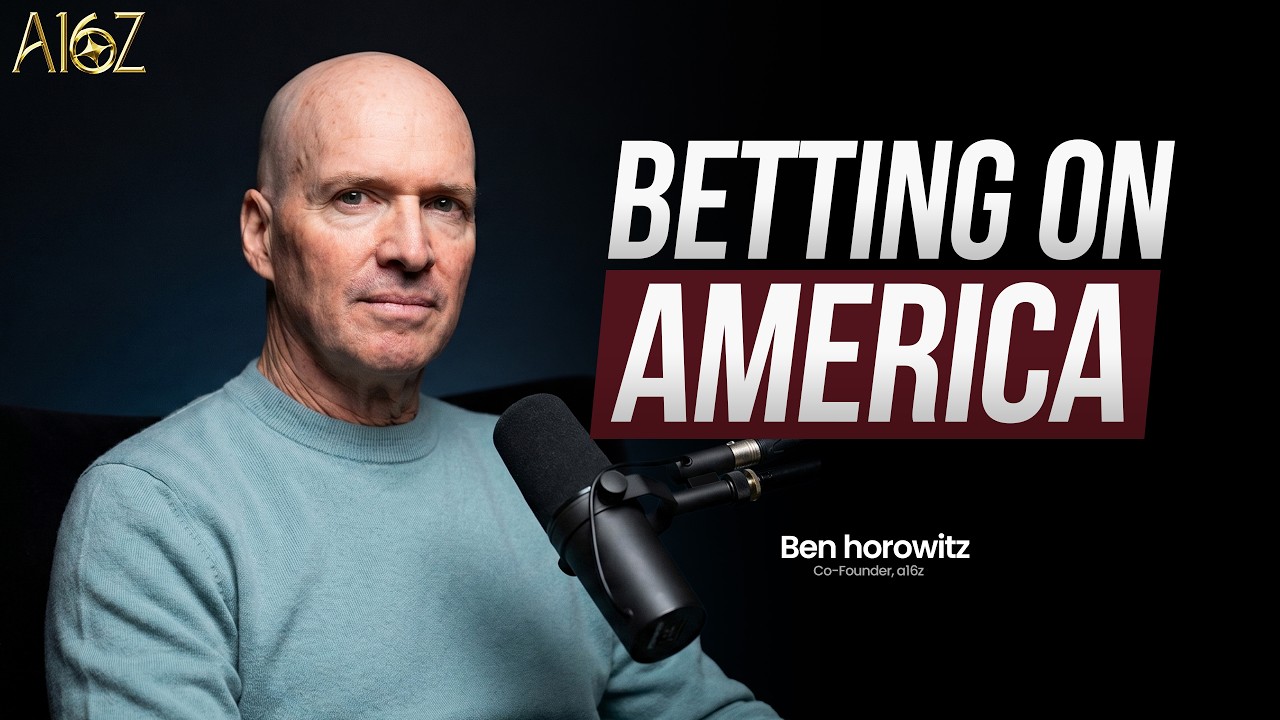
Ben Horowitz on American Dynamism and the Future of AI | The a16z Show
Ben Horowitz and David Ulevitch — recorded at a16z's American Dynamism Summit in Washington — cover the full arc of what it means for a venture firm to accept industry leadership: from America's race to integrate AI into national defense, to the real reason the Anthropic–Department of War deal collapsed, to why the VC industry is consolidating around large generalist firms and narrow specialists. Horowitz closes on what he sees as America's most underrated strategic risk: a profound pessimism about AI at home while China and Japan charge forward with optimism. ## [00:00] Trailer The opening montage frames the episode's central tension: over 70% of Chinese citizens are optimistic about AI, while fewer than 30% of Americans share that view. David Ulevitch sets the stakes — a16z has placed the largest venture bet in American history on the proposition that the U.S. will win the next century of technology. > *"Over 70% of people in China are optimistic about AI and less than 30% in America were optimistic about AI."* ## [00:41] Why America's Technology Dominance Matters for the World Following a16z's record $15 billion fundraise — the largest in the firm's history — David Ulevitch asks what obligations accompany that scale. Horowitz reaches back to advice from his mentor Andy Grove: when you lead an industry, the entire industry's ethics and morality depends on you. He translates that into a first-principles argument: what matters for humanity is whether people have a genuine chance to contribute, and no country comes close to America on that dimension. Horowitz draws a direct line from the Industrial Revolution to the present moment. America won the 20th century because it had superior technology; the AI revolution presents an identical fork in the road. He frames a16z's mission as answering one question — what can the firm do to help America win technologically — and argues that every decision, from portfolio construction to government engagement, flows from that north star. > *"And so when I think about our role in the industry, it's what can we do to help America win technologically?"* ## [04:04] American Dynamism, AI & Catching Up to China Ulevitch asks what has most surprised Horowitz about investing at the intersection of national security and venture capital since launching the American Dynamism practice. Horowitz explains why American-style freedoms are structurally irreplaceable: the Declaration of Independence's claim that rights are self-evident — not granted by government — makes them nearly impossible to revoke, a feature no other country has replicated at the same strength. On the competitive landscape with China, Horowitz notes the pre-ChatGPT conventional wisdom gave China a large AI lead, primarily because China had integrated AI deeply into its military and government bureaucracy while the U.S. lagged far behind. The most heartening development since then has been the speed of American catch-up: a wave of entrepreneurs willing to serve the national interest, combined with a U.S. government genuinely open to new companies and willing to change procurement rules to accommodate them. > *"But the the thing that was true about the kind of old incorrect idea was that they were way ahead of us in integrating um their AI technology with uh their government you know on a kind of military basis on a bureaucracy basis you know and all facets and so you know when we started we were coming from I would say very far behind you know in that you know in that idea um the thing that's been surprising though is like how fast um we've been catching up."* ## [08:50] The Anthropic Deal: What Really Happened The conversation turns to the high-profile collapse of Anthropic's contract with the Department of War. Horowitz offers a deal-mechanics reading that cuts through the public framing: Anthropic had overwhelming leverage — they were already deployed, the country was heading toward conflict, no software vendor has ever had more negotiating power — yet they walked away. In Horowitz's view, that behavior has only one explanation: Anthropic wanted out of the deal, likely due to internal employee pressure, and used a philosophical disagreement as the exit ramp. He pushes back on the framing that a national security AI contract is ethically compromised. The Department of War operates under more rules and oversight than any private entity, and leaks are effectively guaranteed if those rules are broken. Ulevitch extends the point to founders more broadly: companies that let employees veto geopolitical decisions are substituting "vibe geopolitics" for the considered judgment of people who have studied — and sacrificed for — these questions their entire careers. > *"It fell apart because Ananthropic wanted out of the deal."* ## [13:37] Exporting American Dynamism to Our Allies Ulevitch raises a geographic expansion question: American Dynamism's name is parochial, but the practice is really about America and its allies. Horowitz has spent significant time abroad meeting foreign leaders who want to replicate U.S. startup culture. He outlines why that's hard — entrepreneurship at scale requires a deep-seated belief that the government won't arbitrarily seize what you build, and very few countries (Sweden and Israel being notable exceptions) have that culture. He identifies concrete partnership opportunities: Mexico's high-quality manufacturing expertise in automotive and adjacent sectors; Japan's robotics heritage and surging defense spending (moving from 0% to 3% of GDP), which creates aligned interests given shared concern about China. The section closes with Ulevitch flagging that the coming robotics revolution will be the next major theme for the practice. > *"America does give everybody a chance and entrepreneurs can really count on that."* ## [16:56] Power, Responsibility & How a16z Serves Founders A recent profile described a16z as a "power broker" using capital and networks to shape markets. Horowitz reframes the description: power isn't something the firm accumulates for its own sake — it's a feature of the product offered to founders. Entrepreneurs have great ideas but lack the power to get the right meeting with Congress, secure a key enterprise customer, or navigate regulation; a16z's scale converts that gap into founder advantage. The internal culture is deliberately countervailing. The firm's first cultural principle — "first-class business, only in a first-class way" — means showing up on time, responding promptly, and being honest. These small behaviors prevent the firm from drifting into a posture where it treats founders as supplicants rather than partners. > *"So power is sort of a feature of our offering is the way I think about it."* ## [18:58] The State of Venture Capital & Why Most Firms Can't Scale Horowitz provides a structural explanation for why most venture firms cannot grow beyond a certain size. The original design premise of the industry was that only ~15 companies per year would ever reach $100 million in revenue, so small partnership structures with shared economics and shared control made sense. Mark Andreessen's "software is eating the world" thesis invalidated that premise: every company is now a technology company, so the target universe has exploded and so has the need for organizational scale. Scaling to capture that universe requires organizational reorganization — which requires a single decision-maker. Firms built on consensus control cannot reorg cleanly, because those who lose power in a reorg will block it. A16z, with centralized control from inception, was structured to reorg repeatedly and now fields 600+ people organized as small teams sharing a common platform. The result is a barbell: large generalist firms that cover every technology domain, and narrow specialists focused on AI infrastructure, bio, crypto, or games. The mid-size generalist firm is being squeezed out. > *"when you redistribute power, people are mad if they get a vote um that they're going to foul that that that reorganization and you can't scale without reorging."* ## [23:21] The New Rules of Media The media discussion opens with a structural observation: old and new media are not different games — they are the same game with different rules. Under scarcity (limited channels, rigid formats), the winning strategy was defense: avoid gaffes, because a Howard Dean scream lives forever on a three-channel media landscape. Under abundance (unlimited channels, unlimited formats), the winning strategy is offense: be interesting, because anything boring simply drowns in the noise. Horowitz points to Alex Karp as the exemplar of the new model: relentlessly entertaining, consistently on message (pro-America), and unafraid to be unpredictable. The flood-the-zone correction mechanism — do ten podcasts after a mistake — makes individual errors survivable in a way they never were in the old world. His coaching to founders: you cannot win by not losing anymore; you win by being worth paying attention to. > *"Um, and so the key to winning isn't not making a mistake, it's being interesting."* ## [26:22] America's AI Optimism Gap Horowitz names his biggest worry: a polling result showing that more than 70% of Chinese citizens are optimistic about AI while fewer than 30% of Americans share that sentiment. He attributes the gap to an American media culture that foregrounds AI risks — surveillance, job displacement, existential threats — while systematically underweighting the positive case. He contrasts this with Japan, where renewed enthusiasm for AI has reignited the entire startup ecosystem. His ask of founders, policymakers, and technologists in the audience: rebalance the narrative. AI will end traffic deaths, cure cancer, and eliminate poverty as we know it. These outcomes deserve as much airtime as the dangers. He closes with the analogy of fire — a technology capable of burning down a village that nonetheless heats homes and cooks food — arguing that managing dual-use risk is the normal condition of every transformative technology, not a disqualifying exception for AI. > *"We're going to cure cancer."* ## Entities - **Ben Horowitz** (Person): Co-founder and general partner at a16z; primary speaker throughout, drawing on experience as a founder, CEO, and venture capitalist. - **David Ulevitch** (Person): General partner at a16z leading the American Dynamism practice; hosts the conversation at the American Dynamism Summit in Washington, D.C. - **Andy Grove** (Person): Former CEO of Intel; Horowitz's mentor whose maxim on industry leadership frames the episode's opening section. - **Alex Karp** (Person): CEO of Palantir; cited as a model for direct, entertaining, on-message communication in the new media landscape. - **Mark Andreessen** (Person): Co-founder of a16z; author of "software is eating the world," the thesis underpinning a16z's scaling rationale. - **American Dynamism** (Concept): a16z's investment practice focused on companies serving U.S. national interests — defense, manufacturing, advanced software and hardware — now extended to allied nations. - **Anthropic** (Organization): AI safety company whose contract with the U.S. Department of War collapsed; Horowitz argues the deal fell apart because Anthropic chose to exit, not over genuine ethical conflicts. - **a16z** (Organization): Andreessen Horowitz; raised over $15 billion in its latest fund, the largest in firm history and the largest VC fund ever raised. - **Department of War** (Organization): U.S. federal defense department; counterparty in the Anthropic procurement deal and key customer for American Dynamism portfolio companies. - **Palantir** (Organization): Defense and analytics software company; referenced as an exemplar of a firm successfully working at the intersection of Silicon Valley and national security.

The Secrets of Claude's Agent Platform From the Team Who Built It
Dan Shipper interviews Angela Jiang (head of product) and Katelyn Lesse (head of engineering) for the Claude platform at Anthropic, recorded at the Code with Claude developer event. The conversation unpacks how Claude's platform has grown from a simple completion API into a fully managed agent infrastructure, why the harness and the model are increasingly inseparable, and what the "outcome + budget" vision means for the future of agent development. Together the three trace every stage of the agent lifecycle — from spinning up a first session to retiring stale agents — and share candid war stories from Anthropic's own internal deployments. ## [00:00] Where the platform will be in a year Dan opens with a question the rest of the episode keeps circling back to: a year from now, where is the platform? Angela's answer — Claude understands itself well enough to pick its own sub-agents and write its own harness on the fly. Katelyn picks up the other half: an infrastructure layer that can keep up with agents that continually rewrite themselves. This exchange actually comes from late in the interview; the show puts it up front because the whole conversation is about how today's primitives get you there. > *"We'd want to experiment with directions where Claude actually gets so good at understanding itself, it figures out what model you should be using, it figures out how to spin up all the sub agents."* — Angela Jiang ## [01:48] How the Claude platform evolved from API to agents Angela traces the arc from early LLM APIs — stateless, exploratory, maximum surface area — through session-based chat, and now into fully autonomous agents. The through-line is always the same: raise the abstraction layer high enough that customers can get the best outcome from Claude with as little work as possible. Early adopters wanted every raw knob; today, most teams arriving at Anthropic want a substantial set of things "out of the box." The platform's job is to keep shrinking the distance between intention and outcome. > *"It probably ends up just being like whatever it's like the set of primitives and infrastructure that enables you to basically get the outcome as fast as possible with actually as little of work as possible."* — Angela Jiang ## [04:09] The primitives that make up Claude Managed Agents Katelyn explains that Claude Managed Agents is assembled from the same primitives available to anyone on the Messages API — code execution sandboxes, web search, and built-in tools — but wrapped in a curated harness Anthropic has already battle-tested internally. Angela adds that the team is opinionated about two primitives in particular: file systems and skills. These are treated as load-bearing choices that shape how Claude behaves across all agent tasks. The platform is designed to be modular so developers can plug in custom pieces where the standard harness does not fit, and Anthropic publishes reference implementations for teams that want to stay on the Messages API directly. Dan describes his team running Claude via the `claude -p` command on Mac Minis and worries about lock-in and divergence from Claude Code. Katelyn responds that Anthropic's internal first-party products run on the same platform as external customers, which means divergence between Managed Agents and Claude Code will shrink over time. > *"We've taken what we see as all the most powerful of those things and put them together into a harness and a set of infrastructure that is just the way to get what we think is the best outcomes out of Claude."* — Katelyn Lesse ## [10:37] Why the harness and the model are becoming a single unit Angela challenges the conventional wisdom that a generic, model-swappable harness is the right architecture. As models diverge in technique across labs, the alpha is in tight harness-model co-design rather than hot-swapping. Internally, Anthropic tested multiple harness variants for the memory feature and found they performed "drastically differently." The implication: treat the agent (harness + model) as the unit of redundancy, not the model alone. Dan pushes on whether this creates path dependence in the model itself. Angela acknowledges that the primitives chosen really do shape the model's trajectory, and that being wrong about them is hard to undo. She cites models that over-indexed on reasoning versus those that went deep on computer-use as two diverging paths that are difficult to reverse. > *"The harness and the model get very paired. You still need redundancy, and you still might want to use other models for things, but you probably do it at the layer of like the agent, meaning like the harness plus the model."* — Angela Jiang ## [18:49] The infrastructure wall that kills most agent projects in production Katelyn identifies the real blocker for most agent projects: not harness engineering, but the infrastructure wall hit when teams try to move from prototype to production. Keeping a persistent server alive, managing sandbox failures, storing transcript data, and handling secure credential injection — these mundane concerns kill projects that technically "work" on a Mac Mini. Anthropic's own repeated experience of hitting this wall internally was the primary motivation for building Managed Agents. Angela describes the vaults primitive as an early step toward one-click agent deployment: once agent identity and credentials are handled securely at the platform layer, adding a Slack integration should eventually be as simple as telling Claude to "add Slack" and watching the bot appear. > *"Everyone hits the same problem of like, oh wow, I either need to like keep a server constantly running or I need to use infrastructure that will spin up and spin down, and I need to store the transcript data, and I need secure sandboxing, and all these sorts of things."* — Katelyn Lesse ## [24:49] Why team agents need a different shape than individual productivity tools Angela explains why individual productivity tools like Claude Code do not simply scale to team use. The moment three people want a shared agent that automates an end-to-end process across roles, a laptop-resident tool breaks down in availability, access control, and coordination. She cites Guillermo Rauch of Vercel's framing of an internal "AI software factory" as the right mental model: not individual augmentation, but a full organizational stack of agents that continuously produces high-leverage output for every function in the company. > *"When you get to the team layer suddenly everything gets like massively more complex. Like number one obviously it can't like sit on your laptop."* — Angela Jiang ## [26:36] How Anthropic's legal team uses an agent to review marketing copy Katelyn walks through one of Anthropic's own internal deployments: a legal-review agent that accepts marketing copy submissions and performs a first-pass review before anything reaches a human lawyer. The agent can approve copy outright or escalate for human review, eliminating low-value ticket-queue work. The form factor is a thin app layer on top of Managed Agents with shared visibility across both teams. Angela and Dan dig into why this is an agent rather than a skill: human-in-the-loop requirements, the need to spin up separate sessions, and multi-team collaboration all exceed what a single skill invocation can handle. The governance model that emerged was notable: rather than gating changes behind the platform team, end users discovered they could self-serve small improvements via Claude Code. Angela describes the end-state user experience as simply "talking to Claude," even when the underlying system is "many many Claudes engaging with each other." > *"Under the hood it's many many Claudes engaging with each other to get to the part where then they the Claudes themselves are doing the more complex work that the human doesn't really necessarily need to interpret."* — Angela Jiang ## [34:24] Using multi-agent orchestration for advisor strategies, adversarial pairs, and swarms Angela highlights three multi-agent architecture patterns people are assembling with the newly launched orchestration primitives: an advisor strategy that separates execution from advice; adversarial pairs where one agent generates and another critiques; and swarms that split a problem into many small parallel pieces and recombine results. Each pattern suits a different problem class — swarms excel at bug hunting, while wide-research tasks benefit from advisor or parallel-decomposition architectures. LEGO-like primitives let practitioners hill-climb at the architecture level, not just the prompt level. > *"If we can make the primitives very LEGO-like, then people can put them together to solve things at a slightly higher form factor, which is more like an architecture or like a strategy."* — Angela Jiang ## [35:50] How to measure agent success with outcome and budget as the end state Angela frames the long-term measurement philosophy: compress everything to an outcome and a budget, and let the platform resolve all intermediate decisions. Domain-specific evals (e.g., PR-merge rate for coding agents) remain useful today, but the target is a verifiable outcome spec that Claude can grade itself against repeatedly. Katelyn addresses the adjacent problem of agent staleness: Anthropic has built skills to help teams upgrade agents when new models ship, and the most forward-leaning teams already run meta-agents that monitor other agents for degradation and trigger upgrades automatically. > *"Our kind of principle of like maybe the end state of some of these things is that everything should kind of compress down to an outcome and like a budget. And that's probably like about it."* — Angela Jiang ## [39:11] What the platform looks like a year from now, when Claude writes its own harness Angela envisions a world where users supply only an outcome and a budget, and Claude self-selects models, spins up sub-agents, and writes its own harness on the fly — eliminating harness engineering entirely, just as today's platform has already eliminated much of manual tool construction and prompt engineering. She is cautiously optimistic that the "outcome" half of the equation may be achievable within a year with some budget error bars. Katelyn adds the infrastructure corollary: such a world requires a platform capable of supporting agents that continuously recreate themselves, handling arbitrarily shaped long-running requests without ever becoming the bottleneck. > *"Claude is actually able to understand itself enough that it can come almost like write itself on the fly to figure out what is necessary in that kind of like two-parameter world of like outcome and budget."* — Angela Jiang ## Entities - **Angela Jiang** (Person): Head of Product for the Claude platform at Anthropic; co-architect of the Managed Agents product vision. - **Katelyn Lesse** (Person): Head of Engineering for the Claude platform at Anthropic; focuses on infrastructure reliability and scale. - **Dan Shipper** (Person): Host of AI & I on Every; CEO of Every; building internal agent products on the Claude platform. - **Claude Managed Agents** (Software): Anthropic's hosted agent infrastructure — a harness plus cloud compute that wraps the Messages API with built-in memory, sandboxing, vaults, and skills. - **Messages API** (Software): Anthropic's core API; the underlying primitive on which Managed Agents and all first-party products are built. - **Anthropic** (Organization): AI safety company that builds and operates the Claude model family and its associated platform. - **Every** (Organization): Media company producing AI & I; an early Managed Agents customer building internal editorial agents. - **Stripe Minions** (Software): Stripe's internal end-to-end software development platform built on agent infrastructure; cited as a model for company-wide coding agent deployment. - **Vercel** (Organization): Developer infrastructure company; CEO Guillermo Rauch's "AI software factory" framing used as the mental model for team-level agent adoption. - **Outcome + Budget** (Concept): Anthropic's long-term design principle that the final form of agent interaction should require only a verifiable outcome and a cost ceiling, with the platform resolving all intermediate decisions.

Elon's Anthropic Deal, The Next AI Monopoly?, "FDA for AI" Panic, Trading the AI Boom
In one of their most consequential episodes, the All-In besties dissect SpaceX's surprise compute lease to Anthropic — the deal that may cement Anthropic as AI's dominant platform — and debate whether David Sacks's "Rockefeller" framing is prophecy or paranoia. The group then wrestles with a White House trial balloon about an "FDA for AI," ultimately concluding it was mostly media spin, before closing with a bullish-but-cautious read on the AI-driven market boom. Brad Gerstner fills in for David Friedberg, bringing investor perspective from both public and private markets across the episode's 82 minutes. ## [00:00] Bestie intros! Thoughts on the LA mayor election Jason Calacanis opens with the full crew: Chamath Palihapitiya, David Sacks, and fifth bestie Brad Gerstner joining in for David Friedberg, who is out sick. The warm-up quickly turns to the LA mayoral race, where Spencer Pratt is mounting a surprisingly effective challenge to incumbent Karen Bass. The group praises Pratt's viral debate performance — evisceration of the city council candidate over homeless policy — and Chamath notes the power of a sharp social-media team in modern politics. Brad flags a California ballot initiative that would constitutionally protect retirement savings and ban a wealth tax, reading it as a potential seismic signal. Jason observes that New York City hedge-fund titan Ken Griffin publicly announced he is pulling investment from New York after NYC councilman Zohran Mamdani targeted his home in a campaign video, underlining the tension between aggressive progressive politics and capital flight. > *"If California effectively passes a constitutional amendment protecting retirement savings and personal assets and banning the wealth tax and [Spencer Pratt] gets elected, the message that would send to the country — that's a very non-consensus view that I'm becoming increasingly optimistic about."* — Brad Gerstner ## [04:38] SpaceX-Anthropic deal, Elon Web Services, SpaceX IPO valuation, Anthropic's insane growth trajectory Jason leads with the blockbuster news: SpaceX has leased all of Colossus 1 — its H100-based Memphis data center — to Anthropic, adding over 220,000 Nvidia GPUs and 300 megawatts to Anthropic's supply-constrained capacity. The deal immediately doubled Claude Code's rate limits and removed peak-usage caps for paid users. Chamath frames Anthropic's explosive growth as purely supply-constrained: if unlimited power existed, revenues would be "even more parabolic." He sees the deal as Elon strategically de-risking SpaceX's valuation story — blunting bear cases around delayed orbital data centers while generating near-term revenue to subsidize Grok training. Brad estimates the arrangement adds $4–5 billion in incremental 2026 revenue for SpaceX, calling EWS (Elon Web Services) a genuine fourth hyperscaler alongside AWS, Azure, and GCP. He also warns that organized activists — not organic local opposition — are using the same playbook that stalled nuclear construction in America to delay data-center permitting. David Sacks notes that Anthropic grew from $10B ARR on January 1 to $44B ARR by April — a trajectory he calls unlike anything Silicon Valley has ever witnessed. > *"Nobody in Silicon Valley has ever seen anything like it. Forget about the rest of the country. I mean, all we do in Silicon Valley is deal with exponentials. And still, people have never seen that kind of growth at that level of scale."* — David Sacks ## [26:48] Is Anthropic the next great monopoly? Early signals or major overreaction? David Sacks draws an extended analogy between Anthropic and John D. Rockefeller's Standard Oil, arguing that safety-first rhetoric can function as regulatory capture — building a moat that locks in the emerging duopoly of Anthropic and OpenAI while blocking competitors. He notes that if Anthropic sustains its 10× annual growth for just 18 more months it could become "the most powerful monopoly ever created in human history," dwarfing the combined Mag-7 revenue. Brad pushes back hard: Anthropic and OpenAI are still fledgling startups on a GAAP basis, Google and Amazon are producing hundreds of billions in free cash flow to fund competing models, and pre-emptive antitrust action at the starting line of AI would be "a disaster." Jason translates Brad's position as "don't mess with my paper," since Altimeter holds positions in several of these companies. Sacks clarifies his northstar is vigorous competition — but he flags Anthropic's banning of OpenClaw from using its API as a concrete anti-competitive act worth scrutiny. > *"Unless something about their current trajectory changes, Anthropic will be the most powerful monopoly ever created in human history — a trillion dollars of ARR growing at some rate. Dario calls it AGI. I call it the biggest monopoly in human history."* — David Sacks ## [35:21] "FDA for AI" freakout, how the White House thinks about AI safety Reports surfaced that the White House was considering an executive order to create an AI working group that could require pre-release safety reviews for new frontier models — triggered, according to the New York Times, by Anthropic's classified "Mythos" model reportedly alarming national-security officials. NEC Director Kevin Hassett appeared on Fox Business drawing an FDA analogy, while Treasury Secretary Scott Bessent spoke more carefully about balancing innovation and safety. Sacks calls much of it "fake news" amplified by Andrew Ross Sorkin's DealBook column, noting that Susie Wiles, the White House Chief of Staff, issued a statement walking back the FDA framing. He reveals he spoke with Hassett directly and confirms no senior official actually supports a pre-approval regime. He points to the White House's March 20 National AI Regulatory Framework as evidence the administration favors specific solutions over broad regulatory capture. The group converges on one concrete measure: KYC (Know Your Customer) requirements before frontier model API access during preview periods, plus rapid deployment of cyber-capable AI to companies like CrowdStrike and Palo Alto Networks. > *"There is a substantial faction of AI ideologues or doomers who are basically employing the classic 'never let a crisis go to waste' strategy. Yes, we do have this cyber issue that is real — everyone needs to harden their systems now. But what they're trying to do is use that issue to try and create a permanent new infrastructure in Washington."* — David Sacks ## [52:01] Flipping AI's negative perception: Giving, healthcare and education innovation Jason shifts from regulatory defense to offense: how should the tech industry proactively counter negative public perception of AI? He proposes that companies going public — Anthropic, OpenAI, SpaceX — could dedicate 1–5% of IPO proceeds to every American via "Invest America" accounts, creating tangible shared upside. He also calls for serious engagement on minimum wage and universal healthcare, arguing that a financially healthier consumer base is structurally good for capitalism itself. Brad endorses the "Invest America" concept, adding that data center host communities should receive direct benefits like free local electricity. David pivots to political salience data: AI ranks 29th out of 39 voter issues — well below cost of living and economic growth, two metrics where AI is actively deflationary and expansionary. The industry's real message should be economic delivery, not safety governance. Chamath gives tech leaders a "D-minus trending to F" for communications and calls for tangible reinvestment in America at scale. > *"I think that there's a pretty profound vibe shift with respect to tech, tech oligarchs, Silicon Valley, and particularly AI. That vibe shift has already happened on Main Street, and I think that's starting to seep into Washington."* — Chamath Palihapitiya ## [60:04] Trading the AI market, state of the economy Brad leads a comprehensive market check: AWS on a $150B run rate (28% growth), Azure at $108B (39%), Google Cloud at $80B (63%). The S&P 500 is at all-time highs, the 10-year sits at 4.3%, and inflation is under control — far better outcomes than the doom scenarios predicted around tariffs and geopolitical conflicts. S&P 500 operating margins improved from 11% in 2023 to 13% in Q1 2026, and the Mag-5's combined headcount grew only 3% over three years while revenues surged. Chamath urges caution: there is still no direct evidence AI is lifting enterprise profit margins in aggregate, and a reckoning arrives in roughly 500 days when the fork between opex reduction and revenue growth will determine whether the AI boom is real or a mirage. Jason counters that for startups the ROI is already "fait accompli" — AI-generated ad creative at Nike and DoorDash, portfolio companies shipping product at half the headcount. David credits Trump administration policies — rescinding Biden's chip-export licensing and AI-approval regime, unleashing energy permits — for creating the conditions that enabled the boom, and notes that the unemployment rate for recent college graduates has actually improved, contradicting the entry-level-job-loss narrative. > *"I think we have kind of call it 500 days where you just got to be net long. But I think it's literally in the hundreds of days from now that you're going to have to have an important reckoning moment. The people that are paying for all these tokens need to see an actual benefit."* — Chamath Palihapitiya ## Entities - **Jason Calacanis** (Person): Host and moderator; angel investor and podcast co-founder - **Chamath Palihapitiya** (Person): General partner, Social Capital; co-host; contrarian macro voice on AI ROI and market cycles - **David Sacks** (Person): Co-host; former White House AI & Crypto Czar; framed Anthropic as a potential historic monopoly using the Rockefeller analogy - **Brad Gerstner** (Person): Founder & CEO, Altimeter Capital; fifth bestie; bullish on compute stocks and AI market structure - **Dario Amodei** (Person): CEO of Anthropic; referenced as "Daario D. Rockefeller" by Sacks; party to the SpaceX compute deal - **Elon Musk** (Person): CEO of SpaceX and xAI; architect of Elon Web Services and the Colossus 1 compute lease strategy - **Anthropic** (Organization): AI lab behind Claude; grew from $10B to $44B ARR in four months; center of monopoly and FDA debates - **SpaceX / xAI** (Organization): Lessor of Colossus 1 data center to Anthropic; emerging fourth hyperscaler under EWS branding - **Elon Web Services (EWS)** (Concept): SpaceX's compute-leasing business positioned as a hyperscaler competitor to AWS, Azure, and GCP - **Mythos** (Software): Anthropic's classified cyber-capable frontier model that reportedly alarmed White House national-security officials - **KYC for AI** (Concept): Proposal to require identity verification before granting API access to frontier models during preview periods - **Invest America** (Concept): Proposal for IPO-stage tech companies to dedicate a share of proceeds to universal investment accounts for US citizens
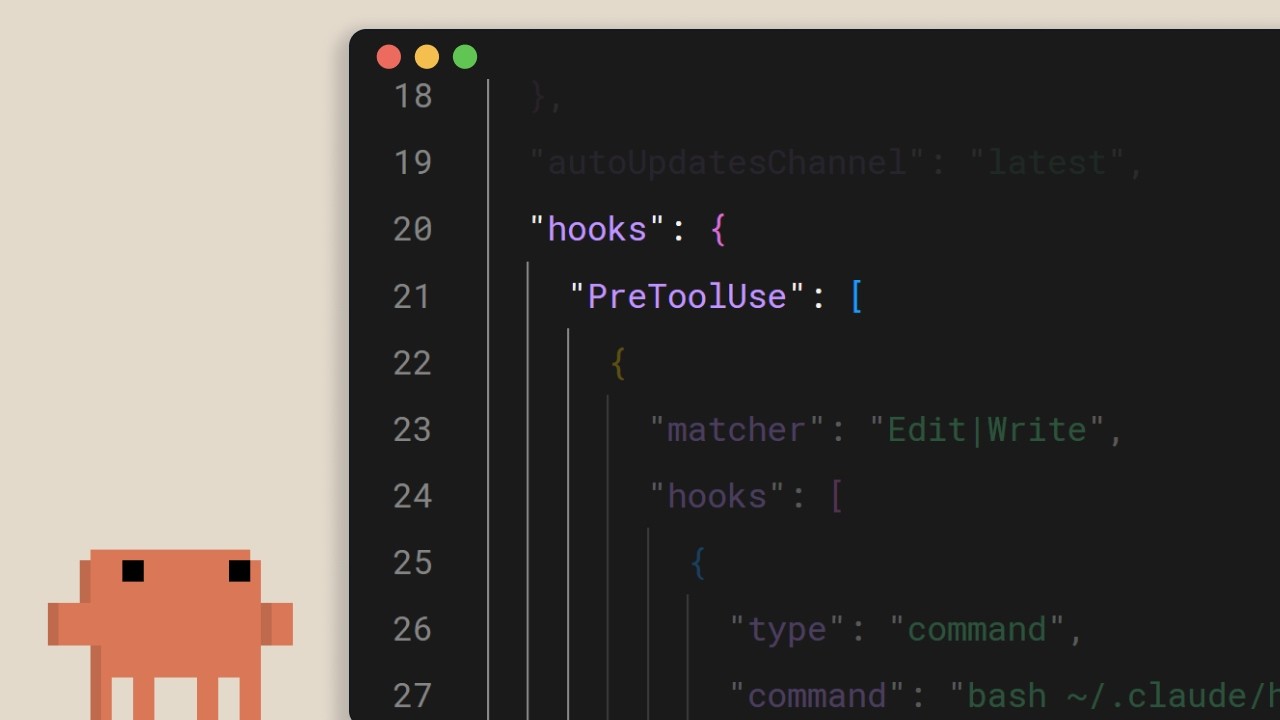
Hooks in Claude Code
Een korte Anthropic-walkthrough van Claude Code hooks: de deterministische nooduitgang voor alles wat absoluut bij iedere bewerking, iedere tool-aanroep en iedere commit moet plaatsvinden. De kernboodschap: als je "altijd prettier uitvoeren" in claude.md schrijft en hoopt dat het werkt, heb je al verloren. Verplaats het naar een hook. ## [00:02] Wat hooks zijn en waarom ze deterministisch zijn Hooks activeren op vaste punten in de lifecycle van Claude Code, en het centrale argument van de verteller is dat ze, in tegenstelling tot prompt-level instructies, altijd worden uitgevoerd. De model in claude.md vertellen om na elke bestandsbewerking prettier te draaien werkt meestal, maar "meestal" is precies het gat dat een hook sluit. Dezelfde intentie, maar afgedwongen door de runtime in plaats van gesuggereerd aan het LLM. > *You can tell Claude in your claude.md file to run prettier after every file edit and most of the time it will do that, but sometimes it won't. It's not perfect. But a hook makes it happen every single time with no exceptions.* ## [00:37] Veelvoorkomende gebruiksscenario's Vier representatieve voorbeelden bepalen de reikwijdte: automatisch formatteren na bestandsbewerkingen, loggen van alle uitgevoerde opdrachten voor compliance, blokkeren van gevaarlijke bewerkingen zoals het wijzigen van productiebestanden, en jezelf een melding sturen wanneer Claude een lange taak afrondt. > *Common use cases could include auto formatting after file edits, logging all executed commands for compliance, blocking dangerous operations like modifying production files, and sending yourself notifications when Claude finishes a task.* ## [00:52] Hooks configureren en de vijf lifecycle-events De configuratie staat in `settings.json`: kies een event, beperk het optioneel met een matcher voor het van toepassing zijnde tool, en geef een shell-opdracht op. Vijf events dekken de lus: `UserPromptSubmit` voordat Claude een prompt ziet, `PreToolUse` en `PostToolUse` rondom elke tool-aanroep, `Notification` wanneer Claude de gebruiker pingt, en `Stop` wanneer Claude klaar is met reageren. > *Pre-tool use which runs before a tool call, post-tool use runs after a tool call completes. Notification runs when Claude sends a notification, and stop runs when Claude finishes responding.* ## [01:22] Automatisch formatteren met een post-tool-use-hook Het standaardvoorbeeld: een `PostToolUse`-hook met een matcher `Edit` of `MultiEdit` activeert wanneer Claude een bestand wijzigt. De opdracht controleert de extensie en stuurt door naar de juiste formatter: prettier voor TypeScript, gofmt voor Go, ruff voor Python, of wat het project standaardiseert. > *You set a post-tool use hook with a matcher of edit or multi-edit, right? So, it fires whenever Claude modifies a file. The command checks the file extension and runs the appropriate formatter.* ## [01:49] Tool-aanroepen blokkeren met pre-tool-use en exitcodes `PreToolUse`-hooks ontvangen de tool-naam en invoer als JSON via stdin en beslissen via exitcode: `0` gaat door, `2` blokkeert. Wanneer een hook blokkeert, wordt wat hij naar stderr schreef als feedback teruggegeven aan Claude, zodat het model begrijpt waarom en zijn plan kan aanpassen. Hier worden harde regels afgedwongen: schrijven naar een productieconfiguratiemap blokkeren, bash-opdrachten met `rm -rf` weigeren, commits op main blokkeren. De visie van de verteller: dingen die het team gegarandeerd nodig heeft, niet slechts gesuggereerd. > *If it exits with code two, the action is blocked and the STD error message gets fed back to Claude's feedback so Claude knows why it was blocked and can adjust.* ## [02:26] Hooks op projectniveau en teamdeling Hooks in `.claude/settings.json` hebben projectbereik en kunnen worden gecommit naar de repository, waardoor het hele team ze automatisch erft bij het klonen. Verwijs naar scripts via de omgevingsvariabele `CLAUDE_PROJECT_DIR` zodat opdrachten correct worden opgelost, ongeacht waar Claudes huidige werkmap zich bevindt. De sluitregel: als iets elke keer zonder falen moet plaatsvinden, zet het dan niet in een prompt, maar in een hook. > *If something needs to happen every time without fail, don't put it in a prompt. Put it in a hook.* ## Entities - **Anthropic Tutorial Narrator** (Person): De officiële stem van Anthropic voor de Claude Code 101-tutorialserie. - **Claude Code** (Software): Anthropics agentische terminal-codingtool waarop hooks bij lifecycle-events aansluiten. - **Hooks** (Concept): Deterministische opdrachten die op vaste punten in de Claude Code-lus activeren, het door de runtime afgedwongen alternatief voor prompt-level instructies. - **settings.json** (Configuration): Waar hooks worden gedeclareerd; `.claude/settings.json` in de projectroot wordt ingecheckt in de repository zodat teams dezelfde regels delen. - **PreToolUse / PostToolUse / UserPromptSubmit / Notification / Stop** (Events): De vijf lifecycle-events waaraan een hook kan worden gekoppeld. - **CLAUDE_PROJECT_DIR** (Environment variable): Gebruikt in hook-opdrachten om te verwijzen naar projectrelatieve scripts, ongeacht de huidige werkmap van Claude.

⚡️ Matt Pocock - Why Engineering Fundamentals matter MORE now
Matt Pocock joins swyx at AI Engineer Europe to argue that the old software design canon — DDD, deep modules, ubiquitous language — matters more, not less, in the AI coding era. The thesis: code is not just a compile target; a codebase that is easy for humans to change is easy for AI to change. Along the way they cover course-making, why traditional lectures still beat AI-native learning, and TypeScript's quiet takeover of AI engineering. ## [00:04] Opening at AIE Europe and the Cursed Course swyx welcomes Matt to the AI Engineer Europe podcast booth in London. Matt jokes that AIE is "the worst" event he has ever attended (the location is in fact astonishing) before turning to his Claude Code course, which is just wrapping up its two-week cohort. He explains why he runs short cohorts: AI moves so fast that self-paced courses cannot guarantee updates, and the "curse" of releasing into breaking changes — AI SDK v5 dropped on day two of his AI SDK v4 course, and the Claude Code source leaked during this one — is now baked in. The conversation then turns to teaching as a craft. Matt rejects the "pundit" branch of YouTuber identity — he is not trying to predict the future, only to teach durable material — and notes that being a teacher first is what differentiates his content. > *I'm not a guy who's trying to predict the future. I'm just trying to teach.* ## [02:51] Why Engineering Fundamentals Matter More with AI Matt previews his AIE talk. The popular narrative says code no longer matters because English plus an AI compiler can produce applications. Every time he tried to ignore the code, he ended up with "a terrible mess." So he went back to the classics — *Extreme Programming*, *The Pragmatic Programmer*, *A Philosophy of Software Design*, DDD — and discovered they ported directly into prompts. Keeping the architecture in your head, even when you delegate implementation, yields outsized dividends. > *If you have a code base that's easy to change for humans, it's going to be easy for AI to change, too.* ## [04:23] Narrow Waist and Deep Modules swyx introduces the "narrow waist" concept from internet architecture (TCP/IP, HTTP at layers 3–4) as a way to contain AI-generated slop: define rigid interfaces, delegate the inside. He extends it to running AIE as a nine-person business — "model-view-claw" instead of MVC, where coordination across people and AI is the real systems problem. Matt maps this onto John Ousterhout's notion of *deep modules*: a large amount of functionality behind a simple interface, ports and adapters style. This is, in his experience, the best way to use AI for coding — be intentional about the interface as a human, then delegate the implementation. > *Deep modules basically — a large amount of functionality with a simple interface. Kind of ports and adapters, right?* ## [06:37] Domain-Driven Design Meets AI DDD is having a moment, and Matt argues it works *because* the framework has been around long enough to sit in the latent space of these models. You do not have to invent new vocabulary; you can bolt on a system that is composable and that the model already understands. The deeper point: DDD is fundamentally about aligning code with language, which is exactly what you want when speaking to an AI. He makes it concrete with the `mattpocock/skills` repo (≈13k stars) and its "ubiquitous language" skill — a Claude Code skill that scans your codebase, surfaces the arcane jargon, and refines it with you into a markdown file he keeps open while prompting. He references it from `agents.md` but does not paste it wholesale, so the agent finds it when searching for those terms. > *Essentially, you're trying to create a unified domain model so that the AI and you are speaking the same language.* ## [10:05] Teaching as an Overpowered Skill swyx asks how Matt got so good at explaining things. Matt credits six years as a voice coach before becoming a developer — communication felt like an unfair advantage when he started as a junior. He has since narrowed his focus: split time between learning material and finding the right phrases for it. The old texts help because they give him pre-built mental models to explain new ideas through. He walks through his course-making process: an "explore and exploit" phase, a Zettelkasten-style Obsidian vault, a custom planning app, P1/P2/P3 prioritization, and the rule that *each lesson teaches exactly one thing* with dependencies made explicit. Most of what he produces ends up on the cutting room floor. > *The ability to communicate always just felt like a ridiculous overpowered skill that I had in my locker that no one else had.* ## [13:20] How People Actually Learn AI Engineering The conversation turns to whether AI has changed how people learn. Matt distinguishes knowledge (lectures), skills (interactive exercises), and wisdom (small-group discussion — and now, talking to an AI). Counterintuitively, the more he leans into AI-experimental teaching, the more it turns his audience off. Most learners still want traditional lectures; swyx recalls Maven's cohort-based education arc landing in the same place. Matt's compromise is to force the work without forcing the form: in his TypeScript material he throws learners into a problem first and gives them the knowledge afterwards. > *The more I lean into the kind of AI experimental stuff, the more it actually turns people off my materials.* ## [15:04] TypeScript Overtaking Python swyx flags that TypeScript overtook Python in the GitHub survey this year — a shift he did not see coming, particularly in AI engineering where Python's expressiveness has been dominant on the backend. Matt's echo chamber is 100% TypeScript, but his real argument is ecosystem: when you care about UX and shipping chat-style applications, the framework gravity is in TypeScript (Vercel's Next.js, Cloudflare's variants). swyx admits this would meaningfully change which frameworks he promotes. > *If you're concerned about UX, concerned about shipping great stuff, you're mostly doing it in TypeScript.* ## [16:45] Inversion of Control and Composable Skills Matt looks ahead. His TypeScript-evals bet (Everlight) stalled — "no one's excited to do evals." The next frontier is *inversion of control*: as coding agents converge on similar architectures (Firebase-style backends, small tool sets), the interesting axis becomes how much control sits with the developer versus the harness. Claude Code's opacity buys ease of use but loses observability; Pydantic AI ("Pi") swings the other way — total control, total maintenance burden. He closes by pointing past coding agents entirely. Software engineers are a step ahead because AI produces quality output in their domain, but the composable skills he authors — like his three-sentence "grill me" skill that makes the AI interrogate you until you reach a shared understanding — generalize to any domain where you want the AI aligned with you. > *The inversion of control is going to be really important — you put more control in the hands of the developer and less in the harness.* ## Entities - **Matt Pocock** (Person): Creator of Total TypeScript and AI Hero; teaches TypeScript and AI Engineering through two-week cohort courses. - **Shawn Wang / swyx** (Person): Host; founder of AI Engineer and the AIE conference series. - **AI Engineer Europe (AIE)** (Organization): The London conference where this conversation was recorded; Matt's talk hit 1M views in 13 days — fastest in AIE history. - **AI Hero** (Organization): Matt's AI engineering education platform (aihero.dev). - **Claude Code** (Software): Anthropic's coding agent; subject of Matt's just-finished course and a recurring example throughout. - **Domain-Driven Design (DDD)** (Concept): Software methodology centered on aligning code with the language of the business domain; Matt argues it ports cleanly into AI prompting. - **Ubiquitous Language** (Concept): DDD practice of maintaining a shared vocabulary doc; Matt's namesake Claude Code skill scans a repo and refines this with the user. - **Deep Modules / Narrow Waist** (Concept): Architectural pattern (Ousterhout / internet protocols) of large functionality behind a small interface — Matt's preferred shape for AI-assisted codebases. - **mattpocock/skills** (Software): Matt's open-source repository of Claude Code skills; ≈13k stars at recording time. - **Pydantic AI (Pi)** (Software): Python agent framework built from low-level primitives; cited as the high-control counterpoint to Claude Code's opaque harness. - **Obsidian** (Software): Note-taking app reportedly run by a team of four; the example for non-engineering domains where AI leverage compounds.
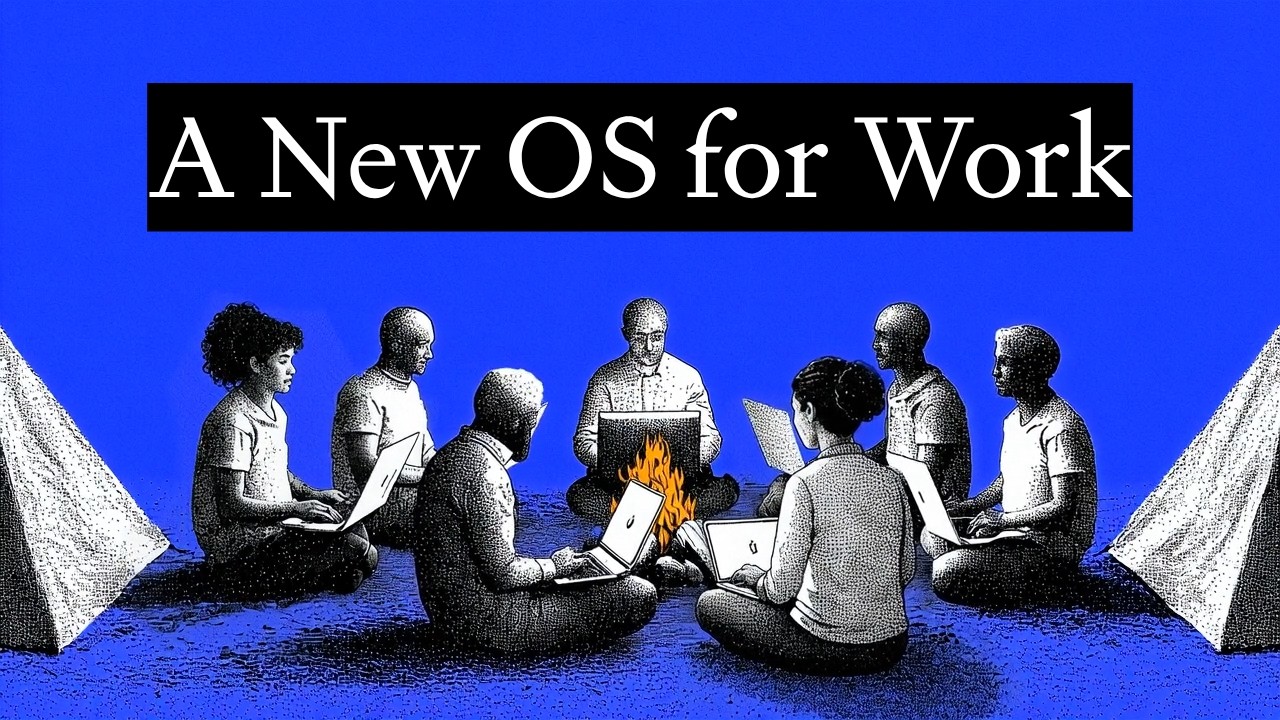
Why We Switched From Claude Code to Codex
Dan Shipper and Austin Tedesco, Every's head of growth, discuss why the Codex desktop app has become their primary interface for all knowledge work — from drafting go-to-market plans to building live KPI dashboards — displacing Claude Code after months of side-by-side use. Dan frames the shift as the emergence of a new "agent management interface" operating system, while Austin walks through his live Codex setup in a screen-share session that covers automations, specialized agent suites, and recruiting workflows. The episode doubles as a practical field guide for non-engineers who want to run the same playbook. ## [00:00] A new operating system for knowledge work Dan opens cold: three months ago Codex was trash. Now Austin is the one firing it up before anything else each morning and routing 80 percent of his working time through it. Dan reads what changed structurally: a general-purpose coding agent that can reach into your filesystem, browser, and connected apps is becoming the operating system for knowledge work, and every major lab is racing for that surface. > *"There's a new operating system for how and where you're going to get your work done and it's this kind of agent management interface."* — Dan Shipper ## [00:57] How Codex went from a tool for senior engineers to a daily driver for knowledge work Dan traces the arc of Codex from its original positioning as a sandboxed pair-programming tool for senior engineers — one that "would argue with you, it would make you feel stupid" — to today's desktop app built on GPT-5.5. He attributes the pivot to OpenAI watching Anthropic prove with Claude Code that an emotionally intelligent, fast, computer-native agent creates a step-change experience for programmers and knowledge workers alike. The race is now between model companies to own the agent management desktop: Anthropic has Claude Code and Claude.ai desktop, OpenAI has Codex, and xAI has effectively acquired Cursor. ## [02:42] How Claude Code proved that a great coding agent works for any knowledge work Dan explains the insight that changed everything: if an agent can write software autonomously, it can do any kind of knowledge work autonomously. Claude Code demonstrated this first, drawing non-engineers — including Austin — into an agent-first workflow. OpenAI's hard pivot on Codex over the last three months is a direct response to that proof point. Dan describes the new paradigm as one where your agent is your interface to software, the internet, and daily tasks, not just a code co-pilot. > *"If it can write software on its own, it can do any kind of knowledge work on its own."* — Dan Shipper ## [07:24] Austin's switch to Codex Austin recounts his agent-pill moment: spending a December week inside Claude Code CLI, hooking it up to every tool he uses for work and personal life, and finding it indispensable for strategic thinking, data analysis, and drafting marketing copy. His initial Codex trial two months later felt alienating — the model was condescending, asking "Why?" when he requested clearer explanations. He kept Claude Code for 80 percent of knowledge work while tolerating Codex for engineering. The turning point was getting early access to GPT-5.5: at model parity, the decisive edge was the Codex desktop app itself — faster, better-organized, and with sub-agents that "just work." > *"So the idea that the codeex app is maybe 30 to 40% better is like that's a lot of work."* — Austin Tedesco ## [13:48] How Austin set up Codex with folders, keys, and reviewer agents Austin shares his screen and walks through his "Every Growth OS" folder inside the Codex app: a directory containing API keys for every tool the company uses (Gmail, Slack, Notion, Stripe), a CLAUDE.md project context file synced to GitHub, and a set of custom reviewer agents forked from Kieran Classen's Compound Engineering plugin. Where the standard Compound Engineering reviewers focus on security and front-end design, Austin's fork — publicly available as "Compound Knowledge" — reviews for strategic alignment with company goals and data accuracy, making it fit for knowledge-work plans rather than code PRs. The folder architecture lets Austin move seamlessly from a go-to-market draft to shipping a code PR without switching apps. > *"It's connected to everything we use for every and then some project instructional files that explain what the every business is, what we care about, how we like to work together."* — Austin Tedesco ## [18:24] Using Codex to brainstorm automations across Gmail, Slack, and Notion Austin demos his recommended on-ramp for new Codex users: open a fresh chat inside the Growth OS folder, run the Compound Engineering brainstorm workflow, and prompt the model to look at Gmail, Slack, and Notion and suggest automations. Codex surfaces a "follow-up radar" that triages incoming communications across sources, a command-center view for events and camps, and a recruiting pipeline automation — all calibrated to Austin's actual work context. Within the session, Codex writes automation scripts that require almost no tweaking and begins scheduling them; Austin highlights a nightly draft-reply routine that compiles unanswered messages and prepares replies for a quick thumbs-up approval. > *"They require very little tweaking to be like this is a thing I would and do use every day of there's this set of instructions that it comes up with based on what it knows about me."* — Austin Tedesco ## [22:42] How Austin manages the human review step when Codex is drafting communications A live audience question from Margaret prompts Austin to describe his human-in-the-loop review discipline. All drafting and orchestration happens inside Codex, but the final review intentionally lives in the native app: Slack draft replies are reviewed in Slack's drafts tab; email drafts are reviewed in Gmail; strategic plans are reviewed in Notion or the Proof markdown viewer. Stepping out of the agentic interface "freshens up my brain" before anything goes to a human. A second question from musician Alex about protecting high-value client emails leads to a discussion of how Austin uses Every's Kora email assistant together with Codex-managed rules, including having the agent interview the user to derive email rules rather than asking the user to specify them manually. > *"I just like for like the last pass before humans engage with it to step away from this agentic space and have a final check in another surface."* — Austin Tedesco ## [28:54] Using Codex to build specialized agents inspired by product executive Claire Vo Austin describes being inspired by a Claire Vo interview with Lenny Rachitsky in which Vo credited a suite of six specialized OpenClaw agents — rather than one overloaded master agent — as the key to unlocking leverage. Austin pasted the transcript of that interview directly into Codex and prompted it to propose six agents tuned to the Every growth function, provisioned into the company Slack. The agents occasionally break, but debugging is straightforward: screenshot the broken output or @-mention the Slack thread inside Codex and ask it to fix the agent's architecture. The result is a self-correcting loop where agent failures become Codex tasks. > *"Um I I actually just sent it the transcript of Claire's interview with Lenny and said like I want to do this too given everything you know about me and my work."* — Austin Tedesco ## [31:09] Synthesizing meeting transcripts and Slack threads into a go-to-market plan Austin walks through his most time-saving workflow: assembling a go-to-market plan for Every's upcoming Plus One product launch using nothing but Codex running the Compound Engineering brainstorm step against all existing meeting transcripts stored in Notion and Slack threads. With only five-minute windows between meetings, Austin prompted Codex to check the scheduled content calendar (a step it skips unless reminded), generate a proof doc, and push the final plan to Notion. The result was 80–90 percent complete. Dan adds the normative point: he prefers reading AI-written documents because they're easier for colleagues to produce, and the standard at Every is that you stand fully behind whatever your agent writes. > *"It's that I'm relying on the model to um look at all of the things that we've already said and thought about the go to market strategy, piece it together, and then review it, right?"* — Austin Tedesco ## [40:15] Building a live KPI tracker in Notion that agents can read Austin shares a more technical workflow: rebuilding Every's KPI tracker as a Notion database that updates every six hours by pulling from Stripe, social platforms, and other data sources via Notion's Workers tool. The tracker is explicitly designed to be both human-readable and agent-readable, so any team member's agent can query it and take autonomous actions — such as spinning up landing pages if an SEO keyword is underperforming. The challenge: the model can't one-shot the full tracker because even a 3–5 percent error in the MRR number is unacceptable for business decisions, so Austin is validating it column by column. Dan notes the philosophical complexity of defining revenue metrics consistently. > *"And so I have been doing this big kind of like to me complex uh workflow problem in codeex of let's build this sheet together, let's have it live in a notion database that all of our agents can point at."* — Austin Tedesco ## [44:54] Using Codex for recruiting Dan describes using Codex for outbound recruiting: he asked Codex to compile a list of General Assembly alumni and then filter it for people who had subsequently moved into AI, targeting candidates for an L&D director role. The first name on the resulting list was someone Dan considered a perfect fit who already followed him on Twitter, allowing an immediate DM. The section expands into a broader Q&A: Austin discusses when to fork Compound Engineering versus using it out of the box, how the team uses a shared Notion "compound" database to capture session learnings and turn them into reusable skills, and how Every's "Think Week" — a bi-annual week with no day-to-day work — creates organizational space for deep AI exploration. > *"Especially for any kind of like outbound effort, it can kind of find that needle in the haststack that you're looking for really really well."* — Dan Shipper ## Entities - **Dan Shipper** (Person): Co-founder and CEO of Every; host of the AI & I podcast; author of essays on AI and vibe coding - **Austin Tedesco** (Person): Head of growth at Every; Codex power user who manages the Growth OS project and suite of specialized agents - **Claire Vo** (Person): Product executive whose interview about specialized agent suites inspired Austin's multi-agent setup at Every - **Kieran Classen** (Person): Engineer at Every; creator of the Compound Engineering plugin used as the basis for Austin's knowledge-work fork - **Codex** (Software): OpenAI's desktop agent app, the primary tool discussed; runs on GPT-5.5 and supports sub-agents, folder-scoped projects, and plugin integrations - **Claude Code** (Software): Anthropic's CLI-based coding agent; Austin's previous daily driver before switching to Codex - **Compound Engineering** (Software): Plugin workflow framework by Kieran Classen; provides structured brainstorm, plan, and review steps used across Claude Code and Codex - **Every** (Organization): AI-focused media and software company publishing essays, courses, and tools; runs the AI & I podcast - **OpenAI** (Organization): Creator of Codex and GPT-5.5; provider of the ChatGPT Pro subscription whose credits were offered to camp attendees - **Notion** (Software): Primary knowledge-management and document platform at Every; used for meeting transcripts, the KPI tracker, and agent-readable databases - **GPT-5.5** (Software): OpenAI model powering the current Codex desktop app; reached parity with Claude Opus for Austin's knowledge-work tasks

FFmpeg: The Incredible Technology Behind Video on the Internet | Lex Fridman Podcast #496
Lex Fridman sits down with Jean-Baptiste Kempf, president of VideoLAN and lead developer of VLC, and Kieran Kunhya, longtime FFmpeg contributor and the voice behind the infamous FFmpeg account on X, for a four-hour deep dive into the invisible machinery behind virtually all video on the internet. Together they trace the full arc from raw bytes and container formats through hand-written assembly and codec reverse-engineering, confronting the open-source sustainability crisis along the way. The conversation is both a technical masterclass and a meditation on why brilliant volunteers—many of them teenagers—quietly build infrastructure that powers billions of devices every day. ## [00:00] Episode highlight The episode opens with a rapid-fire highlight reel that captures the spirit of what follows. Kempf distills the FFmpeg community's core value: code quality is the only credential that matters—"Maybe you're a dog. I don't care. I need to look at your code." Kunhya adds the scale: FFmpeg is running on roughly 100 million CPUs at any moment, with three billion devices continuously decoding video, and FFmpeg's x86 assembly hand-optimization runs 62 times faster than equivalent C. The segment also previews the CIA-VLC spy story, the intelligence-agency backdoor request Kempf flatly refused, and Kieran's "no regrets" Twitter philosophy. > *"We care about excellent code. We don't care who you are. Like maybe you're a dog. I don't care, right? I need to look at your code."* — Jean-Baptiste Kempf ## [02:17] Introduction Lex sets the scene: FFmpeg is the invisible backbone behind YouTube, Netflix, Chrome, VLC, Discord, and nearly every platform that touches video or audio. VLC has been downloaded more than 6.5 billion times. Both projects are built entirely by volunteers. Lex frames the episode not merely as a technical discussion but as a tribute to engineers who work for the craft rather than for fame or money—"one of the great examples of human beings quietly collaborating across borders to build something useful, durable, and elegant." > *"It is one of the most incredible software systems ever developed, and it's all done by volunteers."* — Lex Fridman ## [05:35] Weirdest things VLC opens The conversation lightens up with playful examples of VLC's legendary tolerance for exotic formats. Kempf describes users capturing VHS tapes via capture cards, support for DVD-Audio with custom encryption, and the Lucasfilm Star Wars game codec that FFmpeg implemented for a single 10-second opening sequence. At a VideoLAN conference, a competition to create the most broken file ever—an MKV where every frame changed resolution, aspect ratio, and rotation—ended with VLC playing it perfectly. The orange traffic-cone logo is discussed: so recognizable that 25% of VLC's website traffic arrives from people searching "cone player." > *"There was a file that's a valid ZIP and a valid MP3 at the same time or something like that—and VLC opened all of the stupid files."* — Kieran Kunhya ## [09:59] How video playback works Kempf and Kunhya walk through what happens the moment you press play: the player fetches a byte stream from a URL, the demuxer separates audio, video, and subtitle tracks, entropy decoding removes mathematical compression, intra prediction reconstructs still-image frames (I-frames), motion-compensation handles temporal redundancy (P- and B-frames), and the final raw pixels are handed to the GPU or audio card. Video compression achieves 100x to 200x reduction by exploiting how human eyes perceive luminance versus color—working in YUV space rather than RGB—and by reusing unchanged background regions across frames. Kunhya warns that every single sentence in this pipeline represents someone's lifetime of work. > *"Everything we've just said in the past couple of minutes, every sentence is someone's lifetime's work. There are books about every sentence."* — Kieran Kunhya ## [19:20] Video codecs and containers The hosts clarify the often-confused distinction between containers and codecs. A container (MP4, MKV, MOV) multiplexes audio, video, and subtitle tracks; the codec (H.264, AV1) compresses the content inside. VLC and FFmpeg deliberately ignore the file extension and probe the actual bytes—because in the real world, extensions lie. The segment covers how AVI was Microsoft's format, MOV became MP4 via Apple, and the Matroska/MKV format emerged from the open-source community. Modern codecs like AV1 are not single algorithms but collections of tools that adapt to content type—screen share, animation, live video—each requiring different coding strategies. > *"We discard the file format. We look into the file to understand what's in it because so many people say, 'Oh, it's a video, it must be MP4,' but technically it's an MOV or maybe it's a MKV."* — Jean-Baptiste Kempf ## [30:07] FFmpeg explained FFmpeg is described as a low-level library suite—libavcodec, libavformat, libavfilter—plus a command-line tool so expressive that Kempf calls it a full programming language. Every person watching a YouTube video, recording with OBS, or editing in a professional broadcast box is likely touching FFmpeg. Kunhya notes that trillion-dollar corporations and grandmothers with home videos operate on exactly the same technology stack. The segment dives into open-source licensing—MIT, GPL, LGPL, AGPL—as "social contracts" that define community norms. Kempf recounts the painstaking process of re-licensing VLC's core from GPL to LGPL, requiring him to track down more than 350 contributors, including visiting the factory-worker father of a deceased contributor to obtain permission for two lines of code. > *"From a philosophical level, it's incredible that your grandmother's home videos and trillion-dollar corporations are on a level playing field using the same technology stack."* — Kieran Kunhya ## [51:07] Linus Torvalds Kempf offers a nuanced defense of Linus Torvalds's legendary harshness. The Linux kernel's core community is tiny—as is FFmpeg's (10–15 active maintainers)—and those few people must maintain every line of code forever. "We cannot compromise on quality because the core community of FFmpeg is ten to fifteen, and we are the ones who are going to maintain your code." Kunhya adds that terseness is often simply fatigue: volunteers arrive home after a full day of work and review patches without the bandwidth to hand-hold. Kempf also points out that most community members are non-native English speakers, and cultural misreadings amplify perceived hostility. > *"We cannot compromise on quality because the core community of FFmpeg is ten to fifteen, and we are the ones who are going to maintain your code."* — Jean-Baptiste Kempf ## [55:46] Turning down millions to keep VLC ad-free Kempf traces VLC's unlikely origin: a French engineering school (École Centrale Paris) whose student-run campus built a satellite video-streaming system in 1995—a decade before YouTube—just to enable faster networks for video games. From that Network 2000 project grew VideoLAN, and VLC emerged as its client. Kempf joined in 2003 when the project had nearly died, grew it from hundreds of thousands to billions of installs, and along the way repeatedly refused "obscene" offers to bundle toolbars, change search engines, or insert advertisements. His reasoning: "I need to go to bed at night and be happy about what I've done. If I had sold out, I would have betrayed so many other people who work here." > *"I refuse dozens of millions of dollars, yes, several times. Yes, I could be a multimillionaire and be somewhere on the beach. But I did not do it because I thought it was not moral and it was not the right thing to do."* — Jean-Baptiste Kempf ## [70:04] FFmpeg & Google drama Kunhya recounts a public controversy in which Google's security team used AI to auto-generate bug reports for FFmpeg, filing them under tight 90-day deadlines—with some vulnerability reports going to the press before patches could be written—without contributing corresponding fixes or meaningful funding. Kunhya compares it to "a denial of service by AI-generated bug reports" on obscure 1990s game codecs. The saga escalated via spicy FFmpeg tweets (a "rap battle" in Kunhya's words), but produced concrete results: Google began sending patches and established a financial reward system for fixes. A parallel incident saw Microsoft Teams engineers file a high-priority bug on the volunteer tracker, name-dropping their product's scale, and offering a one-time payment of a few thousand dollars in response to a request for a long-term support contract. > *"Google uses FFmpeg at a scale probably you or I couldn't even contemplate—millions of CPU cores. And yes, they contribute in areas mostly regarding their own products. But in a wider sense, there's a disproportionate level of contribution."* — Kieran Kunhya ## [89:18] FFmpeg developers What motivates FFmpeg's volunteer engineers? Kempf identifies three drivers: passion for the subject matter (many contributors arrived because they loved anime), excellence of the craft ("this is the best school ever of programming"), and pride in impact ("you can tell your grandma: I do this so you can play video on your laptop"). Kunhya adds that Andrew Kelley, creator of the Zig programming language, was an FFmpeg developer who credits his time there as his real-world education. Teenagers have written thousands of lines of hand-optimized assembly for FFmpeg. Kieran's favorite quote, from John Collison: "The world is a museum of passion projects." > *"If you're good in C, if you know how to write assembly in FFmpeg, I assure you you're going to be one of the best programmers ever—even if you're working on writing TypeScript."* — Jean-Baptiste Kempf ## [95:55] VLC and FFmpeg Kunhya frames the FFmpeg-VLC relationship as a "binary star system": VLC is to FFmpeg as Android is to Linux—they depend on each other and succeed because of each other. Roughly 80% of FFmpeg pipelines depend on at least one VideoLAN project (most often x264). VLC gives FFmpeg exposure to a vast zoo of real-world broken files. When compiled for Windows, VLC links against about 16 million lines of code, of which only 1 million live in the VLC repository itself. The two projects share many developers and collectively demonstrate that complex software ecosystems can be built entirely from interdependent open-source components. > *"VLC is to FFmpeg as Android is to Linux. They depend on each other, but they coexist because of each other."* — Kieran Kunhya ## [100:29] History of FFmpeg The "eras tour" of FFmpeg begins with Fabrice Bellard creating the initial concept, followed by the Michael Niedermayer era of the early 2000s—exhaustive support for DivX, Xvid, Windows Media, and RealMedia, eliminating the need for bloated, spyware-ridden codec packs. The late 2000s brought H.264 maturity and the rise of high-definition video. Throughout, VLC served as FFmpeg's field test: millions of users exposing edge cases that no lab could anticipate. > *"At the time you needed a new player to play every different type of file format. Having a single library that was fast and open source—that was a massive achievement."* — Kieran Kunhya ## [103:46] Reverse engineering codecs The segment showcases the art of reverse engineering proprietary codecs. Kostya Shishkov—described as "borderline genius"—reverse-engineered 20–30 megabyte binary blobs (each megabyte representing roughly a month of normal work) for fun, producing decoders for Windows Media, RealMedia, and GoToMeeting formats. Kunhya explains the methodology: hook into the proprietary player to dump raw YUV data, open a disassembler, step through machine code instruction by instruction to infer the entropy coding, prediction, and IDCT stages, then validate bit-exactness against sample files. For months, the work produces no visible output—pure debugging in memory. > *"He looked at the world as a binary specification. He didn't need documentation or anything. He would go away and come back and do interesting stuff."* — Kieran Kunhya ## [117:01] FFmpeg testing FFmpeg's FATE (FFmpeg Automated Testing Environment) system runs a pivot table of test combinations: dozens of compilers (GCC, Clang, MSVC, Apple Clang, Intel Compiler), operating systems (Linux, macOS, Windows, BSD, Solaris), and CPU architectures (x86, ARM, RISC-V, PowerPC). All test machines are volunteer-hosted. The system catches compiler miscompilations—rare but devastating, since even a single wrong bit in a frame dependency chain can cascade into major visual corruption. Kunhya notes that the Macs at the top of the FATE dashboard are hosted in his own office. > *"It's not just a matrix at this point. It's like a pivot table of different combinations—all run by volunteers."* — Kieran Kunhya ## [121:08] Assembly code (handwritten) This extended chapter is the technical heart of the episode. Handwritten x86/ARM SIMD assembly in FFmpeg and x264 runs up to 62 times faster than equivalent C—a gap that modern compilers and auto-vectorization cannot close despite years of trying. VLC still supports Windows XP through Windows 11, macOS 10.7 through macOS 26, iOS 9 through the latest, BSD, Solaris, and even OS/2. Understanding assembly forces programmers to internalize CPU pipeline stages, SIMD registers, L1/L2/L3 cache, and memory bus constraints. Kempf and Kunhya introduce the x86inc framework built by Loren Merritt for x264 and JB's Assembly Lessons tutorial series, which have attracted contributions from teenagers learning directly from the source. > *"I believe it's necessary to understand assembly language, even if you don't do it much, to understand what's going on inside your computer. That will make you a better programmer."* — Jean-Baptiste Kempf ## [145:26] Rust programming language Kempf and Kunhya hold divergent opinions on Rust. Kunhya respects the memory-safety goal but finds the community self-important—"It has a very big Esperanto vibe"—and argues that Rust rewrites reaching only 85–90% of required feature coverage are insufficient; "the last 1% takes 99% of the time." Kempf has written Rust VLC modules and sees genuine value, but notes that the lack of training data for low-level SIMD work means AI tools cannot yet assist meaningfully. The discussion broadens to the two assembly wizards of the community: Henrik Gramner, whose knowledge of Intel x86 cycle counts exceeds Intel's own engineers, and Martin Storsjö, who writes ARM Neon assembly on a virtual keyboard while watching his kids play in the playground. > *"Rust reminds me of the Sinclair C5. In order to get people to move, you have to build something as good as, if not better than, what you have now."* — Kieran Kunhya ## [154:42] FFmpeg and Libav fork In 2011, FFmpeg split into FFmpeg and Libav, primarily over governance and leadership style rather than technical disagreements. Several Linux distributions temporarily shipped Libav instead of FFmpeg. Kempf describes open-source forks as healthy—they force projects to confront structural weaknesses. Eventually most of Libav's developers returned to FFmpeg, and the projects merged back. Kempf draws a parallel to the XZ Utils attack, where a lone maintainer, exhausted by coordinated social engineering, granted commit access to an attacker—highlighting how burnout creates the very single-point-of-failure vulnerabilities that make critical open-source infrastructure fragile. > *"Forks are important because they change the status quo of a community. FFmpeg today is better than it was before the fork."* — Jean-Baptiste Kempf ## [163:04] Open source burnout Kempf and Kunhya confront the mental health crisis among open-source maintainers. Kempf has received physical death threats—including a letter containing powder—over decisions such as dropping PowerPC support. The security community's habit of filing alarming CVEs for hobby-project edge cases adds psychological load without providing patches. Kempf now maintains several libraries whose original maintainers burned out. The conversation broadens to the systemic problem: critical infrastructure like libxml and XZ is maintained by one or two people, unknown to the trillion-dollar enterprises that depend on them. > *"The mental health of the open source maintainers is something that large corporations don't care or don't see."* — Jean-Baptiste Kempf ## [170:51] x264 and internet video H.264 transformed internet video by arriving exactly when Intel Core 2/Nehalem CPUs made real-time software decoding practical. The key innovation of x264 was psychovisual rate-distortion optimization—encoding decisions driven by visual quality metrics rather than mean squared error, producing sharper, more natural-looking video. This was driven by the anime community's high standards for perceived sharpness. AV1 offers 40–60% bandwidth savings over H.264 at the same quality, but encoding costs two orders of magnitude more CPU. YouTube therefore re-encodes only popular videos in AV1, making the extra compute worthwhile by amortizing it over millions of viewers. > *"Thirty percent of the video from Netflix is now in AV1, fifty percent of YouTube."* — Jean-Baptiste Kempf ## [184:07] Video compression basics The chapter clarifies I/P/B frame structure: I-frames are complete still images, P-frames reference only previous frames, and B-frames can reference both past and future frames. ProRes is an intra-only codec designed for nonlinear editing—no temporal dependencies, fast seeking. The segment also covers constant-bitrate versus constant-quality encoding, group-of-pictures length, and the thousands of engineers at Netflix, YouTube, and Meta whose entire job is tuning FFmpeg parameters for specific content types. A historical curiosity: Google Video originally used VLC as an ActiveX plugin inside Internet Explorer; today VLC is compiled to WebAssembly to run inside browser JavaScript engines. > *"You have I-frames that are complete frames, P-frames that depend only on I-frames, and B-frames that can depend on frames in front."* — Jean-Baptiste Kempf ## [191:04] CIA and fake VLC WikiLeaks' Vault 7 release revealed that the CIA built a modified version of VLC with an additional DLL (psapi.dll) that silently encrypted and exfiltrated documents while the victim watched a movie, using the expected high CPU load of video playback as cover. VideoLAN issued a press release directing users to download only from the official website. A separate incident involved Chinese state hackers distributing a fake VLC using legitimate signed VideoLAN DLLs to target Indian users, causing India to ban VLC until Kempf fought a successful legal battle to reverse the ban. The segment also surfaces a hidden feature: VLC can render movies as ASCII art in a terminal, useful for diagnosing multicast network paths via SSH. > *"If we had to compromise our software, we would shut it down. This is clear."* — Jean-Baptiste Kempf ## [201:39] Ultra low latency streaming Kempf explains adaptive streaming (HLS, DASH): the player downloads segments, times the download, and adjusts quality tier accordingly. The real engineering frontier is live broadcasting with strict CBR constraints—satellite uplinks cannot burst even for one second. Kempf describes his company Kyber, an open-source (AGPL dual-licensed) ultra-low-latency streaming stack targeting robotics and XR, streaming compressed video feeds to devices without onboard compute. The segment ends with a discussion of teleop for robots, where latency directly determines safety. > *"Kyber is open source. Everything on Kyber is open source. If you want to use it in your product and not open source it, you pay the commercial license."* — Jean-Baptiste Kempf ## [219:07] AV2 codec and video patents AV2, the successor to AV1 within the Alliance for Open Media (of which VideoLAN is a member), promises a further 30% bandwidth reduction. VideoLAN's dav1d decoder will be followed by "dav2d." The Alliance exists specifically to escape the HEVC/H.265 patent thicket: HEVC's three separate patent pools demanded fees so large that HP removed HEVC support from new laptops, and streaming giants calculated they could build a new royalty-free codec for less than the annual licensing cost. France's rejection of software patents means Kempf has never paid codec licensing fees—if he had to, the bill would exceed 200 euros per user. > *"At a hundred million per year, you know, I could create my own codec—and this is what they did."* — Jean-Baptiste Kempf ## [228:59] VLC backdoors Intelligence agencies from two different countries approached Kempf asking him to insert backdoors into VLC. He declined both, in terms he describes as "a lot less polite" than a simple no. The chapter broadens into a discussion of European entrepreneurship: Kempf argues that French startup culture has transformed over 15 years—failure stigma has fallen, AI companies are proliferating—while acknowledging that over-regulation remains a real drag. He closes by reflecting on his strategy for remaining calm under legal and political pressure: always ask "am I dying? Am I hurting someone?" If not, move on. > *"If we had to compromise our software, we would shut it down. Also because what we do is good and it's done for everyone."* — Jean-Baptiste Kempf ## [239:14] Video archiving Kieran profiles the archiving preservation community, led in part by Dave Rice of CUNY, which relies on FFmpeg as a "Rosetta Stone" for playing future-proof multimedia. The community funded FFV1, FFmpeg's lossless codec, to guarantee that archived footage loses no information—critical because lossy compression could destroy forensic or historical details visible only on close inspection. A famous cautionary tale: the BBC's 1986 New Domesday Book project archived content on BBC Micros, and within 20 years no one had working software to read it. There are now more historical video tapes in archives than functional tape heads in the world to digitize them, forcing painful triage decisions about what human history to preserve. > *"C will be like Latin. It will be a thing you learn from the past, but it will still be usable in certain contexts."* — Kieran Kunhya ## [245:51] Future of FFmpeg and VLC The closing chapter surveys where multimedia is heading: volumetric video, point-cloud codecs for robotics, RGBD depth streams, XR/VR streaming, and—speculatively—neural interfaces that may one day require codecs for compressed brain data. Kempf is confident FFmpeg will exist in 100 years; VLC he rates as "maybe." He closes with his personal philosophy: "Regrets are a tax on your mind. Learn from your mistakes, but don't regret." The episode ends with Lex reading Linus Torvalds: "Most good programmers do programming not because they expect to get paid or get adulation by the public, but because it is fun to program." > *"Regrets are a tax on your mind. Learn from your mistakes, but don't regret. Because you've done it, so unless you have a time machine, don't regret."* — Jean-Baptiste Kempf ## Entities - **Jean-Baptiste Kempf** (Person): President of VideoLAN, primary maintainer of VLC, founder of Kyber and several other companies; declined tens of millions of dollars to keep VLC ad-free. - **Kieran Kunhya** (Person): Veteran FFmpeg contributor, codec engineer, founder of Open Broadcast Systems, the voice behind the FFmpeg account on X. - **Lex Fridman** (Person): Host of the Lex Fridman Podcast, AI researcher, longtime VLC and FFmpeg advocate. - **Fabrice Bellard** (Person): Creator of FFmpeg, QEMU, and tcc; foundational figure of the project. - **Michael Niedermayer** (Person): Long-time FFmpeg maintainer who drove exhaustive codec support through the 2000s. - **Kostya Shishkov** (Person): Legendary FFmpeg reverse engineer who decoded proprietary binary blobs for Windows Media, RealMedia, and GoToMeeting codecs. - **Henrik Gramner** (Person): Assembly wizard with deeper knowledge of Intel x86 cycle counts than Intel's own engineers. - **Linus Torvalds** (Person): Creator of Linux and Git; referenced as a model of uncompromising code quality standards in open-source communities. - **FFmpeg** (Software): Open-source multimedia framework providing codecs, muxers, filters, and command-line tools; the invisible backbone of nearly all internet video. - **VLC** (Software): Open-source media player with 6.5+ billion downloads, built on libVLC and FFmpeg; plays virtually any format on any platform. - **x264** (Software): VideoLAN's open-source H.264 encoder; the dominant software encoder for internet video, famous for psychovisual optimizations. - **dav1d** (Software): VideoLAN's fast open-source AV1 decoder; widely deployed in browsers and streaming clients. - **VideoLAN** (Organization): French nonprofit that stewards VLC, x264, dav1d, and related open-source multimedia libraries. - **Alliance for Open Media** (Organization): Industry consortium including Google, Netflix, Apple, Amazon, and VideoLAN that created AV1 and is developing AV2 as royalty-free codec standards. - **FATE** (Software): FFmpeg Automated Testing Environment; volunteer-hosted CI grid testing hundreds of compiler/OS/architecture combinations. - **Kyber** (Organization): JB Kempf's startup building an ultra-low-latency open-source streaming stack for robotics and XR, dual-licensed AGPL/commercial. - **H.264 / AVC** (Concept): The dominant internet video codec standard; open-source implementation is x264; basis of Blu-ray and most MP4 files. - **AV1 / AV2** (Concept): Royalty-free next-generation video codec standards from the Alliance for Open Media; AV1 saves 40-60% bandwidth vs H.264; AV2 adds another 30%.
Wat is Claude Code?
De officiële introductie van Anthropic over Claude Code — wat het is, hoe het verschilt van Claude.ai en de drie dingen die u moet weten voordat u een LLM opdrachten laat uitvoeren op uw codebase. Gericht op ontwikkelaars die de terminaltool voor het eerst willen installeren. ## [00:04] Wat Claude Code is en waar het draait Claude Code is gepositioneerd als een agentische coderingstool: het begrijpt uw codebase, bewerkt bestanden, voert opdrachten uit en integreert met de ontwikkeltools die u al gebruikt. Het is beschikbaar op meerdere platforms — terminal, VS Code, JetBrains IDEs, de Claude-desktopapp en het web — maar deze walkthrough gebruikt de terminal als de referentie-ervaring. > *Claude Code is an agentic coding tool that understands your code base, edits your files, run commands, and integrates with your existing developer tools to help you get things done faster.* ## [00:34] Hoe het verschilt van Claude.ai Het cruciale verschil zit niet in de modelcapaciteit maar in de toegang: Claude Code heeft rechtstreeks toegang tot uw terminal en uw volledige codebase, waardoor de cyclus van kopiëren en plakken in de chat verdwijnt — de tool doet het werk ter plekke. Het "een AI-agent" noemen is een samenvattende term voor dat directe uitvoeringsoppervlak. > *Unlike Claude AI, Claude Code has direct access to your files in your terminal and your entire code base.* ## [00:51] AI-agenten en wat Claude Code kan doen Een AI-agent betekent hier software die met zijn omgeving interacteert en acties onderneemt om een gedefinieerd doel te bereiken — in de meest basale vorm een LLM in een realtime lus met toegang tot tools, externe diensten en andere agenten. Voor Claude Code vertaalt dit zich in concrete mogelijkheden: uw codebase lezen en uitleggen, bugs over bestanden heen traceren, build-scripts en tests uitvoeren, pakketten installeren en actuele API-documentatie van het web ophalen om te beslissen wat er daarna moet gebeuren. > *An AI agent is a software that can interact with its environment and perform actions to complete a defined goal.* ## [01:45] Drie concepten om te kennen voor je begint De verteller benoemt drie eigenschappen die het dagelijks gebruik bepalen. Ten eerste is het **contextvenster** het werkgeheugen van Claude — groot maar eindig — daarom moet de agent strategisch door een codebase navigeren in plaats van alles te laden. Ten tweede **vraagt Claude Code om toestemming** voordat het opdrachten uitvoert of bestanden wijzigt; u behoudt de controle, of u nu elke stap wilt aansturen of het grotendeels zelfstandig wilt laten werken. Ten derde **kan het fout gaan**: de bedoeling verkeerd interpreteren, bugs introduceren of een oplossing overentgineerden. Behandel de uitvoer zoals u die van elk ander tool zou behandelen, niet als evangelie. > *By default, Claude Code will ask you before running commands or making changes to your code base.* ## [02:34] Samenvatting Claude Code is een agentische coderingstool die uw codebase leest, bestanden bewerkt, opdrachten uitvoert en verbinding maakt met externe tools om u te helpen sneller op te leveren — vandaag beschikbaar in terminal, VS Code, JetBrains en de Claude-desktopapp. > *Claude Code is an agentic coding tool. It reads your code base, edits your files, runs commands, and connects to external tools to help you ship faster.* ## Entiteiten - **Anthropic Tutorial Narrator** (Person): De officiële voice-over-verteller van Anthropic voor de Claude Code 101-tutorialserie. - **Claude Code** (Software): Anthropic's agentische, terminalgebaseerde codeerassistent die direct op uw codebase werkt. - **Claude.ai** (Software): Het chatgebaseerde Claude-product — in contrast met de in-omgeving uitvoering van Claude Code. - **AI agent** (Concept): Een LLM dat in een realtime lus draait met toegang tot tools, externe diensten en andere agenten om een gedefinieerd doel na te streven. - **Context window** (Concept): Het werkgeheugen van Claude — eindig, waardoor de agent strategisch navigeert in plaats van de volledige codebase te laden. - **VS Code / JetBrains IDEs** (Software): Editorintegraties waarnaar Claude Code wordt geleverd, naast de terminal en de Claude-desktopapp.
🔬How GPT-5 derived new results in theoretical physics and quantum gravity — Alex Lupsasca, OpenAI
Alex Lupsasca — 2024 New Horizons Breakthrough Prize winner and OpenAI resident scientist — recounts how GPT-5 resolved a year-long open problem in quantum field theory: proving that single-minus gluon tree amplitudes are non-zero and finding their compact closed form. He then describes how the publicly available GPT Pro, given the gluon paper as a seed, independently generalized the result to graviton amplitudes in under three days of human clock time. Throughout the conversation, Lupsasca reflects on what this trajectory means for how physics is done, how the next generation of physicists will be trained, and where the remaining bottlenecks — verification, creativity, and publishing infrastructure — still lie. ## [00:00] Introduction to AI's impact on physics research Lupsasca opens in medias res, framing the episode's central claim before the formal introduction: AI has crossed a threshold where it can resolve questions that stumped human experts for over a year. He describes this not as a curiosity for theoretical physicists but as a profound, if underappreciated, change in the nature of scientific discovery itself. > *"That's a certain milestone that we've passed, and I think maybe for the average person on the street who doesn't care about theoretical physics, this is not very noticeable, but I think it's a very profound change and we've really passed some kind of a threshold."* ## [00:43] Guest introduction: Alex Luposka The hosts — Brandon (Atomic AI) and RJ Honicky (Miro Omix) — introduce Lupsasca as a Vanderbilt professor and OpenAI fellow who holds both the 2024 New Horizons in Physics Breakthrough Prize (often called the "Oscars for science") and the IUPAP Young Scientist Award. Lupsasca immediately sets the narrative arc: a year ago, AI was useful for email but not for his work; ChatGPT o3 was the first model that genuinely helped with research math; then GPT-5 reproduced one of his hardest published results in 30 minutes. > *"When GPT-5 came out it was able to reproduce one of my best papers that took me a very long time to come up with in like 30 minutes. And that's when I really became AI pilled."* ## [02:49] Alex joining OpenAI and the shift in physics research After GPT-5's release, Lupsasca began evangelizing the shift to colleagues who were skeptical. Finding OpenAI equally excited, and being on sabbatical, he joined as resident scientist — the person physicists around the world now email when something astonishing happens. He describes receiving an inbound that week about Codex simulating the Sachdev-Ye-Kitaev (SYK) model in 10 minutes, a feat that many research groups had struggled to achieve due to the narrow Venn diagram of physicists with strong coding skills. > *"I talked to OpenAI. They were also really excited and I thought I have to get in on this and to understand that this is happening and not be a part of it is a huge mistake so I have to go to OpenAI."* ## [04:08] The release of GPT-5 and the shift in capabilities Lupsasca contrasts the lukewarm Twitter reception of GPT-5 (complaints that it was not better at writing email) with what he observed at the science frontier. He notes GPT-5.4 is another significant jump, and describes how AI capabilities for physics have been accelerating rapidly since o3, the first reasoning model strong enough for research-grade mathematics. He uses this as a bridge to the central technical story of the episode: a pair of new papers on gluon and graviton scattering amplitudes. > *"At the science frontier the capabilities were really taking off."* ## [10:05] Explaining Quantum Field Theory and amplitude calculations Lupsasca gives an accessible primer on quantum field theory (QFT), the framework that reconciles special relativity and quantum mechanics. The key objects in QFT are scattering amplitudes — complex-valued functions that encode the quantum probability for a set of incoming particles (with given energies, momenta, and polarizations) to scatter into a set of outgoing particles. These amplitudes are computed at particle colliders like the LHC, and knowing the n-point amplitude (for any number n of particles) encodes essentially the full content of the theory. > *"If you have a particular force and you're able to compute the n-point amplitudes... you know everything about the theory."* ## [14:20] Overview of gluons and the strong force Gluons are the force-carrying particles of the strong nuclear force — the force that, despite like-charge repulsion between protons, holds the atomic nucleus together. They are the QFT analog of photons for electromagnetism and gravitons for gravity. Like photons, gluons carry a polarization (helicity): positive (right-handed) or negative (left-handed). This helicity structure is central to the paper discussed next. > *"The strong force is mediated by the exchange of the particles of the strong force, which are called gluons, because they're what glues together the nucleus of the atom."* ## [14:38] Discussing the first research paper on single-minus gluon tree amplitudes Lupsasca unpacks the paper's title — "Single-Minus Gluon Tree Amplitudes Are Non-Zero" — piece by piece. Tree amplitudes are the leading-order (no-loop) contributions to scattering. All-plus-helicity amplitudes are exactly zero by a symmetry argument. Single-minus amplitudes — where all but one gluon have positive helicity — were assumed in textbooks to also be zero by the same argument. The paper proves they are not. The result involves collaboration with Alfredo Guevara (IAS), David Skinner (Cambridge), Andrew Strominger (Harvard), and Kevin Wheel. > *"If you look at the lecture notes and textbooks that have been written on this, the same argument that rules out the all-plus amplitudes also appears to rule out the single-minus amplitudes."* ## [20:56] How ChatGPT helped solve a year-long physics puzzle Strominger, Guevara, and Skinner had understood for about a year that the textbook argument has a loophole: when particles are collinear (exactly aligned in momentum), the standard dimensional-analysis reasoning fails, and single-minus amplitudes can be non-zero. But computing what those non-zero amplitudes equal had eluded them. Lupsasca invited Strominger to visit OpenAI and work on it with AI. The week before Strominger's flight, Lupsasca began using ChatGPT Pro. By the time Strominger landed, they had the answer. > *"Using ChatGPT we solved the problem before he even got off the plane."* ## [23:02] Complexity of manual calculations in physics Lupsasca shows the audience a concrete illustration of the difficulty: the six-point single-minus amplitude, worked out by hand by Alfredo Guevara, is a sum of 32 terms each of which is itself a product of four complicated factors. The number of terms grows factorially with the number of particles n — super-exponential growth. This is the messy representation that the group had been staring at for a year, seeking the analog of the elegant Parke-Taylor formula. > *"By the time you get to six terms, it explodes in your face."* ## [26:12] The history and mechanics of Feynman diagrams Feynman diagrams are a visual language introduced by Richard Feynman to organize perturbative QFT calculations: diagrams represent possible intermediate histories of a scattering process, and the full amplitude is a sum over all of them. Diagrams are organized by number of vertices (interaction points); each additional vertex is suppressed by the coupling constant, so tree diagrams (fewest vertices) dominate. Loop diagrams — where intermediate particles are created and annihilated — contribute smaller corrections. The combinatorial explosion of tree diagrams is the root cause of factorial growth. > *"In principle, there are infinitely many pictures to sum over."* ## [27:44] The Parke-Taylor formula and the quest for simplification In the 1980s, Parke and Taylor computed the "maximally helicity violating" (MHV, or double-minus) gluon amplitudes through a heroic Feynman diagram expansion. Despite the factorial number of terms, everything canceled to leave a single compact formula — the Parke-Taylor formula — that fits in half a line. Strominger, Guevara, and Skinner spent a year looking for the analogous compact formula for the single-minus case. Their search stalled at the level of the messy Feynman representation. > *"Andy, Alfredo and David spent the last year chasing the analog of the Parke-Taylor formula, the very simple answer that was obtained in the '80s for the double minus amplitudes."* ## [31:26] Using ChatGPT to find the simplification in the special phase space region When the five-point single-minus amplitude was fed to ChatGPT Pro, the model identified a special subregion of phase space (where one particle's frequency has opposite sign) in which the amplitude simplifies from eight terms to a product of just three. This appears not to have been a known fact; the model wrote Python code and tested thousands of possibilities to deduce it. Moving to the six-point amplitude (Guevara's hand calculation), ChatGPT simplified 32 terms to a product of 4. It then conjectured the general n-point formula — with only linear growth in the number of terms, the best possible behavior. GPT-5.2 Pro guessed the formula but could not prove it. > *"The formula that it proposed, instead of having this factorial growth... here it's actually linear. So if you double the number of particles, you only double the number of terms."* ## [38:07] Proving the formula from scratch to ensure validity To obtain a proof, Lupsasca used an internal OpenAI model with extended reasoning. He gave it the problem cold — without the conjectured formula — and asked it to find the general answer in the special phase-space region. After 12 hours of computation, the model independently rediscovered the same formula and produced a complete three-step proof. The proof constitutes the bulk of the published paper. The team kept the AI attribution to one paragraph, framing the paper as a physics result that stands on its own merits. > *"We gave it the whole problem from scratch... and it came back with the same formula which we had not given it. So it rediscovered the correct formula. But this time it also found the proof."* ## [41:00] Determining the scientific impact and future research Asked to compare the result to the Parke-Taylor formula, Lupsasca is candid that scientific impact is only assessable decades later, but argues the result is genuinely surprising and should open a line of attack toward deeper questions in quantum gravity. The conversation pivots naturally to the second paper. > *"I think the true value of a paper can only be assessed decades into the future based on how much future work it leads to and what developments it opens up."* ## [42:27] Introduction to the second paper on graviton amplitudes Gravitons are the hypothetical quanta of gravity — the spin-2 force carrier analogous to the spin-1 photon (electromagnetism) and gluon (strong force). Unlike gluons, gravitons have never been directly detected, but they are central to quantum gravity theory. The second paper, "Single-Minus Graviton Tree Amplitudes Are Non-Zero," shows the same loophole applies to gravity and that a compact formula extends there too — despite gravitons being mathematically more complex than gluons. > *"We wrote this paper which is called single minus graviton tree amplitudes are non-zero. So it's the same title almost, except with graviton instead of gluon."* ## [45:41] Defining particles, irreducible representations, and symmetry Lupsasca sketches the modern QFT definition of a particle (an irreducible representation of the Poincaré group, classified by Wigner according to mass, spin, and charge) and explains why gravitons are spin-2 while gluons and photons are spin-1, making graviton polarization data twice as rich. Crucially, the second paper was complete within three days of the first going public — most elapsed time was spent verifying correctness, not computing. > *"Most of the time was spent verifying the answer, not writing, which is insane, actually, if you take a step back."* ## [47:46] How GPT Pro generalized the research to gravity For the graviton paper, no internal model was needed — the publicly available ChatGPT GPT-5.2 Pro sufficed. Lupsasca provided the gluon paper as context plus two paragraphs describing the key mathematical changes, then said "Good luck. You're a brilliant theoretical physicist." Over a 110-page exchange, the model worked through the graviton calculation — applying the directed matrix tree theorem, a piece of known combinatorics that neither Lupsasca nor collaborators had thought to invoke — produced correct intermediate results, and wrote a draft paper very close to the final arXiv version from section 3 onward. > *"It's a real solid result in quantum gravity that was done pretty much completely by an AI with human steering it and asking kind of the right questions."* ## [53:57] The epistemological shift: Is this a new way of doing physics? The hosts raise the central epistemological question: if an undergraduate with domain knowledge and good prompting could have done this, what does graduate training mean now? Lupsasca agrees this is the hardest open question facing academia. He notes that arduous calculation trains not just skill but self-confidence, that the gap between coursework and the research frontier is growing, and that many "easy" problems professors once assigned to students are now solvable by AI in minutes. He offers two concrete ways AI has already changed his own workflow: dramatically reducing time spent confused between steps, and enabling parallel AI scouts that explore multiple research directions simultaneously. > *"With AI, actually, you can launch 10 instances of chat and have each one try a different route and send it as a scout that moves very fast into the unknown."* ## [59:27] The use of AI as a 'scout' for research directions Lupsasca elaborates on the scout metaphor: rather than carefully mapping a route from A to C before committing to it, a researcher can now dispatch many AI "scouts" in parallel, get rapid feedback on which directions are promising, and redirect human attention accordingly. Even when a scout makes errors, its signposts reduce orientation cost for the human following. This constitutes a qualitatively new mode of research — one where the bottleneck shifts from calculation to judgment about which directions matter. > *"Even if ChatGPT doesn't always get everything right, just kind of having a scout that signposts some key steps along the way that you can use to anchor your own movement is extremely helpful."* ## [61:44] The role of 'taste' and collaboration with AI The hosts push on the problem of "taste" — the ability to identify which questions are at the productive edge of knowledge. Lupsasca argues that working effectively with ChatGPT requires the same skill a professor develops advising students: knowing what question to give, at what level of detail. "Taste" — knowing where the frontier is and which questions there are tractable — is the last skill to develop and the one AI currently lacks. AI is, he says, like an extremely technically skilled graduate student: given a sharp, well-posed question, it can do incredibly hard computations correctly, but it does not yet know which question to ask. > *"The difference between a good physicist and a great physicist is knowing what is the right question to ask — that is actually the hardest part of being a scientist."* ## [70:23] Personal evolution from AI skeptic to resident scientist Lupsasca recapitulates his personal arc: skeptic → converted by o3 (which solved in 11 minutes a calculation that would have taken him days) → "AI-pilled" by GPT-5 (which reproduced, in 30 minutes, his best published result on black hole Love numbers and tidal symmetries — a paper whose training cutoff predated its arXiv release) → now resident scientist at OpenAI. He notes that no competing model at the time could match GPT Pro on that calculation. > *"In under 30 minutes, with one hint... it completely solved this problem, which is one of the nicest calculations that I've ever done."* ## [72:46] Solving a black hole perturbation problem with GPT-5 Lupsasca details the "Move 37" moment that converted him: his paper "Why Is There No Love in Black Holes?" establishes new symmetry generators for perturbations of a Kerr black hole (explaining why black hole Love numbers — tidal response coefficients, named after mathematician Augustus Love — are exactly zero). When GPT-5 Pro was first given the full problem cold, it failed. But after being primed with the simpler flat-space warm-up (a 200-year-old known result), it then solved the full Kerr black hole problem in 18 minutes. > *"GPT-5 was able to reproduce one of my hardest calculations, which I think the number of people in the world that could do that you could count on your hands."* ## [76:34] Discussing whether AI can make original, conceptual leaps The hosts ask whether AI is doing genuine recombination versus true creative leaps. Lupsasca cites Terry Tao, who has not yet seen an AI proof that cannot be traced to an obscure reference. But Lupsasca has been impressed and frames the distinction as one of degree rather than kind — humans may also be recombination machines. He believes continued scaling will produce feats of insight that look like creativity, and notes OpenAI is actively working on enabling models to take bigger, more out-of-distribution leaps suited to scientific discovery. > *"I'm not sure there's a qualitative difference. I think it's just a matter of degree — as we continue scaling the capabilities, I don't see why it's going to stop."* ## [80:09] Challenges of 'AI slop' and the future of academic publishing With models now capable of turning out a physics paper in 30 minutes when properly steered, the arXiv preprint server is being flooded with submissions. Lupsasca distinguishes legitimate use (expert steering + careful verification) from "AI slop" — poorly prompted outputs submitted without adequate checking. His proposed response: raise the bar rather than increase volume. The single-minus amplitude papers open a clear line of attack toward genuine quantum gravity questions; the goal should be to pursue harder problems, not to publish incrementally. > *"Instead, I think now that we have this new tool that gives us AI superpowers, I think we should just raise the bar for what it means to write a good paper."* ## [83:13] The bottleneck of writing academic papers Asked what single bottleneck he would remove, Lupsasca nominates the paper-writing process itself — finding it increasingly strange that researchers use AI to do calculations, compress results into a static paper, and then readers feed that paper back into AI to understand it. He envisions interactive, LLM-embedded papers as a plausible future. He also identifies two missing capabilities in current models: (1) the spark of creativity to identify the next important question, and (2) reliable self-verification, so that the onus of checking long AI-generated proofs does not fall entirely on humans. > *"Maybe some kind of interactive paper which lives in some LLM. Maybe your whole paper is some ChatGPT page... I think we're going to head in that direction."* ## [90:19] Final takeaways and looking ahead to the next year Lupsasca's closing message: pay attention. The trajectory from "useful for email" to "solves open problems in quantum gravity" has taken roughly 18 months. Models are solving open problems that expert communities spent years on. Extrapolating forward, with more scaling already in the pipeline, the next 6 to 12 months should bring further surprises. The right posture is excitement, careful verification, and a commitment to pursuing harder problems. > *"If you just extrapolate that into the future, imagine where we're going to be in 6 months or a year — I think it's kind of surreal to live through this time, but it's really happening."* ## Entities - **Alex Lupsasca** (Person): Theoretical physicist, Vanderbilt University professor and OpenAI resident scientist; 2024 New Horizons Breakthrough Prize and IUPAP Young Scientist Award winner; expert in black hole physics and scattering amplitudes. - **Andrew Strominger** (Person): Harvard professor and Lupsasca's former PhD advisor; pioneer of celestial holography; co-author of both single-minus amplitude papers. - **Alfredo Guevara** (Person): Postdoctoral researcher at the Institute for Advanced Study (IAS); performed the foundational hand calculations underpinning the AI-assisted breakthrough. - **David Skinner** (Person): Professor at Cambridge University; co-author of the single-minus gluon amplitude paper. - **Terry Tao** (Person): Fields Medal-winning mathematician at UCLA; referenced regarding the question of whether AI proofs involve genuine creativity. - **Scattering Amplitudes** (Concept): Complex-valued functions in quantum field theory encoding probabilities for particles to scatter; the central mathematical objects of both papers discussed. - **Single-Minus Gluon/Graviton Amplitudes** (Concept): Tree-level scattering amplitudes where all but one particle have positive helicity; previously assumed zero in textbooks but shown non-zero in a collinear phase-space region. - **Parke-Taylor Formula** (Concept): Compact closed-form result for maximally helicity violating (MHV, double-minus) gluon amplitudes derived in the 1980s; the template whose analog was sought for single-minus amplitudes. - **Feynman Diagrams** (Concept): Diagrammatic technique to organize perturbative QFT calculations; individual diagrams represent distinct intermediate-particle histories whose amplitudes are summed. - **Love Numbers** (Concept): Coefficients encoding tidal deformability; famously vanish for black holes, a fact connected to hidden symmetries studied in Lupsasca's "Why Is There No Love in Black Holes?" paper. - **Celestial Holography** (Concept): Research program exploring symmetries of quantum gravity via scattering amplitude structure; motivates studying graviton amplitudes. - **OpenAI** (Organization): AI research company where Lupsasca serves as resident scientist; developer of GPT-5 and the internal extended-reasoning model used for the amplitude proof. - **arXiv** (Organization): Open-access physics and mathematics preprint server; mentioned in the context of AI-generated "slop" flooding submissions. - **GPT-5 / ChatGPT Pro** (Software): OpenAI's frontier language model used as the primary AI tool in both amplitude papers; capable of extended reasoning steps of 20-34 minutes per prompt.
Anthropic's Boris Cherny: Why Coding Is Solved, and What Comes Next
Boris Cherny, the creator of Claude Code, sits down with Sequoia's Lauren Reeder at AI Ascent 2026 and makes a blunt claim: for the code he writes, coding is already solved. He hasn't typed a line by hand in 2026, runs dozens of agent "loops" at once, and ships most of his work from his phone. The throughline is a bet that writing code is becoming so cheap that the interesting questions move up a level — to what teams look like, what happens to software products, and whether the printing press is the right way to think about what's coming. ## [00:00] Introduction A Sequoia emcee opens the AI Ascent session by asking the room for a show of hands: who uses Claude Code, and who has "Claude Code psychosis." She introduces Boris Cherny as the creator of the tool and hands the interview to Sequoia's Lauren Reeder. > *"We know that the entirety of software development kind of rests on your shoulders."* ## [00:55] Claude Code Crowd Check Reeder frames the conversation for a room full of builders and fills in Boris's background: a career writing code, a TypeScript textbook, an engineer's engineer. The detail that lands hardest is recent — as of early 2026 he hasn't written a single line of code by hand, a sharp reversal for someone who built his reputation on craft. > *"Last time we chatted you hadn't written a single line of code in the last year, or at least so far in 2026, which is quite the change."* ## [02:39] Origin Story of Claude Code Boris explains that Claude Code started almost by accident inside Anthropic Labs, a small incubator he joined in late 2024 that also produced MCP and the desktop app. The team built what it wanted, disbanded, and has since reunited under Mike Krieger for a second round. The motivation was a sense of "product overhang" — capability sitting unused because no product had caught up to it yet. > *"The reason that I started to work on coding is we felt like there was this product overhang."* ## [03:35] From Typeahead to Agents In late 2024 the state of the art was typeahead — press tab, complete one line — which Sonnet 3.5 had just made viable. Boris bet the model was nearly ready to skip that step and write all the code as an agent. It didn't work for the first six months; even after release, Claude Code wasn't a hit. The exponential growth only arrived with Opus 4. > *"I built it, and it just really didn't work for the first 6 months. It was barely usable."* ## [05:07] Is Coding Solved Reeder presses on Boris's on-the-record claim that coding is solved. He polls the room — hand-written code versus fully agent-written — and lands the audience around "50% solved," then says for him it's 100%. He points out the Claude Code codebase itself is unglamorous TypeScript and React, chosen deliberately because that stack is heavily represented in the model's training distribution. > *"For me it's just solved."* ## [06:50] Boris Personal Workflow Boris walks through a setup he first shared on Twitter six months ago and didn't expect to surprise anyone. It has since changed: most of his work now happens from his phone, through the Claude app's code tab, where he keeps five to ten sessions each running a few hundred agents. The tool he reaches for most is the loop — fire-and-forget agents that grind on a task and report back. > *"I sort of feel like loops are the future at this point."* ## [08:51] Future Teams and Generalists Asked what teams will look like, Boris predicts a shift toward generalists. Today a generalist still means an engineer who spans iOS, web, and server; tomorrow it means people who are cross-disciplinary, blending engineering with product and design rather than staying in a single lane. He notes the Claude Code team already skews this way. > *"There's going to be a lot more generalists... generalists that are cross-disciplinary."* ## [10:26] SaaS Apocalypse Predictions Reeder asks the question Boris calls his favorite: if AI makes writing code 10 to 100x cheaper, does the value of software products collapse — a SaaS apocalypse? Boris argues the two things that will actually happen aren't the ones people keep predicting, and uses his guest spot on the Acquired podcast as a detour into why he thinks the conventional framing misses the point. > *"I think there's two things that are going to happen and I don't think either of them is the thing that people have been talking about."* ## [12:57] Audience Q&A Deep Dive The floor opens to the room. An audience member, Dan, asks how much of Claude Code's success Boris attributes to the model versus product decisions — Boris says a mix, roughly 50/50, and won't forecast two years out because the team plans a week at a time. The richest answer is his printing-press analogy: before the press, about 10% of Europe was literate; in the 50 years after, more was published than in the prior thousand, and literacy eventually climbed toward 70%. He uses it to argue that building software is on track to become a near-universal skill. Later questions probe the engineering-versus-world gap, local versus cloud models, and how to parallelize agents with loops, batches, and sub-teams. > *"In the 50 years after the first printing press, there was more literature published in Europe than in the thousand years before."* ## [23:35] Closing and Whats Next For the last question, Boris is asked what kind of product he'd build today that gets more interesting as models improve. He points to Claude Design as a good example — decent now, much better soon — and teases features landing for Claude Code in the coming weeks, plus more work on loops, batch, and massively parallel agents, with computer use in the mix. > *"I think loop and batch and things like this around like massively parallelizing agents, that's going to get better."* ## Entities - **Boris Cherny** (Person): Creator of Claude Code at Anthropic; former Anthropic Labs member, now back on the team under Mike Krieger. - **Lauren Reeder** (Person): Sequoia Capital partner; interviewer for this AI Ascent session. - **Mike Krieger** (Person): Chief Product Officer at Anthropic and Instagram co-founder; leads the reunited Claude Code team. - **Anthropic** (Organization): AI lab behind Claude and Claude Code. - **Claude Code** (Software): Anthropic's agentic coding tool, originated in Anthropic Labs alongside MCP and the desktop app. - **Anthropic Labs** (Organization): Internal incubator where Claude Code, MCP, and the desktop app were built. - **Product overhang** (Concept): Model capability that outpaces the products built on it — the gap Boris set out to close. - **The loop** (Concept): Fire-and-forget agent runs that work a task continuously and report back; Boris's most-used workflow. - **SaaS apocalypse** (Concept): The thesis that cheap AI-written code collapses the value of software products — which Boris pushes back on. - **Printing press analogy** (Concept): Boris's frame for AI coding — literacy went from ~10% to ~70% over centuries; software-building may follow.
Scott Galloway: AI Wasn't Built For You. The Rich Don't Need You Anymore!
NYU Stern professor and serial entrepreneur Scott Galloway delivers a two-hour reality check on artificial intelligence: the doom-and-gloom predictions from AI CEOs are largely fundraising theatre, yet the technology poses a genuinely insidious risk that almost nobody is discussing — an epidemic of loneliness. Galloway argues that AI primarily benefits the already-wealthy, that tech leaders should not be trusted to self-regulate, and that the most valuable human skill in the AI era is not coding or Mandarin — it is the ability to endure rejection. The conversation weaves through geopolitics, investing, the masculinity crisis, and what it means to find purpose, closing with a raw reflection on grief and fatherhood. ## [00:00] Intro Host Stephen introduces Scott Galloway against a backdrop of rapid AI development and unsettling quotes from tech CEOs predicting total job replacement. Galloway opens with his central thesis: the two greatest brand collapses of the past 18 months are the United States' global reputation and artificial intelligence itself — both victims of overpromising and poor trust management. He signals that he is an AI optimist at the macro level, but insists the people building it do not have the public's best interests at heart. > *"These techs, they do not have our best interests at heart."* ## [02:45] What's Actually True About AI Galloway reveals a striking data point: approval of AI is directly correlated with income. Only households earning over $200,000 per year hold a net-positive view of the technology, because they benefit through rising portfolios and are the heaviest users. Everyone else sees higher electricity bills, no equity stake in the companies, and dismissive comments from leaders like Sam Altman telling people to stop complaining about energy costs. The AI brand, he argues, has shifted in 18 months from "scary but optimistic" to "scary and only good for the already rich." > *"Your view of AI is directly correlated to your wealth. The only cohort that has a positive rating of AI is people making over $200,000."* ## [05:00] Are AI CEOs Exaggerating The Future To Raise Billions? Galloway lays out the economic logic behind AI catastrophizing. These companies sit on astronomical valuations that can only be justified if either (a) a trillion dollars in incremental revenue materialises from AI-powered products, or (b) there is a massive wave of labour cost savings. Because option (a) is not yet visible — he sees no AI-driven products at meaningful scale — the CEOs amplify option (b), painting vivid pictures of job destruction to justify the efficiency gains enterprises need to believe in. He calls some of the doom talk "thinly veiled fundraising," noting that founders catastrophize and then take secondaries and leave for Santorini. > *"The catastrophizing is nothing more than a thinly veiled attempt to say my technology is so devastating that it's going to shift society and you should invest at this crazy valuation."* ## [09:00] What Would Prove The AI Skeptics Wrong? Asked where he could be wrong, Galloway is specific: if unemployment rises to 20% even temporarily, history shows civil unrest follows regardless of eventual job recovery. He points to radiologists and coders as cases where AI has augmented rather than eliminated roles — new coder job listings are up 11% year-on-year. His benchmark for being wrong is sustained destruction outpacing creation fast enough that the recovery "V" triggers social breakdown before the other side is reached. > *"At 20% unemployment, especially among youth, especially young men tend to get very angry and take to the streets."* ## [11:05] Could AI Move Too Fast For Society To Handle? The conversation turns to pace of change. Galloway uses the host's own media empire — 220 hires in 24 months — as a live counter-example to the apocalypse narrative. He notes a structural inversion: for the first time in decades, unemployment among non-college graduates is lower than among college graduates because AI data centres are driving a boom in trades. He praises the entrepreneurial wave unlocked by AI tools and flags Denmark's 2% GDP commitment to retraining versus America's inadequate equivalent as the real policy failure. > *"AI is not going to take your job. Someone who understands AI is going to take your job."* ## [16:05] What Happens When AI Combines With Robots? Galloway addresses Elon Musk's Optimus robot predictions and the convergence of physical automation with AI cognition. His 2026 stock pick is Amazon, which already holds more industrialised robots than the rest of the US combined and plans to double its retail operation by 2032 without additional headcount. He is sceptical of domestic humanoid robots but takes seriously the military application of weaponised autonomous systems as a genuinely dark unknown frontier. > *"Amazon is saying they're going to double their largest business, which is their retail business by 2032 without an incremental hire using robotics, industrialised robots."* ## [19:05] Is Elon Musk Selling Vision or Reality? Galloway separates Musk the innovator from Musk the stock promoter. He calls Starlink the best tech product of the past several years and credits Musk with inspiring the EV race. But Tesla should trade at 30x earnings, not 150x, and capital will migrate to SpaceX when it IPOs at a projected 90–110x revenues. The core insight: the modern CEO's job has inverted from underpromise-and-overdeliver to overpromise-and-underdel in order to access cheap capital and pull the future forward. > *"The key attribute of an innovator right now is storytelling — to make sure the promise is way ahead of the performance such you can access cheap capital and pull the future forward."* ## [24:05] Which Jobs Are First To Disappear In The AI Shift? Long-haul trucking is Galloway's clearest near-term casualty: autonomous trucks can run the 10 pm to 4 am window and trucking is the largest single employer of non-high-school-graduate males in America. Legal work at the junior associate level is already being displaced — he now routes contracts through two competing LLMs rather than a $400–$2,000 law firm review, projecting a third reduction in his annual legal spend. The pattern he observes is multiplication: one AI-fluent analyst replaces five, yet the resulting EBITDA funds expansion that creates new jobs elsewhere in the ecosystem. > *"AI is not going to take your job. Someone who understands AI is going to take your job. So have a second screen — always have a second screen open that has nothing but AI on it."* ## [30:05] What Skills Will Actually Matter In The Future? Storytelling tops Galloway's list — the ability to look at data, construct a narrative arc, and communicate it compellingly across every medium. He holds up Jeff Bezos's 1997 shareholder letter, Jensen Huang's stadium keynotes, and Alex Karp's walk-and-talk earnings calls as models. Relationships are the second pillar: as technology converges and products commoditise, the differentiator is whether people want to work with you. He is honest that predicting specific skills is unreliable — private schools doubled down on computer science and Mandarin a decade ago, and neither bet has paid off as expected. > *"The enduring skill is storytelling — your ability to look at data, create a narrative arc and then communicate that story in a compelling way via all the different mediums."* ## [33:45] Are Young People Losing The Ability To Handle Rejection? Galloway identifies the erosion of rejection-tolerance as the most underrated threat facing young people, especially young men. Frictionless online relationships offer a simulacrum of connection without the emotional labour of real-world risk. He mentors young men by assigning deliberate rejection exercises: approach a stranger for friendship, ask someone out for coffee. The goal is not the yes; it is learning that a no is survivable. He argues his own superpower is simply the willingness to mourn failure and try again. > *"The secret to my success is rejection. I ran for sophomore, junior, and senior class president of my high school. I lost all three times."* ## [39:55] Can You Trust The People Building AI? A sharp cultural critique: America has replaced declining religious institutions with tech idolatry, crowning each new CEO as a secular Jesus Christ. Steve Jobs, then Zuckerberg, then Sam Altman, now Dario Amodei — each is briefly positioned as the good guy before completing the villain's journey. Galloway's argument is not that these people are evil but that they are doing exactly what capitalism demands: maximising earnings regardless of wider harm. The answer is not more trustworthy tech founders; it is competent elected officials who regulate them. > *"Can we trust Sam Altman? No. But we shouldn't need to trust him. We should be able to trust that we have smart elected officials that will regulate these companies."* ## [44:50] Are Tech Leaders Quietly Preparing For The End? Galloway reveals that roughly one in three billionaires maintain a "go bag" — a fully funded escape plan, typically a private jet to Auckland and a fortified New Zealand bunker. He calls this nihilism: the ultra-wealthy have sequestered themselves so completely from ordinary infrastructure — private aviation, concierge medicine, private security, elite schools — that they are no longer invested in the health of society. Their disproportionate political donations are therefore not directed at making the system work for everyone. > *"The problem is the 0.1% are not invested in the health of America. They don't have to put up with TSA lines. They fly private."* ## [52:00] Do Some AI Leaders Believe The Risk Is Worth It? A secondhand but chilling account: a source with direct access to an AI CEO described someone who genuinely believes there is a roughly 7–10% chance their work ends in catastrophe, but considers being the person who summoned this new intelligence consequential enough to proceed regardless. Galloway connects this to widening inequality — the delta between middle-class and ultra-wealthy life has expanded so dramatically across healthcare, travel, and security that the incentives of the 0.1% are structurally misaligned with the rest of society. > *"The bottom 99% of Western societies are essentially being optimised and monetised to make the life of the 1% just unbelievable."* ## [58:04] Ads Sponsored segments for LinkedIn Hiring Pro and Function Health. ## [60:05] Could AI Make Us More Human? Galloway offers a surprising positive: unlike social media algorithms that push users toward political extremes, AI models appear to moderate views by seeking statistical medians. He sees genuine value in AI companionship for isolated elderly users. But he returns to his central fear: the biggest downside of AI is not weapons, not election contamination, not even income inequality — it is loneliness. Men aged 20 to 30 are spending less time outdoors than prison inmates, and 42% of men aged 18 to 24 have never asked a woman out in person. > *"The biggest downside of AI in my view is loneliness. AI is convincing people they can have a reasonable facsimile of life on a screen with an algorithm."* ## [65:00] What Happens When AI Becomes Your Closest Companion The conversation shifts to the Iran conflict as a case study in what happens when strategic incompetence meets operational excellence. Galloway credits the initial military strike as tactically credible but argues the absence of Congressional briefing, Gulf ally coordination, and clear exit objectives has produced a quagmire — and notes Iran's IRGC-produced propaganda is outperforming US information operations in the global war of memes. > *"The problem with wars is that the enemy has a say. And all the enemy needs to do — whether it's the Viet Cong or the Taliban or the IRGC — is survive, and they win."* ## [70:00] The Hidden Trade-Off Between Convenience And Real Relationships Galloway diagnoses America's Iran strategy as a product of a gutted diplomatic corps. When senior officials fly to Islamabad expecting a deal, 97% of the preparatory work that career diplomats would normally complete simply has not happened. The IRGC understands the game better: all they need to do is survive, and every day the conflict continues they look like the underdog who stood up to the superpower. His most optimistic scenario is a multinational force enforcing freedom of navigation through the Strait of Hormuz. > *"Do you know what we have done in the US to our diplomatic corps? We've absolutely gutted it."* ## [75:00] Why Loneliness Could Explode US stock markets hit an all-time high during active Middle East conflict — a sign that the wealthy are so insulated from geopolitical risk that war no longer registers in asset prices. The top 10% account for 50% of consumer spending, and that cohort does not care if gasoline hits six dollars a gallon. The pain is outsourced to lower-income households and oil-dependent nations. Galloway frames this dissociation from shared risk as one of the most dangerous structural features of contemporary inequality. > *"We've outsourced the downside of war to less wealthy nations who are very oil dependent, to the Gulf, which is incurring damage here."* ## [79:26] The Real Reason Human Connection Might Become More Valuable Extended discussion of AI market valuations and the historical pattern of infrastructure overbuild. Every great infrastructure boom — railroads, electrification, the internet — ended in a crash, and AI capex now constitutes a significant share of US GDP growth. Galloway argues there is a one-in-three chance AI ends up like jet aviation or vaccines: transformative for humanity but impossible to monetise exclusively for a small group of companies, because open-weight Chinese models could commoditise the entire stack through "AI dumping." > *"AI puts AI out of business. And that is if you look at the convergence of the technologies, all the models are converging."* ## [85:00] What This Means For The Next Generation Galloway argues that a market correction might actually benefit younger generations by making assets affordable again. He flags GLP-1 drugs as his technology pick over AI in terms of real-world human impact. His personal investment philosophy at age 61: aggressive diversification, no single position above 3% of net worth, rotation out of overheated US markets into Europe and Latin America. For young people, the only wealth-building path he trusts is compound interest through low-cost index funds, with money automatically invested before it can be spent. > *"The only answer I have is slowly — find out a way to start saving when you're a teenager, 25 bucks a month, then in your 20s 100, then 500."* ## [90:00] How Power, Politics, And AI Are Becoming Intertwined Drawing on his experience losing 70% of New York Times ad revenue in 60 days during 2008, Galloway warns that younger entrepreneurs have never experienced a true recession. He argues that the political class has systematically bailed out asset-owning baby boomers — COVID relief, corporate bailouts, perpetual market support — while denying younger generations the chance to buy assets at distressed prices. Recessions historically created entry points; that mechanism is now deliberately suppressed. > *"Your generation really doesn't know what a recession looks like. Like, everything stops."* ## [95:00] The Dangerous Gap Between Technology And Regulation Personal finance advice combined with a reflection on the limits of prediction. Galloway's investment rule for young people: put money in yourself first, then in relationships, then in diversified index funds. He is honest that picking winning sectors is largely futile, and that anyone claiming certainty does not know. His own investment in Pokemon cards with his son illustrates that the best investments compound in non-financial ways — relationships and shared experience accrue value that conventional ROI cannot measure. > *"The only answer I have is slowly and it requires some discipline. Save money, diversify, compound interest, invest in relationships early."* ## [100:00] What Happens If Governments Can't Keep Up With AI Asked what a 33-year-old should know that a 61-year-old has learned, Galloway offers three lessons: be humble in success because much of it is luck; forgive yourself in failure because much of it is also circumstance; and invest aggressively in relationships in your 30s, because he spent his prime years professionally focused and nearly ended up isolated. He frames every major disappointment as something people later regret not the thing itself but how upset they allowed themselves to be. > *"Nothing's ever as good or as bad as it seems. Be humble when you're successful. And forgive yourself and realise this will pass."* ## [105:00] The Future Of Work, Power, And Who Really Wins Fatherhood as purpose. Galloway confesses he did not want children and did not fall in love with his sons immediately after birth. What changed his view was discovering that fatherhood is the one investment where a positive financial return is structurally impossible — and that is precisely what makes it purposeful. The same logic applies to any cause large enough to demand more than you can ever get back: veterans, activism, caregiving. He closes with frank advice on partnership, timing, and the liberation of having no choice but to lean into your children's interests. > *"Finding your purpose is finding that thing that you can never get a real positive return on. I will never get a positive return for my children."* ## [110:00] Why The Biggest AI Risks Aren't What You've Been Told The final chapter opens with Galloway's emotional description of his sons' contrasting personalities — one a mirror of himself, one a "different species" he observes with fascination. He discusses his book *Notes on Being a Man*, framing it as letters he hopes his boys will read in 30 years. The closing question — the biggest setback and its lesson — draws the most emotionally raw answer of the episode: his mother's death. He says he has not gotten over it and does not want to, because grief is the receipt for love, and he hopes his sons will one day feel the same about losing him. > *"My mother dying. And you can never tell your parents how much you love them too much. The reverse of love is grief."* ## Entities - **Scott Galloway** (Person): NYU Stern Professor of Marketing, serial entrepreneur, author of *The Four*, *The Algebra of Happiness*, and *Notes on Being a Man*; host of the Prof G Pod and Pivot podcast - **Sam Altman** (Person): CEO of OpenAI; used as the primary case study in the recurring tech-leader idolisation and disillusionment cycle - **Elon Musk** (Person): CEO of Tesla, SpaceX, and xAI; discussed as visionary storyteller whose real products (Starlink, SpaceX) are transformative but whose timelines consistently overshoot - **Dario Amodei** (Person): CEO of Anthropic; cited as the current tech industry "good guy" before the inevitable villain turn - **Jensen Huang** (Person): CEO of Nvidia; held up as a model of storytelling-driven CEO performance via stadium keynotes - **OpenAI** (Organization): Developer of ChatGPT; primary subject of fundraising-hype and overvaluation critique - **Anthropic** (Organization): AI safety company; referenced as beneficiary of the "latest hero" investor narrative - **SpaceX** (Organization): Musk's rocket company; flagged as likely destination for capital migrating away from Tesla at IPO - **Amazon** (Organization): Galloway's top large-cap stock pick for 2026 due to robotics leadership and warehouse automation scale - **Tesla** (Organization): Great car company trading at an unjustifiable multiple that will correct when SpaceX IPOs - **GLP-1 drugs** (Concept): Weight-loss and metabolic medications (Ozempic/Wegovy class) that Galloway argues will create more real-world human impact and shareholder value than AI - **AI dumping** (Concept): Galloway's term for China flooding the US with cheap open-weight AI models to undermine American AI valuations and destabilise the economy - **Go bag / billionaire nihilism** (Concept): The practice among roughly one-in-three billionaires of maintaining funded escape plans as a symptom of disengagement from shared societal wellbeing - **Rejection tolerance** (Concept): Galloway's candidate for the most underrated skill of the AI era — the willingness to hear no, mourn briefly, and try again
Robotics' End Game: Nvidia's Jim Fan
Jim Fan, lead of Nvidia's embodied AI research, outlines the transition from language-centric models to World Action Models (WAM) that simulate physical reality. He details a roadmap toward the 'Physical Turing Test' and autonomous factories by 2040, driven by video pre-training and human egocentric data scaling. ## [00:00] Introduction Host Sonya Huang introduces Jim Fan, who leads Nvidia's embodied autonomous research group. Fan reflects on his early days as an intern and the excitement surrounding the future of robotics. > *robots are just one of the most thrilling things that's going to happen.* > *[0, 12]* ## [00:30] DGX One Origin Story Jim Fan recounts the 2016 delivery of the first DGX-1 by Jensen Huang to Elon Musk and the OpenAI team. He highlights how this moment catalyzed the deep learning revolution that led to current AI breakthroughs. > *If you believe in deep learning, deep learning will believe in you.* > *[1, 26]* ## [01:42] The Great Parallel Fan proposes 'The Great Parallel,' applying the successful LLM scaling playbook to robotics. Instead of predicting the next token in a string, the goal is to predict the next physical world state through simulation and alignment. > *instead of simulating strings can we simulate next physical world state?* > *[2, 56]* ## [03:31] Robotics Endgame Setup The strategy for achieving the robotics end game is divided into two primary pillars: model strategy and data strategy. Fan notes that while LLMs are in their final 'boss fight,' robotics is just beginning its scaling journey. > *It boils down to two things, model strategy and data strategy.* > *[3, 32]* ## [03:39] Why VLA Falls Short Visual Language Action (VLA) models are criticized for being 'head-heavy' on language while lacking a fundamental grasp of physics and verbs. Fan argues they are better at encoding static knowledge than dynamic physical interaction. > *VLAs are great at encoding knowledge and nouns, but not so much at physics and verbs.* > *[4, 8]* ## [04:32] Video World Models Fan explains how video models like VEO3 learn internal physics—such as gravity and buoyancy—simply by predicting pixels at scale. These models act as simulators that can solve mazes and plan visual sequences internally. > *Physics emerge by predicting the next blob of pixels at scale.* > *[5, 15]* ## [06:09] DreamZero World Action Nvidia introduces 'Dreamer' and World Action Models (WAM), which jointly decode future world states and motor actions. This allows robots to perform zero-shot tasks by 'dreaming' the correct motion sequence before executing it. > *Dreamer jointly decodes the next world states and next actions.* > *[6, 29]* ## [07:46] Scaling Data Collection To overcome the physical limits of teleoperation, Fan discusses Universal Manipulation Interfaces (UMI) and exoskeletons like Dex-UMI. These tools allow humans to collect high-dexterity data directly without the robot being in the loop. > *we're able to break the curse of 24 hours per robot per day* > *[10, 6]* ## [11:06] EgoScale And Scaling Laws Fan introduces Ego-Exo, a policy trained on 21,000 hours of human egocentric video. This research uncovered a neural scaling law for dexterity, showing a mathematical relationship between pre-training volume and robot performance. > *we discovered this neural scaling law for dexterity.* > *[12, 39]* ## [15:39] DreamDojo And The Roadmap Fan outlines the roadmap to 2040, including the Physical Turing Test and 'lights-out' factories. He introduces Dream Dojo, a neural simulator that replaces classical physics engines with data-driven world models. > *I can say with 95% certainty that we'll get to the end of the end game... by 2040.* > *[19, 19]* ## Entities - **Jim Fan** (person): Lead of the embodied autonomous research group at Nvidia. - **Nvidia** (organization): The technology company developing the hardware and software for the robotics end game. - **Jensen Huang** (person): CEO of Nvidia, mentioned for delivering the first DGX-1 to OpenAI. - **OpenAI** (organization): The research lab that received the first DGX-1 for deep learning development. - **DGX-1** (product): The world's first deep learning supercomputer delivered in 2016. - **VEO3** (model): A video world model capable of simulating physics and visual planning. - **Dreamer** (model): A policy model that predicts future world states and actions simultaneously. - **Ego-Exo** (project): A robotics pre-training framework using large-scale human egocentric video data.
Andrej Karpathy: From Vibe Coding to Agentic Engineering
Andrej Karpathy explores the paradigm shift from traditional programming to Software 3.0, where LLMs act as programmable computers driven by context. He details the transition from 'vibe coding' to 'agentic engineering,' emphasizing that while AI handles execution, human taste and understanding remain the ultimate bottlenecks. ## [00:00] Introduction Stephanie Zhan introduces Andrej Karpathy, highlighting his foundational work at OpenAI and Tesla. She notes his unique ability to simplify complex AI shifts and introduces the concept of vibe coding. > *He has a rare gift of making the most complex technical shifts feel both accessible and inevitable. [00:22]* ## [00:44] Feeling Behind as a Coder Karpathy describes a turning point in December 2023 when agentic tools began producing perfect code without manual intervention. This shift led him to adopt vibe coding, trusting the AI to handle complex workflows autonomously. > *I just start to notice that with the latest models the chunks just came out fine. [01:29]* ## [02:28] Software 3.0 Explained Karpathy defines Software 3.0 as a paradigm where the LLM acts as a programmable computer and the context window serves as the primary programming lever. This follows Software 1.0's manual rules and Software 2.0's data-driven weight training. > *Software 3.0 is kind of about your programming now turns to prompting and what's in the context window is your lever. [03:20]* ## [03:44] Agents as the Installer Using the installation of OpenClaw as an example, Karpathy explains how agents replace rigid bash scripts with intelligent, environment-aware execution. This approach allows the AI to debug and adapt to specific system requirements autonomously. > *The agent has its own intelligence that it packages up and then it kind of like follows the instructions. [04:29]* ## [04:49] Menu Gen vs Raw Prompts Karpathy contrasts his custom-coded MenuGen app with raw prompts to models like Gemini, concluding that many traditional software layers are now redundant. He emphasizes that AI can now perform general information processing that was previously impossible with structured code. > *The software 3.0 paradigm is a lot more kind of raw. It just your neural network is doing more and more of the work. [06:11]* ## [07:37] What’s Obvious by 2026 Looking toward 2026, Karpathy envisions neural computers that process raw video and audio directly. These systems would use diffusion models to generate dynamic user interfaces, potentially making traditional UI code obsolete. > *You could imagine completely neural computers... a device that takes raw videos or audio into basically what's a neural net. [08:22]* ## [09:41] Verifiability and Jagged Skills AI models develop 'jagged' capabilities, peaking in verifiable domains like math and code due to reinforcement learning rewards. Karpathy notes the paradox where a model can refactor a massive codebase yet fail simple logic. > *state-of-the-art models today will tell you to walk [to a car wash] because it's so close... This is insane. [11:36]* ## [13:39] Founder Advice and Automation Model performance is heavily dictated by the specific data distributions chosen by frontier labs. Karpathy advises founders to explore the 'circuits' of these models to understand their strengths or use fine-tuning to fill gaps. > *we are slightly at the mercy of whatever the labs are doing, whatever they happen to put into the mix. [12:57]* ## [15:46] From Vibe Coding to Agent Engineering While 'vibe coding' raises the accessibility floor, 'agentic engineering' focuses on maintaining professional quality. This discipline involves coordinating powerful but stochastic agents to accelerate development without sacrificing the engineering bar. > *agentic engineering is about preserving the quality bar of what existed before in professional software. [16:07]* ## [25:17] Agents Everywhere and Learning Karpathy advocates for agent-native infrastructure, expressing frustration with human-centric documentation. He argues that while thinking can be outsourced to AI, human understanding remains a critical bottleneck for directing agents. > *You can outsource your thinking, but you can't outsource your understanding. [28:10]* ## Entities - **Andrej Karpathy** (person): AI researcher and former Director of AI at Tesla and founding member of OpenAI. - **Stephanie Zhan** (person): Partner at Sequoia Capital and host of the discussion. - **Software 3.0** (concept): A paradigm where LLMs act as programmable computers via prompting and context. - **Agentic Engineering** (concept): The professional discipline of coordinating AI agents to maintain software quality. - **MenuGen** (project): An app Karpathy built to OCR and visualize restaurant menus, used as a case study. - **OpenAI** (organization): AI research company co-founded by Karpathy. - **Gemini** (ai-model): Google's LLM used in Karpathy's software comparison. - **Vercel** (organization): A cloud platform used by Karpathy to deploy projects.

Ivanka Trump: Wat de meeste mensen nooit leren, leerde ik op mijn 9e!
Ivanka Trump biedt een openhartige blik op haar leven, van een unieke jeugd gevormd door beroemde ouders en intense media-aandacht tot haar invloedrijke carrière in het bedrijfsleven en de publieke dienst. Ze deelt lessen die ze van haar moeder leerde, de uitdagingen van het opbouwen van vertrouwen, en hoe ingrijpende ervaringen zoals de scheiding van haar ouders en de aanslag op haar vader haar veerkracht versterkten. Trump bespreekt ook haar filosofie over intentionaliteit, de kracht van onderschat worden, en haar persoonlijke groei door moederschap en therapie, uitmondend in haar missiegedreven werk met Planet Harvest. ## [00:00] Waarom vertrouwen niet vanzelfsprekend is en wat dat onthult Ivanka Trump leerde al vroeg, met name tijdens de breed uitgemeten scheiding van haar ouders op negenjarige leeftijd, om op haar hoede te zijn voor onoprechte relaties vanwege constante media-aandacht en opdringerige paparazzi. Haar moeder leerde haar de kracht van onderschat worden en het belang van het filteren van externe "ruis" onder druk. Hoewel ze aanvankelijk een sterk verdedigingsmechanisme tegen vertrouwen ontwikkelde, heeft ze sindsdien bewust een meer vertrouwende houding gecultiveerd voor diepere verbindingen, waarbij ze de inherente risico's accepteert. > *mijn moeder leerde me dat onderschat worden geen slechte zaak is. Het is eigenlijk heel krachtig [00:22]* > *Ik heb mezelf echt aangeleerd om meer vertrouwend te zijn. [05:48]* ## [03:32] Wanneer je beseft dat je anders bent en wat er dan gebeurt Ivanka Trump besefte al op jonge leeftijd dat haar leven atypisch was door de constante media-aandacht en publieke controle, een fenomeen dat ze contrasteert met de huidige versterkte blootstelling aan sociale media voor kinderen. Ze merkt op dat haar ouders moeite deden om haar en haar broers en zus te beschermen tegen deze intense publieke blikken. Ze geeft de voorkeur aan diepgaande gesprekken boven frequente interviews. > *Ik denk dat er altijd veel media-aandacht en controle was. Je ziet het, je ervaart het heel vroeg. [06:24]* > *niet iedereen denk ik de ervaring die onze kinderen hebben waar ze ook gaan mensen hebben een opnameapparaat in hun handen [06:40]* ## [05:44] Hoe haar moeder werkelijk was achter gesloten deuren Ivanka Trump beschrijft haar moeder, Ivana, als een gedisciplineerde voormalig nationaal skiester die de waarde van sport bijbracht, wat Ivanka naar ballet leidde. Ze herinnert zich een ongewone jeugdherinnering waarbij Michael Jackson haar Notenkraker-voorstelling bijwoonde. Ondanks deze buitengewone ervaringen werd haar dagelijks leven gegrond door haar grootmoeder van moederskant, "Bubby," die onvoorwaardelijke liefde gaf en deze uitte door te koken. > *mijn moeder was een ongelooflijke skiester... ze geloofde echt in het belang van sport voor het kweken van discipline [07:07]* > *Mijn grootmoeder... heeft ons echt grootgebracht... ze leerde me een soort onvoorwaardelijke liefde en tederheid [08:44]* ## [11:47] Het cruciale verschil dat bepaalde wie ze werd De opvoeding van Ivanka Trump werd diepgaand gevormd door zowel haar liefdevolle grootmoeder, "Bubby," die onvoorwaardelijke liefde en dagelijkse zorg bood, als haar moeder, Ivana, die als baanbrekend rolmodel fungeerde. Ivana belichaamde kracht, ambitie en veerkracht, en toonde hoe je professionele doelen kunt nastreven terwijl je een liefhebbende moeder bent. Ivanka verduidelijkt dat ondanks de drukke carrières van haar ouders, ze aanwezig waren en haar het gevoel gaven dat ze prioriteit had, waarbij haar grootmoeder de traditionele verzorgingsrol vervulde. > *Mijn moeder was een ongelooflijke pionier... een geweldig voorbeeld voor mij van kracht en veerkracht en glamour en vastberadenheid en ambitie. [11:57]* > *Er was nooit enige twijfel in mijn hoofd dat ik zijn hoogste prioriteit was en dat hij beschikbaar voor me was. [14:42]* ## [15:43] Wat de scheiding van Donald en Ivana Trump echt voor haar betekende De breed uitgemeten scheiding van Donald en Ivana Trump, waarover Ivanka op negenjarige leeftijd las in een krant, had een diepgaande impact op haar. Ze herinnert zich de angst door de intense media-aandacht en de normale angsten van een kind tijdens een scheiding. Deze uitdagende periode, die meer krantenkoppen genereerde dan het O.J. Simpson-proces, smeedde een unieke band tussen haar en haar broers en zus. Later in haar leven, na het overlijden van haar moeder, kreeg Ivanka een dieper begrip van Ivana's complexe karakter, gevormd door haar opvoeding in communistisch Tsjecho-Slowakije, en wenste ze dat ze meer vragen had gesteld toen haar moeder nog leefde. > *deze scheiding genereerde blijkbaar meer krantenkoppen dan het O.J. Simpson-proces. [20:04]* > *het positieve voor mij en mijn broers en zus was dat we echt op een andere manier een band kregen omdat we het samen doormaakten. [23:21]* ## [18:27] De realiteit van Trumps dochter zijn: wat mensen verkeerd begrijpen Als dochter van Donald Trump moest ze al op jonge leeftijd omgaan met intense publieke controle, vooral tijdens de scheiding van haar ouders, wat haar een noodzakelijke voorzichtigheid ten aanzien van vertrouwen bijbracht. Ze heeft sindsdien geleerd om "het signaal in de ruis te vinden" en vermijdt strijdlustige sociale media, waarbij ze innerlijke rust vooropstelt. Ivanka benadrukt de diepe authenticiteit van haar ouders, en hoewel ze zelf delicater communiceert, behoudt ze een sterk zelfbeeld, geleid door de stoïcijnse filosofie, om authentiek te leven en externe druk te weerstaan. > *Als ik die les niet had gehad, weet ik niet of ik zo sterk zou zijn. Het leerde me om niemand te vertrouwen. [18:53]* > *Ik sla niet terug omdat ik niet... geloof in het besteden van mijn tijd en aandacht aan strijdlustig zijn, aan het springen in die arena en de nare draaikolk van sociale media. [26:19]* ## [23:36] Hoe vind je jezelf te midden van macht en roem Te midden van macht en roem vond Ivanka Trump haar identiteit door bewuste persoonlijke groei en de transformerende ervaring van het moederschap, dat haar "openbrak" en haar vermogen tot liefde verdiepte. Ze benadrukt het cruciale belang van zelfbewustzijn om externe druk te weerstaan en jezelf te definiëren, in plaats van "de menigte te laten winnen." Ze past deze filosofie toe op haar opvoeding, bevordert individualiteit bij haar kinderen, en schrijft het aan haar eigen ouders toe dat ze respectvol verzet toestonden, waardoor ze zichzelf kon zijn. > *Als je niet weet wie je bent, wint de menigte. [29:55]* > *Ze creëerden een omgeving waarin afwijkende meningen oké waren. [32:44]* ## [30:57] Waarom onderschat worden haar grootste voordeel werd Ivanka Trump leerde van haar moeder dat onderschat worden een krachtig voordeel kan zijn. In haar vroege vastgoedcarrière werd ze vaak verkeerd beoordeeld als zowel het kind van succesvolle ouders als een jonge vrouw in een door mannen gedomineerde sector. Ze benuttte deze perceptie en gebruikte het als motivatie om harder te werken en overgoed voorbereid te zijn, en zette het uiteindelijk in haar voordeel in tegen degenen die haar onderschatten. > *mijn moeder leerde me dat onderschat worden geen slechte zaak is. Het is eigenlijk heel krachtig [00:22]* > *Ik heb die angst, dat gevoel, gebruikt om mezelf voort te stuwen. [35:06]* ## [32:59] Waar ze echt op let bij het aannemen van personeel en waarom dat ertoe doet Bij het aannemen van personeel geeft Ivanka Trump prioriteit aan mensen met een sterk zelfbeeld, daadkracht, goed beoordelingsvermogen en "straatslimheid," omdat deze aangeboren kwaliteiten moeilijk aan te leren zijn. Ze benadrukt het belang van werken met "goede mensen" die ze vertrouwt en respecteert, en beschouwt deze eigenschappen als fundamenteel voor succesvolle werkrelaties en de algehele teamdynamiek. > *Het is heel moeilijk om mensen te leren, je kunt een briljant persoon hebben, maar als ze geen goed beoordelingsvermogen hebben of geen zelfstarter zijn, is het heel moeilijk om ze dat te geven. [38:15]* > *Ik wil niet werken met mensen van wie ik niet geniet, van wie ik niet denk dat het goede mensen zijn, want ik wil mijn tijd niet besteden aan iemand die ik niet vertrouw of niet respecteer. [39:00]* ## [37:49] Waarom ze de mode verliet voor de overheid Ondanks een prestigieus baanaanbod van Anna Wintour bij Vogue na haar afstuderen aan Wharton, volgde Ivanka Trump haar levenslange passie voor vastgoed. Later bouwde ze een succesvol modemerk, Ivanka Trump.com, dat groeide tot bijna 800 miljoen dollar aan jaarlijkse omzet. Ze nam echter het weloverwogen besluit om dit bloeiende bedrijf te sluiten om te voldoen aan overheidsethiekregels toen ze het verzoek van haar vader aanvaardde om in zijn regering te dienen. Ze beschouwde deze kans als een onmiskenbaar voorrecht en plicht jegens haar land, ondanks de aanzienlijke persoonlijke en professionele offers. > *We deden bijna 800 miljoen dollar aan omzet per jaar toen ik het sloot toen ik bij de overheid ging. [42:30]* > *Ik voel me ongelooflijk bevoorrecht dat hij ons de kans gaf om een land te dienen waar we zoveel van houden. [43:30]* ## [41:06] Wat er echt gebeurde toen Trump besloot zich kandidaat te stellen Donald Trumps besluit om zich in 2015 kandidaat te stellen voor het presidentschap werd aangekondigd tijdens een familiebijeenkomst in Bedminster, wat Ivanka verraste door de snelheid ervan, ondanks zijn langdurige, maar niet uitgesproken, politieke ambities sinds de jaren tachtig. Ze herinnert zich een paniekmoment op haar zestiende, toen ze vreesde dat hij zich kandidaat zou stellen, maar gerustgesteld werd dat dit niet het geval was. Zijn intrede in de presidentiële politiek was een "radicale aanpassing" voor het gezin, die Ivanka's wereldbeeld ingrijpend verruimde voorbij haar New Yorkse "bubbel" en een "buitengewone rit" in de publieke dienst inluidde. > *Ik herinner me dat ik een keer dacht dat het echt was. Ik was 16 en zat op kostschool en ik belde hem op... 'Dit gaat mijn leven ruïneren.' [51:48]* > *zijn campagne scheurde het voor mij open en ik besefte de bubbel waarin ik zat [48:02]* ## [46:23] Trump als presidentskandidaat: wat alles veranderde Donald Trumps besluit om zich kandidaat te stellen voor het presidentschap veranderde fundamenteel alles voor Ivanka en markeerde een "radicale aanpassing" voor het hele gezin. Zijn onconventionele intrede in de politiek, waarbij hij de traditionele carrièrepaden omzeilde, was als "water drinken uit een brandslang." De campagne verbrijzelde Ivanka's vermeende "bubbel" in New York City, verruimde haar wereldbeeld ingrijpend en leidde ertoe dat ze het voorrecht omarmde om haar land te dienen. > *Het was water drinken uit een brandslang voor ons allemaal. [47:08]* > *zijn campagne scheurde het voor mij open en ik besefte de bubbel waarin ik zat [48:02]* ## [48:52] Ads Dit segment bevat een advertentie voor Shopify, een e-commerceplatform dat het opzetten van webwinkels, verkopen via sociale media en het beheren van activiteiten met AI-tools vereenvoudigt. Het promoot ook Pipe Drive, een intelligente CRM die door de presentator wordt gebruikt, met een visueel pijplijndashboard voor helder zicht op het verkoopproces. > *Shopify maakt het gemakkelijk om te beginnen, want je kunt je winkel bouwen, verkopen via socials, betalingen ontvangen, AI-tools gebruiken en alles op één plek beheren. [49:22]* > *Pipe Drive is een gebruiksvriendelijke intelligente CRM... het maakt je verkoopproces zichtbaar via één dashboard. [50:17]* ## [51:04] Dacht ze ooit dat haar vader het echt zou doen Hoewel Donald Trump sinds de jaren tachtig overwoog om zich kandidaat te stellen voor het presidentschap, stelt Ivanka dat deze ambitie niet expliciet werd besproken tijdens haar jeugd. Ze herinnert zich levendig een moment op haar zestiende toen ze in paniek raakte omdat ze dacht dat haar vader zich kandidaat stelde, maar gerustgesteld werd dat het niet zou gebeuren. Ze merkt op dat zijn standpunten over zaken als handelsbeleid decennialang onveranderd bleven. > *Ik herinner me dat ik een keer dacht dat het echt was. Ik was 16 en zat op kostschool en ik belde hem op... 'Dit gaat mijn leven ruïneren.' [51:48]* > *zijn standpunt bleef consistent in de loop der tijd en blijft tot op de dag van vandaag consistent over precies dat over handelsbeleid [52:35]* ## [54:26] Was het vertrek uit het Witte Huis een opluchting of iets anders Het vertrek uit het Witte Huis was geen opluchting in de zin van spijt, aangezien Ivanka Trump het gevoel heeft dat ze "alles heeft gegeven" en trots is op haar prestaties tijdens haar vier jaar publieke dienst. Ze beschouwt de kans om te dienen als een "geweldig voorrecht" maar heeft geen verlangen om terug te keren naar de politiek, waarbij ze haar kinderen prioriteit geeft en niet wil dat zij de prijs betalen van verder publiek leven. Ze is tevreden met haar bijdragen en vindt dat haar vader nu een sterk team heeft om hem te ondersteunen. > *Ik heb alles gegeven, weet je? Ik kijk niet terug en zeg... ik heb geen spijt. [53:33]* > *Mijn eerste verantwoordelijkheid is om hun moeder te zijn. [56:49]* ## [58:08] Was iemand echt voorbereid op het leven in het Witte Huis Ivanka Trump geeft toe dat niets iemand echt voorbereidt op de intense ervaring van de hoge politiek en het leven in het Witte Huis. Ze constateerde dat macht, net als rijkdom, de inherente eigenschappen van mensen versterkt. Haar ontmoetingen met wereldleiders, van vorsten tot gekozen functionarissen, ontraadselden hen en onthulden dat ze in de kern "gewoon mensen" zijn met alledaagse worstelingen, wat uiteindelijk elke intimidatie die ze mogelijk voelde wegnam. > *Niets bereidt je voor op de ervaring. [58:26]* > *Je beseft uiteindelijk dat mensen gewoon mensen zijn. [59:03]* ## [59:44] Wat de aanslag voorgoed veranderde De aanslag op haar vader in juli 2024 veranderde het leven van Ivanka Trump radicaal, verscherpte de beveiligingszorgen en maakte bescherming door de US Secret Service noodzakelijk. Terwijl ze het evenement in real-time meemaakte met haar kinderen, was haar eerste reactie om hen af te schermen, hoewel ze een intuïtief gevoel had dat haar vader in orde zou zijn. Deze aangrijpende ervaring, samen met andere gezondheidscrisissen in de familie, versterkte haar geloof in de kostbaarheid van het leven en haar toewijding aan positiviteit en het waarderen van elk moment, ondanks de verontrustende correlatie tussen publieke dienst en geweld. > *Mijn eerste reactie was om hen weg te draaien. [62:02]* > *In het leven heb je alleen een keuze in hoe je reageert. En ik kies ervoor om de positieve uitkomst te zien. [66:05]* ## [1:07:20] Hoe het leven eruitziet na het verlaten van de politiek Na het verlaten van de politiek in 2022 geeft het leven van Ivanka Trump nu prioriteit aan haar jonge kinderen en het privégezinsleven, aangezien ze de "duistere wereld" van de politiek in strijd vond met haar aard. Ze gaat om met publieke kritiek via de "adelaar en kraai"-metafoor, waarbij ze ervoor kiest boven negativiteit uit te stijgen in plaats van erin mee te gaan. Deze periode van intense publieke controle, inclusief de bijna-doodervaring van haar vader, is een "medicijn" geweest voor persoonlijke groei, dat haar leerde innerlijke rust en harmonie te zoeken binnen haar controle, en zich te richten op dankbaarheid voor de zegeningen van het leven. > *Politiek is een behoorlijk duistere wereld. Er is veel duisternis, veel negativiteit, en het is gewoon echt in strijd met wat goed voelt voor mij als mens. [67:45]* > *De reactie van de adelaar hierop... is niet om te draaien en te keren en de kraai eraf te slaan of zichzelf te verdedigen... Het is gewoon hoger vliegen. [69:28]* ## [1:11:04] Ads Dit hoofdstuk vertegenwoordigt een korte reclamepauze binnen de podcast. ## [1:14:24] Hoe therapie haar kijk op alles veranderde Ivanka Trump begon als volwassene aan therapie en beschouwde het als een instrument voor "interne inventarisatie," gedreven door haar "groeigerichte instelling" en het verlangen om ingrijpende levensgebeurtenissen te verwerken. Belangrijke aanleidingen waren de tweede diagnose van schildklierkanker bij haar man Jared, haar vertrek uit Washington en het onverwachte overlijden van haar moeder. Therapie hielp haar zichzelf te koesteren en emoties te verwerken in plaats van te compartimentaliseren, wat uiteindelijk haar perspectief op zelfbegrip en vooruitgang veranderde. > *Ik heb een heel groeigerichte instelling... Ik ben altijd op zoek om over mezelf en over de wereld te leren [74:35]* > *Jared werd voor de tweede keer gediagnosticeerd met schildklierkanker. En toen overleed mijn moeder [75:59]* ## [1:20:28] Het verlies van haar moeder en wat het haar leerde Ivanka Trump reflecteert op het plotselinge en tragische overlijden van haar moeder, Ivana Trump, in 2022 en benadrukt de unieke impact van een onverwacht ouderlijk verlies. Ze wijdde zich aan een goed rouwproces, confronteerde ongemak en verwerkte haar gevoelens. Als ouder streeft ze er nu naar haar kinderen bloot te stellen aan de positieve eigenschappen van haar moeder, terwijl ze bewust vermijdt haar uitdagingen door te geven, met een helderder volwassen perspectief op het leven van haar moeder. > *Ze heeft toch een goed leven gehad. [81:07]* > *Ik nam echt de tijd om over haar na te denken, niet door de ogen van het kind dat haar volledig aanbad, maar door de ogen van een volwassene die haar helder zag. [83:15]* ## [1:26:28] De 3 regels die volgens haar succes en geluk bepalen Ivanka Trump gelooft dat waar succes en geluk worden bepaald door drie kernprincipes, met name voor ondernemerschap, die ze zou delen met haar dochter Arabella. Ten eerste moet je oprecht houden van wat je doet, want passie is essentieel voor toewijding. Ten tweede is authenticiteit van het grootste belang; jezelf zijn en je eigen pad banen is cruciaal, want imitatie leidt tot verlies. Ten derde, en het meest fundamenteel, moet je zelfvertrouwen kweken voordat de wereld in je gelooft, want dit is het startpunt voor elke prestatie. Ze merkt ook op dat de traditionele "werk-privébalans" ongrijpbaar is en streeft in plaats daarvan naar afstemming op prioriteiten. > *Ik heb nog nooit iemand op de top van zijn kunnen gezien die niet absoluut houdt van wat hij doet. [92:46]* > *je zult in jezelf moeten geloven voordat de wereld in je gelooft. [94:48]* ## [1:28:37] Wat Planet Harvest is en waarom het belangrijker kan zijn dan je denkt Planet Harvest is de missiegedreven onderneming van Ivanka Trump gericht op het verminderen van voedselverspilling en het ondersteunen van Amerikaanse boeren. Het initiatief werd geïnspireerd tijdens de COVID-19-pandemie toen ze enorme hoeveelheden bederfelijke producten zag die werden weggegooid vanwege problemen in de toeleveringsketen. Planet Harvest pakt het aanhoudende probleem aan van perfect goed voedsel dat door retailers wordt afgewezen omdat het niet voldoet aan strenge cosmetische normen, en biedt zo extra inkomsten voor boeren en komt het milieu ten goede. > *Planet Harvest is ontstaan... om ervoor te zorgen dat wanneer mensen voedsel nodig hadden, het voedsel op de velden niet verloren ging door ondergeploegd te worden zoals we zagen in de vroege dagen van de pandemie. [89:18]* > *Elk jaar blijven er 400 miljoen pond aardbeien op de velden liggen... Niet omdat ze imperfect zijn. Ze voldoen gewoon niet aan een heel strikte cosmetische specificatie. [90:57]* ## Entiteiten - **Ivanka Trump** (Persoon): Dochter van Donald en Ivana Trump, zakenvrouw en voormalig overheidsfunctionaris. - **The Diary Of A CEO** (Organisatie): De podcast die het interview presenteert. - **Donald Trump** (Persoon): Vader van Ivanka Trump, voormalig president van de Verenigde Staten. - **Ivana Trump** (Persoon): Moeder van Ivanka Trump, voormalig skiester voor Tsjecho-Slowakije. - **Michael Jackson** (Persoon): Beroemde Amerikaanse zanger, songwriter en danser. - **O.J. Simpson** (Persoon): Voormalig Amerikaans footballspeler, presentator, acteur en veroordeeld misdadiger. - **Marcus Aurelius** (Persoon): Romeins keizer en stoïcijns filosoof. - **Shopify** (Organisatie): E-commerceplatform voor het bouwen van webwinkels. - **Pipe Drive** (Organisatie): Intelligente CRM-software (Customer Relationship Management). - **Anna Wintour** (Persoon): Hoofdredactrice van Vogue. - **Vogue** (Organisatie): Mode- en lifestylemagazine. - **Wharton School of Business** (Organisatie): Business school van de University of Pennsylvania. - **Office of Government Ethics** (Organisatie): Amerikaans overheidsorgaan verantwoordelijk voor het voorkomen van belangenconflicten. - **Jared Kushner** (Persoon): Echtgenoot van Ivanka Trump, die ook bij de overheid werkte. - **US Secret Service** (Organisatie): Overheidsdienst verantwoordelijk voor de bescherming van Ivanka Trump en haar familie. - **Planet Harvest** (Organisatie): Een bedrijf mede-opgericht door Ivanka Trump gericht op het verminderen van voedselverspilling en het ondersteunen van boeren. - **Arabella** (Persoon): Oudste dochter van Ivanka Trump. - **Stoïcisme** (Filosofie): Een oude Griekse filosofische stroming. - **Boeddhisme** (Filosofie): Een oosterse filosofie. - **Daoïsme** (Filosofie): Een oosterse filosofie. - **Tsjecho-Slowakije** (Locatie): Een voormalig land in Centraal-Europa. - **New York City** (Locatie): Grote stad in de Verenigde Staten. - **Bedminster, New Jersey** (Locatie): Locatie waar Ivanka Trump was toen ze hoorde over de aanslag op haar vader. - **Child Tax Credit** (Beleid): Amerikaans belastingkrediet voor gezinnen met kinderen. - **Great American Outdoors Act** (Beleid): Wetgeving gesteund door Ivanka Trump. - **Wetgeving tegen mensenhandel** (Beleid): Wetgeving waaraan Ivanka Trump werkte tijdens haar publieke dienst. - **Beroepsonderwijs en vaardigheidstraining** (Initiatief): Programma's gepromoot door Ivanka Trump om Amerikaanse werknemers op te leiden en bij te scholen. - **Overpeinzingen** (Boek): Een reeks persoonlijke geschriften van Marcus Aurelius.
De Verken→Plan→Code→Commit workflow in Claude Code
Anthropics drieMinuten durende walkthrough van de lus die zij beschouwen als de belangrijkste gewoonte bij het werken met Claude Code: eerst onderzoeken in planmodus, bepalen wat "klaar" betekent voordat een bestand wordt aangeraakt, en vervolgens een subagent de diff laten beoordelen vóór het pushen. ## [00:03] Waarom verkennen-plannen-coderen-committen beter is dan meteen beginnen De opening is direct: als je maar één gewoonte uit de cursus overneemt, laat het dan deze workflow zijn. Het faalpatroon dat het bestrijdt is de reflex om een taak in Claude te plakken en te zien hoe er direct code wordt gegenereerd — dat geeft snelheid vooraf, maar verplaatst de correctiekosten naar achteren. > *Without this, most people jump straight to pasting in Claude to write code, which means more course correcting later on.* ## [00:21] Planmodus: alleen-lezen onderzoek vóór elke bewerking Planmodus comprimeert verkennen en plannen tot één beweging. Claude kan bestanden lezen en webzoekopdrachten uitvoeren, maar mag niet schrijven — Shift+Tab schakelt ernaar over vanuit de prompt. De verteller demonstreert met een echte vraag (WebP-conversie toevoegen aan een beelduploadpijplijn, uitzoeken waar het thuishoort, welke afhankelijkheden nodig zijn en hoe het aan te pakken). Claude geeft een plan terug; je leest het en vraagt om revisies als er iets ontbreekt. Dit is het goedkoopste moment in de hele cyclus om van richting te veranderen, omdat er nog niets geschreven is. > *With plan mode, Claude can't edit files. It just reads files to gather research on how to tackle this implementation.* ## [01:11] Het plan goedkeuren en bijsturen terwijl Claude codeert Zodra het plan er goed uitziet, geeft Goedkeuren de uitvoering terug aan Claude om de checklist af te werken. Je kiest of bestandsbewerkingen automatisch worden geaccepteerd of elke keer om bevestiging vragen. Claude lost problemen zelfstandig op, maar verwacht dat je moet ingrijpen — en de reden waarom planmodus hier loont, is dat de agent de onderzoekscontext meevoert die het plan heeft opgeleverd, zodat correcties midden in de vlucht op de juiste plek landen in plaats van opnieuw te beginnen. > *This is the benefit of working with plan mode because after the plan is finished, we also have the context of how it got to the results to help it guide its next decision.* ## [01:39] Succescriteria expliciet maken en Claude echte tools geven Een plan zonder definitie van "correct" laat Claude raden. Leg vast hoe succes eruitziet en rust de agent uit om het daadwerkelijk te verifiëren: de Claude+Chrome-extensie laat hem een browsertabblad besturen om een zojuist gebouwde UI te testen; een testsuite geeft hem iets om bij elke lus tegen te valideren, en Claude kan de tests ook zelf schrijven — maar alleen als je ze al als basiswaarheid hebt gecontroleerd. Een duurzaamheidstip: als Claude steeds tegen hetzelfde probleem aanloopt, laat hem de oplossing dan vastleggen in het CLAUDE.md-bestand zodat hij het niet steeds opnieuw hoeft te leren. > *In order for Claude to be confident in its results, it has to be clear on what it deems correct.* ## [02:24] Subagentreview, commit en samenvatting Vóór het pushen start je een subagent-codereviewer over de diff — een tweede blik zonder gehechtheid aan de implementatie. Vervolgens laat je Claude het commitbericht in jouw stijl opstellen en stuur je het weg. De samenvatting herformuleert elke stap: Verkennen levert context, Plannen definieert succes, Coderen is het heen-en-weer dat convergeert op het plan, Committen beoordeelt en pusht zodat je verder kunt. > *A tip before you commit, run a sub agent code reviewer to look at your code.* ## Entities - **Anthropic Tutorial Narrator** (Person): De officiële vertelstem van Anthropic voor de Claude Code 101-cursus. - **Claude Code** (Software): Agentisch terminal-coderingstool waarvan de aanbevolen dagelijkse lus het onderwerp van deze aflevering is. - **Plan mode** (Feature): Alleen-lezenmodus die wordt omgeschakeld met Shift+Tab — Claude onderzoekt en stelt een plan voor maar kan geen bestanden bewerken. - **Claude + Chrome extension** (Software): Stelt Claude Code in staat een Chrome-tabblad te besturen om UI-wijzigingen te verifiëren voordat een taak als voltooid wordt verklaard. - **CLAUDE.md** (File): Projectgeheugenbestand dat hier wordt gebruikt als persistentiedoel voor terugkerende oplossingen die Claude blijft heropleren. - **Subagent code reviewer** (Pattern): Pre-commit Claude-subagent die de diff beoordeelt voordat de mens pusht.
Contextbeheer in Claude Code
De Claude Code 101-walkthrough van Anthropic over context — wat het venster vult, wanneer automatische compactie start en de praktische knoppen (/compact, /clear, /context, claude.md, MCP-toggles, skills, sub-agenten) om een sessie efficiënt te houden. ## [00:03] Waarom context eindig is en waarom dat belangrijk is Context is Claudes werkgeheugen: elk prompt, elke bestandslezing, elk toolaanroepresultaat belandt in hetzelfde venster. Het venster is groot maar eindig, dus optimaliseren van wat erin gaat is onvermijdelijk zodra je meerstapssessies uitvoert. > *Every file it reads, every command it runs, every message you send, it all takes up space in the context window.* ## [00:39] Automatische compactie en het /compact-commando Wanneer de limiet nadert, compacteert Claude Code automatisch: het vat de belangrijkste punten samen en verwijdert ruizige toolaanroepresultaten om ruimte vrij te maken. Je kunt `/compact` ook handmatig activeren — handig als je ruimte wilt maar de werkcontext wilt behouden. Nadeel: compactie kan details uit eerdere beurten verliezen. > *Compaction will summarize important details and remove the unnecessary tool call results and free up a lot of space in your context window.* ## [01:11] /clear en /context: opnieuw beginnen en gebruik bekijken Voor een volledig reset zonder geheugen van de vorige sessie wist `/clear` alles. Om te zien waar ruimte werkelijk naartoe gaat, toont `/context` de totale omvang, de meest verbruikende categorieën en een grafisch overzicht — de diagnose voordat je kiest tussen compact en clear. > *To check the state of your context, run the /context command.* ## [01:35] De vuistregel: compact midden in een taak, clear tussen taken De verteller geeft een heldere vuistregel: nog bezig met een feature en de limiet bereiken? Compact — je wilt de relevante geschiedenis bewaren. Plan afgerond en overstappen op iets nieuws? Clear — het oude gesprek kan het nieuwe werk beïnvloeden. > *If you have finished the plan and want to start on a new feature, then clear. You don't want the previous conversation to present bias in anything new that you want to create.* ## [01:57] claude.md, promptprecisie en minder schrijven door meer te schrijven Alles wat Claude tussen sessies moet onthouden hoort in `claude.md` zodat het niet telkens dezelfde feiten opnieuw hoeft te ontdekken. En paradoxaal genoeg kosten korte prompts meer context: bij een vage vraag doorzoekt Claude de codebase met grep en redeneert meer, wat het venster vult. Een of twee zinnen extra specificiteit bespaart daarna veel ruimte. > *The irony behind writing a smaller prompt is that it in the long run, it will take up more context.* ## [02:26] MCP-servers, skills en sub-agenten als contexttools MCP-servers laden standaard alle blootgestelde tools in de context — prima als relevant, duur als niet, dus schakel de ongerelateerde uit. Skills gedragen zich als MCP-servers maar laden niet het volledige tooloppervlak in de context. Sub-agenten draaien parallel met een eigen apart venster; voor informatiezoektaken ("waar zijn de auth-endpoints?") kun je een sub-agent sturen en alleen het antwoord terugkrijgen in plaats van de hele zoektocht. > *Sub agents run in parallel with your main agent but has a complete separate context window.* ## [03:06] Samenvatting Contextbeheer in Claude Code is het verschil tussen een lange productieve sessie en een vastgelopen sessie. Gebruik `/compact` om lange sessies samen te vatten, `/clear` om opnieuw te starten, wees specifiek in prompts, controleer `/context` om te zien wat het venster opslokt en delegeer werk van het type puur-antwoord aan sub-agenten. > *Managing context within cloud code is crucial. Use slash compact to summarize long sessions and slashclear to start fresh.* ## Entiteiten - **Anthropic Tutorial Narrator** (Person): De officiële stem van Anthropic voor de Claude Code 101-tutorialserie. - **Claude Code** (Software): Anthropics agentische terminal-codeerassistent waarvan het contextvenster het onderwerp van deze aflevering is. - **Context window** (Concept): Claudes werkgeheugen — eindig, gevuld door prompts, bestandslezingen en toolaanroepresultaten. - **/compact** (Command): Slash-commando (en automatische trigger) dat de geschiedenis samenvat en toolaanroepgeluid verwijdert om ruimte vrij te maken. - **/clear** (Command): Slash-commando dat de sessie volledig wist voor een schone start bij nieuw werk. - **/context** (Command): Slash-commando dat de totale contextomvang en welke categorieën die verbruiken rapporteert. - **claude.md** (File): Projectbreed geheugenbestand dat Claude tussen sessies leest zodat het dezelfde feiten niet opnieuw ontdekt. - **MCP servers** (Software): Toolproviders die standaard alle blootgestelde tools in de context laden — uitschakelen wanneer niet relevant. - **Skills** (Feature): Lichtgewicht alternatief voor MCP-servers dat niet het volledige tooloppervlak in de context laadt. - **Sub agents** (Feature): Parallelle agenten met eigen contextvensters die gerichte vragen beantwoorden zonder het hoofdvenster te vervuilen.
Waarom AI wiskundigen nog niet zal vervangen – Terence Tao
Terence Tao bespreekt de veranderende rol van AI in de wiskunde en stelt dat AI weliswaar veel routineuze taken zal automatiseren, maar menselijke wiskundigen niet volledig zal vervangen; in plaats daarvan verschuift hun focus naar nieuwe grenzen. Hij benadrukt de toekomst van mens-AI-samenwerking en de onvoorspelbare aard van de langetermijnimpact van AI op wetenschappelijke ontdekkingen. ## [00:10] De huidige rol van AI in grenswiskunde Terence Tao legt uit dat AI al "grenswiskunde" uitvoert die mensen niet aankunnen, al is het een ander soort grens. Hij vergelijkt dit met de manier waarop rekenmachines vroeger de wiskundige mogelijkheden verruimden: ze namen taken op die de menselijke capaciteit te boven gingen, maar wel op een gespecialiseerde manier. > *In zekere zin doen ze al superintelligente grenswiskunde die mensen niet kunnen, maar het is een andere soort grens dan die we gewend zijn.* ## [00:52] AI als automatiseringsinstrument, geen vervanger Tao voorspelt dat AI binnen tien jaar veel routineuze taken die wiskundigen nu doen zal overnemen, zodat mensen zich op complexere, belangrijkere problemen kunnen richten. Hij trekt parallellen met historische verschuivingen: computers automatiseerden ooit werk van menselijke "rekenaars", en genoomsequencing werd geautomatiseerd, terwijl een vakgebied als genetica zich op nieuwe schalen bleef ontwikkelen. > *Binnen tien jaar zal veel van wat wiskundigen nu doen… door AI kunnen worden gedaan. Maar we zullen ontdekken dat dat eigenlijk niet het belangrijkste deel was van wat we doen.* ## [02:46] De toekomst van mens-AI-samenwerking in de wiskunde Dwarkesh Patel vraagt of AI de Millenniumprijsproblemen zelfstandig kan oplossen. Terence Tao gelooft dat de "hybride mens-plus-AI" de wiskunde nog veel langer zal domineren, omdat de huidige AI nog niet alle ingrediënten bezit om intellectuele taken volledig over te nemen — hij functioneert eerder als aanvullend gereedschap. > *Ik geloof echt dat die hybride mens-plus-AI de wiskunde nog veel langer zal domineren.* ## [03:43] Onvoorspelbare impact op wetenschappelijke ontdekking Tao erkent dat AI weliswaar wetenschap en nieuwe ontdekkingen zal versnellen, maar dat er ook een kans bestaat dat AI bepaalde vormen van vooruitgang afremt door "serendipiteit te vernietigen". Hij concludeert dat de toekomstige impact van AI op wetenschappelijke ontdekkingen zeer onvoorspelbaar is. > *Het is mogelijk dat we, door op een of andere manier serendipiteit te vernietigen, bepaalde vormen van vooruitgang daadwerkelijk afremmen.* ## Entiteiten - **Terence Tao** (Persoon): gast, een van de meest vooraanstaande wiskundigen van onze tijd. - **Dwarkesh Patel** (Persoon): host van de podcast. - **AI** (Concept): kunstmatige intelligentie, besproken in haar rol in de wiskunde en wetenschappelijke ontdekking. - **Mathematica / Wolfram Alpha** (Software): rekengereedschap dat wordt genoemd als voorbeeld van automatisering in de wiskunde. - **Millenniumprijsproblemen (Millennium Prize Problems)** (Concept): zeven onopgeloste wiskundige problemen met een prijs van één miljoen dollar per oplossing.
Subagenten effectief inzetten
Subagenten zijn krachtig wanneer het tussenliggende werk niet in je hoofdthread thuishoort — maar klakkeloos delegeren maakt dingen alleen maar erger. Deze tutorial trekt de grens tussen nuttige delegatie (onderzoek, codereviews, domeinspecifieke systeemprompts) en veelgemaakte antipatronen (expertpersonaclaims, sequentiële pipelines, testrunners) die context opslurpen en precies de informatie weggooien die je nodig hebt. ## [00:03] Introductie: wanneer subagenten helpen en wanneer niet De serie behandelde tot nu toe het aanmaken en ontwerpen van subagenten. Dit laatste deel verschuift de focus naar de inzetbaarheid: welke taken profiteren echt van een apart agent, en bij welke gaat het mis? Het antwoord hangt af van één test: doet het tussenliggende werk ertoe voor je hoofdthread? Wanneer exploratie losstaat van uitvoering, verdienen subagenten zichzelf terug. Wanneer elke stap afhankelijk is van wat de vorige stap ontdekte, kost de overdracht je precies de details die je nodig hebt. > *"Simpel gezegd draait het verschil erom of het tussenliggende werk ertoe doet voor je hoofdthread."* ## [00:32] Onderzoekstaken: exploratie gescheiden houden Authenticatietracing is een concreet voorbeeld. Je hoofdthread wil weten waar JWT-validatie plaatsvindt — niet de tientallen bestanden die onderweg zijn gelezen. Een onderzoekssubagent kan de volledige codebase scannen, functieaanroepen door bestanden heen volgen en één precies antwoord teruggeven: JWT-validatie staat in middleware/auth.js op regel 42, aangeroepen vanuit route/api.js. Al die exploratie blijft opgesloten in de context van de subagent. De hoofdthread krijgt de conclusie en gaat verder zonder dat de zoekgeschiedenis zijn venster vervuilt. > *"Je hoofdthread ontvangt: JWT-validatie staat in middleware/auth.js op regel 42, aangeroepen door de Express-router en route/api.js, of zoiets."* ## [01:15] Codereview-subagenten: feedback met frisse ogen Claude die code reviewt die hij zelf heeft helpen schrijven, heeft een bevooroordeeld perspectief — het was bij elke beslissing aanwezig en kan moeilijk zien wat er van buitenaf raar uitziet. Een reviewer-subagent omzeilt dat volledig: die ziet alleen de diff en de gewijzigde bestanden, zonder enige voorgeschiedenis van hoe de code tot stand is gekomen. Die schone lei levert ook een tweede voordeel op. Projectspecifieke reviewcriteria — naamgevingsconventies, beveiligingspatronen, architectuurregels — kunnen eenmalig in de systeemprompt van de subagent worden vastgelegd en consistent worden toegepast, zonder dat de hoofdthread ze bij elke beurt opnieuw moet onthouden. > *"Een reviewer-subagent bekijkt de wijzigingen in een aparte context. Hij voert git diff uit, leest de gewijzigde bestanden en past zijn gespecialiseerde reviewcriteria toe — zonder de geschiedenis van hoe de code is geschreven."* ## [01:59] Aangepaste systeemprompts: copywriting en styling De standaardprompt van Claude Code is geoptimaliseerd voor beknopte, technische output — precies verkeerd voor een landingspagina of marketing-e-mail. Een copywriting-subagent krijgt volledig andere instructies over toon, doelgroep en structuur, en produceert output die de standaard van de hoofdthread nooit zou opleveren. Dezelfde redenering geldt voor CSS. Een styling-subagent die je designsysteembestanden noemt, laadt automatisch kleurvariabelen, spatiëringsconventies en componentpatronen in zijn context voordat hij ook maar één regel schrijft — zodat elke stijlkeuze het echte systeem weerspiegelt in plaats van redelijke vermoedens. > *"De standaardprompt van Claude Code neigt naar beknopt, technisch schrijven, wat echt niet is wat je wilt voor een landingspagina of e-mailcampagne — tenzij je je klanten in slaap wilt sussen."* ## [02:57] Antipatronen: expertclaims, pipelines, testrunners Drie patronen maken dingen consequent slechter. Ten eerste, personaprompts — "Jij bent een Python-expert" of "Jij bent een Kubernetes-specialist" — voegen niets toe, omdat Claude die kennis al heeft. Een subagent starten enkel om er een expertlabel op te plakken, verspilt de overhead van isolatie zonder iets te bieden wat de hoofdthread niet zelf kon. Ten tweede bezwijken sequentiële pipelines zodra stappen niet echt onafhankelijk zijn. Een driestaps-agentflow — bug reproduceren, debuggen, repareren — klinkt helder maar werkt in de praktijk niet: de debugagent heeft de live context van de reproduceragent nodig, niet een samengeperste samenvatting ervan. Ten derde verbergen testrunner-subagenten informatie actief. Als tests mislukken, heb je de ruwe output nodig om te begrijpen wat er mis ging. Een subagent die alleen "test gefaald" teruggeeft, dwingt je extra debugscripts te schrijven om details te achterhalen die directe output meteen had getoond. > *"Een subagent die 'test gefaald' teruggeeft, dwingt je extra debugscripts te schrijven voor details die in directe output zichtbaar waren geweest."* ## [04:10] Samenvatting van de serie en de centrale beslisregel Door de serie heen: subagenten zijn geïsoleerde threads die samenvattingen teruggeven, aangemaakt met /agents, ontworpen met gestructureerde output en specifieke beschrijvingen. Gebruik ze voor onderzoek, codereviews en taken die een aangepaste systeemprompt vereisen. Sla ze over bij expertpersonaclaims, meerstaps afhankelijke pipelines en testuitvoering. Het hele kader valt terug op één vraag: doet het tussenliggende werk ertoe? Als het antwoord nee is, delegeer het. > *"De kernvraag: doet het tussenliggende werk ertoe? Zo niet, delegeer het dan."* ## Entiteiten - **Anthropic Tutorial Narrator** (Persoon): presentator van de Claude Code-subagenten tutorialserie, Anthropic - **Claude Code** (Software): AI-codeerassistent van Anthropic; de omgeving waarin subagenten worden aangemaakt en geörkestreerd - **Subagent** (Concept): een geïsoleerde Claude-thread gestart vanuit de hoofdcontext, die een samengeperste samenvatting teruggeeft in plaats van zijn volledige werkcontext bloot te leggen - **JWT (JSON Web Token)** (Concept): gebruikt als praktijkvoorbeeld van een onderzoekssubagent die authenticatielogica door een codebase traceert - **System prompt** (Concept): per-subagent instructieset die domeinspecifiek gedrag mogelijk maakt, afwijkend van de standaardprompt van Claude Code - **Anthropic** (Organisatie): ontwikkelaar van Claude en de Claude Code-subagenten tutorialserie
Een subagent aanmaken
Claude Code wordt geleverd met ingebouwde subagents, maar aangepaste exemplaren laten je gespecialiseerd gedrag instellen voor specifieke taken. Deze tutorial maakt een code-review-subagent vanaf nul — met het `/agents`-commando, toolselectie, modelkeuze en de velden in het configuratiebestand die bepalen wanneer en hoe Claude delegeert. ## [00:03] Wat aangepaste subagents zijn Claude Code bevat ingebouwde subagents, maar je kunt ook je eigen maken die gespecialiseerd zijn in bepaalde taken. Een aangepaste subagent is een markdown-bestand met YAML front matter: de front matter vertelt Claude wanneer naar die agent te routeren en welke mogelijkheden hij heeft, terwijl de markdown-body de systeemprompt is waaronder de subagent draait. > *"Custom sub aents are markdown files with YAML front matter. These markdown files contain configuration that helps claude understand when to use the sub aent and provides directions to the sub aent itself."* ## [00:28] Een subagent aanmaken met /agents Het `/agents`-commando opent het agentbeheerpaneel. "Nieuwe agent aanmaken" stelt twee vragen: scope (huidig project of gedeeld over alle projecten op de machine) en generatiemethode. De aanbevolen aanpak is om Claude de agent automatisch te laten genereren — de verteller typt een gewoon-taalverzoek voor een subagent die codekwaliteit en beveiligingsproblemen beoordeelt, en Claude doet de rest. > *"Now, the easiest way to create a sub agent is with the / agents command. Next, you can create a sub agent manually, but we recommend using claw code to automatically generate it for you."* ## [00:56] Tools, model en kleur instellen Voordat Claude het bestand schrijft, kies je welke tools de subagent mag gebruiken. Een code-review-agent heeft strikt genomen geen bewerkingstools nodig, maar uitvoering ingeschakeld laten maakt het makkelijker om wijzigingen te inspecteren. Na de tools kies je het model: haiku voor snelheid, opus voor diepgang, sonnet voor het midden. De laatste keuze is een kleur — die verschijnt in de UI zodat je de subagent in één oogopslag herkent. > *"Now, given that our sub agent is only responsible for reviewing code, you might decide to disallow tools for editing, but I'll leave an execution to allow the sub agent to more easily identify pending changes."* ## [01:43] Het configuratiebestand begrijpen Het gegenereerde bestand wordt opgeslagen in het project op het pad dat in het overzichtsvenster wordt getoond. Vier velden zijn het belangrijkst. `name` is de unieke identifier — je kunt er naar verwijzen door `@agent-code-quality-reviewer` in een bericht te typen. `description` is wat Claude leest om te beslissen of het delegeert; dit moet op één regel staan (escaped `\n`-tekens zijn letterlijk). "Proactively" toevoegen aan de description zorgt dat Claude vaker naar de agent grijpt; voorbeeldgesprekken toevoegen maakt de routering nauwkeuriger. `tools` weerspiegelt de toegang die tijdens de generatie is verleend, maar kan direct in het bestand worden bewerkt. > *"If you want Claude to use the sub agent automatically more often, add in the word proactively to the description."* ## [02:41] De systeemprompt en hoe Claude die gebruikt Het veld `model` accepteert `haiku`, `sonnet`, `opus` of `inherit` — `inherit` laat de subagent draaien op hetzelfde model als het bovenliggende gesprek. Alles onder de front matter is de systeemprompt: die begeleidt de subagent bij zijn taak en geeft aan hoe resultaten teruggestuurd moeten worden naar de hoofdagent. > *"The system prompt will provide guidance to the sub agent, helping it understand how to complete its task and how it should return information back to the main agent."* ## [03:15] Je subagent testen Na het opslaan van de configuratie maak je wat codewijzigingen en vraag je Claude om ze te beoordelen. Als de subagent niet triggert wanneer verwacht, is het veld `description` de eerste plek om aan te passen — specifiekere voorbeelden scherpen Claudes gevoel aan voor wanneer te delegeren. > *"If the sub agent isn't being used when you expect, check your description. Adding more specific examples helps Claude understand when to delegate."* ## Entiteiten - **Anthropic Tutorial Narrator** (Persoon): enige presentator van dit aflevering; vertelt de Claude Code-subagents-tutorialserie op het officiële YouTube-kanaal van Anthropic - **Claude Code** (Software): Anthropics AI-codeerassistent; ondersteunt zowel ingebouwde als door gebruikers gemaakte aangepaste subagents - **Aangepaste subagent** (Concept): een markdown-bestand met YAML front matter dat Claude Code configureert om specifieke taken te delegeren aan een gespecialiseerde agentinstantie - **/agents command** (Concept): Claude Code UI-toegangspunt voor het aanmaken en beheren van subagents; biedt project- of globale scope - **Systeemprompt** (Concept): de markdown-body van een subagent-configuratiebestand; biedt taakinstructies en uitvoerformaatinstructies aan de subagent tijdens runtime - **Anthropic** (Organisatie): maker van Claude en het Claude Code-platform