PodcastsHear the voice. See the shape of the thought.
Parcourir les chaînes
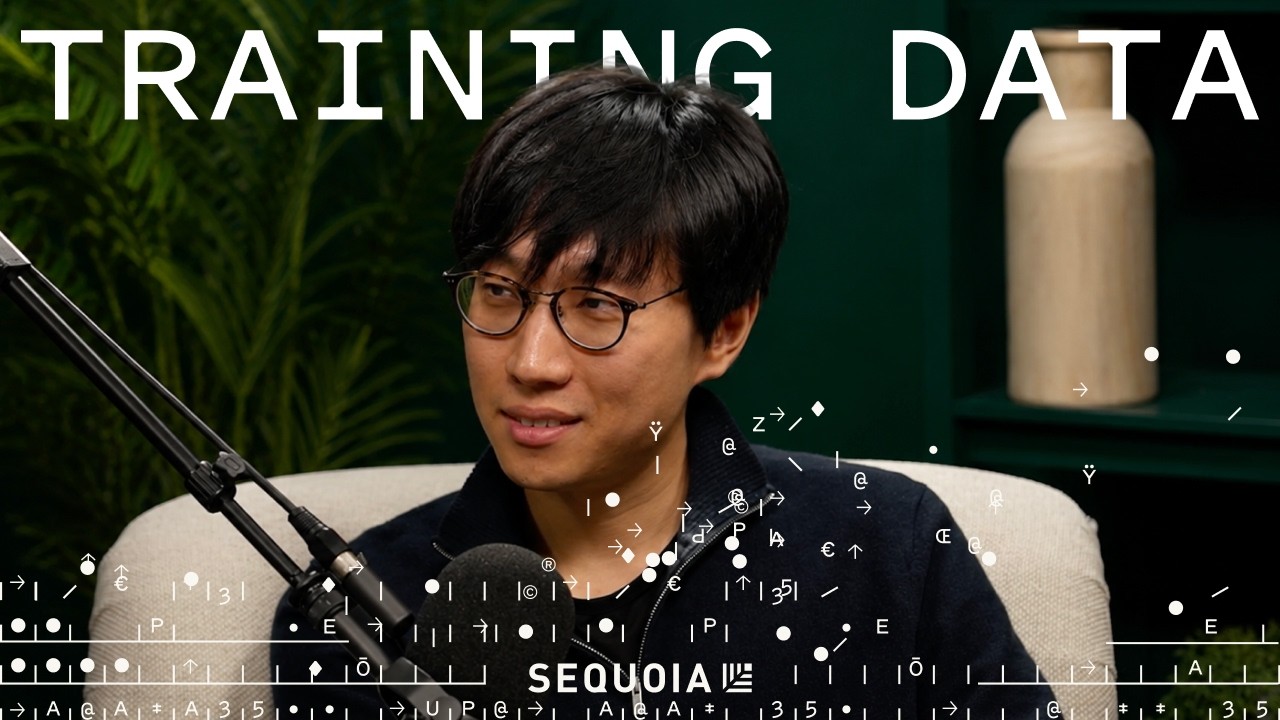
Simulating Humans at Scale: Simile's Joon Sung Park
Joon Sung Park, founder and CEO of Simile and creator of Stanford's Smallville generative-agents study, walks Sonya Huang through the arc from a 25-agent game town that spontaneously threw a Valentine's party to a company that simulated 1,000 Americans and predicted their answers 85% as accurately as the people reproduced their own. His core argument: today's frontier labs are building the "CPU of intelligence" — rational machines superhuman at problems with right answers — while simulating real human society needs the opposite, a model that encodes people's irrational values, preferences, and taste. CVS uses it for concept testing; some customers simulate their own earnings calls; and Joon's longer bet is a "CERN of human society" that could one day model bank runs, climate cooperation, or the early signals of a collapsing democracy. ## [00:00] Inside Smallville: 25 agents throw a Valentine's party The conversation opens on Joon's conviction — that science fiction's advanced societies always rest on two pillars, "some version of AGI and some version of simulations that really help guide the society" — before Sonya takes him back to Smallville, the April 2023 Stanford project that made his name. The setup was 25 generative agents, each given a persona and equipped with memory, planning, and reflection, then left to live in a small game town: wake up, do routines, go to work, form relationships. What surprised the team was emergent coordination. Isabella, a café owner, decided to throw a Valentine's Day party, spent the day before gathering materials and inviting customers, and on the day itself the party actually formed. > *some of the agents did not explicitly get invited, but we had one agent who got the invite, Claus, who decided to ask his crush out on a date* ## [03:34] From a foundation-models paper to simulating a subreddit Joon traces the origin back to 2020, the year GPT-3 was about to land. As a Stanford researcher he co-wrote the "Opportunities and Risks of Foundation Models" paper, and the part that gripped him was not that the models could classify or generate — interaction researchers had done that for years — but that they could encode human behavior. Coming out of the social-computing tradition, he saw a long-standing hole: there was no way to test how millions of people would behave on a platform short of shipping it and watching what happens, sometimes at real cost. That led to the 2022 Social Simulacra paper, the precursor to generative agents, which populated a simulated subreddit with thousands of personas to let a designer see community dynamics before launch. > *The only way we test it today is you basically field test it. You release your prototype, see what happens.* ## [07:57] The CPU of intelligence can't model irrational humans Asked when models got good enough for a faithful representation of society, Joon marks the path from GPT-3 — janky, no instruction tuning, needing prompt tricks just to follow orders — to today's foundation level where these applications become imaginable. But he draws a sharp limit. The frontier labs' north star is a rational, superhuman machine optimized for objective problems, and that is the wrong target for simulating people. As accuracy on objective benchmarks climbs, the ability to predict and simulate human behavior diverges, because people are not rational. > *We have a lot of subjective values, preferences, and taste.* ## [10:04] Why this became a company, not another paper Joon distinguishes the two vehicles bluntly: research is built for breadth, where each researcher owns a slice of thesis and is "not necessarily known for finishing our job," while a company is built for depth on a single conviction. The pull toward a company came roughly half a year after the generative-agents paper, first from social scientists wanting to run RCTs on the platform, then from Fortune 500 boards and CEOs who saw the demo at Stanford and asked whether the surveys and market questions they could never answer might run in simulation. Before committing, the team validated accuracy: simulations of 1,000 people across the US population. > *we can actually predict people's behaviors 85% as accurately as people replicate their own* ## [12:43] How a Simile engagement works — and the say-do gap Simile's first major customer is CVS, brought in by a senior VP of human insights who had read the validation paper and felt bottlenecked by how few questions he could field-test. The workflow mirrors how firms already use polling and panel companies: a customer names a population they want to understand, and Simile — through a strategic partnership with Gallup — reaches real humans, asks the magical 15-minute questions, and turns that data into agents that answer far beyond the original survey. Sonya pushes on why an LLM alone can't just role-play a 34-year-old woman from a coastal metro. Joon's answer is the say-do gap: models are trained on what people said online, not what they actually do, and closing that gap requires behavioral data — RCTs, pricing studies, and life-story interviews that surface the long-tail of a person. > *There are things that people say and then there are people there are things that people actually do and the gap there is real* ## [20:27] The GPU of intelligence: from concept tests to earnings calls Here Joon gives the framing that anchors the company. Today's models are the CPU of intelligence — one model trained on rational data, superb at objective questions. Simile is building something closer to the GPU: not superhuman, but as human as possible, where individual subunits represent the real viewpoints of different populations. Customers usually enter through a concrete door — concept testing, where instead of testing 5 to 10 ideas they imagine testing a thousand ideas across a thousand sub-populations — then move toward product testing with a temporal dimension and multi-agent simulation. One recurring and initially surprising ask: simulate the company's own earnings call to see how the audience reacts. > *imagine the current today's model are akin to the CPU of intelligence unit* ## [26:32] How accurate is it? Convergence versus divergence On evaluation, Joon starts from the theoretical limit — humans answer the same question slightly differently each time, so perfect prediction is impossible — then describes the metric: total variation distance between the ground-truth and simulated response distributions, with a TVD under 0.15 treated as strong enough for decisions. The deeper idea is two categories of simulation. Convergent ones tolerate compounding error because the pull toward an outcome is strong — like a network always forming a hub, the scale-free structure that powered PageRank. Divergent ones — was World War I inevitable, who wins an election — can't be expected to repeat, so the evaluation shifts to confidence: run it 100 times, see how often outcome X appears, and show the diversity of possible futures. He likens the work to the early days of inferential statistics setting the p < 0.05 threshold. > *was World War I inevitable or was it not?* ## [31:56] A CERN for human society Sonya raises the grander possibility — that fields like macroeconomics, which she sees as human behavior at scale, might one day be partly solved by simulation, including the venture question of where value accrues across the AI stack. Joon agrees there is "a Nobel Prize to be won there," recalling how Thomas Schelling's deliberately crude agent-based segregation models revealed something deep about macro behavior. The augmented version replaces red-dot/blue-dot agents with agents that replicate the full richness of individuals, opening questions economists actually asked him: when does a bank run happen, can nations be modeled solving climate's collective-action problem, what are the early signals of a democracy about to collapse. He imagines a simulation that costs $100 million and months to run once but answers a fundamental question — a Hubble telescope for human society. > *building simulator that's akin to the CERN of human society* ## Entities - **Joon Sung Park** (Person): Founder and CEO of Simile; created Stanford's Smallville generative-agents study and co-authored Social Simulacra. - **Sonya Huang** (Person): Partner at Sequoia Capital, AI investing; host of the conversation. - **Simile** (Organization): Applied AI lab building models that simulate human behavior and societies for concept testing, product testing, and multi-agent scenarios. - **Smallville** (Concept): 2023 Stanford experiment with 25 generative agents living in a game town, known for emergent behavior like a self-organized Valentine's party. - **Social Simulacra** (Concept): 2022 paper simulating a subreddit with thousands of personas; precursor to generative agents. - **Say-do gap** (Concept): The difference between what people say (the basis of LLM training data) and what they actually do, which behavioral data is collected to close. - **CPU vs GPU of intelligence** (Concept): Joon's framing — frontier labs build a rational "CPU" superhuman at objective problems; Simile builds a "GPU" encoding the diversity of human values and taste. - **Total variation distance** (Concept): Simile's accuracy metric comparing ground-truth and simulated response distributions; TVD < 0.15 treated as decision-grade. - **CVS** (Organization): Simile's first major customer, using it for concept testing via its human-insights team. - **Gallup** (Organization): Polling and panel partner Simile uses to reach real humans and ground simulations in real data.
Ce que David Senra a appris en étudiant plus de 400 fondateurs
David Senra a passé dix ans à lire plus de 400 biographies de fondateurs avant de commencer à rencontrer les survivants en face à face. Sa réponse en un seul mot à ce qu'ils ont tous en commun : la focalisation — ce qu'il appelle « couper le bruit du monde et construire le sien » — et il explique à Brian Halligan pourquoi ce trait, combiné à une pulsion quasi compulsive ancrée dans des expériences précoces, rend mieux compte du succès entrepreneurial que n'importe quelle grille d'évaluation importée de la Silicon Valley. La conversation aborde les origines dans l'enfance, les archétypes de fondateurs, le danger de vendre sa meilleure entreprise, et la façon dont l'ère de l'IA rend l'excellence artisanale plus précieuse que jamais — tandis que le câblage humain fondamental des grands fondateurs, lui, ne change pas. ## [00:00] Introduction Brian Halligan pose d'emblée ce qu'il attend de David : une synthèse de ce que les meilleurs fondateurs — de Jésus de Nazareth à Jensen Huang — partagent vraiment, et comment s'en servir pour les repérer et les accompagner. L'épisode démarre en plein milieu d'une anecdote sur Tony Xu de DoorDash, qui, avant même la fin du dîner célébrant un cap important, était déjà en train de recenser les dix-sept choses qui n'allaient pas. Cette agitation permanente, selon David, c'est le signe qui ne trompe pas. > *"Avant même que le dîner soit terminé, je pense déjà aux 17 choses qui ne vont pas. C'est pour ça que c'est formidable."* ## [01:11] La focalisation avant tout Le mot de David, c'est la focalisation. Pas l'acharnement, pas la résilience, pas l'intelligence — la focalisation. Il la décrit comme quelque chose de qualitativement différent de ce que font les autres hauts performeurs, presque une espèce à part : ils ne regardent pas ce que font leurs concurrents, ils s'en moquent sincèrement. Sa formule : « couper le bruit du monde et construire le sien. » > *"Si je devais tout résumer en un seul mot, ce serait la focalisation. Ils sont d'une concentration hors norme, pas seulement par rapport à la moyenne — c'est comme s'ils appartenaient à une autre espèce."* ## [01:50] La focalisation de Dana White sur l'UFC Dana White est l'exemple le plus récent que cite David d'une focalisation de missionnaire. White a grandi en se décrivant lui-même comme un raté, travaillait comme portier à Boston, puis a déménagé à Las Vegas pour être au plus près du monde de la boxe, sans rien à perdre. Il a fini par convaincre les frères Fertitta d'acheter l'UFC pour 2 millions de dollars. Pendant six ans, ils ont perdu de l'argent. Puis encore 40 millions avant d'atteindre la rentabilité. Vingt-six ans plus tard, White a signé un contrat télévisé valant près de 8 milliards de dollars — et son explication : il n'a jamais lu un seul livre de management ni écouté un seul podcast d'affaires. Il a simplement fabriqué ce qu'il voulait voir. > *"Son univers tout entier, c'est son entreprise — tout le reste, il s'en fiche. Il est d'une concentration absolue."* ## [04:19] Focalisation et obsession Brian demande si focalisation et obsession sont la même chose. David dit qu'elles sont étroitement liées mais distinctes : la focalisation consiste à dire non à de bonnes idées pour pouvoir poursuivre une grande. Il cite Jony Ive rapportant la distinction de Steve Jobs — la focalisation, c'est dire non à une bonne idée qu'on a vraiment envie de concrétiser parce qu'elle distrait d'une grande idée — et note que quelqu'un d'intensément focalisé sur quelque chose paraît obsédé de l'extérieur, mais que le mécanisme est une exclusion active, pas une fixation passive. > *"La focalisation, c'est dire non à une bonne idée qu'on a vraiment envie de réaliser, parce qu'elle nous éloigne d'une grande idée."* ## [05:05] Les racines dans l'enfance Brian demande d'où vient cette obsession : enfances ordinaires ou quelque chose de cassé très tôt ? David dit que ce n'est pas une seule chose, mais que presque tous les fondateurs qu'il a étudiés ne sont pas ce qu'on appellerait des gens bien dans leur peau. Il cite la biographie de Francis Ford Coppola comme source de la formule qui a cristallisé un schéma qu'il voyait se répéter — que l'élan du fils est toujours inscrit dans l'histoire du père — et explique pourquoi il voit les cinéastes, les animateurs de podcasts et les fondateurs de startups comme le même type entrepreneurial. > *"La réponse, c'est que ce n'est pas une seule chose."* ## [06:07] Coppola et son père Le schéma que David retrouve sans cesse : l'histoire du père est gravée dans le fils. Le père de Coppola était un musicien brillant mais raté qui a dit à son jeune fils « il ne peut y avoir qu'un seul génie dans la famille — c'est moi », puis a passé des années à le rabaisser. Coppola l'a intériorisé et a construit l'une des éthiques de travail les plus acharnées de Hollywood, remportant finalement l'Oscar et laissant son père en composer la musique — qui a également été primée. David applique cela à travers le cadre de Charlie Munger : pour vraiment comprendre une idée, il faut la rattacher à la personnalité qui l'a développée, ce qui explique pourquoi la biographie dépasse les livres de stratégie. > *"On comprend toujours le fils par l'histoire de son père. L'histoire du père est inscrite dans le fils."* ## [08:48] Les caractères difficiles et les archétypes Brian soulève le cliché selon lequel les grands fondateurs sont des gens difficiles. David le rejette catégoriquement. Il travaille avec Daniel Ek de Spotify sur un projet de cartographie des archétypes de fondateurs — l'hypothèse étant que l'adéquation fondateur-problème compte plus que l'adéquation produit-marché. Ek a passé des années à imiter Steve Jobs en perdant son temps à endosser une personnalité qui n'était pas la sienne. Il est davantage du type coach. Le point de David : il n'existe pas un seul archétype, il en existe probablement six à huit, et comprendre lequel on est vaut mieux qu'imiter le fondateur en vogue du moment. > *"L'essentiel, c'est l'adéquation fondateur-problème. Pensez à Demis de DeepMind. Il avait une grande entreprise en lui. C'était DeepMind. Il était fait pour faire ce qu'il fait."* ## [11:14] Autisme et originalité Brian soulève la forte prévalence de traits du spectre autistique parmi les PDG de sociétés à mille milliards de capitalisation — Jobs, Gates, Bezos, Zuckerberg, Jensen, Ellison. David cite Peter Thiel : les fondateurs qui semblent légèrement Asperger manquent du gène de l'imitation sociale, ce qui fait que personne ne les dissuade de leurs idées étranges et originales avant qu'elles soient pleinement formées. Nuance de David : la Baie de San Francisco regorge désormais de gens qui jouent à l'anti-imitation, ce qui en fait les plus mimétiques de tous. Rockefeller ne correspondait probablement pas au profil du spectre — mais il avait des compétences sociales avancées et a quand même bâti la société la plus dominante de l'histoire. > *"Il faut se demander ce qu'il y a dans notre société qui désavantage ceux d'entre nous qui ne souffrent pas du syndrome d'Asperger, parce qu'on va nous dissuader de nos idées intéressantes, originales et créatives avant même qu'elles soient pleinement formées."* ## [14:55] La volonté de l'immigrant David parle d'expérience personnelle en tant que fils d'un immigrant cubain : ceux qui ont risqué leur vie sur des radeaux pour traverser 150 kilomètres d'océan donnent à leurs enfants une autre référence de ce que signifient le risque et l'opportunité. Brian note que seulement trois des dix plus grands fondateurs américains de la tech étaient immigrants — Jensen, Elon, Sergey — tandis que la plupart venaient de classes moyennes supérieures en banlieue. La réplique de David : ces trois-là représentent une part disproportionnée de la capitalisation totale, et beaucoup des autres avaient des pères immigrants. L'avantage peut se transmettre sur une génération. > *"Pensez à combien vous aimez votre fils, et à quel point Cuba et le communisme devaient être terribles pour mettre votre fils de 14 ou 9 ans sur un radeau en espérant qu'il arrive en Floride."* ## [16:38] Miser sur le fondateur David dit que s'il était capital-risqueur, il n'appliquerait aucune grille — il miserait simplement sur la personne. Ed Catmull lui en a donné la formulation la plus claire : donnez une grande idée à une équipe médiocre et elle la gâchera ; donnez une idée médiocre à une grande équipe et elle la corrigera ou la jettera pour construire quelque chose de meilleur. Les idées viennent des gens, donc les gens comptent plus que les idées. Le test de David : est-ce que cette personne a la qualité que Travis Kalanick avait chez Uber, c'est-à-dire qu'elle fera en sorte que ça marche ou mourra en essayant ? > *"Si vous donnez une grande idée à une équipe médiocre, elle va la rater. Si vous donnez une idée médiocre à une grande équipe, elle la corrige ou la jette pour créer autre chose."* ## [17:52] Seul ou en tandem La sagesse conventionnelle — les cofondateurs, c'est mieux, le nombre optimal est trois — ne correspond pas à ce que David observe à travers l'histoire. La plupart des grandes entreprises avaient une force motrice dominante, et le « cofondateur » soit est parti (Wozniak), soit était essentiellement un opérateur que le fondateur avait recruté (Frick chez Carnegie Steel), soit était une personnalité complémentaire qui s'est consciemment subordonné à un talent d'exception (Munger face à Buffett). Quand David a rencontré Munger, celui-ci a admis qu'il s'était toujours cru plus intelligent que tout le monde, mais qu'il avait reconnu la focalisation singulière de Buffett et fait le calcul délibéré de subordonner son propre ego à elle. > *"Si je pouvais revivre ma vie, je me croirais encore plus intelligent que tout le monde, mais je ferais mieux de le cacher."* ## [23:20] La voix intérieure négative comme carburant Jensen Huang dit qu'il se regarde dans le miroir chaque matin en se demandant pourquoi il est aussi nul. Elon décrit son esprit comme une tempête et semble sincèrement mal à l'aise quand tout va bien. La plupart des fondateurs que David a étudiés fonctionnent avec le discours intérieur négatif comme carburant — mais David a récemment changé cela en lui-même. Brad Jacobs, qui a bâti huit entreprises à un milliard de dollars sur 45 ans, lui a dit : la pulsion négative t'a amené jusqu'ici, mais elle ne te sert plus. Maintenant tu aimes le travail. Rends ta motivation intérieure générative. David dit que quelque chose s'est décliqué et qu'il n'est plus revenu en arrière. > *"Votre motivation intérieure devrait être générative. Quelque chose comme : 'J'essaie de créer quelque chose de bon pour le monde, que j'aime faire et dont je suis très fier.'"* ## [26:39] Mutations de plateformes et mode fondateur Brian demande si les grandes mutations de plateformes — la révolution industrielle, la chaîne d'assemblage, et maintenant l'IA — changent le profil de ceux qui réussissent et leur façon de diriger. Il décrit la distinction de Paul Graham entre le mode fondateur et le mode manager, ainsi que son propre cadre du « mode Dorsey » : organigramme plat, titres supprimés, un système d'IA au centre prenant une part croissante des décisions tandis que les humains lui fournissent du contexte et exercent leur jugement. Il voit cela comme structurellement différent de toute mutation de plateforme précédente. > *"Aujourd'hui, le système d'IA prend très peu de décisions, peut-être 5 %, 10 % — mais le rapport entre les décisions prises par l'IA et celles prises par les humains commence à s'inverser."* ## [28:07] Dell face à IBM David a demandé directement à Michael Dell si ce moment ressemble à quelque chose qu'il a déjà vécu. Dell a dit non — c'est catégoriquement différent. David est d'ordinaire sceptique face aux affirmations du type « cette fois c'est différent », mais il est d'accord avec Dell, Toby Lütke et Jack Dorsey que la quantité de levier désormais accessible à une petite équipe change fondamentalement les mathématiques de la construction d'entreprise. IBM avait autrefois 80 % de parts de marché de l'ensemble de l'industrie technologique et a été la première société à atteindre 100 milliards de dollars de capitalisation. Dell les a affrontés depuis une chambre de résidence à l'Université du Texas avec 1 000 dollars — et a été rentable chaque trimestre pendant ses vingt premières années. > *"Je pense vraiment que la façon de diriger une entreprise — la manière de le faire, les outils disponibles — est complètement différente."* ## [30:02] L'avantage du levier infini La formule de Naval Ravikant — « à l'ère du levier infini, être à l'extrême de son art est crucial » — a été écrite avant l'IA. David pense que l'IA amplifie cette vérité d'un ordre de grandeur supplémentaire. Son exemple : Jordi de TBN n'était pas deux fois meilleur en marketing de podcast que le suivant — il était 100 fois meilleur, et les récompenses économiques disponibles pour quelqu'un à cette frontière ne sont pas 100 fois plus grandes, elles sont potentiellement 1 000 fois plus grandes. La prime à la focalisation et à la maîtrise monte, elle ne baisse pas. > *"À l'ère du levier infini, être à l'extrême de son art est crucial."* ## [31:38] Focalisation et vitesse Brian objecte : les fondateurs natifs de l'IA qu'il connaît — Harvey, Lovable, ElevenLabs — avancent vite sur plusieurs fronts simultanément. La focalisation est-elle encore la règle ? La réponse de David : ils n'ont pas encore bâti d'entreprises durables, il est donc trop tôt pour le savoir. Sa préoccupation plus profonde : que se passe-t-il après la vente ? Il a passé du temps avec des fondateurs dans la soixantaine et la soixante-dizaine qui ont vendu leur meilleure entreprise et ont passé des décennies à essayer de retrouver la magie sur des deuxièmes et troisièmes paris — presque aucun n'a réussi. Si vous avez vraiment une entreprise générationnelle, ne la vendez pas. Vous êtes soit tout dedans, soit tout dehors. > *"Vous êtes tout dedans ou tout dehors — mais pourquoi seriez-vous tout dedans sur votre deuxième, troisième, quatrième ou cinquième meilleure idée ?"* ## [34:20] Le goût et l'écoute Brian demande si le bon goût est un vrai trait de fondateur ou un concept à la mode. David dit que le goût est très réel, et son exemple le plus clair est Rick Rubin — qui fait à 62 ans ce qu'il a commencé à 18 ans dans sa chambre universitaire. Mais la thèse plus précise de David est que l'avantage de Rubin n'est pas seulement le goût, c'est qu'il est un écouteur professionnel. La plupart des gens en conversation attendent de répondre. Rubin est réellement intéressé. Cette qualité d'attention, transposée de la production musicale aux podcasts, fait son exception. David aborde aussi l'authenticité du fondateur : tout le monde ne devrait pas être sans filtre — cela dépend de qui vous êtes, du secteur dans lequel vous évoluez et de ce que vous cherchez à construire. > *"Il a pris une compétence de la musique et l'a appliquée aux podcasts. Vous êtes un écouteur professionnel."* ## [40:52] Les traits du fondateur et l'équilibre Les traits fondamentaux que David a identifiés à travers plus de 400 biographies : l'obsession, un fort niveau de désaccord, l'obsession du contrôle des coûts et le micromanagement — ce que Paul Graham a appelé le « mode fondateur », que David note n'être pas du tout nouveau. Rockefeller était en réalité une exception sur le désaccord, ne haussait jamais la voix, mais était une force de la nature à d'autres égards. Sur la question de l'équilibre vie professionnelle-vie personnelle : David peut nommer exactement trois fondateurs sur quatre siècles qui avaient une vie personnelle vraiment épanouie. Sam Walton, rédigeant son autobiographie en mourant d'un cancer, a dit qu'il referait tout exactement de la même façon. Phil Knight, à 75 ans, n'arrive toujours pas à se réconcilier pleinement avec son absence de la vie de ses fils. Ce qui motive les grands, ce n'est pas l'argent — c'est le contrôle. > *"Je ne pense pas que les petits egos bâtissent de grandes entreprises — je pense que tous ces gens ont des egos énormes. Certains savent juste mieux le cacher. Et ce qui motive la plupart des fondateurs, ce n'est pas l'argent, c'est le contrôle."* ## [54:22] Conclusions Brian distille trois enseignements : l'obsession profonde fondateur-marché est le vrai fil conducteur ; avoir un bon équilibre vie professionnelle-vie personnelle tout en bâtissant une grande entreprise est genuinement rare (trois sur 400) ; et travailler sur le syndrome de l'imposteur vaut la peine — Brian cite l'évolution de Brian Chesky, passé de diriger par la peur à diriger par l'amour, comme modèle. L'épisode se conclut avec la formule de Dana White : comprendre profondément qui vous êtes, comprendre profondément ce que vous voulez faire dans le monde, puis vous lever chaque jour et exécuter. Rester dans la partie assez longtemps pour avoir de la chance. > *"Restez dans la partie assez longtemps pour avoir de la chance."* ## Entités - **David Senra** (Personne) : Animateur du podcast Founders ; a lu plus de 400 biographies de fondateurs et rencontre désormais les vivants en face à face - **Brian Halligan** (Personne) : Cofondateur et président exécutif de HubSpot ; anime cette série Sequoia Capital - **Dana White** (Personne) : Fondateur et PDG de l'UFC ; l'a achetée pour 2 millions de dollars en 2001, a récemment signé un contrat de droits télévisés d'environ 8 milliards de dollars - **Daniel Ek** (Personne) : Fondateur de Spotify ; travaille avec David sur un cadre d'archétypes de fondateurs ; défend l'adéquation fondateur-problème plutôt que l'adéquation produit-marché - **Demis Hassabis** (Personne) : Cofondateur de DeepMind ; cité comme l'exemple le plus clair d'une adéquation parfaite fondateur-problème - **Charlie Munger** (Personne) : Associé chez Berkshire Hathaway ; a consciemment subordonné son ego au talent d'exception de Buffett - **Ed Catmull** (Personne) : Cofondateur de Pixar ; plus long collaborateur consécutif de Steve Jobs ; source du principe « donnez une grande idée à une équipe médiocre » - **Brad Jacobs** (Personne) : Entrepreneur ayant bâti huit entreprises à un milliard de dollars séparées ; a conseillé David de passer d'une motivation punitive à une motivation générative - **Rick Rubin** (Personne) : Producteur de musique ; exemple cité par David du goût allié à l'écoute professionnelle comme avantage cumulatif - **Founders** (Média) : Podcast de David Senra couvrant plus de 400 biographies de fondateurs de l'histoire à nos jours - **founder-problem fit** (Concept) : Cadre de Daniel Ek — l'adéquation entre l'identité d'un fondateur et le problème spécifique qu'il résout est la forme d'adéquation la plus importante - **infinite leverage** (Concept) : Idée de Naval Ravikant selon laquelle, à l'ère des logiciels et de l'IA, être à l'extrême de son art produit des récompenses disproportionnellement grandes - **Sequoia Capital** (Organisation) : Fonds de capital-risque ; base actuelle de Brian Halligan et hôte de cette série de podcasts
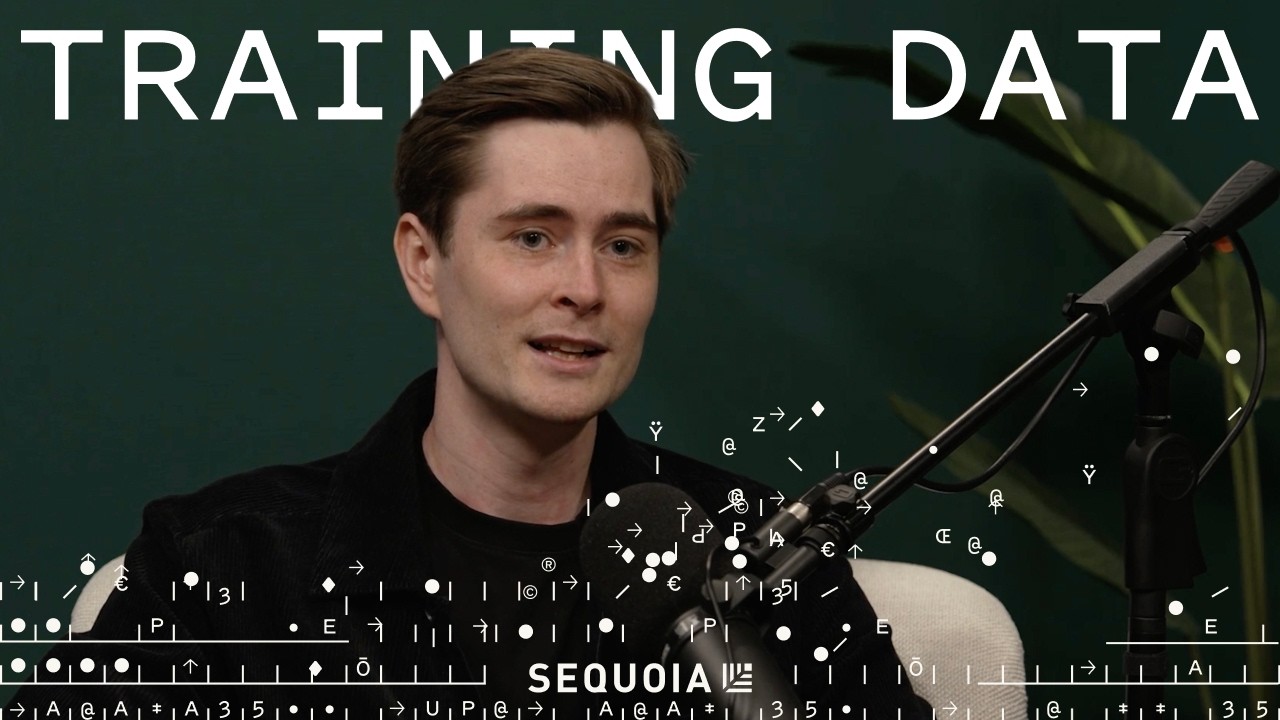
Knowing What Your Customers Want, All the Time: Listen Labs' Alfred Wahlforss
Alfred Wahlforss built Listen Labs after scratching his own itch: when his viral AI-avatar app hit 20,000 users overnight and churn spiked, he needed to know why—fast. The answer was an AI agent that runs voice interviews at scale, drawing from a panel of 30 million people. A year in, Listen serves 20% of the Fortune 500 and has completed over a million interviews. The deeper finding is counterintuitive: respondents are often more honest with an AI interviewer than a human one, and voice transcripts turn out to be richer training signal than credit card data or behavioral logs. Wahlforss and Sequoia's Konstantine Buhler work through why audience selection consumes 80% of Listen's engineering, how back-tested simulation beats vanilla ChatGPT at message testing, and why—as AGI makes building trivially cheap—knowing *what* to build becomes the scarce resource Listen wants to own. ## [00:00] Introduction Alfred opens in the middle of a thought about audience depth: Listen's long-term goal is to reach a billion people and build rich profiles that reveal each person's genuine areas of expertise—not just demographic boxes, but things like whether someone is a true sneaker influencer versus a casual buyer. Konstantine then formally introduces him: Listen launched roughly a year ago, already counts Microsoft, Anthropic, Sweet Green, NBC, and others as customers, and runs thousands of voice interviews simultaneously. The brief cold-open framing gives the episode its throughline—the value of talking to the *right* person, not just any person. > *"Our goal is to get to a billion people in our audience and then to be able to stratify and know what exactly is this person an expert on."* ## [01:20] How Listen Works The product works in three stages: a researcher types a question (say, "how can we improve Cursor's onboarding?"), Listen's AI agent generates an interview guide, then routes those interviews to matched participants from its 30-million-person panel. Hundreds of conversations run in parallel, the results are synthesized, and recommendations surface. The next stage, launching in a few months, is simulation: after tens of thousands of interviews accumulate on a topic, can Listen predict how customers will answer *future* questions without running a new interview? > *"As we get closer to AGI, it will be easier to build things, but the hard part will be knowing what to build—and that's what we're building at Listen."* ## [02:23] Customer Wins Chubbies discovered that chest hair caught uncomfortably on one of their shirt materials; Listen surfaced the feedback, Chubbies redesigned the garment, and comfort scores jumped. Manscaped used Listen insights to reshape a Super Bowl ad. Skims uses it for ongoing product testing. The through-line Alfred draws: Listen handles both small product details and high-stakes campaign decisions with the same workflow—talk to real people, fast. > *"They discovered that chest hair interface really poorly with one of the materials they have. So it's really uncomfortable to wear one of their shirts, and they changed the shirt and it became radically more comfortable."* ## [03:28] Surveys Versus Reality Konstantine presses on the classic critique: survey respondents lie, or at least contradict themselves. Alfred's evidence: Listen ran the same multiple-choice survey questions back to the same people and found radical inconsistency—but when those same people had to reason through an open-ended voice answer, consistency improved sharply. On sales-data back-testing, Alfred agrees AB tests are the gold standard but notes they require large user bases that most companies don't have. Interview data, properly designed, beats no data. > *"If you go back to the same person and ask them a survey question in a multiple choice fashion, they're much more inconsistent. But when you actually have to think and reason through your answer, you're much more consistent."* ## [05:13] Zoom Like AI Interviews The participant experience is a video call with an AI agent—not a text form. The agent watches facial expressions and vocal tone, giving Listen a second signal layer beyond what people say. Alfred cites advertising testing as the clearest win: respondents might rate an ad highly on a Likert scale but show genuine enthusiasm in video, and that enthusiasm predicts Meta and LinkedIn performance marketing results significantly better than the numeric score. Every data point links back to the actual video clip, so researchers can verify the AI isn't hallucinating sources. > *"For every data point you can always click and then look at the video or see the quote—so you know that AI is not just hallucinating where it's coming from."* ## [07:14] Origin Story Alfred and his co-founder shipped a consumer app called "Be Fake"—an early stable-diffusion fine-tuning tool for creating AI avatars of yourself—which went viral overnight and hit 20,000 users. Churn spiked immediately and they had no idea why. They built an AI interview tool to ask their own users, found it genuinely useful, and pivoted. The market-research product they built for themselves became Listen Labs. > *"We built this AI interview for ourselves because we had a ton of churn and we wanted to understand why—and that's how we got started."* ## [08:01] Old World Research The pre-Listen world had two speeds: slow online survey tools like Qualtrics, or expensive services firms that charge tens of millions to recruit participants, design question methodology, moderate focus groups, and synthesize hundreds of transcripts. Question design alone is an academic discipline—ask "how much would you pay for this?" and you get junk data. The sourcing problem is equally hard: incidence rates of 10% mean nine out of ten recruited panelists get screened out, burning trust and causing churn on the databases themselves. > *"In traditional industries like CPG or even Microsoft, they spend tens of millions of dollars on focus groups to bring people in a room and interview them—and we can help speed that up much faster."* ## [09:50] AI First Benefits Three compounding advantages: speed (results from real people in five minutes), cost (asynchronous interviews pay participants less than synchronous ones, and participants accept that willingly), and honesty (people open up more to a non-judgmental AI than to a human interviewer who might silently judge them). Alfred mentions sensitive use cases—interviewing children about products, with parental consent—as an area where the AI's non-threatening presence produces data that focus groups can't. > *"People are more honest talking to an AI. It's a very therapeutic experience because it's a non-judgmental entity that's really interested in you."* ## [11:32] Finding The Right People Listen spends 80% of its engineering resources on audience quality, not the interview agent itself. The reason: power-law customer segmentation means talking to the wrong 100 people gives you wrong insights. Sweet Green's most valuable customer is urban, high-income, mostly female, and—Alfred's specific example—knows what seed oils are (roughly 1% of the population). Listen builds rich profiles across every interview a panelist ever participates in, so an offhand comment ("I'm a total sneaker head") in an unrelated interview can resurface that person when Nike needs launch feedback. Traditional email-list panels couldn't do cross-topic profiling. > *"Even a product like Sweet Green, which you would think is for everyone, the right audience is typically urban, high household income, mostly female—and they need to know what seed oils are, which only like 1% of the population does."* ## [14:30] CRM And Prospecting Sweet Green already has a CRM full of its most loyal customers—so why use Listen? Three reasons: researching *prospective* customers who aren't yet in the CRM requires an external panel; CRMs are typically disorganized and legally constrained (Google can't spam Gmail users, even its own); and direct outbound email risks getting flagged as spam, which can permanently damage a domain's deliverability. Listen provides clean, third-party panel access that sidesteps all three problems while still supporting CRM-connected campaigns when brands want them. > *"What we found is that the CRM is typically really unorganized, and sometimes there are regulatory issues—if you're at Google, you can't just send emails to people who use Gmail."* ## [15:35] Consulting In The AI Era Konstantine—a former buyer of McKinsey-style consulting—asks whether firms like Bain still have a role. Alfred's view: yes, but margins compress. Bain already uses Listen to accelerate existing workflows. The more optimistic scenario: AI doesn't just replace a research project, it makes research cheap enough to run five simultaneous strategic explorations that a company never would have commissioned before. Alfred predicts consulting expands in scope even as price-per-project falls. On economic surplus, Listen has charged hundreds of thousands of dollars to interview 20 doctors across eight countries—fast—a project that previously would have taken months. The surplus is currently staying with the supplier. Alfred also flags an emerging agentic loop: churn interviews surface bugs, which connect directly to a coding agent that opens a PR and ships the fix. Listen as the customer-intelligence "left side" of an autonomous product development cycle. > *"Because you're able to do it faster, I would argue you should be able to charge more for it—and we have charged hundreds of thousands of dollars to speak to 20 doctors across eight countries."* ## [20:05] Market Research Simulation This is the episode's technical core. Konstantine frames the evolution as 1.0 (call 100 people manually), 2.0 (AI-native simultaneous interviews), and 3.0 (generative simulation). Alfred explains how Listen's simulation works: interview a single person deeply, build a persona model, then scale to a thousand statistically representative agents. Back-testing removes a held-out question and measures prediction accuracy—they reach 95% on stable preference domains and deliberately expose the model to nonsensical queries (dog names) to calibrate what it *can't* predict. Alfred ran a personal live test: 100 title variants for a conference talk, run through Listen's panel simulation. The top-ranked title performed twice as well as the second. He then ran the same test in ChatGPT—which picked the wrong title when shown a past successful talk versus a less successful one. Listen's domain-specific panel data beat the general model. The gap: interview transcripts outperform credit card spend, behavioral logs, or ChatGPT persona prompting because voice conversations capture how a specific *type* of person actually reasons, not just what the average person does. Looking ahead, Alfred sees simulation handling "billboard tagline" decisions while real interviews remain the standard for Super Bowl ad buys. The product's proprietary eval climbed from 20% to 85% on avoiding repetitive questions, then Listen raised the bar with a harder eval (screen-state awareness, skipping irrelevant questions) and is back at 20%—which Alfred frames as the vertical AI flywheel: a proprietary benchmark that only you can keep climbing. > *"We were able to get 95% accuracy to predict how they will answer certain questions. The tricky part is knowing what things you can answer and what you can't."* ## [35:33] Closing Thoughts Alfred's conviction: human input will always be necessary because humans are inherently irrational—TikTok trends can overturn a marketing strategy overnight, and no AGI will preempt that. His uncertainty: the ceiling for simulation quality. His moat argument: network effects on the panel (supply-demand flywheel), data network effects (more interviews → better simulation), and product stickiness (interview history compounds inside the platform). But the simplest advantage he cites is opinionated defaults—early customers using vanilla LLMs to design their own interview guides got bad data and blamed Listen; now the agent enforces question-design best practices and data quality is consistent. Konstantine ends with the "Tide Pods moment" question: can Listen's AI start *generating* product ideas mid-interview rather than just testing them? Alfred says customers already feed AI-generated images into interviews manually; the MCP integration means Claude can loop Listen calls autonomously. The vision is live brainstorming between the AI interviewer and the respondent—ideas surfacing as the customer articulates a pain, not after. > *"Founders want to build something that's complex X, but customers want something that's stupid simple and it just works. And that's the advantage you have as a vertical AI company—you can train the agent to follow best practices in the work that you do."* ## Entities - **Alfred Wahlforss** (Person): Co-founder and CEO of Listen Labs; previously built "Be Fake," a viral AI-avatar consumer app. - **Konstantine Buhler** (Person): Partner at Sequoia Capital; host of the Training Data podcast; former consultant and operator. - **Listen Labs** (Organization): AI-first customer research platform; runs voice interviews with a 30-million-person panel; building generative simulation. - **Market Research Simulation** (Concept): Building persona models from accumulated interview data to predict future customer responses without running new interviews; back-tested against held-out questions. - **Audience Quality** (Concept): Listen's thesis that 80% of research value comes from recruiting the right respondents—power-law customer segments—not just any panelists. - **Be Fake** (Software): Alfred's earlier consumer app (AI avatar fine-tuning via stable diffusion); the origin of Listen's interview tooling. - **Bain** (Organization): Management consulting firm; cited as an active Listen customer using the platform to accelerate traditional research workflows. - **Procter & Gamble** (Organization): Cited as the historical archetype of market-research-driven brand management; Tide Pods and M&M's given as canonical examples. - **Qualtrics** (Software): Legacy survey platform representing the "old world" of market research tooling.
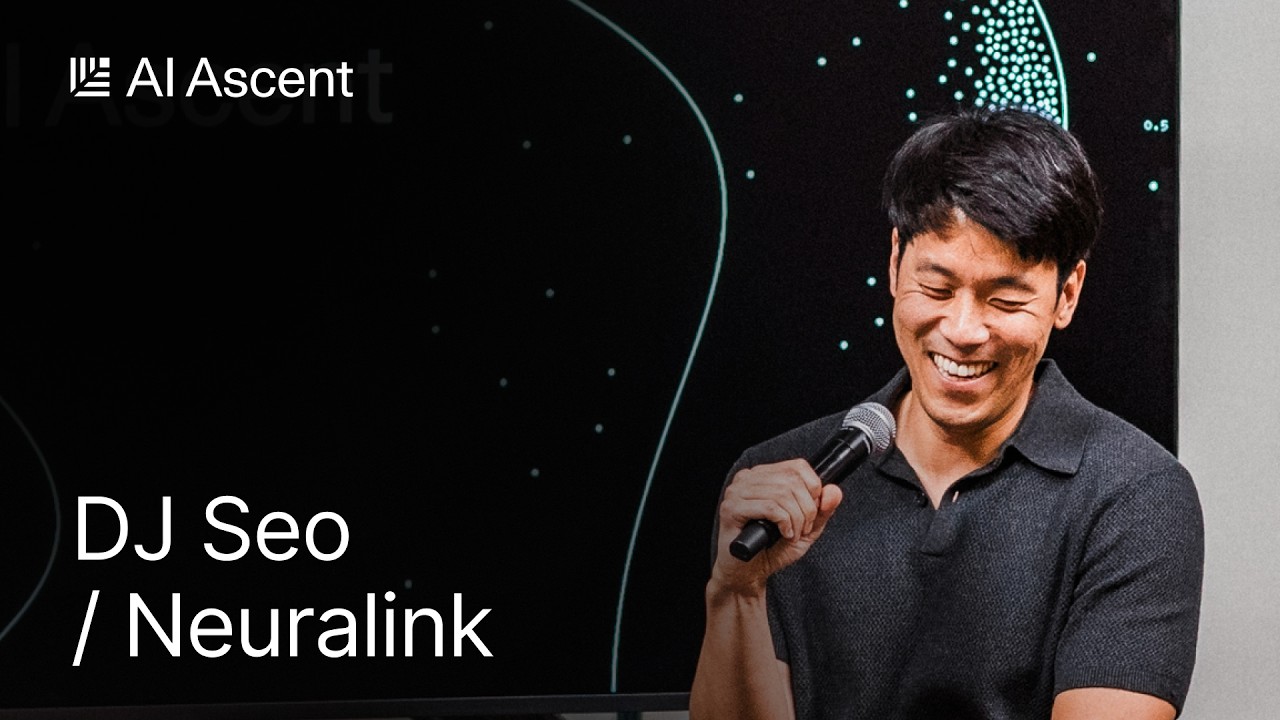
Neuralink's DJ Seo: Inside the Race to Connect Brains and AI
At AI Ascent 2026, Neuralink co-founder and president DJ Seo sits down with Sequoia partner Shaun Maguire to lay out exactly where the company stands: 20-plus Telepathy patients controlling computers and robotic arms through pure thought, Blindsight in preclinical testing and potentially cleared for human use by end of 2026, and a first-principles manufacturing philosophy borrowed from Elon Musk that treats surgical robots the way SpaceX treated reusable rockets. DJ argues that the real ceiling of this technology is not cursor control or speech synthesis but direct, uncompressed, multimodal transfer of concepts — AI as a neocortical layer sitting above the human limbic system — and that scale, the same variable that unlocked the LLM era, is the only remaining gate. ## [00:00] Introduction Shaun Maguire opens the session by announcing a two-minute Neuralink patient video before the interview begins, telling the audience to stay on the side because what they are about to watch is proof that the company has already cleared the hardest bar: restoring human agency to people who had lost it entirely. ## [00:21] Telepathy Patient Stories The video narrates four patients whose lives changed after receiving the Telepathy implant. A quadriplegic patient describes moving a cursor with thought alone — "I'm thinking and a cursor is moving on a screen. It blew my mind." An ALS patient who lost the ability to speak regains a digital voice through the implant: "I'm talking to you with my mind." Another patient notes that the implant flipped how his child sees him: "I am not able to do things that other dads can, but now he thinks it's so cool that I can do things that other dads cannot." > *"Before the implant, I was locked in, non-verbal, quadriplegic. Now I control my computer just by thinking and the rewards have been immense for me."* ## [01:06] Convoy Robotics Independence The video shifts to Convoy, Neuralink's assistive robotics team, which is extending BCI control beyond a screen to physical manipulation in the real world. A patient who had been losing motor function moves a robotic arm through its axes using only neural intent: "It was incredible to be able to just gesture with an arm again." A second patient, Kenneth, who was losing his voice to ALS, uses the system's speech synthesis to speak aloud in real time during the video — words generated by his brain signals rather than his vocal cords. > *"Gaining functionality that I thought was gone forever was so incredibly life-changing."* ## [02:04] Blindsight Vision Restore The video previews Blindsight, Neuralink's second product line, designed for patients who have lost both eyes or optic nerve function. An external camera captures the visual scene; the device writes the signal directly into the visual cortex via electrical stimulation, generating phosphenes — artificial pixels of light. A patient named Audrey, asked how it feels, answers simply: "Life-changing." The video closes with the line "all with my mind" spoken over footage of a patient interacting with the world through the restored signal. > *"The future of this technology feels almost unlimited... we are finding ways to apply it across all regions of the brain."* ## [03:10] After Video Reflections DJ Seo, visibly moved after watching the video alongside the audience, speaks first: "We were cracking a lot of jokes before that video, but honestly, that brought tears to my eyes." He describes the work as one of the most inspiring projects in the world — not because of the technical milestone but because the team is giving back capabilities that patients had already grieved as permanently lost. Maguire affirms the sentiment before pivoting to the founding story. > *"This is one of the most inspiring projects in the world. It's incredibly difficult what they're doing and I mean, they're truly saving people."* ## [03:31] Origin Story And AI DJ traces Neuralink's founding insight to a single bottleneck: the mismatch between human output bandwidth and AI capability. In 2016, saying that out loud "sounded insane," but the logic has not changed. His personal path ran through a childhood fascination with the brain, undergraduate work at Caltech building miniaturized low-power electronics, and a Berkeley PhD focused on shrinking lab-grade neural systems down to something deployable. When he met Elon Musk near the end of his PhD, the scale and ambition of the project made refusal impossible. He frames the brain as "the most interesting compute that we all carry" and "the only form of general intelligence that we know to date." > *"Really the key insight back then was sort of the IO bottleneck between the human output and AI capabilities."* ## [06:31] Scaling And Vertical Integration Maguire presses on what smart people most misunderstand about Neuralink: many know the implant and the decoding algorithm, but almost nobody grasps the manufacturing and surgical-robot infrastructure the company built in parallel from day one. DJ attributes this to what he calls "Elon magic" — an insistence on vertical integration that gives Neuralink control over every layer from chip design to factory floor to robotic surgery deployment. The target is not a niche medical device; it is LASIK-scale surgery available to millions. Building that capacity first means progress looks slow until "the iceberg pops over the waterline" and ramp becomes near-instantaneous. > *"Vertical integration is something that is really the lifeblood of Neuralink and Elon companies and what really enables us to have that fast iteration loop from design, develop, deploy."* ## [09:27] Caregivers And Purpose Asked which patient story inspires him most, DJ refuses to pick one — the power, he says, is not only in the patients but in the caregivers: Nolan's mother Mia, Brad's wife Tiffany, Ken's wife Cheryl. He describes their presence as "a really powerful human story of love, sacrifice, and resilience." He then takes what he calls a philosophical tangent: his core belief is that fulfillment comes from helping others, because the gap between self and other is not categorically different from the gap between your present and future selves. That belief is what he says keeps him and much of the Neuralink team going — they are "igniting a fire of hope" for people who had given up on recovering what they lost. > *"I personally and as well as many others at Neuralink find extreme fulfillment being able to help those that really cannot help themselves."* ## [13:10] BCIs Meet AI Future Maguire asks the room's core question: how do BCIs and AI converge? DJ sketches a two-horizon answer. Near term, the system translates neural intent into legacy interfaces — keyboard, mouse, language — which is already working. The real breakthrough, which he thinks is "not super distant," is bypassing those legacy interfaces entirely and computing on raw neural intent. He points to transformer architectures as existence proofs: nothing prevents them from learning the latent manifolds of neural data given sufficient scale. Neuralink is already fine-tuning LLM-class models on neural recordings from its 20 participants and finding "very counterintuitive" patterns. The ultimate ceiling he names is "direct, uncompressed, high-fidelity, multimodal transfer of concepts" — the Matrix's "I learned kung fu" moment and possibly beyond it. He also shares what he calls a clarifying lesson from working with Musk: "all green light schedule" — a first-principles forcing function that strips every man-made bottleneck and asks how fast something could actually be built if every light were green. His estimate is that 80–90% of perceived constraints in hardware development are artifacts of convention, not physics. > *"I think if you really think about the ultimate ceiling of this technology, it's really direct uncompressed high fidelity and multimodal transfer of concepts."* ## [21:05] Audience Q&A Wrap Three audience questions in the final four minutes. On product sequencing — when to go deep versus expand — DJ explains the "beachhead and expand" strategy: build everything generalizably enough from the start so that regulatory approval for motor cortex becomes a template for visual cortex and beyond. The first approval is the hardest; every subsequent one rides the clinical safety record already established. On augmentation for healthy users, DJ frames everything around benefit-risk: the calculus is obvious for quadriplegic patients; for otherwise healthy users it remains unclear, but he notes that off-label use after approval is legally available to anyone who can find a neurosurgeon and pay out-of-pocket. On the hard problem of consciousness, he gives a pointed one-liner: if you can inject new senses and measure the subjective response quantitatively, you may have a pathway toward measuring consciousness itself. Maguire closes by calling Neuralink "one of the most inspiring companies in the world." > *"If you are able to inject new senses, there may be ways to quantitatively understand that."* ## Entities - **DJ Seo** (Person): Co-founder and president of Neuralink; PhD in miniaturized electronics from Berkeley; joined after meeting Elon Musk near the end of his doctorate - **Shaun Maguire** (Person): Partner at Sequoia Capital; host of the AI Ascent 2026 fireside session - **Elon Musk** (Person): Co-founder of Neuralink; originator of the "all green light schedule" and vertical integration philosophy carried across Tesla, SpaceX, and Neuralink - **Neuralink** (Organization): BCI company founded in 2016; products include Telepathy (motor prosthesis) and Blindsight (vision restoration via visual cortex stimulation) - **Telepathy** (Software): Neuralink's first commercial product; allows paralyzed patients to control computers and robotic devices through neural intent decoding - **Blindsight** (Software): Neuralink's second product line; restores vision for patients with total loss of eyes or optic nerve by writing directly to the visual cortex; in preclinical testing as of mid-2026 - **IO Bottleneck** (Concept): The mismatch between human output bandwidth (speech, typing, gesture) and AI processing capability; the founding problem Neuralink was built to solve - **Neural Foundational Model** (Concept): LLM-class transformer models fine-tuned on neural recording data; Neuralink is building these at 20-participant scale and observing counterintuitive patterns in neural latent space - **All Green Light Schedule** (Concept): Elon Musk's first-principles engineering discipline — strip every man-made constraint and ask what physics alone limits; DJ estimates 80–90% of hardware delays are conventional, not physical
Comment Cursor a entraîné Composer sur Fireworks : infrastructure distribuée pour le RL haute performance
Federico Cassano de Cursor et Dmytro Dzhulgakov de Fireworks emmènent Sonya Huang à travers chaque couche de la construction de Composer 2 — d'une base MoE Kimi 2.5 jusqu'au mid-training à grande échelle et au RL asynchrone distribué mondialement — en expliquant pourquoi la spécialisation surpasse les modèles généralistes sur le coût et la qualité. L'infrastructure est au cœur du sujet : quatre clusters GPU répartis sur plusieurs continents, un algorithme de Delta Compression qui expédie des snapshots de poids de 1 To en moins d'une minute, et une boucle RL en temps réel qui met à jour le modèle en production toutes les quelques heures à partir de signaux utilisateurs réels. L'ensemble de ces techniques permet à Cursor de livrer des performances de coding de niveau frontier à une fraction du coût d'inférence des modèles généralistes. ## [00:00] Introduction L'épisode s'ouvre au milieu d'une conversation sur un problème soulevé par Dmytro à propos de la fidélité des environnements RL : l'environnement d'entraînement doit reproduire aussi fidèlement que possible la machine d'un vrai utilisateur, car les modèles peuvent détecter qu'ils tournent dans un environnement factice et en exploiter les failles. > *"Les modèles adorent tricher. Le RL est vraiment très efficace pour encourager la triche."* — Federico Cassano Cette seule observation pose le cadre de la discipline technique qui traverse tout l'épisode : chaque composant de l'infrastructure existe pour réduire l'écart entre les conditions d'entraînement et la réalité en production. ## [00:53] Pourquoi Cursor a entraîné Composer 2 Federico expose le pari au cœur de Composer 2 avec une analogie : les poids d'un modèle sont un disque de stockage de taille fixe, et chaque bit alloué à des tâches qui n'intéressent pas Cursor est un bit gaspillé. En dédiant l'intégralité du budget de poids au génie logiciel dans Cursor — pas au coding en général, encore moins au langage naturel — le modèle peut à la fois exceller dans son unique mission et coûter moins cher à servir à l'inférence. Dmytro pose la même idée côté infrastructure : le prompt engineering permet d'aller jusqu'à un certain point, mais la seule façon de capturer les comportements vraiment spécifiques à un harness — quels outils l'agent doit appeler, dans quel ordre, avec quels arguments — est de les graver dans le modèle par le fine-tuning et le RL. > *"Il y a une sorte de plafond sur jusqu'où on peut aller avec le prompt engineering. Et si vous voulez construire de vrais grands produits IA, vous devez passer par le fine-tuning et influer sur le comportement du modèle."* — Dmytro Dzhulgakov ## [04:55] Spécialisation contre Bitter Lesson Sonya soulève une objection : l'histoire du machine learning est jalonnée de modèles spécialisés écrasés par de plus grands modèles généralistes. Composer 2 répète-t-il l'erreur de TabNine ? Federico répond que non. La Bitter Lesson joue sur l'échelle des paramètres et des données ; ce que fait Cursor, c'est libérer la capacité finie du modèle de ses distractions pour que davantage du scaling de la Bitter Lesson puisse être absorbé par la seule tâche qui compte. Les modèles de lab avec lesquels Cursor est en compétition s'entraînent eux aussi massivement sur du code — ils ne sont pas purement généralistes. Cursor pousse simplement cette spécialisation plus loin et plus vite en contrôlant le pipeline de données de bout en bout. ## [06:16] La recette d'entraînement de Composer 2 Composer 2 part de Kimi 2.5, un modèle mixture-of-experts de 1 billion de paramètres avec 30 milliards de paramètres actifs. L'entraînement se déroule en deux phases séquentielles : d'abord un mid-training sur des tokens de code à une échelle proche du pré-entraînement (les données produit de Cursor lui donnent un accès inhabituel à des contextes de coding de haute qualité), puis une phase de RL à grande échelle où le modèle exécute de vraies sessions d'agent Cursor dans des environnements simulés. Le mid-training apprend au modèle le monde du code — les API de bibliothèques, les patterns idiomatiques, la syntaxe correcte. Le RL affine ensuite cette connaissance en comportement correct : le modèle apprend à appeler les outils correctement, à naviguer dans des sessions d'agent multi-tours, et à écrire du code qui compile et passe les tests. Le pipeline asynchrone signifie que le trainer et les environnements de rollout tournent en parallèle plutôt qu'en alternance ; la staleness est acceptée en échange d'une utilisation GPU proche de 100 %. > *"Vous perdez peut-être quelques pourcents en étant asynchrone et en ne faisant pas des mises à jour mathématiquement parfaites, mais vous compensez largement en ne laissant pas la moitié de votre capacité sur la table."* — Dmytro Dzhulgakov L'entraînement tourne en FP4 pour extraire le maximum de throughput d'une flotte GPU plus petite que celle des labs frontier. Le moteur d'inférence est Fireworks plutôt qu'un build maison — un choix délibéré pour que les ingénieurs de Cursor restent concentrés sur l'efficacité de l'entraînement plutôt que de construire une autre pile d'inférence. ## [16:32] Passer l'infrastructure RL à l'échelle mondiale Aucun grand cluster contigu n'était disponible à l'échelle requise par Composer 2, alors l'équipe a désagrégé : un cluster gère tout l'entraînement, tandis que l'inférence — le composant rollout — tourne sur quatre clusters géographiquement distribués, dont la capacité dormante de Composer 1.5 en production pendant les heures creuses. L'entraînement exige un interconnect rapide et une opération en lockstep ; l'inférence non, elle peut donc tourner sur des générations de GPU hétérogènes avec des réseaux intra-cluster plus modestes. Le problème système difficile est la synchronisation des poids : Kimi 2.5 pèse environ 1 To, et le trainer produit un nouveau checkpoint toutes les 5 à 15 minutes. Expédier 1 To entre continents toutes les 10 minutes bloquerait l'inférence. La solution : les mises à jour RL tendent à être creuses et régulières dans les poids qu'elles modifient, alors l'équipe a développé un algorithme de Delta Compression qui réduit la charge utile d'environ 20× et ne transmet que le diff. Le récepteur reconstruit le checkpoint complet sans perte, sans surprise numérique de l'autre côté. > *"Malgré le modèle complet faisant environ 1 téraoctet, tous les poids ne changent pas à chaque étape... il y a des patterns très réguliers dans quel sous-ensemble de poids est modifié."* — Dmytro Dzhulgakov ## [23:32] Dérive en virgule flottante Quand la boucle RL asynchrone expédie un batch de trajectoires de rollout de l'inférence vers le trainer, le trainer rejoue le même forward pass pour recalculer les log-probabilités pour la GRPO loss. En théorie, les log probs devraient être identiques. En pratique, elles diffèrent souvent, parfois substantiellement. La cause profonde est le non-déterminisme en virgule flottante : l'addition de nombres en virgule flottante n'est pas commutative, donc A + B + C ≠ C + B + A, et de petites différences se cumulent sur des milliards d'opérations. Dans une inférence normale, le modèle est robuste à ce bruit. Sous RL — surtout avec une fonction de gating MoE creuse — le bruit s'amplifie au point que le trainer et l'inférence ne s'accordent plus sur quels tokens ont été échantillonnés, ce qui corrompt le signal d'entraînement. ## [25:11] La sensibilité des MoE expliquée L'architecture MoE amplifie la dérive en virgule flottante à cause de la couche de gating. À chaque couche transformer, le réseau de gating note les 384 experts et sélectionne les 8 meilleurs pour chaque token. Une différence dans les états cachés au cinquième décimal peut suffire à substituer l'expert 7 par l'expert 9 à la frontière de sélection, routant le token vers une partie complètement différente du modèle. Parce que les experts MoE sont larges et largement non chevauchants, une mauvaise sélection d'expert produit une grande divergence en sortie plutôt qu'une petite — contrairement à un modèle dense où le bruit numérique reste faible tout au long. ## [26:25] Le correctif Router Replay La mitigation est le Router Replay : pendant l'inférence, le modèle enregistre quel index d'expert il a activé pour chaque token et transmet cet entier avec la séquence générée au trainer. Le trainer force alors la même sélection d'expert plutôt que de la recalculer de zéro, brisant la chaîne d'amplification. En parallèle du Router Replay, l'équipe a aligné les niveaux de quantification et les implémentations de kernels entre inférence et entraînement pour minimiser chaque autre source de divergence numérique. > *"Une grande partie de cet alignement numérique consiste essentiellement à faire des astuces comme ça, aligner les niveaux de quantification, aligner les kernels, etc. pour réduire la divergence entre les implémentations d'entraînement et d'inférence."* — Dmytro Dzhulgakov ## [27:19] La boucle RL en temps réel En parallèle de la boucle de rollout simulé, Cursor fait tourner ce que Federico appelle le RL en temps réel : de vraies sessions utilisateurs en production alimentent le pipeline d'entraînement. Quand un utilisateur est satisfait ou insatisfait d'une génération de Composer, ce signal est capturé, et une nouvelle version du modèle est expédiée toutes les quelques heures. L'équipe travaille activement à resserrer ce cycle, mais sait aussi qu'il faudra l'allonger à nouveau à mesure que les horizons de rollout s'étendent — des sessions d'agent plus longues prennent plus de temps à évaluer. La boucle simulée et la boucle en temps réel servent des objectifs différents. La simulation permet au modèle de lancer 16 à 128 rollouts depuis le même prompt en parallèle (la GRPO loss exige des rollouts groupés), d'explorer hors-politique sans impacter aucun utilisateur, et d'amorcer les performances avant que le modèle soit assez bon pour que de vrais utilisateurs s'en servent. Le RL en temps réel est une couche de raffinement qui ne peut opérer qu'une fois que le modèle atteint déjà un niveau de qualité minimum — les utilisateurs qui ont une mauvaise expérience cessent de générer des signaux de feedback. > *"On ne peut pas vraiment utiliser ça pour créer le modèle de zéro parce que les utilisateurs doivent utiliser le modèle. Il faut donc qu'il soit déjà bon, et on peut seulement l'améliorer."* — Federico Cassano ## [31:49] Agents à horizon long À mesure que les horizons de rollout s'étendent, deux problèmes structurels émergent. D'abord, l'attribution du crédit : avec une seule récompense pouce-haut/pouce-bas à la fin d'une session de plusieurs minutes, le modèle doit déterminer laquelle des 50+ décisions dans la trajectoire a conduit au résultat. Cela devient exponentiellement plus difficile à mesure que la trajectoire s'allonge. Ensuite, la fenêtre de contexte se remplit. La solution de Cursor est d'intégrer l'auto-résumé directement dans la boucle RL sous le nom de "compaction" : le modèle apprend, par la récompense RL, à la fois à écrire un résumé utile de sa progression quand il approche de la limite de contexte et à poursuivre fidèlement à partir de ce résumé. Le modèle à contexte de 200K opère en pratique sur des millions de tokens parce qu'il peut réinitialiser sa fenêtre et conserver sa mémoire de travail sous forme compressée. > *"Grâce au RL, parce que le RL pousse le modèle à faire les choses correctement vers l'objectif, en même temps et conjointement, nous entraînons le modèle à produire un bon résumé et nous entraînons le modèle à bien écouter ce résumé."* — Federico Cassano ## [34:29] Pourquoi le RL est partout Sonya présente le RL comme un outil spécifiquement pour l'utilisation d'outils agentique à long horizon. Federico nuance : le RL est utile partout, y compris pour la complétion par tabulation. Sa théorie : les modèles pré-entraînés ont absorbé toute la connaissance humaine mais ne savent pas quelle persona adopter quand on les interroge — expert, étudiant, ou quelque chose entre les deux. La première phase de l'entraînement RL affine cette distribution, disant au modèle "tu es l'expert, fais-le correctement." Cet effet a de la valeur même pour des tâches comme le résumé qui n'ont pas de harness interactif. La deuxième phase — où le modèle commence à raisonner visiblement et la courbe de compute s'aplatit — est là où le signal spécifique à la tâche se compose vraiment. ## [37:34] Récompenses LLM-as-Judge Plus la récompense est vérifiable — le code compile-t-il, les tests passent-ils, la réponse est-elle numériquement correcte — plus on peut injecter de compute dans le RL et toujours obtenir un meilleur modèle. Le LLM-as-Judge comble le vide pour les tâches où la vérité terrain est difficile à définir, en encodant un critère d'évaluation comme prompt et en laissant un second modèle évaluer la qualité du rollout. Dmytro note que c'est particulièrement utile pour les tâches orientées style comme le résumé, où les évaluateurs humains peinent à articuler ce que "bon" signifie mais peuvent l'évaluer à l'aune de critères explicites. > *"En général, plus votre récompense est vérifiable, mieux c'est, parce que ça vous permet de faire monter le compute en charge et d'obtenir de meilleurs résultats."* — Dmytro Dzhulgakov ## [39:14] RL dans les domaines difficiles Pour les domaines où la vérité terrain ne peut être calculée à bas coût — écriture créative, raisonnement ouvert, expertise de domaine — le chemin vers un meilleur RL passe par des environnements plus riches. Des environnements simulés plus larges, capturant davantage de la métrique produit, permettent de pousser plus loin l'évaluation automatisée. Les experts restent nécessaires, non pas pour juger des rollouts individuels, mais pour concevoir les tâches et les critères qui définissent ce que la fonction de récompense doit optimiser. ## [40:13] Construire ses propres environnements Cursor n'utilise aucun fournisseur d'environnement RL. Pour le coding, les dépôts GitHub fournissent un pool pratiquement illimité d'environnements fonctionnels : cloner un dépôt, installer les dépendances, donner une tâche au modèle, et mesurer le résultat contre la suite de tests. Le problème d'infrastructure plus difficile est de rendre ces environnements assez réalistes pour prévenir le type de triche évoqué en ouverture de l'épisode, et assez rapides pour en lancer 100 000 simultanément à la demande. La réponse de Cursor est une pile de machines virtuelles personnalisées — des VM complètes, pas des conteneurs — qui peuvent monter en charge instantanément à une échelle arbitraire et qui reproduisent les machines des vrais utilisateurs assez fidèlement pour que le modèle ne puisse pas faire la différence. Dmytro dépeint le paysage des fournisseurs : les labs frontier ont besoin d'environnements génériques couvrant toutes les tâches ; les entreprises produit devraient faire du RL contre leur propre environnement de production. L'environnement d'entraînement le plus puissant pour n'importe quel modèle, c'est le produit dans lequel il sera réellement utilisé. > *"L'environnement le plus puissant, c'est votre propre produit."* — Dmytro Dzhulgakov ## [44:34] Réflexions finales Sonya conclut en notant que la trajectoire de Cursor — d'entreprise applicative à lab de modèles frontier — est le schéma que suivront les autres entreprises de produits IA. Federico remercie Fireworks d'avoir fourni la colonne vertébrale d'infrastructure qui a rendu la campagne d'entraînement réalisable avec le budget GPU de Cursor. Dmytro revient sur la profondeur d'ingénierie système qu'a exigée un problème que la plupart des gens supposaient purement algorithmique. ## Entités - **Federico Cassano** (Personne) : Responsable de la recherche pour Composer 2 chez Cursor ; a piloté la recette d'entraînement et la méthodologie RL. - **Dmytro Dzhulgakov** (Personne) : Responsable infrastructure chez Fireworks AI ; a conçu le système d'entraînement RL distribué pour Composer 2. - **Sonya Huang** (Personne) : Associée chez Sequoia Capital ; animatrice du podcast centré sur l'investissement IA. - **Composer 2** (Logiciel) : Le modèle de coding agentique spécialisé de Cursor, entraîné avec mid-training et RL à grande échelle sur Kimi 2.5 MoE. - **Fireworks AI** (Organisation) : Entreprise d'infrastructure d'inférence et de serving de modèles ayant fourni le backbone GPU distribué pour l'entraînement RL de Composer 2. - **Cursor** (Organisation) : Entreprise d'IDE de coding IA ; a entraîné Composer 2 comme modèle de fondation spécialisé pour le génie logiciel dans son produit. - **Kimi 2.5** (Logiciel) : Modèle MoE open-source de 1 billion de paramètres (30 milliards actifs) de Moonshot AI ; utilisé comme base pour Composer 2. - **GRPO** (Concept) : Group Relative Policy Optimization — l'algorithme RL utilisé pour Composer 2, qui exige plusieurs rollouts parallèles depuis le même prompt pour calculer le gradient de politique. - **Router Replay** (Concept) : Technique d'alignement numérique pour MoE où l'inférence enregistre et rejoue les décisions de routage des experts au trainer, empêchant la dérive en virgule flottante de diverger les log-probabilités. - **Real-Time RL** (Concept) : La boucle de feedback en production de Cursor qui capture les signaux de satisfaction des utilisateurs en direct et met à jour le modèle en continu, expédiant une nouvelle version toutes les quelques heures. - **Delta Compression** (Concept) : Technique de synchronisation des poids qui ne transmet que les paramètres modifiés entre l'entraînement et les clusters d'inférence distribués, réduisant des snapshots de 1 To à environ 50 Go en pratique. - **Auto-résumé / Compaction** (Concept) : Capacité entraînée par RL permettant à l'agent de compresser son contexte de travail quand il approche de la limite de fenêtre de contexte, permettant une opération à horizon effectivement illimité.

Notion’s Ivan Zhao: The Refounder
Brian Halligan interviews Notion co-founder Ivan Zhao on his journey as a 'refounder' who navigated the company through its 2015 Kyoto restart and the 2023 generative AI pivot. Zhao details Notion's transition from a traditional SaaS structure to an AI-native 'jazz band' model that prioritizes technical versatility, taste, and agency over rigid hierarchies. The discussion explores how AI acts as the 'steel' for modern organizations, enabling flatter structures and faster, more reversible decision-making. ## [00:00] Introduction Brian Halligan introduces Ivan Zhao as the 'refounder' of Notion, highlighting his unique ability to restart the company during critical junctures in 2015 and 2023. The conversation sets the stage for Zhao's transition from a traditional SaaS management model to an AI-native organization. Halligan compares Zhao's approach to other tech visionaries like Jack Dorsey, emphasizing the importance of personal style and 'taste' in building a lasting brand. > *I like to think of him as the refounder... he's the canonical example of how a SAS company can move and become an AI company. [00:52]* > *We want to be a jazz band, not a marching band. [00:02]* ## [02:22] From Founder Mode to AI Org Ivan Zhao discusses his detour into traditional delegation and professional management before returning to a hands-on 'founder mode' necessitated by the AI shift. He explains that building with language models is less like predictable bridge engineering and more like 'brewing beer,' where the underlying technology dictates the development path. Zhao emphasizes hiring 'jazz band' people—versatile individuals like designers who code—to navigate the experimental nature of AI integration. > *Building with language model... is like brewing beer. You can't truly predict the things the underlying thing. [06:33]* > *The spirit is technology first-driven development rather than customer-driven first development. [07:01]* ## [11:00] Hiring for Taste and Agency Notion utilizes a 'barbell' hiring strategy that targets both super-junior and super-senior talent while avoiding the 'middle' of traditional SaaS experience. Zhao defines talent as the product of capability, taste, and agency, noting that AI has democratized basic capabilities like coding and writing. Consequently, the company now optimizes for 'agency' and 'taste,' qualities that remain difficult to automate and serve as the primary differentiators for the brand. > *capability got normalized democratized and taste becomes still important [11:53]* > *So the shape it's not it's more like the barbell barbell shape, right? [12:35]* ## [24:28] Refounding Notion in Kyoto In 2015, facing potential failure and low morale, Zhao and co-founder Simon Last laid off their entire staff and relocated to Kyoto, Japan, to rebuild Notion from scratch. This 'Kyoto Reset' allowed them to focus entirely on craft and coding while living a minimalist lifestyle. Zhao chose Kyoto specifically for its status as the 'craft capital of Asia,' which provided the spiritual inspiration needed to view software as a fundamental human tool. > *So my co-founder and I said let's just lay off everybody just go by the two of us. That's the Japan story. [25:41]* > *The story we tell ourselves is like Kyoto is a special place. If you can pull off anywhere, you can pull off from Reborn in Kyoto. [28:05]* ## [30:27] Craft Versus Commerce Zhao views Notion as part of a historical lineage of 'tools for thought,' tracing back to pioneers like Douglas Engelbart and Alan Kay. He criticizes modern Silicon Valley 'tinker culture' for ignoring the history and humanity behind technology. For Zhao, the goal is to find an equilibrium between the pure craft of an artist and the commercial viability of a business, ensuring the product has a 'soul' that resonates with users. > *Tech is like industry doesn't know its past. If you don't know his past you don't know history which is humanity. [31:52]* > *I need to be in equilibrium with my own value of what this company I want to build... [51:33]* ## [32:26] When to Refound For founders whose companies are stagnating, Zhao suggests listening to the 'inner urge' to take drastic action rather than wasting years on ventures without momentum. He argues that refounding is often harder than starting fresh because it involves taking a significant step back to pivot toward a new growth engine. Zhao believes the current AI-driven market is wide open, making it an ideal time for founders to be risk-seeking and follow their intuition. > *For me it's like there's you just feel you have to do something drastic... then you feel liberated once you land in Japan. [32:56]* > *The refounding is harder than it looks. It typically involves like a big step back and two steps forward. [59:57]* ## [34:07] GPT-4 Refounding Shock Zhao describes gaining early access to GPT-4 as a 'full body religious experience' that signaled a fundamental shift in the world. This realization forced a second refounding of Notion, as Zhao felt any work not involving this technology would soon become meaningless. The transition included a grueling 18-month period of low morale while the team waited for the underlying AI models to catch up with their ambitious product vision. > *GBD4 is a religious experience for me. It's like holy [ __ ]... anything you do if you don't do this it will be meaningless. [34:27]* > *that was like a year and a half just go with no error and morale is definitely low [35:50]* ## [45:35] Leadership and Founder Energy Despite being naturally introverted, Zhao explains how he forced himself to master one-to-many communication to build trust within Notion. He maintains a disciplined daily routine, starting at 7 AM and often working until midnight, while using 'guilty pleasure' reading to recharge. To prevent organizational calcification, Notion aggressively acquires startups to bring in 'founder energy,' currently employing over 50 former founders who lead critical domains. > *To lead the group of human you need to do one to many communications otherwise people don't trust you. [46:17]* > *founders are are kind of this kind of like little decalcified meatthead machinery just trying to break things [39:10]* ## [53:17] Sales Culture and Closing Thoughts Notion's transition to enterprise sales involved moving away from 'first-principle' experimentation toward established playbooks, pairing system thinkers with high-energy sales leaders. The conversation concludes with a vision of the 'AI-native' CEO playbook, which replaces traditional 'triangle' hierarchies with a 'circular' model. In this structure, a centralized AI system saturated with company context enables smaller teams to move at breakneck speed with reversible decision-making. > *You should only have each company should only preserve your innovation point to few places... [54:54]* > *All of those kind of one-way doors that Bezos used to talk about are really two-way doors... [62:39]* ## Entities - **Ivan Zhao** (person): Co-founder and CEO of Notion, known for his 'refounder' mindset. - **Brian Halligan** (person): Co-founder of HubSpot and interviewer. - **Notion** (organization): A productivity software company that pivoted to an AI-native model. - **Simon Last** (person): Co-founder of Notion who helped rebuild the company in Kyoto. - **Kyoto** (location): The Japanese city where Notion was restarted in 2015. - **GPT-4** (technology): The AI model that triggered Notion's second refounding. - **Steve Jobs** (person): Former Apple CEO cited as an inspiration for refounding and craft. - **Jack Dorsey** (person): Tech leader mentioned for his AI-centric organizational redesign. - **Douglas Engelbart** (person): Computing pioneer in the 'tools for thought' lineage. - **Erica** (person): CRO of Notion and former CRO of GitHub. - **SaaS** (concept): Software as a Service, the industry context for Notion's evolution. - **Jazz Band** (concept): Metaphor for a flexible, high-agency organizational structure.
Suno's Mikey Shulman: Everyone Can Make Music Now
Mikey Shulman, co-founder of Suno, discusses the platform's evolution from a physics-based startup to a leader in generative AI music. By modeling music as raw sound waves rather than traditional theory, Suno empowers users to transition from passive listeners to active creators in the era of 'creative entertainment.' ## [00:00] Physics, Raw Sound, and Technical Philosophy Mikey Shulman explains how his background in quantum physics at Harvard influenced Suno's interdisciplinary approach to music technology. By modeling audio as raw sound waves sampled 48,000 times per second rather than using traditional music theory, Suno avoids creative constraints and allows for the emergence of new, microtonal genres. > *I think what I mostly learned is playing at the nexus of two things that don't usually play together is just a massive opportunity. [02:00]* ## [02:15] The Pivot to Consumer Music Generation Initially focused on audio analysis, the Suno team pivoted to generation after breakthroughs in audio compression made high-quality output computationally feasible. They validated the product's 'fun factor' through a Discord bot, discovering that the addictive nature of creation was a stronger signal than traditional business use cases. > *When you are staying up late playing with the thing, and you don't want to go to sleep, it's like a really good sign. [04:49]* ## [11:41] Why Music AI is a Research Problem, Not a Scale Problem Unlike Large Language Models, music generation lacks objective benchmarks, making raw compute scale less effective than targeted research. Shulman emphasizes using human preference data and reinforcement learning to align models with creative tastes, favoring a steady release cadence over long-term isolated development. > *In music there are no right answers. There are no benchmarks. Um, and so scale is somewhat less helpful in solving it. [12:28]* ## [16:22] From Passive Consumption to Creative Entertainment Shulman introduces the concept of 'creative entertainment,' where the act of building provides more fulfillment than the final product itself. He notes that 90% of Suno users are active creators, drawing parallels to the 'bedroom producer' era where accessible tools led to the discovery of new genres. > *People are creating music for the fun and enjoyment and fulfillment that comes with being creative. [17:05]* ## [22:52] Industry Partnerships and Professional Integration Addressing industry concerns, Shulman highlights Suno's partnership with Warner Music Group and its role in augmenting professional workflows. He argues that AI will raise the quality ceiling for artists and predicts that interactive live performances, such as audience participation at Coachella, are the next frontier. > *I think people incorrectly assume that we hate the existing music industry and especially we hate the record labels. [23:17]* ## [25:53] Product Strategy and the Application Moat Suno prioritizes the application layer and user experience as its primary competitive moat, viewing itself as a music company rather than just a technology firm. By focusing on storytelling through full-length lyrical songs and social co-creation features, the company aims to revive the cultural impact of music as a social medium. > *It's unclear how much moat exists in only a model... it's just really undervalued to invest in the product and the UI and the UX. [26:50]* ## Entities - **Mikey Shulman** (person): CEO and co-founder of Suno with a PhD in physics from Harvard. - **Suno** (organization): An AI-powered creative entertainment platform for music generation. - **Sonya Huang** (person): Partner at Sequoia Capital and host of the interview. - **Warner Music Group** (organization): A major global record label that partnered with Suno. - **Discord** (organization): The platform where Suno initially launched its music generation bot. - **Harvard** (organization): The university where Mikey Shulman studied quantum computing. - **Iamona** (person): A poet and artist who uses Suno to create music, illustrating the tool's professional potential. - **Coachella** (event): A major music festival cited as a future venue for interactive AI music experiences.
Anthropic's Boris Cherny: Why Coding Is Solved, and What Comes Next
Boris Cherny, the creator of Claude Code, sits down with Sequoia's Lauren Reeder at AI Ascent 2026 and makes a blunt claim: for the code he writes, coding is already solved. He hasn't typed a line by hand in 2026, runs dozens of agent "loops" at once, and ships most of his work from his phone. The throughline is a bet that writing code is becoming so cheap that the interesting questions move up a level — to what teams look like, what happens to software products, and whether the printing press is the right way to think about what's coming. ## [00:00] Introduction A Sequoia emcee opens the AI Ascent session by asking the room for a show of hands: who uses Claude Code, and who has "Claude Code psychosis." She introduces Boris Cherny as the creator of the tool and hands the interview to Sequoia's Lauren Reeder. > *"We know that the entirety of software development kind of rests on your shoulders."* ## [00:55] Claude Code Crowd Check Reeder frames the conversation for a room full of builders and fills in Boris's background: a career writing code, a TypeScript textbook, an engineer's engineer. The detail that lands hardest is recent — as of early 2026 he hasn't written a single line of code by hand, a sharp reversal for someone who built his reputation on craft. > *"Last time we chatted you hadn't written a single line of code in the last year, or at least so far in 2026, which is quite the change."* ## [02:39] Origin Story of Claude Code Boris explains that Claude Code started almost by accident inside Anthropic Labs, a small incubator he joined in late 2024 that also produced MCP and the desktop app. The team built what it wanted, disbanded, and has since reunited under Mike Krieger for a second round. The motivation was a sense of "product overhang" — capability sitting unused because no product had caught up to it yet. > *"The reason that I started to work on coding is we felt like there was this product overhang."* ## [03:35] From Typeahead to Agents In late 2024 the state of the art was typeahead — press tab, complete one line — which Sonnet 3.5 had just made viable. Boris bet the model was nearly ready to skip that step and write all the code as an agent. It didn't work for the first six months; even after release, Claude Code wasn't a hit. The exponential growth only arrived with Opus 4. > *"I built it, and it just really didn't work for the first 6 months. It was barely usable."* ## [05:07] Is Coding Solved Reeder presses on Boris's on-the-record claim that coding is solved. He polls the room — hand-written code versus fully agent-written — and lands the audience around "50% solved," then says for him it's 100%. He points out the Claude Code codebase itself is unglamorous TypeScript and React, chosen deliberately because that stack is heavily represented in the model's training distribution. > *"For me it's just solved."* ## [06:50] Boris Personal Workflow Boris walks through a setup he first shared on Twitter six months ago and didn't expect to surprise anyone. It has since changed: most of his work now happens from his phone, through the Claude app's code tab, where he keeps five to ten sessions each running a few hundred agents. The tool he reaches for most is the loop — fire-and-forget agents that grind on a task and report back. > *"I sort of feel like loops are the future at this point."* ## [08:51] Future Teams and Generalists Asked what teams will look like, Boris predicts a shift toward generalists. Today a generalist still means an engineer who spans iOS, web, and server; tomorrow it means people who are cross-disciplinary, blending engineering with product and design rather than staying in a single lane. He notes the Claude Code team already skews this way. > *"There's going to be a lot more generalists... generalists that are cross-disciplinary."* ## [10:26] SaaS Apocalypse Predictions Reeder asks the question Boris calls his favorite: if AI makes writing code 10 to 100x cheaper, does the value of software products collapse — a SaaS apocalypse? Boris argues the two things that will actually happen aren't the ones people keep predicting, and uses his guest spot on the Acquired podcast as a detour into why he thinks the conventional framing misses the point. > *"I think there's two things that are going to happen and I don't think either of them is the thing that people have been talking about."* ## [12:57] Audience Q&A Deep Dive The floor opens to the room. An audience member, Dan, asks how much of Claude Code's success Boris attributes to the model versus product decisions — Boris says a mix, roughly 50/50, and won't forecast two years out because the team plans a week at a time. The richest answer is his printing-press analogy: before the press, about 10% of Europe was literate; in the 50 years after, more was published than in the prior thousand, and literacy eventually climbed toward 70%. He uses it to argue that building software is on track to become a near-universal skill. Later questions probe the engineering-versus-world gap, local versus cloud models, and how to parallelize agents with loops, batches, and sub-teams. > *"In the 50 years after the first printing press, there was more literature published in Europe than in the thousand years before."* ## [23:35] Closing and Whats Next For the last question, Boris is asked what kind of product he'd build today that gets more interesting as models improve. He points to Claude Design as a good example — decent now, much better soon — and teases features landing for Claude Code in the coming weeks, plus more work on loops, batch, and massively parallel agents, with computer use in the mix. > *"I think loop and batch and things like this around like massively parallelizing agents, that's going to get better."* ## Entities - **Boris Cherny** (Person): Creator of Claude Code at Anthropic; former Anthropic Labs member, now back on the team under Mike Krieger. - **Lauren Reeder** (Person): Sequoia Capital partner; interviewer for this AI Ascent session. - **Mike Krieger** (Person): Chief Product Officer at Anthropic and Instagram co-founder; leads the reunited Claude Code team. - **Anthropic** (Organization): AI lab behind Claude and Claude Code. - **Claude Code** (Software): Anthropic's agentic coding tool, originated in Anthropic Labs alongside MCP and the desktop app. - **Anthropic Labs** (Organization): Internal incubator where Claude Code, MCP, and the desktop app were built. - **Product overhang** (Concept): Model capability that outpaces the products built on it — the gap Boris set out to close. - **The loop** (Concept): Fire-and-forget agent runs that work a task continuously and report back; Boris's most-used workflow. - **SaaS apocalypse** (Concept): The thesis that cheap AI-written code collapses the value of software products — which Boris pushes back on. - **Printing press analogy** (Concept): Boris's frame for AI coding — literacy went from ~10% to ~70% over centuries; software-building may follow.
Robotics' End Game: Nvidia's Jim Fan
Jim Fan, lead of Nvidia's embodied AI research, outlines the transition from language-centric models to World Action Models (WAM) that simulate physical reality. He details a roadmap toward the 'Physical Turing Test' and autonomous factories by 2040, driven by video pre-training and human egocentric data scaling. ## [00:00] Introduction Host Sonya Huang introduces Jim Fan, who leads Nvidia's embodied autonomous research group. Fan reflects on his early days as an intern and the excitement surrounding the future of robotics. > *robots are just one of the most thrilling things that's going to happen.* > *[0, 12]* ## [00:30] DGX One Origin Story Jim Fan recounts the 2016 delivery of the first DGX-1 by Jensen Huang to Elon Musk and the OpenAI team. He highlights how this moment catalyzed the deep learning revolution that led to current AI breakthroughs. > *If you believe in deep learning, deep learning will believe in you.* > *[1, 26]* ## [01:42] The Great Parallel Fan proposes 'The Great Parallel,' applying the successful LLM scaling playbook to robotics. Instead of predicting the next token in a string, the goal is to predict the next physical world state through simulation and alignment. > *instead of simulating strings can we simulate next physical world state?* > *[2, 56]* ## [03:31] Robotics Endgame Setup The strategy for achieving the robotics end game is divided into two primary pillars: model strategy and data strategy. Fan notes that while LLMs are in their final 'boss fight,' robotics is just beginning its scaling journey. > *It boils down to two things, model strategy and data strategy.* > *[3, 32]* ## [03:39] Why VLA Falls Short Visual Language Action (VLA) models are criticized for being 'head-heavy' on language while lacking a fundamental grasp of physics and verbs. Fan argues they are better at encoding static knowledge than dynamic physical interaction. > *VLAs are great at encoding knowledge and nouns, but not so much at physics and verbs.* > *[4, 8]* ## [04:32] Video World Models Fan explains how video models like VEO3 learn internal physics—such as gravity and buoyancy—simply by predicting pixels at scale. These models act as simulators that can solve mazes and plan visual sequences internally. > *Physics emerge by predicting the next blob of pixels at scale.* > *[5, 15]* ## [06:09] DreamZero World Action Nvidia introduces 'Dreamer' and World Action Models (WAM), which jointly decode future world states and motor actions. This allows robots to perform zero-shot tasks by 'dreaming' the correct motion sequence before executing it. > *Dreamer jointly decodes the next world states and next actions.* > *[6, 29]* ## [07:46] Scaling Data Collection To overcome the physical limits of teleoperation, Fan discusses Universal Manipulation Interfaces (UMI) and exoskeletons like Dex-UMI. These tools allow humans to collect high-dexterity data directly without the robot being in the loop. > *we're able to break the curse of 24 hours per robot per day* > *[10, 6]* ## [11:06] EgoScale And Scaling Laws Fan introduces Ego-Exo, a policy trained on 21,000 hours of human egocentric video. This research uncovered a neural scaling law for dexterity, showing a mathematical relationship between pre-training volume and robot performance. > *we discovered this neural scaling law for dexterity.* > *[12, 39]* ## [15:39] DreamDojo And The Roadmap Fan outlines the roadmap to 2040, including the Physical Turing Test and 'lights-out' factories. He introduces Dream Dojo, a neural simulator that replaces classical physics engines with data-driven world models. > *I can say with 95% certainty that we'll get to the end of the end game... by 2040.* > *[19, 19]* ## Entities - **Jim Fan** (person): Lead of the embodied autonomous research group at Nvidia. - **Nvidia** (organization): The technology company developing the hardware and software for the robotics end game. - **Jensen Huang** (person): CEO of Nvidia, mentioned for delivering the first DGX-1 to OpenAI. - **OpenAI** (organization): The research lab that received the first DGX-1 for deep learning development. - **DGX-1** (product): The world's first deep learning supercomputer delivered in 2016. - **VEO3** (model): A video world model capable of simulating physics and visual planning. - **Dreamer** (model): A policy model that predicts future world states and actions simultaneously. - **Ego-Exo** (project): A robotics pre-training framework using large-scale human egocentric video data.
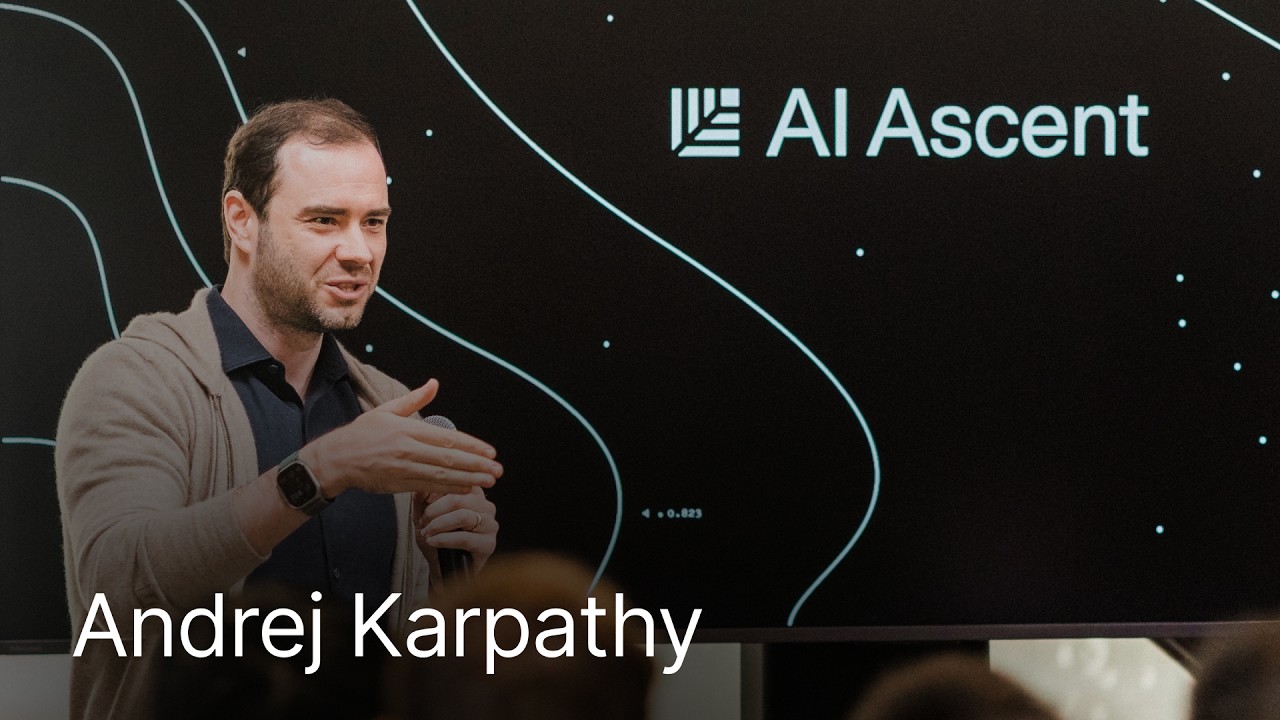
Andrej Karpathy: From Vibe Coding to Agentic Engineering
Andrej Karpathy explores the paradigm shift from traditional programming to Software 3.0, where LLMs act as programmable computers driven by context. He details the transition from 'vibe coding' to 'agentic engineering,' emphasizing that while AI handles execution, human taste and understanding remain the ultimate bottlenecks. ## [00:00] Introduction Stephanie Zhan introduces Andrej Karpathy, highlighting his foundational work at OpenAI and Tesla. She notes his unique ability to simplify complex AI shifts and introduces the concept of vibe coding. > *He has a rare gift of making the most complex technical shifts feel both accessible and inevitable. [00:22]* ## [00:44] Feeling Behind as a Coder Karpathy describes a turning point in December 2023 when agentic tools began producing perfect code without manual intervention. This shift led him to adopt vibe coding, trusting the AI to handle complex workflows autonomously. > *I just start to notice that with the latest models the chunks just came out fine. [01:29]* ## [02:28] Software 3.0 Explained Karpathy defines Software 3.0 as a paradigm where the LLM acts as a programmable computer and the context window serves as the primary programming lever. This follows Software 1.0's manual rules and Software 2.0's data-driven weight training. > *Software 3.0 is kind of about your programming now turns to prompting and what's in the context window is your lever. [03:20]* ## [03:44] Agents as the Installer Using the installation of OpenClaw as an example, Karpathy explains how agents replace rigid bash scripts with intelligent, environment-aware execution. This approach allows the AI to debug and adapt to specific system requirements autonomously. > *The agent has its own intelligence that it packages up and then it kind of like follows the instructions. [04:29]* ## [04:49] Menu Gen vs Raw Prompts Karpathy contrasts his custom-coded MenuGen app with raw prompts to models like Gemini, concluding that many traditional software layers are now redundant. He emphasizes that AI can now perform general information processing that was previously impossible with structured code. > *The software 3.0 paradigm is a lot more kind of raw. It just your neural network is doing more and more of the work. [06:11]* ## [07:37] What’s Obvious by 2026 Looking toward 2026, Karpathy envisions neural computers that process raw video and audio directly. These systems would use diffusion models to generate dynamic user interfaces, potentially making traditional UI code obsolete. > *You could imagine completely neural computers... a device that takes raw videos or audio into basically what's a neural net. [08:22]* ## [09:41] Verifiability and Jagged Skills AI models develop 'jagged' capabilities, peaking in verifiable domains like math and code due to reinforcement learning rewards. Karpathy notes the paradox where a model can refactor a massive codebase yet fail simple logic. > *state-of-the-art models today will tell you to walk [to a car wash] because it's so close... This is insane. [11:36]* ## [13:39] Founder Advice and Automation Model performance is heavily dictated by the specific data distributions chosen by frontier labs. Karpathy advises founders to explore the 'circuits' of these models to understand their strengths or use fine-tuning to fill gaps. > *we are slightly at the mercy of whatever the labs are doing, whatever they happen to put into the mix. [12:57]* ## [15:46] From Vibe Coding to Agent Engineering While 'vibe coding' raises the accessibility floor, 'agentic engineering' focuses on maintaining professional quality. This discipline involves coordinating powerful but stochastic agents to accelerate development without sacrificing the engineering bar. > *agentic engineering is about preserving the quality bar of what existed before in professional software. [16:07]* ## [25:17] Agents Everywhere and Learning Karpathy advocates for agent-native infrastructure, expressing frustration with human-centric documentation. He argues that while thinking can be outsourced to AI, human understanding remains a critical bottleneck for directing agents. > *You can outsource your thinking, but you can't outsource your understanding. [28:10]* ## Entities - **Andrej Karpathy** (person): AI researcher and former Director of AI at Tesla and founding member of OpenAI. - **Stephanie Zhan** (person): Partner at Sequoia Capital and host of the discussion. - **Software 3.0** (concept): A paradigm where LLMs act as programmable computers via prompting and context. - **Agentic Engineering** (concept): The professional discipline of coordinating AI agents to maintain software quality. - **MenuGen** (project): An app Karpathy built to OCR and visualize restaurant menus, used as a case study. - **OpenAI** (organization): AI research company co-founded by Karpathy. - **Gemini** (ai-model): Google's LLM used in Karpathy's software comparison. - **Vercel** (organization): A cloud platform used by Karpathy to deploy projects.