PodcastsHear the voice. See the shape of the thought.
Kanalen verkennen
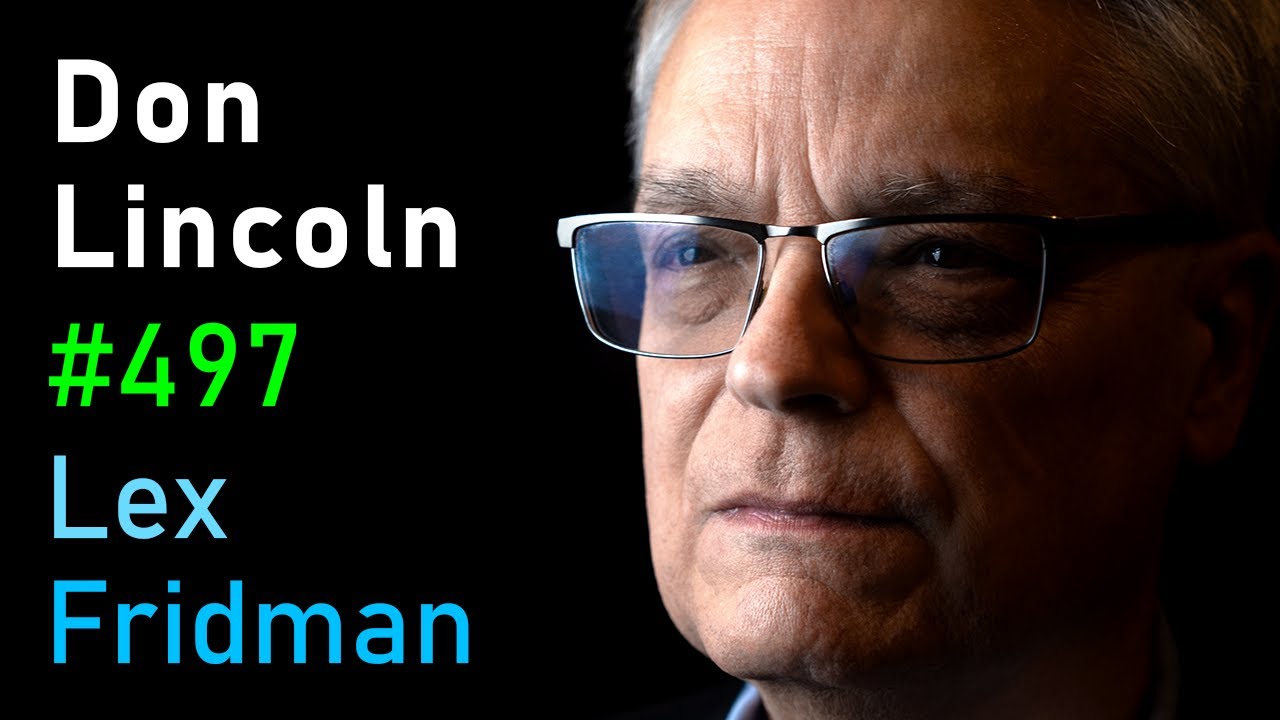
Biggest Mysteries in Physics: Antimatter, Dark Energy & ToE - Don Lincoln | Lex Fridman Podcast #497
Fermilab physicist Don Lincoln joins Lex Fridman for nearly three hours to trace physics as a four-century-long project of unification — Newton binding celestial and terrestrial gravity, Maxwell fusing electricity and magnetism, Einstein bending spacetime, and the Standard Model merging three of four forces. Lincoln then turns to what the Standard Model cannot explain: why the universe contains any matter at all, what dark energy really is, and whether dark matter will ever show itself in a detector. Throughout, he holds a clear line between what has been measured and what remains a brilliant guess, making the boundaries of human knowledge unusually concrete. ## [00:00] Introduction Lex Fridman opens by describing Don Lincoln as someone with Richard Feynman's rare gift for stripping complicated ideas down to their essential core without losing the brilliance inside them. The episode is framed as a tour through physics' deepest open questions, guided by a working experimentalist who has spent decades at the frontier. ## [00:49] Unifying the laws of nature Lincoln frames the entire history of physics through one lens: unification. Newton showed that the moon falling toward Earth and an apple falling from a tree obey the same equation — "universal" was the operative word in his law of universal gravity. Maxwell did something structurally identical in the 1860s: electricity and magnetism, which looked nothing alike, turned out to be two faces of a single force, and their equations automatically predicted that light travels at a fixed speed. Lincoln draws the practical line from that abstract discovery to every modern technology — "without being able to govern electricity, we'd still be farmers and shoemakers." The conversation broadens into why fundamental research pays off centuries later, with Lincoln arguing that nuclear physics, incomprehensible in 1900, is now the most potent energy source available to civilization. Lex adds the longer arc — mastery of antimatter or dark energy might one day enable propulsion systems that let humanity reach other star systems. > *"It has spin-offs. And it has spin-offs. One of the big spin-offs is our entire technological society."* ## [15:20] Einstein, special relativity, and general relativity Lincoln walks through Einstein's 1905 miracle year: special relativity rested on two premises — the laws of nature are the same for everyone, and everyone measures the speed of light as identical regardless of relative motion. That second premise sounds absurd but particle accelerators have confirmed it directly, watching photons emitted from fast-moving decaying particles still arrive at detectors at exactly *c*. Minkowski then showed that Einstein's equations implied space and time were components of a single object, spacetime. General relativity took one more step: Einstein noticed that free-fall in a rocket and gravity feel identical, then worked out that gravity is not a force at all but the curvature of spacetime caused by mass. Lincoln credits Minkowski for the mathematical articulation but insists the conceptual leap — *mass bends the geometry of space itself* — was Einstein's alone. He also defends Einstein's late-career skepticism of quantum mechanics as productive rather than blind: Einstein's critiques forced concrete predictions that experimentalists went out and confirmed. > *"We all agree that your idea is crazy, but is it crazy enough?"* ## [32:27] Electroweak force By the 1930s physicists had catalogued four forces: gravity, electromagnetism, the strong nuclear force, and the weak nuclear force. The last two only matter inside atomic nuclei, which is why most people have never encountered them. In the late 1950s and 1960s, Glashow, Salam, and Weinberg showed that electromagnetism and the weak force were the same at high energies — the electroweak force. The catch was obvious: electromagnetism reaches across the universe (we see light from galaxies billions of light-years away) while the weak force barely reaches across a proton. How could they be the same? Lincoln uses a dropped pen to demonstrate: the Higgs field, postulated in 1964 by Peter Higgs and colleagues, permeates all of space. Particles that couple to it gain mass; those that do not, like the photon, remain massless. At the high temperatures of the early universe the Higgs field was zero, so nothing had mass and the forces were unified. As the universe cooled, the Higgs field switched on and broke that symmetry — giving the W and Z bosons mass and splitting the electroweak force into its two familiar components. The vibration of the Higgs field itself is the Higgs boson: an experimentally detectable excitation of an otherwise invisible field. > *"In the Higgs field, the vibration is the Higgs boson. And so what we can do is not see the field, but we can actually excite the field, make it vibrate and detect the vibrations."* ## [44:09] How particle colliders work E=mc² is not just a slogan: kinetic energy can be converted into mass. Smash two particles head-on with enough energy and the collision region can materialize entirely new particles, always in matter-antimatter pairs. This is what colliders do. Lincoln describes the cascade of accelerators at Fermilab — five machines feeding into each other like gears of a manual transmission — and the scale of the LHC's CMS detector (70 feet long, 14,000 tons, photographing collisions 40 million times per second). The data-reduction challenge is equally striking. The LHC produces about a billion proton-proton collisions per second. Fast electronics discard all but 100,000 per second, commercial processors trim that to 1,000, and those 1,000 records are handed to graduate students hunting for the handful that might be Nobel Prize material. Lincoln reserves particular admiration for the engineers who move petabytes of data around the world seamlessly, calling them the unsung heroes of modern physics. > *"Of the 50 million possible collisions per second, the fast electronics and then the computers pick the thousand, and then we pass those through analysis software and hand them to the graduate students."* ## [62:12] Higgs boson discovery Lincoln was simultaneously working at Fermilab's Tevatron and transitioning to CERN's LHC — a physicist wearing two hats and rooting for both. Fermilab had methodically ruled out most possible Higgs mass ranges; by mid-2012 they had narrowed it to between roughly 120 and 145 GeV. Two days before CERN's July 4 announcement, Fermilab confirmed that if the Higgs existed, it had to be in exactly the region Fermilab had not yet been able to rule out. CERN got there first. Lincoln is careful about what the 2012 announcement actually meant: a particle *consistent with* the Higgs boson. Supersymmetry predicted five Higgs bosons rather than one. Only in the years since — measuring spin (zero), decay products (bottom quarks, W and Z, photons), and their rates — has the evidence converged on Peter Higgs's original 1964 prediction. The Higgs was not a revolution like Einstein's work, Lincoln argues, but it was the final punctuation on 50 years of experimental discovery: the Standard Model, while incomplete, is mostly right as far as it goes. > *"It was a punctuation point, end of about 50 years of discovery and searching, where we finally were able to say the Standard Model, while incomplete, it's mostly right as far as it goes."* ## [72:32] Theory of everything The Grand Unified Theory (GUT) aims to merge the electroweak force and the strong force; a Theory of Everything would then fold in gravity. Lincoln is blunt: he does not see fast progress. The unification energy scale is roughly 10¹⁵ times higher than what the LHC can reach, and accelerator energy grows by only a factor of seven every 20 years. Extrapolating that curve suggests 500 years — and Moore's Law does not hold forever. His critique of string theory is not that it is wrong but that it is currently untestable. It uses approximate solutions to approximate equations, and its landscape of possible universes renders it practically unpredictive. Loop quantum gravity is better developed and makes testable predictions — its original claim that light speed should depend on wavelength was ruled out by gamma-ray burster observations, and the theory was revised. Lincoln's preferred path to a ToE is not extrapolating from current theory but making precise measurements of phenomena that already disagree with predictions. His analogy: an Australopithecus in Kenya trying to predict the Alps, Antarctica, and sperm whales from their local savanna — the farther you extrapolate beyond what you can measure, the more the prediction diverges from reality. > *"I think it is the absolute pinnacle of arrogance to think that what we can do — predict it out a quadrillion times higher than we can see now."* ## [102:17] Physics of empty space "Empty" space is not empty. Quantum field theory says every species of particle has a corresponding field that fills all of space, and those fields are always vibrating. When they vibrate in a characteristic way, a real particle appears; off-frequency vibrations are virtual particles — fleeting excitations that have measurable consequences. Two experiments confirm this. The Casimir effect: two metal plates placed micrometers apart are pushed together by the pressure difference between constrained virtual particles inside the gap and unconstrained ones outside. The anomalous magnetic moment: old quantum mechanics predicts one value for the electron's magnetic moment; including the bath of virtual particles surrounding a bare electron shifts the prediction by 0.1% — and that shifted prediction matches measurement to 10 significant figures. > *"We have measured the magnetic properties of both the electron and the muon to 12 — count them — 12 significant figures. And the theory and the data agree number for number for 10 places."* ## [109:41] Antimatter Paul Dirac's 1928 attempt to merge quantum mechanics with special relativity produced an equation with two solutions: +1 was the electron, −1 was something nobody had seen. He insisted the math was right. Carl Anderson confirmed it in 1932 by photographing a positron in a cloud chamber. Today CERN can make and trap antimatter hydrogen, cool it to near absolute zero, agitate it with lasers, and measure its spectral lines — they match ordinary hydrogen exactly. A 2023 experiment released antimatter hydrogen atoms into a bottle and found they fall downward, consistent with normal gravity, though the measurement precision is not yet tight enough to confirm the gravitational strength is identical. The deeper mystery is why the universe is made of matter at all. Counting galaxies versus cosmic microwave background photons, physicists infer that for every billion antimatter particles in the early universe, there were a billion-and-one matter particles. The billions annihilated; that extra one is everything we see. Fermilab is now testing whether neutrinos and antineutrinos oscillate between flavors at slightly different rates — leptogenesis — as a possible mechanism, racing a parallel effort in Japan. > *"For every billion antimatter particles that existed in the universe, there were a billion and one matter particles. The billions canceled, annihilated, destroyed each other, and that extra one that's left over is us."* ## [130:31] Dark energy In 1998, astronomers expected to measure how fast gravity was braking the expansion of the universe. They found the expansion is accelerating instead. The driving force is dark energy — a repulsive form of gravity. Einstein had added exactly this term to his field equations in 1917 to keep the universe static, then removed it when Hubble showed it was expanding. In 1998 it went back in. What dark energy actually is remains unknown. The most common view is that it is the energy density of space itself. The problem is that quantum field theory predicts a vacuum energy density about 10¹²⁰ times larger than what is observed — the worst prediction in physics. Lincoln notes that if dark energy has constant *density* while space expands, total dark energy is growing, which pushes toward the view that space is quantized: new quanta of space appear as the universe grows, each carrying a fixed energy, producing constant density as an emergent property. > *"There is very clearly something going on, something very badly wrong in the quantum field theory."* ## [134:20] Dark matter Galaxies rotate too fast. Galaxy clusters move too quickly. Gravitational lensing of distant galaxies is stronger than visible matter can explain. Three independent observations all point to the same conclusion: there is roughly five times more mass in the universe than we can see. Lincoln traces his own intellectual journey: 25 years ago he suspected the problem was with Newton's laws; two observations changed his mind. The Bullet Cluster — two galaxy clusters that passed through each other — shows gravitational distortions following the galaxies, not the gas clouds that stopped in the middle, exactly what dark matter predicts. The Dragonfly galaxies (DF2 and DF4) rotate exactly according to Newton's laws because they appear to have had their dark matter stripped away — a galaxy *without* dark matter is actually strong evidence that dark matter is real. Despite 30 years of searching with three approaches — direct detection underground, gamma-ray searches near galactic centers, and missing-momentum signals at the LHC — no dark matter particle has been confirmed. The viable mass range spans from sub-electron to asteroid scale, and experiments can only cover one slice of that range at a time, which is why Lincoln is not currently running a dark matter experiment himself. > *"We've ruled out some dark matter particles, but the problem is the range of space of possible mass — it ranges from something like the mass of an asteroid to far lighter than an electron and everywhere in between."* ## [162:56] Future of physics Lincoln grew up poor in rural America, shaped by science fiction and the popular science books of Isaac Asimov, Carl Sagan, and George Gamow. He chose particle physics over cosmology in the mid-1980s because particle physics let him actually measure things. He worked 8 a.m. to midnight Monday through Saturday as a graduate student not out of obligation but because he could not imagine anything he would rather be doing. His science communication — YouTube videos, popular books — is a deliberate attempt to reach the kid in Iowa or Montana who has no highly educated family mentors but the same hunger he had. He has already heard from Fermilab summer interns who came because they watched one of his videos. Lex closes with Marie Curie: *"Nothing in life is to be feared. It is only to be understood."* > *"One of your viewers might be one of the people who answer these questions that have stymied very smart people for decades."* ## Entities - **Don Lincoln** (Person): Senior scientist at Fermilab; co-author on the 1995 top quark discovery paper; CMS collaboration member at LHC; author of *Einstein's Unfinished Dream* and multiple popular science books. - **Lex Fridman** (Person): MIT researcher and host of the Lex Fridman Podcast; conducts long-form interviews at the intersection of science, technology, and philosophy. - **Fermilab** (Organization): U.S. Department of Energy particle physics laboratory near Chicago; operated the Tevatron collider; currently the world's most powerful neutrino beam facility. - **CERN / LHC** (Organization): European particle physics laboratory home to the Large Hadron Collider; CMS and ATLAS detectors; site of the 2012 Higgs boson discovery. - **Standard Model** (Concept): Quantum field theory describing three of four fundamental forces and all known elementary particles; validated to extraordinary precision but does not include gravity or explain dark matter, dark energy, or the matter-antimatter asymmetry. - **Higgs field / Higgs boson** (Concept): A scalar quantum field whose non-zero vacuum value gives mass to the W and Z bosons while leaving the photon massless; the Higgs boson is its detectable excitation, discovered July 4, 2012 at CERN. - **Dark matter** (Concept): Invisible mass accounting for roughly 85% of all matter in the universe, inferred from galaxy rotation curves, cluster dynamics, and gravitational lensing; no candidate particle detected after 30 years of searches. - **Dark energy** (Concept): The repulsive energy driving the accelerating expansion of the universe; quantum field theory's prediction for its magnitude is 10¹²⁰ times larger than observation — the "worst prediction in physics." - **Baryogenesis / Leptogenesis** (Concept): Frameworks attempting to explain why the early universe produced a matter excess; Fermilab's neutrino program is testing leptogenesis by comparing neutrino and antineutrino oscillation rates. - **String theory / Loop quantum gravity** (Concept): Leading candidates for quantum gravity; string theory predicts at energies untestable by a factor of 10¹⁵; loop quantum gravity quantizes space itself and has produced some falsifiable predictions.

FFmpeg: The Incredible Technology Behind Video on the Internet | Lex Fridman Podcast #496
Lex Fridman sits down with Jean-Baptiste Kempf, president of VideoLAN and lead developer of VLC, and Kieran Kunhya, longtime FFmpeg contributor and the voice behind the infamous FFmpeg account on X, for a four-hour deep dive into the invisible machinery behind virtually all video on the internet. Together they trace the full arc from raw bytes and container formats through hand-written assembly and codec reverse-engineering, confronting the open-source sustainability crisis along the way. The conversation is both a technical masterclass and a meditation on why brilliant volunteers—many of them teenagers—quietly build infrastructure that powers billions of devices every day. ## [00:00] Episode highlight The episode opens with a rapid-fire highlight reel that captures the spirit of what follows. Kempf distills the FFmpeg community's core value: code quality is the only credential that matters—"Maybe you're a dog. I don't care. I need to look at your code." Kunhya adds the scale: FFmpeg is running on roughly 100 million CPUs at any moment, with three billion devices continuously decoding video, and FFmpeg's x86 assembly hand-optimization runs 62 times faster than equivalent C. The segment also previews the CIA-VLC spy story, the intelligence-agency backdoor request Kempf flatly refused, and Kieran's "no regrets" Twitter philosophy. > *"We care about excellent code. We don't care who you are. Like maybe you're a dog. I don't care, right? I need to look at your code."* — Jean-Baptiste Kempf ## [02:17] Introduction Lex sets the scene: FFmpeg is the invisible backbone behind YouTube, Netflix, Chrome, VLC, Discord, and nearly every platform that touches video or audio. VLC has been downloaded more than 6.5 billion times. Both projects are built entirely by volunteers. Lex frames the episode not merely as a technical discussion but as a tribute to engineers who work for the craft rather than for fame or money—"one of the great examples of human beings quietly collaborating across borders to build something useful, durable, and elegant." > *"It is one of the most incredible software systems ever developed, and it's all done by volunteers."* — Lex Fridman ## [05:35] Weirdest things VLC opens The conversation lightens up with playful examples of VLC's legendary tolerance for exotic formats. Kempf describes users capturing VHS tapes via capture cards, support for DVD-Audio with custom encryption, and the Lucasfilm Star Wars game codec that FFmpeg implemented for a single 10-second opening sequence. At a VideoLAN conference, a competition to create the most broken file ever—an MKV where every frame changed resolution, aspect ratio, and rotation—ended with VLC playing it perfectly. The orange traffic-cone logo is discussed: so recognizable that 25% of VLC's website traffic arrives from people searching "cone player." > *"There was a file that's a valid ZIP and a valid MP3 at the same time or something like that—and VLC opened all of the stupid files."* — Kieran Kunhya ## [09:59] How video playback works Kempf and Kunhya walk through what happens the moment you press play: the player fetches a byte stream from a URL, the demuxer separates audio, video, and subtitle tracks, entropy decoding removes mathematical compression, intra prediction reconstructs still-image frames (I-frames), motion-compensation handles temporal redundancy (P- and B-frames), and the final raw pixels are handed to the GPU or audio card. Video compression achieves 100x to 200x reduction by exploiting how human eyes perceive luminance versus color—working in YUV space rather than RGB—and by reusing unchanged background regions across frames. Kunhya warns that every single sentence in this pipeline represents someone's lifetime of work. > *"Everything we've just said in the past couple of minutes, every sentence is someone's lifetime's work. There are books about every sentence."* — Kieran Kunhya ## [19:20] Video codecs and containers The hosts clarify the often-confused distinction between containers and codecs. A container (MP4, MKV, MOV) multiplexes audio, video, and subtitle tracks; the codec (H.264, AV1) compresses the content inside. VLC and FFmpeg deliberately ignore the file extension and probe the actual bytes—because in the real world, extensions lie. The segment covers how AVI was Microsoft's format, MOV became MP4 via Apple, and the Matroska/MKV format emerged from the open-source community. Modern codecs like AV1 are not single algorithms but collections of tools that adapt to content type—screen share, animation, live video—each requiring different coding strategies. > *"We discard the file format. We look into the file to understand what's in it because so many people say, 'Oh, it's a video, it must be MP4,' but technically it's an MOV or maybe it's a MKV."* — Jean-Baptiste Kempf ## [30:07] FFmpeg explained FFmpeg is described as a low-level library suite—libavcodec, libavformat, libavfilter—plus a command-line tool so expressive that Kempf calls it a full programming language. Every person watching a YouTube video, recording with OBS, or editing in a professional broadcast box is likely touching FFmpeg. Kunhya notes that trillion-dollar corporations and grandmothers with home videos operate on exactly the same technology stack. The segment dives into open-source licensing—MIT, GPL, LGPL, AGPL—as "social contracts" that define community norms. Kempf recounts the painstaking process of re-licensing VLC's core from GPL to LGPL, requiring him to track down more than 350 contributors, including visiting the factory-worker father of a deceased contributor to obtain permission for two lines of code. > *"From a philosophical level, it's incredible that your grandmother's home videos and trillion-dollar corporations are on a level playing field using the same technology stack."* — Kieran Kunhya ## [51:07] Linus Torvalds Kempf offers a nuanced defense of Linus Torvalds's legendary harshness. The Linux kernel's core community is tiny—as is FFmpeg's (10–15 active maintainers)—and those few people must maintain every line of code forever. "We cannot compromise on quality because the core community of FFmpeg is ten to fifteen, and we are the ones who are going to maintain your code." Kunhya adds that terseness is often simply fatigue: volunteers arrive home after a full day of work and review patches without the bandwidth to hand-hold. Kempf also points out that most community members are non-native English speakers, and cultural misreadings amplify perceived hostility. > *"We cannot compromise on quality because the core community of FFmpeg is ten to fifteen, and we are the ones who are going to maintain your code."* — Jean-Baptiste Kempf ## [55:46] Turning down millions to keep VLC ad-free Kempf traces VLC's unlikely origin: a French engineering school (École Centrale Paris) whose student-run campus built a satellite video-streaming system in 1995—a decade before YouTube—just to enable faster networks for video games. From that Network 2000 project grew VideoLAN, and VLC emerged as its client. Kempf joined in 2003 when the project had nearly died, grew it from hundreds of thousands to billions of installs, and along the way repeatedly refused "obscene" offers to bundle toolbars, change search engines, or insert advertisements. His reasoning: "I need to go to bed at night and be happy about what I've done. If I had sold out, I would have betrayed so many other people who work here." > *"I refuse dozens of millions of dollars, yes, several times. Yes, I could be a multimillionaire and be somewhere on the beach. But I did not do it because I thought it was not moral and it was not the right thing to do."* — Jean-Baptiste Kempf ## [70:04] FFmpeg & Google drama Kunhya recounts a public controversy in which Google's security team used AI to auto-generate bug reports for FFmpeg, filing them under tight 90-day deadlines—with some vulnerability reports going to the press before patches could be written—without contributing corresponding fixes or meaningful funding. Kunhya compares it to "a denial of service by AI-generated bug reports" on obscure 1990s game codecs. The saga escalated via spicy FFmpeg tweets (a "rap battle" in Kunhya's words), but produced concrete results: Google began sending patches and established a financial reward system for fixes. A parallel incident saw Microsoft Teams engineers file a high-priority bug on the volunteer tracker, name-dropping their product's scale, and offering a one-time payment of a few thousand dollars in response to a request for a long-term support contract. > *"Google uses FFmpeg at a scale probably you or I couldn't even contemplate—millions of CPU cores. And yes, they contribute in areas mostly regarding their own products. But in a wider sense, there's a disproportionate level of contribution."* — Kieran Kunhya ## [89:18] FFmpeg developers What motivates FFmpeg's volunteer engineers? Kempf identifies three drivers: passion for the subject matter (many contributors arrived because they loved anime), excellence of the craft ("this is the best school ever of programming"), and pride in impact ("you can tell your grandma: I do this so you can play video on your laptop"). Kunhya adds that Andrew Kelley, creator of the Zig programming language, was an FFmpeg developer who credits his time there as his real-world education. Teenagers have written thousands of lines of hand-optimized assembly for FFmpeg. Kieran's favorite quote, from John Collison: "The world is a museum of passion projects." > *"If you're good in C, if you know how to write assembly in FFmpeg, I assure you you're going to be one of the best programmers ever—even if you're working on writing TypeScript."* — Jean-Baptiste Kempf ## [95:55] VLC and FFmpeg Kunhya frames the FFmpeg-VLC relationship as a "binary star system": VLC is to FFmpeg as Android is to Linux—they depend on each other and succeed because of each other. Roughly 80% of FFmpeg pipelines depend on at least one VideoLAN project (most often x264). VLC gives FFmpeg exposure to a vast zoo of real-world broken files. When compiled for Windows, VLC links against about 16 million lines of code, of which only 1 million live in the VLC repository itself. The two projects share many developers and collectively demonstrate that complex software ecosystems can be built entirely from interdependent open-source components. > *"VLC is to FFmpeg as Android is to Linux. They depend on each other, but they coexist because of each other."* — Kieran Kunhya ## [100:29] History of FFmpeg The "eras tour" of FFmpeg begins with Fabrice Bellard creating the initial concept, followed by the Michael Niedermayer era of the early 2000s—exhaustive support for DivX, Xvid, Windows Media, and RealMedia, eliminating the need for bloated, spyware-ridden codec packs. The late 2000s brought H.264 maturity and the rise of high-definition video. Throughout, VLC served as FFmpeg's field test: millions of users exposing edge cases that no lab could anticipate. > *"At the time you needed a new player to play every different type of file format. Having a single library that was fast and open source—that was a massive achievement."* — Kieran Kunhya ## [103:46] Reverse engineering codecs The segment showcases the art of reverse engineering proprietary codecs. Kostya Shishkov—described as "borderline genius"—reverse-engineered 20–30 megabyte binary blobs (each megabyte representing roughly a month of normal work) for fun, producing decoders for Windows Media, RealMedia, and GoToMeeting formats. Kunhya explains the methodology: hook into the proprietary player to dump raw YUV data, open a disassembler, step through machine code instruction by instruction to infer the entropy coding, prediction, and IDCT stages, then validate bit-exactness against sample files. For months, the work produces no visible output—pure debugging in memory. > *"He looked at the world as a binary specification. He didn't need documentation or anything. He would go away and come back and do interesting stuff."* — Kieran Kunhya ## [117:01] FFmpeg testing FFmpeg's FATE (FFmpeg Automated Testing Environment) system runs a pivot table of test combinations: dozens of compilers (GCC, Clang, MSVC, Apple Clang, Intel Compiler), operating systems (Linux, macOS, Windows, BSD, Solaris), and CPU architectures (x86, ARM, RISC-V, PowerPC). All test machines are volunteer-hosted. The system catches compiler miscompilations—rare but devastating, since even a single wrong bit in a frame dependency chain can cascade into major visual corruption. Kunhya notes that the Macs at the top of the FATE dashboard are hosted in his own office. > *"It's not just a matrix at this point. It's like a pivot table of different combinations—all run by volunteers."* — Kieran Kunhya ## [121:08] Assembly code (handwritten) This extended chapter is the technical heart of the episode. Handwritten x86/ARM SIMD assembly in FFmpeg and x264 runs up to 62 times faster than equivalent C—a gap that modern compilers and auto-vectorization cannot close despite years of trying. VLC still supports Windows XP through Windows 11, macOS 10.7 through macOS 26, iOS 9 through the latest, BSD, Solaris, and even OS/2. Understanding assembly forces programmers to internalize CPU pipeline stages, SIMD registers, L1/L2/L3 cache, and memory bus constraints. Kempf and Kunhya introduce the x86inc framework built by Loren Merritt for x264 and JB's Assembly Lessons tutorial series, which have attracted contributions from teenagers learning directly from the source. > *"I believe it's necessary to understand assembly language, even if you don't do it much, to understand what's going on inside your computer. That will make you a better programmer."* — Jean-Baptiste Kempf ## [145:26] Rust programming language Kempf and Kunhya hold divergent opinions on Rust. Kunhya respects the memory-safety goal but finds the community self-important—"It has a very big Esperanto vibe"—and argues that Rust rewrites reaching only 85–90% of required feature coverage are insufficient; "the last 1% takes 99% of the time." Kempf has written Rust VLC modules and sees genuine value, but notes that the lack of training data for low-level SIMD work means AI tools cannot yet assist meaningfully. The discussion broadens to the two assembly wizards of the community: Henrik Gramner, whose knowledge of Intel x86 cycle counts exceeds Intel's own engineers, and Martin Storsjö, who writes ARM Neon assembly on a virtual keyboard while watching his kids play in the playground. > *"Rust reminds me of the Sinclair C5. In order to get people to move, you have to build something as good as, if not better than, what you have now."* — Kieran Kunhya ## [154:42] FFmpeg and Libav fork In 2011, FFmpeg split into FFmpeg and Libav, primarily over governance and leadership style rather than technical disagreements. Several Linux distributions temporarily shipped Libav instead of FFmpeg. Kempf describes open-source forks as healthy—they force projects to confront structural weaknesses. Eventually most of Libav's developers returned to FFmpeg, and the projects merged back. Kempf draws a parallel to the XZ Utils attack, where a lone maintainer, exhausted by coordinated social engineering, granted commit access to an attacker—highlighting how burnout creates the very single-point-of-failure vulnerabilities that make critical open-source infrastructure fragile. > *"Forks are important because they change the status quo of a community. FFmpeg today is better than it was before the fork."* — Jean-Baptiste Kempf ## [163:04] Open source burnout Kempf and Kunhya confront the mental health crisis among open-source maintainers. Kempf has received physical death threats—including a letter containing powder—over decisions such as dropping PowerPC support. The security community's habit of filing alarming CVEs for hobby-project edge cases adds psychological load without providing patches. Kempf now maintains several libraries whose original maintainers burned out. The conversation broadens to the systemic problem: critical infrastructure like libxml and XZ is maintained by one or two people, unknown to the trillion-dollar enterprises that depend on them. > *"The mental health of the open source maintainers is something that large corporations don't care or don't see."* — Jean-Baptiste Kempf ## [170:51] x264 and internet video H.264 transformed internet video by arriving exactly when Intel Core 2/Nehalem CPUs made real-time software decoding practical. The key innovation of x264 was psychovisual rate-distortion optimization—encoding decisions driven by visual quality metrics rather than mean squared error, producing sharper, more natural-looking video. This was driven by the anime community's high standards for perceived sharpness. AV1 offers 40–60% bandwidth savings over H.264 at the same quality, but encoding costs two orders of magnitude more CPU. YouTube therefore re-encodes only popular videos in AV1, making the extra compute worthwhile by amortizing it over millions of viewers. > *"Thirty percent of the video from Netflix is now in AV1, fifty percent of YouTube."* — Jean-Baptiste Kempf ## [184:07] Video compression basics The chapter clarifies I/P/B frame structure: I-frames are complete still images, P-frames reference only previous frames, and B-frames can reference both past and future frames. ProRes is an intra-only codec designed for nonlinear editing—no temporal dependencies, fast seeking. The segment also covers constant-bitrate versus constant-quality encoding, group-of-pictures length, and the thousands of engineers at Netflix, YouTube, and Meta whose entire job is tuning FFmpeg parameters for specific content types. A historical curiosity: Google Video originally used VLC as an ActiveX plugin inside Internet Explorer; today VLC is compiled to WebAssembly to run inside browser JavaScript engines. > *"You have I-frames that are complete frames, P-frames that depend only on I-frames, and B-frames that can depend on frames in front."* — Jean-Baptiste Kempf ## [191:04] CIA and fake VLC WikiLeaks' Vault 7 release revealed that the CIA built a modified version of VLC with an additional DLL (psapi.dll) that silently encrypted and exfiltrated documents while the victim watched a movie, using the expected high CPU load of video playback as cover. VideoLAN issued a press release directing users to download only from the official website. A separate incident involved Chinese state hackers distributing a fake VLC using legitimate signed VideoLAN DLLs to target Indian users, causing India to ban VLC until Kempf fought a successful legal battle to reverse the ban. The segment also surfaces a hidden feature: VLC can render movies as ASCII art in a terminal, useful for diagnosing multicast network paths via SSH. > *"If we had to compromise our software, we would shut it down. This is clear."* — Jean-Baptiste Kempf ## [201:39] Ultra low latency streaming Kempf explains adaptive streaming (HLS, DASH): the player downloads segments, times the download, and adjusts quality tier accordingly. The real engineering frontier is live broadcasting with strict CBR constraints—satellite uplinks cannot burst even for one second. Kempf describes his company Kyber, an open-source (AGPL dual-licensed) ultra-low-latency streaming stack targeting robotics and XR, streaming compressed video feeds to devices without onboard compute. The segment ends with a discussion of teleop for robots, where latency directly determines safety. > *"Kyber is open source. Everything on Kyber is open source. If you want to use it in your product and not open source it, you pay the commercial license."* — Jean-Baptiste Kempf ## [219:07] AV2 codec and video patents AV2, the successor to AV1 within the Alliance for Open Media (of which VideoLAN is a member), promises a further 30% bandwidth reduction. VideoLAN's dav1d decoder will be followed by "dav2d." The Alliance exists specifically to escape the HEVC/H.265 patent thicket: HEVC's three separate patent pools demanded fees so large that HP removed HEVC support from new laptops, and streaming giants calculated they could build a new royalty-free codec for less than the annual licensing cost. France's rejection of software patents means Kempf has never paid codec licensing fees—if he had to, the bill would exceed 200 euros per user. > *"At a hundred million per year, you know, I could create my own codec—and this is what they did."* — Jean-Baptiste Kempf ## [228:59] VLC backdoors Intelligence agencies from two different countries approached Kempf asking him to insert backdoors into VLC. He declined both, in terms he describes as "a lot less polite" than a simple no. The chapter broadens into a discussion of European entrepreneurship: Kempf argues that French startup culture has transformed over 15 years—failure stigma has fallen, AI companies are proliferating—while acknowledging that over-regulation remains a real drag. He closes by reflecting on his strategy for remaining calm under legal and political pressure: always ask "am I dying? Am I hurting someone?" If not, move on. > *"If we had to compromise our software, we would shut it down. Also because what we do is good and it's done for everyone."* — Jean-Baptiste Kempf ## [239:14] Video archiving Kieran profiles the archiving preservation community, led in part by Dave Rice of CUNY, which relies on FFmpeg as a "Rosetta Stone" for playing future-proof multimedia. The community funded FFV1, FFmpeg's lossless codec, to guarantee that archived footage loses no information—critical because lossy compression could destroy forensic or historical details visible only on close inspection. A famous cautionary tale: the BBC's 1986 New Domesday Book project archived content on BBC Micros, and within 20 years no one had working software to read it. There are now more historical video tapes in archives than functional tape heads in the world to digitize them, forcing painful triage decisions about what human history to preserve. > *"C will be like Latin. It will be a thing you learn from the past, but it will still be usable in certain contexts."* — Kieran Kunhya ## [245:51] Future of FFmpeg and VLC The closing chapter surveys where multimedia is heading: volumetric video, point-cloud codecs for robotics, RGBD depth streams, XR/VR streaming, and—speculatively—neural interfaces that may one day require codecs for compressed brain data. Kempf is confident FFmpeg will exist in 100 years; VLC he rates as "maybe." He closes with his personal philosophy: "Regrets are a tax on your mind. Learn from your mistakes, but don't regret." The episode ends with Lex reading Linus Torvalds: "Most good programmers do programming not because they expect to get paid or get adulation by the public, but because it is fun to program." > *"Regrets are a tax on your mind. Learn from your mistakes, but don't regret. Because you've done it, so unless you have a time machine, don't regret."* — Jean-Baptiste Kempf ## Entities - **Jean-Baptiste Kempf** (Person): President of VideoLAN, primary maintainer of VLC, founder of Kyber and several other companies; declined tens of millions of dollars to keep VLC ad-free. - **Kieran Kunhya** (Person): Veteran FFmpeg contributor, codec engineer, founder of Open Broadcast Systems, the voice behind the FFmpeg account on X. - **Lex Fridman** (Person): Host of the Lex Fridman Podcast, AI researcher, longtime VLC and FFmpeg advocate. - **Fabrice Bellard** (Person): Creator of FFmpeg, QEMU, and tcc; foundational figure of the project. - **Michael Niedermayer** (Person): Long-time FFmpeg maintainer who drove exhaustive codec support through the 2000s. - **Kostya Shishkov** (Person): Legendary FFmpeg reverse engineer who decoded proprietary binary blobs for Windows Media, RealMedia, and GoToMeeting codecs. - **Henrik Gramner** (Person): Assembly wizard with deeper knowledge of Intel x86 cycle counts than Intel's own engineers. - **Linus Torvalds** (Person): Creator of Linux and Git; referenced as a model of uncompromising code quality standards in open-source communities. - **FFmpeg** (Software): Open-source multimedia framework providing codecs, muxers, filters, and command-line tools; the invisible backbone of nearly all internet video. - **VLC** (Software): Open-source media player with 6.5+ billion downloads, built on libVLC and FFmpeg; plays virtually any format on any platform. - **x264** (Software): VideoLAN's open-source H.264 encoder; the dominant software encoder for internet video, famous for psychovisual optimizations. - **dav1d** (Software): VideoLAN's fast open-source AV1 decoder; widely deployed in browsers and streaming clients. - **VideoLAN** (Organization): French nonprofit that stewards VLC, x264, dav1d, and related open-source multimedia libraries. - **Alliance for Open Media** (Organization): Industry consortium including Google, Netflix, Apple, Amazon, and VideoLAN that created AV1 and is developing AV2 as royalty-free codec standards. - **FATE** (Software): FFmpeg Automated Testing Environment; volunteer-hosted CI grid testing hundreds of compiler/OS/architecture combinations. - **Kyber** (Organization): JB Kempf's startup building an ultra-low-latency open-source streaming stack for robotics and XR, dual-licensed AGPL/commercial. - **H.264 / AVC** (Concept): The dominant internet video codec standard; open-source implementation is x264; basis of Blu-ray and most MP4 files. - **AV1 / AV2** (Concept): Royalty-free next-generation video codec standards from the Alliance for Open Media; AV1 saves 40-60% bandwidth vs H.264; AV2 adds another 30%.