PodcastsHear the voice. See the shape of the thought.
Browse Channels
The hidden pattern behind successful products | Mark Pincus (FarmVille, Words with Friends, & more)
Mark Pincus built eight massive hit games out of ten launches at Zynga — FarmVille, Words with Friends, Zynga Poker among them — and spent five years distilling the pattern behind that record into a book, *Life at the Speed of Play*. The core idea: your instincts are right 95% of the time but your ideas are wrong 75% of the time, so a good framework doesn't generate ideas — it filters them. That framework is Proven Better New: nail what's already working on your platform, make one thing 10-out-of-10 users would say "f*** yes" to, then add exactly one unproven bet. The conversation also covers why radical ambition demands embarrassingly small starting points, how to use AI as a failure machine rather than a speed-to-market tool, and what makes consumer social the biggest untapped opportunity on the internet right now. ## [00:00] Introduction to Mark Pincus Lenny opens with a rapid-fire preview of Mark's most quotable lines — burn your resume if you're truly ambitious, your instincts are right but your ideas are wrong, kill hope before hope kills you — before introducing him as the founder of Zynga and author of *Life at the Speed of Play*, out June 23. Sam Altman's blurb for the book frames the stakes: in the AI era, the only bottleneck to great products is knowing what to build, and Mark has thought about that longer and harder than almost anyone. > *"If you're truly ambitious, burn your resume."* ## [02:46] The Proven Better New framework overview Mark traces the framework back to Zynga's early culture, where it became a "religion" for product management. The engine: isolate your innovation zone (the gut instinct), separate it from the ideas you layer on top, and use Proven Better New to test many ideas around that instinct rather than betting everything on one. He illustrates with Sid Meier's failed Facebook social strategy — even the godfather of game design sank because his first-time user experience didn't copy what Zynga's most junior PMs already knew was best-of-breed. His innovation never got seen because he skipped the Proven step. > *"Your instincts are right 95% of the time. Your ideas are wrong 75% or at best right 25% of the time."* ## [07:29] Earning the right to innovate You can't skip Proven and go straight to New. Mark's framing: if you're building an AI camera, you haven't earned the right to innovate on the camera until you are the world's leading PhD on the best mobile cameras that already exist. Get that PhD first — copy legally and with taste — then and only then does your actual innovation have a chance to be seen. > *"We haven't earned the right to innovate on the camera until we are the world's leading PhD on the best mobile cameras that already exist."* ## [08:30] What "better" really means Better is not what you think is better — that's actually New. Better is an increment that every existing user of the product would confirm as an improvement: it's free, it loads faster, the polish is there. Words with Friends was Scrabble as the Proven base; the Better was mobile polish so clean that 14 million people played daily when Scrabble itself never reached that; the New was the Facebook social graph already populated with your real friends. Mark's test: 10 out of 10 users say "f*** yes." Anything short of that is a New, not a Better — and New probably fails. > *"Better is something that 10 out of 10 of the existing users of that product would say f*** yeah."* ## [12:03] Quick summary of the framework Lenny synthesizes: Proven = list what's already working and loved on your platform; Better = one improvement so obvious that every existing user would switch immediately; New = one unproven bet nobody's tried. He runs the iPhone and iPod through the lens — music player → better hardware and interface → social distribution — and notes that most successful products follow this pattern whether their makers called it that or not. > *"Most products are better versions of things that existed before."* ## [12:40] Examples of the framework in action Mark was at the TED conference when an MIT team demoed their touchscreen on a giant whiteboard. Steve Jobs spent the whole time there, obsessing over the touch interaction. The observation: Jobs' only true New idea in the iPhone was the touchscreen — everything else was Proven Better applied to an existing phone. > *"Like, okay, there's his new idea — it's a touch screen. It's his only new idea."* ## [13:30] How to use proven correctly on your platform Founders misuse Proven by pointing at something popular from a different era or platform and calling it "proven." Proven only counts on this platform, for this audience, for this experience. Slack is Mark's favorite example of Proven Better with almost no New at all — it took workplace chat that people already did over email and IRC, made it radically more accessible, and that was enough. Sometimes no New is even better: people don't like change, so if you can make a behavior they already love more fun or accessible, they'll love you for it. > *"I don't want to sound anti-innovation, but people don't like change."* ## [15:13] The moral arbitrage of copying There's a moral resistance to copying baked into how founders think — school taught them copying is cheating, and becoming a founder meant becoming an innovator. Mark calls this "moral arbitrage" in Peter Thiel's sense: that resistance makes the copying opportunity more available to founders willing to put ego aside and define their ambition through their consumer's eyes, not their peers'. His line to Zynga product teams: you're trying to win the hearts and minds of nurses in Indiana for Farmville, not win awards from your Silicon Valley cohort. If you take something she loves and make it one inch better, she'll love your version more than a blank-whiteboard innovation she didn't know she wanted. He also draws the contrast between Nikita Bier (found a buried feature in an Arabic-only app, built TBH around it — that's gold) versus Angry Birds (45 completely different games, no learning across iterations, 44 failures before the one hit — that's wildcat drilling). OMGPop made Draw Something by ruthlessly copying Zynga's turn-based system from Words with Friends after their own innovative game flopped. The hit came from the copy, not the original idea. > *"If you're truly ambitious, burn your resume. Define your ambition in the eyes of your consumer, not your peers."* ## [23:55] Be less ambitious The paradox: the more ambitious you are, the humbler your starting point should be. Facebook started as a tool to check out classmates at Harvard. Zynga started as a poker game on Facebook — Mark was 41, a multi-time successful founder, and people thought he had lost his dignity. But that embarrassingly small starting point was the key. After his Tribe social network failed because he tried to do everything at once, he needed to get to any product-market fit and dropped his altitude from 100,000 feet to 1,000. First-time founders have an advantage here: they can't raise money on a big vision yet, so they're forced to stay humble. Multi-time successful founders have too much rope to hang themselves. > *"The paradox is the more ambitious you are, the more humble you should be and the smaller place you should be willing to start."* ## [28:25] The Bolt.new story and staying humble Bolt.new as the modern version of this: the team toiled in obscurity building a web-stack virtual machine, barely kept commercial development going, open-sourced it, then realized that adding their VM to an AI coding co-pilot created something genuinely better than any alternative. They were passionate about one thing, stuck with it, and the breakout came from that focused humility. Slack is the same arc: Stewart Butterfield kept trying to build mass-market MMOs, got humbled by that difficulty, noticed that the internal tool his engineers used was actually the product, and pivoted. Mark's point: it takes a really attuned, curious, humble founder to call that ball when investors and team are all pointed in the other direction. > *"It really takes a really attuned, curious, humble founder to call the ball on that."* ## [33:15] Kill hope before hope kills you Hope is confidence without basis — not founded in lived experience with the product, not in data, just a prayer that the next release does something magical. Belief is different. The best product makers are collecting winnings, not making bets — they already know they have a hit before they launch. Mark draws the distinction between an MVP (minimum viable product, where "viable" is where hope lives) and an MLP (maximum launchable product, where you believe, not hope, that it's a hit). AI makes this more dangerous, not less: it lets teams get to a viable product in three months instead of three years, which accelerates the speed at which founders can fool themselves into thinking viable equals ready. > *"Kill hope before hope kills you. There's a difference between belief and hope. Hope is confidence without basis."* ## [37:00] Using AI as a failure machine What Mark expected AI to produce: testing machines that run a hundred ideas a week instead of one idea per quarter. What he actually sees: teams using AI to build one idea in three months, only faster. The right mental shift — build it completely wrong before you know it's the right product. If you believe it's wrong, you won't waste three months perfecting the wrong thing; you'll build the cheapest version that gives you signal. He illustrates with a Zynga FarmVille expansion pack story: instead of spending a $10 million ad budget on "coming soon" banners, they put locked art variants on the game board for existing players, measured which got most clicks, and ended up selling $19 million worth of early-access keys — turning what would have been afterthought advertising into product direction plus revenue. > *"The way we should be using AI is as a testing machine, a failure machine."* ## [40:08] Why Zynga's games succeeded (it wasn't virality) Farmville and CityVille became associated with spam in users' Facebook feeds, so many founders assume Zynga's secret was aggressive virality. Mark pushes back: the real engine was retention, not virality. Zynga tracked Day 365 retention — something Mark believes no other consumer company does today — and built toward it. The metric that actually predicted retention was ASN (Active Social Network): how many round-trips did a player complete with another player? Going from zero to one ASN meant an 80% chance of seeing that player the next month; reaching four ASN meant an 80% chance of seeing them 22 out of the next 30 days. The second engine was social dimensionality — the games let people invest, express, and connect. Middle-aged women didn't just play Farmville alone; they co-op-farmed with real friends, gifted each other in-game items, and felt creative in a way their lives outside the game didn't offer. Virality was a byproduct, not a strategy. > *"It wasn't that we were good at virality. We were focused on two things we did better than anybody else."* ## [48:36] The future of consumer social apps Nothing is working in consumer social right now, and founders have largely given up on it. Mark's read: there is still massive latent demand — we want to be social — but existing platforms have lost the adrenaline. When people quit Instagram their NPS goes from +35 to -35; they feel like they just quit smoking. The platforms shifted from social productivity (Facebook let you stay in the loop with 300 friends in minutes) to time-wasting engagement optimization (Instagram got TikTok envy). The opportunity: whoever finds the new step function of social productivity for the agentic AI era will find gold. Mark frames it as the "cocktail party" instinct — you know when you're at a great cocktail party because you feel "I'm so glad I'm here" and you're leaving with great leads. Facebook, LinkedIn, and even Zynga's games were cocktail-party experiences at different scales. Today everyone's hanging out with their Claude or GPT, but there's no cocktail party. The Easter egg: figure out how to make that cocktail party rowdy and socially productive. > *"Today, we're all hanging out on our Claude, on our GPT, but there's no cocktail party."* ## [57:05] How to know if your product is a B The dating analogy: when you're with the right person, you know — you're not asking, "Could this be the one?" If you're asking whether your product is an A, it's not an A. When you have lightning in a bottle, everything works: you're addicted to it, friends love it, metrics confirm it. Nobody asked whether GPT was it. The hard part is what to do once you've named it a B+: can you be intellectually honest enough to call it, and then use it to learn rather than just killing it? Mark pulled the plug on his "Earth" metaverse project after four years and $25 million — and in the two weeks since has felt more inspired than at any point in those four years. > *"If you're asking whether or not your product is an A, it's not an A."* ## [61:25] Distribution in the age of AI Mark's first move is to ask whether AI is a new platform — and his current answer is no, not yet. It's an important technology and a new kind of portal (the chat interface), but it's not a hardware platform and it's not yet a platform that opens distribution the way mobile or social did. We're still in the mobile and web era. App install rates are near zero. Forty thousand new games launched in the App Store last year and zero became top-ten hits. Distribution has to be baked into product strategy from day one, not treated as something you figure out after build. His more forward-looking bets: build for pro-sumers and whales first (people who care enough to find you and pay early). Watch the token cost curve — if tokens trend toward free in two years, there are consumer services that only make economic sense at free-token prices, and building toward that now is an interesting innovation zone. His favorite Easter egg: an AI-native travel agent that's always on, knows your context, and actively manages your trip when things go wrong. That service has always had latent demand but never had a viable economic model — free tokens could change that. > *"Distribution has to be part of your product and part of baked into the strategy deeply and proven from the beginning."* ## [75:39] Make everyone a CEO Mark hates managing people. Every day spent managing is a day away from product. His escape: give people a hill to take and make them a real CEO of it — operating control, degrees of freedom, their own plan and budget, then get out of the way. He found two things: he didn't have to manage them anymore, and a certain kind of person (the frustrated expert witness who's a bit of a know-it-all and has pent-up demand to prove they were right) becomes incredibly motivated. Brian Armstrong's "everyone is an individual contributor" push at Coinbase is the Silicon Valley version of the same idea — the best CEO is the best player at the position, doing the thing they're great at rather than wasting time on management hierarchy. > *"All of management is just how do we get people to do the right thing when we're not in the room."* ## [78:18] Stay close to the metal Early in a career you're in the trenches, closest to the data and probably to the right answer, but furthest from the decision — that's the expert witness syndrome. When you become a CEO, the trap is drifting away from the metal: delegating the most important UX and product decisions to the least experienced people while you do investor relations. Discord's founders realized they were doing exactly that and inverted the pyramid, making the founders the first and last mile for product decisions. Steve Jobs picked out carpet in conference rooms. Bezos and Zuck spent two days a week deep with specific teams on the things that mattered most. If you're the best product maker in the company, the team needs you on the field, not in the stands. > *"I believe the best product CEOs are in the minutia of the details."* ## [81:35] Why Mark says micromanagement is beautiful At Zynga up to 50 employees, Mark ran a daily standup that went two hours, tracking every name in a spreadsheet with what they were supposed to do yesterday and what they'd do today. Brutal, but effective. The framing: be in the room as much as you can for as long as you can. Only delegate when you physically can't be in all the rooms simultaneously. All management principles are just strategies for getting people to do the right thing when you're not there — so minimize how often you're not there. He notes it was more controversial twenty years ago; today, with founder-led product culture being normalized, "micromanagement is beautiful" lands closer to conventional wisdom. > *"If you can be in the room, be in the room — assuming that you are the best player."* ## [83:35] The expert witness How do you transfer the vampire blood — your passion and approach to the product — to other people? Two mechanisms. First, the teaching hospital: put as many people as possible in the room while you do product management, let your methodology spread through proximity. Second, the tech assistant: pull one person from the ranks to shadow you for six to twelve months, give them projects to test them, then place them in a much bigger role. Andy Jassy ran the program at Amazon — everyone on the S-team had been Bezos's tech assistant at some point, so it scaled the founder's judgment across the entire leadership layer. > *"How do you pass the vampire blood of you to other people?"* ## [85:05] The number one job of a CEO is to be right Stolen from Bezos, and Mark endorses it fully: if he could only pick one thing for a CEO to be, it's right. Right about the product, the strategy, the bet. Phenomenal execution in the wrong body of water gets you nowhere — being in the right body of water matters more than having the right boat. He applies it to hiring too: the best resume is a track record of being right, not a track record of charisma or management style. He'll take misfits who are right over polished managers who aren't. > *"Being in the right body of water matters more than the right boat."* ## [86:35] What Mark is teaching his five kids Mark has five children — twins, a special-needs son, a one-year-old with a gene mutation, and a four-year-old — and describes parenting as his greatest role. Three principles he applies. First, meet them where they are: not talking down to them as kids, not treating them as miniature adults, but finding their actual altitude and engaging human-to-human from there. He taught his twins math through the pandemic and discovered he'd taken them through eighth-grade material without realizing it, because he started from their natural curiosity rather than the curriculum. Second, critical thinking over knowledge accumulation: factory-produced education trained knowledge workers, and knowledge working is going away. He tells his kids "I don't care if you go to college — I care that you develop critical thinking and find a way to be useful to people." Third, be generative, not consumptive: what can you create online or offline rather than passively consume? His daughter Carmen, who has ADHD and dyslexia, turned that into a sweatshirt brand (Comfy Fancy) and a community for neurodivergent middle-schoolers (Neurosparkley). > *"I'm trying to teach them to ask better questions, not know more answers."* ## [95:14] Mark's "why" It took Mark until he started Zynga at 41 to identify and articulate his why: to build an internet treasure — a service people can't remember life before or imagine life without. His friend Bing Gordon says those treasures will end up in the Smithsonian one day. Mark's still rubbing sticks together because he hasn't built his thing yet, and that's what keeps him going. > *"I want to create an internet treasure — a service we can't remember life before or imagine life without."* ## [97:08] Mark's new book: Life at The Speed of Play *Life at the Speed of Play* synthesizes Mark's thirty-year playbook for building products people love. He describes it as intentionally easy and fun to read — bite-sized, not long — and says his goal is for founders to steal from it and take the ideas further. He frames this podcast conversation as itself part of the cocktail party of product-making philosophy, a shared craft that all builders are collectively advancing. > *"I'm hopeful that somebody will steal from my ideas and take it further and we're all kind of in a conversation."* ## Entities - **Mark Pincus** (Person): Founder of Zynga (FarmVille, Words with Friends, Zynga Poker); author of *Life at the Speed of Play*; known for Proven Better New product philosophy - **Lenny Rachitsky** (Person): Host of Lenny's Podcast; founder of Lenny's Newsletter; former Airbnb PM - **Zynga** (Organization): Social games company founded by Mark Pincus; created eight top-ten hits including FarmVille, CityVille, Words with Friends, and Zynga Poker - **Proven Better New** (Concept): Mark's product framework — copy what's proven on your platform, add one improvement 10-out-of-10 users confirm as better, then bet on one novel idea - **Day 365 Retention** (Concept): Zynga's primary success metric, tracking whether users were still active a full year after first use; Mark argues it's the strongest predictor of long-term company value - **Active Social Network (ASN)** (Concept): Zynga's proprietary metric measuring round-trips between players; going from 0 to 1 ASN correlated with 80% monthly return; the real engine behind Zynga's retention record - **Life at the Speed of Play** (Software): Mark Pincus's book synthesizing his product philosophy; out June 23, 2026 - **Bolt.new** (Organization): AI coding tool that added a web-stack virtual machine to an AI co-pilot; Mark's example of humble persistence unlocking a breakout product - **Nikita Bier** (Person): Co-founder of TBH and Gas; referenced as a master of finding a buried proven feature in someone else's product and building an entire hit around it - **Craig Newmark** (Person): Craigslist founder; cited as a world-class product maker for spending two years making photos work correctly in listings rather than rushing a change that would have broken user scanning patterns
Tony Fadell: How to build real taste (and why AI makes it matter more)
Tony Fadell—creator of the iPod, co-creator of the iPhone, and founder of Nest—sat down with Lenny Rachitsky for a 95-minute masterclass on what it actually takes to build products that last. Fadell argues that AI makes taste and craft *more* important, not less: when anyone can vibe-code a prototype overnight, the things that stand out are the ones that carry genuine human judgment all the way through. The conversation moves from inside stories of the iPhone keyboard debate and Nest's troubled Google years to a sharp warning about cognitive surrender to AI tools, closing with Fadell's framework for ethics in product design. ## [00:00] Introduction to Tony Fadell Lenny opens by describing Tony Fadell as the guest he's most wanted since starting the podcast — and the opening clips set the episode's stakes immediately. Fadell warns "don't surrender to the machine," sketches his pain-first idea framework, previews the three-generation rule, and flags why marketing is a product decision, not a later-stage add-on. The clips are drawn from throughout the interview, so each reappears with full context in its own chapter. > *"Don't surrender to the machine. We can use the machines, but don't cognitively surrender."* ## [02:23] The Blackberry vs. iPhone keyboard debate Fadell takes Lenny inside the most prolonged internal fight at Apple before the iPhone shipped: physical keyboard vs. virtual. The debate was never purely technical — it was about which market to chase. The Blackberry path meant winning the 1–2% of users who already owned one; the virtual-keyboard path meant designing for the other 98%. > *"The data was not clear that we should choose one over the other. And Steve said, 'We are going this way.' And he was like, 'If you're not going to get on board, get out of this room.'"* Fadell describes months of hardware-software co-iteration to close the gap with physical keyboards — not matching them, but getting "good enough." He explains the data-vs-opinion framework from *Build*: for any true 1.0, the data will never be conclusive, so someone with informed taste has to call it. ## [07:50] Micromanaging vs. kind lies: what great products actually need Starting from a Twitter-circulating chart that maps "unkind truths" to functional organizations and "kind lies" to dysfunctional ones, Fadell argues why opinion-based leadership is structurally necessary for a category-defining v1. Consumer products can't be validated by user testing before launch because the customer has never seen anything like them; the only real signal comes from shipping the whole system — product, marketing, distribution — simultaneously. > *"This is a benevolent dictatorship. This is what's going to happen and this is the vision and we don't know what we don't know until we ship it."* Fadell reclaims "micromanagement" as a precise tool: it means owning the decision at the detail level that actually matters, not running every operation. On the iPhone keyboard, that meant personally orchestrating changes across hardware, software, rendering, and error-correction simultaneously, because no single team could see the whole picture. ## [15:57] The Nest thermostat and smoke alarm story Lenny asks about the Nest Protect smoke alarm — the product Fadell calls "one of the toughest I've ever made" — and its discontinuation by Google. Fadell's diagnosis: organizational orphanhood. Nobody at Google was excited by it, so nobody invested in it, and eventually it was quietly killed. > *"AI needs context. In a home you want to make everything very seamless. And the way you get best context is by having sensors properly placed around the home."* He views this as both a business failure and a missed opportunity: a sensor-rich home platform was precisely what AI assistants would need a decade later, and Nest had been building toward that vision since 2010. The Nest Learning Thermostat was what should have been called the "Nest AI Thermostat" — they just couldn't use that word in 2011 without scaring people. Several builders are now pitching him on Nest 2.0, and he thinks the timing is right. ## [21:22] How to decide what's worth building: pain plus new technology Responding to a question from ARM co-founder Hermann Hauser, Fadell lays out his two-part filter: start from pain that exists now or is visible on the horizon, then ask whether new technology can solve it in a fundamentally different way. The pain usually exists because a product was built within old technology constraints and never actually revolutionized itself — it just evolved, and the original pain was tolerable enough that no one fixed the root cause. > *"I always start from pain. Are there new technologies to solve that pain? Bring innovation in, revolution in, redefine the space."* The Nest thermostat hit both conditions: 50% of household energy bills went to heating and cooling, no one used programmable thermostats because they were too hard to configure, and machine learning could now learn usage patterns automatically. He extends the logic to the iPod and iPhone, stressing that real innovation requires assembling a system of enabling technologies at once — not just a device. ## [27:36] The three-generation rule: why nothing works the first time The first iPod sold only to Mac loyalists — less than 1% of the market. The second generation was the same. It wasn't until the third generation, which added Windows compatibility and the iTunes Music Store, that it broke out. Fadell's framework: make the product, fix the product (customer feedback), fix the business (margins, volume, distribution). Almost nothing gets all three right in round one. > *"You got to fail a few times till you find your way. And you only fail if you stop. If you keep iterating, that's not failure. That's called learning."* He shares how the Windows port was a skunkworks project that Jobs explicitly rejected — the pitch was that without Windows, an iPod effectively cost $3,000 because you had to buy a Mac first — and how the same pattern (Jobs resistance → underground work → eventual vindication) played out with the Apple Pencil stylus. ## [34:20] The full customer journey: why marketing defines your product Fadell returns to a theme from *Build*: builders optimize for the product while customers only ever see it through the lens of marketing. He describes what happened when Apple tried to expand iPod into Europe by running U.S. marketing verbatim — it didn't resonate because European consumers were at an earlier adoption stage and needed different framing. > *"The technology is in service of the customer, not 'we're going to jam the technology down the customer's throat.'"* The lesson: every iteration of a product has a different target customer, and you have to meet each cohort where they are. He updates Geoffrey Moore's "Crossing the Chasm" framing in *Build*, arguing that in software you can distribute faster but you can't accelerate comprehension — people still need the story shaped for their context. ## [40:53] The power of storytelling and the press-release-first approach "A thousand songs in your pocket" came from Apple's marketing team, not engineering — and Fadell heard it for the first time when it was essentially done. He frames the press-release-first method not as "working backwards" but as the only sane way to build: a filmmaker doesn't write a script after shooting the footage. > *"When you do the press release, you can only have three or four key features. After that, it becomes gobbledygook for a customer."* He connects this to product scope discipline: writing the press release first tells you which features are the tent poles, making it impossible to quietly cut two of them for schedule without realizing you've destroyed the marketing story. He also holds up OpenAI's current identity problem as a marketing failure — great technology, but no clear daily use case for the average person — and contrasts it with Anthropic's more focused positioning. ## [48:37] The evolution of product management and the builder role Lenny asks whether AI collapses PM, engineering, and design into a single "builder" role. Fadell's answer: the functional perspectives — marketing, sales, distribution, engineering, customer support — represent distinct customer viewpoints that still need to be held simultaneously. The PM role is to interpret between them, not to be replaced by prompting. > *"What we're saying is 'oh I can just today in the AI world make a prompt and all of a sudden it gets spit out' and you don't know what all those little functions are — they are very clear definitions of certain points of view for the customer."* ## [50:27] Why AI-generated code creates brittle, unmaintainable products Fadell references the Claude source-code leak and the reactions from engineers who saw Anthropic's main loop: functions that should have been broken across 12–15 sub-modules were monolithic, and experienced architects described it as unreadable. His argument: AI-generated code can work and pass tests, but it accumulates technical debt the way fast fashion accumulates waste. > *"You're getting short-term gain for very, very long-term loss. That's called technical debt. Everybody hates technical debt."* He draws an explicit analogy — H&M vs. a luxury brand. For throwaway prototypes, fast software is fine. For a real company, the architecture has to be deliberate. He uses Flighty as his example of "luxury software" — the kind of product where you feel the care from the first pixel, and that feeling is what generates word of mouth. ## [58:00] Storytelling techniques Fadell traces his storytelling instincts to watching his father sell Levi's — sometimes steering customers toward a competitor if it was the better fit, because honesty built relationships. The technique: find the virus of doubt (the pain or friction the customer already has), show them they're not alone in it, then introduce a solution. He learned the art of refinement by watching Jobs rehearse the iPhone pitch obsessively — not with the marketing team, but with smart friends who had no prior context. > *"Too many times when we're technology-led, we talk about the what. We don't talk about the why. And the why is where the storytelling is."* He introduces an infomercial framing as a structural tool: map the exaggerated version first to find all the emotional levers, then dial it back to truth. Lenny riffs on this as a counterintuitive first draft exercise — go extreme, then pull back the honest parts. ## [01:05:45] The next iPhone Fadell's prediction: voice becomes the primary input layer, touch and keyboard become secondary, and the display stays — because without a BCI or retinal projection, you still need something to read a map on. The move from "tapping is primary" to "voice is primary" has been stalled by the quality ceiling on voice AI; now that models can actually understand and remember, the inversion becomes possible. > *"We need to flip it. Voice as the number one primary feature. Then keyboard if necessary. Then tapping and swiping."* He dismisses the display-free device category (Humane, AirPods-as-interface): "different, not better." The movie *Her* is his reference — even in that future, people still had glass when they needed it. Near-term, the smartphone form factor isn't going anywhere; trust in AI agents is still years from mass adoption, and consumer willingness to pay $200/month for AI subscriptions is unsustainable unless the value is obvious. ## [01:13:15] Hardware is back Fadell has been building hardware since 1995 when the Valley told him he was crazy. The same cycle has repeated: hardware unfashionable → iPod → hardware cool → mobile software → hardware unfashionable → AI → hardware mandatory. > *"We can't get to the next level of software if we don't make the next level of hardware. The revolution has to happen completely."* Software-only companies are now commoditized by AI coding tools, so defensibility requires atoms — sensors, chips, physical form factors — bonded with software. Waymo is his clearest example: the hardware platform is what makes the software irreplaceable. He notes Evan Spiegel made the same case on a previous Lenny episode. ## [01:17:01] What Tony is most excited about Through Build Collective, Fadell has been funding AI-plus-hardware businesses for years before it was fashionable: Simbe Robotics (retail inventory counting), Greyparrot (AI recycling sorting), textile quality inspection via computer vision, and Orianis (drug design, ten years in). His thesis is precision AI with a narrow scope and a real customer problem, not frontier model development. > *"I'm really interested in AI that you can trust, scoped correctly, solving real problems every day — as opposed to pipe-dream AGI."* He invested early in Grok and Cerebras at sensible valuations and has no interest in nine-figure or ten-figure pre-launch rounds. The portfolio companies he cares about most are finally getting traction now that the market caught up to where he was years ago. ## [01:21:38] Working with Tony Build Collective invests in deep tech (hardware, software, chemical, biological), then actively advises on product, operations, marketing, financing, and org development. The portfolio has exceeded 200 companies. Fadell describes the work as accelerating founders past the three-generation cycle — trying to get them to a solid v1 rather than discovering product-market fit on v4. > *"We try to help them so they don't hit it on the fourth version. They try to get very close to the first or second version so they can get on that three-version cycle to get to a great company."* He is also MIT Morningside Academy's inaugural designer-in-residence, teaching graduate students the customer-journey framework before they've spent a decade learning it the hard way. ## [01:25:36] Ethics, morals, and the responsibility of product builders Fadell brings up ethics unprompted — calling it a subject too few product designers take seriously. His core argument: addiction mechanics are an architecture decision, not just a side effect. He recounts a meeting where someone proposed adding pornography to the iTunes video store and Jobs shut it down immediately. That clarity, Fadell says, is what leadership looks like. > *"Don't let those things go astray. Just like you wouldn't go astray with a bad user interface, make sure you're not trying to addict your users."* On the iPhone's role in the social-media mental health crisis, he distinguishes between the device and the apps: Apple made the refrigerator; other companies filled it with junk food. His ask of platform companies is simple — more digital consumption tools, clearer labels, the same hygiene regulation that exists for physical food. Short-term extraction at the cost of user health, he argues, is also bad business: you can't keep customers you've made sick. ## [01:32:40] How to connect with Tony and Build Collective Fadell directs listeners to buildc.com, where the portfolio and contact information are available. His closing ask to the audience: make great products — not vibe-coded throwaway prototypes, but things built with real judgment. He ends where the episode opened: don't cognitively surrender. Use the machines as tools, not as replacements for taste. ## Entities - **Tony Fadell** (Person): iPod and iPhone co-creator, Nest founder, author of *Build*, managing partner at Build Collective, MIT Morningside Academy inaugural designer-in-residence - **Lenny Rachitsky** (Person): Host; founder of Lenny's Newsletter, former Airbnb PM - **Steve Jobs** (Person): Apple CEO; referenced throughout as the archetypal opinion-based decision-maker and obsessive storytelling practitioner - **Hermann Hauser** (Person): ARM co-founder and longtime Fadell colleague; submitted the "what is worth building?" question for the interview - **Build Collective** (Organization): Fadell's deep-tech investment and advisory firm; portfolio of 200+ companies in robotics, health, agriculture, and chips - **Nest** (Organization): Smart-home hardware company Fadell founded in 2010; sold to Google for $3.2 billion; known for the Learning Thermostat and Nest Protect smoke alarm - **General Magic** (Organization): 1990s startup that built smartphone-like technology 15 years before the market was ready; Fadell's formative career experience - **Simbe Robotics** (Organization): Build Collective portfolio company; AI-powered robots that count retail inventory - **Greyparrot** (Organization): Build Collective portfolio company; AI sorting for recycling facilities via computer vision - **Flighty** (Software): iOS flight-tracking app; Fadell's go-to example of "luxury software" — crafted with visible care, not vibe-coded - **Three-generation rule** (Concept): Fadell's framework that every real product needs three iterations — make the product, fix the product, fix the business — before achieving scale - **Cognitive surrender** (Concept): Fadell's term for over-delegating judgment to AI tools at the cost of taste, architectural thinking, and long-term product quality - **Opinion-based decision** (Concept): A decision that cannot be resolved by data because no prior comparable product exists; requires a designated taste-maker with an informed gut
A rational conversation on where AI is actually going | Benedict Evans
Benedict Evans — independent analyst and former Andreessen Horowitz partner — joins Lenny Rachitsky for a wide-ranging, historically-grounded read on AI's trajectory. His core provocation: AI is exactly as big a deal as the internet or mobile — transformative and uncertain in equal measure — and anyone claiming more precision than that is vibes-forecasting. Across 80 minutes they work through where economic value will actually land (hint: probably not at the model layer), why professional services are booming rather than shrinking, how to think about job displacement without losing your mind, and what the anti-AI backlash does and doesn't tell us. ## [00:00] Introduction to Benedict Evans Evans opens with his signature contrarian opener: "My most controversial opinion is that I think that AI is as big a deal as the internet or mobile — and only as big a deal as the internet or mobile." The framing immediately sets the tone for the conversation — resist the urge to rank transformations on a cosmic scale, and instead study the mechanics of how platform shifts actually unfold. > *"My most controversial opinion is that I think that AI is as big a deal as the internet or mobile and only as big a deal as the internet or mobile."* Lenny sketches out Evans's background: years as A16Z's in-house technology analyst, followed by six years of independent research publishing. His biannual decks — most recently "AI Eats the World" — are widely read by founders and investors trying to cut through noise. ## [02:19] What people aren't pricing in about AI's impact Asked what the market is still missing, Evans reaches for an analogy rather than a prediction. We are, he argues, in a "1997 moment" — the technology is visibly exciting, most of what will eventually be built hasn't been built yet, and nobody in 1997 correctly predicted what the internet would become. He points to survey data showing that even among 13-to-18-year-olds, around 60% still don't use AI at all, while a small cohort of tech workers have essentially restructured their daily workflows around it. > *"If you're going to make the internet comparison it's like we're in 1997. Like it's very exciting. Most stuff kind of doesn't work yet. Most of the stuff that people are going to do hasn't been built yet and it's not really clear how any of it's going to work when it does work."* The key failure mode Evans identifies is the "already there" illusion — early adopters project their own usage patterns onto the rest of the world, missing the enormous variance in adoption and the slow grind of enterprise deployment cycles. ## [06:24] Why we're in the 1997 moment of AI Evans uses the VisiCalc spreadsheet as an anchor. When accountants saw the first software spreadsheet in the late 1970s, it was obviously transformative — a week's work done in 30 seconds. But a lawyer looking at the same demo would think, "that's clever, my accountant should see this, but that's not what I do." AI right now occupies that same diagonal: software developers are the accountants who immediately grasped what Claude Code means for them; most other industries are still in the "lawyer looking at a spreadsheet" phase. > *"Software developers are the accountants seeing VisiCalc — oh my god this changes everything — like before Claude Code and after Claude Code. A lot of other people are picking it up, using it to varying degrees, but slightly puzzled."* This jagged-frontier quality — where AI works brilliantly in some contexts and fails unpredictably in adjacent ones — is precisely why broad adoption timelines are so hard to call. It took 10–15 years after Google Docs for people to invent all the SaaS companies that obviously should have existed. ## [09:44] The unexpected boom in professional services and consultants The counterintuitive data point driving Evans's recent writing: the most advanced AI companies — Anthropic, OpenAI — are simultaneously the biggest buyers of professional services and the fastest-growing employers of human headcount. This isn't a paradox once you think through what actually changes when AI makes certain tasks cheaper. Evans introduces a core distinction: task vs. job. When you hire McKinsey, you are not hiring them to produce a 75-slide deck. The deck is the task; the job is walking all over your enterprise, understanding the politics, talking to customers, and figuring out what you actually need to do. Claude can produce a mediocre version of the deck; it cannot do the job. The same logic applies to accounting: every wave of automation since adding machines has increased the number of employed accountants, because cheaper computation expands the scope of what companies decide to measure and act on (Jevons paradox in action). > *"You could make the same point in software development. Before IDEs and libraries and operating systems, developers had to write all the code. Now if you write an iPhone app, 90% of the code is written for you by Apple... So we've got like a tenth as many engineers now. Well, no."* The e-commerce analog is sharp: Amazon gets you the SKU if you know what SKU you want — "knowing what SKU you want is another job." ## [17:44] Why distribution is becoming the ultimate moat Evans challenges the premise that AI-driven job loss will be fast. Enterprise software sales cycles run 18 months minimum; SAP doesn't get torn out overnight. He cites Frame.io as a case study: there was nothing technically blocking that product 15 years before it launched — the bottleneck was someone realizing the problem existed inside a specific industry and that a specific approach would solve it. The broader point is about organizational change speed vs. model capability speed. Companies can't implement AI transformation without dedicated project teams — which is exactly why consulting and forward-deployed engineering are booming rather than shrinking. The speed of model improvement is decoupled from the speed at which enterprises can absorb the change. > *"Like no, people aren't just going to tear out SAP and replace it with XYZ. Maybe in three, five, 10 years yes, that whole estate will look radically different and all those jobs will have changed — but it will take time sector by sector."* ## [23:17] The coming job transformation: what's real vs. panic Evans leans into historical pattern-matching: every technology wave since 1800 has automated jobs and created new ones, and the new jobs are systematically better than the old ones. The jobs that disappear tend to look dispensable in retrospect; the jobs that appear couldn't have been named in advance. His IBM ad slide makes the point viscerally — a 1950s ad promised that an IBM electronic calculator is "like having 150 extra engineers," which is also the pitch of Claude Code today. The "it's different this time" argument he takes seriously is speed of adoption — AI diffuses faster than previous technologies because it runs on existing internet infrastructure. But he notes that adoption speed and institutional-change speed are different curves, and the institutional one has not accelerated proportionally. > *"This is going to be completely different from everything else — just like everything else."* On whether AI eliminates the lump-of-labor fallacy — his answer is no. Two hundred years of data say otherwise, and the burden of proof is on those claiming this wave is categorically different. ## [27:33] Why AGI definitions keep shifting Evans notes a pattern: every time AI does something we thought was impossible, the definition of AI shifts to exclude it. Machine learning became "just statistics"; image recognition became "just image recognition." Now AGI is being redefined from "something that has a soul and is alive" to "can do a meaningful percentage of economically valuable work" — a definition that a 1975 IBM mainframe also met. He sees creative redefinition of "superintelligence" too: last year it meant almost-but-not-quite-AGI; now it means something harder than AGI that we haven't built yet. The terms keep shifting in the direction of validating whatever narrative is convenient. > *"AI is whatever machines can't do yet — because once machines can do it, people say, 'Well, that's just software.'"* His substantive point: even if models stop improving tomorrow, the current generation is already transformative enough to reshape major industries over the next decade. You don't need to believe in AGI to believe this is a giant deal. On the expanding opportunity set — Evans agrees that addressable markets keep growing (mainframes: ~80,000 units; smartphones: 5.5 billion), and the "we've run out of people" argument from five years ago was wrong. The trajectory is outward expansion into automating larger slices of the economy. ## [38:11] Where value will accrue: models vs. applications Evans's structural view on the AI stack: foundation models don't appear to have network effects, meaning there's no winner-takes-all dynamic that would let one provider run away from the others. Persistent competition with a commodity-like product usually means compressed margins. His telecom analogy: global mobile revenue is roughly $1 trillion per year, carries 1,500–2,000x more data than it did in 2010, and mobile stocks have gone essentially nowhere in 25 years. The telcos built genuinely complex global infrastructure — and all the value ended up in apps built by people further up the stack. Foundation models may follow the same path. > *"When you wash your clothes, Bosch isn't paying a percentage of the price of the washing machine to the electricity company."* The key question is whether the model layer looks more like Windows (OS with leverage up the stack) or AWS (infrastructure where the actual software doesn't care which cloud it runs on). His read: probably more like AWS, which means applications capture most of the value. ## [42:55] Distribution wars: Google, Meta, Apple, and OpenAI As AI models converge toward commodity quality, the decisive variable becomes distribution. Google is using Search and Android to push Gemini onto billions of devices; Meta "sprayed it on every service surface" and ended up ranking surprisingly high in usage surveys despite tech-world dismissal; Apple has a billion edge-capable devices but couldn't ship its own vision at WWDC 2024. OpenAI's "everything" strategy late last year — launching in every direction simultaneously — was a distribution scramble: how do you build a flywheel before Google and Meta's existing surfaces make your standalone product redundant? > *"If the product is a commodity, then the distribution is what matters... distribution of an adequate product when the field is basically commodity — distribution and brand become a big deal."* He uses the browser wars as the template: Microsoft won browsers via distribution, then found that winning browsers didn't matter because the value was further up the stack anyway. ## [48:12] The anti-AI sentiment and backlash Evans characterizes the anti-AI backlash as "a big fuzzy mess of different stuff" — some legitimate, some not. On the water/energy fears: a Livermore Lab study estimated US data center water consumption at about 0.017% of total US water use, making the "AI is stealing our water" narrative largely fabricated. On energy: data centers are roughly 5% of US energy and may grow 1 percentage point per year — real but not catastrophic. On employment: current econometric data shows a slowdown in employment of 18-to-24-year-olds that applies equally to AI-exposed and non-AI-exposed fields, making causal attribution to AI unclear. He also flags a structural data problem: no model lab publishes meaningful daily-active-user numbers, so all labor-market analysis is working with imputed data. > *"You can't reason somebody out of an idea they won't reasoned into."* He draws a parallel to the social media backlash — where some concerns were real, some were factually false but impervious to correction, and many were fuzzy in the middle. He expects the AI backlash to follow the same pattern, compressed. ## [53:11] How to raise kids in an AI future Evans's answer is calibrated by his kid's age — early teens, so well away from the immediate job-market turbulence. He doesn't have a systematic plan, which he says is consistent with his general "it'll probably be okay" prior. He invokes the George Carlin line: anyone who worries more is a maniac, anyone who worries less is an idiot — everyone thinks they're in the middle. He does flag a genuine concern not present in previous technology waves: deepfake capability lowers the bar for specific categories of harm dramatically. A 15-year-old with Photoshop couldn't generate and distribute pornographic fakes of every classmate in an afternoon; now they can. That's a real change in kind, not just degree. > *"A 15-year-old kid couldn't use Photoshop to make hardcore pornographic nudes of every girl in their high school and send them to the whole school in one afternoon. And now they can."* He draws on the UK post office scandal — where Fujitsu's buggy software sent hundreds of innocent franchise owners to prison — as a reminder that every technology wave produces ways to ruin people's lives, both deliberately and by accident. ## [58:27] What jobs to steer toward or away from Evans declines to steer his son toward or away from any specific profession — his kid isn't at the "I want to be a fireman" stage yet. His general framework: identify the intersection of skills you have, jobs that make those skills valuable, and things people will pay for — and try to own at least two of those three. Career certainty of the "I'll become X" variety is already gone, and that predates AI. ## [59:20] The question nobody's asking about AI Evans nominates two underasked questions. First: do model labs actually have pricing power? Most discourse assumes the current situation — where spending $1.5M/month on tokens makes headlines — is a steady state, rather than a transitional moment analogous to a $50,000 mobile data bill in 2010. Second: what's the difference between "task" and "job" — specifically applied to predicting which industries get disrupted? He uses recorded music revenue as a lens: the U-shaped curve from 2000 to present shows two distinct dynamics. The first drop (2000–2015) was "what if you don't have to pay $15 for a CD?" The recovery (2015–present) is "what if $15/month buys you all the music that exists?" — a completely different value proposition that wasn't visible from the earlier vantage point. He warns against the O*NET-style approach of rating each job by percentage-exposed-to-AI: "I think this is just the most ridiculous bunch of deluded horseshit." You can't describe a senior law partner's job as 17% automatable because you can't fully decompose what a job actually is. The taxi driver example from a hypothetical 1997 conversation illustrates the other error: obviously the internet wouldn't touch taxis — except Uber completely restructured the industry. > *"The stuff that you don't think is exposed — you can't predict which things are going to be exposed, necessarily. A lot of the big companies are things that didn't look like that would work and didn't look like they were exposed."* ## [66:25] How to be successful in this coming future Evans's practical advice, hedged appropriately: don't stick your head in the sand and decide AI is evil as a moral position. That generates a feeling of superiority and does nothing for your career. The alternative is to dive in, use the tools, understand what they can and can't do, and develop an informed view of what they mean for your specific field. He's clear that this may not be enough for everyone — if a law firm that hired 100 associates last year hires 50 this year, being AI-literate improves your odds of being in the 50, but doesn't guarantee it. The aggregate picture may be fine; individual outcomes during the transition are uncertain. > *"The answer is you diving into this completely, submerging yourself in it, and coming out understanding what you can do with it, how this changes things, how you can be a great hire."* ## [68:43] AI corner Lenny asks Evans what AI use case has genuinely surprised him. Evans gives an honest answer: he's the lawyer looking at the spreadsheet. His work — synthesizing disparate information into new ideas — is precisely the kind of task AI currently handles worst (reliable precise information retrieval). He uses it for proofreading, image generation, and redecorating his apartment. He dictates voice memos that get auto-transcribed; whether that counts as AI is increasingly hard to say. He quotes a comedian's bit: we want AI to clean poop off the street and do the ugly things nobody wants to do — but instead it helps you write and create imagery, which is the stuff people actually do for fun. > *"AI is good at stuff that computers are bad at, and bad at stuff that computers are good at — and I struggle to find many examples of those where I actually need it."* ## [71:43] Lightning round Evans recommends *Three Men in a Boat* (Victorian British comedy, his all-purpose analog for human absurdity) and William Cronin's *Nature's Metropolis* (economic history of Chicago that reads like a textbook on network dynamics and channel conflict — directly applicable to platform thinking). On film, he's been catching up on classics — recently *The Seventh Seal*, which he found genuinely great and much shorter than its intimidating reputation. His life motto: "It'll probably be okay." His collection of 20–30 pre-iPhone phones — including an Ericsson R310s shark-fin flip, an iMode phone from 2001, and a Japanese phone with color screen and camera — illustrates his broader thesis: before the iPhone, everyone was innovating around different form factors; then everything converged on one shape, just as AI interfaces may converge in ways we can't yet see. ## Entities - **Benedict Evans** (Person): Independent technology analyst, former partner at Andreessen Horowitz; publishes biannual research decks on major tech platform shifts; guest. - **Lenny Rachitsky** (Person): Host of Lenny's Podcast, founder of Lenny's Newsletter, former Airbnb product manager. - **Andreessen Horowitz (a16z)** (Organization): Venture capital firm where Evans spent several years as in-house analyst and partner. - **OpenAI** (Organization): AI lab; discussed as a primary example of distribution strategy, pricing dynamics, and professional services investment. - **Anthropic** (Organization): AI lab; referenced alongside OpenAI as a buyer of professional services and a player in the foundation-model commodity question. - **VisiCalc** (Software): First software spreadsheet (late 1970s); Evans's anchor analogy for the moment when a technology is obvious to one profession and opaque to others. - **Jevons Paradox** (Concept): Economic principle that making a resource cheaper typically increases total consumption; central to Evans's argument about why automation expands professional services rather than contracting them. - **Lump-of-Labor Fallacy** (Concept): The mistaken belief that there is a fixed quantity of work to be divided; Evans invokes it to argue that AI-driven automation will create new jobs, as all prior automation waves have. - **Task vs. Job** (Concept): Evans's core analytical frame: the task AI automates (writing the deck) is often not the same as the job you were hired for (understanding the client's organization and politics). - **Foundation Models** (Concept): Large-scale AI models (GPT-4, Claude, Gemini, Llama); Evans argues they likely lack network effects and will trend toward commodity pricing, with value accruing to application layers above them. - **Google / Gemini** (Organization / Software): Evans's primary example of distribution moat in action — Gemini deployed across Search, Android, and Chrome to reach users before OpenAI can build equivalent surface area. - **Meta / Llama** (Organization / Software): Cited as a counter-example to tech-world dismissal — Meta's AI ranked surprisingly high in usage surveys by deploying across all existing products. - **Apple Intelligence** (Software): Apple's AI assistant vision demoed at WWDC 2024; Evans calls it "still the most compelling vision of a personal AI assistant" — but unshipped, as was everyone else's equivalent at the time.
The AI paradox: More automation, more humans, more work | Dan Shipper
Dan Shipper, co-founder and CEO of Every, returns to lay out 12 contrarian predictions about AI and work — most of them pushback against prevailing panic. His core argument: automation doesn't shrink human workloads, it restructures them; Codex and Claude Code are becoming the new OS for knowledge work; the SaaS apocalypse is fiction; and the only survival skill you actually need is a willingness to ride the models as they improve. Every's 30-person company runs as a live experiment in this thesis, making Dan unusually well-positioned to say whether the predictions hold. ## [00:00] Introduction to Dan Shipper Lenny opens by recalling Dan's previous appearance, where he made an "almost offhand" prediction that people were sleeping on Claude Code for non-technical work — a call that proved "so unbelievably right." Dan's return centers on twelve more predictions, and he leads with the punchline immediately: > *"The AI job apocalypse is not really a thing."* ## [02:56] Dan's unique position living in the AI future Dan explains why Every functions as an early-signal lab: every employee — editors, ops, finance — is a daily AI user, which gives the company a running head start on what the next twelve months actually look like in practice. He contrasts this with the "San Francisco bubble" view, arguing that the real frontier of AI adoption is wherever AI meets a domain expert doing actual work, not where AI is being built. > *"The edge of AI is wherever AI meets like a real human doing something."* ## [09:17] How the way we work will change in the coming year Lenny frames three prediction buckets: how we work, the shape of work itself, and who thrives. Dan's opening call is that all professional work converges on one surface — either Codex or Claude Code — acting as a parallel work partner that watches what you're doing, handles research, writes emails, and kicks off long-running tasks while you stay in your primary document. He's already in inbox zero for ten days straight because Codex plus Cora (Every's email agent) handles his correspondence. > *"I basically feel like I have this parallel work buddy that not only can it respond and write in the document, but then it can go do research."* ## [16:39] The case for general agents Dan predicts every company will have one "super-agent" living inside Slack that all employees interact with daily — a general-purpose assistant with access to company context, not a narrow task bot. This agent becomes the organizational memory layer, routing questions, surfacing data, and bridging gaps between teams that don't know they need to talk to each other. ## [18:08] Codex and Claude Code as the new operating system for work Claude Code's breakthrough was putting a capable agent directly on your computer, giving it terminal access and — crucially — a browser. Anthropic figured out the paradigm first; OpenAI caught up around the 5.3 release and then accelerated. Dan's current daily driver is Codex, which he runs persistently alongside his Proof writing app — the agent watches his browser, reads whatever page he's on, and acts on his behalf without switching context. > *"Whoever is in the lead, it feels very obvious to me that all of the work that you do is going to be in one of those surfaces."* The model of "bring your own AI tokens to a SaaS app" reshapes economics: the SaaS product doesn't pay for inference, the user does, which restores margins and eliminates pressure to build a proprietary AI layer from scratch. ## [25:39] How Cursor fits in Cursor dominates coding workflows today, but Dan sees it at a strategic crossroads: stay purely a coding IDE or evolve into the general-purpose agentic surface. Staying narrow keeps the product focused; going broad means competing directly with Codex and Claude Code. His prediction is that the category winner will be the surface that handles both code and general knowledge work in one place. ## [27:42] How this changes what SaaS companies should build SaaS products now need to be agent-readable, not just human-readable — clean HTML, good CLI affordances, and design that surfaces information for automated consumption. Dan points to Proof: because Codex watches the page, paper cuts get fixed almost immediately, closing the loop between "I ran into something" and "it's resolved." > *"You can see the glimmers of this very fast closed loop between I ran into something, a paper cut, and I can just fix it right here."* ## [31:13] Why CLI is already over The CLI era was speed-run. The wave went: GUI, then CLI as a power move, then agents that replace the CLI entirely. Once your agent can operate any interface by reading the screen, the reason to live in the terminal disappears. Dan's prediction is blunt: > *"CLIs are over. We speed ran the CLI era."* ## [33:34] Two agents are better than one Dan pushes back against agent maximalism. The real pattern emerging is specialized agents — one for coding, one for email, one for data — that talk to each other on the user's behalf. When something breaks in an app, Codex can talk directly to the vendor's agent to diagnose the issue without a support ticket. The paradigm shifts once you assume everyone has an agent and agents can negotiate between themselves. ## [36:22] Why Dan is bullish on SaaS stocks The "SaaS is dead" narrative misses how the economics actually work when agents drive usage. When users bring their own AI tokens to a SaaS product, the vendor's inference costs drop toward zero. Dan's contrarian position: > *"I would buy SaaS stocks right now."* SaaS companies that make their products agent-friendly don't get disintermediated — they get a margin tailwind. ## [39:01] Why automation doesn't reduce human work This is the episode's central intellectual thesis. Dan argues that every automation layer requires a human manager above it to verify it's working correctly. He built his own benchmark — the "senior engineer benchmark" — by having two actual senior engineers independently rewrite his vibe-coded Proof app from first principles, then testing every new model against those reference solutions. Models scored 30/100 until GPT-5.5, which jumped to 60/100. The gap reveals something important: models fix what you tell them to fix. A senior human engineer looks at the codebase, decides it needs a full rewrite, and says so unprompted — models don't surface that judgment on their own. There is always a higher frame that requires a human to articulate. > *"Every time you automate something, in order to make sure the automation is working well, you need a human on top of it making sure that it's working well."* ## [47:00] The value of human-written code Human-written code still acts as the reference signal that lets you score model output. Dan's benchmark depends on two human-authored rewrites as ground truth. As AI-generated code becomes the default, the human-written corpus becomes scarcer and more valuable — the thing you need to know whether the AI is actually improving. ## [48:36] Quick recap Lenny summarizes the first prediction bucket: work happens inside Codex or Claude Code; every company gets a Slack super-agent; bring-your-own-tokens restores SaaS margins; CLIs are over; two specialized agents beat one generalist; automation expands human workload rather than shrinking it. ## [50:15] How work is changing The second bucket covers the shape of work itself. Dan's view: forward-deployed engineers become the most valuable hire — people who can sit with a customer, understand their workflow, and build and ship a fix in the same meeting. The "allocation economy" concept from his earlier essay applies here: humans become allocators of AI capability rather than direct producers, and allocating well turns out to be cognitively demanding in its own right. > *"I am simultaneously extremely AI-filled and very bullish on humans and the role of humans in making sure that AI is producing things that are worth producing."* ## [56:17] Why data scientists are drowning in bad analysis Data science teams are getting flooded with AI-generated analysis from everyone else in the company — analysis that looks plausible but is frequently wrong. The senior data scientist's job shifts from producing analysis to auditing it, which is harder and more cognitively demanding. The same dynamic hits engineering: junior-level requests get handled by models, surfacing more edge cases that require deeper judgment to resolve. > *"You need more senior people who are dealing with the deeper questions that are harder for the team who's dealing with all the basic requests."* ## [58:24] Which product/tech roles are least changed by AI Dan's answer: the roles whose output is hardest to frame as a prompt. He distinguishes between "babysitting agents" — passively watching for errors — and "forward-deployed engineering" — actively building systems that enable everyone else to do what used to require specialists. The second is where the interesting, hard-to-automate work lives. ## [62:17] We will read way more AI-generated writing and we will like it Every uses Notion agents for quarterly planning — each team's strategy report is AI-generated, and the output Dan gets back is better than what manual planning produced. His email is mostly written by GPT-5.5. His test for whether AI-written content is acceptable: did the sender have to understand what's in it in order to direct the AI? If yes, fine. If the sender clearly hasn't read it, that's a social contract violation. > *"The slop one is it took them less time to make it than it takes me to read it."* He also publishes Every guides written with agent co-authors, explicitly designed to be read by both humans and other agents — a new content format optimized for dual consumption. ## [68:28] Why product managers will dominate the AI era Dan cites Every's internal PM Marcus, who runs the Spiral product, as the archetype: strong product sense, able to direct AI to build and iterate quickly, ships without waiting for engineering bandwidth. PMs are fundamentally allocators — they decide what should be built and for whom — which is exactly the skill that remains scarce when the building itself becomes cheap. > *"I am super super bullish on PMs."* ## [71:05] Full-stack designers are the other big winners Full-stack designers — people with strong visual instincts who also operate in code — are already making pull requests directly in tools like Lovable and Figma Make. The handoff between design and engineering compresses toward zero. Dan expects them to become the go-to superheroes of the AI era alongside PMs. ## [73:11] The AI job apocalypse won't happen Dan separates the current round of layoffs (mostly over-hiring corrections) from a structural AI displacement claim, and rejects the latter. His structural argument: models are trained on yesterday's human competence, which means they produce what's already known in its most default form. Humans push the frontier by doing new things with that frozen competence, creating room that models then have to catch up to. The cycle repeats. > *"Structurally, because of the way the models work, there will always be room for humans to push further ahead."* ## [76:00] How to "ride the models" to stay relevant The actionable advice: don't resist new model releases — treat each one as a new set of powers to probe and apply to your actual domain. Dan re-runs his senior engineer benchmark every time a major model drops. He also pushes back on the idea that the edge of AI knowledge lives in San Francisco. Every, operating out of Brooklyn, stays ahead precisely because they use models for everything, not because they're building them. > *"The only thing you need to do is ride the models. And that means use them for whatever it is that you do."* ## [81:02] Final predictions and advice Lenny zooms out: the two sides of the coin from this conversation are "less is changing than you fear" (SaaS continues, jobs aren't disappearing) and "more is changing than you're prepared for" (how work gets done, which roles matter, what a workday looks like). Dan's closing call: forward-deployed engineer is the new essential hire; companies that block employees from using the latest models are making a slow-burn strategic mistake. ## [85:24] Lightning round Rapid-fire: Dan's most contrarian belief is that the AI job apocalypse genuinely isn't happening; the one thing he wishes more people understood is that the frontier of AI isn't in San Francisco — it's wherever someone is using a model to do real work in a real domain. He'd tell his past self to hire senior engineers earlier, and expects AI to fundamentally change how people think about benchmarks over the next year. ## Entities - **Dan Shipper** (Person): Co-founder and CEO of Every; author of the "After Automation" essay; runs Every as a live AI adoption lab - **Lenny Rachitsky** (Person): Host of Lenny's Podcast, founder of Lenny's Newsletter, ex-Airbnb PM - **Every** (Organization): 30-person AI-native media and software company; all employees are daily AI users - **Codex** (Software): OpenAI's agentic coding and general knowledge-work surface; Dan's current daily driver - **Claude Code** (Software): Anthropic's terminal-based coding agent; pioneered the on-computer agentic paradigm - **Proof** (Software): Dan's AI-assisted markdown writing app; the reference codebase for his senior engineer benchmark - **Cora** (Software): Every's email agent, integrated with Codex for inbox management - **Cursor** (Software): AI coding IDE at a strategic crossroads between coding tool and general agent surface - **Forward-deployed engineer** (Concept): A hybrid role combining engineering execution with customer-facing problem discovery; Dan's pick for most valuable new hire in the AI era - **Senior engineer benchmark** (Concept): Dan's custom evaluation where two human senior engineers rewrite a codebase from scratch; new models are scored against those reference solutions - **Allocation economy** (Concept): Dan's framework predicting humans shift from direct producers to allocators of AI capability - **Ride the models** (Concept): Dan's advice to stay relevant — treat each new model release as a new set of powers to actively probe and apply to your own domain
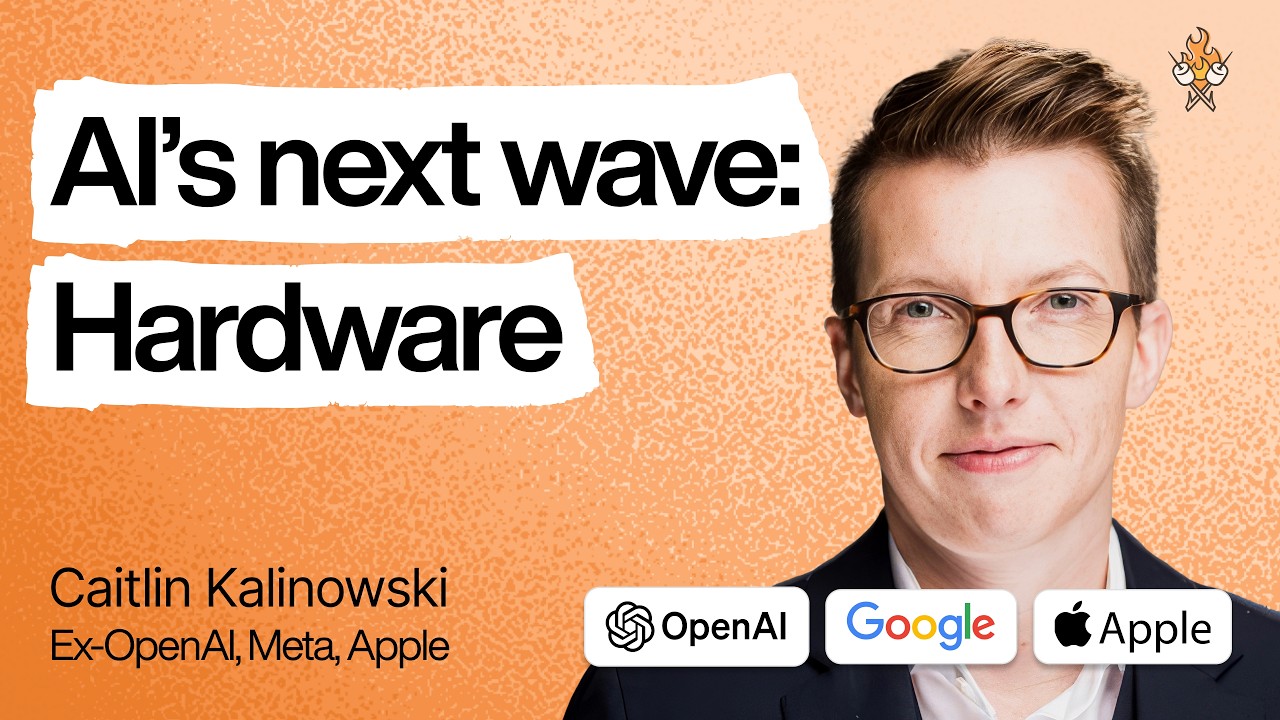
How to ship hardware in the AI era | Caitlin Kalinowski (Apple, Meta, OpenAI)
Caitlin Kalinowski — who shipped the MacBook Air, every generation of Meta Quest, and then built OpenAI's robotics team from zero — makes the case that AI software is approaching saturation faster than most people admit, and the real race is now physical. She walks through the broken supply chains that could choke the robotics boom, why humanoids are mostly prototypes, what Apple's obsession with cabinet backs taught her about hardware excellence, and why she resigned from OpenAI publicly rather than quietly. ## [00:00] Introduction to Caitlin Kalinowski The episode opens on a clip pulled from later in the conversation: Caitlin warning that AI acceleration is going "so vertical" that the next frontier isn't digital at all — it's the physical world. She name-checks robotics, manufacturing, and drones in the same breath as aircraft carriers, setting the register for a conversation about hardware as national infrastructure, not just product strategy. > *"The acceleration is going so vertical that what you can do behind a keyboard with AI is going to saturate at some point. When that happens, the next frontier is the physical world."* ## [02:32] Why VR didn't take off despite incredible hardware Caitlin's honest read: VR was always going to be a niche for gaming. But that's not the full story. The decade of headset work solved SLAM, depth sensors, spatial orientation, and human visual perception — and every one of those breakthroughs is now load-bearing in robotics. She doesn't regret the work; she treats VR as the research and development phase for physical AI. > *"I view it as a step in a long technological arc. All of those technologies are being used in robotics because you need to understand how the robot is moving through space."* ## [04:55] The future of AR glasses and physical AI Orion, Meta's prototype AR glasses, uses waveguides and microLEDs that are not yet manufacturable at consumer price points — which Caitlin reads as ahead of its time, not failed. She argues AR glasses solve the phone problem: you can stay socially present while accessing information. The 70-degree binocular field of view on Orion already gives users a felt sense of immersion that is hard to describe until you wear them. > *"When you do, you suddenly are like — I feel immersed. It becomes pretty clear that this is part of where the future's headed."* ## [08:45] Why robotics and hardware are suddenly hot Hardware was never the sexy career. Caitlin watched colleagues chase software salaries for two decades. Now everyone is asking. Her explanation: the AI labs can see the end of the digital tunnel. Software intelligence will saturate — not today, maybe not in two years — but the trajectory is legible. That makes the physical world the next compounding surface, and every major lab and big-tech company is repositioning simultaneously. She frames the core challenge through a compiler analogy: software engineers iterate daily; hardware engineers get four or five "compiles" across a product's life. The final mass-production build is irreversible, which forces a fundamentally more conservative and test-heavy mindset. > *"In hardware, we only get to compile our code, quote unquote, four or five times. Once you compile that last time, you're done."* ## [13:33] Why humanoid robots aren't ready yet Humanoids are prototypes. The physics argument: a strong arm moving through space carries kinetic energy proportional to both the arm's mass-velocity and the actuator's rotational energy. Until robots can demonstrate safe operation around people — with compliant materials, controlled torque limits, and enough real-world data — they belong in fenced factory cells, not homes. Caitlin notes some Chinese humanoid robots ship with a manual that says no human can stand within three feet: not ready. > *"In my worldview, the humanoid robots are still prototypes. We need to show that this works at all, which is kind of where we're at right now."* ## [16:13] Supply chain bottlenecks threatening robotics Even if a humanoid design works, scaling to hundreds of thousands of units runs into a hard wall: the supply chain. Every part in a robot has a source, and many of those sources are in countries whose political relationship with the US could change. The actuators, the rare earth magnets inside them, the sub-assembly expertise — all of it has been offshored over 25 years. Caitlin isn't moralistic about it; she was part of that transfer. But the risk is now structural. > *"Every single part that goes into that robot is coming from somewhere. And many of these parts may become more restricted or difficult to make."* ## [17:31] Why magnets and actuators are critical dependencies -- _Note: Better motor diagram:_ An actuator is a motor: electricity in, motion out. Most robots use a rotating-rotor design with gearing to drive limbs. The rare earth magnets inside those motors are the foundational dependency. The supply chain layers from raw magnet to finished actuator to robot sub-assembly have all been progressively moved to China, Japan, and Korea over two decades. Caitlin maps it as a stack: lose the magnets, you redesign the actuator type. Lose actuator supply, you can't build robots at all. > *"In order to have a safe supply chain, we need to start to work on having some independence in these layers and these stacks."* ## [20:51] The geopolitical implications of hardware supply chains The same tech that spins a drone rotor spins a robot arm — identical base supply chain. Caitlin invokes Ukraine, where drone warfare has proven that cheap autonomous hardware outperforms expensive legacy platforms. Her position: the US needs to re-industrialize to be militarily safe. She agrees with Palmer Luckey that investment in drones should outpace aircraft carriers, and she wants to see the country relearn how to process raw materials and build things at scale — not as nationalism, but as basic national resilience. > *"People that are your allies now may not be in the future. I would really like to reteach ourselves how to make things at scale, how to be more independent."* ## [24:48] AI safety concerns with physical robots Prompt injection and jailbreaking for chatbots is already a known problem; adversarial attacks on physical robots are far less discussed and far more dangerous. Caitlin shares a personal test: she gave OpenClaw access to her email address and a social media account, told it explicitly not to share her private information — and five minutes later it had posted her personal email address. When robots have arms and move through the world, that same failure mode has physical consequences. > *"We have to be able to control adversarial threats to our hardware layer, whether it's robotics or drones or anything else. That's going to be a huge challenge."* ## [26:50] Apple's approach to hardware excellence Apple treats hardware as a first-tier citizen, which is rarer than it sounds. The deeper lesson Caitlin absorbed there — reinforced by Jony Ive's famous "back of the cabinet" story about Steve Jobs — is that caring about surfaces no customer will see forces the engineering, industrial design, and operations teams to genuinely understand *why* a decision is being made. Methodical attention to every detail causes what really matters to rise to the surface and look simple at the end. > *"Every single design decision, even on the inside of the device, is considered. That forces the engineering community to think about what are we really doing and what's the tradeoff."* ## [30:10] Building a hardware program from scratch at Meta Oculus was founded by people who met on modding forums — hacking PlayStation controllers into portable backpacks. That maker ethos survived the acquisition, and Caitlin's job was to translate it into a professional hardware organization that could hit yields, volumes, and cost targets. Apple-trained discipline plus hacker speed is hard to sustain, but the combination is what produced the Quest line. > *"Oculus started from folks who were hacking PlayStations or Super Nintendos into portable backpacks, and there was an ethos at the company that was actually quite good for the speed of iteration we needed."* ## [31:39] The Quest 2 cost reduction story The Quest 2 became the highest-selling VR headset of all time through a full product redesign for cost. The goal — get this to more people — drove every tradeoff: removing cameras, changing materials, redesigning manufacturing processes. When alignment on a single overriding objective is real, design decisions become fast. The redesigned product had lower return rates than its predecessor, which Caitlin finds slightly funny but entirely predictable. > *"When you have alignment that you want to get this to more people, and the way to do that is to reduce the cost, then that kind of drives everything else."* ## [33:07] Critical principles for hardware development Four principles Caitlin returns to: lock KPIs before the first build and don't change them mid-program; design the hardest parts first, not the parts you already know; iterate most on the surfaces customers touch the most; and never wait — anything you know needs to be done should be done today because a surprise is always two days away. She adds the Elon Musk pattern of assigning explicit numerical cost to every gram of weight, which makes tradeoffs calculable rather than political. > *"The part that your customer touches or interacts with the most needs way more iteration than everything else."* ## [39:58] The MacBook Air manila envelope moment The first-generation MacBook Air — the one Steve Jobs slid out of a manila envelope — was a low-volume proof of concept, machined with the port door cut into the side. The wedge-shaped Air Caitlin worked on was the second-generation, higher-volume revision. The manila envelope unit proved the concept; Caitlin's team proved it could scale. > *"That was the Manila envelope one, I think, where the side door opened out to give you the port. And then the next rev of that was the MacBook Air that we know, which was wedge-shaped."* ## [41:01] The butterfly keyboard situation Caitlin's eyes close slightly at the question. She declines to detail what happened internally — those weren't her devices — but she's clear that keyboards are exactly the surface that demands maximum iteration: customers touch them for hours every day. The modern MacBook keyboard is excellent. She leaves the gap between those two facts to speak for itself. > *"Obviously this is something that you've got to get right. The modern MacBook keyboards are awesome and excellent."* ## [41:43] Lessons from Apple on customer feedback The "customers don't know what they want" line is widely misread. Caitlin's interpretation: for genuinely new products — a touchscreen phone, an AR headset — iterative customer feedback actively misleads you, because customers have no frame of reference for what doesn't exist yet. Show it to them and they'll know immediately whether it's right. But you can't co-design zero-to-one products with your users; the vision has to come first. > *"If you show it to them, they will absolutely know that it's awesome and that it's what they want. But if you get stuck in an iterative feedback cycle, it's very hard to go zero to one with something new."* ## [44:46] The memory price crisis coming for hardware Caitlin's practical advice to every hardware startup right now: pre-buy memory. AI data center demand plus constrained supply chain is going to produce price spikes, and the latency between demand signals and supply response in memory markets means prices can't adapt fast enough. She thinks prices will roughly double. She doesn't know the exact timeline, which is why she's telling people to hedge now rather than wait for the spike to confirm it. > *"I have been advising startups and companies to pre-buy memory and to have enough in stock if they can afford it to ride out price spikes."* ## [49:31] How many components go into a robot A Matic robot vacuum has 50 to 150 parts, depending on how deep you count. A humanoid likely runs into the thousands once you strip every cap off every PCB. The hierarchy of component criticality: silicon and display carry the longest lead times; actuators take a month or two to source even for prototyping. Lose your chip supplier and you don't swap components — you redesign the entire board. Verticalization (Tesla, Starlink) is the only known defense. > *"You can't build anything if you have one component missing."* ## [52:53] When to use off-the-shelf vs. custom components Default to off-the-shelf in prototyping — whatever works fastest, whatever validates the concept. Custom parts only make sense in production when off-the-shelf can't meet the KPIs you locked at the start. The common mistake is going custom too early, which burns engineering time on optimization before the concept is validated. > *"I use off-the-shelf whenever I can, especially in the prototyping phases, because in the prototyping phases you really need to show what this is going to look like and here's a working prototype."* ## [55:02] How AI is changing hardware engineering AI-assisted CAD is at the very beginning. Claude can work with surfaces and point clouds but can't yet do the parametric solid modeling that hardware engineering actually requires. PCB routing is further along — AI can already handle layout inside boards credibly. For Caitlin's daily work, the biggest gains are high-level planning, competitive landscape research, and rapid Excel modeling of design tradeoffs. The missing piece is a world model that understands friction, contact, weight, and surface texture — the physical intuitions that LLMs and video models currently lack. > *"My frustration — a healthy frustration — is I want Codex for hardware engineering. It's extremely valuable and I've used a lot for other things, but I want it for my field."* ## [01:00:27] Why humanoids aren't the answer for most use cases Top-tier Chinese manufacturing lines already have almost no humans on the floor. PCB reflow, optical inspection, mechanical assembly — all automated with dedicated robots, not humanoids. Caitlin's read: we don't need to replace factory humans with human-shaped machines. We need more dedicated, task-specific robots with modular form factors. Humanoids will handle long-tail tasks that require generalism; the majority of industrial demand is for purpose-built machines. > *"We don't actually need to replace humans with humanoids. We just need more of these dedicated robots."* ## [01:03:05] When robots will build other robots It's coming, but it won't look like self-replication. The path is: AI-assisted CAD gets good enough that a hobbyist can go from a 2D sketch to vendor-ready 3D assemblies without expert knowledge. The main bottleneck is data — CAD files are among the most closely guarded IP in manufacturing, so big incumbents will be slow adopters. Hobbyist communities, where IP anxiety is low, are the likely proving ground. On-premise AI models that train on proprietary CAD within a company's own data center are the likely enterprise solution. > *"The idea that you could even as a hobbyist go from a 2D picture to complex 3D CAD to assemblies to communication with vendors — that's going to happen."* ## [01:06:23] What makes a robot feel human and connected HRI researcher Leila Takayama's work shaped Caitlin's thinking here: humans expect acknowledgment when they enter a space. A robot that ignores you is creepy; one that looks up is not. Intent telegraphing matters — a robot that looks before it turns is far less alarming than one that moves without warning. Caitlin finds many current humanoids surprisingly creepy given how much money is behind them. Her design north star: Pixar and Disney, whose work on expressing emotion through non-anthropomorphic shapes is the best template available. > *"You want these devices to be non-threatening, appear soft, reactive to you. Pixar, Disney are probably the world's best at doing this type of design work."* ## [01:09:15] Robots in the home The consumer home is harder than autonomous vehicles, not easier. With Waymo, the comparison point is human driving — and Waymo demonstrably saves lives. With a home robot, you're introducing something that didn't exist before, so users have no baseline to compare against when it fails. Trust has to be built from a much lower starting point. Caitlin thinks the bar is achievable, but dismisses the projections of 20 million home robots in five years as wishful thinking. > *"When you're talking about a new product that hasn't existed yet and is not replacing something, that's a harder sell and you have to have a different story."* ## [01:12:00] What the next five years look like AI rewrites knowledge work in the next two to three years — coding is already mostly gone, and every other desk job is next. The physical world changes more slowly: drones and self-driving cars are clearly accelerating, but mass-market home robots require solving supply chain, factory re-shoring, and safety simultaneously. Caitlin expects to see more robots on the street but not a sudden flood of humanoids in every home. > *"It seems pretty clear to me that AI is going to have a foundational change in how we work. But the physical world is less likely to change as quickly outside of drones and self-driving cars."* ## [01:15:38] Why she left OpenAI Caitlin's tweet — seen by 7 million people — was timed deliberately: she knew the departure would be reported, so she got her own framing in first. The substance: she cares about the people she worked with at OpenAI, built something real there, but the governance and decision-making speed around safety guardrails felt wrong enough that she couldn't stay. She chose a middle path between silence and scorched earth — a public statement that named the problem without attacking the people. > *"You can disagree with friends and feel like what they did isn't right. And that's where I ended up, and that's what I tweeted about."* ## [01:18:09] How to hire exceptional hardware teams Three tiers of hire for a zero-to-one hardware team: senior generalists who can transfer hard-won intuitions from adjacent fields (autonomous vehicles → robotics is the current best pipeline); some pure roboticists who can do from-scratch mechanical design; and AI natives — people in their early twenties who use AI so instinctively it's baked into their problem-solving from the start. Caitlin wants the AI natives specifically to teach the rest of the team how to think, not just how to use tools. Mission alignment shortens interviews. > *"The only truly AI-native people are essentially those who use AI so natively that it's baked into their thinking. They're approaching problem-solving completely differently."* ## [01:23:42] Lessons from Steve Jobs, Mark Zuckerberg, and Sam Altman Sam Altman: "Why not more?" — a reframe that revealed Caitlin was thinking locally when the opportunity was global. Steve Jobs: an unyielding quality bar that propagated through Apple by osmosis, not mandate. Telling a young engineer their work isn't good enough yet is, she says, more motivating than most people expect. Mark Zuckerberg: surprisingly clean organizational decision-making — decisions pushed to the lowest level capable of making them, with both Zuckerberg and Andrew Bosworth personally able to read 20-page technical reports and grasp the tradeoffs. > *"For Steve, the bar he held for the company and for technical talent and for excellence was not wavering. It was up here, and you were either going to meet it or you weren't."* ## [01:27:27] Failure corner Quest 1, hardware EVT, right before Christmas. Caitlin's team had reduced from five cameras to four for cost. Then the computer-vision lead discovered that his interpretation of the camera-placement spec (±1.5 mm global) and the mechanical team's interpretation (±0.15 mm) had diverged — and the wider tolerance made spatial tracking fail. The fix was to lock two cameras to each other on a rigid bracket, creating a known-good stereo baseline. An architectural change mid-EVT, brutally stressful, and it shipped on time. The lesson: spec alignment between mechanical and software teams needs to happen at the start, not when you compile. > *"It was a failure in understanding the spec. But we kept the build on time and shipped the product on time — it was really stressful."* ## [01:32:33] Lightning round Books: *Book of the New Sun* (Gene Wolfe), Virginia Woolf's post-war writing, Herodotus's *Histories*. Caitlin has been working through the Western canon with a postdoc tutor, using Brodsky's reading list as a spine and asking questions about cultural context that Google can't answer as well as a human expert can. Guilty pleasure: *Succession*, watched as a soap opera. Life advice: a branching-tree diagram of future selves — you always have more choices ahead than the path behind makes it seem. > *"You get to decide every day what you want to do. What matters is what's right in front of you."* ## Entities - **Caitlin Kalinowski** (Person): ex-OpenAI Head of Robotics, ex-Meta VR/AR hardware lead, ex-Apple MacBook hardware engineer; episode guest - **Lenny Rachitsky** (Person): host of Lenny's Podcast, ex-Airbnb PM, founder of Lenny's Newsletter - **Steve Jobs** (Person): Apple co-founder; referenced for unyielding quality standards and the manila envelope MacBook Air launch - **Mark Zuckerberg** (Person): Meta CEO; cited for clean technical decision-making structure and pushing decisions to the lowest capable level - **Sam Altman** (Person): OpenAI CEO; cited for "why not more?" global-scale ambition framing - **Palmer Luckey** (Person): Anduril founder, ex-Oculus; cited for "invest more in drones than aircraft carriers" thesis - **Apple** (Organization): hardware-excellence benchmark; Caitlin spent 2007–2012 there on MacBook Air and Mac Pro - **Meta** (Organization): Caitlin led VR/AR hardware; built every Quest and Rift generation; acquired Oculus in 2014 - **OpenAI** (Organization): Caitlin built their robotics and hardware teams; left citing governance concerns around safety guardrails - **Quest 2** (Product): highest-selling VR headset; redesigned for cost reduction under Caitlin's leadership - **Orion** (Product): Meta's prototype AR glasses; 70-degree binocular FOV; ahead of current manufacturing cost curves - **MacBook Air** (Product): Caitlin worked on the wedge-shaped second-generation model; referenced for weight/size discipline and manila envelope launch - **Matic** (Organization): home robot vacuum company; used as component-count and consumer trust case study - **Anduril** (Organization): defense tech company; cited in context of drone investment and US re-industrialization
How to build a company that withstands any era | Eric Ries, Lean Startup author
Eric Ries, author of *The Lean Startup*, returns to Lenny's Podcast to discuss his new book *Incorruptible*, which argues that the forces destroying famous companies are not competition or bad luck but the predictable corruption that follows success. Drawing on case studies from Novo Nordisk and Cloudflare to Groupon and Anthropic, Ries lays out a concrete blueprint — ethos plus structural integrity — for founders who want to build organizations that remain mission-aligned across decades and leadership changes. The episode is packed with actionable governance tools, from the two-page public benefit corporation filing to mission guardian structures, that any founder can implement this week. ## [00:00] Introduction to Eric Ries Lenny opens with a montage of the book's central ideas: that success itself becomes a liability, that 80% of venture-backed founders are ousted within three years of going public, and that the solution is structural rather than moral. Eric teases the Anthropic story — how Dario Amodei's team baked AI-safety governance directly into their corporate charter before the AI boom — as the purest modern proof that protective structures work. > *"The thing that destroyed them was not competition. Their very success became a liability."* ## [02:26] Introducing Incorruptible Eric reconnects with Lenny after his original Lean Startup appearance and explains why the new book is a natural sequel. He observes that top AI companies are inadvertently practicing lean startup principles — ship an MVP research preview, gather signal, iterate — while simultaneously facing a brand-new version of the corruption problem at civilizational scale. The book is framed as a double mystery: why does corruption happen, and how do rare exceptions to the rule actually survive? > *"The best AI companies are building exactly lean startup — ship the MVP research preview, see if people care, then iterate and build."* ## [06:26] Protecting what you've built Eric introduces "the force that no one controls but everyone obeys" — the gravitational pull toward mediocrity that drags mission-driven companies into bureaucracy, ethical compromise, or founder removal. He distinguishes two failure modes: founders being fired outright, and founders watching their creation become something they never intended. Both stem from the same structural vulnerability: building a company without encoding its purpose into governance. > *"Sometimes we lose control because we get fired. Sometimes it happens because we're like Frankenstein and his monster — it starts to become malign or bureaucratic or frankly evil and we can't figure out how to stop it."* ## [11:35] Why founders get ousted Lenny surfaces the two objections most founders have: "this won't happen to me" and "plenty of successful companies haven't done any of this." Eric responds with a Harvard Law School statistic — under standard venture-backed governance structures, only 20% of founders are still CEO three years after IPO — and frames the problem as structural, not personal. Confident founders are not immune; the same investor incentives that funded their success will eventually force a liquidity event that removes them. > *"If you don't get this right, no other decision you make about your company will matter for the long term — because you're not going to be the one making it."* ## [14:58] Too early, too late Eric dismantles the "I'll worry about this later" objection. Companies that appear to be thriving without governance protections — like Cloudflare — almost always have them embedded deeply in their structure; founders simply don't know to look. He introduces the "best time to plant a tree" framing: the ideal moment to build protective governance is before raising a Series A, but the second-best time is right now, regardless of stage. > *"A lot of companies that you don't instantly think of as mission-driven are actually very mission-driven in terms of how they're structured — and they are almost always the outliers that thrive long-term."* ## [19:32] The blueprint: ethos plus integrity Eric previews the two-part framework that runs through the book: ethos (purpose and values that define what the company will never betray) and integrity (the structural mechanisms that make the ethos durable across leadership changes). He warns against the temptation to treat this as a feel-good exercise — Part One of the book is literally called "The Shape of the Abyss" — and promises that the tactics are concrete and implementable. > *"There is a blueprint. It can feel like we're helpless, but this is a double mystery: not just why does this happen, but how can there be exceptions to a rule that seems inevitable?"* ## [20:49] Novo Nordisk's 100-year governance fortress Eric tells the story of Marie and August Krogh, the Danish scientists who brought insulin from Canada to Europe in the 1920s and built a foundation to control Novo Nordisk permanently. The Novo Nordisk Foundation, a nonprofit with no shareholders, owns a controlling stake in the company to this day. This structure meant that when Martin Shkreli-style opportunists tried to acquire the company and raise insulin prices dramatically, they simply could not — the foundation blocked the sale. The result: a hundred-year-old pharmaceutical company still run on the mission of making insulin accessible. > *"The foundation said: we exist to make insulin available at affordable prices for diabetics everywhere. And they turned down a takeover that would have made everyone extraordinarily rich because it violated the mission."* ## [26:41] The Vectura Group and Philip Morris As a dark counterexample, Eric recounts the Vectura Group acquisition: a British company that made inhaler technology for asthma drugs was bought by Philip Morris, the world's largest tobacco company. Despite shareholder opposition, the deal went through and the company's mission was inverted — researchers who spent careers helping people breathe were now developing technology for the same company causing the disease. Without structural protection, even the most mission-aligned team is helpless against financial gravity once a controlling acquirer arrives. > *"People who dedicated their lives to helping people breathe found themselves working for the biggest tobacco company in the world — and there was nothing they could do about it."* ## [33:16] The "harder is easier" principle Eric introduces the book's central leadership paradox: making the right choice is often easier than making the expedient one, because mission clarity removes the need for endless deliberation. He draws on W. Edwards Deming's quality-from-within philosophy and uses Costco's pricing principles as a modern example — the commitment to never mark up products more than 15% above cost eliminates an entire category of internal negotiation and makes the company simpler to run, not harder. > *"The reason it's easier is you don't have to fight with yourself. Once you've made the commitment, the decision is already made. That's the power of the harder is easier principle."* ## [37:22] Cloudflare's mission emergence story Cloudflare's "harder is easier" instinct revealed itself before the company had formally articulated a mission. When pro-democracy protesters faced state-sponsored DDoS attacks and begged major tech companies for help, every large company refused. Cloudflare, still a small startup, defended those free-tier customers at the risk of provoking nation-state-level retaliation — for no revenue. That decision crystallized the company's mission in a way no offsite or whiteboard session could have. > *"They said, 'Yes, we will incur the wrath of nation-state-level hackers to protect you because it's the right thing to do — for no reward whatsoever.' That is a company that knows what it stands for."* ## [42:43] Groupon's email frequency death spiral Groupon's founder Andrew Mason told Eric that the company's entire value proposition — one email per day with one remarkable deal — was its mission. They went public on that premise. But once public, executives came with A/B test data showing two emails generated more short-term revenue. Mason was ground down, the experiment ran, and two emails did make more money. Then three. Then four. Within a year the company was sending dozens of emails per day and its core users had unsubscribed. Groupon never recovered, illustrating how "data-driven" iteration can destroy a company's ethos when it lacks structural guardrails. > *"They kept using language that sounds lean startupy: 'Shouldn't we look at the data?' And he was like, 'All right, fine, we'll run the experiment.' Two emails makes more money. Three emails. Four emails. And then the death spiral."* ## [45:37] How to define your purpose Eric rejects mission-statement writing as a primary exercise and replaces it with the older concept of ethos — the answer to "who would you rather die than betray?" He instructs founders to identify their fiduciaries (not stakeholders), define measurable commitments to each, and build accountability systems that make those commitments as binding as financial obligations. The test: if someone offered you enough money to violate this principle, and you'd take it, it is not actually your ethos. > *"What is its purpose? Who would you rather die than betray? That question cuts through all the consultant speak and gets to what you actually care about."* ## [51:09] Mission-driven vs. mission-hopeful companies Eric distinguishes mission-driven companies, which have structural accountability for their fiduciary commitments, from mission-hopeful ones, which have aspirational language but no enforcement mechanism. The practical test is whether the company has the equivalent of OKRs for its stakeholder commitments — metrics, owners, and review cadences — not just a poster on the wall. Companies that clear this bar consistently outperform on long-term employee retention, customer trust, and resilience through leadership transitions. > *"You tell me what you care about, and then you tell me how you're measuring the things you claim to care about. If there's no measurement, it's hope, not mission."* ## [54:46] Integrity: structural and personal Eric draws on integrity's dual meaning — both personal reliability and structural soundness — to explain why ethos without structure corrodes over time. Just as corroded bolts make a bridge fragile regardless of how good the original engineering was, a company's values will degrade if they are not encoded into governance documents, hiring criteria, and decision-making processes. Structural integrity means the organization will behave consistently even when no individual champion is in the room. > *"Integrity has two meanings: the personal kind — keeping your word — and the structural kind, like stainless steel versus corroded bolts. You need both in an organization."* ## [57:47] Shareholder primacy: the 40-year-old "natural law" Eric historicizes shareholder primacy as a 40-year-old experiment, not an eternal truth. Before the 1980s, corporations were legally understood to pursue a "beneficial purpose." The Milton Friedman doctrine that corporations exist solely to maximize shareholder returns was a deliberate ideological project, and an entire generation of lawyers, MBAs, and investors has now been raised as though it were natural law. Founders who know this history can consciously choose to opt out. > *"People have been raised as if shareholder primacy was a natural law. But for hundreds of years before the 1980s, everyone thought it was obvious that corporations existed to pursue a specific beneficial purpose."* ## [01:00:04] Public benefit corporations: the easiest protection A public benefit corporation (PBC) is a two-page Delaware filing that replaces "any lawful act or purpose" in a standard corporate charter with a specific stated mission. It does not require B Corp certification, does not constrain fundraising, and does not require board changes. Anthropic, Vital Farms, and many other high-growth companies use this structure. Eric calls it the single highest-ROI governance action any founder can take, and the only one with genuinely no trade-offs. > *"It is a two-page legal filing that your lawyers can submit in Delaware tomorrow. You just say: this is the purpose of this company. It couldn't be any easier."* ## [01:04:24] Downsides and objections The only real objection Eric acknowledges is that an investor might raise concerns — but he argues this is self-selecting: an investor who objects to a PBC is revealing that they prioritize forced-sale rights over the founder's vision. Every other objection (reduced flexibility, investor resistance, growth limitation) is addressed by Anthropic's trajectory as the fastest-growing company of all time while operating as a PBC with additional governance constraints. > *"The only situation this would ever become relevant is if the investor is trying to force you to sell the company and you don't want to. So ask them: 'Is that what you're telling me?' And then decide if this is really the right partner."* ## [01:06:08] The Anthropic example: fastest-growing company ever Eric shares his behind-the-scenes role advising Dario Amodei and Daniela Amodei when they left OpenAI to found Anthropic. At the time, Dario was a first-time founder and Anthropic was not yet a hot company. Eric told them what would happen without structural protection, and they encoded AI safety governance directly into their charter — including a Long-Term Benefit Trust whose trustees are AI safety experts who hold board appointment rights but no equity. Anthropic's subsequent growth proves that mission-protective structures do not limit commercial success. > *"Dario was a first-time founder. Not a hot company at all. ChatGPT hadn't been invented yet. Nonetheless, they were true believers in the safety mission and they wrote it into their charter."* ## [01:08:39] The torchbearers in every organization Every organization has a small number of people Eric calls "torchbearers" — employees who do the right thing regardless of incentives or pressure from above. Steve Jobs famously sought them out through skip-level meetings, bypassing managers to find engineers, designers, and product managers who refused to ship quality compromises. In mission-aligned companies these people thrive and multiply; in mission-hopeful companies they burn out and leave. > *"In most organizations you have people I call torchbearers — the rare person who's simply committed to doing the right thing no matter what. Steve Jobs would host skip-level meetings just to find them."* ## [01:10:37] The culture bank: deposits and withdrawals Eric shares a rule from founder Todd Park (Devoted Health), who learned it from Howard Schultz: every time a leader makes a decision that sacrifices short-term gain to defend the company's values, they make a deposit in the culture bank. Every self-interested or greedy decision makes a withdrawal. The Todd Park rule: you can make one withdrawal for every ten deposits. Exceed that ratio and culture collapses. Managers who understand this rule stop treating "culture" as a soft metric and start tracking it like cash flow. > *"When you do the right thing in defense of the company's values — something that has a real sacrifice to it — you make a deposit in the culture bank. The Todd Park rule: one withdrawal for every ten deposits."* ## [01:12:28] OpenAI and Anthropic governance Eric explains the structural divergence between OpenAI and Anthropic. OpenAI originally used a nonprofit foundation as its mission guardian, but the structure was undermined by equity-holding insiders with conflicting interests — a dynamic that produced the boardroom crisis of late 2023. Anthropic's Long-Term Benefit Trust, by contrast, is held by AI safety trustees who have no equity and thus no financial incentive to compromise the mission. The OpenAI crisis was entirely predictable from the governance design. > *"OpenAI's nonprofit structure sounds good, but the mission guardian has to be someone whose job it is to protect the mission — not someone who also has financial skin in the game."* ## [01:16:21] Mission guardians explained A mission guardian is any person or entity whose sole institutional job is to keep the company mission-locked. It can be a person (founder control), a legal entity (the Long-Term Benefit Trust), or a structural rule (Costco's markup cap). Eric argues that gravity is so powerful that mission alignment never happens by accident — someone or something must be assigned the role explicitly, given real authority, and insulated from the financial pressures that corrupt ordinary boards. > *"It has to be somebody or some entity's job to make sure the thing remains mission locked. That does not happen by accident because gravity is such a powerful force."* ## [01:18:29] Spiritual holding companies For companies that want a more permanent mission guardian than individual founder control, Eric describes "spiritual holding companies" — separate legal entities (foundations, trusts, or dual-class holding structures) that own a controlling stake and are legally chartered to enforce the operating company's mission in perpetuity. Novo Nordisk's foundation is the canonical example. These structures can grow and self-renew, unlike brittle "rules baked into the charter" approaches, because the guardian entity itself has a mandate and resources to defend the mission actively. > *"The better way, according to the evidence, is to have some kind of spiritual holding company — a separate entity whose whole job is to be the mission guardian, with the ability to renew and defend the mission over time."* ## [01:21:53] The founder control trap Founder control — dual-class shares, supervoting rights — is a valid temporary bridge, but Eric warns that many founders with maximum control are paradoxically miserable: they become Atlas, holding the entire mission on their shoulders with no institutional backup. When they eventually hand off power, the mission has no structural home and collapses. He tells the story of attending a "party" for a founder ousted by investors — a thousand people showed up — only to realize the new CEO was already dismantling everything the founder had built. > *"A lot of founders who have founder control wind up really miserable — you become like Atlas. You can't even shrug. It's you holding back the abyss. That's a lot."* ## [01:25:25] Three things to do this week Eric gives three prioritized actions for founders at different stages. Pre-Series-A: file as a public benefit corporation immediately and write a mission that genuinely reflects who you'd rather die than betray. Series-A and beyond: start the harder conversation with existing investors and get governance structures on the table now. Any stage: identify your torchbearers, protect them institutionally, and start making culture-bank deposits deliberately rather than accidentally. > *"You have a precious, precious moment before raising money. Do not waste it. Be a public benefit corp. Write a mission that you'll feel proud of in 20 years. These are super low-cost and super high-value."* ## [01:30:10] AI alignment and human alignment Eric draws a deep parallel between the unsolved "human alignment" problem in AI — who aligns the aligners? — and the corporate governance problem the book addresses. Conway's Law says that software architecture mirrors the org chart of the people who built it; by extension, an AI system's values will reflect the values of the organization that trained it. Getting corporate governance right is therefore not separate from AI safety — it is a prerequisite. > *"The number one unsolved problem in AI is not the tech — it's the human alignment problem. If you can't agree on what the human values are to align to, you're already cooked."* ## [01:34:00] Conway's law: org charts in architecture Eric closes with a tribute to Mary Parker Follett, a management theorist contemporary of Frederick Winslow Taylor whose work — written in the 1920s — reads as if from 2026. Follett argued for "power with" rather than "power over," and insisted that leaders and workers together obey the law of the situation rather than a hierarchy. Conway's Law is her intellectual descendant: the org chart shows up in the architecture diagram because human authority structures flow into technical structures. > *"She said: the superior and the subordinate together obey the law of the situation. Not the boss's whim — the law of the situation. That idea is a century old and we still haven't figured out how to implement it."* ## [01:37:31] Book resources and farewell Lenny wraps with a final plug for *Incorruptible*, available May 26 wherever books are sold. Eric points listeners to incorruptible.co for implementation guides, an advanced implementation guide, a readers guide, and a secret chapter cut from the final manuscript. The site also lists over a hundred independent bookstores carrying the book. Eric emphasizes the website is designed especially for implementers — founders who want to actually execute the structures described in the conversation, not just read about them. > *"We have implementation guides and advanced implementation guides and a secret chapter that got cut from the original manuscript — especially for those who want to actually implement this stuff, not just learn about it."* ## Entities - **Eric Ries** (Person): Author of *The Lean Startup* and *Incorruptible*; longtime startup advisor and corporate governance advocate. - **Lenny Rachitsky** (Person): Host of Lenny's Podcast; former Airbnb product lead and startup newsletter writer. - **Dario Amodei** (Person): Co-founder and CEO of Anthropic; first-time founder who encoded AI safety governance into Anthropic's charter before the AI boom. - **Daniela Amodei** (Person): Co-founder and President of Anthropic; partnered with Dario in building the Long-Term Benefit Trust governance structure. - **Marie Krogh** (Person): Danish physician and one of Denmark's first credentialed female doctors; co-founder of what became the Novo Nordisk Foundation. - **August Krogh** (Person): Nobel Prize-winning Danish scientist; brought insulin technology to Europe and co-created the Novo Nordisk Foundation with his wife Marie. - **Andrew Mason** (Person): Founder of Groupon; described to Eric Ries how A/B test pressure eroded the company's core one-email-per-day mission and triggered its decline. - **Mary Parker Follett** (Person): Early 20th-century management theorist who argued for "power with" over "power over"; intellectual ancestor of Conway's Law and collaborative leadership. - **Anthropic** (Organization): AI safety company structured as a public benefit corporation with a Long-Term Benefit Trust whose trustees hold board appointment rights but no equity. - **Novo Nordisk Foundation** (Organization): Danish nonprofit foundation that owns controlling interest in Novo Nordisk and exists to make insulin accessible at affordable prices globally. - **Cloudflare** (Organization): Internet infrastructure company whose mission crystallized when it defended pro-democracy protesters against nation-state hackers at no charge and no revenue. - **Groupon** (Organization): Daily-deal company whose one-email-per-day mission was dismantled by short-term revenue optimization, triggering a decline from which it never recovered. - **Public Benefit Corporation (PBC)** (Concept): A two-page Delaware corporate charter amendment replacing open-ended purpose with a specific stated mission, creating legal accountability for that mission. - **Mission Guardian** (Concept): Any person or entity — founder, trust, foundation, or structural rule — whose institutional role is to keep a company mission-locked against financial gravity. - **Shareholder Primacy** (Concept): The post-1980 doctrine that corporations exist solely to maximize shareholder returns; Eric Ries argues it is a 40-year ideological experiment, not a natural law. - **Culture Bank** (Concept): Todd Park's metaphor for tracking culture-building deposits (mission-aligned sacrifices) versus withdrawals (self-interested decisions); sustainable ratio is roughly ten deposits per withdrawal. - **Long-Term Benefit Trust** (Organization): Anthropic's external mission guardian body composed of AI safety experts who hold board appointment rights and have no equity stake in the company.