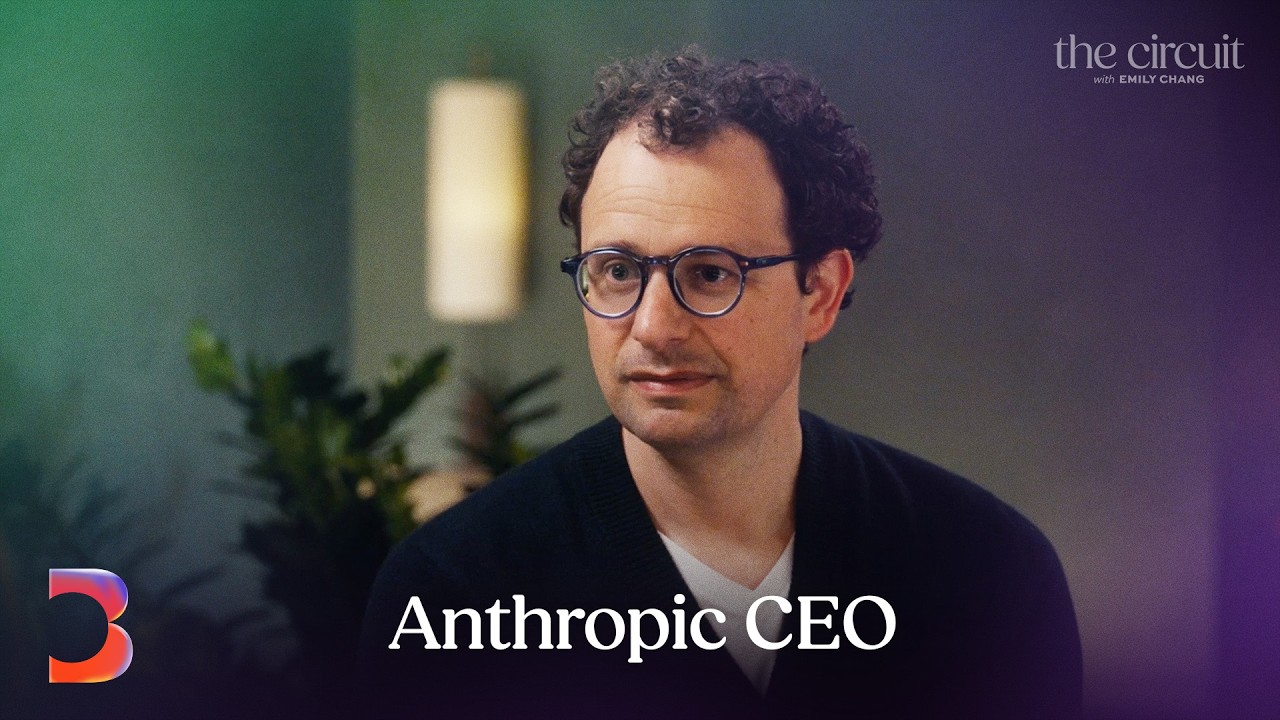
Emily Chang sits down with Anthropic CEO Dario Amodei for a wide-ranging hour that swings from how he sleeps under "relativistic" pressure to why he signed a Pentagon contract despite a lifelong anti-war stance. Along the way he explains the bet on coding and enterprise that vaulted Anthropic past OpenAI, walks through a compute crunch driven by revenue tripling in a single quarter, and defends releasing — and withholding — a cyber-capable model called Mythos. He closes on the stakes he keeps returning to: AI job loss, the case against nationalizing AI, and his own 10-25% estimate of civilizational collapse.
## [00:00] Inside Anthropic
Amodei opens on the personal cost of running a frontier lab, describing the pace with a special-relativity analogy: each day he "wakes up" to find more days have passed on the outside. He admits the pressure is unusual and that he is still learning to manage it.
> *"Well, let's just say I'm, you know, I'm, I'm learning the art of, of, you know, finding ways to relax and sleep through, through moments of unusual pressure."*
## [03:34] Dario background
He traces his San Francisco childhood — a leather-craftsman father, a librarian mother — and a kid who ignored the dot-com boom around him in favor of math, physics and science fiction. He credits the city with a culture of nonconformism that shaped how he thinks.
> *"Yeah, I mean, I think the general, you know, the general spirit of kind of, you know, nonconformism and individualism and it's okay to be crazy."*
## [05:51] Leaving OpenAI
Pressed on what really drove the split from OpenAI, Amodei says disagreements over safety alone never would have been enough — every lab has those. The break came down to trust and values, not any single policy fight.
> *"And look, at the end of the day, why argue with someone when you don't have the same vision and you don't trust them."*
## [07:42] India AI summit
On the viral moment where he and Sam Altman appeared to refuse to hold hands on stage, Amodei blames a chaotic, last-minute summit setup rather than personal animus. He reframes the OpenAI relationship less as a feud than as rivals who quietly borrow each other's good ideas.
> *"It's not even competition, it's just, it's just, you know, each company does something cool and the other company's like, that's cool."*
## [10:45] Enterprise bet
He explains why Anthropic leaned into coding and enterprise with Claude Code and Claude Cowork: a business model that funds expensive model training without betraying the company's values. The flip side, he warns, is that incumbents who refuse to adapt will struggle.
> *"I think those who don't adapt, who put their heads in the sand, who don't kind of see what's coming, who don't identify the moats they have, they're gonna have a really hard time."*
## [19:29] Compute crunch
Amodei pushes back on the idea that Anthropic under-bought compute. The team planned for 10x annual growth; instead revenue grew more than 3x in a single quarter — a pace that would annualize to roughly 80x, which he says no one could rationally have provisioned for in advance.
> *"It would not have been rational to plan for 80x annualized growth, because that means if you only get 10x, you know that you, you have eight times less."*
## [21:15] Surpassing OpenAI
Asked whether passing his arch-rival feels good, Amodei downplays the scoreboard and returns to his "race to the top" framing: the point of being preeminent is the ability to pull the rest of the ecosystem toward better behavior, not to beat rivals for its own sake.
> *"And so I think the value of being the preeminent company, both commercially and in terms of models, you know, it's, it's not about beating rivals for the sake of beating rivals."*
## [24:07] Product velocity
He attributes Anthropic's shipping speed to two things: a culturally unified, efficient organization, and Claude itself, now used internally to help build and accelerate the next models.
> *"That we're now using Claude to help, you know, develop our models and, you know, make them more efficient and quickly develop products."*
## [24:52] AI discoveries
The most striking results he's seen are in biology and medicine — including a case where Claude caught a diagnosis human specialists had missed — and early strength in drug design and computational chemistry. This, he argues, is where AI's enormous upside lives.
> *"I've seen a number of cases, including Daniela actually, where Claude diagnosed a medical problem that, you know, a bunch of fancy doctors had missed."*
## [26:13] Dario’s writing style
A committed essayist, Amodei says he still won't let Claude write his prose directly — he's too particular about style — but uses it to brainstorm, pressure-test themes and hunt references. He worries aloud about what we lose if we stop struggling through our own ideas.
> *"There's some way, as the models get better, I think probably to, to use them directly much more directly in the writing and yet still preserve those benefits."*
## [28:10] AI and the workforce
Revisiting his warning that AI could wipe out half of entry-level white-collar jobs, Amodei says the original point was about the magnitude of possible disruption, not a precise forecast — and that he's always paired it with proposed responses, from a token tax to macro policy. He points to emerging hybrid roles as one way work adapts.
> *"You know, there's something we call a forward deployed engineer or in like applied AI solutions architect where their job is a mix of technical work and talking to customers."*
## [36:41] Pentagon standoff
He defends signing one of the first DoD contracts to run on classified networks despite a longstanding anti-war stance, citing a resurgent authoritarian bloc — Russia in Ukraine, the risk of China and Taiwan. His line: Anthropic won't deny the technology over individual operations it might privately disagree with.
> *"Now, I might privately believe that this military operation makes sense and that military operation is a bad idea, but we're not gonna deny the technology."*
## [43:29] AI warfare
Confronted with a reported strike that killed children, Amodei says the company can't know exactly how its models are used, calls such outcomes terrible, and stresses the red lines Anthropic enforces. The core principle he defends: a human, not the model, makes the final call.
> *"But you know, the principle that, that we have established, and I think the principle that was obeyed here is a human makes the human makes the final decision."*
## [48:18] Mythos
On the model deemed too powerful to release, Amodei describes a sharp, unprompted jump in the ability to find vulnerabilities and turn them into working exploits — to the point that early testers called it a weapon.
> *"It was a particularly large jump and without us really prompting them at all, some of the early companies that we gave this to said things like, this is a super weapon."*
## [55:15] Nationalizing AI
Amodei takes the "why not let the government take you over" question seriously but argues against it, noting AI is the first powerful technology built in the private sector rather than government labs. He's wary of those who opposed all regulation until the first scare, then pivoted to seizure.
> *"And then as soon as they see the first real danger, which I've been expecting all along, there's all this talk of like nationalization and the government should just seize it."*
## [58:57] Visit to the White House
He describes Anthropic's approach to government as principle-driven and cooperative where possible, citing serious engagement on Mythos with Treasury Secretary Bessent and Chief of Staff Susie Wiles, while accepting that every administration has parts easier and harder to work with.
> *"You know, I, I I said we have this simple approach, like we have a set of principles, we like follow those principles and we hope that folks on the other side are reasonable."*
## [59:47] China
Drawing on his time at Baidu, Amodei frames Chinese open-source models through the lens of an intelligence premium — users rarely prefer weaker models — and warns of the authoritarian risk if the CCP can reach into US networks. He'd rather AI become a pro-democracy technology.
> *"The fact that the CCP could reach into the US business network and, you know, and suppress criticism, that's an authoritarian state and, and a high tech authoritarian state."*
## [63:24] Recursive self-improvement
He rejects the idea of a single moment when AI starts improving itself, describing instead a continuous, accelerating process already visible in AI suggesting architectures for the next AI. Sudden reversals on policy, he says, signal people who were caught off guard.
> *"If you see someone having this kind of crazy yo-yo reaction, that's a sign that they were caught by surprise and that they're not serious."*
## [65:07] Dario’s favorite book
Amodei identifies less with Oppenheimer than with Leo Szilard, who first grasped the chain-reaction idea, and casts Oppenheimer as a cautionary tale. His takeaway: no larger-than-life figure should be at the center — what's needed is checks and balances among many powerful actors.
> *"There's a lot of powerful actors who have interests here, and the only way it's gonna end well for everyone is if there is some, there's basically checks and balances everywhere."*
## [65:49] Civilization collapse
Asked whether Anthropic's own technology could trigger the 10-25% collapse risk he cites, Amodei says he hopes not and argues the company's actions lower that probability more than they raise it — while conceding the risk can never reach zero given the technology's inherent unpredictability.
> *"You know, half of what we do within the company is try and, you know, reduce the risk as much as we can, but, you know, it's, it's never gonna be zero."*
## [67:32] Trust
Closing on "why should we trust you," Amodei accepts that starting from distrust is rational given Silicon Valley's recent record, and argues trust has to be earned through actions — pointing to the commercial cost Anthropic ate by holding back Mythos and cutting model access over China.
> *"And there were a bunch of smaller things before it, you know, we, we, we put our money where our mouth is on, you know, China, we cut off access to, to models."*
## Entities
- **Dario Amodei** (Person): Co-founder and CEO of Anthropic; former biologist and OpenAI VP of research.
- **Emily Chang** (Person): Bloomberg anchor and host of *The Circuit*, conducting the interview.
- **Daniela Amodei** (Person): Anthropic co-founder and president; cited in a Claude medical-diagnosis anecdote.
- **Sam Altman** (Person): OpenAI CEO, referenced over the India summit and the labs' rivalry.
- **Leo Szilard** (Person): Physicist who conceived the nuclear chain reaction; the figure Amodei most identifies with.
- **Anthropic** (Organization): Frontier AI lab behind Claude, maker of the withheld Mythos model.
- **OpenAI** (Organization): Rival lab Amodei left and which Anthropic claims to have surpassed.
- **Claude** (Software): Anthropic's model family, including Claude Code and Claude Cowork, used internally to accelerate development.
- **Mythos** (Software): Anthropic model judged too powerful to release publicly due to autonomous cyber-exploit capability.
- **Pentagon / Department of Defense** (Organization): US defense agency at the center of the classified-networks contract standoff.